
Medical Supplies Market Size and Share
Market Overview
| Study Period | 2020 - 2031 |
|---|---|
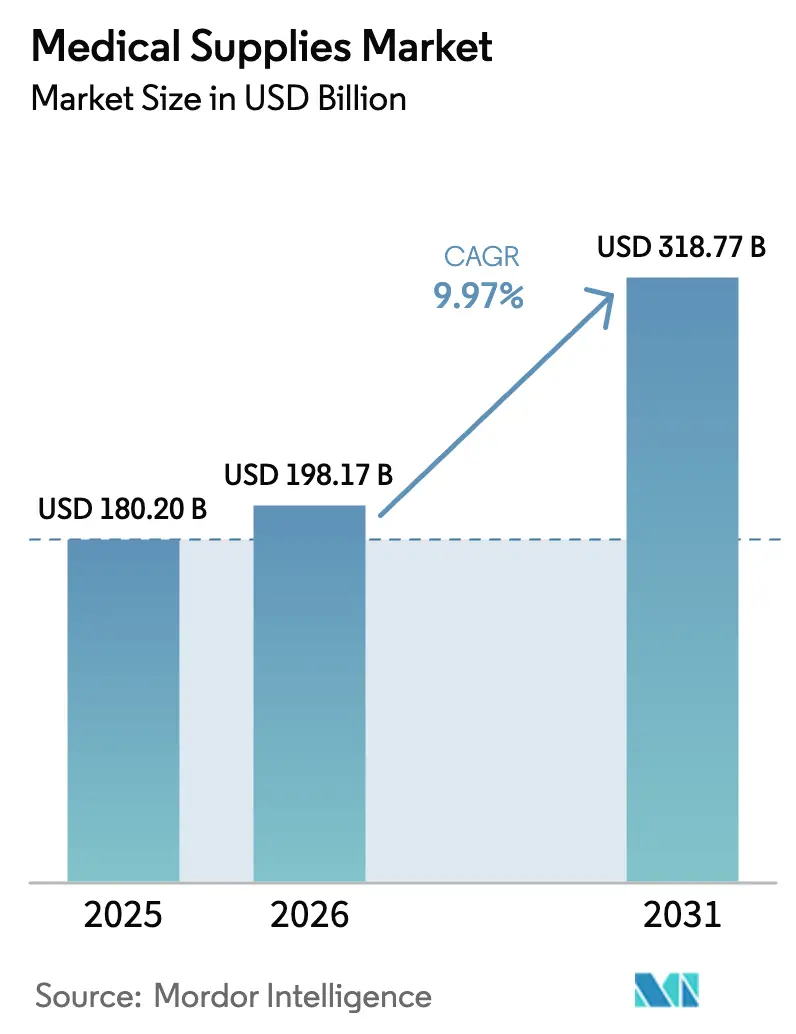
| Market Size (2026) | USD 198.17 Billion |
| Market Size (2031) | USD 318.77 Billion |
| Growth Rate (2026 - 2031) | 9.97 % |
| Fastest Growing Market | Asia-Pacific |
| Largest Market | North America |
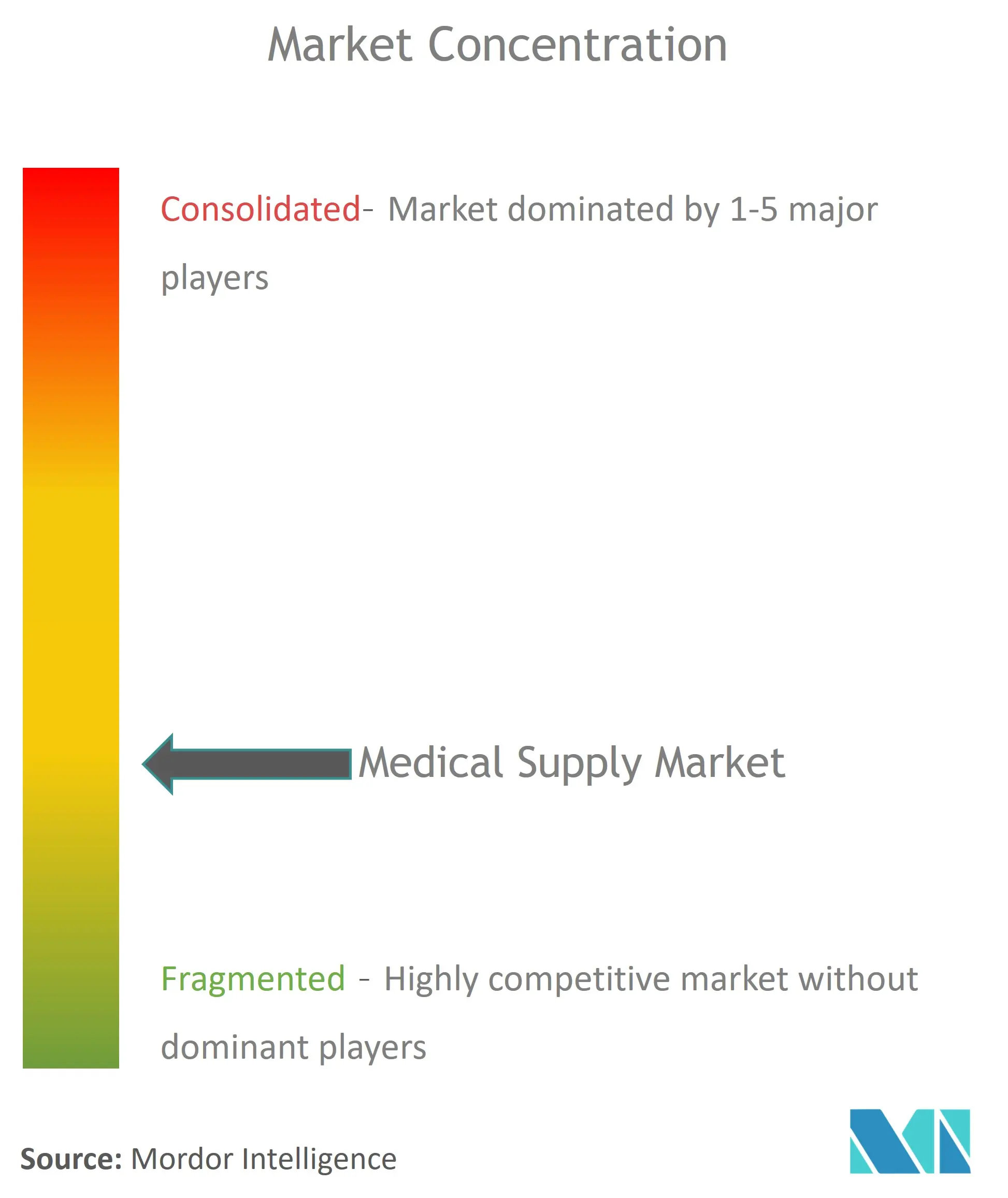
| Market Concentration | Medium |
Major Players *Disclaimer: Major Players sorted in no particular order Image © Mordor Intelligence. Reuse requires attribution under CC BY 4.0. | |
Medical Supplies Market Analysis by Mordor Intelligence
The medical supplies market size was valued at USD 180.2 billion in 2025 and estimated to grow from USD 198.17 billion in 2026 to reach USD 318.77 billion by 2031, at a CAGR of 9.97% during the forecast period (2026-2031). Demand expands well beyond population growth as infection-control norms, value-based reimbursement, and care decentralization elevate supplies from commodity inputs to essential enablers of health-system performance. Higher personal protective equipment (PPE) baselines, broader acceptance of single-use procedure kits, and regulatory alignment with ISO 13485:2016 are lowering compliance frictions for global producers while driving up minimum quality thresholds. Regional trajectories diverge: North America protects its lead through entrenched reimbursement and early adoption. Asia Pacific records the fastest growth as capacity and chronic-disease incidence climb, and Europe balances new Medical Device Regulation (MDR) obligations with sustainability rules that catalyze product reformulation. Competitive positioning now hinges on the ability to deliver total-cost-of-ownership gains, infection-rate reductions, and home-care-ready formats, reinforcing consolidation and technology partnerships that blend devices, consumables, and data services.
Key Report Takeaways
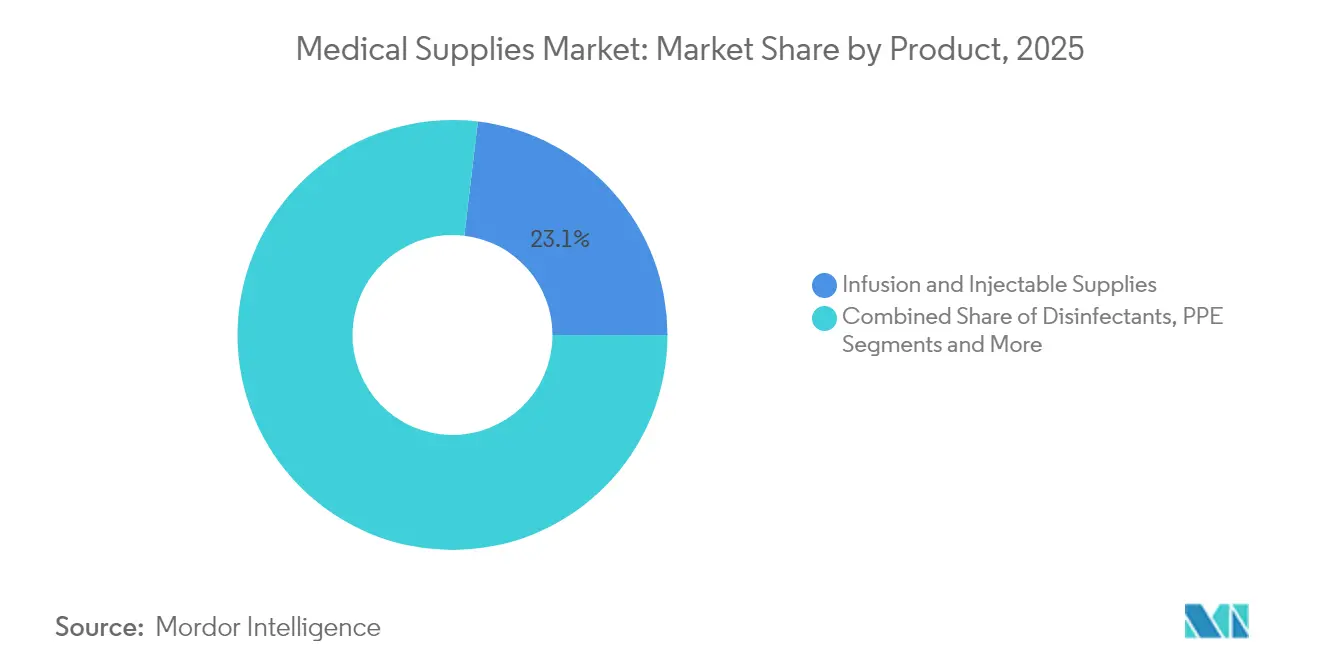
- By product type, infusion and injectable supplies led with 23.12% of the medical supplies market share in 2025, while dialysis consumables are projected to expand at a 7.55% CAGR to 2031.
- By application, infection control held 19.08% revenue share in 2025; respiratory applications are set to advance at an 8.31% CAGR through 2031.
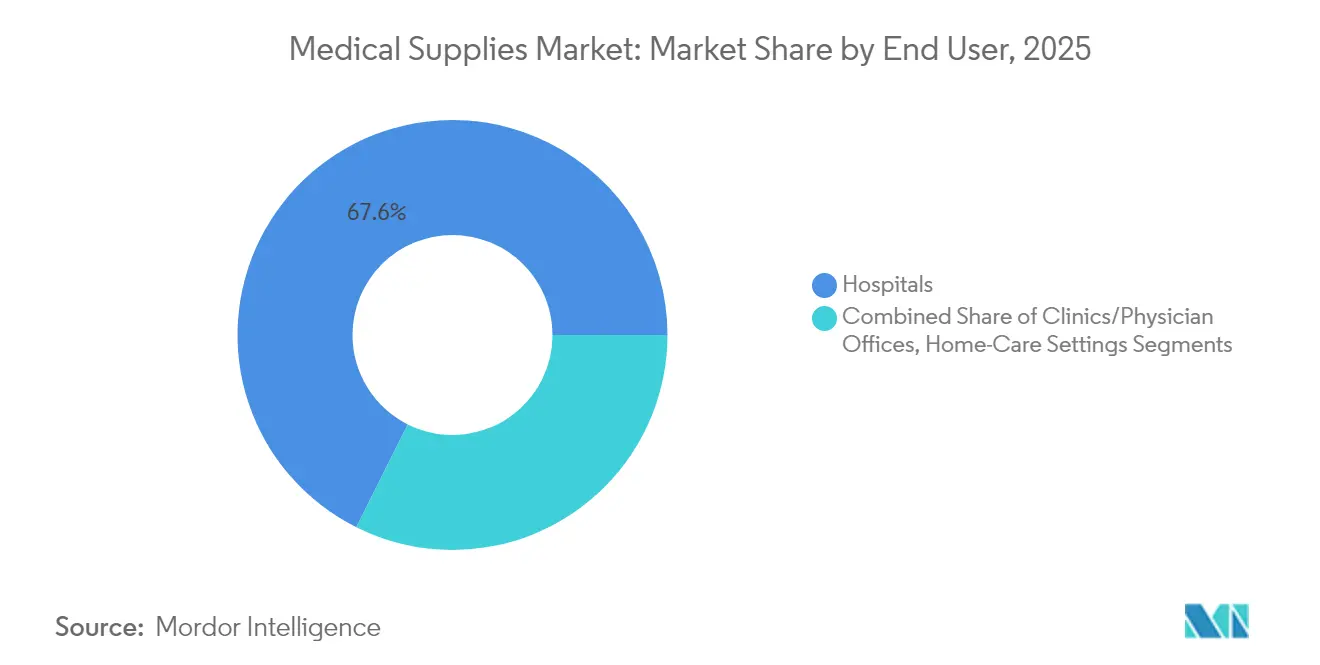
- By end-user, hospitals commanded 67.62% share of the medical supplies market size in 2025, whereas home-care settings represent the fastest rising channel with a 8.98% CAGR to 2031.
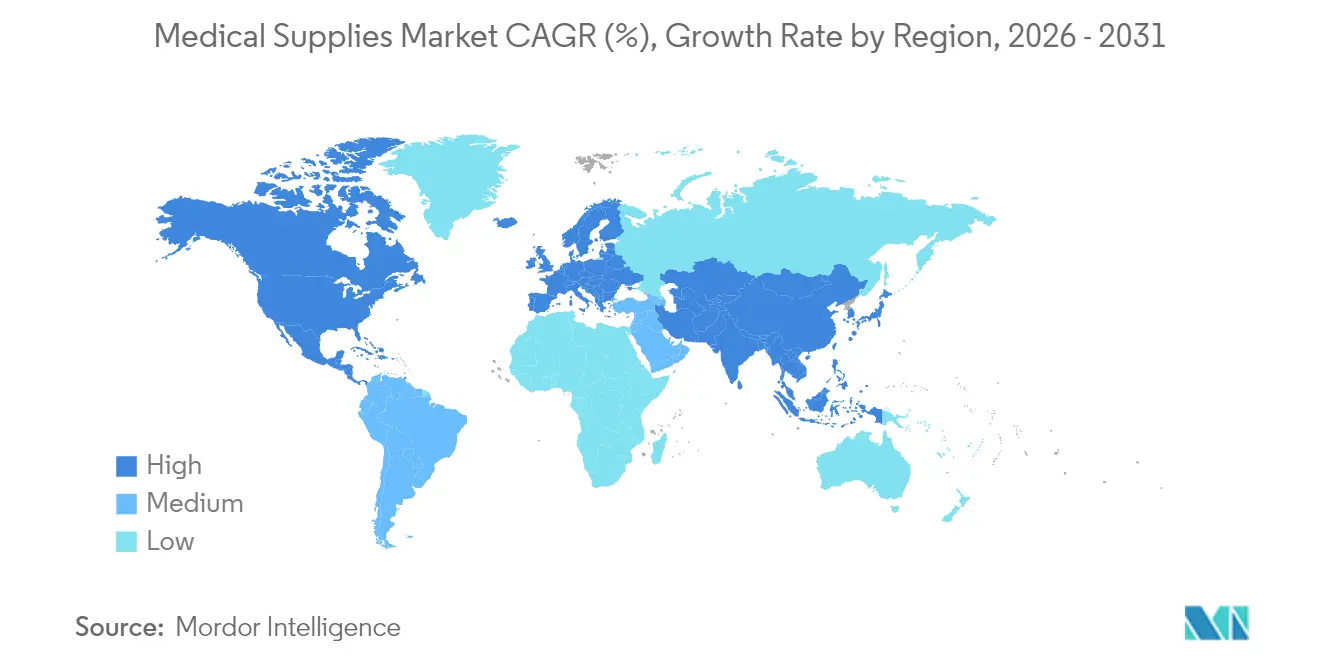
- By geography, North America captured 40.75% of the medical supplies market size in 2025, but Asia Pacific is forecast to register the highest regional CAGR at 11.45% during 2026-2031.
Note: Market size and forecast figures in this report are generated using Mordor Intelligence’s proprietary estimation framework, updated with the latest available data and insights as of 2026.
Market Trends and Insights
Drivers Impact Analysis of Medical Supplies Market*
| Driver | (~) % Impact on CAGR Forecast | Geographic Relevance | Impact Timeline |
|---|---|---|---|
| Rapid growth of ambulatory surgery centers | +1.50% | North America and Europe, expanding to Asia Pacific | Medium term (2-4 years) |
| Shift to home-based care and hospital-at-home | +1.80% | Global, with early adoption in developed markets | Long term (≥ 4 years) |
| Growing chronic-care patient pool | +1.20% | Global, concentrated in aging populations | Long term (≥ 4 years) |
| Rising PPE replenishment cycles | +0.80% | Global, health-system emphasis | Short term (≤ 2 years) |
| AI-enabled predictive maintenance | +0.60% | North America and Europe, pilot programs in Asia Pacific | Medium term (2-4 years) |
| Circular-economy mandates | +0.50% | Europe leading, expanding to North America | Long term (≥ 4 years) |
| Source: Mordor Intelligence | |||
Rapid Growth of Ambulatory Surgery Centers
Ambulatory surgery centers (ASCs) now handle more than 25 million U.S. procedures each year, growing 3-4% annually as payers widen approved procedure lists.[1] ASCs deliver 40-60% cost savings over hospital outpatient departments, so suppliers are redesigning single-use kits that compress turnover times and cut waste. The Food and Drug Administration (FDA) guidance on Predetermined Change Control Plans, effective August 2024, lets manufacturers iterate devices faster to match ASC workflow needs.[2] Portfolio shifts toward low-complexity disposables with embedded safety features boost recurring revenue and deepen penetration of the medical supplies market.
Shift to Home-Based Care & Hospital-at-Home Programs
Hospital-at-home models cover more than 300 U.S. health systems and deliver 25-30% cost reductions with higher patient-satisfaction scores than inpatient wards. Medical supplies must now feature simpler packaging, longer shelf life and intuitive instructions suited to residential caregivers. Suppliers are investing in last-mile logistics and digital reorder platforms to maintain uninterrupted supply streams. As decentralized care expands in Europe, Australia and Japan, the medical supplies market gains a durable growth avenue anchored in recurring home-therapy consumption.
Growing Chronic-Care Patient Pool
Chronic conditions are projected to account for 73% of global deaths by 2030.[3] Dialysis consumables illustrate the impact: the treated renal population is rising 6-8% annually, with home-dialysis uptake further lifting per-patient utilization. Producers targeting the medical supplies industry segment for diabetes, cardiovascular and renal care are emphasizing user-friendly designs that enable self-management and command premium pricing.
Rising PPE Replenishment Cycles Post-COVID
Strategic national stockpiles now retain rolling 90-day inventories, and most acute-care facilities have doubled their on-hand PPE buffers relative to pre-2020 levels. This institutionalized demand removes the boom-bust procurement swings seen during the pandemic and supports steadier revenue for glove, mask, and gown manufacturers within the medical supplies market.
Restraints Impact Analysis of Medical Supplies Market*
| Restraint | (~) % Impact on CAGR Forecast | Geographic Relevance | Impact Timeline |
|---|---|---|---|
| Heightened FDA & MDR Post-Market Surveillance Recalls | -0.80% | North America & Europe primarily | Medium term (2-4 years) |
| Volatile Resin & Nitrile Prices Squeezing Consumable Margins | -0.60% | Global, with supply chain concentration in Asia | Short term (≤ 2 years) |
| ESG Pressure Against Single-Use Plastics In Hospitals | -0.40% | Europe leading, expanding to North America & APAC | Long term (≥ 4 years) |
| Tight Global Ethylene Oxide Sterilization Capacity | -0.30% | Global, with critical bottlenecks in North America | Medium term (2-4 years) |
| Source: Mordor Intelligence | |||
Heightened FDA & MDR Post-Market Recalls
Class I recalls climbed 35% in 2024 and predominantly involved sterility lapses. In Europe, MDR audits expose latent quality issues and trigger market withdrawals. Providers facing shortages shift to substitute products, but manufacturers absorb 8-12% higher compliance costs that thin margins across the medical supplies market.
Volatile Resin & Nitrile Prices
Nitrile prices oscillated 40-60% in 2024, while key resins saw 25-35% swings driven by feedstock volatility and environmental curbs. Commodity-heavy product lines such as examination gloves and syringes suffer margin compression because reimbursement schedules lag material inflation. Larger players hedge through vertical integration and multi-year supply contracts, but smaller firms in the medical supplies industry risk contract losses when unable to hold quoted pricing.
*Our forecasts treat driver/restraint impacts as directional, not additive. The impact forecasts reflect baseline growth, mix effects, and variable interactions.
Medical Supplies Market Segment Analysis
By Product Type:
Infusion Supplies Retain Leadership as Dialysis OutpacesInfusion and injectable supplies contributed 23.12% of the medical supplies market size in 2025, underscoring the universal requirement for intravenous therapy across every care level. Growth is held steady by safety-engineered needles and smart infusion pumps that curb medication errors. Emerging volume now stems from home-infusion programs backed by reimbursement expansion, prompting vendors to bundle devices and disposables for at-home regimens.
Dialysis consumables deliver the swiftest rise with a 7.55% CAGR through 2031. Prevalence gains in diabetes and hypertension enlarge the renal patient pool, while policy incentives for home peritoneal dialysis push demand for compact bags, cassettes and sterile connectors. Suppliers that document reduced infection rates and easier self-administration can capture share in this premium slice of the medical supplies market. Advanced polymer membranes and antimicrobial coatings remain differentiation levers as competition intensifies.

By Application:
Infection Control Dominates, Respiratory SurgesInfection control accounted for 19.08% of the medical supplies market share in 2025 and continues to anchor procurement priorities. Hospitals invest in surface disinfectants, sterile wraps, and barrier drapes to meet zero-infection targets, and regulators heighten penalties tied to hospital-acquired events. Vendors offering complete system bundles such as chemistries, indicators, and sterilizer consumables position themselves as strategic partners rather than suppliers of single SKUs.
Respiratory applications, projected to expand at 8.31% CAGR to 2031, benefit from rising diagnoses of sleep apnea and chronic obstructive pulmonary disease. Technological progress in non-invasive ventilation masks and disposable humidifier chambers supports home-care adoption and enhances patient adherence. Combined, these trends reinforce a multi-year uplift across the broader medical supplies market.
By End-User:
Hospitals Hold Scale; Home Care AcceleratesHospitals commanded 67.62% of the medical supplies market size in 2025, reflecting their role in trauma, critical care, and complex surgery. Purchasing teams now emphasize lifetime value, favoring suppliers that quantify infection-rate reductions and workflow efficiencies. Integrated supply agreements covering broad SKU portfolios simplify vendor management and secure volume commitments.
Home-care settings post the sharpest gain at a 8.98% CAGR through 2031. Remote monitoring, home infusion, and renal self-care reshape demand toward small-pack formats with tamper-evident seals and clear pictorial guides. Logistics partners that guarantee two-day replenishment or offer subscription models win provider contracts. Clinics, physician offices, and long-term-care facilities grow at mid-single-digit rates as they broaden procedural capabilities, sustaining a diversified demand base within the medical supplies market.
Geography Analysis
North America Medical Supplies Market
North America remained the most significant contributor in 2024, owing to entrenched reimbursement schemes and rapid uptake of best-in-class infection-control products. Predictable FDA user-fee structures and alignment with ISO 13485:2016 lower regulatory friction for international suppliers. Canada accelerates device approvals through its Medical Device Single Audit Program, while Mexican private hospitals import premium disposables to serve medical tourism. Together, these factors stabilize regional growth and sustain high purchasing power within the medical supplies market.
Europe Medical Supplies Market
Europe’s trajectory is steadier as MDR documentation expenses and PFAS restrictions weigh on smaller suppliers. Germany leads export value with its embedded manufacturing base, and the United Kingdom refines its post-Brexit conformity rules to mirror global standards, providing dual-pathway access for transatlantic producers. Southern European markets, despite fiscal constraints, channel structural funds into infection-prevention upgrades, securing incremental expansion for sterilization and respiratory disposables.
APAC Medical Supplies Market
Asia Pacific delivers the fastest CAGR at 11.45% through 2031. China’s volume-based procurement favors cost-efficient domestic producers for high-volume items, while preference remains for imported premium consumables in tertiary hospitals. Japan’s aging society drives steady uptake of wound-care and ostomy supplies, and South Korea layers digital connectivity onto disposables to enable device-agnostic data capture. India scales its Pradhan Mantri Jan Arogya Yojana insurance scheme, broadening access to interventional procedures that utilize medical supplies market offerings. Manufacturing clusters in Malaysia, Thailand and Vietnam expand export capacity, reducing dependence on single-country sourcing.
Regulatory Landscape
Regulation in medical supplies continues to tighten around harmonized quality systems, traceability, and post-market vigilance. In the United States, the FDA transitioned to the Quality Management System Regulation (QMSR) on February 2, 2026, incorporating ISO 13485:2016 by reference, which raises baseline documentation and supplier-control expectations across sterile consumables and procedure kits. In Europe, implementation activity under the Medical Device Regulation (MDR) advanced through Implementing Regulation (EU) 2026/977 (dated May 4, 2026) for conformity assessment activities by notified bodies, and mandatory enforcement of core EUDAMED modules initiated May 28, 2026. These steps increase data, UDI, and vigilance workload for manufacturers and importers.
Outside the US and EU, national frameworks are also sharpening supply-chain requirements. Great Britain brought the Medical Devices (Amendment) Regulations 2025 into force on May 24, 2025, shaping transition timelines and market access planning for suppliers serving the UK. Brazil, via ANVISA, signaled stronger emphasis on UDI readiness through its 2026-2027 priorities and Normative Instruction 426/2026 related to the SIUD UDI database, reinforcing the need for globally consistent labeling and traceability processes across high-volume consumables.
Value Chain Analysis
The medical supplies value chain runs from petrochemical and specialty-material inputs (resins, elastomers, adhesives, medical-grade silicones) through component molding and textiles, sterile conversion and assembly, sterilization and packaging, and onward to channel distribution. This includes group purchasing organizations, distributors, and direct hospital and home-care fulfillment. Sterile manufacturing and final release testing are recurring bottlenecks, where process validation, bioburden controls, and change management determine usable output as much as nameplate capacity.
Recent events show how supplier quality and release controls can ripple through availability. Becton Dickinson resumed shipments of ChloraPrep and PurPrep in May 2026 after a voluntary hold to add final release testing, highlighting how quality gates can temporarily constrain downstream hospital supply despite installed manufacturing capability. In April 2026, B. Braun Medical recalled spinal anesthesia kits tied to compromised components from external supplier Huons Co., Ltd., illustrating the risk concentration in sub-tier suppliers for procedure kits. The International Medical Device Regulators Forum (IMDRF) consultation on guidance for the control of products and services obtained from suppliers (closed July 6, 2026) further elevates supplier qualification, monitoring, and traceability as differentiators alongside distribution scale.
Competitive Landscape
The medical supplies market shows moderate concentration. Cardinal Health controls about 15.36% of the market through distribution, kitting, and logistics advantages. Becton Dickinson holds 2.11% by focusing on safety-engineered syringes and infection-control disposables, while ICU Medical reaches 1.55% with niche strength in infusion therapy. Consolidation remains active: the USD 950 million Medline-Ecolab infection-prevention alliance merges consumable production with chemistries to offer bundled value.
Technology partnerships differentiate leaders. Firms embed RFID tags and barcode systems that integrate into hospital inventory platforms, cutting stockouts by up to 30%. AI-driven demand forecasts reduce unused inventory and align replenishment with contracted volumes. Sustainability has become a procurement criterion; DuPont’s 2024 acquisition of Donatelle Plastics added low-energy sterilization packaging, and B. Braun’s 50% packaging-reduction pledge targets both cost and carbon metrics.
New entrants gravitate toward home-care niches and bio-based materials, yet scale barriers in sterile manufacturing and validation temper their advance. ISO 13485:2016 harmonization by February 2026 favors multinational incumbents already compliant across regions. Overall, competitive intensity shifts from pure price toward outcome-linked contracts and integrated service bundles that deepen switching costs.
Medical Supplies Industry Leaders
-
Medtronic plc
-
Cardinal Health
-
Becton, Dickinson and Company
-
B. Braun Melsungen AG
-
Boston Scientific Corporation
- *Disclaimer: Major Players sorted in no particular order
Medical Supplies Market Companies Covered in this Report
- Medtronic
- Cardinal Health
- Beckton Dickinson
- Johnson & Johnson
- B. Braun
- Boston Scientific
- Thermo Fisher Scientific
- Baxter
- 3M
- Smiths Group
- Abbott Laboratories
- Convatec Group
- Cook Group
- Stryker
- Hamilton Medical
- Terumo
- Fresenius
- Coloplast
- Molnlycke Health Care
- ICU Medical
- Avanos Medical
- Hollister
Market Opportunities and Future Outlook
Regulatory harmonization and digitization create whitespace for suppliers that can operationalize compliance as a service, especially around ISO 13485:2016-aligned quality systems, supplier controls, and UDI-driven traceability. The FDA QMSR transition (effective February 2, 2026) and mandatory enforcement of core EUDAMED modules starting May 28, 2026 push manufacturers to standardize labeling, master data, and post-market workflows across regions. That shift favors platforms that bundle consumables with data-ready identification (barcodes and RFID) and change-control documentation designed for reuse across markets.
Product-side opportunity also clusters around safety-led, procedure-standardizing innovations and home-care-ready formats, supported by visible market access actions. Medtronic received FDA approval expansions for its OmniaSecure lead for conduction system pacing in March 2026, reflecting continued clearance momentum for interventional and implant-adjacent supplies that pull through associated access, infusion, and sterile procedural components. At the same time, manufacturers and distributors are responding to geopolitical and tariff volatility by diversifying manufacturing and sourcing footprints. This aligns with provider priorities for continuity of supply and creates room for regionalized production, dual sourcing, and kitting models that reduce stockouts and simplify procurement across hospitals and decentralized care settings.
Recent Industry Developments in Medical Supplies Market
- July 2026: Medtronic plc completed the acquisition of SPR Therapeutics, expanding its chronic pain management portfolio and peripheral nerve stimulation devices. Strengthens high-growth therapeutic area and accelerates entry into non-opioid pain management solutions.
- June 2026: Becton, Dickinson and Company was awarded the Vizient Innovative Technology contract for the BD CentroVena One Insertion System. The contract validates a clinical adoption pathway and drives hospital system-standardization of procedures.
- June 2026: Medtronic plc completed the acquisition of Scientia Vascular, expanding neurovascular access device portfolio. Enhances market position in neurovascular access and broadened procedural capabilities.
Medical Supplies Market Report Scope and Research Methodology
Market Definition and Coverage
The medical supplies market is defined as the revenue generated from consumable and semi-durable products used to prevent infection, support procedures, deliver therapy, and enable routine care across clinical and home settings, measured in USD at the point of sale to end users.
Scope exclusions: We exclude capital medical equipment and implantable devices where the primary value sits in the long-life device rather than the supply item.
Segments Covered in This Report
- By Product Type
- Diagnostic Supplies
- Infusion & Injectable Supplies
- Intubation & Ventilation Supplies
- Disinfectants
- Personal Protective Equipment
- Sterilization Consumables
- Wound-Care Consumables
- Dialysis Consumables
- Radiology Consumables
- Catheters
- Other Product Types
- By Application
- Urology
- Wound Care
- Radiology
- Respiratory
- Infection Control
- Cardiology
- In-Vitro Diagnostics
- Other Applications
- By End-User
- Hospitals
- Clinics / Physician Offices
- Home-Care Settings
- Other End-Users
- Geography
- North America
- United States
- Canada
- Mexico
- Europe
- Germany
- United Kingdom
- France
- Italy
- Spain
- Rest of Europe
- Asia Pacific
- China
- Japan
- India
- South Korea
- Australia
- Rest of Asia Pacific
- Middle East & Africa
- GCC
- South Africa
- Rest of Middle East & Africa
- South America
- Brazil
- Argentina
- Rest of South America
- North America
Data Sources, Market Sizing, and Validation
Desk Research
Desk research helps set the market boundary, build starting assumptions, and link the model to visible healthcare activity indicators. For the US coverage, we reference public and official sources such as the US FDA (device listings and safety actions), CDC (infection prevention and healthcare utilization signals), WHO (health system indicators), and OECD Health Statistics (spend and service volumes). For global coverage, we also reference sources such as Eurostat, UN Comtrade, and national health ministries, where trade flows, public procurement direction, and utilization context are needed.
After the perimeter is clear, secondary materials translate activity into value, including company annual reports, investor presentations, association publications, and reputable press coverage on usage norms and care shifts. In a few places, we also use paid subscriptions for company financials and intelligence, shipment-level import and export checks, and patent databases to verify timing and innovation direction. The sources cited here are illustrative rather than exhaustive, and many additional documents were reviewed to collect data, validate assumptions, and clarify open questions.
Primary Interviews and Surveys
Primary work is used to pressure-test desk assumptions and fill gaps on pricing, purchasing cycles, channel markups, and mix shifts across major product families. We interview stakeholders such as manufacturers, distributors, hospital procurement teams, clinicians, and home-care providers across APAC, EMEA, and the Americas, so demand signals and price logic can be cross-checked across clinical and home settings.
Distribution of primary research fieldwork respondents
| Company type | Respondent position | Region |
|---|---|---|
| Top tier: 31% | CXOs: 14% | APAC: 44% |
| Mid tier: 55% | Functional/Unit leaders: 28% | EMEA: 33% |
| Smaller Players: 14% | Managers: 58% | Americas: 23% |
Market-Sizing & Forecasting
Sizing starts with a top-down build where care delivery and trade indicators are reconstructed into a demand pool, which is then filtered by usage intensity and supply mix for medical supplies. We also use selective bottom-up approximations as a check, mainly through sampled price per unit times volume for priority items, distributor channel checks, and limited supplier revenue roll-ups where disclosures are clear enough.
Key model inputs include procedure volumes and inpatient and outpatient activity, infection-prevention requirements that influence single-use adoption, chronic disease care loads that shape recurring consumption, import and export trends for high-volume consumables, and average selling price movement by product family (including mix shifts between standard and premium formats). When direct volumes are not consistently available for smaller categories, gaps are handled using proxies such as patient-days, visits, or procedure counts, and then refined using expert feedback on typical consumption per case.
For forecasting, scenario analysis is applied around utilization normalization, infection-control standards, and procurement budgets, and then the paths are validated with expert consensus on which variables are likely to move together. Where historical series are stable, exponential smoothing is used for pricing and mix assumptions so the model does not overreact to one-off spikes.
Data Validation & Update Cycle
Validation is handled through triangulation across the model outputs, desk indicators, and primary feedback so inconsistencies are caught early. Analysts run variance checks by geography and care setting, and unusual jumps are reviewed against trade movements, policy changes, and known supply disruptions before sign-off.
Quality checks happen in steps, starting with category definitions, followed by pricing and volume assumptions, and then the final totals and growth rates. Reports refresh annually, with interim updates for material events, and right before delivery an analyst performs a fresh pass so clients receive the latest updated view.
Mordor Intelligence's Medical Supplies Market Sizing Compared With Other Published Estimates
It is common to see different market values for medical supplies because publishers often draw the scope line differently and then apply different pricing and volume assumptions. The gaps usually show up around whether home-care consumption is fully counted, how distributor markups are treated, and which adjacent items are classified as supplies versus devices.
By tracking procedure activity, import and export signals, and care-setting mix, and then refreshing inclusion rules around consumables, Mordor Intelligence avoids pulling in capital equipment and implantable device value, which can otherwise lift totals even when supply consumption is similar.
Benchmark comparison
| Source | Market Size | Gaps in Research Methodology |
|---|---|---|
| Mordor Intelligence | USD 198.17 B (2026) | |
| Global Consultancy A | USD 214.90 B (2026) | This estimate appears to use a wider product perimeter, which can add adjacent device-related items and broader channel margins that raise the reported value versus a consumables-only view. |
| Industry Association B | USD 182.40 B (2026) | This estimate is typically built from a narrower reporting base, where outpatient and home-care consumption is underrepresented, and pricing is held closer to conservative averages without explicit mix upgrades. |
The table suggests most of the spread comes from scope and price build choices rather than disagreement on demand direction. When the scope stays tied to supplies used in care delivery and the value build is checked against activity signals plus realistic price movement, the market total becomes easier for teams to replicate and use in planning.
Key Questions Answered in the Report
What is the current value of the medical supplies market?
The medical supplies market is valued at USD 198.17 billion in 2026.
How fast is the medical supplies market expected to grow?
It is projected to expand at a 9.97% CAGR, reaching USD 318.77 billion by 2031.
Which product category presently holds the largest medical supplies market share?
Infusion and injectable supplies led with 23.12% share in 2025.
Which region will grow the fastest through 2031?
Asia Pacific is forecast to post the highest CAGR at 11.45% during 2026-2031.
Why are home-care settings attracting medical supplies investment?
Hospital-at-home programs, reimbursement for home infusion and remote monitoring drive a 8.98% CAGR for home-care consumption, spurring demand for simplified, home-ready supplies.
How are stricter regulations affecting suppliers?
ISO 13485:2016 alignment and tougher post-market surveillance raise compliance costs but standardize quality expectations, benefiting firms with established global quality systems.