
IoT Data Management Market Size and Share
Market Overview
| Study Period | 2020 - 2031 |
|---|---|
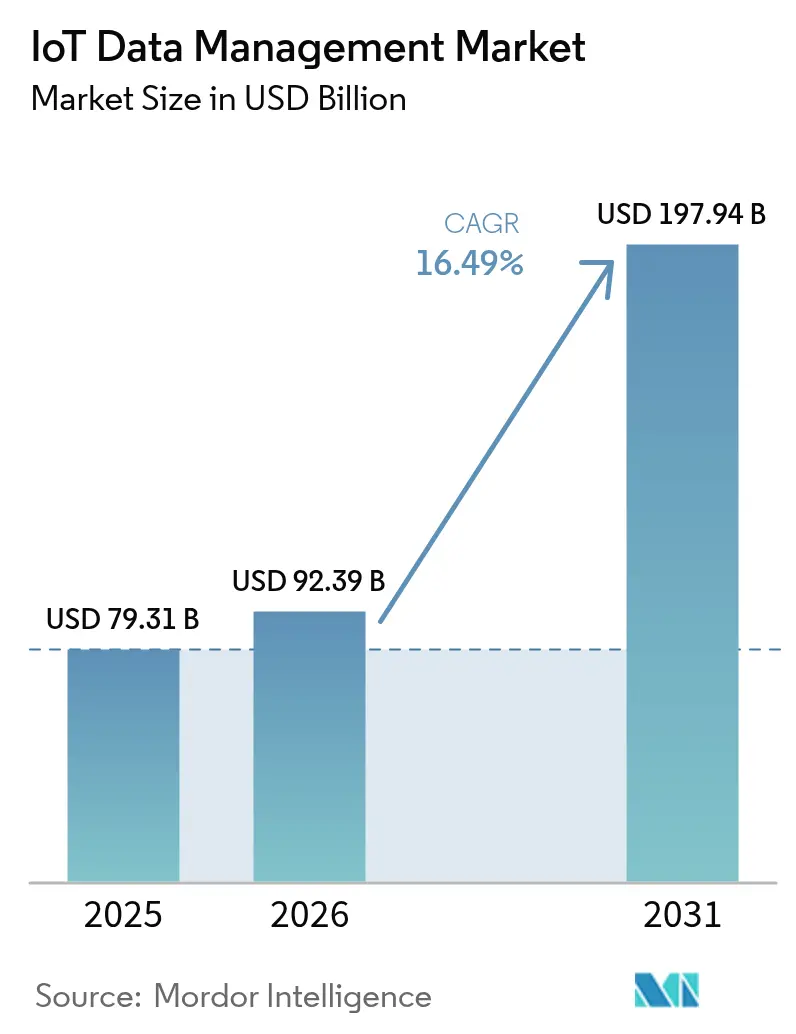
| Market Size (2026) | USD 92.39 Billion |
| Market Size (2031) | USD 197.94 Billion |
| Growth Rate (2026 - 2031) | 16.49 % |
| Fastest Growing Market | Asia Pacific |
| Largest Market | North America |
| Market Concentration | Medium |
Major Players *Disclaimer: Major Players sorted in no particular order Image © Mordor Intelligence. Reuse requires attribution under CC BY 4.0. | |
IoT Data Management Market Analysis by Mordor Intelligence
IoT Data Management Market size in 2026 is estimated at USD 92.39 billion, growing from 2025 value of USD 79.31 billion with 2031 projections showing USD 197.94 billion, growing at 16.49% CAGR over 2026-2031.
Strong demand stems from swelling connected-device volumes, the move toward edge-enabled architectures, and the rise of cloud-native analytics that turn raw telemetry into high-value insights. Predictive maintenance, asset-health optimization, and cross-enterprise data-sharing are accelerating vendor revenues as enterprises modernize legacy stacks and monetize sensor data. Intensifying merger activity, such as Cisco’s USD 28 billion Splunk purchase, is sharpening competitive differentiation around unified ingestion, governance, and AI-ready analytics. [1] Meanwhile, hybrid deployment models, 5G-powered low-latency networks, and regulatory pressure for airtight data governance are shaping investment priorities across industries and regions.
Key Report Takeaways
- By solution, analytics led with a 36.42% revenue share in 2025, while stream processing is projected to expand at a 16.86% CAGR through 2031.
- By deployment model, cloud held a dominant 70.35% share in 2025; hybrid architectures are the fastest-growing at 17.12% CAGR to 2031.
- By data type, time-series workloads accounted for 48.20% of processing demand in 2025, whereas unstructured data management is set to rise at a 16.88% CAGR.
- By end-user industry, manufacturing & industrial captured 31.25% of the IoT data management market share in 2025; healthcare & life sciences is forecast to lead growth at 17.19% CAGR.
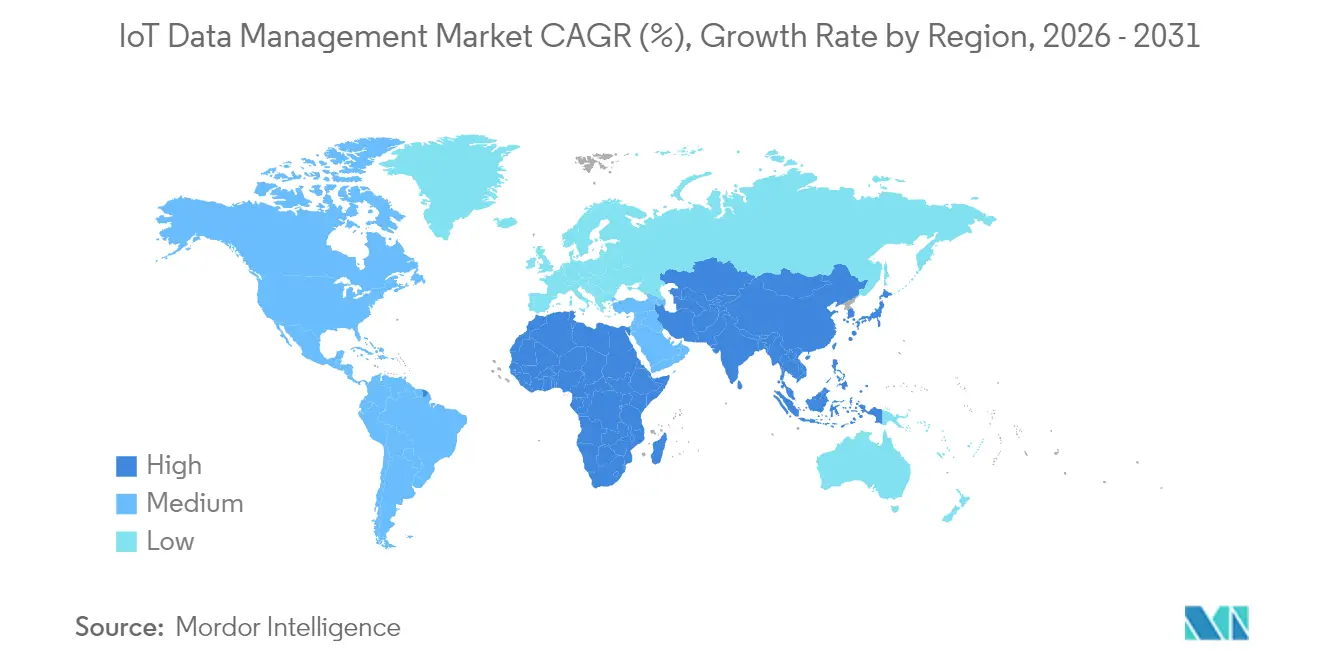
- By geography, North America commanded 40.55% of the IoT data management market size in 2025, but Asia Pacific is poised for the highest 17.56% CAGR.
Note: Market size and forecast figures in this report are generated using Mordor Intelligence’s proprietary estimation framework, updated with the latest available data and insights as of 2026.
Market Trends and Insights
Drivers Impact Analysis of IoT Data Management Market*
| Driver | (~) % Impact on CAGR Forecast | Geographic Relevance | Impact Timeline |
|---|---|---|---|
| Proliferation of connected devices spurring data volumes | +4.2% | Global; APAC leads deployments | Medium term (2-4 years) |
| Cloud-native data lakes and analytics maturity | +3.4% | North America & EU core; APAC rising | Long term (≥4 years) |
| Regulatory push for data governance and security | +3.0% | EU leads; global adoption | Medium term (2-4 years) |
| Real-time edge analytics for operational efficiency | +2.5% | Manufacturing hubs in Germany, US, China | Short term (≤2 years) |
| 5G network-slicing enabling prioritised IoT data streams | +2.0% | Urban centers in developed markets | Long term (≥4 years) |
| Emergence of data-marketplaces monetising sensor data | +1.3% | North America & EU early adopters | Long term (≥4 years) |
| Source: Mordor Intelligence | |||
Proliferation of Connected Devices Spurring Data Volumes
Industrial plants now deploy thousands of sensors per line, generating terabytes of telemetry that traditional data stores cannot absorb. Bosch shortened AI rollout cycles from months to weeks by automating data-pipeline orchestration, underscoring the scale challenges of sensor growth. Healthcare sees a similar surge as remote patient monitors stream continuous biometrics, needing HIPAA-compliant, low-latency storage. Velocity and variety pressures are pushing enterprises toward stream-first, time-series-native architectures that synchronize edge and cloud data in sub-second windows.
Cloud-Native Data Lakes and Analytics Maturity
Containerized and serverless data-lake patterns auto-scale with ingestion peaks, dissolving prior capacity-planning bottlenecks. Snowflake’s Openflow release in June 2025 illustrates friction-free cross-cloud data mobility that accelerates AI prototyping. Built-in ML pipelines now run directly inside lake environments, avoiding costly ETL steps and strengthening governance via lineage, encryption, and granular permissions.
Regulatory Push for Data Governance and Security
The EU Digital Services Act sets a precedent for enforceable algorithmic transparency, pushing vendors to embed data-classification, provenance, and privacy controls by design. Similar compliance requirements in healthcare and financial services reward platforms that automate audit trails across the entire IoT data lifecycle. Cross-border deployments must juggle overlapping rulesets while keeping architectures unified, making native governance a competitive differentiator.
Real-Time Edge Analytics for Operational Efficiency
Factories apply edge-resident vision analytics for instant quality checks, trimming bandwidth use and preventing production delays. The COGNIFOG framework shows how Kubernetes-orchestrated micro-services span edge and core for seamless DevOps. Utilities echo this approach by performing grid load-balancing at millisecond speeds, cutting latency costs and strengthening resilience.
Restraints Impact Analysis of IoT Data Management Market*
| Restraint | (~) % Impact on CAGR Forecast | Geographic Relevance | Impact Timeline |
|---|---|---|---|
| Fragmented standards and interoperability gaps | -2.5% | Global, multi-vendor projects | Medium term (2-4 years) |
| High total cost of ownership for end-to-end stacks | -2.0% | SMEs in developing regions | Short term (≤2 years) |
| Sustainability concerns over energy footprint | -1.3% | EU & North America regulatory focus | Long term (≥4 years) |
| Data-sovereignty regulations restricting cross-border flows | -1.0% | EU, China, Russia | Medium term (2-4 years) |
| Source: Mordor Intelligence | |||
Fragmented Standards and Interoperability Gaps
Divergent protocols force businesses to build custom middleware that inflates maintenance costs and slows rollouts. Legacy industrial gear exacerbates complexity by requiring translation layers to talk to modern IoT platforms. Proprietary data models heighten vendor lock-in, burdening teams with parallel catalogs and lineage trackers that sap productivity and elevate risk.
High Total Cost of Ownership for End-to-End Stacks
Budget overruns often arise when integration, data-engineering, and security expenses triple initial license fees. Specialized skill shortages in edge orchestration and cyber-resilience lengthen deployment timelines, while hidden cloud egress charges widen cost gaps for SMEs. These dynamics fuel demand for managed, pay-as-you-grow IoT data services that mask infrastructure intricacies.
*Our forecasts treat driver/restraint impacts as directional, not additive. The impact forecasts reflect baseline growth, mix effects, and variable interactions.
IoT Data Management Market Segment Analysis
By Solution:
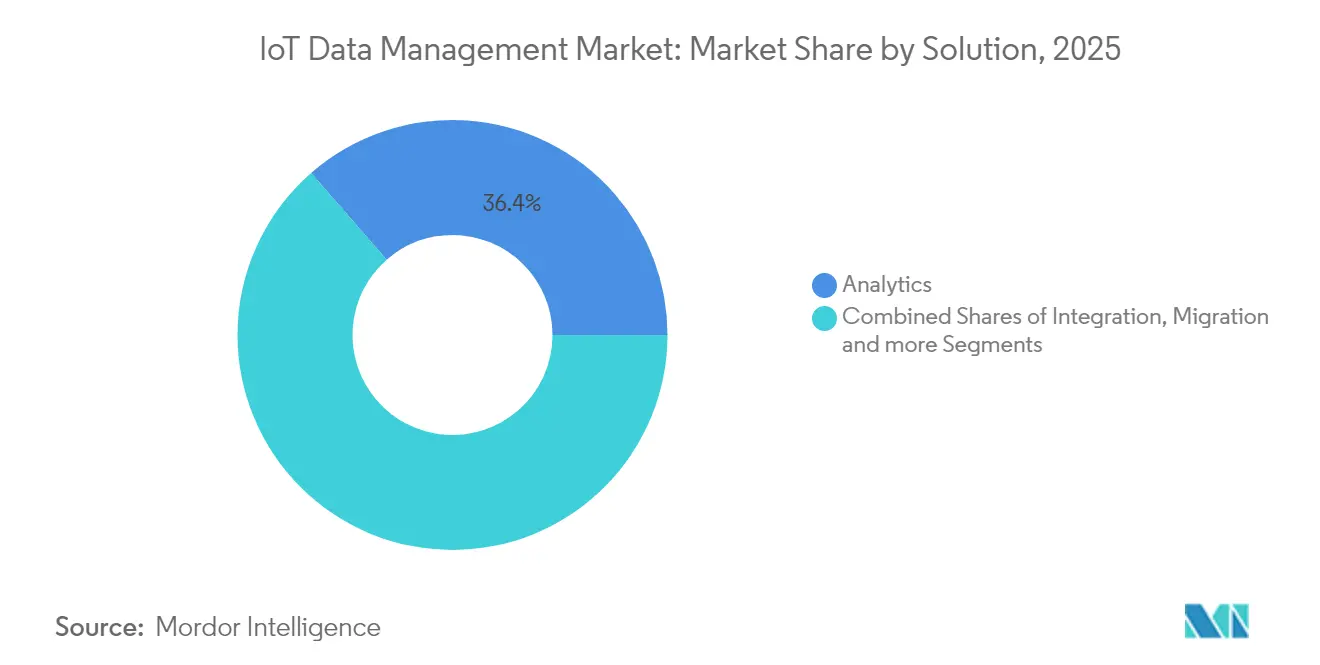
Analytics Drives InnovationAnalytics held a 36.42% revenue lead in 2025 as enterprises pivoted from raw-data capture to actionable insight generation within the IoT data management market. The need to visualize anomalies, optimize asset utilization, and feed predictive algorithms propelled analytics adoption alongside integrated dashboards that democratize insights for frontline staff.
Stream processing is slated for a 16.86% CAGR, reflecting a decisive transition to continuous decision loops in manufacturing, healthcare, and mobility. Teradata’s integrated enterprise vector store debuted in March 2025 to power AI-ready workloads that unify traditional analytics and generative models. Security, metadata management, and time-series-optimized storage deepen platform stickiness, positioning full-stack suites as default enterprise choices.

By Deployment Model:
Hybrid Architectures AccelerateCloud retained a commanding 70.35% share in 2025 thanks to limitless scalability and opex-friendly pricing, delivering elastic compute for AI-intensive workloads across the IoT data management market. Yet hybrid configurations will post a 17.12% CAGR as data-sovereignty rules and latency-sensitive use cases keep select workloads on-premises.
Organizations increasingly process high-frequency data at the edge, forwarding aggregated analytics to cloud lakes for enterprise reporting. Hitachi Vantara’s EverFlex with Cisco Powered Hybrid Cloud showcases on-demand infrastructure ranging from IaaS to Containers-as-a-Service, bundled under flexible subscriptions. The convergence of edge orchestration and centralized governance unlocks new deployment patterns that align cost, compliance, and performance goals.
By Data Type:
Unstructured Growth AcceleratesTime-series telemetry made up 48.20% of workloads in 2025, reflecting its legacy position within SCADA systems and asset-health monitoring across the IoT data management market size. However, unstructured inputs will rise fastest at a 16.88% CAGR as computer-vision, audio, and NLP sensors proliferate in smart manufacturing and telehealth.
Manufacturers now blend machine-vision feeds with vibration and temperature streams to anticipate faults, while voice-activated hospital wards generate dialog data for clinical insights. Blockchain-enabled frameworks capable of managing 1 million devices illustrate the push for unified platforms that simultaneously support structured SQL queries and unstructured vector search.
By End-User Industry:
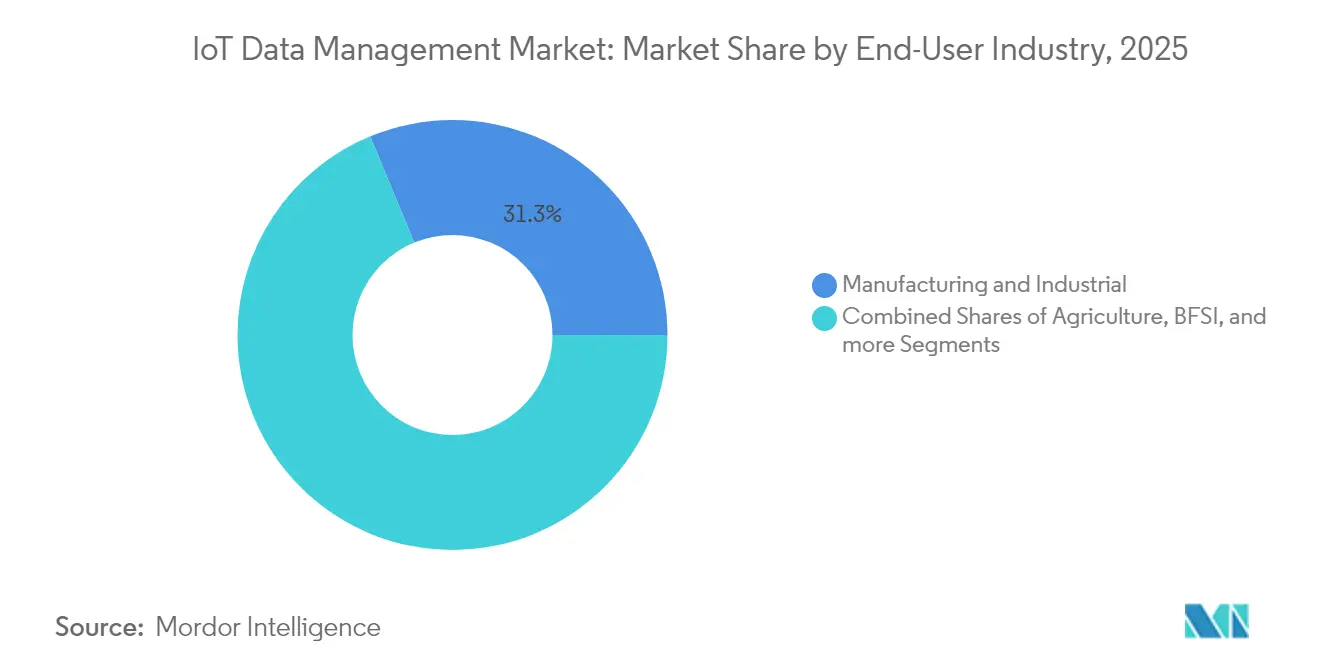
Healthcare Transformation LeadsManufacturing & industrial users captured 31.25% of the 2025 IoT data management market share through predictive-maintenance returns that directly cut downtime and scrap. Conversely, healthcare & life sciences will log a 17.19% CAGR on the back of remote-patient monitoring, clinical-trial digitization, and rising regulatory compliance for connected devices.
Government and smart-city projects are scaling sensor grids for traffic, air-quality, and safety oversight. Energy providers deploy distributed analytics to balance dynamic loads and integrate renewables, while BFSI firms embrace IoT-enabled fraud analytics. Cisco and TELUS plan to onboard 1.5 million 5G cars to the Cisco IoT Control Center from 2024, highlighting automotive traction.
By Application:
Asset Tracking InnovationPredictive maintenance dominated with 28.02% share in 2025, providing tangible ROI across heavy industry through reduced unplanned downtime. Asset-tracking and fleet management will expand at a 16.97% CAGR as supply-chain visibility and cold-chain integrity become board-level priorities in the IoT data management market.
Utilities advance smart-metering rollouts for demand-response programs, while remote-patient monitoring scales value-based care. PTC’s Servigistics upgrade on Cisco UCS X-Series cites 6-35% uptime boosts and 10-35% inventory cuts, validating broader business-case appeal. Multi-application convergence reduces platform sprawl and operational overheads.
Geography Analysis
North America IoT Data Management Market
North America generated 40.55% of 2025 revenue, anchored by hyperscaler ecosystems, abundant data-science talent, and regulatory clarity that speeds enterprise adoption. Ongoing 5G and edge rollouts support sub-second processing needs in smart-factory and telehealth programs. AWS signaled healthy momentum with robust Q1 2025 cloud revenue.
APAC IoT Data Management Market
Asia Pacific will pace global growth at an 17.56% CAGR to 2031 as China’s industrial-IoT drive and India’s smart-city spend enlarge addressable volumes. Huawei’s AI Data Lake and 5.5G network solutions reveal regional commitment to low-latency, AI-centric infrastructure. Rising Southeast-Asian deployments in logistics and agriculture further broaden demand.
EMEA and LATAM IoT Data Management Market
Europe sustains measured expansion through Industry 4.0 and stringent privacy rules that necessitate localized processing. Germany’s automotive lines, the UK’s digital-health pilots, and Nordic smart-grid projects exemplify high-value, compliance-first engagements within the IoT data management market. Meanwhile, Latin America and Middle East & Africa remain early-stage, yet infrastructure programs and urbanization create long-run upside for vendors offering turnkey, cost-efficient solutions.
Regulatory Landscape
IoT data management deployments are increasingly shaped by horizontal cybersecurity and data-sharing rules that cut across industries and device types. In the European Union, the Data Act (Regulation (EU) 2023/2854) introduces mandatory obligations for data holders of connected products and related services, including design-by-default accessibility of product and service data from September 12, 2026, which elevates requirements for interoperable data export, consented third-party sharing, and auditable governance across edge and cloud estates.
Security compliance is tightening in parallel. The EU Cyber Resilience Act (Regulation (EU) 2024/2847) brings product security requirements and introduces vulnerability and incident reporting obligations beginning September 11, 2026, pushing vendors and connected-product ecosystems toward secure-by-design data pipelines, vulnerability handling, and software bill of materials aligned practices. In the United States, NIST updated guidance for IoT product cybersecurity, finalizing NIST IR 8259r1 in April 2026 and issuing the initial public draft of NIST SP 800-213r1 in June 2026, reinforcing standardized expectations for device-to-cloud security controls that influence federal procurement and enterprise security baselines.
Value Chain Analysis
The IoT data management value chain starts with device and edge data producers (sensors, gateways, industrial controllers, medical monitors, connected vehicles) and extends through connectivity and edge platforms that normalize telemetry, enforce local security, and execute low-latency analytics. Data is then ingested into time-series databases, data lakes/lakehouses, stream-processing engines, and governance layers (metadata, lineage, access control, and audit trails), before being consumed by analytics and AI applications for use cases such as predictive maintenance, asset tracking, smart metering, and remote patient monitoring. Systems integrators and managed service providers commonly sit across stages, handling protocol translation, OT-IT integration, and operations, while hyperscalers and enterprise software vendors increasingly package reference architectures and managed services to reduce total deployment effort.
Partnership-led bundling is becoming a key mechanism for moving data from edge to cloud with fewer middleware dependencies. Examples include InfluxData partnering with Litmus (April 2026) to integrate InfluxDB 3 Enterprise with Litmus Edge for edge-to-cloud pipelines, AVEVA signing a multi-year strategic collaboration with AWS (May 2026) to expand and migrate CONNECT industrial intelligence workloads, and AVEVA collaborating with Snowflake (May 2026) to enable zero-code integration between CONNECT and Snowflake Data Cloud. Siemens also partnered with Databricks and FFT Produktionssysteme GmbH (June 2026) to stream contextualized production data into AI platforms via FFT DataBridge, illustrating how OEMs, industrial software, and data platform providers are aligning around governed, contextualized data flows that support Industrial AI.
Competitive Landscape
The vendor field remains moderately fragmented, though consolidation is quickening as buyers favor all-in-one suites over stitched point tools. Cisco’s USD 28 billion Splunk acquisition and Databricks’ USD 1 billion Neon deal underline the race to unify observability, security, and AI-ready data pipelines.
Three strategic archetypes are emerging: cloud-first hyperscalers with integrated AI services; edge-native specialists optimizing latency and sovereignty; and hybrid orchestrators bridging both realms. Patent US12143425B1 describes distributed graph analytics that adapt in real time, offering disruptive performance advantages for complex sensor streams.[3] Differentiation now hinges on built-in governance, cross-format querying, and seamless AI model deployment across the edge-to-cloud continuum.
Partnership ecosystems are just as pivotal. Hitachi Vantara teams with Cisco for hybrid IaaS; PTC aligns with Cisco hardware for AI-powered service-life extensions; Snowflake collaborates with Microsoft Azure OpenAI to embed LLM capabilities within data lakes. Vendors that combine robust marketplaces, low-code tooling, and managed services are best positioned to capture share as enterprises pursue faster time-to-value.
IoT Data Management Industry Leaders
-
SAP SE
-
IBM
-
PTC Inc.
-
Cisco Systems, Inc.
-
Teradata Corporation
- *Disclaimer: Major Players sorted in no particular order

IoT Data Management Market Companies Covered in this Report
- Amazon Web Services (AWS)
- Microsoft Corp. (Azure)
- IBM Corp.
- SAP SE
- Cisco Systems Inc.
- Oracle Corp.
- Google Cloud Platform
- PTC Inc.
- Teradata Corp.
- Hewlett Packard Enterprise
- SAS Institute Inc.
- Fujitsu Ltd.
- Cloudera Inc.
- Snowflake Inc.
- Databricks Inc.
- Hitachi Vantara LLC
- Huawei Technologies Co. Ltd.
- Bosch.IO GmbH
- MongoDB Inc.
- Software AG
Market Opportunities and Future Outlook
Compliance-driven architecture changes create whitespace for platforms that provide governance, auditability, and controlled data sharing from the point of collection through analytics. The EU Data Act (Regulation (EU) 2023/2854) sets a concrete milestone on September 12, 2026 for design-by-default data accessibility for connected products and related services, which raises demand for standard interfaces, policy-based access controls, and operational tooling to support third-party data access without duplicative ETL and bespoke integrations. In parallel, the EU Cyber Resilience Act (Regulation (EU) 2024/2847) starts vulnerability and incident reporting obligations on September 11, 2026, reinforcing the need for secure data pipelines that integrate vulnerability handling workflows and evidence-ready logging.
Industrial and smart-infrastructure programs are also pushing edge-to-cloud data designs that reduce latency and bandwidth while preserving context for AI. The spread of Unified Namespace patterns using MQTT and Eclipse Sparkplug B highlights an opportunity for vendors to productize semantic/context layers that decouple data producers and consumers and improve interoperability across multi-vendor OT estates. New edge-native data capabilities reinforce this shift, such as ITTIA DB Lite AI (April 2026), which embeds time-series data management and feature engineering on microcontrollers to support edge AI without cloud dependency, and enterprise packaging moves such as Oracle introducing the OCI IoT Platform integrated with Oracle Autonomous AI Database to simplify ingestion plus database operations. Partnerships that unify OT data ecosystems with cloud data platforms, including AVEVA with AWS and Snowflake (May 2026), show active demand for turnkey IT-OT convergence that minimizes custom middleware and accelerates industrial AI deployments.
Recent Industry Developments in IoT Data Management Market
- July 2026: SAP and IBM highlighted client momentum using IBM technology with SAP Cloud ERP Private environments to drive AI innovation. The focus on running governed data and AI workloads in private or dedicated cloud setups aligns with enterprises balancing performance and data-control requirements, strengthening end-to-end IoT-to-analytics foundations for regulated and latency-sensitive operations.
- December 2025: IBM released Cloud Pak for Data 5.3, adding enhanced master data management capabilities (renamed from IBM Match 360) including historical data capture to support audit trails. The upgrade reinforces enterprise-grade governance and traceability, which are core requirements when IoT data is reused across analytics, AI model training, and cross-functional operational workflows.
- May 2024: IBM and SAP announced plans to expand their collaboration to help clients adopt generative AI across business processes and data foundations. The expanded alliance supports tighter integration between enterprise applications and data platforms, which helps reduce siloed telemetry and operational data when building IoT-driven analytics and automation.
IoT Data Management Market Report Scope and Research Methodology
Market Definition and Coverage
This market covers the revenue earned from software and related services that ingest, store, govern, secure, and prepare IoT generated data so it can be used for analytics, monitoring, and operational decisions across industries.
Scope exclusions: It does not count general IT infrastructure that is not bought mainly for IoT data handling, and it also excludes pure connectivity services and standalone devices.
Segments Covered in This Report
- By Solution
- Integration
- Migration
- Analytics
- Storage
- Security
- Visualization and Dashboards
- Metadata Management
- Stream Processing
- By Deployment Model
- Cloud
- On-Premise
- Hybrid
- By Data Type
- Structured
- Semi-Structured
- Unstructured
- Time-Series
- By End-User Industry
- Automotive and Transportation
- Healthcare and Life Sciences
- Government and Smart Cities
- Manufacturing and Industrial
- Energy and Utilities
- Retail and E-commerce
- Agriculture
- BFSI
- Others
- By Application
- Predictive Maintenance
- Asset Tracking and Fleet Management
- Smart Metering
- Supply-Chain Visibility
- Remote Patient Monitoring
- Smart Grid Analytics
- By Geography
- North America
- United States
- Canada
- Mexico
- South America
- Brazil
- Argentina
- Rest of South America
- Europe
- Germany
- United Kingdom
- France
- Italy
- Spain
- Russia
- Rest of Europe
- Asia Pacific
- China
- Japan
- India
- South Korea
- Rest of Asia Pacific
- Middle East and Africa
- Middle East
- Saudi Arabia
- United Arab Emirates
- Turkey
- Rest of Middle East
- Africa
- South Africa
- Nigeria
- Rest of Africa
- Middle East
- North America
Data Sources, Market Sizing, and Validation
Desk Research
Desk work sets the boundaries and provides the public signals used to size a market that changes quickly. We review official and non paywalled sources such as the US Census Bureau and Bureau of Economic Analysis releases, International Telecommunication Union datasets, NIST publications on IoT and cybersecurity, and OECD digital economy indicators. Where it is relevant, we also reference public cloud usage and data governance guidance from regulator and standards bodies, including ISO and IEC materials.
The desk phase is then filled out with company filings, earnings call notes, investor presentations, product documentation, and reputable press coverage that explain rollout pace in manufacturing, utilities, transport, and smart buildings. We also use selected paid databases for company financials and intelligence, patent databases, and news and financials to confirm timelines, M and A effects, and portfolio changes that can shift reported revenue. These desk research sources are not exhaustive, and we used additional public references to collect, cross check, and clarify data points.
Primary Interviews and Surveys
Primary interviews are used to pressure test assumptions that are hard to read from public materials, such as how data volumes, security needs, and deployment models change the spend per connected asset. We speak with a mix of solution providers, system integrators, and end user teams across APAC, EMEA, and the Americas, so pricing direction, adoption pace, and replacement cycles can be checked consistently against interview inputs.
Distribution of primary research fieldwork respondents
| Company type | Respondent position | Region |
|---|---|---|
| Top tier: 37% | CXOs: 13% | APAC: 45% |
| Mid tier: 49% | Functional/Unit leaders: 35% | EMEA: 37% |
| Smaller Players: 14% | Managers: 52% | Americas: 18% |
Market-Sizing & Forecasting
For market sizing, we start with a top-down build that reconstructs the demand pool using enterprise digital spend, cloud and edge rollout signals, and the share of IoT programs that require dedicated ingestion, governance, and time series handling. We then check the result with selective bottom-up approximations, including sampled pricing for platform subscriptions and services, partner channel feedback, and supplier roll ups when public revenue hints are available, and we adjust totals if the two views drift.
A few inputs that matter in this market are the connected device base growth by major industries, the expected data volumes and retention policies, the cloud versus on premises split for IoT workloads, the mix shift toward security and governance features, and the typical contract term and expansion pattern for platform subscriptions. Because these variables move differently by region, we apply separate adoption curves and currency assumptions before rolling results up to the global total.
Forecasting is run using scenario analysis, supported by trend smoothing on the key drivers, and then aligned to what interviewees expect for IoT program budgets, regulatory pressure on data handling, and cloud migration timing. When bottom-up information is missing for smaller geographies or niche use cases, we fill gaps using proxy indicators such as industry IoT adoption intensity and IT spend ratios, and then we re check the implied spend per deployment for realism.
Data Validation & Update Cycle
Outputs are validated through multiple checks so the numbers stay tied to real buying patterns. We compare results against independent signals such as cloud workload growth, connected asset adoption, and public revenue commentary, and we investigate outliers that show unusual jumps in pricing, mix, or regional shares. If a variance cannot be explained cleanly, we revisit the assumptions and trigger targeted re contacts with primary respondents.
Before sign off, the model is reviewed in steps by another analyst so formulas, currency conversions, and segment mappings stay consistent with the stated scope. Reports are refreshed annually, and interim updates are made when material events occur, such as policy changes, major platform shifts, or large acquisitions that alter reported revenue. Right before delivery, a fresh review pass is completed so clients receive the latest updated view.
Mordor Intelligence's IOT Data Management Market Estimate Compared With Other Published Estimates
Published market values for IoT data management can differ widely, even when the topic label looks the same. The gaps typically come from how each publisher sets the boundary around what counts as data management, how pricing is normalized across contract types, and when currency and inflation assumptions are refreshed.
In this study, the refresh cycle and currency timing are treated as active inputs because fast changes in cloud pricing, security add ons, and multi year contracts can shift the implied ASP if they are not rechecked. This is where Mordor Intelligence ties the totals back to current pricing direction and adoption signals before locking the year value.
Benchmark comparison
| Source | Market Size | Gaps in Research Methodology |
|---|---|---|
| Mordor Intelligence | USD 92.39 B (2026) | |
| Global Consultancy A | USD 96.92 B (2025) | Uses a different base year and can include a broader application mapping for IoT programs, which shifts the counted spend earlier, and it may apply uniform price progression across regions without rechecking contract driven ASP resets. |
| Industry Publisher B | USD 70.39 B (2023) | Starts from an earlier year that can miss the latest cloud adoption inflection, and it may apply a blended global currency view for multi region revenue, which can understate the current value when exchange rates moved materially. |
The spread in the table mainly reflects timing and scope alignment, not just different math. When the year, currency conversion point, and what is counted as IoT specific data management are made explicit, the estimate becomes easier to reproduce and easier to validate against real adoption and pricing checks.
Key Questions Answered in the Report
What is the current size of the IoT Data Management Market?
The market is valued at USD 92.39 billion in 2026.
How fast will the IoT Data Management Market grow by 2031?
It is projected to reach USD 197.94 billion, registering a 16.49% CAGR over 2026-2031.
Which deployment model is expanding quickest?
Hybrid architectures lead growth with a 17.12% CAGR as organizations balance sovereignty and scalability.
Which region offers the highest growth opportunity?
Asia Pacific shows the fastest regional trajectory at an 17.56% CAGR due to smart-city and manufacturing digitization.
What is the leading end-user segment today?
Manufacturing & industrial applications hold the largest 31.25% share in 2025, driven by predictive-maintenance returns.
Why are analytics solutions dominant in IoT data management?
They commanded 36.42% revenue in 2025 because enterprises derive the greatest business value by converting raw device data into actionable, real-time insights.