
Industrial Network Switch Market Size and Share
Market Overview
| Study Period | 2020 - 2031 |
|---|---|
| Market Size (2026) | USD 4.20 Billion |
| Market Size (2031) | USD 6 Billion |
| Growth Rate (2026 - 2031) | 7.40 % |
| Fastest Growing Market | Asia-Pacific |
| Largest Market | Asia-Pacific |
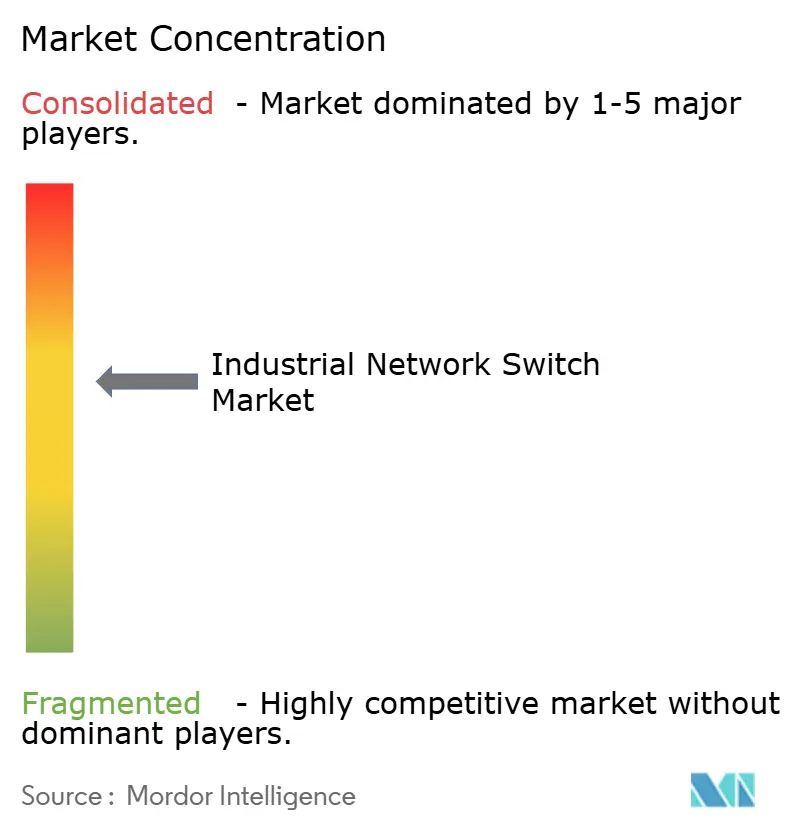
| Market Concentration | Medium |
Major Players *Disclaimer: Major Players sorted in no particular order Image © Mordor Intelligence. Reuse requires attribution under CC BY 4.0. | |
Industrial Network Switch Market Analysis by Mordor Intelligence
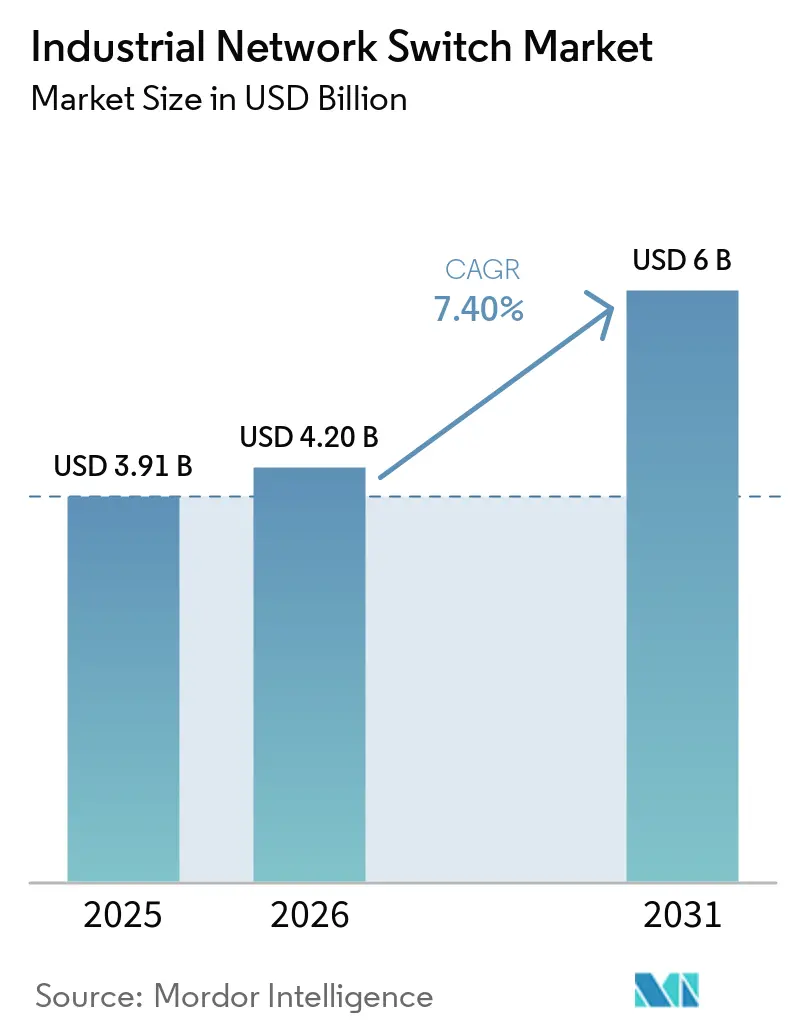
The industrial network switch market size is expected to increase from USD 3.91 billion in 2025 to USD 4.20 billion in 2026 and reach USD 6.00 billion by 2031, growing at a CAGR of 7.4% over 2026-2031. The spending wave is anchored in deterministic Ethernet roll-outs, edge-computing mandates inside hazardous areas, and government-funded reshoring programs that are expanding clean-room fabs, digital substations, and software-defined factories across major economies. Enterprises now favor IEC 62443-certified, TSN-ready switches that enforce granular traffic segregation while supporting zero-touch orchestration. Vendors are racing to integrate per-port power management, RESTful APIs, and converged wired-plus-5G backplanes so plant operators can stream real-time analytics to on-premise edge clusters. Parallel investments in domestic semiconductor fabs are shortening lead times for ruggedized ASICs, which in turn lowers the total cost of ownership for high-density, extended-temperature switch families.
Key Report Takeaways
- By type, managed switches commanded 65.8% of the industrial network switch market share in 2025 and are projected to post a 10.3% CAGR through 2031.
- By port speed, Gigabit Ethernet led with 48.1% revenue share in 2025 while 10 Gigabit Ethernet is forecast to expand at a 10.1% CAGR, reflecting the shift to machine-vision and AI workloads.
- By PoE capability, non-PoE models held 70.12% share in 2025, yet PoE-capable variants are on track for a 10.5% CAGR through 2031 as IEEE 802.3bt becomes mainstream.
- By port count, the 2-8-port bracket captured 35.6% share in 2025, whereas above-48-port systems are set to grow at a 9.3% CAGR thanks to aggregation-layer consolidation.
- By vertical, manufacturing represented 28.5% share in 2025 while energy and power is positioned to deliver the fastest 9% CAGR through 2031 on the back of smart-grid mandates.
- By geography, Asia-Pacific secured 37.2% share in 2025 and is forecast to advance at a 9.7% CAGR to 2031, propelled by software-defined factory programs in China, India, and Southeast Asia.
Note: Market size and forecast figures in this report are generated using Mordor Intelligence’s proprietary estimation framework, updated with the latest available data and insights as of January 2026.
Market Trends and Insights
Drivers Impact Analysis of Industrial Network Switch Market*
| Driver | (~) % Impact on CAGR Forecast | Geographic Relevance | Impact Timeline |
|---|---|---|---|
| Surge in Industry 4.0 Automation | +1.8% | Global, early gains in China, Germany, United States, Japan | Medium term (2–4 years) |
| Rapid Adoption of Time-Sensitive Networking for Deterministic Ethernet | +1.5% | North America and Europe, spill-over to Asia-Pacific manufacturing hubs | Long term (≥ 4 years) |
| Growing Deployment of Industrial PoE Cameras and Sensors | +1.2% | Global, concentrated in smart-city and manufacturing verticals | Short term (≤ 2 years) |
| Expansion of Smart Grids and Digital Substations | +1.0% | Europe and North America, selective Asia-Pacific utilities | Medium term (2–4 years) |
| Edge-Computing Requirements in Harsh Environments | +0.9% | Global, focus on oil and gas, mining, offshore wind | Medium term (2–4 years) |
| Government-Led Reshoring of Critical Manufacturing | +0.7% | North America, Europe, Japan, South Korea | Long term (≥ 4 years) |
| Source: Mordor Intelligence | |||
Surge in Industry 4.0 Automation
Factory operators are converting legacy fieldbus islands into unified Ethernet fabrics that support digital twins, AI-driven defect detection, and closed-loop quality control. A 2026 Cisco survey found that 61% of manufacturers are already deploying artificial intelligence on the shop floor and 97% anticipate higher connectivity density, underscoring rising demand for managed switch ports.[1]Cisco Systems, “Industrial AI Report 2026,” cisco.com Siemens observed productivity gains of 49% in Indonesian pilot lines after migrating to software-defined production cells. Automotive assemblers are standardizing on Ethernet-based motion control, which accelerates switch refresh cycles and lifts access-layer bandwidth from Fast Ethernet to 10 Gigabit. The industrial network switch market therefore benefits from every new edge AI workload that pushes ports toward higher speeds and deterministic traffic scheduling. Vendors that bundle NETCONF interfaces and VLAN templates help plant managers overcome configuration complexity, shortening commissioning windows by up to 30%.
Rapid Adoption of Time-Sensitive Networking for Deterministic Ethernet
IEEE 802.1AS time synchronization, 802.1Qbv time-aware shaping, and 802.1Qbu frame pre-emption together let Ethernet match fieldbus-level determinism, a prerequisite for closed-loop motion and safety cells. IEC/IEEE 60802 published in 2024 codified industrial TSN profiles that require sub-microsecond jitter. France’s grid operator RTE validated multi-vendor TSN interoperability across 400 kV substations in 2025, demonstrating carrier-grade robustness. Automotive Ethernet committees have also ratified TSN scheduling to carry camera, LiDAR, and over-the-air update streams simultaneously. Consequently, the industrial network switch market sees surging orders for devices that certify to both TSN and legacy industrial protocols on a single hardware platform. Suppliers that embed IEEE 1588-based clock recovery and hot-standby paths secure a technical moat against low-end entrants.
Growing Deployment of Industrial PoE Cameras and Sensors
IEEE 802.3bt Type 4 delivers up to 90 W per port, removing the need for separate power wiring in smart-city and factory retrofits and cutting installation budgets by as much as 50%. Singapore’s Smart Nation program relies on PoE switches to energize multi-spectral traffic cameras and environmental monitors deployed curb-side. Inside plants, predictive-maintenance sensors stream vibration data through PoE to edge gateways, allowing operators to detect bearing wear weeks earlier. Oil and gas majors install PoE-driven cameras on offshore rigs where AC circuits are expensive to maintain, leveraging central UPS rooms for continuity. Each of these roll-outs expands addressable demand for PoE switch ports, nudging the industrial network switch market toward higher power budgets, port-level load shedding, and per-device reboot logic.
Expansion of Smart Grids and Digital Substations
Utilities are replacing copper control wires with IEC 61850 Ethernet process buses, reducing commissioning time by 40% while enabling real-time fault isolation. Siemens introduced virtualized protection relays in the SIPROTEC V platform that run on commercial servers interconnected by TSN switches. CIGRE guidelines stipulate VLAN prioritization and rapid-spanning-tree functions to protect sampled-value messaging. North American utilities additionally require role-based access control to comply with NERC CIP, widening demand for IEC 62443-certified managed switches. As smart-grid budgets pivot to real-time automation, the industrial network switch market experiences accelerated orders for extended-temperature, fiber-ready devices.
Restraints Impact Analysis of Industrial Network Switch Market*
| Restraint | (~) % Impact on CAGR Forecast | Geographic Relevance | Impact Timeline |
|---|---|---|---|
| Cybersecurity Vulnerabilities in Operational Technology Networks | -0.8% | Global, acute in critical-infrastructure sectors | Short term (≤ 2 years) |
| Shortage of Industrial Networking Skill Sets | -0.6% | North America and Europe, emerging in Asia-Pacific | Medium term (2–4 years) |
| Volatility in Industrial Semiconductor Supply Chains | -0.5% | Global, heavy in ruggedized component lines | Short term (≤ 2 years) |
| Higher Total Cost of Ownership Versus Commercial-Grade Switches | -0.4% | Global, cost-sensitive verticals | Long term (≥ 4 years) |
| Source: Mordor Intelligence | |||
Cybersecurity Vulnerabilities in Operational Technology Networks
Converged IT-OT topologies expose legacy PLCs and HMIs to ransomware that exploits unpatched firmware and default credentials. CISA issued 47 advisories in 2025 addressing switch vulnerabilities that allowed remote code execution. Less than 30% of installed industrial switches meet IEC 62443-4-2 security levels as of early 2026. Dragos reported that 68% of industrial organizations logged at least one cyber incident in 2025, with Ethernet devices as the initial access vector in 42% of cases. Phoenix Contact’s FL Switch 2000 achieved IEC 62443-4-2 certification in December 2025, proving compliance is feasible but costly. Rising insurance premiums for non-segmented networks further restrain short-run purchasing decisions.
Shortage of Industrial Networking Skill Sets
Deploying TSN or zoning an IEC 62443 architecture demands hybrid OT-IT skills, yet the Manufacturing Institute noted in 2025 that 77% of U.S. plants struggle to hire automation technicians, with roles staying open for 93 days on average. IEEE launched a TSN certification path in 2024, but fewer than 5,000 engineers have completed the program worldwide. Multi-protocol complexity—PROFINET, EtherNet/IP, Modbus TCP, EtherCAT—raises commissioning risk and lengthens project schedules. While vendors now ship auto-discovery scripts and graphical editors, these aids do not fully bridge the expertise gap. In turn, some end-users defer high-density switch upgrades, tempering near-term growth in the industrial network switch market.
*Our forecasts treat driver/restraint impacts as directional, not additive. The impact forecasts reflect baseline growth, mix effects, and variable interactions.
Industrial Network Switch Market Segment Analysis
By Switch Type:
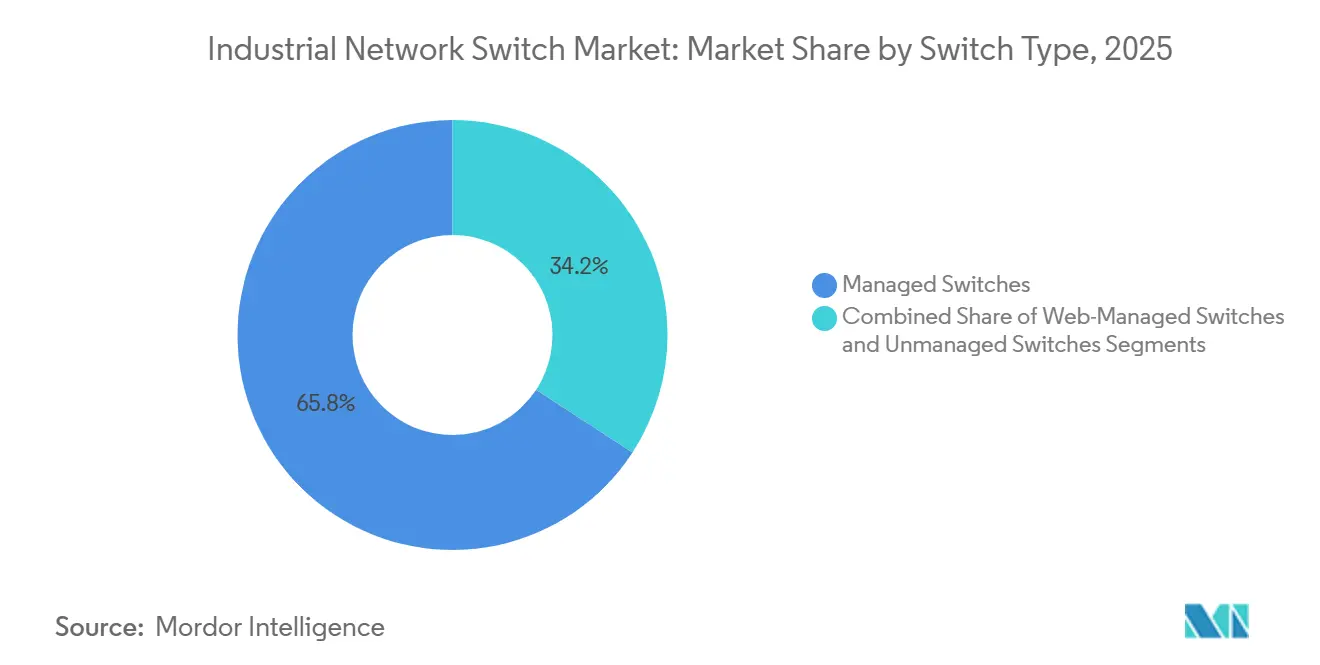
Managed Switches Hold the Lion’s ShareManaged switches captured 65.8% of the industrial network switch market in 2025 and are forecast to deliver a 10.3% CAGR through 2031, as VLAN segmentation, QoS queuing, and remote diagnostics become essential in Industry 4.0 production zones. Utilities deploying digital substations demand sub-10-millisecond failover, which unmanaged models cannot provide. Smart or web-managed variants appeal to small plants by offering browser GUIs without the full CLI complexity. Cybersecurity-certified managed switches now command 25-40% price premiums, yet critical-infrastructure buyers consider compliance non-negotiable.
In contrast, unmanaged switches remain viable for single-machine islands but face headwinds where safety traffic needs deterministic prioritization. Vendors are therefore investing in firmware upgradability that lets customers unlock management features later, future-proofing entry-level hardware. As the industrial network switch market matures, analysts expect the managed tier to exceed 70% share by mid-decade, reinforcing the shift toward centrally orchestrated, API-driven fabrics.



By Port Count:
High-Density Platforms Gain MomentumThe 2-8-port class held 35.6% share in 2025, serving compact machine cells, while switches above 48 ports are projected to post a 9.3% CAGR through 2031 as automotive, electronics, and semiconductor fabs consolidate edge cabinets into aggregation-layer racks. Automotive lines deploy 48-port Gigabit access blocks feeding 10 G uplinks to handle thousands of vision frames per second. High port density trims per-port costs, yet it introduces single points of failure unless redundant PSUs and hot-swap fan trays are adopted.
Ruggedized 19-inch chassis with modular PSU bays are therefore supplanting DIN-rail boxes in control rooms. Vendors also push software-defined provisioning so engineers can repurpose idle ports without manual patching. As virtualization spreads, the industrial network switch market size for the above-48-port bracket is set to climb steadily, particularly inside brownfield plants seeking cable reduction.
By Port Speed:
10 Gigabit Ethernet AcceleratesGigabit Ethernet led with 48.1% revenue share in 2025, balancing throughput and cost across most automation workloads. Yet 10 Gigabit Ethernet is slated to record a 10.1% CAGR, fueled by AI inference, 4K camera inspection, and digital-twin replication. The Ethernet Alliance forecasts 2.5G, 5G, and 10G as the next access baseline, pushing 100G to the aggregation core.[2]Ethernet Alliance, “2026 Ethernet Roadmap,” ethernetalliance.org
Industrial adopters report latency cuts of 80% and defect-rate falls to 0.3% after upgrading vision islands to 10 G links. Fast Ethernet lingers in legacy gateways but sees erosion as PoE and TSN favor Gigabit operation or better. Above-10 G speeds—25G, 40G, and 100G—are emerging inside co-located data centers that synchronize digital twins in real time. As optics prices fall, the industrial network switch market size for high-speed ports will widen beyond early adopters.
By PoE Capability:
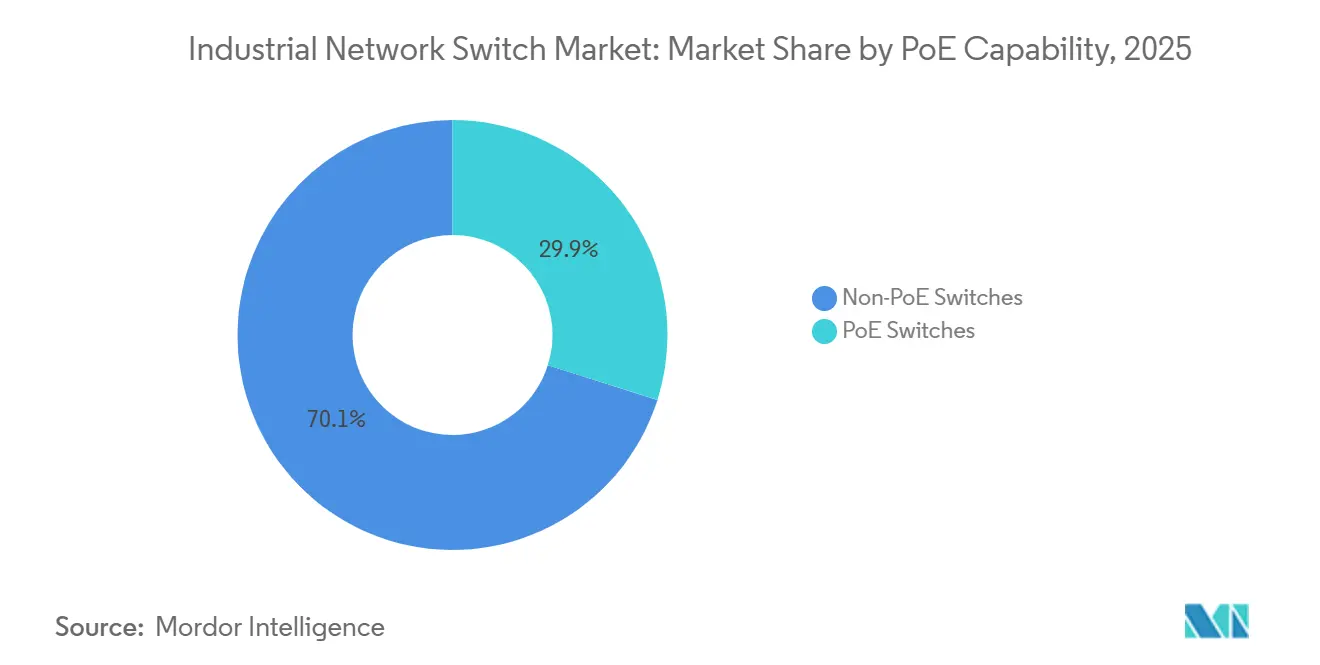
IEEE 802.3bt Reshapes Remote PowerNon-PoE units owned 70.12% share in 2025, yet PoE-enabled models are projected for a 10.5% CAGR through 2031 as smart-city and predictive-maintenance roll-outs demand single-cable power plus data. IEEE 802.3bt Type 4 now powers pan-tilt-zoom cameras, Wi-Fi 6E radios, and hazardous-area lighting up to 90 W per port. Field tests in Barcelona showed 40% lower installation outlays when PoE replaced AC spurs.
Industrial buyers increasingly request per-port budgeting and remote reboot to slash truck rolls. Switches able to auto-negotiate mixed 15 W, 30 W, and 90 W endpoints protect PSU margins, driving adoption. As device wattage rises, PoE-capable gear is set to dominate new project bids, steadily lifting the industrial network switch market share of powered ports.
By Industry Vertical:
Energy and Power Surges AheadManufacturing remained the largest buyer with 28.5% share in 2025, but energy and power is on track for the fastest 9% CAGR to 2031, propelled by IEC 61850 digital-substation programs. Utilities retrofit fiber rings and TSN switches to comply with NERC CIP and continental smart-grid targets. Oil and gas deploy extended-temperature switches across upstream, midstream, and downstream facilities, while transportation operators demand EN 50155 and NEMA TS2 certifications.
Automotive plants, now pursuing software-defined vehicles, adopt Ethernet from body-shop robotics to final-assembly ADAS calibration. Aerospace, mining, and water utilities round out the long-tail of niche deployments. Collectively, these verticals diversify demand and cushion the industrial network switch market from cyclical dips in any single sector.
Geography Analysis
APAC Industrial Network Switch Market
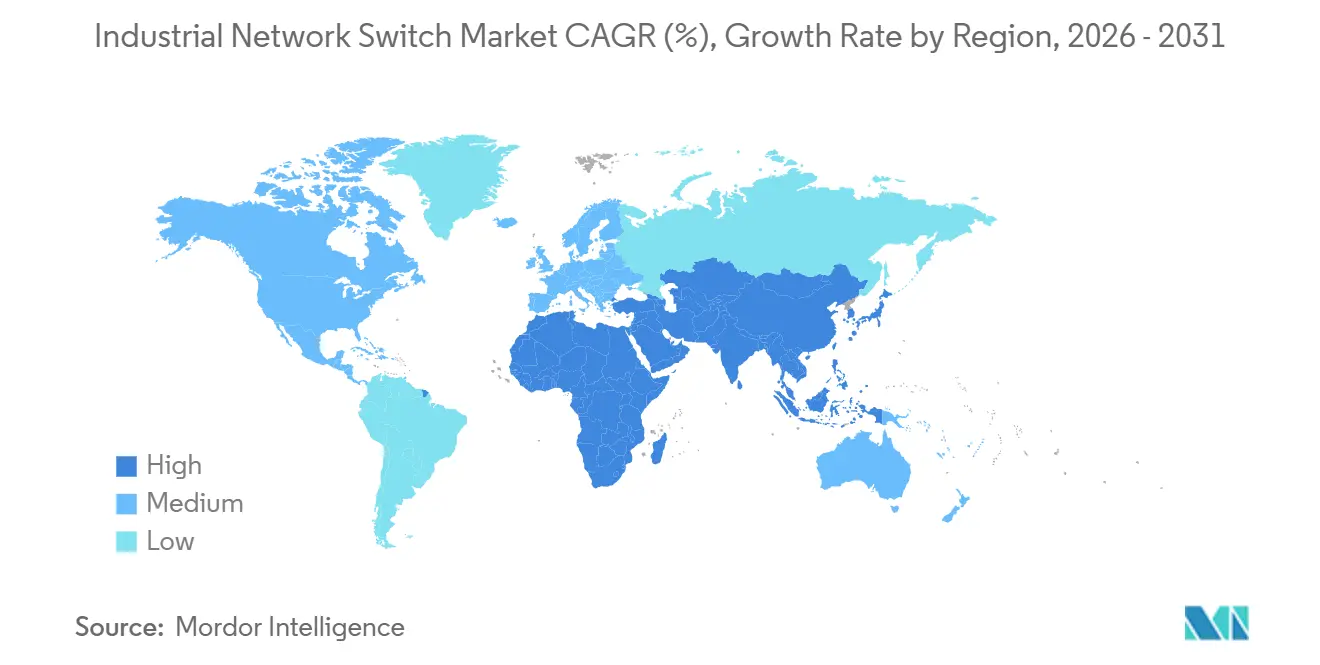
Asia-Pacific commanded 37.2% of the industrial network switch market in 2025 and is forecast to expand at a 9.7% CAGR through 2031. China’s Made in China 2025 plan, India’s Production-Linked Incentives, and Southeast Asian smart-factory grants jointly sustain multi-year capex cycles. Siemens estimated factory-automation outlays could climb to USD 125.84 billion by 2030, citing 49% productivity gains in Indonesian pilots. Japanese and South Korean fabs require TSN switches for 5 nm lithography sync, while India’s solar parks install IEC 61850 gear to balance renewable intermittency. Domestic Taiwanese and Chinese vendors undercut incumbents on price, but Tier-1 automotive and aerospace OEMs still prefer global suppliers with 24-hour support.
North America Industrial Network Switch Market
North America benefits from the USD 52.7 billion CHIPS and Science Act, which underwrites Intel’s USD 20 billion Arizona fabs, TSMC’s USD 40 billion Phoenix campus, Micron’s USD 20 billion New York line, and Samsung’s USD 17 billion Texas facility.[3]U.S. Department of Commerce, “CHIPS for America,” commerce.gov Each fab specifies TSN-capable 10 G and 100 G fabrics to synchronize lithography, metrology, and automated material handling. Utilities across the United States and Canada modernize substations to meet NERC CIP, which accelerates demand for IEC 62443-compliant switches. Mexico’s nearshoring wave further expands regional sales as automotive clusters replicate U.S. line architectures.
Europe Industrial Network Switch Market
Europe’s market hinges on smart-grid roll-outs, automotive electrification, and NIS2 cybersecurity rules. RTE’s multi-vendor TSN deployment across 400 kV sites validated commercial viability and sets a precedent for other grid operators. German automakers now embed Ethernet backbones to manage camera and LiDAR streams, lifting local demand for low-latency switches. The EU Digital Decade targets 80% enterprise cloud and big-data adoption by 2030, nudging manufacturers to upgrade legacy fieldbus networks to Ethernet fabrics.

Competitive Landscape
The industrial network switch market is moderately concentrated. The top five suppliers—Moxa, Siemens, Belden, Phoenix Contact, and Advantech—collectively controlled about 40% share in 2025, leaving space for niche specialists to differentiate on certifications and protocol stacks. Managed-switch leaders emphasize IEC 62443-4-2 credentials, TSN conformance, and RESTful APIs that plug into industrial edge platforms. Unmanaged rivals focus on price, lead time, and conformal coating availability.
Strategic partnerships broaden feature roadmaps. Phoenix Contact allied with Xona Space Systems in March 2025 to inject satellite-based zero-trust timing into FL Switch models, addressing location-verified authentication for critical infrastructure. Belden’s April 2026 BRS-5G concept with Qualcomm merges 5G radios and TSN ports to serve mobile robots, foreshadowing a hybrid wired-wireless paradigm.[4]Belden Inc., “BRS-5G Industrial Switch Concept,” belden.comSmaller firms such as Westermo, Lantronix, and ORing win rail, maritime, and ATEX-zone tenders by offering EN 50155, DNV-GL, and flame-proof housings.
Technology shifts also reset competitive lines. Linear pluggable optics halve transceiver power, so vendors with optical-module expertise gain an edge in 100 G industrial backbones. Software-defined networking decouples control logic from hardware, allowing integrators to orchestrate multi-vendor fabrics and eroding proprietary lock-in. Consequently, incumbents invest in DevOps-ready toolchains, cyber-hardening, and silicon roadmaps aligned with PoE++ and TSN, ensuring sustained relevance in the industrial network switch market.
Industrial Network Switch Industry Leaders
Moxa Inc.
Belden Inc.
Advantech Co., Ltd.
Phoenix Contact GmbH & Co. KG
Westermo Network Technologies AB
- *Disclaimer: Major Players sorted in no particular order
Industrial Network Switch Market Companies Covered in this Report
- Moxa Inc.
- Advantech Co., Ltd.
- Belden Inc.
- Phoenix Contact GmbH & Co. KG
- Antaira Technologies, LLC
- Westermo Network Technologies AB
- Beijer Electronics Group AB
- Hirschmann Automation and Control GmbH
- Red Lion Controls, Inc.
- RuggedCom Inc.
- PLANET Technology Corporation
- TRENDnet, Inc.
- Allied Telesis Holdings K.K.
- Lantronix, Inc.
- ORing Industrial Networking Corporation
- Korenix Technology Co., Ltd.
- EtherWAN Systems, Inc.
- Weidmüller Interface GmbH & Co. KG
- Patton Electronics Co.
- Siemens AG

Recent Industry Developments in Industrial Network Switch Market
- April 2026: Belden revealed the BRS-5G industrial switch concept with Qualcomm at Hannover Messe 2026, integrating 5G private-network radios and TSN Ethernet ports to support mobile robotics and AGVs in smart factories.
- April 2026: Siemens showcased its Industrial Edge ecosystem at Hannover Messe 2026, highlighting edge-analytics workloads running on TSN-linked COTS servers.
- December 2025: Phoenix Contact earned IEC 62443-4-2 certification for its FL Switch 2000 series, enabling bids for utility and critical-infrastructure projects that require secure-by-design hardware.
- June 2025: HMS Networks completed the re-branding of Red Lion Controls and N-Tron, merging support channels and R&D pipelines for converged Ethernet switches and protocol gateways.
- March 2025: Phoenix Contact partnered with Xona Space Systems to embed zero-trust network access and satellite timing in FL Switch platforms, mitigating GPS spoofing risks.


Global Industrial Network Switch Market Report Scope
| Managed Switches |
| Unmanaged Switches |
| Smart / Web-Managed Switches |
| 2–8 Ports |
| 9–16 Ports |
| 17–24 Ports |
| 25–48 Ports |
| Above 48 Ports |
| Fast Ethernet (100 Mbps) |
| Gigabit Ethernet (1G) |
| 10 Gigabit Ethernet (10G) |
| Above 10G (25G / 40G / 100G) |
| PoE Switches |
| Non-PoE Switches |
| Manufacturing |
| Energy and Power (Electric Utilities / Smart Grid) |
| Oil and Gas |
| Transportation (Rail, Ports, Intelligent Transport Systems) |
| Automotive |
| Aerospace and Defense |
| Mining and Metals |
| Others Industry Verticals |
| North America |
| South America |
| Europe |
| Asia-Pacific |
| Middle East |
| Africa |
| By Switch Type | Managed Switches |
| Unmanaged Switches | |
| Smart / Web-Managed Switches | |
| By Port Count | 2–8 Ports |
| 9–16 Ports | |
| 17–24 Ports | |
| 25–48 Ports | |
| Above 48 Ports | |
| By Port Speed | Fast Ethernet (100 Mbps) |
| Gigabit Ethernet (1G) | |
| 10 Gigabit Ethernet (10G) | |
| Above 10G (25G / 40G / 100G) | |
| By PoE Capability | PoE Switches |
| Non-PoE Switches | |
| By Industry Vertical | Manufacturing |
| Energy and Power (Electric Utilities / Smart Grid) | |
| Oil and Gas | |
| Transportation (Rail, Ports, Intelligent Transport Systems) | |
| Automotive | |
| Aerospace and Defense | |
| Mining and Metals | |
| Others Industry Verticals | |
| By Geography | North America |
| South America | |
| Europe | |
| Asia-Pacific | |
| Middle East | |
| Africa |


Key Questions Answered in the Report
What is the current industrial network switch market size and expected growth to 2031?
The industrial network switch market size was USD 3.91 billion in 2025, is USD 4.20 billion in 2026, and is projected to reach USD 6.00 billion by 2031 at a 7.4% CAGR.
Which switch type is expected to grow the fastest through 2031?
Managed switches are projected to post the highest 10.3% CAGR as factories adopt TSN scheduling, VLAN segmentation, and IEC 62443-compliant security.
Why is Asia-Pacific the largest regional buyer?
China, India, and Southeast Asia are scaling software-defined factories under national automation programs, driving the region’s 37.2% share and 9.7% CAGR outlook.
How is PoE shaping industrial switch demand?
IEEE 802.3bt PoE, which supplies up to 90 W per port, cuts installation costs by up to 50% and drives a 10.5% CAGR for PoE-capable models through 2031.
Page last updated on:


 Your data is secure and never sold or shared.


