
In-Vehicle Infotainment System Market Size and Share
Market Overview
| Study Period | 2019 - 2031 |
|---|---|
| Market Size (2026) | USD 31.08 Billion |
| Market Size (2031) | USD 44.87 Billion |
| Growth Rate (2026 - 2031) | 7.62 % |
| Fastest Growing Market | Middle East and Africa |
| Largest Market | Asia Pacific |
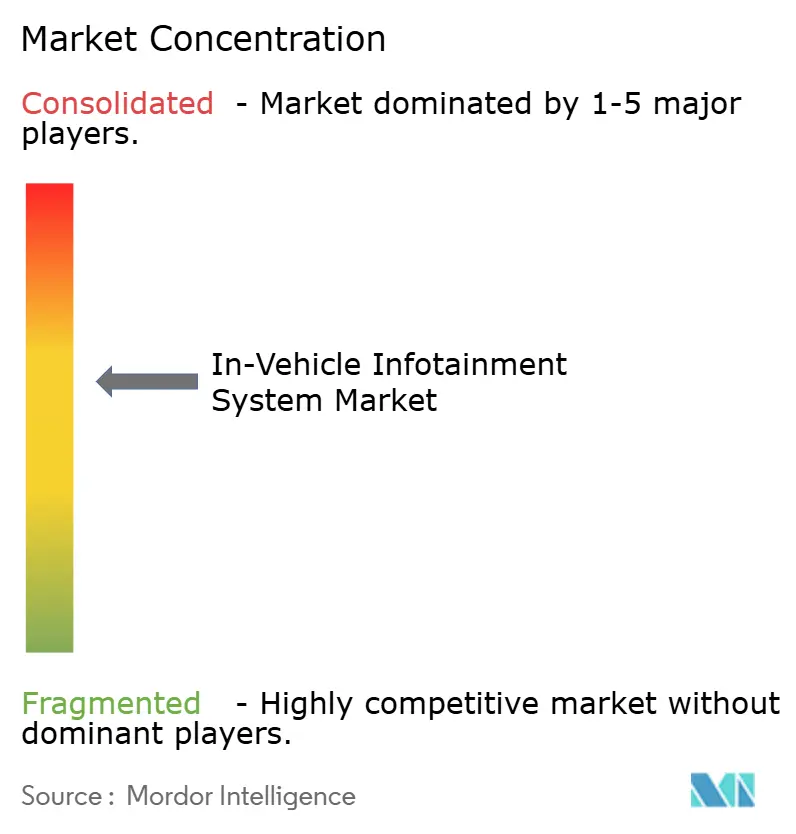
| Market Concentration | Medium |
Major Players
*Disclaimer: Major Players sorted in no particular order Image © Mordor Intelligence. Reuse requires attribution under CC BY 4.0. |
|
In-Vehicle Infotainment System Market Analysis by Mordor Intelligence
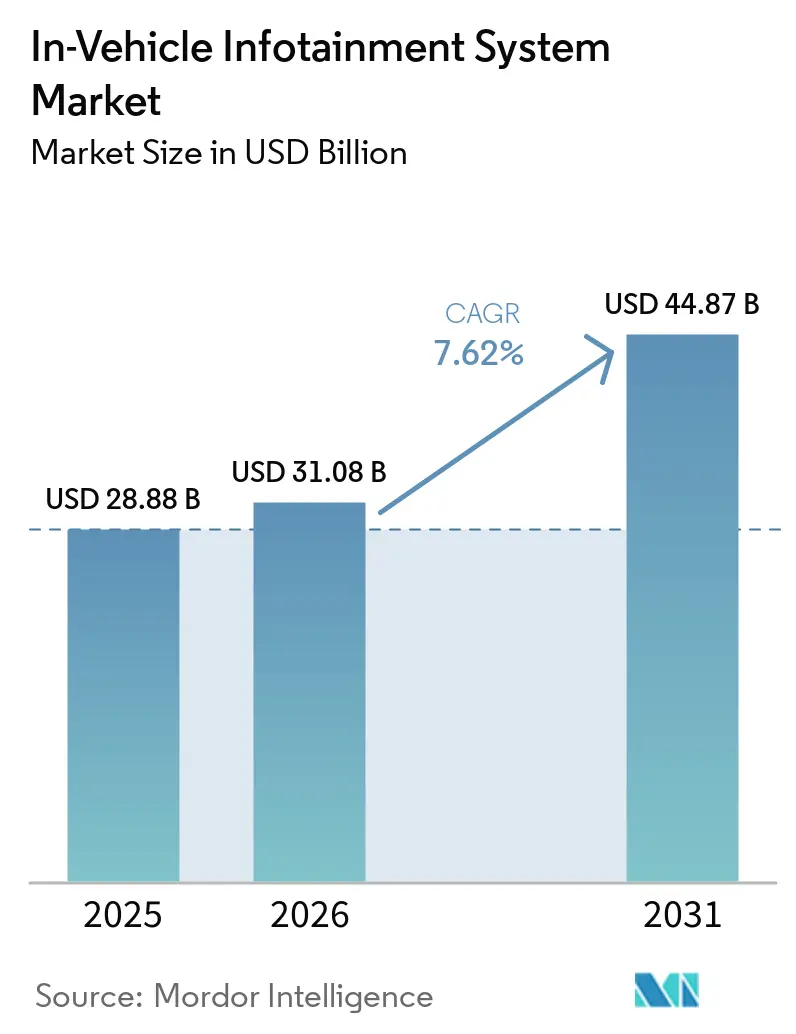
The in-vehicle infotainment system market size was valued at USD 28.88 billion in 2025 and is expected to increase from USD 31.08 billion in 2026 to USD 44.87 billion by 2031, growing at a CAGR of 7.62% over 2026-2031. The in-vehicle infotainment system market is moving toward software-based cockpit systems that combine connectivity, personalization, and post-delivery services. Automakers are treating the cockpit as a continuing customer interface rather than a fixed entertainment feature. Voice interaction, connected services, and software updates are raising the value of systems that can remain current after sale. The shift also favors suppliers that can combine display, audio, connectivity, and software functions within a reliable vehicle platform. Regulation and cybersecurity requirements are increasing the importance of telematics-ready and secure designs in the in-vehicle infotainment system market.
Key Report Takeaways
- By component, display units held 42.98% of the in-vehicle infotainment system market share in 2025, while communication units are forecast to grow at a 13.12% CAGR through 2031.
- By operating system, Android held 67.08% of the in-vehicle infotainment system market share in 2025 and is forecast to grow at a 15.84% CAGR through 2031.
- By installation type, in-dash systems held 80.46% of the in-vehicle infotainment system market share in 2025, while rear-seat systems are forecast to grow at a 12.45% CAGR through 2031.
- By vehicle type, passenger cars held 74.72% of the in-vehicle infotainment system market share in 2025, while light commercial vehicles are forecast to grow at an 11.01% CAGR through 2031.
- By geography, Asia-Pacific held 37.78% of the in-vehicle infotainment system market share in 2025, while the Middle East and Africa are forecast to grow at a 10.34% CAGR through 2031.
Note: Market size and forecast figures in this report are generated using Mordor Intelligence’s proprietary estimation framework, updated with the latest available data and insights as of January 2026.
Global In-Vehicle Infotainment System Market Trends and Insights
Drivers Impact Analysis*
| Driver | (~)% Impact on CAGR Forecast | Geographic Relevance | Impact Timeline |
|---|---|---|---|
| Generative-AI Voice Assistants | +1.8% | Global; led by North America, Europe, East Asia | Short term (≤ 2 years) |
| Advanced Vehicle Demand | +1.5% | Global; concentrated in North America, Europe, Asia-Pacific | Medium term (2-4 years) |
| eCall and Telematics Mandates | +1.2% | Europe (EU-mandated); spill-over to APAC and MEA | Short term (≤ 2 years) |
| Connected-Car Data Services | +1.0% | Global; strongest in North America and China | Medium term (2-4 years) |
| Rising Integration of Smartphone Mirroring | +0.8% | Global; high penetration in North America and Europe | Short term (≤ 2 years) |
| Monetization of Cockpit Data | +0.6% | North America and Europe; emerging in APAC | Long term (≥ 4 years) |
| Source: Mordor Intelligence | |||
Emergence of Generative-AI Voice Assistants
Generative AI voice systems are changing how automakers define the role of an in-vehicle infotainment system market product. These tools can support natural requests and connect vehicle controls with navigation, media, and other digital services. BMW stated that its 2026 iX3 introduced a generative AI assistant and that the technology will expand across specified vehicle programs during 2026[1]BMW Group, “The BMW iX3 Ushers in Next-Generation Innovations at CES 2026,” BMW Group Press, press.bmwgroup.com. This direction makes voice control a more central part of the cabin experience, particularly when drivers need to keep their attention on the road. Automakers that develop their own AI experience can retain greater control over customer data and product design. They also take on more responsibility for software development, testing, and ongoing support.
Increasing Demand for Advanced Vehicles
Electric vehicles and higher-trim models are bringing larger screens and richer digital functions into more vehicle classes. This broadens demand in the in-vehicle infotainment system market beyond premium models. Software-defined vehicle designs connect infotainment with other vehicle software, making the cockpit a more important integration point. Panasonic Automotive Systems said its infotainment system was selected for the new Toyota RAV4 and works with the Arene software platform for software updates[2]"Panasonic Automotive Systems IVI debuts in Toyota RAV4," Automotive World Ltd, automotiveworld.com. Such arrangements make it important for suppliers to provide systems that can work with an automaker’s chosen software architecture. They also raise the competitive threshold for suppliers that offer only standalone hardware.
Regulatory Mandates for eCall and Telematics
European eCall rules are strengthening the need for vehicle systems that support newer cellular networks. Commission Delegated Regulation (EU) 2025/1871 sets out updated technical requirements connected with 4G and 5G eCall deployment, with the relevant standards applying from 2027[3]European Union, “Commission Delegated Regulation (EU) 2025/1871,” EUR-Lex, eur-lex.europa.eu. These requirements encourage automakers to consider telematics capabilities when selecting infotainment systems. The effect extends beyond emergency calling because the same connectivity architecture can support service updates and connected features. The in-vehicle infotainment system market, therefore, benefits when compliance needs coincide with a broader vehicle technology refresh. Suppliers must still meet vehicle approval requirements and protect the system from unauthorized access.
Growing Adoption of Connected-Car Data Services
Connected services are pushing automakers to build vehicles with persistent, secure links to cloud-based functions. The in-vehicle infotainment system market supplies the interface through which drivers and passengers use many of these services. Navigation, media, remote vehicle functions, payments, and service notifications can all appear within the cockpit. Google has reported the continuing expansion of Android Auto and Google built-in across its automotive offerings. This gives automakers access to familiar consumer services, but it also increases their dependence on external platforms. Suppliers are responding by building systems that support secure connectivity, application updates, and multiple user profiles.
Restraints Impact Analysis*
| Restraint | (~) % Point Impact on Market CAGR | Geographic Relevance | Impact Timeline |
|---|---|---|---|
| Cybersecurity Vulnerabilities | -0.9% | Global | Short term (≤ 2 years) |
| System Integration Complexity | -0.8% | Global; highest complexity in APAC multi-tier supply chains | Medium term (2-4 years) |
| Price Sensitivity in Emerging Markets | -0.6% | APAC (emerging economies), South America, MEA | Medium term (2-4 years) |
| Thermal and Power-Management Limits of OLED Displays | -0.4% | Global; highest impact in premium segments | Long term (≥ 4 years) |
| Source: Mordor Intelligence | |||
Cybersecurity Vulnerabilities in Connected Vehicles
As infotainment systems become a gateway to connected vehicle functions, cybersecurity becomes a design requirement. A security weakness can affect customer trust, software launch schedules, and approval processes. The in-vehicle infotainment system market must support secure software updates, access controls, and separation between entertainment functions and safety-related systems. European vehicle cybersecurity rules require manufacturers to manage cyber risks across applicable vehicle types and electronic systems. These obligations can increase development work for suppliers and automakers. They can also favor firms that already have established security engineering and testing processes.
Complexity in System Integration
Vehicle software is increasingly organized around shared computing platforms rather than separate electronic domains. This makes infotainment integration more difficult because systems must work with displays, connectivity, driver-assistance functions, and automaker-specific software. The in-vehicle infotainment system market faces longer validation cycles when a cockpit program combines several functions on one computing platform. Suppliers must balance fast screen response and consumer-style usability with vehicle safety and reliability requirements. Integration can be especially difficult when several companies contribute hardware, operating systems, applications, and connectivity services. The burden can delay launches, although established platform relationships may reduce the risk for automakers over time.
*Our forecasts treat driver/restraint impacts as directional, not additive. The impact forecasts reflect baseline growth, mix effects, and variable interactions.
Segment Analysis
By Component: Communication Units Support the Connected Cockpit
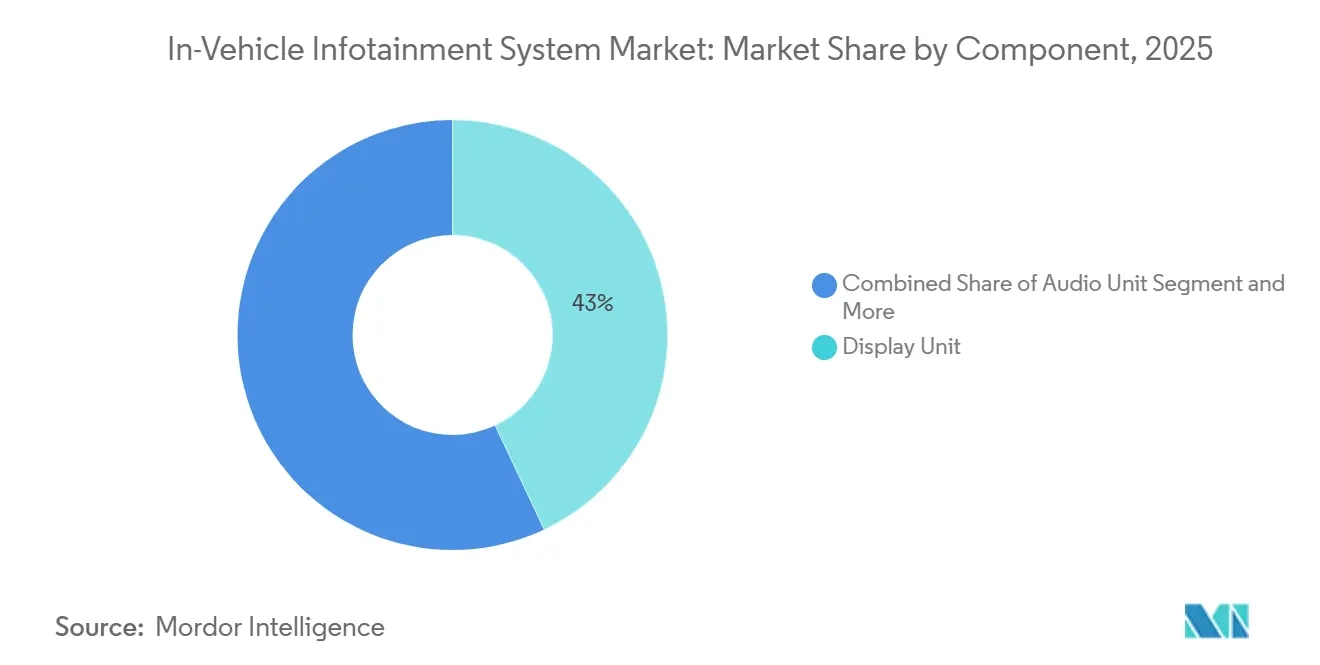
Display units held 42.98% of the in-vehicle infotainment system market share in 2025. Their position reflects the central role of the screen as the main point of interaction for navigation, media, and vehicle settings. Large touch displays are now used across a wider range of passenger vehicles. Suppliers are also combining display functions with audio and lighting features to simplify dashboard design. A cleaner dashboard layout can give automakers more freedom to shape the cabin around a consistent digital interface. Audio units remain important for cabin experience, while embedded navigation is facing pressure from cloud-based route guidance. The component mix is shifting toward systems that can handle higher levels of data, media, and connectivity. Automakers also need display systems that remain easy to read and operate in varied driving conditions.
Communication units are forecast to grow at a 13.12% CAGR through 2031, the fastest rate among components. This part of the in-vehicle infotainment system market supports cellular links, vehicle-to-everything communication, and connected services. The move toward newer eCall networks also increases the need for communication hardware that meets current requirements. A suitable communication unit helps an automaker manage updates, emergency functions, and service connections from a common platform. It also supports the steady exchange of information between the vehicle, the user, and approved external services. Suppliers with proven modem integration can be better positioned during vehicle design cycles. Demand also depends on the quality of network coverage and the pace at which automakers introduce connected features.



By Operating System: Android Strengthens Its Position in the Cockpit
Android held 67.08% of the in-vehicle infotainment system market share in 2025. Its position reflects consumer familiarity and the availability of applications, voice services, and connected content. Android Automotive OS gives automakers an embedded operating system, while Android Auto supports phone-based mirroring. Google has described the wider use of its automotive software offerings across vehicle programs. This creates a practical route for automakers that want a recognizable user experience without building every service internally. It also makes integration with digital maps, media, and app ecosystems easier. A common software foundation can simplify user training and support as models are updated. The result is a stronger role for operating-system decisions in vehicle program planning.
Android is forecast to grow at a 15.84% CAGR through 2031, the fastest rate within the operating-system category. This expansion is tied to the wider use of software-defined vehicle platforms and over-the-air updates. The in-vehicle infotainment system market gains from operating systems that can support more applications and regular feature updates. These systems also allow automakers to adapt selected functions after the vehicle reaches the customer. Linux continues to have a role where customization and technical control are important. QNX also remains relevant in architectures that need established safety support or separation between functions.
By Installation Type: Rear-Seat Systems Add New Cabin Uses
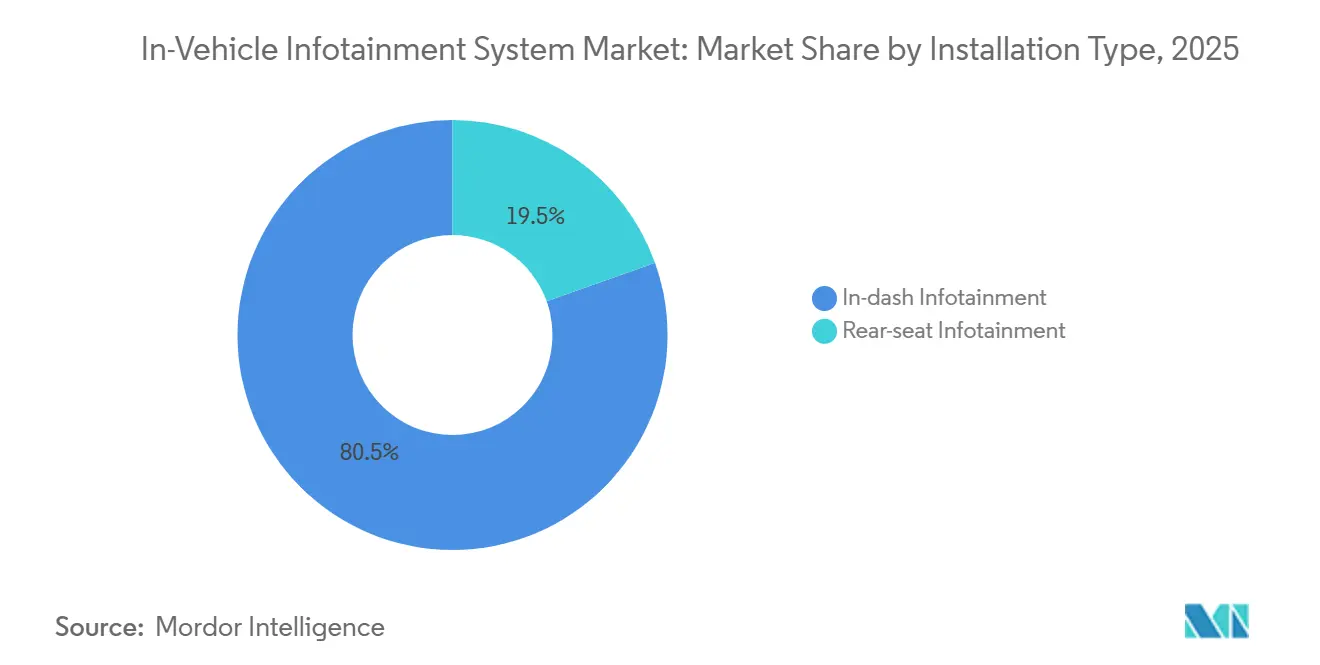
In-dash systems held 80.46% of the in-vehicle infotainment system market share in 2025. They remain the main cabin interface because they bring together navigation, media, vehicle controls, and driver information. The in-dash system is often planned early in a vehicle development program because it shapes the dashboard layout and software architecture. As cockpits add more screens, the in-dash position is becoming part of a larger display and computing arrangement. It must work reliably with other cabin displays without distracting the driver. Suppliers must ensure that the system remains readable and responsive in changing light conditions. It must also support connectivity and cybersecurity features without making the experience difficult to use. These requirements keep in-dash systems central to vehicle cockpit investment.
Rear-seat infotainment is forecast to grow at a 12.45% CAGR through 2031, the fastest rate in this category. Automakers are using these systems to offer media and gaming options to passengers, particularly in premium vehicles and electric vehicles. The in-vehicle infotainment system market can benefit when rear-seat screens are linked to subscriptions and other digital services. These products create a separate user experience from the driver-focused in-dash system. They can also make better use of time spent in the vehicle by passengers who are not driving. They require careful management of content rights, payments, and network capacity. Carmakers must decide which services are included with the vehicle and which are offered as recurring options. This means that commercial planning is as important as display hardware for the segment.
By Vehicle Type: Commercial Use Broadens Cockpit Requirements
Passenger cars held 74.72% of the in-vehicle infotainment system market share in 2025. Their leadership reflects higher production volumes and the broad availability of infotainment features across vehicle price points. Passenger cars are also where new cockpit functions often appear before reaching other vehicle types. The in-vehicle infotainment system market is being shaped by systems that connect displays, voice interaction, navigation, and updates within a single experience. Hyundai Motor Group has presented Pleos Connect as a next-generation infotainment platform focused on intuitive use, safety, and openness. Such programs show how voice and software functions are becoming part of mainstream vehicle planning. Automakers also use these systems to give different models a more consistent cabin experience. Passenger-car demand will continue to depend on model launches, consumer expectations, and software platform decisions.
Light commercial vehicles are forecast to grow at an 11.01% CAGR through 2031, the fastest rate among vehicle types. Fleet operators increasingly want cockpit systems that bring navigation, driver communication, vehicle information, and operational tools together. The in-vehicle infotainment system market can serve these needs through interfaces designed for daily commercial use. A well-integrated system can reduce the need for drivers to move between separate devices during a workday. Commercial vehicle customers tend to assess systems based on reliability, operating value, and how easily they work with fleet processes. They may adopt new features more gradually than passenger-car buyers because fleet replacement cycles can be longer. However, telematics requirements and the need to improve driver productivity support demand for more capable systems.
Geography Analysis
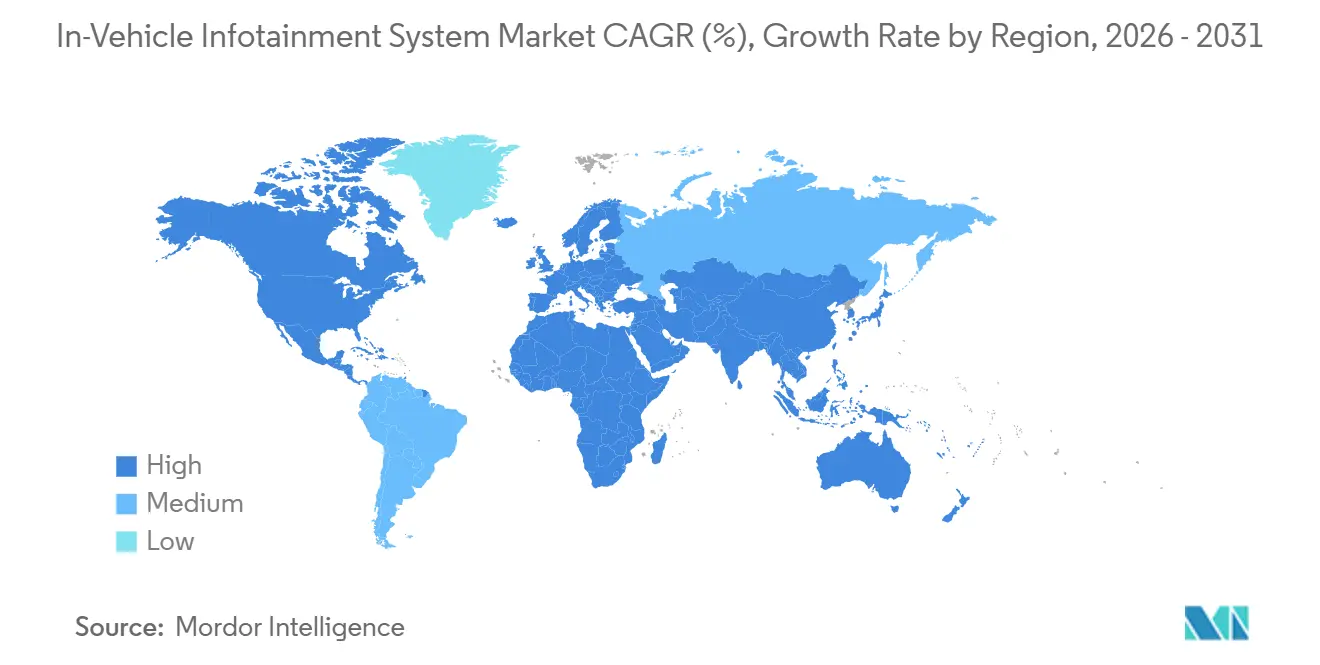
Asia-Pacific held 37.78% of the in-vehicle infotainment system market share in 2025. China’s large vehicle base and rapid adoption of digital cockpit features support regional demand. Japan and South Korea add established automotive suppliers and strong domestic automaker relationships. India offers demand for more cost-conscious cockpit designs as its passenger-vehicle base expands. Local automakers and suppliers are also influencing product design through faster development cycles and different customer preferences. This makes it important for global suppliers to adapt interfaces, content, and connectivity choices to each country. Panasonic Automotive Systems’ work with Toyota on the new RAV4 shows how regional suppliers can secure programs intended for wide international distribution.
North America remains important because of its premium vehicle mix, mature connectivity infrastructure, and strong presence of technology providers. Automakers in the region are looking for systems that support connected services and familiar digital experiences. Europe has a related demand base, but regulatory requirements add a distinct reason to refresh telematics-capable vehicle systems. The European eCall framework supports the adoption of newer connectivity technologies and related vehicle integration work. Germany, the United Kingdom, and France continue to support demand through established vehicle manufacturing and premium brands. Other European markets contribute through mainstream vehicle programs and replacement demand.
The Middle East and Africa is forecast to grow at a 10.34% CAGR through 2031, the fastest regional rate. Rising vehicle imports and demand for well-equipped vehicles support the in-vehicle infotainment system market across selected countries. Gulf markets are particularly relevant for premium vehicle features and connected cabin services. South Africa, Turkey, and Egypt also provide manufacturing or distribution links to nearby markets. The region does not have one uniform demand pattern because income levels, vehicle fleets, and network conditions vary widely. South America remains more price sensitive, with Brazil and Argentina serving as the main sources of regional vehicle demand. Connectivity conditions, local service availability, and vehicle affordability will shape the pace of adoption across both regions.

Competitive Landscape
The in-vehicle infotainment system market spans Tier 1 suppliers, semiconductor firms, software providers, and display specialists. Key players like Harman International, Continental AG, and Pioneer hold strong positions through long-term automaker relationships. Competition has shifted toward integrated systems combining displays, connectivity, and software. Suppliers that manage complex validation and full-system coordination are better placed to win programs, while smaller firms can still compete through specialized software or local integration skills.
Semiconductor and software platforms are reshaping competitive dynamics. Automakers now select computing and operating-system foundations early, which can sideline suppliers focused solely on hardware. Leading Tier 1 firms are responding by partnering to add cloud, AI, and advanced computing to their offerings. BMW's generative AI deployment shows how platform choices influence software updates, data access, and supplier relationships, rewarding those with strong software capability and clear approaches to data security.
Strategic focus has shifted to platform partnerships, display quality, and post-sale services. Panasonic deepened its role in Toyota's software-connected infotainment program, while Google expands through Android Auto and Google Built-in. Hyundai's Pleos Connect targets AI-driven cabin experiences. Automakers are locking in software partners earlier, and suppliers are building longer-term roles through updatable features. Opportunities remain in voice services, commercial vehicles, rear-seat content, and payments.
In-Vehicle Infotainment System Industry Leaders
-
Continental AG
-
Harman International
-
Pioneer Corporation
-
Denso Corporation
-
Panasonic Automotive Systems Co., Ltd.
- *Disclaimer: Major Players sorted in no particular order

Recent Industry Developments
- July 2026: Kia announced plans to introduce Hyundai Motor Group’s next-generation software-defined infotainment platform in future models from 2027. The rollout is intended to provide a more connected and AI-enabled in-car experience across Kia’s global lineup.
- June 2026: BMW Group Middle East added STARZPLAY to BMW and MINI infotainment systems in the region. The integration gives customers access to sports and entertainment content through the vehicle’s cabin interface.
- May 2026: LG Electronics presented Android Automotive OS-based infotainment and software-defined vehicle solutions. The company positioned the products as tools for managing vehicle functions while improving passenger infotainment experiences.
- April 2026: Hyundai Motor Group introduced Pleos Connect as a next-generation infotainment system. The platform combines a mobile-style user environment with AI features and is designed around intuitive use, safety, and openness.


Global In-Vehicle Infotainment System Market Report Scope
The in-vehicle infotainment system market is segmented by component, operating system, installation type, vehicle type, and geography.
By Component, the market is segmented into Audio Unit, Display Unit, Navigation Unit, and Communication Unit. By Operating System, the market is segmented into Android, Linux, QNX, and Others. By Installation Type, the market is segmented into In-dash Infotainment and Rear-seat Infotainment. By Vehicle Type, the market is segmented into Passenger Cars, Light Commercial Vehicles, and Medium and Heavy Commercial Vehicles. By Geography, the market is segmented into North America (United States, Canada, and Rest of North America), South America (Brazil, Argentina, and Rest of South America), Europe (Germany, United Kingdom, France, Italy, Spain, Russia, and Rest of Europe), Asia-Pacific (China, Japan, India, South Korea, Indonesia, Vietnam, Philippines, Australia, and Rest of Asia-Pacific), and Middle East and Africa (Saudi Arabia, United Arab Emirates, Egypt, Turkey, South Africa, and Rest of Middle East and Africa).
Market forecasts are provided in terms of Value (USD).
| Audio Unit |
| Display Unit |
| Navigation Unit |
| Communication Unit |
| Android |
| Linux |
| QNX |
| Others |
| In-dash Infotainment |
| Rear-seat Infotainment |
| Passenger Cars |
| Light Commercial Vehicles |
| Medium and Heavy Commercial Vehicles |
| North America | United States |
| Canada | |
| Rest of North America | |
| South America | Brazil |
| Argentina | |
| Rest of South America | |
| Europe | Germany |
| United Kingdom | |
| France | |
| Italy | |
| Spain | |
| Russia | |
| Rest of Europe | |
| Asia-Pacific | China |
| Japan | |
| India | |
| South Korea | |
| Indonesia | |
| Vietnam | |
| Philippines | |
| Australia | |
| Rest of Asia-Pacific | |
| Middle East and Africa | Saudi Arabia |
| United Arab Emirates | |
| Egypt | |
| Turkey | |
| South Africa | |
| Rest of Middle East and Africa |
| By Component | Audio Unit | |
| Display Unit | ||
| Navigation Unit | ||
| Communication Unit | ||
| By Operating System | Android | |
| Linux | ||
| QNX | ||
| Others | ||
| By Installation Type | In-dash Infotainment | |
| Rear-seat Infotainment | ||
| By Vehicle Type | Passenger Cars | |
| Light Commercial Vehicles | ||
| Medium and Heavy Commercial Vehicles | ||
| By Geography | North America | United States |
| Canada | ||
| Rest of North America | ||
| South America | Brazil | |
| Argentina | ||
| Rest of South America | ||
| Europe | Germany | |
| United Kingdom | ||
| France | ||
| Italy | ||
| Spain | ||
| Russia | ||
| Rest of Europe | ||
| Asia-Pacific | China | |
| Japan | ||
| India | ||
| South Korea | ||
| Indonesia | ||
| Vietnam | ||
| Philippines | ||
| Australia | ||
| Rest of Asia-Pacific | ||
| Middle East and Africa | Saudi Arabia | |
| United Arab Emirates | ||
| Egypt | ||
| Turkey | ||
| South Africa | ||
| Rest of Middle East and Africa | ||


Key Questions Answered in the Report
What is driving demand for in-vehicle infotainment systems?
Software-defined vehicle designs, connected services, voice interaction, and telematics requirements are expanding the role of cockpit systems.
Which component is growing fastest in in-vehicle infotainment?
Communication units are forecast to grow at a 13.12% CAGR through 2031 because connected services and newer cellular systems need stronger vehicle connectivity.
Why is Android important for automotive infotainment?
Android led operating-system deployments in 2025 and supports embedded vehicle software as well as phone-based mirroring and digital applications.
What is the main challenge for connected car infotainment?
Cybersecurity and system integration remain important challenges because vehicle systems must protect data while working across multiple software and hardware layers.
Which vehicle type offers the fastest growth for infotainment suppliers?
Light commercial vehicles are forecast to grow at an 11.01% CAGR through 2031 as fleet operators seek integrated navigation, communication, and operational tools.
Page last updated on:





