
Automotive Telematics System Market Size and Share
Market Overview
| Study Period | 2021 - 2031 |
|---|---|
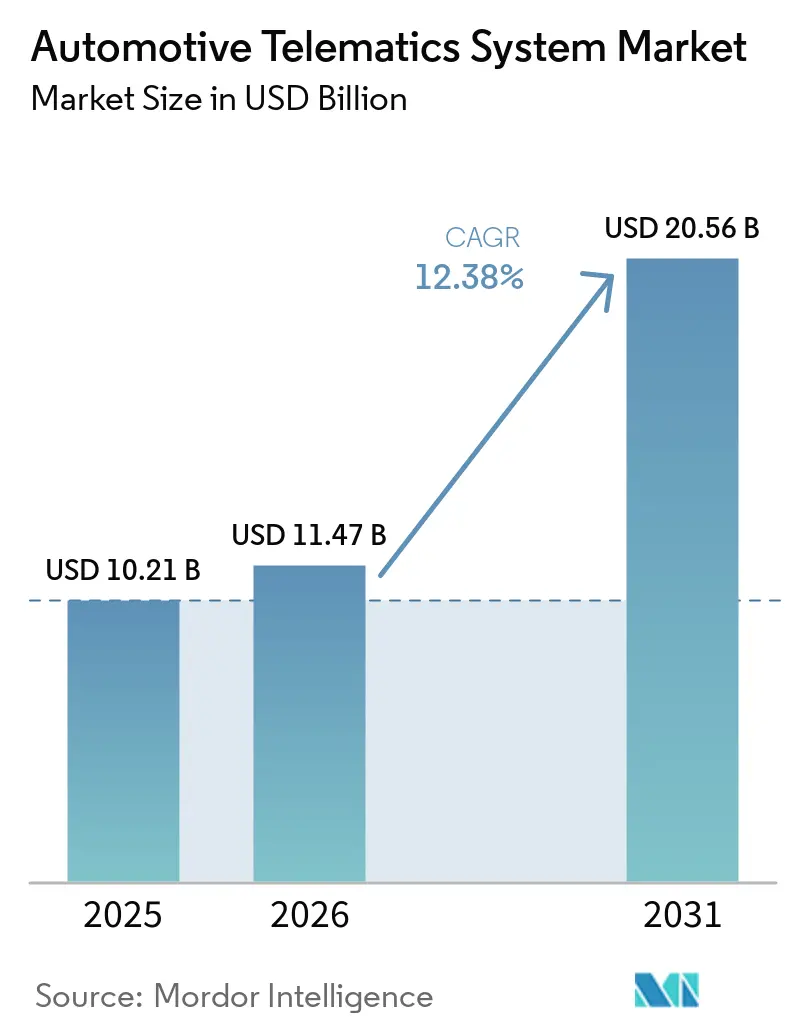
| Market Size (2026) | USD 11.47 Billion |
| Market Size (2031) | USD 20.56 Billion |
| Growth Rate (2026 - 2031) | 12.38 % |
| Fastest Growing Market | Asia-Pacific |
| Largest Market | North America |
| Market Concentration | Medium |
Major Players *Disclaimer: Major Players sorted in no particular order Image © Mordor Intelligence. Reuse requires attribution under CC BY 4.0. | |
Automotive Telematics System Market Analysis by Mordor Intelligence
Automotive telematics system market size in 2026 is estimated at USD 11.47 billion, growing from 2025 value of USD 10.21 billion with 2031 projections showing USD 20.56 billion, growing at 12.38% CAGR over 2026-2031. Rising regulatory requirements for in-vehicle emergency calls, falling connectivity costs, and the shift toward software-defined vehicles are expanding baseline connectivity across model ranges. Commercial operators are turning to telematics to offset fuel volatility and driver shortages, which lifts demand for fleet-management platforms capable of double-digit fuel savings and crash reduction. Growth opportunities also stem from electric-vehicle charging optimization, vehicle-to-grid services, and emerging API marketplaces that let third parties purchase anonymised data streams.
Key Report Takeaways
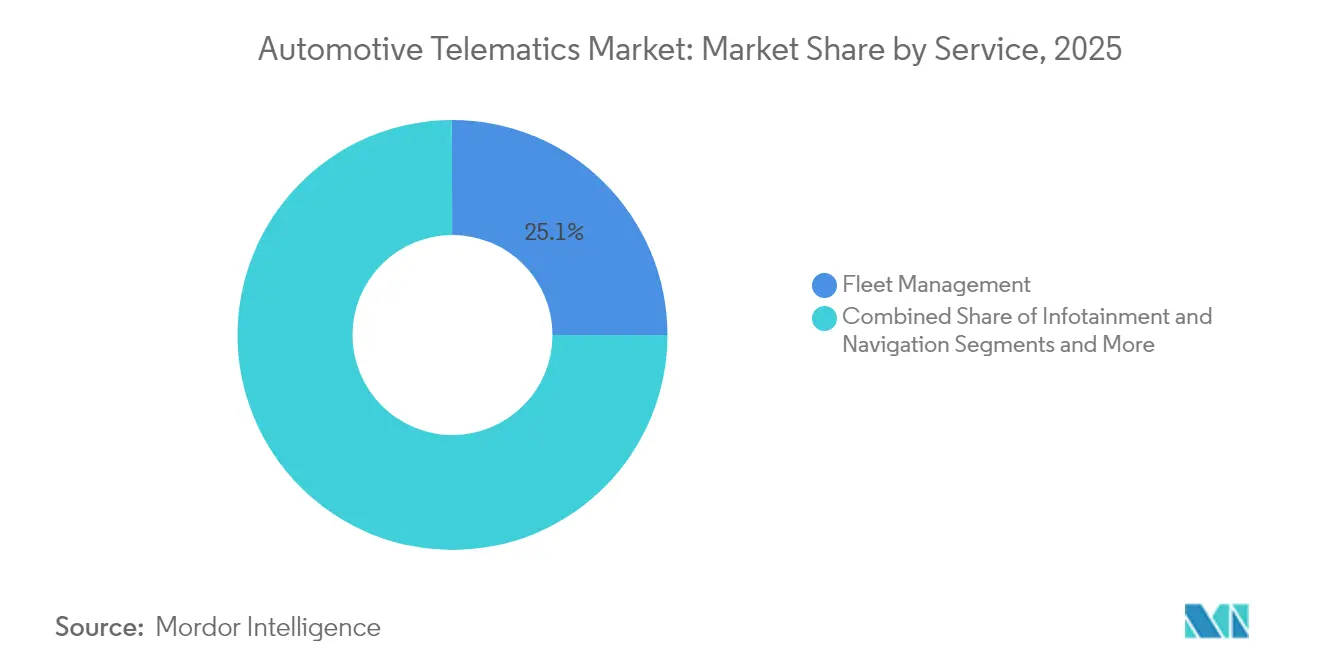
- By service, fleet management led with 25.05% revenue share in 2025, whereas V2X & OTA updates are projected to expand at a 31.02% CAGR to 2031.
- By sales channel type, OEM-fitted systems accounted for 66.45% of the automotive telematics market share in 2025, while the aftermarket is set to grow at 19.2% CAGR through 2031.
- By connectivity solution, embedded architectures held 69.40% of the automotive telematics market size in 2025 and are advancing at a 27.1% CAGR.
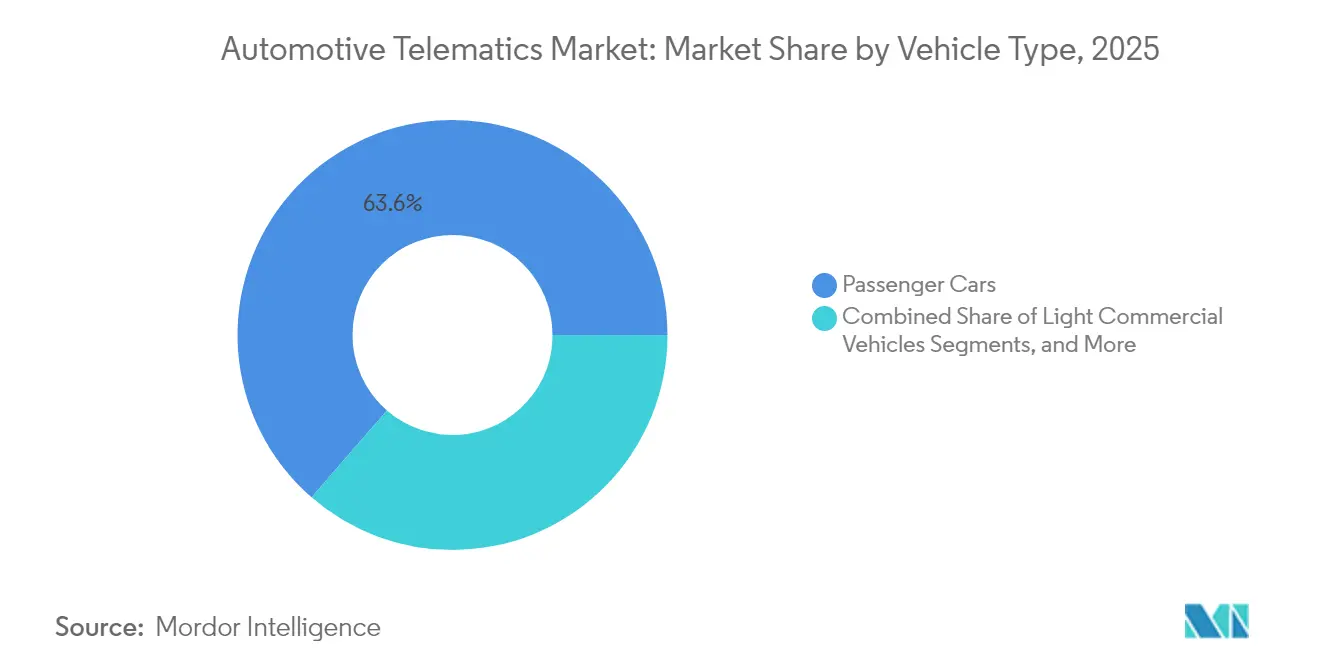
- By vehicle type, passenger cars contributed 63.62% of 2025 revenue; light commercial vehicles are forecast to grow at 17.9% CAGR between 2026-2031.
- By end-user, fleet operators captured 32.70% of 2025 revenue, whereas car-sharing and mobility providers will record the fastest growth at 24.85% CAGR.
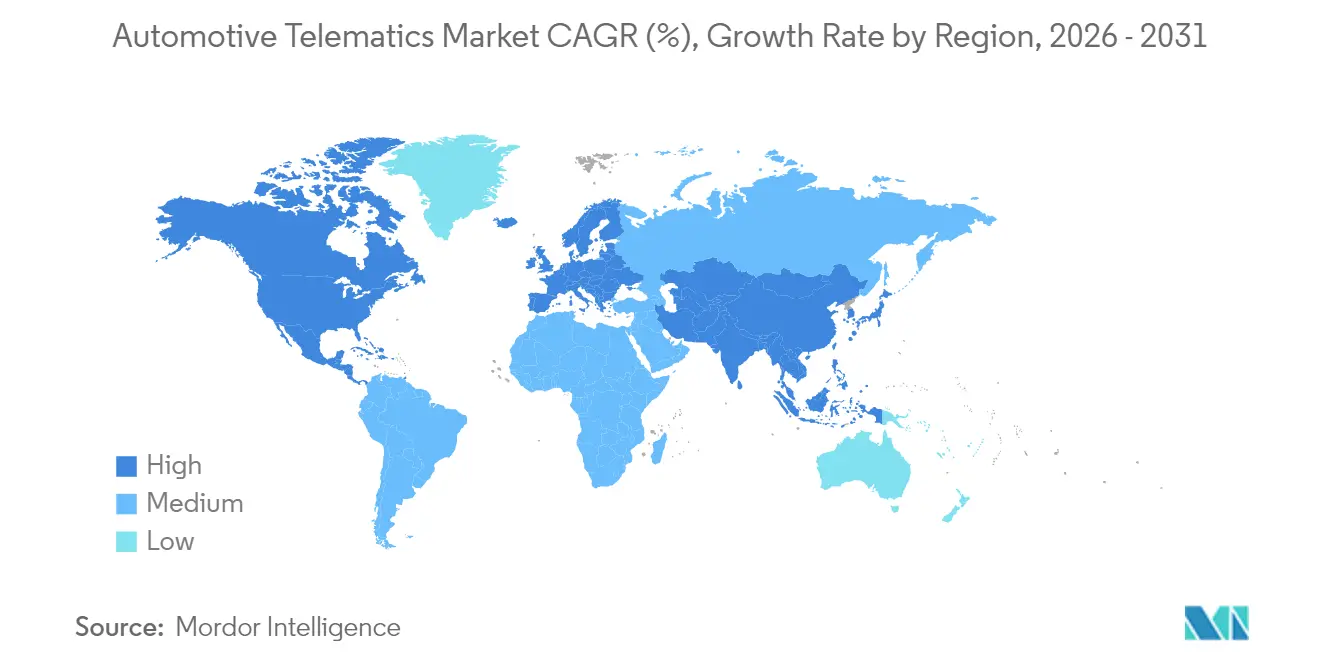
- By geography, North America maintained a 26.90% revenue share in 2025; Asia-Pacific is rising at a 20.9% CAGR on the back of Chinese and Indian digitisation mandates.
Note: Market size and forecast figures in this report are generated using Mordor Intelligence’s proprietary estimation framework, updated with the latest available data and insights as of 2026.
Global Automotive Telematics System Market Trends and Insights
Drivers Impact Analysis*
| Driver | (~) % Impact on CAGR Forecast | Geographic Relevance | Impact Timeline |
|---|---|---|---|
| Government eCall Mandates | +2.1% | Europe, Russia, Brazil, spillover to APAC | Medium term (2–4 years) |
| Fleet-Optimization Amid Fuel Volatility | +1.8% | Global; focus on North America & Europe | Short term (≤ 2 years) |
| Usage-Based-Insurance Adoption | +1.5% | North America, Europe, core APAC markets | Medium term (2–4 years) |
| EV Charging-Network Integration | +1.2% | China, EU, California | Long term (≥ 4 years) |
| Monetization of In-Vehicle Data | +0.9% | Developed markets | Long term (≥ 4 years) |
| UNECE OTA-Cyber-Security Regulations | +0.7% | Europe; global harmonization | Medium term (2–4 years) |
| Source: Mordor Intelligence | |||
Government eCall & Similar Mandates Drive Baseline Connectivity
Mandatory emergency-call systems under the EU eCall regulation and comparable rules in Russia and Brazil have made cellular modules standard equipment in new passenger cars, laying a foundation for added paid services[1]“eCall: Life-Saving Automatic Emergency Call System,” European Commission, europa.eu. Countries in Asia–Pacific are drafting alike frameworks, ensuring the automotive telematics market keeps a minimum penetration rate even in budget segments. Automakers leverage this compulsory hardware for value-added remote diagnostics and stolen-vehicle recovery, which lifts average revenue per unit. Tier-1 suppliers respond with integrated 5G TCUs that meet both accident notification and over-the-air-update needs. The resulting installed base expedites scale economies, pushing unit costs down and facilitating wider mass-market deployment.
Fleet-Optimization Demand Intensifies Amid Fuel-Price Volatility
Diesel and gasoline price swings continue to pressure logistics margins, prompting fleets to adopt real-time telematics that cut idle time and penalize aggressive driving. Studies show 10–15% fuel-cost reduction when advanced routing and driver coaching modules are enabled. Insurer analyses covering US and UK fleets find crash and claim frequencies fall more than 70% once telematics data is fused with driver-training programs. Utilities, construction firms, and municipal services now embed telematics in procurement policies, broadening the end-user base beyond long-haul trucking. Artificial-intelligence add-ons that predict maintenance further improve uptime, increasing the platform’s payback and accelerating adoption in mixed-asset fleets.
Usage-Based-Insurance Adoption Accelerates Insurer Digital Transformation
North American and European carriers have moved personalized premium models from pilot to mainstream, with 65% of policy-holders opting into app- or dongle-based monitoring programs. Real-time feedback nudges safer behaviour, and actuarial data confirms a double-digit drop in loss ratios, delivering rapid ROI to underwriters. Asia–Pacific regulators, notably in South Korea and Australia, support pay-as-you-drive tariffs, which stimulate cross-regional knowledge transfer and product standardization. Partnerships between insurers and automakers to access embedded data via secure APIs remove the cost of aftermarket hardware. As telematics-driven pricing gains consumer acceptance, the automotive telematics market experiences a virtuous circle of higher data volumes and improved risk models.
EV Charging-Network Integration Creates New Service Paradigms
Vehicle-to-grid trials in California and Denmark prove that bidirectional charging can triple the value of managed charging compared with unidirectional methods. Automakers embed telematics to orchestrate charge scheduling, state-of-charge alerts, and grid-service participation, which ensures battery-health safeguards comply with warranty terms. Utilities in the western United States aim for 5–15% onboarding of EV owners into demand-response schemes by 2027 [2]“2025 Vehicle-to-Grid Integration Assessment,” U.S. Department of Energy, energy.gov. These programs rely on secure, low-latency data exchanges governed by ISO 15118 and Open Charge Point Protocol, driving demand for cyber-hardened telematics modules. Charging service providers increasingly bundle connectivity in subscription plans, opening a fresh recurring-revenue pool for OEMs and platform vendors.
Restraints Impact Analysis*
| Restraint | (~) % Impact on CAGR Forecast | Geographic Relevance | Impact Timeline |
|---|---|---|---|
| High Device and Data-Plan Cost | -1.9% | Emerging markets: entry-level vehicles worldwide | Short term (≤ 2 years) |
| Persistent Semiconductor Shortages | -1.4% | Global, acute in Asian manufacturing hubs | Medium term (2–4 years) |
| Data-Privacy and Sovereignty Laws | -1.1% | Europe, North America, and expanding across APAC | Long term (≥ 4 years) |
| Country-Specific Telematics Taxation | -0.8% | Global; jurisdiction-dependent | Medium term (2–4 years) |
| Source: Mordor Intelligence | |||
High Device & Data-Plan Costs Limit Entry-Level Market Penetration
Low-margin vehicle segments in India, Brazil and Southeast Asia face consumer price sensitivity that squeezes optional connectivity features. Data-plan fees constitute a larger share of household spending in these markets, making subscription renewals particularly challenging. Local mobile operators rarely provide pan-regional M2M tariffs, adding complexity to exports. Hardware makers are miniaturizing chipsets and system-on-modules to cut bill-of-materials costs, yet inflationary headwinds in 2025 offset part of the gain. Flexible pay-per-use plans and government incentives for road-safety solutions could mitigate the barrier but are unevenly implemented.
Semiconductor Shortages Disrupt Telematics Hardware Supply Chains
While automotive chip availability improved compared with the 2021-2022 crisis, tight 28 nm and 16 nm capacity persists, affecting telematics control units and 5G modems. The Embedded OEMs segment dominates the global telematics control unit market, commanding approximately 77% market share in 2024, while also exhibiting the strongest growth trajectory with a projected growth rate of around 15% during 2024-2029. Automotive silicon represents 17% of global semiconductor sales, with Taiwan’s TSMC holding up to 80% share in mature nodes [3]“Semiconductor Supply Chain Risk,” U.S. Chamber of Commerce, uschamber.com. Shipping delays ripple through telematics retrofit programs, forcing fleets to prolong vehicle lifecycles or defer digital upgrades. Automakers are redesigning boards for multi-sourcing and adopting chiplet architectures, yet qualification cycles extend lead times. Investment in local fab capacity will ease constraints only toward the end of the forecast horizon.
*Our forecasts treat driver/restraint impacts as directional, not additive. The impact forecasts reflect baseline growth, mix effects, and variable interactions.
Segment Analysis
By Service: Fleet Management Anchors Market While V2X Accelerates
Fleet-management services generated the largest revenue slice in 2025, capturing 25.05% of the automotive telematics market, while demand for vehicle tracking system market solutions continues to grow among logistics and field-service fleets. Logistics, utilities, and field-service fleets rely on routing optimization, fuel monitoring, and driver coaching to maintain margins amid volatile diesel prices. Safety and security modules remain a staple, and predictive-maintenance dashboards help defer costly roadside breakdowns. Diagnostics APIs that integrate with enterprise resource-planning systems are now standard in Western fleets and are gaining traction in Southeast Asia. The automotive telematics market size for V2X & OTA services is projected to expand at 31.02% CAGR, propelled by software-defined vehicle architectures that demand continuous feature deployment. Automakers use dual-radio modules to support both cellular-V2X and 5.9 GHz ITS-G5, unlocking cooperative perception, traffic-signal priority, and over-the-air firmware upgrades that keep vehicles compliant with evolving safety standards.
Second-order demand sources include insurer partnerships that add crash-AI reconstruction to V2X data feeds, improving liability assessments. Infotainment vendors also see an upgraded pathway from one-way streaming to bi-directional cloud gaming, creating incremental data-plan usage. Policy initiatives such as the U.S. DOT’s 5G Roadmap encourage transportation-infrastructure owners to enable lane-level warnings, fostering an ecosystem where public and private datasets converge. Consequently, telematics platforms bundle edge-computing resources and virtualized network functions to meet varying latency and bandwidth requirements across service tiers.



By Sales Channel Type: OEM Integration Dominance Faces Aftermarket Pressure
Factory-installed telematics controlled 66.45% of 2025 revenue as automakers seized data ownership and ensured seamless human-machine interface integration. European eCall mandates and proliferating EV remote-management features further support embedded adoption at the assembly line. The automotive telematics market share of aftermarket boxes, however, is set to escalate as legacy fleets and private owners retrofit non-connected vehicles, a segment growing at 19.2% CAGR. Aftermarket suppliers differentiate through rapid installation, device-agnostic cloud dashboards, and pay-as-you-go contracts.
Ride-hailing operators rely on aftermarket solutions to standardize data across mixed vehicle makes, enabling unified fleet analytics. Yet OEMs are countered by exposing freemium APIs to entice developers, which may cannibalize aftermarket add-ons over the medium term. Regulatory scrutiny over data portability under the EU Data Act could tip bargaining power toward third-party service providers, potentially reshaping channel economics.
By Connectivity Solution: Embedded Systems Lead Despite Integration Challenges
Embedded modules delivered 69.40% of 2025 revenue and are growing at 27.1% CAGR, primarily because they guarantee antenna placement, power management, and cybersecurity compliance that tethered smartphones struggle to match. A GSMA outlook anticipates more than 600 million embedded-connected cars on the road by 2025. The automotive telematics market size tied to embedded architectures scales further as shared data plans let drivers bundle vehicles with existing mobile subscriptions, enhancing stickiness.
Nevertheless, integrated-smartphone solutions remain pivotal in cost-sensitive segments where consumers value flexibility over deep vehicle integration. They serve as a steppingstone, generating behavioral datasets that encourage users to upgrade to embedded packages at vehicle replacement. Tethered dongles comprise a niche yet persistent category, especially in asset tracking and cold chain monitoring where temporary deployments are necessary.
By Vehicle Type: Commercial Segments Drive Electrification Adoption
Passenger cars retained the largest slice of revenue, accounting for 63.62% of the 2025 automotive telematics market share, thanks to universal eCall mandates and mature infotainment ecosystems that encourage consumer adoption. SUVs and MPVs show the highest feature penetration because higher sticker prices support bundled connectivity packages, whereas sedans and hatchbacks still register steady uptake as embedded hardware costs fall. Usage-based insurance programs now attract large chunk of global drivers, reinforcing data-rich telematics services that enhance underwriting accuracy. Heavy commercial vehicles keep robust adoption in long-haul logistics, where real-time route optimization and driver-behaviour monitoring deliver measurable fuel and safety gains. Two-wheeler connectivity remains nascent but is gaining ground in dense urban centers and last-mile delivery fleets that require theft tracking and ride-sharing integration.
Light commercial vehicles represent the fastest-growing category, advancing at an 17.9% CAGR through 2031 as fleet operators digitize vans and pickups to navigate fuel-price swings and tight delivery windows. Operators that pair telematics with driver-training tools report up to 72% crash-and-claim reduction, underlining the segment’s return on investment. Government incentives for zero-emission delivery zones push OEMs to embed 4G/5G modules at the factory, while aftermarket suppliers rush to provide retrofit kits for legacy diesel fleets. Together, these dynamics elevate commercial segments from a cost-control tool to a strategic pillar in electrified, data-centric logistics operations
By End-User: Fleet Operators Lead While Mobility Providers Accelerate
Fleet-operator demand formed 32.70% of 2025 revenue, driven by compelling ROI calculations on fuel, maintenance, and insurance-cost reduction. The automotive telematics industry sees 51% of surveyed fleets planning feature enhancements within the next 12 months. Car-sharing and subscription businesses are expanding at 24.85% CAGR because telematics underpin keyless access, billing accuracy, and real-time utilization monitoring.
Consumer adoption remains steady, aided by bundled infotainment and safety-alert subscriptions that extend beyond the initial free trial. Leasing companies integrate telematics to monitor asset usage and residual-value risk, often mandating device installation as part of contract terms. The confluence of these end-user groups broadens the data lake, enabling more granular segmentation and personalized service offers.
Geography Analysis
North America retained leadership with 26.90% of 2025 revenue, supported by dense 4G/5G coverage, mature fleet-management adoption, and early migration to usage-based insurance. Federal crash-data standards encourage open APIs that simplify insurer and law-enforcement access, while carrier sunsets of 3G networks drove a wave of hardware upgrades across long-haul carriers and delivery fleets. Strong aftermarket penetration complements factory-fit growth because mixed-brand enterprise fleets require uniform dashboards for compliance reporting.
Asia-Pacific is the fastest-growing territory at a 20.9% CAGR, propelled by China’s connected-vehicle mandates and India’s commercial-vehicle digitization rules that make AIS-140 telematics units compulsory. Local automakers pre-install 4G modules in new-energy vehicles to comply with MIIT data-sharing requirements, generating a large, embedded base for value-added apps. Japan and South Korea run V2X corridor pilots that showcase low-latency safety messages, while Southeast Asian ride-hailing fleets rely on smartphone-centric solutions that are beginning to migrate toward embedded hardware as electric-vehicle warranties demand deeper battery analytics. Regional telecom operators are forming cross-border roaming alliances to cut data costs, a move likely to lift small-fleet adoption in 2026-2027.
Europe delivers steady growth underpinned by universal eCall compliance and emerging CO₂-emission monitoring schemes that use telematics payloads for real-world verification. GDPR and the forthcoming EU Data Act raise operating complexity but also create new market space for privacy-preserving analytics vendors. The Middle East and Africa, though still nascent, gain momentum from Gulf smart-city corridors and South African insurers piloting mileage-based premiums, with satellite-IoT and low-power networks extending reach beyond urban centers. Harmonized UNECE cybersecurity rules apply across these regions, guiding procurement toward compliant hardware and making secure over-the-air update capability a non-negotiable feature for both premium and entry-level vehicles.

Regulatory Landscape
Automotive telematics is shaped by mandatory safety connectivity, vehicle cybersecurity rules, and expanding requirements for secure data access. In Europe, the EU eCall framework continues to embed cellular capability into new vehicles, while UNECE WP.29 regulations (UN R155 for cybersecurity management systems and UN R156 for software update management) have shifted OTA and in-vehicle network security toward type-approval-oriented compliance across many UNECE-contracting markets.
Between 2024 and 2026, policy focus has broadened from safety to data governance and supply-chain controls. The EU Cyber Resilience Act (Regulation (EU) 2024/2847) sets horizontal cybersecurity obligations for products with digital elements, reinforcing security-by-design expectations for telematics control units and connected services. The European Commission adopted Delegated Regulation (EU) 2026/699 on standardized and secure access to on-board diagnostics and repair/maintenance information, tightening requirements around secure gateways and bi-directional access for independent operators. In the United States, trade and national-security measures have also become relevant to telematics hardware and software sourcing, with a January 2025 final rule from the Bureau of Industry and Security addressing Vehicle Connectivity System restrictions tied to certain foreign-origin components and software.
Value Chain Analysis
The automotive telematics value chain runs from component suppliers (automotive-grade processors, memory, GNSS chipsets, cellular modems, antennas, sensors) to Tier-1 module and telematics control unit manufacturers, followed by OEM integration and validation. Connectivity enablement involves MNOs, MVNOs, and eSIM/profile management, while the software and data layers cover cloud ingestion, analytics, driver apps, fleet portals, insurer scoring, and API management. OEM-fitted deployments dominate because they fit vehicle electrical architecture, antenna placement, and compliance needs, while aftermarket device makers and installers support legacy fleets and mixed-brand operators that need fast retrofit and unified dashboards.
A key shift is the growing role of OEM data access hubs and direct integrations that reduce reliance on aftermarket hardware. Partnerships, including Volkswagen Group Info Services AG integrating fleet data into Targa Telematics and Stellantis Mobilisights enabling embedded data access for platforms like Zubie with collaboration involving OCTO, show how OEM-controlled data pipelines are being commercialized for fleet and insurance use cases. On the demand side, fleet platforms increasingly prioritize multi-OEM ingestion, including Geotab and Mercedes-Benz USA launching an integrated telematics solution feeding vehicle data into MyGeotab. Supply-side constraints remain tied to automotive-grade semiconductor availability and long OEM program validation cycles, which affect lead times for TCUs and the pace at which new 4G/5G designs can be industrialized across regions.
Competitive Landscape
Competition sits at a moderate level of concentration as factory-fit solutions from global automakers—including General Motors, Stellantis, Ford, and Toyota—overlap with specialist aftermarket providers such as Verizon Connect, Geotab, Trimble, and TomTom. Pure-play players emphasise data analytics and open-API ecosystems that appeal to enterprise fleets, while Tier-1 suppliers like Continental, Bosch, ZF, and Harman embed 5G and cybersecurity capabilities directly into telematics control units. Technology conglomerates—including LG Electronics and Qualcomm—supply cloud, edge-compute, and AI toolchains that allow smaller brands to white-label end-to-end platforms.
Strategic partnerships define market evolution. LG Electronics invested USD 60.5 million in a Mexican telematics factory, adding 400 jobs to shorten North American supply chains. HERE Technologies expanded its HD mapping collaboration with fleet-management vendors to deliver centimeter-level lane guidance. Cybersecurity vendors capitalize on UNECE R155 compliance audits, offering managed threat-detection services embedded at the TCU and gateway levels. White-space niches such as agricultural equipment, micro-mobility, and off-highway machinery attract start-ups that bundle ruggedized sensors with cloud dashboards.
Technological differentiation hinges on multi-radio (satellite, cellular, Wi-Fi) connectivity, edge-compute offload, and AI-driven predictive models. 5G Release 17 features like reduced-capability NR devices allow cost-effective rural coverage, while vehicle-edge containerization supports low-latency sensor fusion essential for assisted-driving functions. The race to secure developer mindshare intensifies, with OEMs and Tier-1s launching app stores offering SDKs, documentation and revenue-sharing terms. Success factors now encompass data-governance maturity and the ability to provide cross-domain digital twins linking vehicles, infrastructure and energy grids.
Automotive Telematics System Industry Leaders
Robert Bosch GmbH
Continental AG
Denso Corporation
Harman International (Samsung)
Verizon Connect
- *Disclaimer: Major Players sorted in no particular order


Market Opportunities and Future Outlook
Regulation-led standardization around secure access and cybersecurity is creating whitespace for compliant data-access, authentication, and privacy-preserving analytics offerings that connect OEM platforms, independent repair, fleet operators, and insurers. The EU move to formalize standardized and secure access to vehicle OBD and repair/maintenance information via Delegated Regulation (EU) 2026/699 (entering into force in June 2026) increases the emphasis on secure gateway architectures, credentialing, logging, and policy-based data sharing. These are areas where telematics service providers and Tier-1s can differentiate through managed security and scalable API operations.
Supply-chain localization and connectivity resilience are also becoming investable opportunity zones as embedded architectures expand and 5G TCUs proliferate. In June 2026, Optiemus Electronics partnered with Quectel to manufacture automotive 4G/5G modules in Noida, supporting India-centric sourcing for connected-vehicle and telematics deployments. In July 2026, Kontron Automotive launched production of 5G automotive network access devices in Duesseldorf, strengthening European availability of core connectivity hardware. For fleets and commercial vehicles, higher-performance edge processors and assured memory supply enable V2X, OTA, and predictive maintenance workloads, including NXP highlighting increased output for S32G3 vehicle processors aimed at heavy-duty telematics and Micron signing a long-term supply agreement with Ford to strengthen memory and storage availability for next-generation vehicles.
Recent Industry Developments
- July 2026: Continental AG signed a definitive agreement to sell its ContiTech material solutions group to an affiliate of Lone Star Fund XIII, L.P. for EUR 4.0 billion. The transaction sharpens Continental's strategic focus and capital allocation toward its automotive technology portfolio, including software and electronics domains that underpin connected-vehicle and telematics programs.
- March 2026: HARMAN and Viasat announced a collaboration to enable in-cabin voice calls over satellite communications, demonstrated around HARMAN's Ready Connect telematics control unit and connected services stack. Adding satellite as a complementary bearer expands coverage for safety and service continuity in areas with weak terrestrial networks, a capability increasingly relevant for premium and commercial use cases.
- May 2025: HARMAN released its connected services platform to the Eclipse Foundation as open-source code for software-defined vehicle deployments. The move supports a broader developer ecosystem and accelerates reuse of cloud-to-vehicle service building blocks, influencing how OEMs and suppliers scale telematics-backed services and integrations.


Research Methodology Framework and Report Scope
Market Definition and Coverage
This market is sized as the revenue generated from in-vehicle telematics systems and related services that capture, transmit, and use vehicle data for functions like navigation, safety, diagnostics, and fleet tracking across passenger and commercial vehicles.
Scope exclusions: stand-alone infotainment head units that do not enable two-way vehicle data transfer are not counted.
Segmentation Overview
- By Service
- Infotainment and Navigation
- Fleet Management
- Safety & Security
- Diagnostics and Prognostics
- Insurance Telematics
- V2X and OTA Updates
- By Sales Channel Type
- OEM-fitted
- Aftermarket
- By Connectivity Solution
- Embedded
- Integrated-smartphone
- Tethered / Portable
- By Vehicle Type
- Two-Wheelers
- Passenger Cars
- Hatchbacks
- Sedans
- SUVs and MPVs
- Light Commercial Vehicles
- Medium and Heavy Commercial Vehicles
- By End-User
- Private Consumers
- Fleet Operators
- Insurance and Leasing Firms
- Car-Sharing and Mobility Providers
- By Geography
- North America
- United States
- Canada
- Rest of North America
- South America
- Brazil
- Argentina
- Rest of South America
- Europe
- Germany
- United Kingdom
- France
- Italy
- Spain
- Russia
- Rest of Europe
- Asia-Pacific
- China
- Japan
- India
- South Korea
- Rest of Asia-Pacific
- Middle East and Africa
- Egypt
- Turkey
- Saudi Arabia
- United Arab of Emirates
- Rest of Middle East and Africa
- North America
Data Sources, Market Sizing, and Validation
Desk Research
Desk research was used to set the market structure, validate adoption patterns, and anchor the model to real vehicle and connectivity signals before primary inputs were added. We leaned on public sources such as vehicle production and registration statistics from government transport agencies, road safety and eCall documentation from the European Commission, spectrum and connectivity notes from the FCC, and telecommunication indicators published by the ITU.
To tighten assumptions, we also reviewed company annual reports, earnings call transcripts, investor presentations, association websites, and credible press coverage that described connected services rollouts and subscription approaches. In parallel, paid subscriptions focused on company financials and intelligence, news and financials, and patent databases were used selectively to cross-check product direction and reported revenue exposure where disclosures were limited. These desk sources are illustrative only, and we also used other public references for data collection, validation, and clarification.
Primary Interviews and Surveys
Primary work was used to test what is actually being bundled versus sold separately, and how pricing and attach rates move by vehicle class and region. We spoke with a mix of OEM-side product owners, telematics platform and hardware specialists, fleet operators, insurers, and channel partners to close gaps in installation base, churn, and service penetration with practical checks across major regions.
Distribution of primary research fieldwork respondents
| Company type | Respondent position | Region |
|---|---|---|
| Top tier: 35% | CXOs: 15% | APAC: 46% |
| Mid tier: 48% | Functional/Unit leaders: 31% | EMEA: 32% |
| Smaller Players: 17% | Managers: 54% | Americas: 22% |
Market-Sizing & Forecasting
Sizing followed a top-down and bottom-up approach, where vehicle production, parc, and connectivity adoption were first used to reconstruct the addressable pool, and then selective supplier and channel checks were used to verify the totals. The top-down build tied demand to fitted telematics rates in new vehicles plus retrofit activity, and then value was derived using blended pricing for hardware-enabled systems and recurring service revenue.
Key inputs included OEM-fitment share versus aftermarket installations, connected-car subscription attach rates and typical free-trial conversion timing, average service ARPU by use case (fleet, safety, navigation, diagnostics), cellular module penetration and network readiness, and the mix shift between passenger cars and commercial fleets. Where bottom-up data was incomplete, gaps were handled through ratio-based extrapolation using comparable vehicle classes and region-level adoption benchmarks, followed by a reasonableness check against independent connectivity and fleet indicators.
For forecasting, scenario analysis was used because the market is sensitive to policy mandates, OEM bundling behavior, and the pace of connected-service monetization. Assumptions were then tightened using primary guidance on renewal rates, pricing progression, and expected changes in OEM versus aftermarket mix.
Data Validation & Update Cycle
Model outputs were checked against independent signals such as vehicle production trends, connected vehicle penetration commentary, and regional regulatory triggers, and then reviewed for any sharp step-changes that did not match real-world rollout timing. Outliers were investigated through back-checking source assumptions, rerunning sensitivity cases, and re-contacting selected interviewees when the variance was meaningful.
Before sign-off, the work is reviewed in multiple steps so calculations, conversions, and scope treatment stay consistent across regions and years. The report is refreshed annually, and interim updates are made when material events occur. A final pre-delivery pass is then completed to reflect the latest available data.
Mordor Intelligence's Automotive Telematics System Market Size Compared Against Other Published Estimates
Published market values for automotive telematics systems often differ because each estimate draws the scope line in a different place and then applies different pricing and adoption assumptions. Differences usually show up around whether the number is counting only embedded OEM systems or also including retrofit devices, plus whether services are treated as recurring revenue or as a one-time bundle.
The main gap comes from bundling and scope, where Mordor Intelligence counts telematics revenue only when a connected system is actually fitted (OEM or aftermarket) and then values services through attach rate and renewal logic, instead of rolling broad connected-car software and unrelated infotainment value into the same total.
Benchmark comparison
| Source | Market Size | Gaps in Research Methodology |
|---|---|---|
| Mordor Intelligence | USD 11.47 B (2026) | |
| Global Consultancy A | USD 66.49 B (2024) | Uses a wider connected-services definition that can pull in broader infotainment and adjacent connected-car revenues, and its base-year timing differs, which can inflate the number versus a telematics-system-only scope. |
| Industry Publisher B | USD 12.42 B (2024) | Relies on a different base year and may apply more aggregated average pricing across use cases, which can miss the impact of OEM trial periods and renewal rates when converting installs into service revenue. |
The spread mainly reflects what gets included and how recurring services are valued, not just math differences. By keeping the model tied to fitment, attach rates, and renewal behavior, the estimate stays traceable to clear demand drivers and can be updated consistently as adoption and monetization change.


Key Questions Answered in the Report
What is the current size of the automotive telematics market?
The market generated USD 11.47 billion in 2026 and is forecast to reach USD 20.56 billion by 2031, growing at a 12.38% CAGR.
Which service category holds the largest share of the automotive telematics market?
Fleet-management platforms lead with a 25.05% revenue share in 2025, thanks to proven fuel savings and safety benefits.
Why is Asia–Pacific the fastest-growing region for automotive telematics?
Chinese connected-car mandates and Indian commercial-vehicle digitization policies are driving a 20.9% CAGR in Asia–Pacific adoption.
How do OEM-fitted and aftermarket channels compare?
OEM-fitted systems captured 66.45% of 2025 revenue, but aftermarket solutions are expanding at 19.2% CAGR as older fleets retrofit connectivity.
Page last updated on:


 Your data is secure and never sold or shared.


