
Commercial Vehicle ADAS Market Size and Share
Market Overview
| Study Period | 2019 - 2031 |
|---|---|
| Market Size (2026) | USD 18.5 Billion |
| Market Size (2031) | USD 43.58 Billion |
| Growth Rate (2026 - 2031) | 18.69 % |
| Fastest Growing Market | Asia Pacific |
| Largest Market | Asia Pacific |
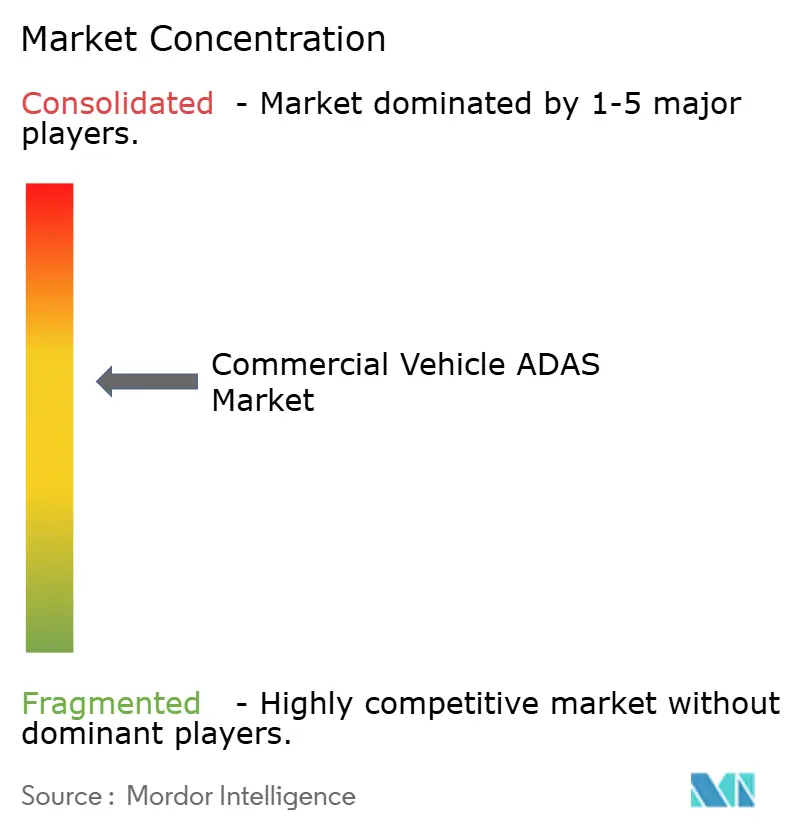
| Market Concentration | Medium |
Major Players *Disclaimer: Major Players sorted in no particular order Image © Mordor Intelligence. Reuse requires attribution under CC BY 4.0. | |
Commercial Vehicle ADAS Market Analysis by Mordor Intelligence
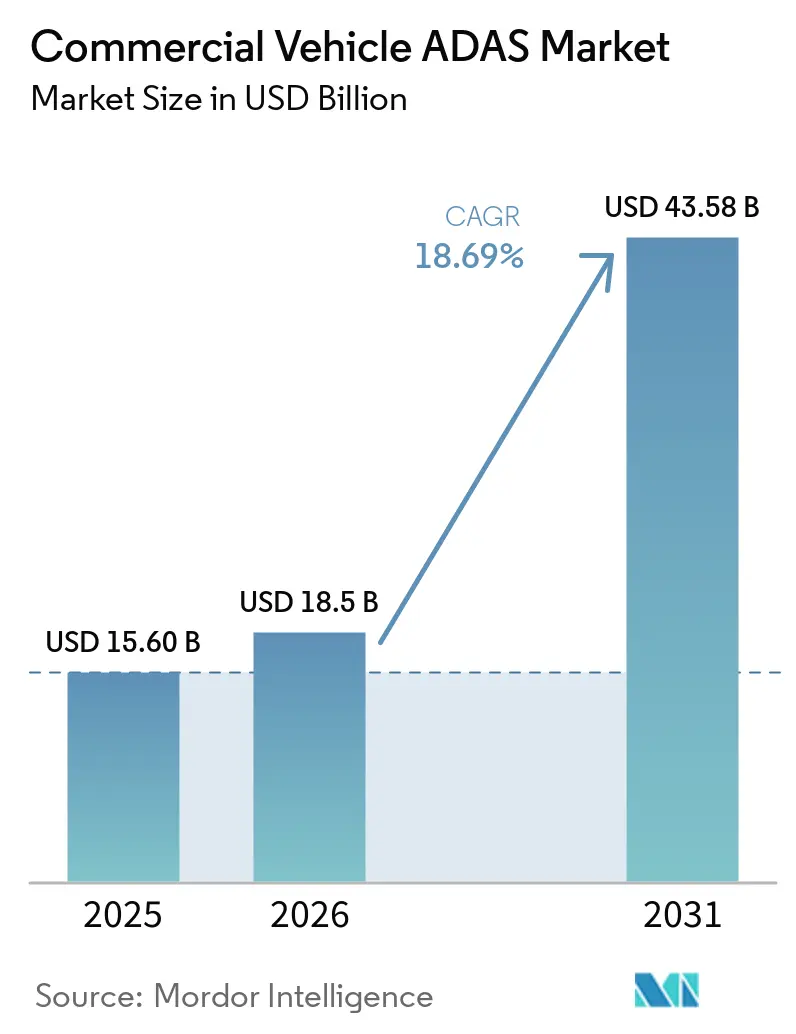
The Commercial vehicle ADAS market size was valued at USD 15.60 billion in 2025, and is projected to grow from USD 18.50 billion in 2026 to USD 43.58 billion by 2031, growing at a CAGR of 18.69% from 2026 to 2031. Regulators across the European Union, India, China, and the United States are treating advanced driver-assistance functions as compulsory safety equipment, thereby compressing the technology adoption curve. Insurers are tying premium discounts to telematics-verified usage, further shortening payback periods and making the commercial-vehicle ADAS market integral to fleet economics. Tier-1 suppliers are shifting capital toward software-defined architectures while divesting hardware-heavy divisions, signaling that value is migrating to edge AI and perception algorithms. Long-haul operators in North America and Europe are piloting Level 4 trucks, and retrofit economics are unlocking demand in legacy fleets across South America, Eastern Europe, and the Middle East.
Key Report Takeaways
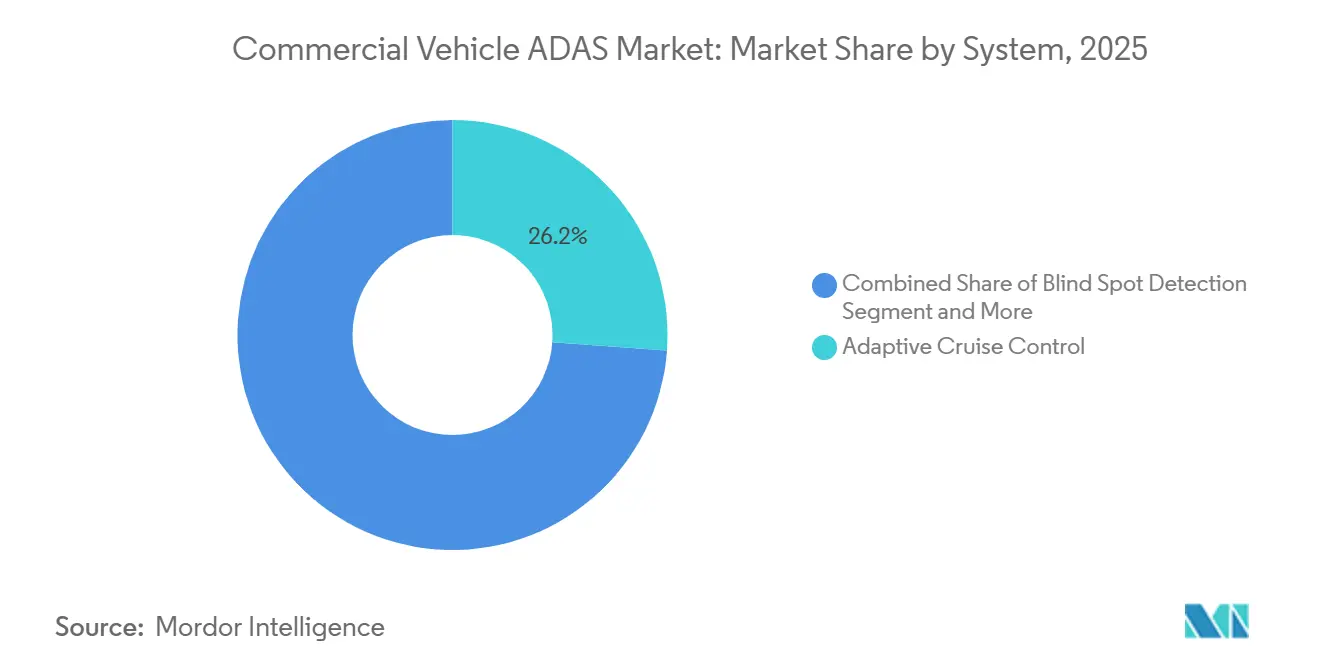
- By system, adaptive cruise control led with 26.15% revenue share of the Commercial vehicle ADAS market in 2025, while driver monitoring is forecast to post the fastest growth, advancing at a 20.05% CAGR through 2031.
- By sensor type, radar accounted for 49.05% of the Commercial vehicle ADAS market size in 2025, while LiDAR is projected to grow at a 19.72% CAGR during 2026-2031.
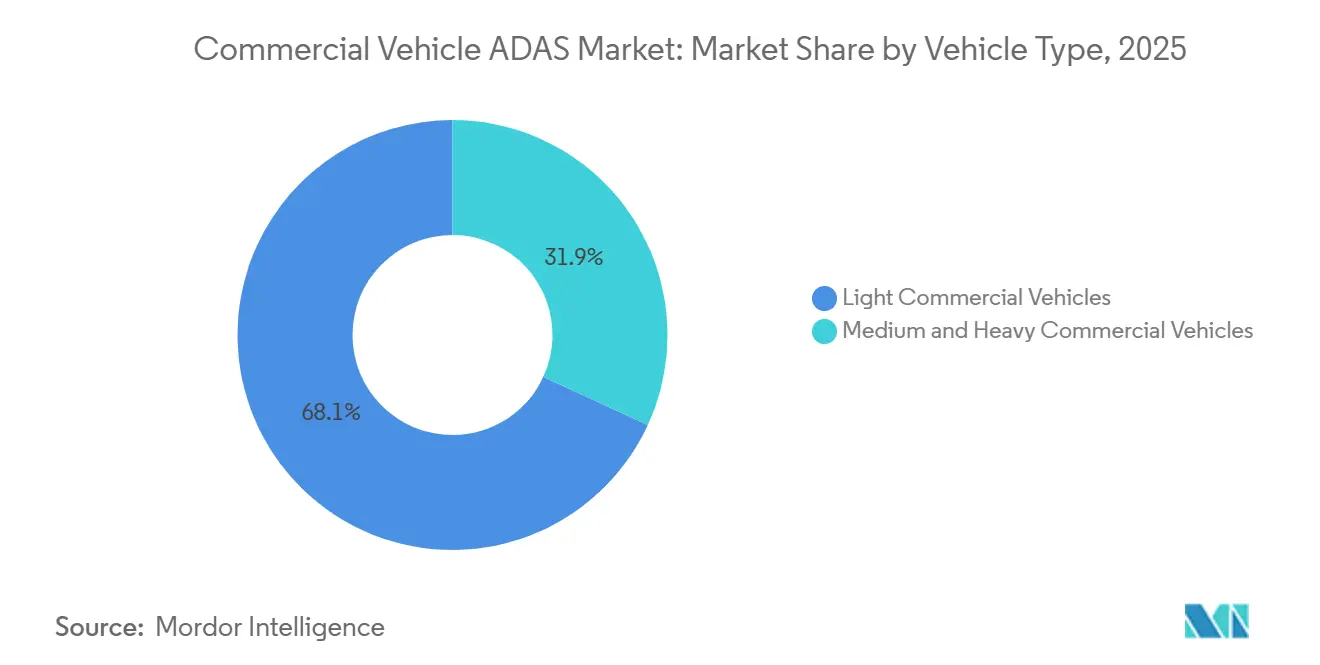
- By vehicle type, light commercial vehicles held 68.13% of the Commercial vehicle ADAS market share in 2025; medium and heavy commercial vehicles are set to expand at a 19.33% CAGR through 2031.
- By distribution channel, OEM-fitment channels captured 74.33% of the Commercial vehicle ADAS market share in 2025, whereas aftermarket installations are expected to grow at a 20.54% CAGR through 2031.
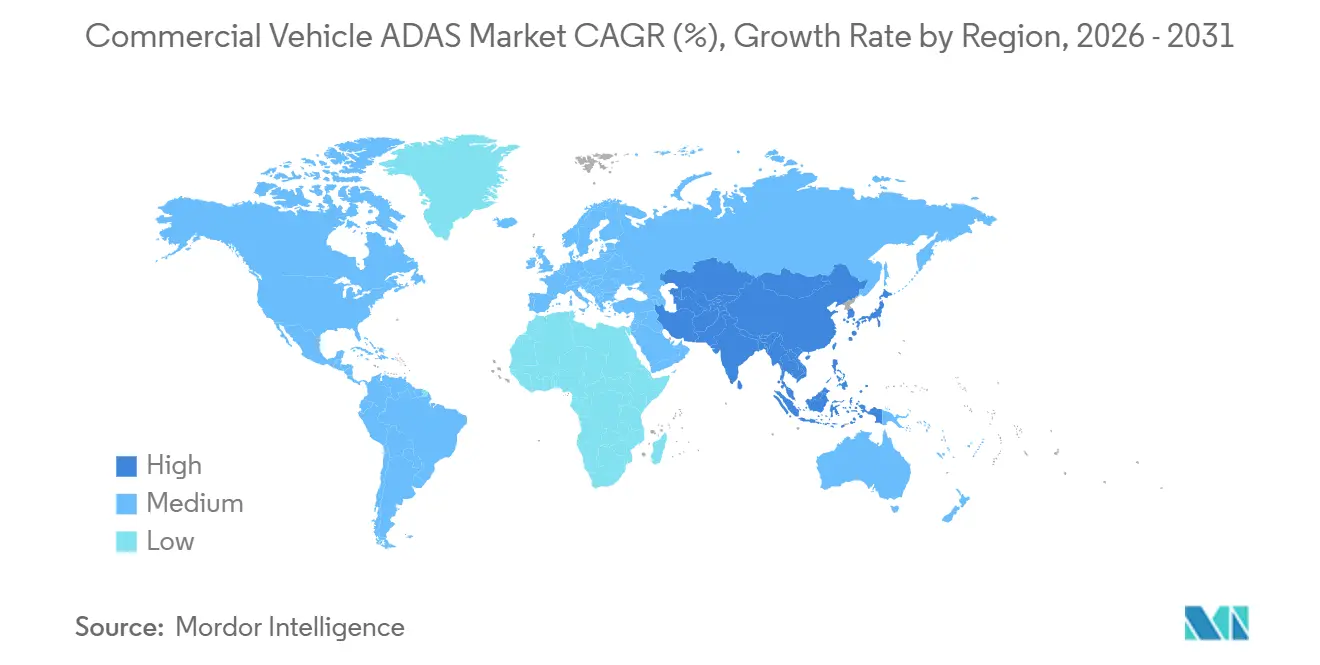
- By geography, Asia-Pacific accounted for 39.26% of the Commercial vehicle ADAS market share in 2025 and will expand at a 18.97% CAGR through 2031.
Note: Market size and forecast figures in this report are generated using Mordor Intelligence’s proprietary estimation framework, updated with the latest available data and insights as of January 2026.
Market Trends and Insights
Drivers Impact Analysis of Commercial Vehicle ADAS Market*
| Driver | (~) % Impact on CAGR Forecast | Geographic Relevance | Impact Timeline |
|---|---|---|---|
| Increasing Road-Safety Regulations | +4.2% | EU, India, China, North America | Short term (≤ 2 years) |
| Advances in ADAS Stacks | +3.8% | North America, EU, Asia-Pacific hubs | Medium term (2-4 years) |
| Fleet TCO Optimization Mandates | +3.1% | North America, EU, high-mileage Asia-Pacific corridors | Medium term (2-4 years) |
| Insurance-Telematics ADAS Incentives | +2.5% | North America, EU, pilots in Brazil and United Arab Emirates | Short term (≤ 2 years) |
| Post-2026 Driver Monitoring Mandate | +2.3% | European Union, UNECE states | Short term (≤ 2 years) |
| Retrofit Kits for Fleets | +1.9% | Global, strong in South America, the Middle East and Africa | Long term (≥ 4 years) |
| Source: Mordor Intelligence | |||
Increasing Road-Safety Regulations
The General Safety Regulation 2022/1426 mandates that all new commercial vehicles in the EU must feature driver-drowsiness alerts, automated braking, and blind-spot detection. This regulation aligns specifications across all 27 EU member states. India follows with AIS-162, AIS-186, and AIS-188 mandates, which took effect in April 2026 for new models and will take effect in October 2026 for existing platforms. These mandates will drive baseline inclusion, even in cost-sensitive segments. China’s GB 39901-2025 will extend automatic emergency braking requirements to N1 vans from January 2028. In addition, its autonomous driving code will permit Level 3 operations from July 2027, effectively establishing a progressive performance ladder.[1]. In the United States, NHTSA’s proposed heavy-vehicle braking rule is under final review after the 2023 notice-and-comment period. UNECE regulations R131, R152, R171, and R157 provide harmonized technical criteria among signatories, reducing compliance fragmentation and facilitating cross-border fleet deployment.
Technological Advances in Autonomous/ADAS Stacks
Sensor fusion is converging on hybrid radar-camera-LiDAR formats that strike a cost-performance balance. PlusAI’s SuperDrive 6.0 compresses a 10-billion-parameter foundation model into a 0.5-billion-parameter edge variant, enabling real-time object classification without cloud latency. Valeo won orders for imaging radar capable of supporting Level 3 highway pilot at 130 km/h, proving that 4D radar can substitute for LiDAR in structured use cases and significantly trim the bill of materials [2]. By 2028, MicroVision's Movia S LiDAR aims to achieve competitive pricing, utilizing 905-nm MEMS scanning modules. This move expands its reach beyond just premium trucks. Early-fusion methods combine raw data from radar, LiDAR, and cameras, enhancing perception but requiring more computing power. In contrast, late fusion reduces latency but risks misalignment between modalities. OEMs are experimenting with both methods to find the right balance between performance and cost.
Fleet TCO Optimization Mandates
In North America, maintenance and downtime significantly impact the total cost of ownership (TCO) for Class 8 vehicles. However, by harnessing predictive analytics through ADAS telemetry, TCO can be effectively reduced. ZF’s OnGuardMAX package, featuring advanced radar technology, combines adaptive cruise control with automated braking[3]. This innovation not only minimizes brake wear but also enhances highway fuel efficiency. AI vision systems, capable of preventing collisions, offer a rapid return on investment for long-haul fleets. This financial incentive is driving faster adoption, surpassing mere regulatory compliance. Furthermore, telematics dashboards are evolving. They now consolidate forward-collision warnings, lane-departure incidents, and driver-distraction alerts into unified scorecards. This integrated approach enables precise coaching, leading to a significant reduction in incident frequency over time.
Insurance-Telematics-Linked ADAS Incentives
Fleets equipped with telematics enjoy significant premium discounts. Furthermore, revenues from usage-based insurance are expected to grow substantially by 2035, aligning carrier economics with the deployment of Advanced Driver-Assistance Systems (ADAS). In the United States trucking industry, "nuclear verdicts" have increased notably over the last decade. In response, insurers now mandate forward-collision warning as a prerequisite in their policies. With parametric settlement models, claims can be resolved in mere hours, provided black-box data confirms system alerts. This efficiency can significantly reduce legal costs. In a notable move, Brazil and the United Arab Emirates are piloting a per-kilometer tariff system. Under this system, tariffs decrease when ADAS functions are activated, underscoring the potential of incentives to boost the commercial-vehicle ADAS market in cost-sensitive regions.
Restraints Impact Analysis of Commercial Vehicle ADAS Market*
| Restraint | (~) % Impact on CAGR Forecast | Geographic Relevance | Impact Timeline |
|---|---|---|---|
| Initial ADAS Component Cost | −2.8% | Global, intense in India, Brazil, parts of Africa | Short term (≤ 2 years) |
| Retrofit for Pre-CAN Vehicles | −1.6% | MEA, South America, Eastern Europe | Medium term (2-4 years) |
| Urban Radar-Spectrum Congestion | −1.2% | EU, Tokyo, Seoul, Mumbai | Long term (≥ 4 years) |
| Driver Disengagement and Skills Gap | −0.9% | North America, EU | Medium term (2-4 years) |
| Source: Mordor Intelligence | |||
High Initial ADAS Component Cost
In India and Brazil, a baseline 77-GHz radar and mono-camera suite adds to the price of light trucks, accounting for a small percentage of their ex-factory price. While mechanical spinning LiDAR remains expensive, MicroVision's solid-state roadmap targets significant cost reductions over the next three years. Valeo's imaging radar claims to offer substantial savings in system costs by substituting LiDAR on structured highways. However, fleets are balancing the costs of ADAS with those of electrification and driver training. To ease the financial burden, leasing and insurance-linked financing are converting capital expenditures into operational expenditures. This strategy is helping to maintain momentum in the commercial vehicle ADAS market, even amidst broader economic fluctuations.
Retrofit Complexity for Pre-CAN Vehicles
Trucks manufactured before 2008 that lack Controller Area Networks (CAN) experience a significant increase in wiring labor. This not only raises labor costs but also voids their steering-system warranties. While these older trucks represent a substantial portion of the global parc, they account for a much smaller share of retrofit installations. Initiatives like India's scrappage rebate and the EU's end-of-life directive are pushing for quicker attrition of these vehicles. However, hybrid kits, boasting standalone power and wireless communications, come with a notable premium. These kits, despite their advantages, have yet to demonstrate reliability under high-vibration duty cycles.
*Our forecasts treat driver/restraint impacts as directional, not additive. The impact forecasts reflect baseline growth, mix effects, and variable interactions.
Commercial Vehicle ADAS Market Segment Analysis
By System:
Driver Monitoring Poised to LeadThe commercial vehicle ADAS market segment for driver-monitoring systems is projected to expand at a CAGR of 20.05% through 2031, driven by regulatory mandates in the European Union and India. By comparison, adaptive cruise control is expected to account for 26.15% of the commercial vehicle ADAS market share in 2025, although unit margins are declining as the technology becomes commoditized. Automatic emergency braking is mandatory in many UNECE territories, shifting the focus toward perception algorithms with low false-positive rates. Blind-spot detection is gaining traction through retrofit kits, particularly among public transport fleets in the Asia-Pacific. Functions such as park assist and night vision remain niche, as thermal cameras continue to add high cost per truck, limiting adoption beyond premium tour bus segments.
Integrated domain controllers consolidate multiple ADAS functions into a single camera, reducing per-vehicle costs and simplifying over-the-air upgrades. This integration supports the advanced driver assistance systems market’s shift from hardware-based revenue toward software-driven value capture. OEMs are bundling driver monitoring systems with lane-keeping assistance and forward-collision warning, significantly reducing incremental hardware spending.

By Sensor:
LiDAR Gains MomentumRadar continues to anchor vehicle perception systems, accounting for 49.05% of the commercial vehicle ADAS market share in 2025. However, LiDAR is expected to register a 19.72% CAGR, reflecting strong growth potential as unit prices fall below USD 200. Imaging radar, which delivers point-cloud depth data, is blurring traditional sensor categories and enabling Level 3 autonomy on structured highways without the need for spinning LiDAR. Cameras remain the most cost-effective modality and are essential for driver monitoring, traffic sign recognition, and object classification. Early fusion of multimodal data improves system robustness in fog and low-light conditions but increases computing costs, creating opportunities for silicon-optimized inference engines.
Declining LiDAR prices will drive adoption of LiDAR from luxury motorcoaches to high-volume medium-duty trucks, expanding the commercial vehicle ADAS market. However, radar spectrum congestion in European metropolitan areas could create opportunities for higher-frequency 140 GHz radar after 2030.
By Vehicle Type:
Medium and Heavy Trucks AccelerateLight commercial vehicles accounted for 68.13% of the commercial vehicle ADAS market share in 2025. However, medium and heavy trucks are forecast to grow at a 19.33% CAGR, driven by insurers and shippers incorporating safety mandates into freight tenders. Predictable highway duty cycles are also making Level 4 autonomy economically attractive. In preparation for 2028–2029, Daimler Truck and TRATON are investing significantly in redundant steering and braking platforms. Meanwhile, coal, mining, and energy corridors are testing driverless convoys, which are narrowing the cost gap with rail transport.
In India, regulations such as GB 39901 prioritize N1 vehicles, making a low-cost stereo camera combined with a single radar adequate for light vans. However, medium-duty vehicles operating across urban and intercity routes require more advanced sensor suites, including LiDAR or imaging radar, to improve cut-in detection.
By Distribution Channel:
Aftermarket Adoption RisingFactory fitment accounted for 74.33% of the Commercial Vehicle ADAS market revenue in 2025, while retrofit kits are projected to grow at the fastest rate, with a CAGR of 20.54%. Bitsensing’s R151 and R159 kits offer blind-spot and moving-off alerts. In South Korea, insurers are increasing adoption by covering a portion of the cost through multi-year premium contracts. Meanwhile, ZF’s OnGuardMAX retrofit system can be installed within a single workshop shift, minimizing vehicle downtime and meeting the requirements of just-in-time logistics carriers.
As UNECE and local governments increase safety inspections, legacy fleets in South America and Africa will become critical battlegrounds. Financing models that shift capital expenditure (capex) to operational expenditure (opex) through data-sharing arrangements will play a pivotal role. These models will determine the extent to which aftermarket suppliers can penetrate price-sensitive regions, ultimately shaping the long-term size of the commercial vehicle ADAS market.
Geography Analysis
APAC Commercial Vehicle ADAS Market
Asia-Pacific holds the largest Commercial vehicle ADAS market share at 39.26% and is expanding 18.97% annually. India’s December 2025 commercial-vehicle sales rose 24.6% year-on-year to 83,666 units, and April 2026 mandates that ADAS be fitted to every new heavy truck and bus [4]. China’s GB 39901-2025 makes automatic braking compulsory on N1 vans by 2028, while its Level 3 framework legalizes partial autonomy from July 2027. The combined scale drives supplier localization, with camera, radar, and LiDAR plants expanding in Anhui, Maharashtra, and Nagoya.
Europe Commercial Vehicle ADAS Market
Europe is enforcing tight timelines, driving the adoption of software-defined architectures. By 2028, TRATON's ONE OS aims to unify the truck stacks of MAN, Scania, and International. Meanwhile, IVECO's pilot in Madrid-Zaragoza, operating at Level 4, suggests the region may bypass widespread Level 3 adoption. Eastern Europe's older fleets remain heavily reliant on retrofitting, but weaker enforcement continues to hinder market penetration.
The Americas and MEA Commercial Vehicle ADAS Market
North America awaits NHTSA’s final heavy-vehicle braking rule. Still, it is already commercializing Level 4 pilots. Bosch and Kodiak are deploying 100 driverless trucks in the Permian Basin by the end of 2026, demonstrating the potential of controlled-route autonomy ahead of broader deployment. In Canada, long-haul corridors reflect U.S. economic patterns, where maintenance-related downtimes significantly boost the ROI for ADAS. While South America and the Middle East-Africa regions are still in their infancy, Brazil's ambitious infrastructure initiatives and the UAE's aspirations as a logistics hub are paving the way for early experiments. Furthermore, insurance-telematics initiatives offer pay-per-kilometer discounts during active ADAS use, making these systems more affordable.
Competitive Landscape
Bosch, Continental, ZF, Autoliv, and Valeo command a notable share of Tier-1 revenues, yet concentration is easing as hardware incumbents spin out units and software specialists claim higher gross margins. ZF sold its ADAS division to Harman in December 2025, shifting focus to electrified powertrains. Applied Intuition’s OS collaboration with TRATON marks a pivot toward centralized compute, decoupling perception algorithms from hardware and enabling faster feature cycles.
Disruptors such as PlusAI and Kodiak Robotics skip incremental Level 2 paths and target Level 4 in constrained geographies. Valeo’s imaging radar demonstrates how 4D point-cloud capability can displace LiDAR in cost-conscious fleets. Suppliers with frequency-hopping radar IP are advantaged in Europe’s spectrum-crowded cities, while retrofit specialists fill white spaces in South America, the Middle East, and Africa.
Strategic moves highlight a significant shift from focusing on individual components to leveraging software capabilities. This transition emphasizes that data ownership and over-the-air monetization are poised to play a critical role in shaping future profit pools within the commercial vehicle ADAS market.
Commercial Vehicle ADAS Industry Leaders
-
Robert Bosch GmbH
-
Continental AG
-
ZF Friedrichshafen AG
-
Autoliv Inc.
-
Valeo SA
- *Disclaimer: Major Players sorted in no particular order
Commercial Vehicle ADAS Market Companies Covered in this Report
- Robert Bosch GmbH
- Continental AG
- ZF Friedrichshafen AG
- Autoliv Inc.
- Valeo SA
- Daimler Truck AG
- Volvo Group
- MAN Truck & Bus SE
- HL Mando Corporation
- Harman International
- Applied Intuition
- Imagination Technologies
- Vignal Group
- Gauzy Ltd.
Recent Industry Developments in Commercial Vehicle ADAS Market
- July 2026: Aurora launched its second-generation driverless trucks in the United States and announced plans to deploy the new fleet across its commercial network, which currently includes 10 driverless routes across the US Sun Belt.
- May 2026: A leading Indian OEM selected Valeo’s Smart Safety 360 (VSS360) advanced driver assistance system (ADAS) for commercial vehicles. Valeo manufactures the India-specific system at its Sanand, Gujarat, facility. The system uses three radars and one camera, offering automatic emergency braking, lane departure warning, forward collision warning, and driver drowsiness and attention warning.
- January 2026: China introduced its first mandatory national standard for advanced driver-assistance systems (ADAS), “Technical Requirements and Test Methods for Automatic Emergency Braking Systems for Light Vehicles” (GB 39901—2025). It will take effect on January 1, 2028.
Global Commercial Vehicle ADAS Market Report Scope
The scope includes segmentation by system (adaptive cruise control, blind spot detection, lane departure warning system, automatic emergency braking, forward collision warning, night vision, driver monitoring, tire-pressure monitoring system, head-up display, park assist system, and others), sensor (radar, lidar, ultrasonic, image, and others), vehicle type (light commercial vehicles and medium and heavy commercial vehicles), and distribution channel (OEM-fitment and aftermarket). The analysis also covers regional-level segmentation, including North America, South America, Europe, Asia-Pacific, the Middle East, and Africa. Market size and growth forecasts are presented in USD by value.
| Adaptive Cruise Control |
| Blind Spot Detection |
| Lane Departure Warning System |
| Automatic Emergency Braking |
| Forward Collision Warning |
| Night Vision System |
| Driver Monitoring |
| Tire-Pressure Monitoring System |
| Head-Up Display |
| Park Assist System |
| Others |
| Radar |
| LiDAR |
| Ultrasonic |
| Image |
| Others |
| Light Commercial Vehicles |
| Medium and Heavy Commercial Vehicles |
| Original Equipment Manufacturer (OEM)-Fitment |
| Aftermarket |
| North America | United States |
| Canada | |
| Rest of North America | |
| South America | Brazil |
| Argentina | |
| Rest of South America | |
| Europe | Germany |
| United Kingdom | |
| France | |
| Italy | |
| Spain | |
| Rest of Europe | |
| Asia-Pacific | China |
| Japan | |
| India | |
| South Korea | |
| Australia | |
| Rest of Asia-Pacific | |
| Middle East and Africa | United Arab Emirates |
| Saudi Arabia | |
| South Africa | |
| Rest of Middle East and Africa |
| By System | Adaptive Cruise Control | |
| Blind Spot Detection | ||
| Lane Departure Warning System | ||
| Automatic Emergency Braking | ||
| Forward Collision Warning | ||
| Night Vision System | ||
| Driver Monitoring | ||
| Tire-Pressure Monitoring System | ||
| Head-Up Display | ||
| Park Assist System | ||
| Others | ||
| By Sensor | Radar | |
| LiDAR | ||
| Ultrasonic | ||
| Image | ||
| Others | ||
| By Vehicle Type | Light Commercial Vehicles | |
| Medium and Heavy Commercial Vehicles | ||
| By Distribution Channel | Original Equipment Manufacturer (OEM)-Fitment | |
| Aftermarket | ||
| By Geography | North America | United States |
| Canada | ||
| Rest of North America | ||
| South America | Brazil | |
| Argentina | ||
| Rest of South America | ||
| Europe | Germany | |
| United Kingdom | ||
| France | ||
| Italy | ||
| Spain | ||
| Rest of Europe | ||
| Asia-Pacific | China | |
| Japan | ||
| India | ||
| South Korea | ||
| Australia | ||
| Rest of Asia-Pacific | ||
| Middle East and Africa | United Arab Emirates | |
| Saudi Arabia | ||
| South Africa | ||
| Rest of Middle East and Africa | ||
Key Questions Answered in the Report
What is the projected size of the Commercial vehicle ADAS market by 2031?
The Commercial vehicle ADAS market size is expected to reach USD 43.58 billion by 2031.
Which ADAS system is growing the fastest?
Driver-monitoring systems are forecast to post the highest CAGR at 20.05% between 2026 and 2031.
How are insurers influencing ADAS uptake?
Fleets equipped with telematics-verified ADAS often receive premium discounts of 15%-30%, shortening hardware payback periods.
Which region currently leads ADAS revenues in commercial vehicles?
Asia-Pacific accounts for the largest revenue share, at 39.26% in 2025, driven by rapid regulatory rollouts in China and India.