
Vehicle Access Control Market Size and Share
Market Overview
| Study Period | 2020 - 2031 |
|---|---|
| Market Size (2026) | USD 18.88 Billion |
| Market Size (2031) | USD 33.56 Billion |
| Growth Rate (2026 - 2031) | 12.21 % |
| Fastest Growing Market | Asia Pacific |
| Largest Market | Asia Pacific |
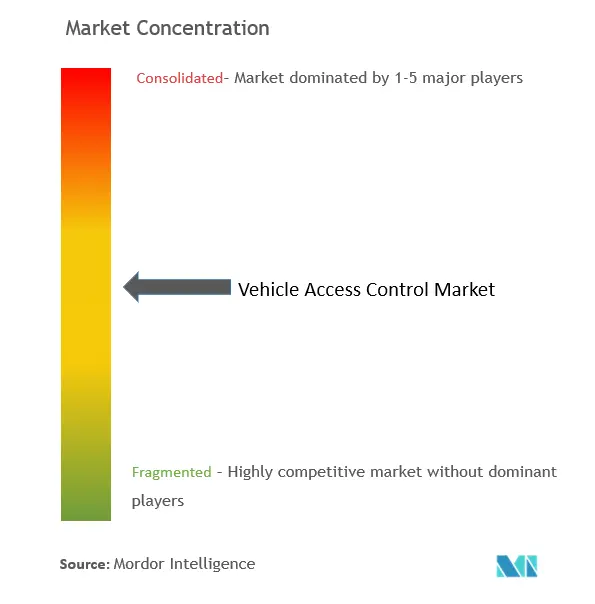
| Market Concentration | Medium |
Major Players *Disclaimer: Major Players sorted in no particular order Image © Mordor Intelligence. Reuse requires attribution under CC BY 4.0. | |
Vehicle Access Control Market Analysis by Mordor Intelligence
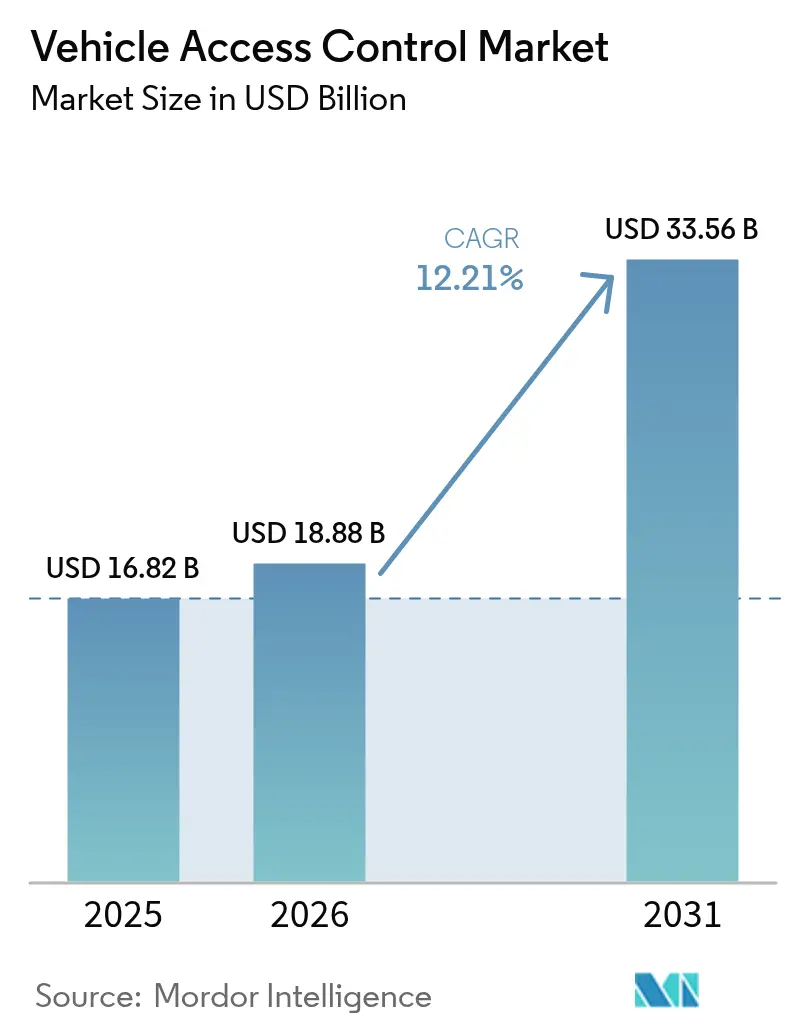
The vehicle access control market size is expected to grow from USD 16.82 billion in 2025 to USD 18.88 billion in 2026 and is forecast to reach USD 33.56 billion by 2031 at 12.21% CAGR over 2026-2031. Growth is propelled by tighter cybersecurity mandates, insurers’ premium incentives for anti-theft analytics, and rapid adoption of Ultra-Wideband (UWB) technology that counters relay attacks. Asia-Pacific anchors both volume and momentum, supported by China’s electric-vehicle surge and India’s manufacturing incentives. Biometric authentication is gaining double-digit traction, yet RFID and other non-biometric systems retain volume leadership because of mature supply chains. Commercial fleets and shared-mobility operators have become pivotal, demanding multi-user credential management that converts access hardware into recurring software revenues. Tier-1 suppliers remain influential, but disruptive semiconductor and cybersecurity specialists are carving defensible niches with post-quantum cryptography and secure element chipsets[1].
Key Report Takeaways
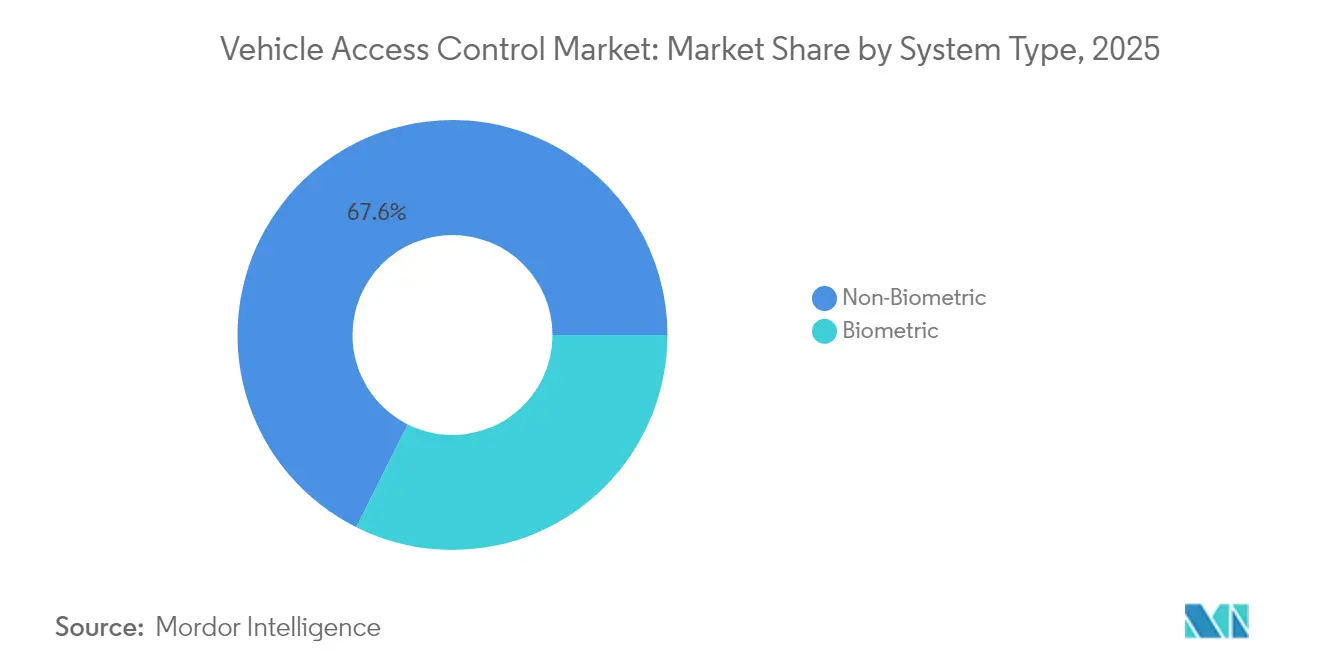
- By system type, non-biometric platforms held 67.62% of vehicle access control market share in 2025, while biometric systems are forecast to lead growth at 13.63% CAGR to 2031.
- By technology, RFID commanded 44.95% share of the vehicle access control market size in 2025, whereas UWB is projected to expand at 18.05% CAGR through 2031.
- By vehicle type, passenger cars captured 63.74% revenue share in 2025; shared-mobility and fleet vehicles are advancing at 13.98% CAGR to 2031.
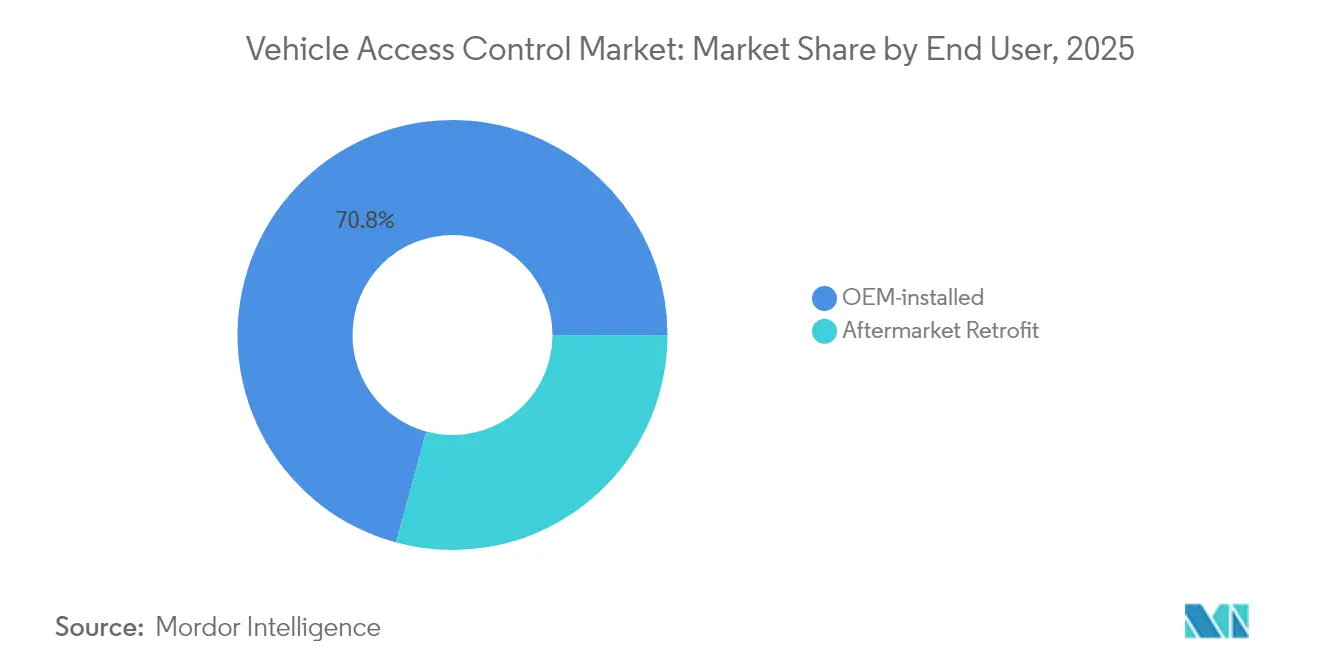
- By end user, OEM-installed solutions accounted for 70.78% of the vehicle access control market share in 2025, yet fleet and shared-mobility operators exhibit the highest 15.29% CAGR through 2031.
- By sales channel, direct-to-OEM transactions represented 65.11% of the vehicle access control market size in 2025, while e-commerce and aftermarket upgrades are growing at 15.43% CAGR.
- By geography, Asia-Pacific dominated with 42.87% share in 2025 and maintains the fastest 13.12% CAGR through 2031.
Note: Market size and forecast figures in this report are generated using Mordor Intelligence’s proprietary estimation framework, updated with the latest available data and insights as of 2026.
Market Trends and Insights
Drivers Impact Analysis of Vehicle Access Control Market*
| Driver | (~) % Impact on CAGR Forecast | Geographic Relevance | Impact Timeline |
|---|---|---|---|
| Rising Demand for Connected Vehicles | +2.5% | Global, with APAC and North America leading adoption | Medium term (2-4 years) |
| Push Toward Key-As-A-Service Platforms | +1.8% | North America and EU, expanding to APAC | Long term (≥ 4 years) |
| Insurance Incentives for Integrated Anti-Theft Analytics | +1.2% | North America and EU core markets | Short term (≤ 2 years) |
| EU "Digit-Key" Regulation | +0.9% | EU primary, spillover to global standards | Medium term (2-4 years) |
| E-Commerce Dark-Hour Delivery Programs | +0.7% | Urban centers globally, led by North America and China | Short term (≤ 2 years) |
| Shift to Integrated Secure Element Chipsets | +0.6% | Global supply chain impact | Long term (≥ 4 years) |
| Source: Mordor Intelligence | |||
Rising Demand For Connected And Autonomous-Ready Vehicles
Connected architectures have elevated access control from simple entry to the master authentication gateway for over-the-air updates, diagnostics, and autonomous coordination. BMW’s Digital Key Plus proves how UWB-driven spatial awareness enables automated parking and charging while preventing relay attacks[2]. As the Car Connectivity Consortium codifies UWB in Digital Key 3.0, OEMs can justify higher per-unit pricing for secure positioning, accelerating adoption across premium and mass-market segments.
OEM Push Toward Key-As-A-Service Platforms
Subscription-based digital keys transform one-time hardware margins into recurring cloud revenue. Continental’s CoSmA allows multi-OEM credential lifecycle management, supporting dynamic feature upgrades that monetize convenience tiers. This model reduces key-fob logistics costs and supports shared-mobility by provisioning and revoking credentials in real time.
Insurance Incentives For Integrated Anti-Theft Analytics
Insurers now tie premium discounts to real-time theft-prevention analytics. Hyundai’s collaboration with AAA offers lower rates once upgraded software blocks key-cloning exploits[3]. Reduced risk underwriting creates immediate ROI for both OEM and consumer, stimulating aftermarket retrofits that embed behavior analytics.
EU “Digit-Key” Regulation Mandating Tamper-Proof OTA Credentialing
The 2024 Cyber Resilience Act forces vehicle access control suppliers to embed hardware security modules that authenticate software throughout the vehicle lifecycle[4]. Compliance costs reward firms with mature cybersecurity pipelines and ripple globally because suppliers standardize on the toughest rules to simplify platform deployment.
Restraints Impact Analysis of Vehicle Access Control Market*
| Restraint | (~) % Impact on CAGR Forecast | Geographic Relevance | Impact Timeline |
|---|---|---|---|
| Escalating Cybersecurity and Zero-Day Exploits | -1.4% | Global, with higher impact in connected vehicle markets | Short term (≤ 2 years) |
| High BOM Cost for Premium Modules | -0.8% | Cost-sensitive markets, particularly emerging economies | Medium term (2-4 years) |
| Automotive E/E Architecture Consolidation | -0.6% | Developed markets with established aftermarket channels | Long term (≥ 4 years) |
| Fragmented Credential Standards Delaying V2X Trust | -0.5% | Global, with regional variations in implementation | Long term (≥ 4 years) |
| Source: Mordor Intelligence | |||
Escalating Cybersecurity Vulnerabilities And Zero-Day Exploits
Open-source tools now clone eight remote-keyless protocols, with one fully compromised according to MIT research. Rapid attack evolution outpaces automotive patch cycles, keeping consumer anxiety high and inviting stricter oversight. Tesla’s past CVE-2022-37709 phone-key bypass exemplifies how even high-end designs can be undermined within months of launch.
High BOM Cost For Premium Biometric Modules
Automotive-qualified fingerprint ICs add USD 50-100 per vehicle, stressing margins in price-sensitive segments. Additional secure processing inflates budgets, restricting use to luxury models while volume cars persist with RFID or NFC.
*Our forecasts treat driver/restraint impacts as directional, not additive. The impact forecasts reflect baseline growth, mix effects, and variable interactions.
Vehicle Access Control Market Segment Analysis
By System Type:
Biometric Projects Challenge Non-Biometric DominanceNon-biometric solutions sustained a 67.62% stronghold in 2025, driven by mature RFID and NFC price points and entrenched supply chains. Biometric alternatives, however, are pacing the vehicle access control market at a 13.63% CAGR as fingerprint and facial recognition find early success in luxury passenger cars. OEM pilots show that biometric modules dramatically cut theft claims, bolstering insurance rebates that erase part of the cost premium.
Volume adoption remains gated by sensor cost and privacy regulation, yet over 100 automakers and Tier-1s are prototyping biometric gateways. Continental’s 2025 CES showcase blended facial ID with vital-sign monitoring to detect unauthorized occupants, hinting at a future where access control doubles as a safety platform.

By Technology:
UWB Surge Disrupts RFID LeadershipRFID retained 44.95% of 2025 revenue, but UWB’s 18.05% CAGR is resetting the competitive arc of the vehicle access control market. BMW, Volkswagen, and Hyundai embed UWB to build centimeter-grade secure zones that block signal amplification attacks. Semiconductor innovation, such as NXP’s NCJ29D5 chip, lowers integration hurdles and pushes UWB downmarket.
Bluetooth and NFC persist where cost ceilings matter or physical contact is preferred, for instance, in car-sharing pick-up spots. Wi-Fi and cellular serve background credential synchronization rather than immediate unlock.
By Vehicle Type:
Fleets Break the Passenger-Car MoldPassenger cars delivered 63.74% of 2025 revenue; nonetheless, fleet and shared-mobility vehicles are the new growth engines at 13.98% CAGR. Fleet operators value credential auditing, driver authentication, and automated maintenance triggers, monetizing access data in ways private owners cannot. Irdeto’s Keystone illustrates fine-grained, cloud-managed keys that feed compliance logs, a critical need in last-mile logistics.
Commercial adoption also spurs facial recognition to log driver shifts and tie access to telematics scoring for insurance optimization. Larger vehicles such as heavy trucks fold access control into broader domain control units, preparing the path for platooning and autonomous freight.
By End User:
Shared Mobility Redefines Integration PrioritiesOEM-installed hardware captured 70.78% in 2025 because factory integration simplifies warranty and functional safety validation. Yet shared-mobility and fleet customers expand fastest at 15.29% CAGR, demanding API-ready platforms that can hand out and revoke keys per trip. WirelessCar’s digital key suite underpins such dynamic workflows, cutting fob logistics and enabling monetization of vehicle time slots.
Aftermarket retrofits remain relevant in regions where older fleets seek insurance benefits quickly. Secure-element modules that marry CAN bus pins with Bluetooth Low Energy give aging vehicles modern defense without full E/E rewiring. However, continued consolidation of vehicle domain controllers may shrink addressable aftermarket nodes over the long term.
By Sales Channel:
Online Upgrades Pressure Tier-1 PipelinesDirect sales into OEM programs represented 65.11% of 2025 revenue. Vehicle electrification and centralized computing reinforce long design-in cycles that favor Tier-1 incumbents. Yet the aftermarket is blooming at 15.43% CAGR as consumers shop e-commerce kits to capture insurance discounts. Unified diagnostic connectors and plug-and-play harnesses simplify do-it-yourself installation, a trend especially visible in India’s aftermarket.
Over time, software-defined vehicles may re-centralize access credentials inside zonal controllers, limiting drop-in kit feasibility. Suppliers are responding with cloud-first key-management services that operate above the hardware layer, preserving aftermarket relevance in an ECU-consolidated world.
Geography Analysis
APAC Vehicle Access Control Market
The Asia-Pacific’s 42.87% share in vehicle access control market in 2025 is rooted in strong EV volume and an integrated supply chain that spans semiconductors to final assembly. China’s 8 million EV sales in 2024 required secure keys that coordinate with charging infrastructure, while India’s domestic production push fuels demand for cost-optimized modules fueling growth of 13.12% CAGR through 2031. Japan and South Korea drive semiconductor innovation—Renesas and Samsung deliver secure microcontrollers that underpin next-generation credential vaults.
North America Vehicle Access Control Market
North America records a steady growth, leveraging high vehicle density and robust premium segments that readily pay for biometric and UWB additions. NHTSA guidelines and insurer incentives combine to standardize higher security baselines. The region’s leadership in ride-hailing and e-commerce fleets speeds multi-user credential experimentation, shaping global software-as-a-service feature sets.
Europe Vehicle Access Control Market
Europe growth is moderate, but regulatory gravity outstrips raw growth. The Cyber Resilience Act cements tamper-proof OTA updating and post-quantum readiness as ticket-to-play requirements. Continental’s rebranding to Aumovio and pivot to software ecosystems reflect how suppliers adapt to regulation-led demand. OEMs often certify to EU standards first and roll the same architecture worldwide, making Europe’s policy stance a global bellwether.

Regulatory Landscape
Vehicle access control suppliers are being pulled into vehicle-wide cybersecurity and software lifecycle compliance regimes that treat digital keys, OTA credentialing, and vehicle data access as part of a managed security system. UNECE UN Regulation No. 155 requires automakers to operate a Cybersecurity Management System (CSMS) covering risks that include access pathways, while software-update discipline aligns with UN Regulation 156 through ISO 24089:2023 (amended in 2024) for software update engineering across verification, validation, and cybersecurity controls.
In the European Union, Commission Delegated Regulation (EU) 2026/699 (adopted 23 March 2026) tightens requirements around standardized and secure bi-directional access to vehicle OBD and repair/maintenance information for independent operators, linking access interfaces to cybersecurity expectations. The regulation also directs manufacturers and toolchains toward recognized security controls, with compliance expectations extending to standards such as TISAX or ISO 27001 by December 2026. This raises the baseline for secure credential handling across OEMs, Tier-1s, and diagnostic-tool ecosystems.
Value Chain Analysis
The value chain runs from secure silicon and sensors (secure elements, microcontrollers, NFC readers, BLE radios, UWB transceivers and antennas) to Tier-1 integration into body domain controllers and vehicle E/E architectures, then into OEM backend systems that provision and revoke credentials. Digital key delivery increasingly relies on key lifecycle management infrastructure, including cloud key tracking servers and OEM key management/PKI workflows that support issuance, sharing, and audit logs for fleets and shared mobility.
Interoperability and certification are acting as a coordination layer across the chain. The Car Connectivity Consortium (CCC) Digital Key Certification Program covers NFC, Bluetooth LE, and UWB, and the CCC certified 115 products in 2025, including certifications attributed to automakers and ecosystem players such as NIO, XPENG, Zhejiang Geely Holding Group (including brands such as Volvo, Polestar, ZEEKR, Lynk & Co., smart, and Lotus), Mahindra & Mahindra, and Hyundai. This certification pull is shifting supplier emphasis from standalone hardware modules toward integrated stacks that combine secure ranging, localization software, and credential management aligned to CCC requirements.
Competitive Landscape
Moderate fragmentation typifies the vehicle access control market. Continental AG and Robert Bosch GmbH, both leverage decades-long OEM relationships, bundling keys with ignition, infotainment, and ADAS domains for cost efficiency. Valeo and Huf expand UWB portfolios to secure second-tier slots, while chipset vendors such as NXP and Infineon climb upstream with secure element solutions that close relay loopholes.
Disruptors exploit white space at the convergence of cybersecurity and access control. SEALSQ fields post-quantum-ready TPMs, solving long-horizon cryptographic compliance for OEMs. FiRa Consortium and Car Connectivity Consortium collaborations accelerate standards, rewarding early adopters with interoperability prestige. Competitive strategy tilts toward software, cloud credential orchestration locks in revenue far beyond hardware EBIT.
Acquisition appetite remains high as Tier-1s shore up software gaps. Bosch’s Perfectly Keyless passenger-car rollout demonstrates vertical integration, while Continental invests in AI-based occupant detection to merge personalization and security. The race now centers on securing end-to-end trust, from silicon root to OTA cloud, before autonomous features mandate formal safety certification.
Vehicle Access Control Industry Leaders
-
Continental AG
-
Lear Corporation
-
Robert Bosch GmbH
-
Denso Corporation
-
Valeo SA
- *Disclaimer: Major Players sorted in no particular order
Vehicle Access Control Market Companies Covered in this Report
- Continental AG
- Robert Bosch GmbH
- Denso Corporation
- Valeo SA
- Lear Corporation
- VOXX Automotive
- Fingerprint Cards AB
- Mitsubishi Electric Corp.
- BorgWarner Inc.
- Nuance Communications
- Thales Group
- Gentex Corporation
- Synaptics Incorporated
- ASSA ABLOY
- dormakaba Holding
- HID Global
- Impinj Inc.
- IDEMIA
- Nedap N.V.
- Smartrac Technology
- Stanley Black and Decker (STANLEY Access)
Market Opportunities and Future Outlook
Standardized, smartphone-based digital keys are creating whitespace for suppliers that can deliver end-to-end interoperability along with lifecycle credential operations for multi-user vehicles. CCC momentum provides a concrete adoption signal: in 2025 the CCC certified 115 products across NFC, Bluetooth LE, and UWB, and the consortium reported 140 certified products in the first half of 2026. This supports packaging opportunities for Tier-1s, security specialists, and cloud platforms that can combine UWB-based secure ranging with BLE/NFC fallback, plus enterprise-grade provisioning, revocation, and audit features needed by fleets and shared mobility.
A second opportunity sits at the intersection of compliance and serviceability, as regulators tighten secure access to vehicle data and interfaces. Commission Delegated Regulation (EU) 2026/699 (adopted 23 March 2026) mandates standardized and secure bi-directional access to OBD and repair/maintenance information for independent operators, while also elevating cybersecurity controls across tools and workflows through recognized security standards by December 2026. Vendors that connect digital key security, OTA-safe credential updates (aligned with ISO 24089 and UN R156), and secure diagnostic access gain a clearer pathway into OEM and independent-operator ecosystems, alongside support for the insurer-driven anti-theft analytics programs discussed in the market context.
Recent Industry Developments in Vehicle Access Control Market
- February 2026: Robert Bosch GmbH and NIO Inc. announced a strategic cooperation agreement to collaborate on core smart electric-vehicle technologies, including body electronics and body-related systems. Tighter integration between body electronics and security-capable access subsystems supports broader rollouts of digital key and credential management functions inside centralized vehicle architectures.
- June 2025: Continental AG started supplying its CoSmA intelligent access system for the Audi Q6 e-tron, using ultra-wideband (UWB) and Bluetooth Low Energy (BLE) for smart device-based vehicle entry. The production supply win reinforces UWB plus BLE as a mainstream anti-relay attack combination and strengthens Continental's position in OEM factory-fit programs for premium EV platforms.
- April 2024: Continental technologies, including the CoSmA smart device-based access solution with UWB, were highlighted in connection with the Mercedes-Benz E-Class. OEM deployment at this level indicates broader acceptance of smartphone-centric access as a platform feature, increasing demand for secure elements, ranging components, and backend credential lifecycle services.
Vehicle Access Control Market Report Scope and Research Methodology
Market Definition and Coverage
For this methodology, the vehicle access control market includes systems and enabling technologies that authenticate a user and then allow vehicle entry or starting, whether installed by OEMs or fitted later.
Scope exclusions: We exclude purely mechanical keys and locks, and we also exclude vehicle cybersecurity tools that do not directly manage access authorization.
Segments Covered in This Report
- System Type
- Biometric
- Fingerprint Recognition
- Facial Recognition
- Iris / Retina Recognition
- Non-Biometric
- RFID Tag and Reader
- NFC / Bluetooth Low Energy
- Key Fob / Smart Card
- Biometric
- Technology
- RFID
- Bluetooth
- NFC
- Ultra-Wideband (UWB)
- Wi-Fi / Cellular
- Vehicle Type
- Passenger Cars
- Hatchback
- Sedan
- SUV / Crossover
- Commercial Vehicles
- Light Commercial Vehicles
- Heavy Trucks and Busses
- Passenger Cars
- End User
- OEM-installed
- Aftermarket Retrofit
- Sales Channel (Cross-segmentation)
- Direct to OEM
- Tier-1 Supply
- e-Commerce / Aftermarket
- Geography
- North America
- United States
- Canada
- Mexico
- Rest of North America
- South America
- Brazil
- Argentina
- Rest of South America
- Europe
- Germany
- United Kingdom
- France
- Italy
- Rest of Europe
- Asia-Pacific
- China
- Japan
- India
- South Korea
- Rest of Asia-Pacific
- Middle East and Africa
- Saudi Arabia
- United Arab Emirates
- South Africa
- Rest of Middle East and Africa
- North America
Data Sources, Market Sizing, and Validation
Desk Research
Desk research was used to set clear market boundaries and to build the first set of demand anchors before any interview assumptions were applied. We referred to public sources such as OICA for vehicle production baselines, the International Energy Agency (IEA) for electrification direction that impacts feature uptake, UN Comtrade for trade flows that signal component movement, the USITC DataWeb portal for import patterns, and patent offices such as USPTO and WIPO to track authentication and secure access technology themes.
We also reviewed company annual reports, 10-K style filings, investor presentations, association websites, and reputable automotive and security trade publications to understand go-to-market routes and pricing cues. Where needed, paid subscriptions for company financials and patent databases were used to confirm revenue splits and reduce the risk of missing smaller product lines. The sources named here are illustrative, and many other public documents and datasets were also consulted for data collection, validation, and research clarification.
Primary Interviews and Surveys
Primary work was used to confirm how systems are priced and sold, and how OEM fitment differs from retrofit demand across major regions. We spoke with a mix of hardware suppliers, software and authentication specialists, OEM-facing teams, and channel partners, which then helped validate penetration rates, realistic ASP movement, and the adoption pace of newer options like UWB.
Distribution of primary research fieldwork respondents
| Company type | Respondent position | Region |
|---|---|---|
| Top tier: 26% | CXOs: 15% | APAC: 45% |
| Mid tier: 55% | Functional/Unit leaders: 33% | EMEA: 36% |
| Smaller Players: 19% | Managers: 52% | Americas: 19% |
Market-Sizing & Forecasting
Sizing starts from a top-down build where vehicle production and parc direction are converted into an addressable pool, which is then filtered by estimated fitment of access control features by vehicle type and sales channel. Once those demand anchors are set, we corroborate the total using selective bottom-up approximations such as sampled ASP multiplied by implied unit volumes for key technology families, followed by checks against supplier revenue disclosures.
Model inputs that were treated as important drivers include passenger versus commercial production by region, OEM-installed versus retrofit split, penetration of keyless and smartphone-based access, adoption pace of UWB relative to older proximity methods, and ASP movement linked to secure elements, biometric modules, and software content. When a country series was thin, gaps were handled with proxy indicators such as regional production mix and platform penetration, then corrected using interview feedback. Forecasting was built using scenario analysis so adoption timing, price normalization, and security-driven upgrade cycles could be flexed without breaking the model.
Data Validation & Update Cycle
Validation is done by triangulating model outputs against independent signals, and then by running variance checks that flag sharp shifts in penetration, ASP, or regional mix. If a variance cannot be explained by a known driver, assumptions are reviewed again and selected respondents are re-contacted to confirm whether a one-off event or a structural change is underway.
Before sign-off, the model and narrative are reviewed in more than one analyst pass so definitions, units, and calculations stay consistent. Reports refresh annually, with interim updates added when material events occur, such as regulation shifts, recall activity tied to access features, or step-changes in component pricing. Right before delivery, we complete a final freshness pass so clients receive the latest updated view.
Mordor Intelligence's Vehicle Access Control Market Sizing Compared With Other Published Estimates
Published values for vehicle access control do not always match because each publisher sets its own scope, year labeling, and pricing logic, and these choices flow into the final total. Differences also come from refresh cadence, especially when the technology mix is changing and prices are moving.
Common gap drivers include whether adjacent automotive electronics are bundled into the number, and whether the counted demand is limited to vehicle entry and start authorization. Currency timing and ASP progression also matter, since exchange-rate windows and price-step assumptions can drift if they are not rechecked often. With quarterly spot checks on key price points and an annual model rebuild that revalidates technology mix using interviews, a consistent currency conversion window and refreshed ASP curves are applied in the Mordor Intelligence estimate.
Benchmark comparison
| Source | Market Size | Gaps in Research Methodology |
|---|---|---|
| Mordor Intelligence | USD 16.82 B (2025) | |
| Industry Publisher A | USD 10.60 B (2023) | Uses an earlier base year and a broader definition that emphasizes non-biometric access control, which changes the timing of adoption and the technology mix used for pricing. |
| Research Publisher B | USD 7.90 B (2024) | Appears to align the scope closer to site and facility vehicle access deployments and related applications, which narrows the addressable pool compared with vehicle-centric access and start authorization demand. |
The spread across sources is mainly explained by what is counted, the year used for the headline value, and how quickly price and mix assumptions get refreshed. When totals are anchored to vehicle volume signals and then pressure-tested against interview feedback and supplier disclosures, the resulting market size is easier to track, repeat, and audit over time.
Key Questions Answered in the Report
What is the current size of the vehicle access control market?
The vehicle access control market size stands at USD 18.88 billion in 2026 and will reach USD 33.56 billion by 2031.
Which region leads the vehicle access control market?
Asia-Pacific leads with 42.87% market share in 2025 and posts the fastest 13.12% CAGR through 2031.
Why is Ultra-Wideband technology gaining traction?
UWB offers centimeter-level positioning that blocks relay attacks, driving an 18.05% CAGR and challenging RFID dominance.
How are insurers influencing adoption?
Premium discounts for vehicles with anti-theft analytics make advanced access systems financially attractive, accelerating adoption.
Which segment is growing fastest by end user?
Shared mobility and fleet operators are expanding at 15.29% CAGR as they need real-time credential management.
What regulatory changes affect the market?
The EU’s Cyber Resilience Act mandates tamper-proof over-the-air credentialing, compelling global compliance upgrades in new systems.