
Green IT Consulting Software Platform Market Size and Share
Market Overview
| Study Period | 2020 - 2031 |
|---|---|
| Market Size (2026) | USD 1.02 Billion |
| Market Size (2031) | USD 1.74 Billion |
| Growth Rate (2026 - 2031) | 11.27 % |
| Fastest Growing Market | Asia-Pacific |
| Largest Market | North America |
| Market Concentration | Low |
Major Players *Disclaimer: Major Players sorted in no particular order Image © Mordor Intelligence. Reuse requires attribution under CC BY 4.0. | |
Green IT Consulting Software Platform Market Analysis by Mordor Intelligence
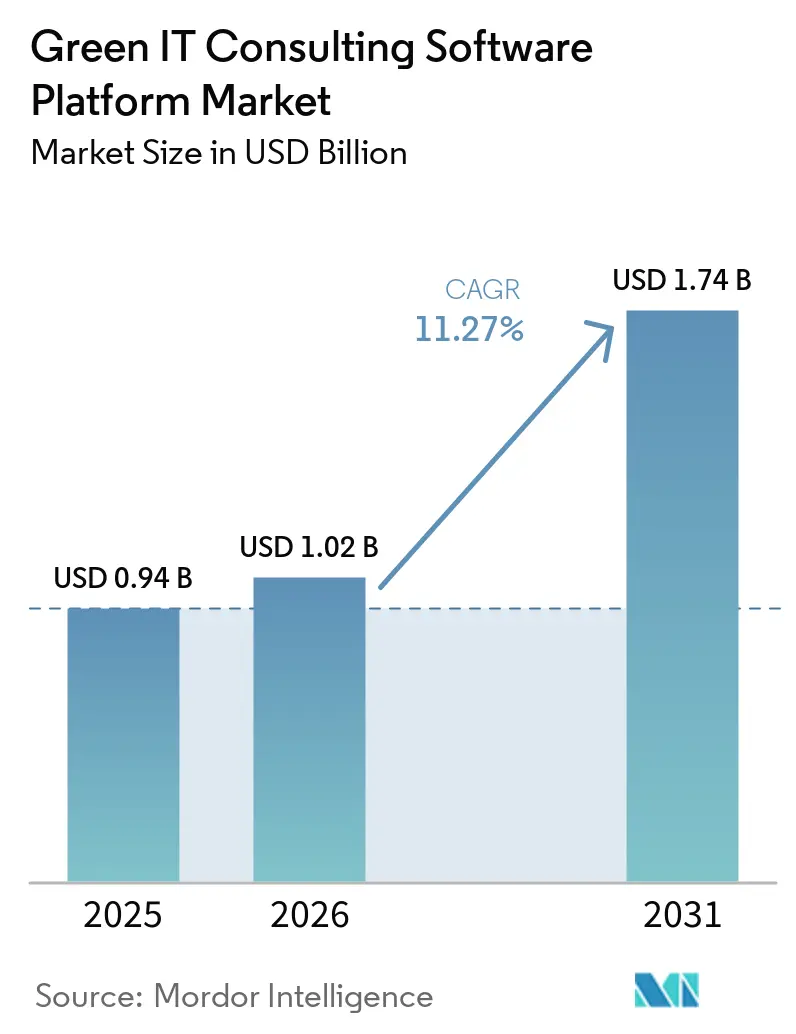
The green IT consulting software platform market size is expected to increase from USD 0.94 billion in 2025 to USD 1.02 billion in 2026 and reach USD 1.74 billion by 2031, growing at a CAGR of 11.27% over 2026-2031. The green IT consulting software platform market is expanding as emissions disclosure is increasingly tied to routine operating data rather than just annual reporting cycles. Rising data center power costs are also making sustainability software more relevant to finance, procurement, and infrastructure teams that need clearer energy and carbon visibility. The shift toward Scope 3 accountability is widening adoption across supplier networks, which is moving the green IT consulting software platform market beyond large sustainability teams and into broader enterprise workflows. Vendors are responding by integrating carbon accounting, IT asset lifecycle tracking, and multi-framework reporting into a single environment, making these platforms more useful than older point tools. The green IT consulting software platform market also benefits from demand for auditable evidence, regional hosting flexibility, and workflow integration with procurement, finance, and operations systems, which gives larger vendors and well-connected specialists a clearer path to long-term growth.
Key Report Takeaways
- By offering, software held a 76.13% share of the green IT consulting software platform market in 2025, and software is projected to expand at a 12.13% CAGR through 2031.
- By deployment, cloud-based delivery held 64.17% share in 2025, while hybrid deployment is projected to expand at 13.23% CAGR through 2031.
- By enterprise size, large enterprises held 69.12% share in 2025, while small and medium enterprises are projected to expand at 12.83% CAGR through 2031.
- By application, carbon accounting and emissions management accounted for 31.14% share in 2025, while sustainability analytics and decision support are projected to expand at 14.53% CAGR through 2031.
- By end user, IT and telecom held 22.17% share in 2025, while energy and utilities are projected to expand at 13.93% CAGR through 2031.
- By geography, North America held 38.12% of the green IT consulting software platform market share in 2025, while Asia-Pacific is projected to expand at 13.63% CAGR through 2031.
Note: Market size and forecast figures in this report are generated using Mordor Intelligence’s proprietary estimation framework, updated with the latest available data and insights as of January 2026.
Market Trends and Insights
Drivers Impact Analysis of Green IT Consulting Software Platform Market*
| Driver | (~) % Impact on CAGR Forecast | Geographic Relevance | Impact Timeline |
|---|---|---|---|
| Rising Corporate Net-Zero Commitments Requiring Measurable IT Emissions Reduction | 2.8% | Global | Medium term (2-4 years) |
| Tightening Sustainability Disclosure Rules for Digital Operations | 2.3% | North America and EU | Short term (≤ 2 years) |
| Cloud and Data Center Optimization Pressure from Energy Cost Volatility | 1.8% | Global | Medium term (2-4 years) |
| AI-Assisted Emissions Analytics and Automated Evidence Capture | 1.5% | North America, EU, and APAC | Short term (≤ 2 years) |
| Procurement Preference for Verified Low-Carbon Software Suppliers | 0.8% | EU and North America | Medium term (2-4 years) |
| Growing Demand for Green IT Advisory in Mid-Market Enterprises | 0.7% | APAC and North America | Long term (≥ 4 years) |
| Source: Mordor Intelligence | |||
Rising Corporate Net-Zero Commitments Require Measurable IT Emissions Reduction
Corporate net-zero targets now require traceable IT emissions data, which is changing how buyers assess the green IT consulting software platform market. Microsoft’s 2025 sustainability report showed that even a hyperscale operator uses life-cycle assessment tools to review the emissions impacts of server and cooling choices at a detailed infrastructure level.[1] That matters because enterprise buyers increasingly need software that can turn infrastructure, procurement, and usage data into evidence that withstands internal review and external assurance. Buyers who postpone this work until reporting season often face more manual data reconstruction, which increases costs and weakens confidence in the final numbers. The result is that automated baselining, continuous monitoring, and evidence trails are moving from optional features to standard expectations in the green IT consulting software platform market.
Tightening Sustainability Disclosure Rules for Digital Operations
The green IT consulting software platform market is also benefiting from stricter disclosure rules that require more detailed, structured sustainability reporting. The European Commission’s CSRD-related policy updates kept reporting obligations central to enterprise planning and reinforced the need for digital reporting support infrastructure.[2] The same policy direction is encouraging companies to look for platforms that can map one underlying data set across multiple reporting frameworks without rebuilding the process each year. That is raising the value of configurable standards mapping, audit support, and workflow controls that can serve finance, sustainability, and compliance teams together. Jurisdictional differences also matter, because companies operating across regions need tools that can adapt to different disclosure methods and assurance requirements rather than serving only one regime. The green IT consulting software platform market, therefore, favors vendors that can support enterprise reporting across evolving standards with less manual rework.
Cloud and Data Center Optimization Pressure from Energy Cost Volatility
Rising power demand in digital infrastructure is strengthening the commercial case for the green IT consulting software platform market beyond compliance alone. The International Energy Agency estimated that global data center electricity consumption reached 415 terawatt-hours in 2024, after growing 12% annually over the prior 5 years.[3] That scale of electricity use means infrastructure teams need workload-level visibility into energy and carbon usage, especially as AI activity increases both compute demand and cost sensitivity. A 2025 Nature study also showed that liquid cooling can reduce data center greenhouse gas emissions by 15% to 31% compared with conventional air cooling, underscoring the value of platforms that can track hardware, cooling, and operational changes at the asset level. As organizations try to match workloads with lower-carbon grid windows and tighter energy budgets, the green IT consulting software platform market becomes more closely tied to operating efficiency and return on investment.
AI-Assisted Emissions Analytics and Automated Evidence Capture
AI-led automation is changing how quickly companies can build and verify emissions records inside the green IT consulting software platform market. Net Zero Cloud was rebranded as Agentforce Net Zero in 2025 and linked to Data Cloud, enabling users to connect energy, travel, supplier, and enterprise records in a single workflow.[4] Then, in 2026, new sustainability AI agents were planned to reduce manual compliance effort and errors in product carbon footprint calculations, pointing to a clear shift toward embedded automation in enterprise sustainability tasks. This matters because buyers not only want faster calculations but also cleaner audit trails that link each result to the source record. As a result, the green IT consulting software platform market is moving toward systems that shorten reporting cycles, reduce manual effort, and make assurance preparation easier for larger organizations.
Restraints Impact Analysis of Green IT Consulting Software Platform Market*
| Restraint | (~) % Impact on CAGR Forecast | Geographic Relevance | Impact Timeline |
|---|---|---|---|
| High Data Quality Gaps Across IT, Finance, and Facilities Systems | -1.9% | Global | Long term (≥ 4 years) |
| Limited Internal Sustainability and Data Engineering Skills | -1.5% | Global | Medium term (2-4 years) |
| Integration Complexity Across Legacy ERP, Cloud, and Device Telemetry Stacks | -1.2% | Global | Long term (≥ 4 years) |
| Short Payback Visibility for Smaller Buyers | -0.8% | South America and MEA | Long term (≥ 4 years) |
| Source: Mordor Intelligence | |||
High Data Quality Gaps Across IT, Finance, and Facilities Systems
The green IT consulting software platform market still faces a basic data problem because emissions reporting depends on information scattered across supplier records, ERP systems, facilities tools, and IT asset databases. Sage reported in December 2025 that only 8% of surveyed small and medium enterprises had a formal sustainability reporting process, even though 32% had an active sustainability strategy. SAGE That gap matters because large companies often depend on smaller suppliers for primary data, and weak upstream reporting makes downstream Scope 3 calculations less reliable. It also increases implementation time because vendors must normalize inconsistent taxonomies, fill missing records, and validate data before reporting can begin. As companies approach their first mandatory disclosure cycle, these quality gaps slow procurement and raise audit concerns within the green IT consulting software platform market.
Limited Internal Sustainability and Data Engineering Skills
Skill shortages are another restraint, as many sustainability teams do not yet have deep expertise in software integration or emissions methodologies. A 2025 Small Business Economics study found that digitally advanced small and medium enterprises were much more likely to adopt net-zero innovations, which shows how digital readiness shapes adoption outcomes. The same tension appears in larger organizations, where climate teams often rely on outside support to connect systems, structure data, and prepare for assurance. It was also found that companies using AI-powered carbon-tracking tools were more likely to have formal sustainability reporting in place, suggesting that capability gaps and tooling maturity often move together. Until internal teams become more comfortable with platform setup, data engineering, and reporting workflows, the green IT consulting software platform market will continue to see longer rollout periods and heavier dependence on external service layers.
*Our forecasts treat driver/restraint impacts as directional, not additive. The impact forecasts reflect baseline growth, mix effects, and variable interactions.
Green IT Consulting Software Platform Market Segment Analysis
By Offering:
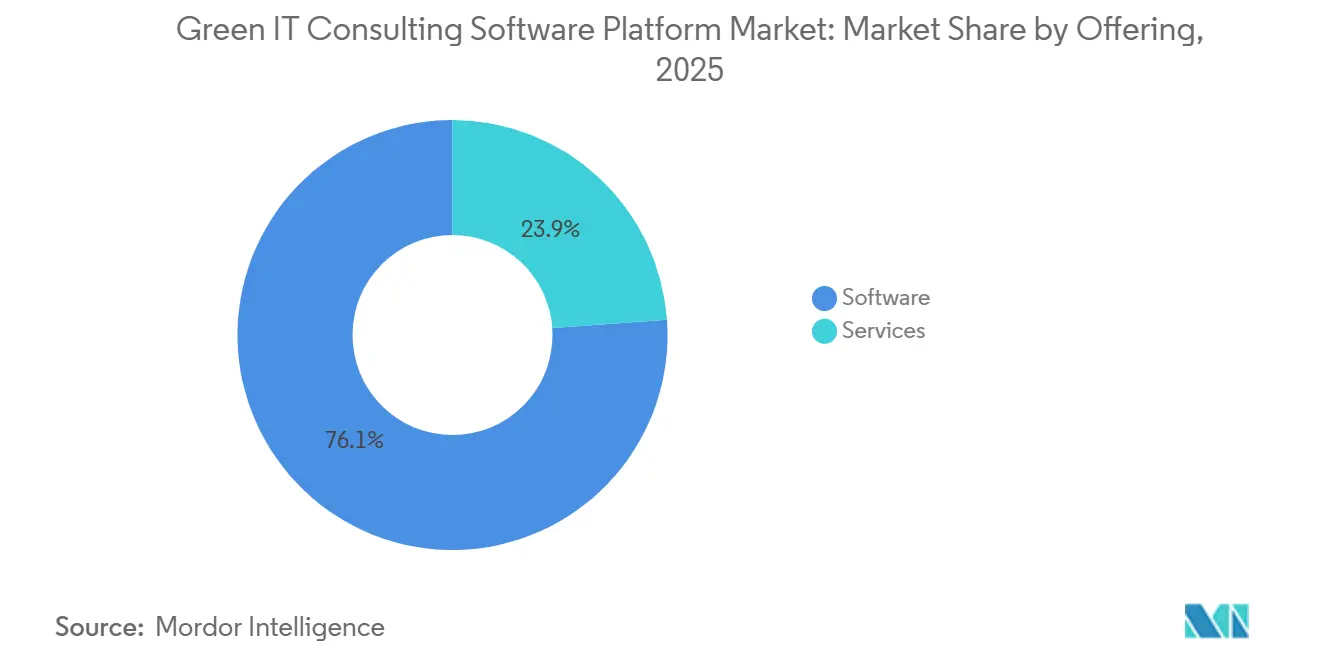
Software Platforms Move Ahead of Consulting-Led ModelsSoftware held 76.13% of the green IT consulting software platform market share in 2025, indicating that buyers were already favoring subscription platforms over recurring, advisory-led delivery. The pace of change across CSRD, ISSB S2, GRI, and related reporting frameworks made continuously updated software more practical than periodic consulting engagements for most enterprises. The software layer also remained the fastest-growing offering category, with a 12.13% CAGR through 2031, indicating that the green IT consulting software platform market is still broadening across new buyer groups rather than slowing after first-wave adoption. Services still matter, especially for implementation support, managed carbon data work, and strategy guidance during early rollout stages.
The balance between software and services is now changing in form rather than disappearing in substance. Vendors are building onboarding tools, training workflows, and managed data overlays directly within the platform, reducing dependence on open-ended consulting while keeping service revenue tied to subscriptions. This model is attractive because buyers want a system they can keep using every month, not a one-time advisory exercise that leaves data collection fragmented. It also supports higher retention because the platform serves as the operating layer for reporting, evidence management, and improvement tracking across the green IT consulting software industry.
By Deployment:
Hybrid Architectures Gain Ground in Regulated EnvironmentsCloud-based deployment accounted for 64.17% share of the green IT consulting software platform market size in 2025, reflecting demand for automatic updates, elastic scaling, and lower infrastructure overhead. Hybrid deployment is the fastest-growing model, and the green IT consulting software platform market size for hybrid configurations is projected to expand at 13.23% CAGR through 2031. Regulated sectors are driving that shift because they want cloud-based analytics and reporting tools while keeping selected data within local or internal environments. The on-premises model still plays a role in environments where legacy systems remain central or where policy controls limit full cloud adoption.
The balance between software and services is now changing in form rather than disappearing in substance. Vendors are building onboarding tools, training workflows, and managed data overlays directly within the platform, reducing dependence on open-ended consulting while keeping service revenue tied to subscriptions. This model is attractive because buyers want a system they can keep using every month, not a one-time advisory exercise that leaves data collection fragmented. It also supports higher retention because the platform serves as the operating layer for reporting, evidence management, and improvement tracking across the green IT consulting software industry.
By Enterprise Size:
Supply Chain Demands Bring Smaller Firms Into ScopeLarge enterprises held a 69.12% share in 2025 because early disclosure obligations and assurance demands initially concentrated spending among the largest organizations. Small and medium enterprises are the fastest-growing group, with a 12.83% CAGR through 2031, largely because reporting pressure is spreading through supplier networks. When prime contractors and large customers request auditable carbon data, smaller suppliers often need formal systems instead of spreadsheets or one-off estimates. This shift is one of the clearest ways the green IT consulting software platform market is broadening beyond large listed enterprises.
The growth path for smaller firms depends on simpler onboarding, clearer templates, and pricing that matches smaller team capacity. It was found that smaller businesses using AI-powered carbon tracking tools were 1.6 times more likely to secure green finance and 2.4 times more likely to have formal sustainability reporting, which gives adoption a commercial angle beyond compliance alone. Another study also showed that digital maturity and net-zero innovation move together, which explains why adoption varies sharply across supplier groups and regions. Large enterprises are consolidating toward broader platforms, while smaller buyers remain more mixed and more sensitive to guidance, packaging, and ease of use across the green IT consulting software platform market.
By Application:
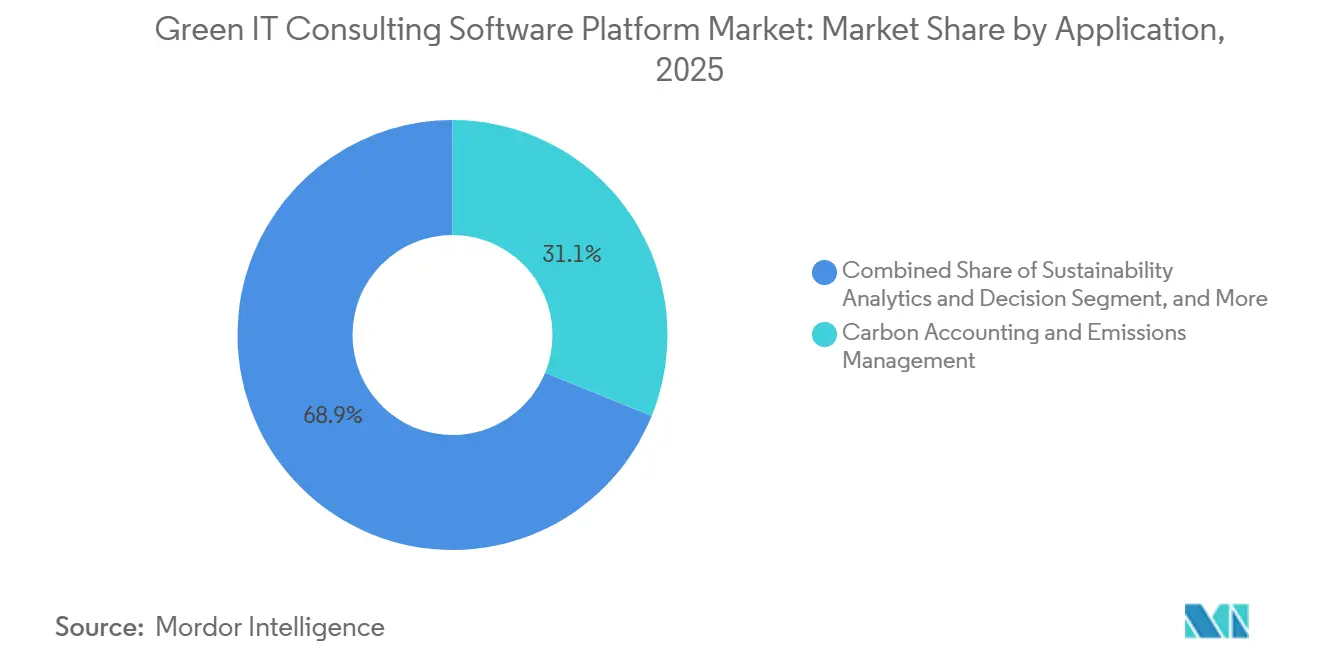
Carbon Accounting Stays Core While Analytics DeepensCarbon accounting and emissions management captured a 31.14% share in 2025, keeping it at the center of platform design and buyer evaluation. Sustainability analytics and decision support is projected to expand at a 14.53% CAGR through 2031, indicating that the green IT consulting software platform market is shifting from backward-looking reporting toward planning and scenario-based use cases. Energy management and resource optimization are gaining momentum as platforms connect utility data, smart meter inputs, and renewable procurement records to provide more continuous operating views. Sustainable IT asset lifecycle management is also becoming more important because buyers need better visibility into hardware-related emissions from procurement through end-of-life handling.
The application mix is widening as companies seek a single system to support reporting, operational improvement, and investment decisions simultaneously. Agentforce Net Zero and a sustainability AI roadmap both point to a deeper use of automated forecasting, workflow support, and product-level data within enterprise decision-making. Product carbon footprint calculation also became generally available in 2026, expanding platform use to labeling, procurement, and product-level allocation needs. That combination keeps carbon accounting as the anchor while pushing the green IT consulting software platform industry toward more forward-looking, operational use cases.

By End User:
Energy and Utilities Sets The Fastest PaceIT and telecom held a 22.17% share in 2025 because data centers, networks, and hardware fleets create substantial direct and value-chain reporting needs. Energy and utilities are projected to grow at 13.93% CAGR through 2031, making it the fastest-moving end-user group in the green IT consulting software platform market. Utilities need more frequent recalculation of grid emission factors and project-level visibility, which makes their use case more dynamic than a simple annual disclosure cycle. BFSI remains important because disclosure, financed emissions, and climate governance needs support steady demand for structured sustainability software.
Sector-specific demand is also widening the product opportunity. In April 2026, EcoSpace was launched to give utilities and grid developers project-level carbon footprint quantification and visualization, demonstrating how the market is extending beyond general corporate carbon reporting into specialized operating environments. Retail, construction, government, and other sectors are entering through different routes, but each needs stronger data visibility, higher-quality evidence, and stronger workflow controls to manage procurement and disclosure expectations. This is helping the green IT consulting software platform market deepen by vertical, not only by company size or geography.
Geography Analysis
North America Green IT Consulting Software Platform Market
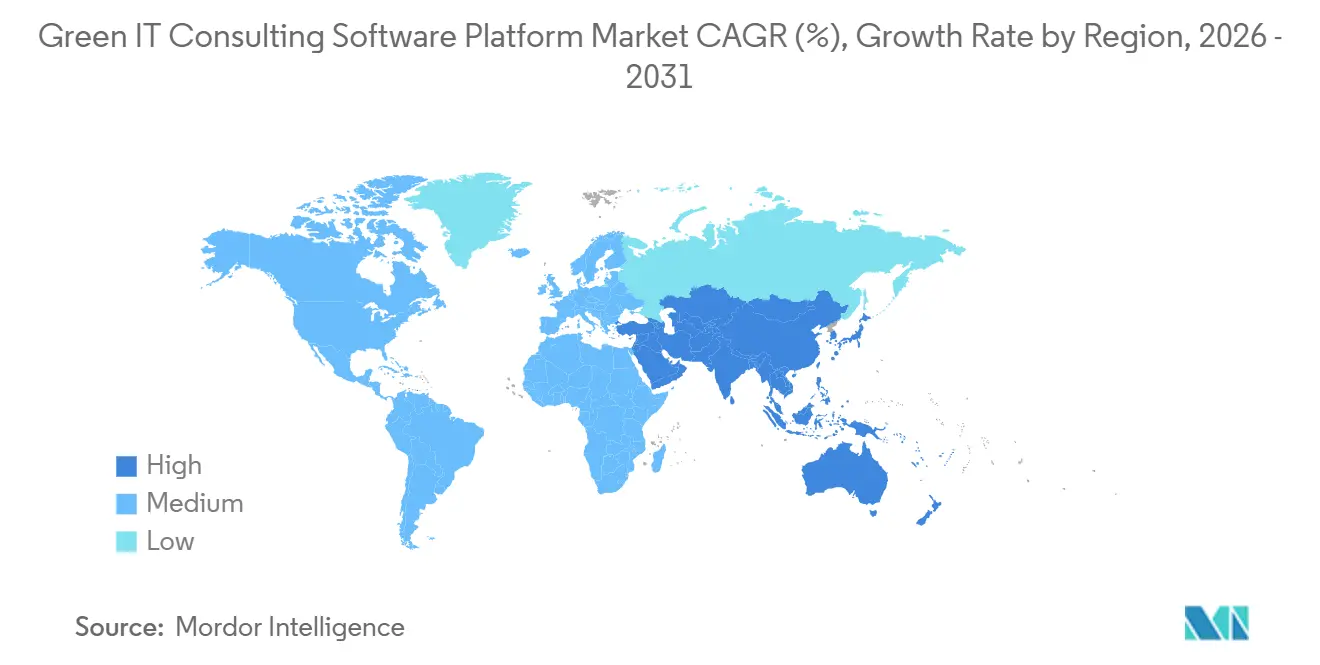
North America held 38.12% of the green IT consulting software platform market share in 2025, maintaining its position as the largest regional revenue base. The region benefits from large enterprise budgets, mature reporting functions, and concentrated demand among technology-heavy companies with large digital estates. Detailed sustainability reporting shows how infrastructure and product-level evaluation are becoming part of routine enterprise management, not just a disclosure exercise. The view of rising data center electricity use also supports North America’s strong position, as the region accounts for a large share of digital infrastructure spending and faces significant efficiency pressures. These conditions give the green IT consulting software platform market a larger average contract value in North America than in earlier-stage regions.
Europe Green IT Consulting Software Platform Market
Europe remained the second-largest regional market because reporting obligations and assurance expectations pushed buyers toward structured, audit-ready platforms. Policy updates around CSRD scope and reporting support continued to shape buying criteria across large enterprises in the region. Germany, the United Kingdom, and France remain central demand centers because industrial reporting depth, product carbon footprint needs, and cross-border compliance all carry more weight there. European buyers also place more emphasis on traceability, methodology clarity, and evidence quality, which suits vendors that can document data lineage in detail.
APAC, MEA and South America Green IT Consulting Software Platform Market
Asia-Pacific is projected to expand at 13.63% CAGR through 2031, making it the fastest-growing regional segment in the green IT consulting software platform market. Growth comes from the spread of mandatory and semi-mandatory sustainability disclosure frameworks across several major economies, which is creating first-time demand rather than replacement demand. Buyers in Japan, Singapore, Australia, South Korea, India, and China are moving at different speeds, but the common need is stronger digital support for carbon accounting, reporting, and supplier engagement. South America, the Middle East, and Africa remain earlier-stage opportunities, though emerging disclosure frameworks and green finance activity are widening the long tail of adoption across the green IT consulting software platform market.
Competitive Landscape
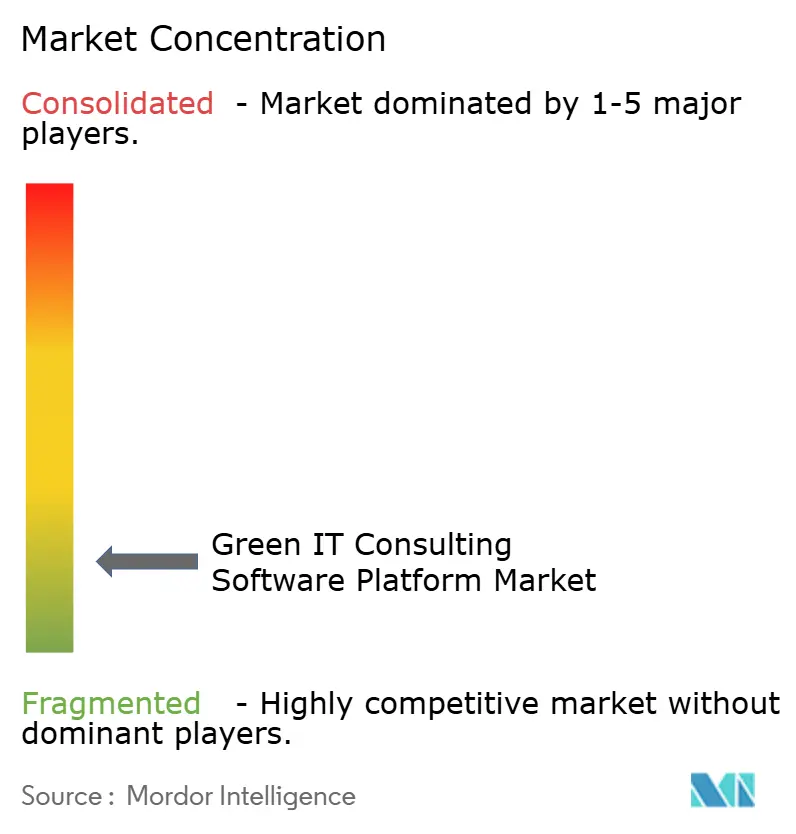
The green IT consulting software platform market remains fragmented, with competition spread across large enterprise software vendors, pure-play carbon accounting specialists, and industrial operations software providers. Each group approaches the market from a different starting point, which is why platform design still varies widely by data model, workflow depth, and deployment flexibility. A convergence model has emerged by linking sustainability platforms with broader data systems, embedding sustainability data into customer and enterprise processes. Another path is being followed with sustainability AI agents and Green Ledger-linked workflows that connect environmental accounting more directly to core business processes.
Strategic moves in 2025 and 2026 showed that buyers increasingly value integration and operational fit over stand-alone reporting features. One acquisition in June 2026 strengthened product carbon footprint and Scope 3 capabilities for manufacturing users. Other collaborations also expanded in June 2026, aiming to combine AI, data, and automation capabilities to support complex enterprise workflow modernization. These moves matter because the green IT consulting software platform market rewards vendors that can sit within existing operating systems rather than remain outside them.
Open ecosystem models are also becoming more important because buyers want supplier, finance, operations, and product data to move across systems with less manual effort. A new launch in May 2026 for asset-intensive industries demonstrated how entrants can compete by building on operational integration rather than relying solely on annual reporting. Engineering initiatives in 2026 also reinforced the value of deep implementation of enterprise AI and sustainability workflows. This leaves the green IT consulting software platform market competitive, but it also raises switching costs for vendors that can combine strong methodology support with deeper process integration.
Green IT Consulting Software Platform Industry Leaders
-
SAP SE
-
Microsoft Corporation
-
Schneider Electric SE
-
IBM Corporation
-
Accenture plc
- *Disclaimer: Major Players sorted in no particular order
Green IT Consulting Software Platform Market Companies Covered in this Report
- Accenture plc
- SAP SE
- Microsoft Corporation
- IBM Corporation
- Schneider Electric SE
- ServiceNow, Inc.
- Salesforce, Inc.
- Oracle Corporation
- Workiva Inc.
- Cority Software Inc.
- Enablon SA
- FigBytes Inc.
- Sphera Solutions, Inc.
- ENGIE Impact
- Persefoni AI, Inc.
- Watershed Technology, Inc.
- Greenly SAS
- Sweep SAS
- Plan A Earth GmbH
- Emitwise Limited
- Normative AB
- Diligent Corporation
- IFS AB
- EcoVadis SAS
- Wolters Kluwer N.V.
- Intelex Technologies ULC
Recent Industry Developments in Green IT Consulting Software Platform Market
- June 2026: IBM and ServiceNow expanded their strategic collaboration to combine IBM's AI, data, and automation capabilities with the ServiceNow AI Platform, targeting legacy system modernization and autonomous IT operations; joint solutions addressing sustainability data management workflows are expected in the second half of 2026 and will enable enterprises to connect operational IT data with emissions reporting systems at scale.
- June 2026: Makersite completed its acquisition of Siemens' SiGREEN product carbon footprint and supply chain data exchange platform, effective June 1, 2026; the acquisition consolidates product-level carbon data from Siemens' industrial customer base with Makersite's product lifecycle intelligence software, materially expanding Scope 3 category 1 accounting capabilities for manufacturing buyers.
- May 2026: SAP SE announced that new sustainability AI agents would be generally available by end of 2026, targeting up to 80% reduction in manual compliance effort and 60% error reduction in product carbon footprint workflows, according to the SAP Sapphire 2026 announcement; the launch positions SAP's integrated financial and sustainability reporting stack as an AI-first platform supporting automated audit preparation.
- May 2026: IFS launched IFS Zero, an agentic Emissions Operating System designed for asset-intensive industries, providing a unified calculation platform for Scope 1, 2, and 3 emissions with an operational integration model that delivers an emissions baseline in short timescales; the platform expands the green IT consulting software addressable market into heavy industrial operations where annual inventory construction has historically been the standard.
Global Green IT Consulting Software Platform Market Report Scope
The Green IT Consulting Software Platform market refers to solutions and services that help enterprises embed sustainability principles into IT operations, procurement, and asset management. These platforms provide functionalities such as carbon accounting, energy and resource optimization, sustainable IT asset lifecycle management, ESG compliance reporting, and advanced sustainability analytics for decision support. By integrating consulting-driven intelligence with software capabilities, these platforms enable organizations to reduce IT-related emissions, optimize energy usage, extend asset lifecycles, and align with global ESG frameworks. Serving both large enterprises and SMEs across diverse industries, the market’s primary objective is to enhance transparency, automate compliance, and support the transition toward greener, more efficient, and resilient digital infrastructure.
The Green IT Consulting Software Platform market report is segmented by Offering (Software, and Services), Deployment (Cloud-Based, On-Premise, and Hybrid), Enterprise Size (Large Enterprises, and Small and Medium Enterprises), Application (Carbon Accounting and Emissions Management, Energy Management and Resource Optimization, Sustainable IT Asset Lifecycle Management, ESG Reporting and Compliance, and Sustainability Analytics and Decision Support), End User (IT and Telecom, BFSI, Manufacturing, Energy and Utilities, Retail and E-Commerce, Construction and Infrastructure, Government and Public Sector, and Other End-User Industries), and Geography (North America, South America, Europe, Asia-Pacific, Middle East, and Africa). The Market Forecasts are Provided in Terms of Value (USD).
Segmentation Overview
| Software |
| Services |
| Cloud-Based |
| On-Premise |
| Hybrid |
| Large Enterprises |
| Small and Medium Enterprises |
| Carbon Accounting and Emissions Management |
| Energy Management and Resource Optimization |
| Sustainable IT Asset Lifecycle Management |
| ESG Reporting and Compliance |
| Sustainability Analytics and Decision Support |
| IT and Telecom |
| BFSI |
| Manufacturing |
| Energy and Utilities |
| Retail and E-Commerce |
| Construction and Infrastructure |
| Government and Public Sector |
| Other End-User Industries |
| North America | United States | |
| Canada | ||
| Mexico | ||
| South America | Brazil | |
| Argentina | ||
| Rest of South America | ||
| Europe | Germany | |
| United Kingdom | ||
| France | ||
| Italy | ||
| Spain | ||
| Russia | ||
| Rest of Europe | ||
| Asia-Pacific | China | |
| India | ||
| Japan | ||
| South Korea | ||
| Australia | ||
| Rest of Asia-Pacific | ||
| Middle East and Africa | Middle East | Saudi Arabia |
| United Arab Emirates | ||
| Rest of Middle East | ||
| Africa | South Africa | |
| Nigeria | ||
| Rest of Africa | ||
| By Offering | Software | ||
| Services | |||
| By Deployment | Cloud-Based | ||
| On-Premise | |||
| Hybrid | |||
| By Enterprise Size | Large Enterprises | ||
| Small and Medium Enterprises | |||
| By Application | Carbon Accounting and Emissions Management | ||
| Energy Management and Resource Optimization | |||
| Sustainable IT Asset Lifecycle Management | |||
| ESG Reporting and Compliance | |||
| Sustainability Analytics and Decision Support | |||
| By End User | IT and Telecom | ||
| BFSI | |||
| Manufacturing | |||
| Energy and Utilities | |||
| Retail and E-Commerce | |||
| Construction and Infrastructure | |||
| Government and Public Sector | |||
| Other End-User Industries | |||
| By Geography | North America | United States | |
| Canada | |||
| Mexico | |||
| South America | Brazil | ||
| Argentina | |||
| Rest of South America | |||
| Europe | Germany | ||
| United Kingdom | |||
| France | |||
| Italy | |||
| Spain | |||
| Russia | |||
| Rest of Europe | |||
| Asia-Pacific | China | ||
| India | |||
| Japan | |||
| South Korea | |||
| Australia | |||
| Rest of Asia-Pacific | |||
| Middle East and Africa | Middle East | Saudi Arabia | |
| United Arab Emirates | |||
| Rest of Middle East | |||
| Africa | South Africa | ||
| Nigeria | |||
| Rest of Africa | |||
Key Questions Answered in the Report
What is the current and forecast value of the green IT consulting software platform market?
The market was valued at USD 0.94 billion in 2025, stood at USD 1.02 billion in 2026, and is forecast to reach USD 1.74 billion by 2031 at a 11.27% CAGR.
Which offering type leads green IT consulting software platforms?
Software led with a 76.13% share in 2025, and it is also the fastest-growing offering category with a 12.13% CAGR through 2031.
Why is hybrid deployment gaining traction in this space?
Hybrid deployment is projected to grow at 13.23% CAGR because regulated buyers want cloud analytics and reporting while keeping selected data in local or internal environments.
Which application area remains central to buyer demand?
Carbon accounting and emissions management remained the largest application with a 31.14% share in 2025, while sustainability analytics and decision support is growing the fastest at 14.53% CAGR.
Which customer group is expanding the fastest?
Energy and utilities is the fastest-growing end-user group at 13.93% CAGR, while small and medium enterprises are also expanding quickly at 12.83% CAGR because supply chain reporting requirements are spreading.
Which region offers the strongest growth outlook?
Asia-Pacific has the fastest regional growth outlook at 13.63% CAGR through 2031, while North America remained the largest region with a 38.12% share in 2025.