
Canada Green IT Software Market Size and Share
Market Overview
| Study Period | 2020 - 2031 |
|---|---|
| Forecast Data Period | 2026 - 2031 |
| Base Year Market Size (2025) | USD 0.75 Billion |
| Market Size (2026) | USD 0.85 Billion |
| Market Size (2031) | USD 1.85 Billion |
| Growth Rate (2026 - 2031) | 16.83 % |
| Market Concentration | Medium |
Major Players *Disclaimer: Major Players sorted in no particular order Image © Mordor Intelligence. Reuse requires attribution under CC BY 4.0. | |
Canada Green IT Software Market Analysis by Mordor Intelligence
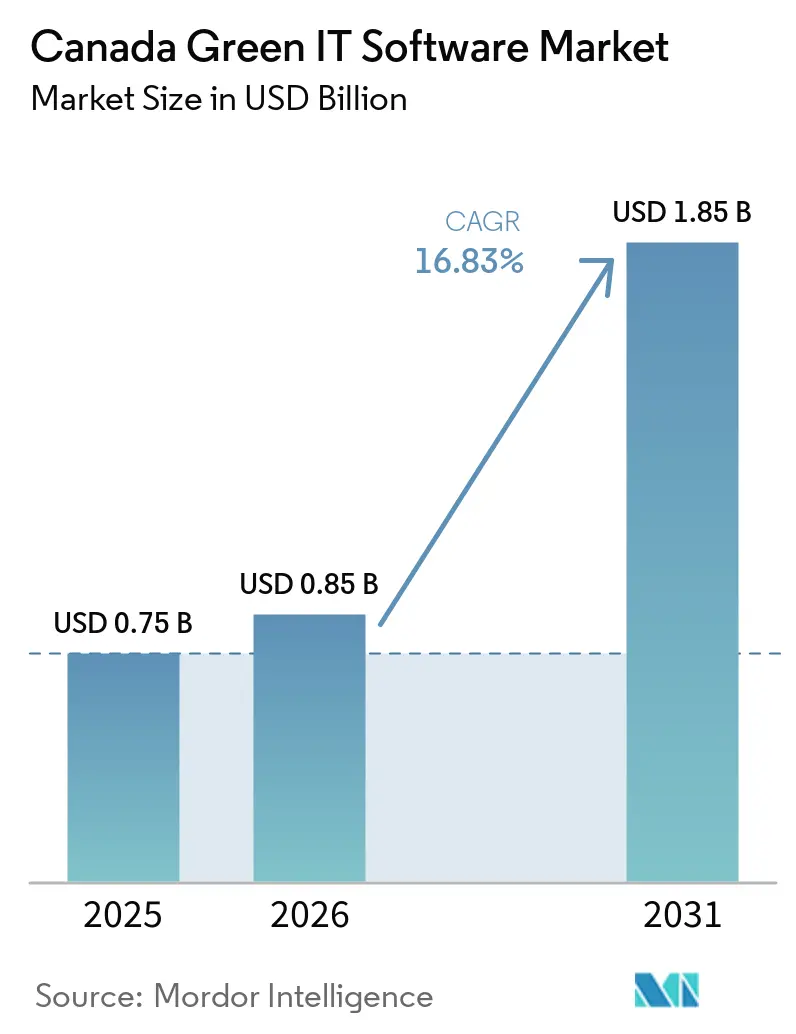
The Canada Green IT Software market size is projected to be USD 0.75 billion in 2025, USD 0.85 billion in 2026, and reach USD 1.85 billion by 2031, growing at a CAGR of 16.83% from 2026 to 2031. The Canada Green IT Software market is expanding as disclosure standards and climate-risk rules are moving software buying from discretionary planning into structured implementation across regulated enterprises. Demand is also rising because organizations increasingly need a single system to manage emissions data, reporting workflows, and transition planning across multiple business units and reporting frameworks. The market is also gaining support from rising electricity costs in digital infrastructure, making energy-tracking and optimization tools relevant even when compliance is not the main driver. Ontario and Quebec continue to anchor adoption because they combine large enterprise demand, public-sector activity, and major digital infrastructure investment. Competition is tightening as established enterprise software vendors add sustainability functions into broader platforms, while uncertainty around wider securities rulemaking may slow some purchases outside regulated segments.
Key Report Takeaways
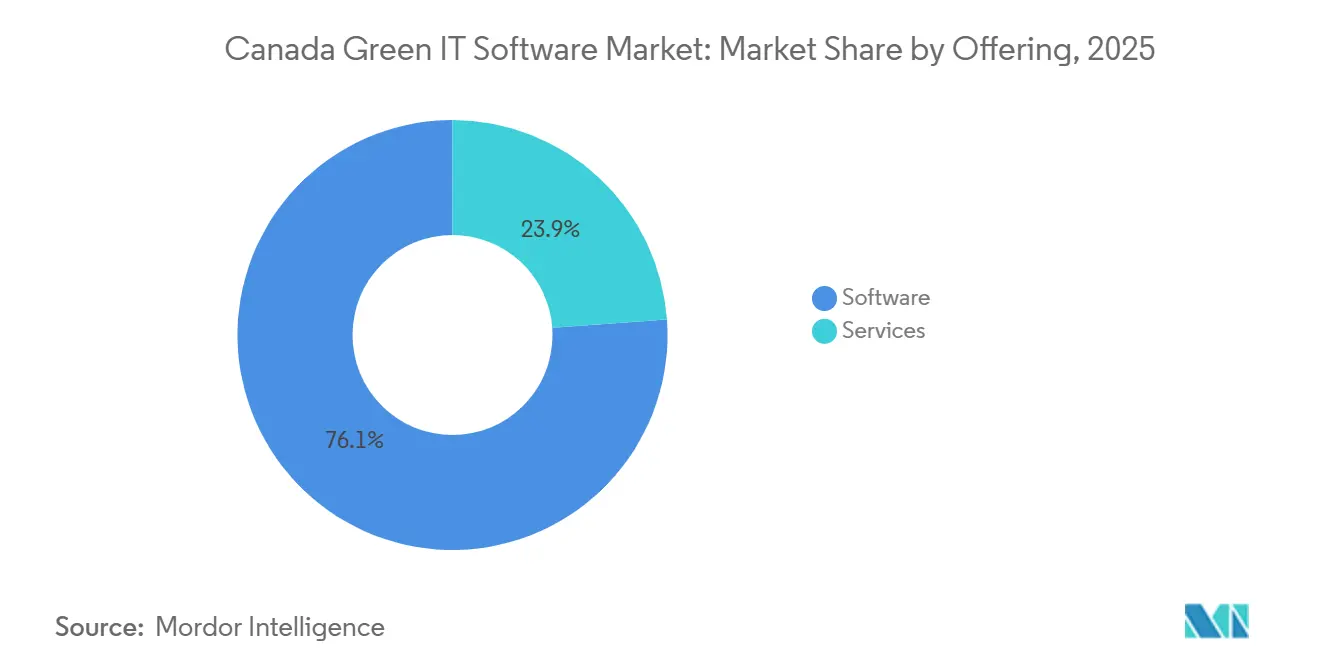
- By offering, software held 76.14% of the Canada Green IT Software market share in 2025, while services are projected to expand at a 16.91% CAGR through 2031.
- By deployment, cloud-based solutions accounted for 64.17% of revenue in 2025, while hybrid deployment is projected to grow at a 17.02% CAGR through 2031.
- By enterprise size, large enterprises held 69.12% of the Canada Green IT Software market share in 2025, while SMEs are projected to expand at a 17.13% CAGR through 2031.
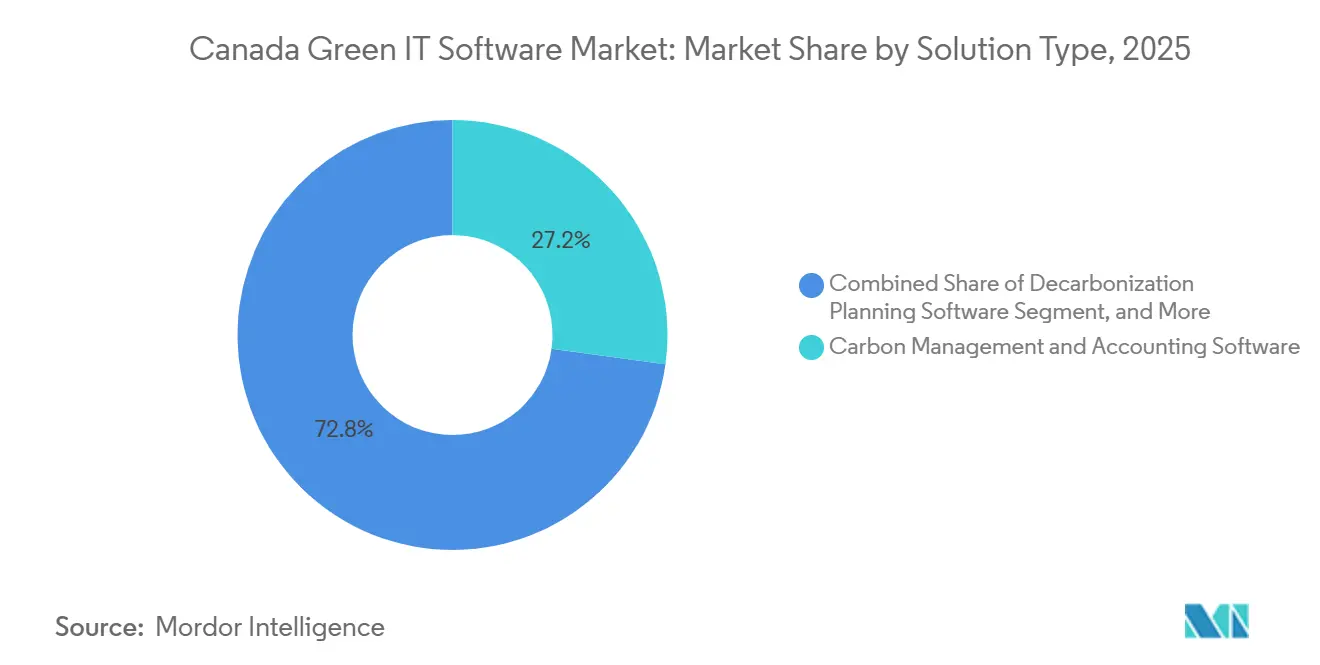
- By solution type, carbon management and accounting software accounted for 27.18% of the Canada Green IT Software market size in 2025, while decarbonization planning software is projected to grow at a 17.24% CAGR through 2031.
- By end user, IT and telecom held 22.13% share in 2025, while energy and utilities are projected to record the fastest CAGR of 17.31% through 2031.
Note: Market size and forecast figures in this report are generated using Mordor Intelligence’s proprietary estimation framework, updated with the latest available data and insights as of January 2026.
Canada Green IT Software Market Trends and Insights
Drivers Impact Analysis*
| Driver | (~) % Impact on CAGR Forecast | Geographic Relevance | Impact Timeline |
|---|---|---|---|
| ESG Disclosure Compliance Demand | +3.2% | National, with high intensity in Ontario, Quebec, and British Columbia | Short term (≤ 2 years) |
| Corporate Net-Zero Commitments | +2.8% | National, concentrated in Ontario and Alberta | Medium term (2-4 years) |
| Energy Cost Optimization In IT Operations | +2.5% | National, with early gains in Alberta and Ontario | Medium term (2-4 years) |
| AI-Driven Scope 3 Data Automation | +2.3% | National, with concentration in Ontario and Quebec | Medium term (2-4 years) |
| Data Sovereignty And Cloud-First Modernization In Canada | +2.0% | National, with Quebec and British Columbia leading | Long term (≥ 4 years) |
| Public Sector Sustainable Procurement Programs | +1.5% | National, with early gains in Ottawa, Toronto, and Vancouver | Medium term (2-4 years) |
| Source: Mordor Intelligence | |||
ESG Disclosure Compliance Demand
Canada’s disclosure environment shifted quickly as national sustainability standards and financial-sector climate requirements moved from policy discussion into real reporting obligations. The Canadian Sustainability Standards Board released CSDS 1 and CSDS 2 in December 2024, and voluntary application began for annual periods starting January 1, 2025, providing enterprises with a clear reporting reference aligned with IFRS S1 and S2. OSFI’s Guideline B-15 already requires federally regulated financial institutions to address climate risk management and disclose greenhouse gas metrics over a phased timeline, keeping procurement active in the financial sector through 2026 and beyond.[1] This sequence matters because it brings large institutions into implementation first, while smaller regulated entities now move from awareness into vendor selection and workflow design. It also reduces the room for spreadsheet-led processes because buyers increasingly need audit trails, methodological controls, and governance features that can withstand review. In the Canada Green IT Software market, this demand is strengthening platforms that can connect reporting, assurance readiness, and emissions calculation within a single, controlled system.[2]
Corporate Net-Zero Commitments
Corporate climate commitments are becoming longer-term software investments, as targets now require measurable operating plans rather than broad public statements. TELUS reported that it achieved 100% renewable and low-emitting electricity sourcing across its global operations by December 31, 2025, while also maintaining its path toward net-zero greenhouse gas emissions across Scopes 1, 2, and 3 by 2040. Desjardins stated in May 2026 that it had committed more than CAD 4 billion (USD 2.9 billion) to energy transition financing since 2021, underscoring how climate programs are tied to funding, governance, and operational accountability. These commitments increase demand for tools that can track transition roadmaps, connect emissions outcomes to capital decisions, and, where required, support financed-emissions workflows. They also extend buying pressure beyond the largest companies because supplier networks increasingly need carbon data to remain in preferred procurement channels. In the Canada Green IT Software market, this keeps demand broadening from direct compliance into commercial relationship management.
Energy Cost Optimization in IT Operations
Energy use in digital operations is becoming a practical buying trigger because data centers, cloud workloads, and AI processing are increasing the need for precise resource tracking. The Canada Energy Regulator noted that energy demand from data centers is steadily increasing and that AI development is a significant factor behind that shift. Natural Resources Canada also continues to emphasize data center efficiency practices, which reinforces the value of software-led visibility into cooling, electricity use, and performance management. This changes the sales conversation because green IT tools are not only supporting disclosure, they are also helping operators control cost and improve utilization. The effect is stronger in environments where organizations can gain efficiency through better workload scheduling and continuous monitoring without waiting for a full infrastructure rebuild. In the Canada Green IT Software market, this creates a clearer return case for buyers whose primary concern is operating efficiency rather than reporting deadlines.[3]
AI-Driven Scope 3 Data Automation
Scope 3 reporting remains difficult because supplier, logistics, and purchased goods data usually sit across several disconnected systems and formats. IBM introduced the Envizi Emissions API in April 2026 to let developers and software providers embed GHG Protocol-aligned emissions calculations directly into operational workflows, reducing the friction of using emissions data in day-to-day systems. SAP also stated in May 2026 that new sustainability AI agents covering packaging compliance review, Scope 3 scenario simulation, and GHS classification automation would reach general availability by the end of 2026. These product moves matter because they shift software value from static reporting into faster data ingestion, scenario testing, and workflow completion. They also favor vendors that can preserve traceability while using automation, since enterprises still need methods that can be reviewed and explained. In the Canada Green IT Software market, AI is therefore becoming more important as a scaling tool for disclosure readiness than as a standalone feature.
Restraints Impact Analysis*
| Restraint | (~) % Impact on CAGR Forecast | Geographic Relevance | Impact Timeline |
|---|---|---|---|
| High Upfront Migration and Integration Costs | -2.5% | National, with heightened impact in SME-dense Ontario and Quebec | Short term (≤ 2 years) |
| Shortage of Sustainability Analytics Talent | -2.0% | National, with acute shortages in Atlantic Canada and Prairie provinces | Medium term (2-4 years) |
| Fragmented ESG Data and Metric Standardization | -1.5% | National, with cross-provincial variance in regulatory timelines | Medium term (2-4 years) |
| Legacy IT and Data Center Lock-In | -1.2% | National, with intensity in Alberta and Ontario | Long term (≥ 4 years) |
| Source: Mordor Intelligence | |||
High Upfront Migration and Integration Costs
Migration remains a real barrier because many organizations still manage sustainability data across spreadsheets, ERP modules, energy records, and separate finance systems. When those environments need to be connected into a single reporting workflow, the project often exceeds the initial software purchase. This slows decision-making in the Canadian Green IT Software market because buyers may agree on the need for better reporting but still pause during architecture reviews, data mapping, and implementation scoping. IBM’s April 2026 launch of Envizi Emissions Calculations in Excel addresses that problem directly, providing spreadsheet-based users with a more structured entry point before a full platform deployment. The practical effect is that vendors with modular onboarding and lower-change implementation paths are better placed to convert early interest into signed projects. This restraint does not remove demand, but it does stretch sales cycles and pushes many buyers toward phased deployments.[4]
Shortage of Sustainability Analytics Talent
The talent gap is another constraint, as many organizations still lack teams capable of integrating emissions accounting, reporting requirements, and system configuration. The Future Skills Center identified sustainability-related digital capabilities as a structural barrier for Canadian SMEs and noted that green skills development will depend heavily on upskilling existing workforces. Sage Canada reported in December 2025 that 72% of Canadian SMEs considered sustainability important, but only 11% were using carbon or emissions-tracking tools, which shows the distance between intent and operational readiness. The same release said 46% of Canadian SMEs believed AI tools could make reporting easier, which supports demand for simpler workflows and guided automation. In the Canada Green IT Software market, that means product design matters as much as product depth because usability will influence adoption, retention, and expansion. Vendors that reduce the need for specialist configuration are likely to perform better with first-time buyers.
*Our forecasts treat driver/restraint impacts as directional, not additive. The impact forecasts reflect baseline growth, mix effects, and variable interactions.
Segment Analysis
By Offering: Software Leads, While Services Deepen Ongoing Delivery
Software held 76.14% of the Canada Green IT Software market share in 2025, indicating that core platforms still account for the largest share of current spending. Buyers first secure systems for carbon accounting, ESG reporting, and sustainability data management before expanding into broader operational support. This pattern fits a market that is still building its foundational technology layer across large organizations. It also shows that reporting systems remain the starting point for many enterprise programs because they establish the data structure needed for later planning and optimization. In the Canada Green IT Software market, software remains the anchor because it organizes data, controls workflows, and supports ongoing disclosure obligations.
Services are still important because they are projected to grow at a 16.91% CAGR through 2031, which is close to the overall market expansion pace. That growth reflects rising demand for implementation support, preparation for disclosure assurance, managed updates, and advisory work after the first platform rollout. As standards evolve, enterprises often need ongoing help to keep methods, controls, and templates aligned with current requirements. This gradually changes competition because vendors are not only selling applications, they are also competing on delivery continuity and regulatory responsiveness. Over time, services deepen customer relationships and can influence renewal decisions just as strongly as software capability.
By Deployment: Hybrid Adoption Rises Within A Cloud-Led Bas
By Deployment: Hybrid Adoption Rises Within A Cloud-Led Base
Cloud-based deployment accounted for 64.17% of revenue in 2025, confirming that it remains the default entry path for many buyers in the Canadian Green IT Software market. Cloud delivery enables organizations to access reporting workflows faster, make updates more easily, and reduce internal infrastructure demands during early adoption. It also aligns with the buying model of companies that want to move quickly on disclosure readiness without first building a separate system environment. For many customers, cloud deployment still offers the shortest path from procurement to active reporting. This is why the market remains cloud-led even as buyer requirements become more specific.
Hybrid deployment is projected to grow at a 17.02% CAGR through 2031, as some users now seek cloud analytics alongside tighter control over sensitive operational data. SAP Canada’s September 2025 launch of Sovereign Cloud On-Site shows how vendors are adapting to that need by allowing managed cloud infrastructure within customer facilities. Microsoft’s Canadian infrastructure program, valued at CAD 19 billion (USD 13.6 billion), also supports broader enterprise comfort with cloud-hosted digital workloads while keeping sustainability design visible in new builds. Hybrid, therefore, grows because it gives regulated and public-sector users more flexibility without fully abandoning cloud-scale reporting tools. On-premise deployment still has a place where residency and internal control requirements remain strict.
By Enterprise Size: Large Enterprises Lead, While SMEs Build Momentum
Large enterprises held 69.12% of the market in 2025, which reflects their earlier exposure to investor pressure, regulatory expectations, and multi-entity reporting complexity. These organizations usually have the scale to absorb platform costs and the internal need to replace manual sustainability processes. They also face greater external scrutiny, making it harder to delay the implementation of controlled reporting systems. In the Canada Green IT Software market, large enterprises therefore remain the primary base of current revenue and reference deployments. Their buying patterns continue to shape feature priorities, with auditability, governance, and system integration at the forefront.
SMEs are projected to grow at a 17.13% CAGR through 2031 as disclosure pressure increasingly moves through supply chains and procurement programs. The Treasury Board Secretariat’s standard on greenhouse gas disclosure and target setting requires suppliers to larger federal contracts to measure emissions and set reduction targets, thereby extending reporting expectations beyond direct public institutions. Sage Canada said that 26% of Canadian SMEs planned to begin sustainability reporting by 2026, which signals a near-term wave of first-time adoption rather than distant interest. This part of the market will favor products that are easier to implement, explain, and maintain with small teams. SME growth, therefore, broadens the Canada Green IT Software market even if enterprise accounts still dominate the current value.
By Solution Type: Decarbonization Planning Moves into Daily Decisions
Carbon management and accounting software accounted for 27.18% of the Canada Green IT Software market in 2025, indicating that emissions measurement remains the foundation of demand. Organizations still need reliable inventories, calculation engines, and reporting outputs before more advanced transition programs can work at scale. This makes carbon accounting the most established solution category in the market today. It is the point where finance, sustainability, operations, and compliance data first come together in a usable structure. As a result, the category maintains its lead because all subsequent workflows depend on it.
Decarbonization planning software is projected to expand at a 17.24% CAGR through 2031, signaling a shift from measuring emissions to managing operational responses. These tools matter because they help organizations test changes in infrastructure, procurement, energy sourcing, and supplier choices before spending capital. ESG reporting systems and sustainability data management platforms remain important alongside them because external disclosure still depends on controlled, well-structured information. Cority’s March 2026 recognition as a leader in carbon management software, with its December 2025 Cortex AI launch highlighted as a differentiator, shows that vendors are also pushing deeper into AI-supported workflow management. The solution mix is therefore becoming more operational, but it still rests on strong accounting and data-governance foundations.

By End User: IT And Telecom Lead, While Energy and Utilities Expand Fastest
IT and telecom accounted for 22.13% of the Canada Green IT Software market in 2025, making it the largest end-user segment. This leadership reflects the sector’s direct energy footprint and its role as the digital backbone for the same software systems being adopted. Companies in this segment often need sustainability tools for both their own operations and enterprise-grade customer reporting. That dual role keeps demand steady because platform use is tied to internal efficiency, external disclosure, and infrastructure planning simultaneously. It also means this segment often adopts new functions earlier than slower-moving industries.
Energy and utilities are projected to grow at a 17.31% CAGR through 2031 as grid transition pressures and asset-level reporting requirements become more complex. TELUS and the Vector Institute reported nearly 12% annual electricity savings in early testing of an AI tool for HVAC optimization in 24/7 data centers, which illustrates how operating efficiency and sustainability goals are now being managed together. Scotiabank’s April 2026 launch of an AI-enabled home energy advisory tool also shows that green IT capabilities are moving beyond internal reporting into customer-facing products in financial services. Manufacturing, government, healthcare, construction, and retail are also adding demand as procurement standards and supplier disclosure needs spread into more operating tiers. This keeps end-user expansion broad, even though the early revenue base remains led by digitally intensive sectors.
Geography Analysis
Ontario and Quebec remained the main demand centers in 2025 and 2026 because they combine large regulated institutions, public-sector bodies, and major digital infrastructure investment. That concentration matters because procurement in the Canada Green IT Software market is strongest where compliance obligations, enterprise scale, and technology budgets overlap. Microsoft’s Canadian infrastructure commitment, valued at CAD 19 billion (USD 13.6 billion), is being deployed across Ontario and Quebec and includes LEED Gold standards in data center design, which reinforces the sustainability profile of digital infrastructure in those provinces. Ontario also benefits from its concentration of financial institutions and enterprise headquarters, which keeps demand for carbon management and reporting platforms active. Quebec adds strength through a cleaner electricity mix and a favorable setting for low-emissions cloud and AI workloads. Together, these factors keep central Canada at the core of current software demand.
British Columbia and Alberta represent different growth paths within the Canadian Green IT Software market. British Columbia benefits from a lower-emissions power profile that supports sustainability-led digital operations and strengthens the case for low-carbon cloud workloads. Alberta faces a stronger need for optimization because power-intensive digital activity creates pressure to manage electricity use, operating costs, and carbon performance more closely. This makes the province relevant for software tied to monitoring, resource efficiency, and decarbonization planning, even when the demand trigger is not formal disclosure.
Atlantic Canada and the Prairie provinces remain earlier-stage parts of the Canada Green IT Software market, but they are not outside the adoption path. The Future Skills Center identified limited sustainability-specific digital skills as a structural challenge for SMEs, particularly in regions with smaller talent pools and high SME density. The Government of Canada’s Greening Government Strategy required departments to identify high-carbon procurement categories and develop reduction criteria by 2025, with implementation beginning in 2026, which creates supplier-side demand across the country. The draft 2026-2029 Federal Sustainable Development Strategy also signals that this procurement-linked policy direction continues beyond a single cycle. These national signals reduce the risk that smaller provinces stay permanently behind larger markets. Over time, adoption in these regions is likely to grow through supplier requirements, public-sector influence, and more user-friendly software models.
Competitive Landscape
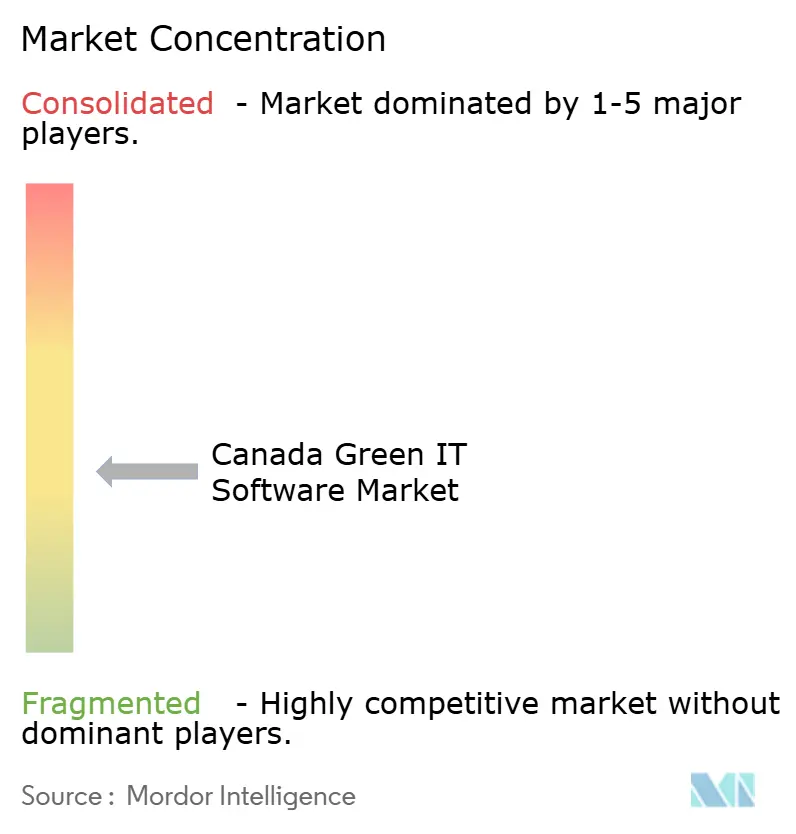
The Canada Green IT Software market remains moderately fragmented, with global enterprise vendors and specialist providers competing across reporting, carbon accounting, planning, and data-management workflows. Large platform vendors benefit from existing customer relationships because they can add sustainability functions into systems that buyers already use. That reduces switching friction and often shortens the path to expansion within installed accounts. At the same time, specialist providers remain relevant because they can move faster in targeted use cases and often offer stronger depth in carbon-specific workflows. This balance keeps competition active across both suite-based and focused product strategies.
IBM, SAP, Workiva, and Cority illustrate the main directions of competition in 2026. IBM expanded its position through the Envizi Emissions API and Envizi Emissions Calculations in Excel, which gives it both enterprise-scale integration and an easier path for earlier-stage users. SAP is strengthening its offer through sustainability AI agents and sovereign-cloud deployment options that better fit enterprise control requirements. Workiva is focusing on disclosure workflow support through its Sustainability Disclosure Agent and release-driven updates that help users manage evolving reporting tasks. Cority remains a meaningful domestic challenger because it combines carbon management depth with AI-led workflow expansion and local market familiarity. a
Another visible competitive theme is ecosystem building rather than pure standalone software expansion. EcoVadis expanded its Carbon Data Network in April 2026 by adding Carbmee’s AI-native environmental intelligence system, which enables SKU-level emissions data to flow into procurement and reporting workflows. That kind of move matters because buyers increasingly need supplier data, financial relevance, and reporting outputs to work together without manual reconciliation. Competitive advantage is therefore shifting toward vendors that can connect internal systems, supplier inputs, and assurance-ready disclosures into a single flow. This still leaves room for smaller providers, especially when customers want localized implementation support or a narrower product depth with faster response times. The market is therefore consolidating in terms of capabilities, even though the vendor base remains broad.
Canada Green IT Software Industry Leaders
-
Microsoft Corporation
-
IBM Corporation
-
SAP SE
-
Schneider Electric SE
-
Salesforce, Inc.
- *Disclaimer: Major Players sorted in no particular order
Recent Industry Developments
- May 2026: SAP announced at Sapphire 2026 that new sustainability AI agents covering packaging compliance review, Scope 3 scenario simulation, and GHS classification automation will reach general availability by end-2026. Beta results demonstrated more than 50% reduction in packaging compliance review hours and scenario simulation time cut from one day to 20 minutes, with over 20% fewer compliance errors.
- April 2026: IBM released the Envizi Emissions API, enabling developers and software providers to embed GHG Protocol-aligned emissions calculations directly into operational systems, extending IBM's sustainability accounting capabilities into mid-market workflows and third-party applications without requiring full adoption of the Envizi platform.
- April 2026: IBM also launched Envizi Emissions Calculations in Excel, targeting organizations at the spreadsheet stage of GHG reporting and creating a low-friction entry point into the Envizi ecosystem. The product bridges manual and enterprise-grade accounting workflows and is designed as a structured upgrade pathway.
- April 2026: Scotiabank launched an AI-enabled home energy advisory tool in partnership with Climative, becoming the first Canadian bank to offer property-level decarbonization guidance to mortgage clients. The deployment extends green IT capabilities from internal sustainability reporting into customer-facing financial products, broadening the BFSI use case for sustainability software.
Canada Green IT Software Market Report Scope
The Canada Green IT Software market refers to platforms and services that enable Canadian enterprises to integrate sustainability into IT operations by managing carbon emissions, optimizing energy and resource consumption, and ensuring compliance with ESG frameworks. These solutions include carbon management and accounting, ESG reporting and compliance, sustainability data management, decarbonization planning, and energy optimization software. By embedding sustainability intelligence into IT workflows, these platforms help organizations across Canada reduce environmental impact, enhance operational efficiency, and align with national climate commitments and global decarbonization goals. The market’s primary objective is to provide transparency, automate sustainability reporting, and support the transition toward greener, more resilient digital infrastructure across diverse industries.
The Canada Green IT Software market report is segmented by Offering (Software, and Services), Deployment (Cloud-Based, On-Premise, and Hybrid), Enterprise Size (Large Enterprises, and Small and Medium Enterprises), Solution Type (Carbon Management and Accounting Software, ESG Reporting and Compliance Software, Sustainability Data Management Platforms, Decarbonization Planning Software, and Energy and Resource Optimization Software), and End User (IT and Telecom, BFSI, Manufacturing, Energy and Utilities, Retail and E-Commerce, Government, Healthcare, Construction and Infrastructure, and Other End-User Industries). The Market Forecasts are Provided in Terms of Value (USD).
| Software |
| Services |
| Cloud-Based |
| On-Premise |
| Hybrid |
| Large Enterprises |
| Small and Medium Enterprises |
| Carbon Management and Accounting Software |
| ESG Reporting and Compliance Software |
| Sustainability Data Management Platforms |
| Decarbonization Planning Software |
| Energy and Resource Optimization Software |
| IT and Telecom |
| BFSI |
| Manufacturing |
| Energy and Utilities |
| Retail and E-Commerce |
| Government |
| Healthcare |
| Construction and Infrastructure |
| Other End-User Industries |
| By Offering | Software |
| Services | |
| By Deployment | Cloud-Based |
| On-Premise | |
| Hybrid | |
| By Enterprise Size | Large Enterprises |
| Small and Medium Enterprises | |
| By Solution Type | Carbon Management and Accounting Software |
| ESG Reporting and Compliance Software | |
| Sustainability Data Management Platforms | |
| Decarbonization Planning Software | |
| Energy and Resource Optimization Software | |
| By End User | IT and Telecom |
| BFSI | |
| Manufacturing | |
| Energy and Utilities | |
| Retail and E-Commerce | |
| Government | |
| Healthcare | |
| Construction and Infrastructure | |
| Other End-User Industries |
Key Questions Answered in the Report
What is the current and forecast size of Canada Green IT Software Market?
The Canada Green IT Software market size was USD 0.75 billion in 2025, is valued at USD 0.85 billion in 2026, and is forecast to reach USD 1.85 billion by 2031 at a 16.83% CAGR.
What is driving software adoption in Canada for green IT and sustainability reporting?
The main drivers are CSDS standards, OSFI climate-risk disclosure requirements, rising enterprise net-zero programs, and growing pressure to manage energy use in digital operations.
Which deployment model is gaining the fastest traction in Canada?
Hybrid deployment is projected to grow the fastest at a 17.02% CAGR through 2031, while cloud-based deployment remained the largest with 64.17% share in 2025.
Which customer group contributes the most revenue today?
Large enterprises led with 69.12% share in 2025 because they face stronger reporting obligations, investor pressure, and more complex data-management needs.
Which solution category is expanding the fastest?
Decarbonization planning software is projected to grow at a 17.24% CAGR through 2031, showing that buyers are moving from basic measurement into operational transition planning.
Which end-user sector is leading demand and which one is growing the fastest?
IT and telecom led with 22.13% share in 2025, while energy and utilities are projected to post the fastest growth at a 17.31% CAGR through 2031.