
Australia Green IT Software Market Size and Share
Market Overview
| Study Period | 2020 - 2031 |
|---|---|
| Forecast Data Period | 2026 - 2031 |
| Base Year Market Size (2025) | USD 0.32 Billion |
| Market Size (2026) | USD 0.37 Billion |
| Market Size (2031) | USD 1.06 Billion |
| Growth Rate (2026 - 2031) | 23.43 % |
| Market Concentration | Medium |
Major Players *Disclaimer: Major Players sorted in no particular order Image © Mordor Intelligence. Reuse requires attribution under CC BY 4.0. | |
Australia Green IT Software Market Analysis by Mordor Intelligence
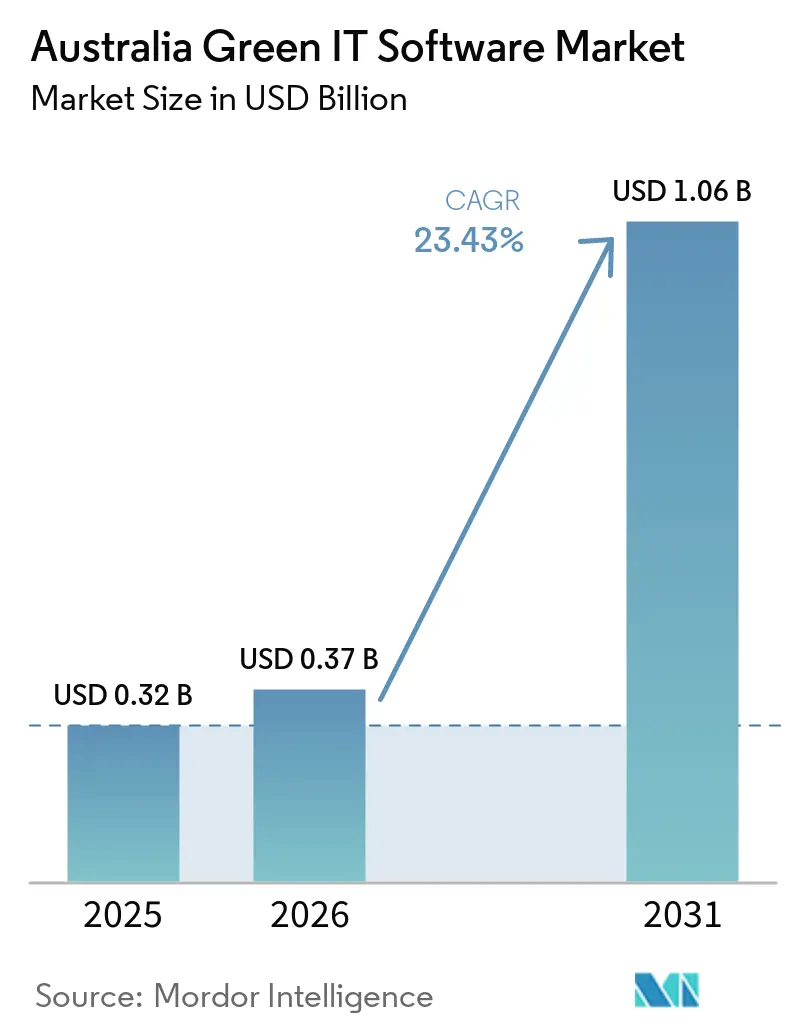
The Australia green IT software market size is expected to grow from USD 0.32 billion in 2025 to USD 0.37 billion in 2026 and is forecast to reach USD 1.06 billion by 2031 at 23.43% CAGR over 2026-2031. The phased rollout of mandatory climate disclosure requirements has shifted the Australia green IT software market from optional sustainability spending to a core compliance and reporting priority for large organizations. Rising electricity use across Australian data centers is adding a second layer of demand, because enterprises now need software that can measure energy use, link it to emissions, and support operational decisions. Buying patterns are also moving beyond first-stage data capture, as organizations prepare for scenario analysis, planning, and audit-ready reporting after their initial disclosure cycles. Hybrid deployment is gaining ground because many enterprises now run mixed IT estates and need a more complete view of emissions across on-premise and cloud environments. Competition in the Australia green IT software market is broadening across large enterprise software firms, specialist sustainability platforms, and local compliance-focused vendors, which is increasing pressure on undifferentiated mid-market offerings.
Key Report Takeaways
- By offering, software held 79.14% share Australia green IT software market in 2025, while services are projected to expand at a 23.51% CAGR through 2031.
- By deployment, cloud-based deployment held 67.17% share in 2025, while hybrid deployment is projected to expand at a 23.62% CAGR through 2031.
- By enterprise size, large enterprises held 72.12% share in 2025, while SMEs are projected to expand at a 23.73% CAGR through 2031.
- By solution type, carbon management and accounting software held 30.18% share in 2025, while decarbonization planning software is projected to expand at a 23.84% CAGR through 2031.
- By end user, IT and Telecom held 25.13% of the Australia green IT software market share in 2025, while Energy and Utilities projected to expand at a 24.12% CAGR remained the fastest-growing vertical through 2031.
Note: Market size and forecast figures in this report are generated using Mordor Intelligence’s proprietary estimation framework, updated with the latest available data and insights as of January 2026.
Australia Green IT Software Market Trends and Insights
Drivers Impact Analysis*
| Driver | (~) % Impact on CAGR Forecast | Geographic Relevance | Impact Timeline |
|---|---|---|---|
| Mandatory Climate Disclosure Expansion | +6.8% | National, with early concentration in Sydney, Melbourne, and Brisbane | Short term (≤ 2 years) |
| Energy Cost Pressure Accelerates Green IT Adoption | +5.2% | National | Short term (≤ 2 years) |
| Cloud-Native Platforms Reduce IT Carbon Footprint | +4.5% | National, with APAC data sovereignty spill-over | Medium term (2-4 years) |
| AI-Based Optimization Improves Green IT Efficiency | +3.5% | National | Medium term (2-4 years) |
| Sovereign Data Hosting Preferences Drive On-Shore Investment | +2.2% | New South Wales, Victoria, and Queensland | Medium term (2-4 years) |
| Sustainability Data Fragmentation Drives Platform Adoption | +1.8% | National | Long term (≥ 4 years) |
| Source: Mordor Intelligence | |||
Mandatory Climate Disclosure Expansion
The phased rollout of AASB S2 has created a scheduled buying cycle in the Australia green IT software market, because reporting obligations now arrive in defined cohorts rather than through voluntary adoption.[1] Group 2 entities enter mandatory sustainability reporting for periods beginning July 1, 2026, and Group 3 entities follow from July 1, 2027, which extends demand beyond the initial Group 1 wave. Early reporting activity by larger entities has also set a practical benchmark for later entrants, making preparation more urgent across the broader market. This pattern favors vendors that can combine data capture, workflow design, and audit support within a single implementation path. ASIC's RG 280 has increased the importance of traceable, defensible reporting processes, raising the quality threshold for software selection. The result is that the Australia green IT software market is seeing earlier procurement discussions and a wider shift toward enterprise-grade compliance platforms.
Energy Cost Pressure Accelerates Green IT Adoption
Electricity remains one of the largest variable operating costs for Australian data centers, so energy efficiency now sits closer to core financial decision making in the Australia green IT software market. NABERS modeling shows that moving a data center from a 3-star rating with a PUE of 1.88 to a 5-star rating with a PUE of 1.34 can save more than AUD 2.2 million (approximately USD 1.4 million) per facility each year.[2] Those savings strengthen the business case for energy management and optimization software, even before compliance value is considered. At the same time, data center electricity demand across the National Electricity Market is rising sharply, which increases the operational value of software that can track and reduce power intensity. Buyers are therefore evaluating green IT platforms not only as reporting tools, but also as cost-control systems linked to facilities, procurement, and IT operations. Vendors that position their products around both savings and compliance are likely to move through budget approvals faster than those focused solely on disclosure.
Cloud-Native Platforms Reduce IT Carbon Footprint
Cloud migration is influencing architecture decisions in the Australia green IT software market because it changes both emissions intensity and reporting complexity. Research commissioned by Amazon Web Services found that Australian organizations moving compute-heavy AI workloads to AWS infrastructure can reduce carbon emissions by up to 94% compared with on-premise data centers.[3] That benefit increases the appeal of cloud-native sustainability tools, especially when companies need to connect infrastructure decisions to emissions outcomes. At the same time, multi-cloud environments create attribution gaps because each provider has different metering logic, renewable procurement positions, and grid profiles. The proposed 2026 updates to the NGER scheme are expected to tighten reporting granularity for cloud and IT infrastructure operators, which reinforces demand for tools that can reconcile data across environments. This is one reason hybrid deployment has become a strategic delivery model in the Australia green IT software market rather than a temporary transition stage.
AI-Based Optimization Improves Green IT Efficiency
Artificial intelligence is becoming a practical performance layer in the Australia green IT software market because buyers now expect automation to improve speed, data quality, and reporting consistency. IBM released the Envizi Emissions API in April 2026, which lets organizations embed Scope 1, 2, and 3 calculations directly into existing enterprise systems and workflows. SAP announced new sustainability AI agents in May 2026, including capabilities linked to SAP Green Ledger and SAP S/4HANA Cloud, which shows that automation is moving into mainstream enterprise platforms. Watershed also expanded its AI-enabled utility bill ingestion and data lineage capabilities in 2026, indicating a stronger market focus on faster measurement and audit preparation. La Trobe University launched a national research project with NEXTDC, Fujitsu, and AQ Intelligence to improve data center energy use and emissions through quantum computing and AI, which signals a longer-term innovation path beyond current software workflows. Competitive differentiation in the Australia green IT software market is therefore shifting toward automation depth and workflow integration, not only feature breadth.[4]
Restraints Impact Analysis*
| Restraint | (~) % Impact on CAGR Forecast | Geographic Relevance | Impact Timeline |
|---|---|---|---|
| Integration Complexity Across Legacy IT Estates | -4.2% | National | Medium term (2-4 years) |
| Budget Scrutiny Delays Non-Core IT Investment | -3.4% | National | Short term (≤ 2 years) |
| Limited Internal Sustainability Data Quality | -2.0% | National, more acute in regional and remote areas | Medium term (2-4 years) |
| Vendor Overlap Creates Feature Confusion | -1.5% | National | Medium term (2-4 years) |
| Source: Mordor Intelligence | |||
Integration Complexity Across Legacy IT Estates
Legacy finance, procurement, and asset management systems remain a real barrier in the Australia green IT software market because many organizations still run older platforms that do not connect easily with new sustainability tools. Green IT deployments often need data from several internal systems before reporting outputs are usable. That raises implementation costs and extends deployment timelines, especially when buyers want evidence that can withstand formal review. ASIC's reporting framework has increased the importance of data controls and traceability, which makes integration quality more important than simple dashboard delivery. Organizations entering later reporting waves must often manage system integration and data cleanup simultaneously, which can slow decision-making even when demand is clear. This gives vendors with prebuilt connectors and structured implementation services an advantage, but it also keeps total ownership costs high for many buyers.
Budget Scrutiny Delays Non-Core IT Investment
Green IT spending still competes with other major technology priorities in the Australia green IT software market, including ERP upgrades, cybersecurity, and cloud migration. Many organizations delay procurement until deadlines move closer, especially when compliance exposure is not yet immediate. The staged reporting calendar supports that behavior because later cohorts know their start dates in advance and may wait before committing funds. That delay often compresses procurement, implementation, and go-live activities into a shorter period, increasing execution risk. Vendors with modular onboarding approaches are better placed to win under these conditions because they can start with narrower reporting needs and expand later. Budget pressure is therefore shaping not just whether companies buy, but also how solutions are packaged and sold.
*Our forecasts treat driver/restraint impacts as directional, not additive. The impact forecasts reflect baseline growth, mix effects, and variable interactions.
Segment Analysis
By Offering: Services Gain Structural Traction on a Software Foundation
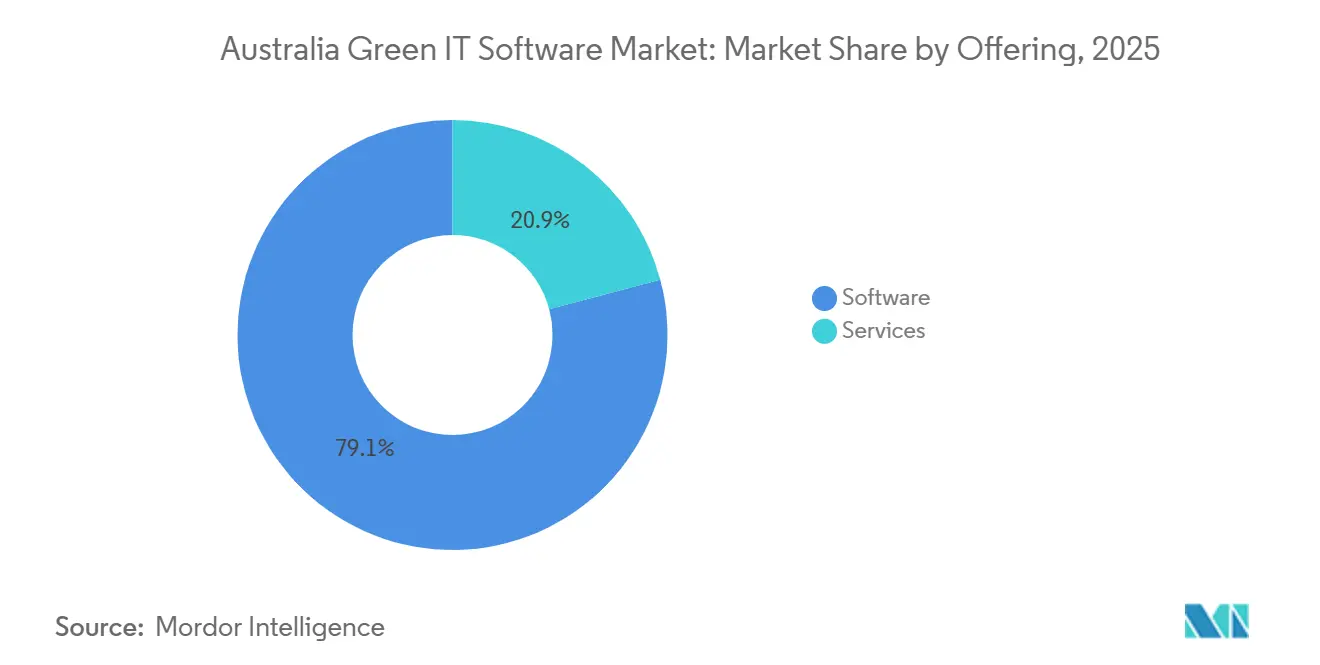
Software accounted for 79.14% of the Australia green IT software market size in 2025, which shows that first-wave adoption was centered on platform purchases by larger reporting entities. Those early buyers needed systems that could support formal sustainability disclosures and centralize emissions information. Many of them had the internal teams and implementation capacity required to deploy software with limited outside support. This created a software-led base for the Australia green IT software market at the start of the forecast period.
Services are projected to expand at a 23.51% CAGR through 2031, suggesting a broader implementation cycle as later cohorts enter mandatory reporting. These buyers often need help with setup, system mapping, data migration, staff training, and audit preparation. Regulatory clarification in 2025 also increased demand for interpretation and implementation support, which lifted the role of external specialists in the Australia green IT software industry. Over time, this means the Australia green IT software market is likely to generate a larger share of revenue from managed and advisory work built around the core software layer.
By Deployment: Hybrid's Rise Signals Multi-Cloud Carbon Attribution Gaps
Cloud-based deployment accounted for 67.17% of the Australia green IT software market size in 2025, supported by broad enterprise use of public cloud infrastructure and ongoing investment in local data center capacity. Cloud delivery fits well with the need for centralized reporting, faster updates, and easier integration with business applications. On-premises deployment still had relevance in regulated settings where data-handling rules or internal architecture standards limited migration. Even so, deployment decisions in the Australia green IT software market are now shaped more by coverage across environments than by a simple cloud versus on-premise split.
Hybrid deployment is projected to expand at a 23.62% CAGR through 2031, as many large organizations operate on-premises systems and 2 or more hyperscaler environments. That model lets companies combine energy meter data, internal system records, and cloud-provider information in a single reporting view. It also supports more credible Scope 2 accounting when organizations need to reconcile different grid mixes and renewable procurement arrangements. The proposed 2026 NGER updates strengthen the need for granular cross-environment data, which supports hybrid demand in the Australia green IT software market. Vendor strategies are adapting in the same direction, with hybrid migration pathways increasingly tied to embedded sustainability capabilities.
By Enterprise Size: SMEs Enter the Market via Supply Chain Pressure, Not Regulation
Large enterprises represented 72.12% of the Australia green IT software market size in 2025, reflecting their position as the earliest mandatory reporters and their stronger ability to fund platform adoption. These organizations were better placed to run enterprise implementations, define controls, and align reporting systems with broader governance processes. Their buying behavior also helped shape early product priorities in the market, including audit readiness, workflow controls, and integration depth. Large-enterprise demand therefore set the initial structure of the Australia green IT software market.
SMEs are projected to expand at a 23.73% CAGR through 2031, and that growth is being pulled forward by customer requirements rather than by their own immediate reporting deadlines. As larger organizations strengthen Scope 3 reporting, many smaller suppliers are being asked to provide more credible emissions data as part of commercial relationships. This creates room for simpler platforms that use local accounting integrations and Australian emissions factors, which lowers the entry barrier for firms without large IT teams. Within the Australia green IT software industry, this shift is extending demand upstream through procurement chains rather than through direct regulation alone. The Australia green IT software market is therefore widening beyond listed companies and into supplier ecosystems that need practical and lower-friction reporting tools.
By Solution Type: Decarbonization Planning Software Moves Beyond the Reporting Layer
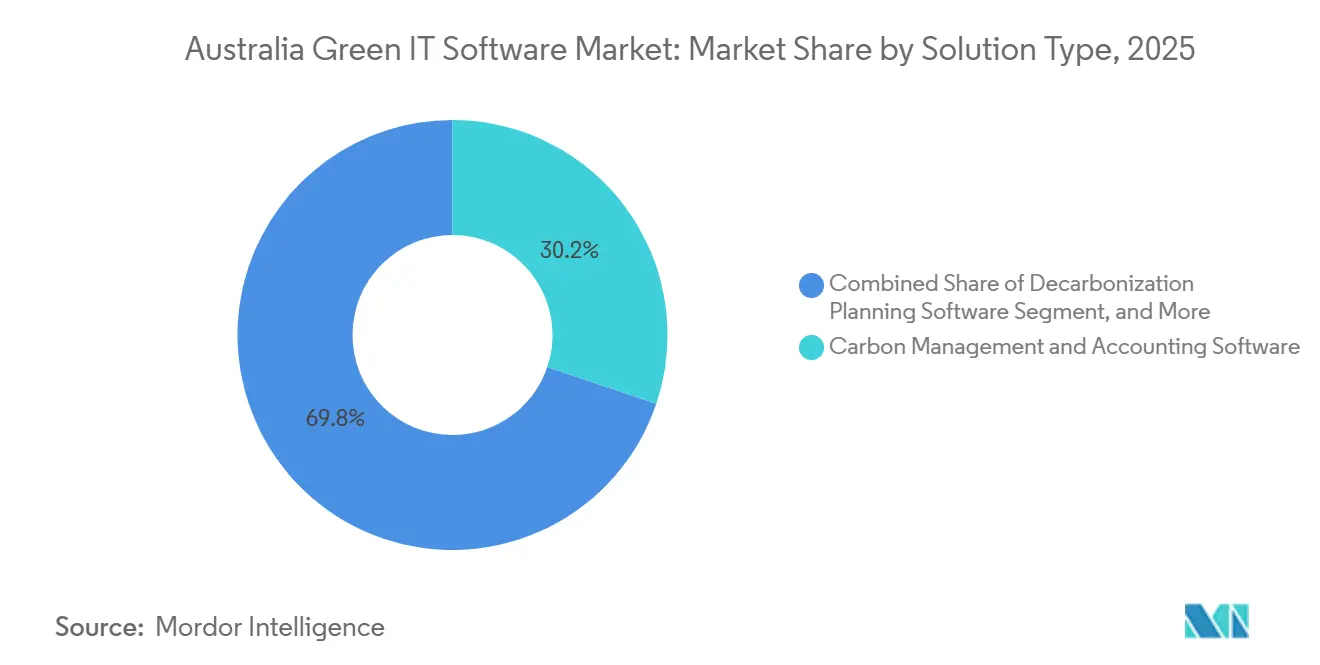
Carbon Management and Accounting Software held 30.18% of the Australia green IT software market share in 2025 because emissions accounting is the first operational step for organizations entering mandatory reporting. That position reflects the need to gather and structure Scope 1 and Scope 2 data before more advanced actions can follow. ESG reporting software supports the disclosure format and workflow layer, while sustainability data management tools help organize information across source systems. Energy and resource optimization software addresses the operational side of the Australia green IT software market by linking efficiency action with emissions reporting.
Decarbonization Planning Software is projected to expand at a 23.84% CAGR through 2031, indicating that buyers are moving from disclosure readiness to action planning. Once organizations complete an initial reporting cycle, the next need is often to test scenarios, compare pathways, and connect carbon decisions with capital planning. AASB S2 requires scenario analysis for both a 1.5°C and a well-above-2°C climate pathway, thereby increasing the relevance of planning and modeling tools. SAP's sustainability roadmap also points in that direction by bringing carbon accounting closer to financial workflows and ledgers. This makes decarbonization planning one of the clearest signs that the Australia green IT software market is moving beyond first-stage compliance.

By End User: Energy and Utilities Faces Compounding Compliance Obligations
IT and Telecom accounted for 25.13% share of the Australia green IT software market in 2025, because the sector directly owns and operates much of the data center and digital infrastructure that must be measured. Telcos and managed service providers also face customer expectations around carbon accountability in procurement and service delivery. BFSI remained a meaningful demand base because reporting obligations increasingly intersect with financed emissions and multi-entity governance needs. Other sectors, including manufacturing, government, healthcare, retail, and construction, each add demand through their own reporting and infrastructure requirements.
Energy and Utilities remained the fastest-growing end-user vertical at 24.12% through 2031 because it sits on both sides of the reporting equation. These companies must account for emissions associated with their own digital operations while also managing data related to electricity generation and supply. Proposed NGER updates add to that complexity by increasing the value of precise and auditable reporting methods for energy and infrastructure operators. Standard tools can be less effective when operational IT emissions and supply-portfolio emissions must be separated clearly. This is why the Australia green IT software market is creating room for more tailored platforms in the utility segment rather than relying only on generic carbon accounting products.
Geography Analysis
New South Wales and Victoria accounted for the largest share of activity in the Australia green IT software market in 2025 because the eastern seaboard holds the biggest concentration of large reporting entities and digital infrastructure. Sydney remains the main center for listed corporations, major service providers, and implementation activity tied to the earliest reporting wave. Melbourne also plays a central role because financial institutions there often manage complex reporting across multiple business units and sites. The concentration of enterprise headquarters in these states keeps software demand closely tied to governance, disclosure, and assurance schedules. As a result, the Australia green IT software market has developed first around where large compliance budgets and data-heavy organizations are most concentrated.
Queensland and Western Australia formed a second tier within the Australia green IT software market in 2026, but each state is expanding demand for different reasons. Queensland's mix of mining, gas, and agriculture supports demand for software that can ingest operational and activity-based emissions data across large asset footprints. Amazon committed AUD 20 billion (approximately USD 12.66 billion) to Australian data center infrastructure through 2029, including new solar farm projects in Victoria and Queensland. That investment adds more renewable procurement and infrastructure data that enterprises will need to track and disclose. Western Australia has a different grid context, which makes direct energy optimization especially important, given that market-based accounting tools are less straightforward there than in the National Electricity Market.
South Australia remained a smaller but still important test bed within the Australia green IT software market because high renewable penetration makes contract-level attribution and reporting more relevant. The state is useful for vendors testing software that links energy sourcing with digital operations and formal disclosure outputs. National rules still shape the broad compliance path, but demand varies by industrial mix, grid structure, and the pace of data center build-out across states. Geography in the Australia green IT software market therefore reflects both the reporting calendar and the power system conditions behind each local demand center.
Competitive Landscape
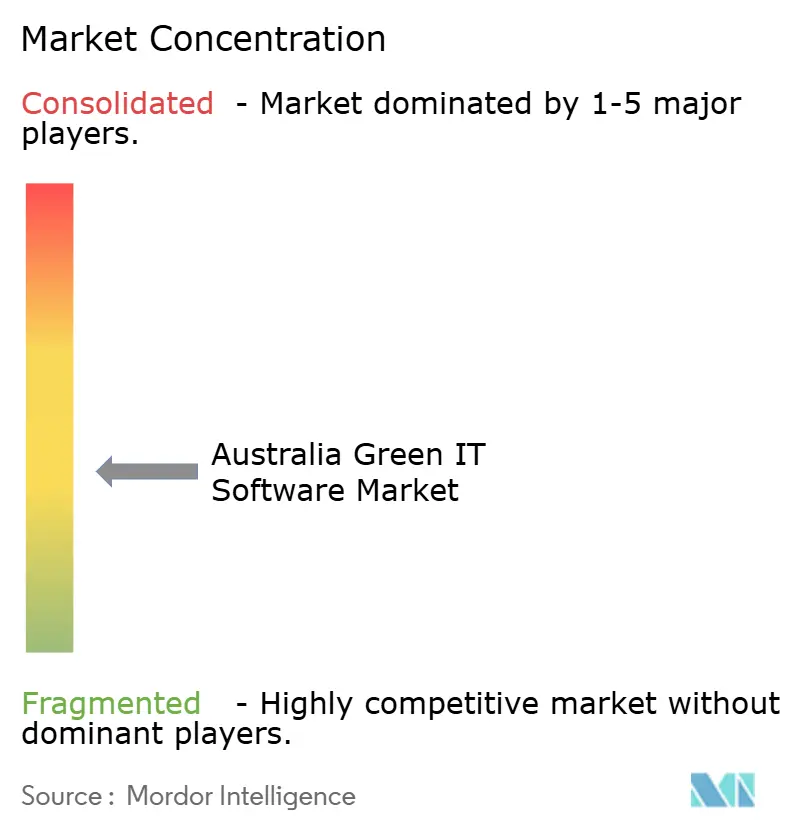
The Australia green IT software market is moderately fragmented, with global enterprise suites, specialist sustainability vendors, and local compliance-focused players all competing for demand. IBM, SAP, Microsoft, Salesforce, Oracle, ServiceNow, and Workiva hold strong positions because their products already sit inside financial, customer, ERP, and IT service workflows. Specialist vendors such as Sphera Solutions, Cority Software, Benchmark Gensuite, and Enablon compete by offering deeper sustainability and compliance functionality. Energy and operational technology providers, including Schneider Electric, Honeywell International, Siemens AG, and ABB, add a different angle by linking physical infrastructure monitoring with digital emissions reporting. This mix keeps the Australia green IT software market open to both platform bundling and specialist differentiation.
Leading vendors are increasingly competing through product integration and workflow automation rather than solely through basic reporting features. IBM released the Envizi Emissions API in April 2026, which lets organizations and developers embed GHG Protocol-aligned calculations directly into existing systems. SAP announced new sustainability AI agents in May 2026 and pushed carbon accounting closer to core enterprise workflows through SAP Green Ledger. SAP and Microsoft also expanded the RISE with SAP on Microsoft Azure initiative for Australia and New Zealand, which strengthens their position in hybrid migration programs with embedded compliance support. Watershed's 2026 measurement release added AI-powered utility bill ingestion and stronger data lineage, which shows how specialist vendors are using automation to compete with larger software stacks.
White space remains strongest in SME-ready software and in tools built for multi-cloud carbon attribution, where simpler deployment and local relevance still matter. Australian-native vendors can compete in those areas by using local accounting integrations, local emissions factors, and shorter implementation cycles. Larger suites still benefit from installed enterprise relationships, but buyers remain sensitive to cost, service intensity, and time to value. The Australia green IT software market therefore continues to reward vendors that can combine compliance credibility with faster delivery and more practical data handling.
Australia Green IT Software Industry Leaders
-
Microsoft Corporation
-
SAP SE
-
IBM Corporation
-
Schneider Electric SE
-
Salesforce, Inc.
- *Disclaimer: Major Players sorted in no particular order
Recent Industry Developments
- June 2026: La Trobe University announced a national research project combining quantum computing and artificial intelligence to optimize energy use and emissions across Australian data centers, in collaboration with NEXTDC, Fujitsu, and AQ Intelligence. The project aims to generate verifiable reductions in energy consumption and strengthen Australia's sovereign capability in quantum-assisted energy optimization for IT infrastructure.
- May 2026: SAP announced that new sustainability AI agents, including capabilities embedded in SAP Sustainability Control Tower, SAP Green Ledger, and SAP Sustainability Footprint Management, would be made generally available by end of 2026, enabling autonomous Scope 1, 2, and 3 data collection, target setting, and disclosure generation within enterprise workflows.
- May 2026: SAP and Microsoft expanded the global RISE with SAP on Microsoft Azure initiative, explicitly covering Australia and New Zealand, deepening joint support for hybrid SAP-to-cloud migrations with embedded sustainability and compliance tooling for enterprise customers.
- April 2026: IBM released the Envizi Emissions API, enabling organizations, developers, and software vendors to embed GHG Protocol-aligned emissions calculations, covering Scope 1, 2, and 3, directly into existing enterprise systems and workflows, lowering the technical barrier to credible carbon accounting.
Australia Green IT Software Market Report Scope
The Australia Green IT Software market refers to platforms and services that enable Australian enterprises to embed sustainability into IT operations by managing carbon emissions, optimizing energy and resource usage, and ensuring compliance with ESG frameworks. These solutions include carbon management and accounting, ESG reporting and compliance, sustainability data management, decarbonization planning, and energy optimization software. By integrating sustainability intelligence into IT workflows, these platforms help organizations across Australia reduce environmental impact, enhance operational efficiency, and align with national climate policies and global decarbonization goals. The market’s primary objective is to provide transparency, automate sustainability reporting, and support the transition toward greener, more resilient digital infrastructure across diverse industries.
The Australia Green IT Software market report is segmented by Offering (Software, and Services), Deployment (Cloud-Based, On-Premise, and Hybrid), Enterprise Size (Large Enterprises, and Small and Medium Enterprises), Solution Type (Carbon Management and Accounting Software, ESG Reporting and Compliance Software, Sustainability Data Management Platforms, Decarbonization Planning Software, and Energy and Resource Optimization Software), End User (IT and Telecom, BFSI, Manufacturing, Energy and Utilities, Retail and E-Commerce, Government, Healthcare, Construction and Infrastructure, and Other End-User Industries), and Geography. The Market Forecasts are Provided in Terms of Value (USD).
| Software |
| Services |
| Cloud-Based |
| On-Premise |
| Hybrid |
| Large Enterprises |
| Small and Medium Enterprises |
| Carbon Management and Accounting Software |
| ESG Reporting and Compliance Software |
| Sustainability Data Management Platforms |
| Decarbonization Planning Software |
| Energy and Resource Optimization Software |
| IT and Telecom |
| BFSI |
| Manufacturing |
| Energy and Utilities |
| Retail and E-Commerce |
| Government |
| Healthcare |
| Construction and Infrastructure |
| Other End-User Industries |
| By Offering | Software |
| Services | |
| By Deployment | Cloud-Based |
| On-Premise | |
| Hybrid | |
| By Enterprise Size | Large Enterprises |
| Small and Medium Enterprises | |
| By Solution Type | Carbon Management and Accounting Software |
| ESG Reporting and Compliance Software | |
| Sustainability Data Management Platforms | |
| Decarbonization Planning Software | |
| Energy and Resource Optimization Software | |
| By End User | IT and Telecom |
| BFSI | |
| Manufacturing | |
| Energy and Utilities | |
| Retail and E-Commerce | |
| Government | |
| Healthcare | |
| Construction and Infrastructure | |
| Other End-User Industries |
Key Questions Answered in the Report
What is the Australia green IT software market size in 2026 and what will it reach by 2031?
The Australia green IT software market stands at USD 0.37 billion in 2026 and is forecast to reach USD 1.06 billion by 2031 at a 23.43% CAGR.
What is driving demand for green IT software in Australia?
The main demand drivers are mandatory climate disclosures, rising data center electricity use, multi-cloud reporting complexity, and stronger interest in AI-based automation.
Which solution type is growing the fastest in Australia?
Decarbonization planning software is the fastest-growing solution type, with a projected 23.84% CAGR through 2031.
Which end-user group currently leads adoption?
IT and Telecom leads adoption with a 25.13% share in 2025, supported by direct ownership of data center and digital infrastructure.
Why is hybrid deployment expanding faster than other deployment models?
Hybrid deployment is growing quickly because many enterprises need one reporting layer across on-premise systems and multiple cloud environments.
How competitive is the vendor landscape in Australia?
The field is moderately fragmented, with global enterprise software firms, specialist sustainability vendors, and local compliance-focused providers all competing across different buyer needs.