
Cabbage Seeds Market Size and Share
Market Overview
| Study Period | 2021 - 2031 |
|---|---|
| Market Size (2026) | USD 290.90 Million |
| Market Size (2031) | USD 386.74 Million |
| Growth Rate (2026 - 2031) | 5.86 % |
| Fastest Growing Market | Asia-Pacific |
| Largest Market | Asia-Pacific |
| Market Concentration | Medium |
Major Players *Disclaimer: Major Players sorted in no particular order Image © Mordor Intelligence. Reuse requires attribution under CC BY 4.0. | |
Cabbage Seeds Market Analysis by Mordor Intelligence
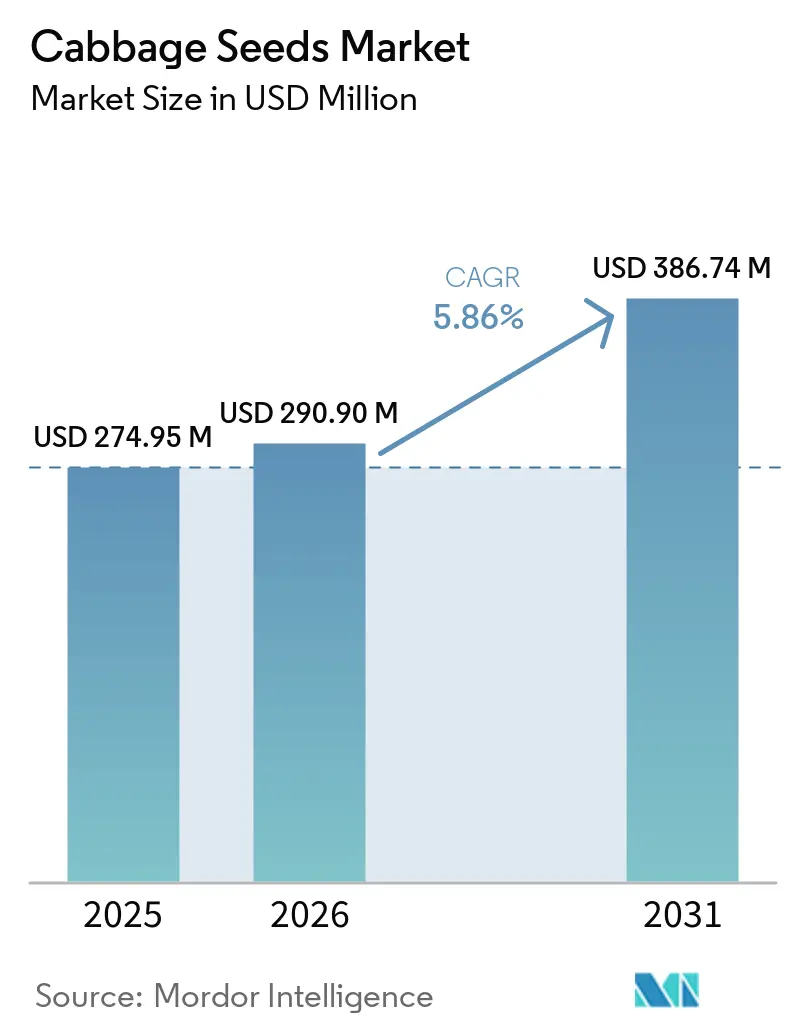
The cabbage seeds market size is estimated at USD 274.95 million in 2025, USD 290.90 million in 2026, and projected to reach USD 386.74 million by 2031, growing at a CAGR of 5.86% from 2026 to 2031. The cabbage seeds market is supported by a broad production base, with cabbage cultivated across 2.4 million hectares worldwide and an output of 75.4 million tons in 2024[1]Source: Food and Agriculture Organization of the United Nations, “Agricultural Production Statistics 2010–2025. December 2025 Update,” FAO, fao.org, which keeps seasonal seed replacement demand steady even when farm expansion is limited. Public and private seed investment in Asia-Pacific is strengthening the move toward hybrid seed use, making formal seed adoption more durable in the cabbage seeds market, especially as yield consistency and quality standards rise. China's cabbage seeds market is driven by strong demand from commercial growers seeking advanced genetics to support large-scale production. According to the Food and Agriculture Organization (FAO), China produced approximately 36.8 million metric tons of cabbage in 2024, representing nearly 50% of global cabbage production. Climate stress and disease pressures are influencing seed procurement priorities, with growers increasingly opting for varieties that offer resilience, field stability, and strong post-harvest performance. The competitive landscape remains active yet balanced, with leading seed companies leveraging extensive breeding capabilities while regional breeders focus on locally adapted varieties and targeted product innovations.
Key Report Takeaways
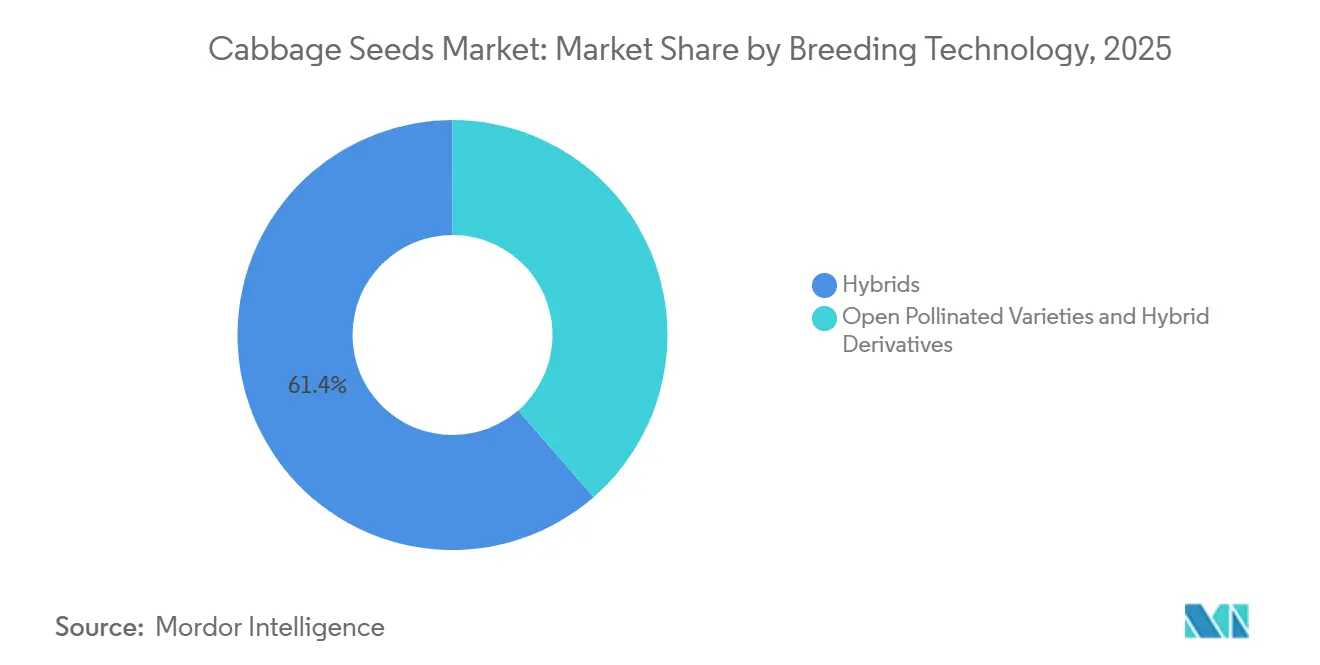
- By breeding technology, hybrids represented the largest cabbage seeds market share at 61.4% in 2025 and are also forecast to be the fastest-growing segment, advancing at a CAGR of 6.1% through 2031.
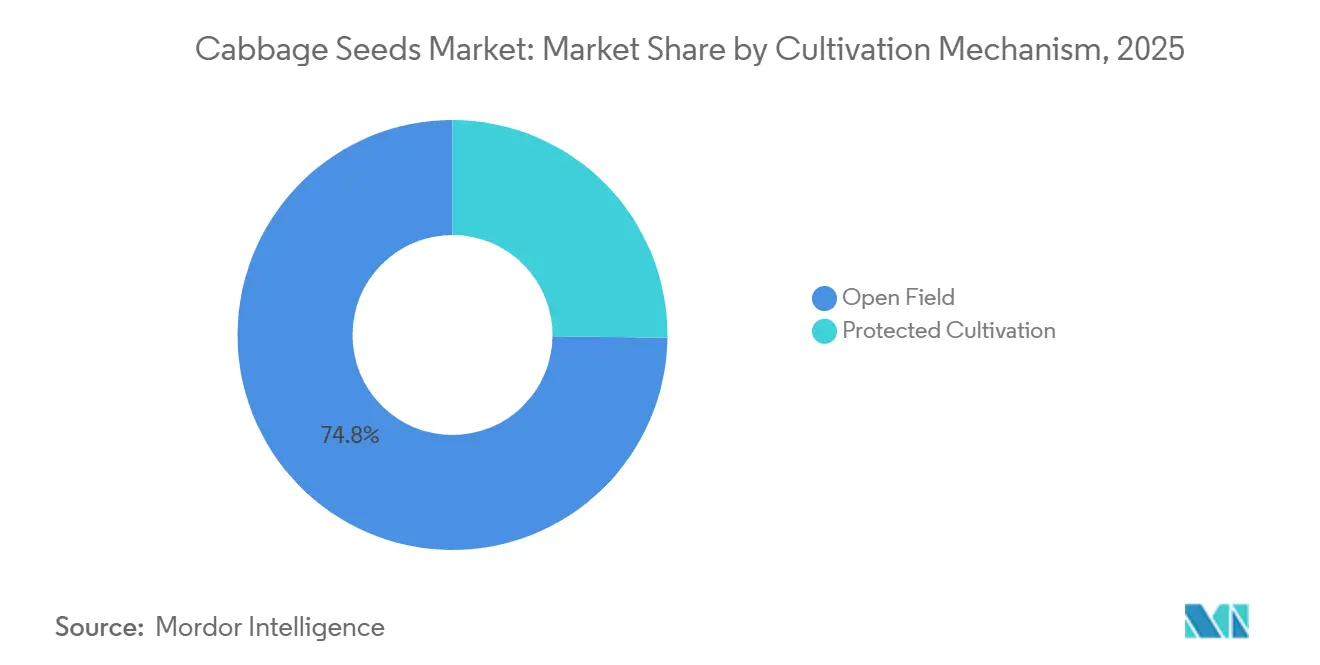
- By cultivation mechanism, open-field cultivation dominated the cabbage seeds market, accounting for 74.8% in 2025, whereas protected cultivation is projected to expand fastest at a CAGR of 7.4% during 2026–2031.
- By geography, Asia-Pacific accounted for the largest share of the cabbage seeds market at 38.7% in 2025 and is anticipated to register the highest growth, expanding at a CAGR of 6.9% through 2031.
Note: Market size and forecast figures in this report are generated using Mordor Intelligence’s proprietary estimation framework, updated with the latest available data and insights as of January 2026.
Market Trends and Insights
Drivers Impact Analysis of Cabbage Seeds Market*
| Driver | (~) % Impact on CAGR Forecast | Geographic Relevance | Impact Timeline |
|---|---|---|---|
| Rising Shift Toward Hybrid Cabbage Seeds in Commercial Farming | +1.8% | Global, strongest adoption velocity in Asia-Pacific and South America | Medium term (2-4 years) |
| Expansion of Protected Cultivation for Uniform Head Production | +1.2% | Asia-Pacific core, spillover to Europe and North America | Medium term (2-4 years) |
| Rising Demand for Disease-Resistant and Climate-Resilient Varieties | +1.0% | Global, highest urgency in Asia-Pacific, Sub-Saharan Africa, and South Asia | Long term (≥ 4 years) |
| Growth of Seed E-Commerce Distribution | +0.8% | Asia-Pacific and North America lead, Middle East and Africa and South America emerging | Medium term (2-4 years) |
| Seed-Specific Breeding for Shelf Life and Transportability | +0.7% | Europe, North America, and export-oriented Asia-Pacific regions | Long term (≥ 4 years) |
| Low-Cost Income Gardening and Urban Kitchen Gardening Adoption | +0.6% | North America, Europe, and urban Asia-Pacific | Short term (≤ 2 years) |
| Source: Mordor Intelligence | |||
Rising Shift Towards Hybrid Cabbage Seeds in Commercial Farming
Hybrid use is becoming harder for commercial growers to reverse once they begin supplying formal retail, food service, and export channels. Buyers in those channels expect head size consistency, uniform maturity, and reliable germination, and that gives hybrids a practical advantage over open-pollinated material when crop failure costs are high. The World Vegetable Center reported that the Asia and Pacific Seed Association and the World Vegetable Center Vegetable Breeding Consortium expanded, reaching 58 full members in 2024, with 59% of members classified as small and medium-sized enterprises, indicating that hybrid access is widening beyond the largest seed houses. The same program reported that commercial vegetable varieties containing WorldVeg germplasm reached 193 by 2024, while related seed sales rose from 50 metric tons in 2022 to 83 metric tons in 2024, reaching an estimated 829,700 farm households across 316,300 hectares[2]Source: World Vegetable Center, “New Report Shows the Benefits of Public-Private Partnerships for Promoting the Sharing of Improved Vegetable Varieties in Asia,” World Vegetable Center, worldveg.org. China's status as the world's largest cabbage producer, accounting for nearly half of global cabbage output, underscores the critical role of advanced seed genetics in enabling large-scale commercial production. The combination of expanded germplasm access and stringent buyer requirements continues to drive reliance on hybrid seeds in the cabbage seeds market.
Expansion of Protected Cultivation for Uniform Head Production
Protected cultivation is transitioning from a niche, premium practice to a more established production method in the cabbage seeds market. Growers utilizing greenhouses and polyhouses require seed varieties that can thrive under dense planting conditions, controlled humidity, and stringent visual quality standards. Consequently, seed selection in protected cultivation is more specialized compared to open-field production. The increasing adoption of greenhouse and polyhouse vegetable production is driving demand for cabbage varieties with uniform head formation, high germination rates, and robust disease resistance. Controlled-environment systems facilitate year-round cultivation and enhanced productivity, prompting growers to invest in premium seed genetics tailored to protected conditions. This trend is fostering the growth of a premium seed submarket, as protected systems prioritize traits such as compact plant architecture, consistent germination, and resistance to greenhouse-specific diseases more than open-field systems. As more producers adopt year-round or off-season production, the cabbage seeds market is increasingly distinguishing between general-purpose varieties and those bred for optimal performance in protected cultivation.
Rising Demand for Disease-Resistant and Climate-Resilient Varieties
Disease resistance and climate resilience are becoming critical factors influencing purchasing decisions in the cabbage seeds market. This shift is driven by increasing weather variability and heightened disease pressure, which elevate production risks and input costs. In response, seed companies are intensifying efforts to develop improved varieties. For instance, in May 2025, LUTESEEDS introduced new F1 hybrid cabbage varieties during its Spring Cabbage Variety Field Day in Beijing. These varieties utilize gene pyramiding and molecular breeding technologies to enhance resistance to Fusarium wilt, black rot, and clubroot. Leading seed companies, such as Bejo Zaden BV, Sakata Seed Corporation, Syngenta Group, Bayer AG, and Groupe Limagrain, are prioritizing breeding programs to improve disease resistance, adaptability, and consistent field performance. These advancements underscore the increasing importance of advanced breeding technologies in the cabbage seeds market, where resilience traits are essential for safeguarding yields and ensuring sustainable commercial production.
Low-Cost Income Gardening and Urban Kitchen Gardening Adoption
Urban gardening and small-scale household cultivation are forming a broader base of demand in the cabbage seeds market, even though purchase volumes per buyer remain modest. This channel matters because it spreads demand among many buyers, reducing dependence on a smaller group of large commercial farms. Breeders are responding with products that fit home-scale cultivation, visual appeal, and short retail pack formats rather than only large commercial acreages. Bejo Zaden BV highlighted its Red Power concept in 2026 as a pointed cabbage with strong pigmentation, easy cultivation, and year-round production suitability. The launch reflects growing efforts by seed companies to diversify the cabbage seeds market with premium, value-added varieties that address evolving grower and consumer preferences while creating new opportunities for product differentiation.
Restraints Impact Analysis of Cabbage Seeds Market*
| Restraint | (~) % Impact on CAGR Forecast | Geographic Relevance | Impact Timeline |
|---|---|---|---|
| High Cost of Hybrid and Specialty Cabbage Seed Varieties | -1.0% | Global, most acute in Sub-Saharan Africa, South Asia, and smallholder segments of Southeast Asia | Long term (≥ 4 years) |
| Infrastructure Limitations and Quality Assurance Delays | -0.7% | Africa, South and Southeast Asia, and parts of South America | Medium term (2-4 years) |
| Intellectual Property Gaps and Counterfeit Seed Risk | -0.6% | Sub-Saharan Africa and South and Southeast Asia | Short term (≤ 2 years) |
| High Sensitivity to Heat Stress and Extreme Weather | -0.8% | Asia-Pacific, South Asia, and the Middle East | Long term (≥ 4 years) |
| Source: Mordor Intelligence | |||
High Cost of Hybrid and Specialty Cabbage Seed Varieties
Hybrid seed pricing remains a clear barrier in the cabbage seeds market, especially where farm budgets are tight and seasonal financing is weak. Proprietary genetics need to recover breeding and development costs during a limited commercial window, so price premiums cannot fall quickly without weakening future product development. In smallholder systems across Africa and South Asia, those premiums can absorb a large share of seasonal variable costs, which pushes growers back toward lower-cost seed even when hybrid performance is better. Public support programs in parts of Asia-Pacific have shown that hybrid adoption increases when the upfront cost burden is reduced, but this effect has not yet spread evenly across other developing regions. As long as financing, subsidies, and certified distribution remain uneven, the cabbage seeds market will continue to face a gap between technical demand for hybrids and practical affordability on the farm.
Intellectual Property Gaps and Counterfeit Seed Risk
Counterfeit seed remains a direct commercial drag because it cuts branded sales, weakens trust in certified seed systems, and blurs quality differences that premium breeders depend on. The Ethiopian Seed Partnership expanded its barcode-based certification system in March 2025 to five additional regional authorities, following a 2024 pilot, with training and equipment support completed for 14 participants, demonstrating that formal traceability is becoming increasingly important in seed system reform[3]Source: Ethiopian Seed Partnership, “Efforts to Combat Counterfeit Seeds with Barcode Tagging System,” Ethiopian Seed Partnership, esp-seed.org. Kenya’s Seeds and Plant Varieties Amendment Bill of 2025 also points to more active legal work on standards-based registration and stronger oversight of the seed trade. Even with stronger frameworks, enforcement in remote and informal channels still lags statutory intent, keeping revenue leakage high where formal seed adoption should be growing fastest. This issue is especially relevant to the cabbage seeds market because hybrid value rests heavily on purity, germination performance, and brand credibility.
*Our forecasts treat driver/restraint impacts as directional, not additive. The impact forecasts reflect baseline growth, mix effects, and variable interactions.
Cabbage Seeds Market Segment Analysis
By Breeding Technology:
Hybrid Dominance Deepens as Commercial Standards TightenHybrids accounted for the largest share of the cabbage seeds market at 61.4% in 2025 and are projected to grow at a CAGR of 6.1% from 2026 to 2031. This dominance highlights that hybrids have become the commercial standard in the cabbage seeds market, driven by formal supply chains that prioritize uniform head development, consistent maturity, reliable germination, and enhanced marketability. While hybrids are projected to maintain their leading position, the growth rate suggests that non-hybrid varieties will continue to cater to niche segments where seed saving, regional taste preferences, and lower upfront seed costs are key purchase drivers.
The increasing professionalization of vegetable production is further accelerating the adoption of hybrids in the cabbage seed industry. Contract farming, organized retail procurement, and export-oriented vegetable supply chains emphasize crop uniformity and harvest predictability to minimize grading losses and ensure consistent supply. Additionally, growers are seeking varieties that perform reliably across diverse weather conditions and planting windows, making hybrid seeds the preferred choice for commercial operations. Although open-pollinated varieties remain relevant in certain price-sensitive and traditional farming systems, the market share of hybrids is projected to remain robust as growers increasingly prioritize reliability and production efficiency over initial seed costs.



By Cultivation Mechanism:
Greenhouse Expansion Reshapes Seed Procurement PrioritiesIn 2025, open-field cultivation accounted for the largest share of the cabbage seeds market, representing 74.8%. However, protected cultivation is anticipated to grow the fastest, with a projected compound annual growth rate (CAGR) of 7.4% from 2026 to 2031. Open-field systems maintain their dominance due to extensive outdoor cabbage acreage across Asia, Europe, and the Americas, securing a clear leadership position in volume. Nevertheless, demand for cabbage seeds in protected cultivation systems is growing rapidly. Greenhouse and polyhouse operators prioritize seed selection for precision, consistency, and season-extension capabilities rather than solely on cost.
The protected cultivation segment is gaining traction as growers aim to mitigate weather-related risks, optimize production schedules, and enhance crop quality. Seed requirements for these systems differ significantly from those of open-field production, with a greater focus on uniform growth, disease resistance in controlled environments, and reliable germination rates. Although protected cultivation currently accounts for a smaller share of total cabbage acreage, its higher-value production model is driving the adoption of specialized seed varieties, solidifying its position as the fastest-growing cultivation method in the cabbage seeds market.
Geography Analysis
APAC Cabbage Seeds Market
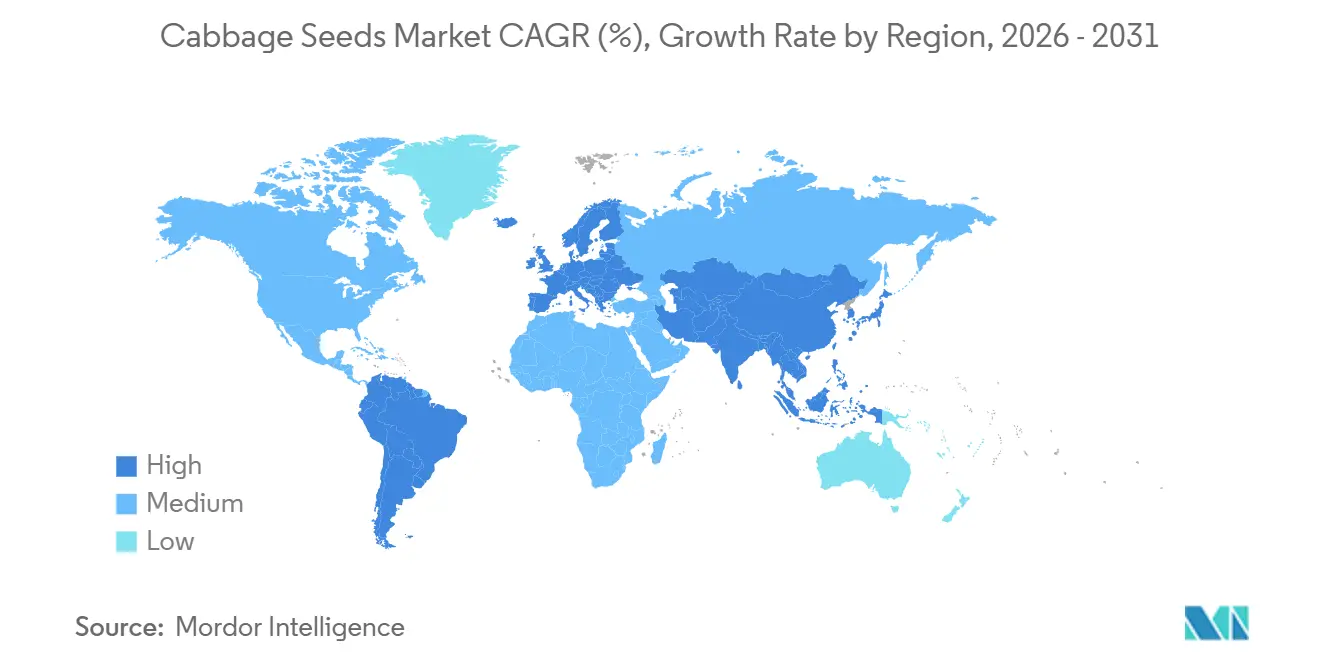
In 2025, Asia-Pacific accounted for the largest share of the cabbage seeds market at 38.7% and is projected to grow the fastest with a CAGR of 6.9% from 2026 to 2031. The region dominates the market in terms of both scale and growth due to extensive vegetable production, increasing adoption of hybrid seeds, and rising investments in commercial horticulture. China plays a pivotal role as the world's largest cabbage producer, accounting for nearly half of global cabbage output. India also drives demand through the expansion of protected cultivation and the growing use of high-performance hybrid varieties. Additionally, climate pressures in the region are accelerating the shift toward resilient cabbage genetics, emphasizing the importance of breeding programs that can adapt to changing production conditions.
Europe Cabbage Seeds Market
Europe remains a key contributor to the cabbage seeds market, driven by protected cultivation practices, premium fresh produce retail, and a strong focus on improved shelf life and post-harvest quality. The Netherlands plays a particularly influential role, with leading breeding companies spearheading innovation in the commercial brassica sector. According to the Food and Agriculture Organization (FAO), Europe's cabbage harvested area increased from 285.5 thousand hectares in 2023 to 290.2 thousand hectares in 2024. This growth underscores the demand for advanced seed varieties offering uniformity, disease resistance, and marketable quality. Research initiatives aimed at extending shelf life and reducing food waste align with retailer requirements for longer display periods and enhanced transport stability.
The Americas, APAC, MEA and Oceania Cabbage Seeds Market
In North America, the cabbage seeds market benefits from the expansion of greenhouse cultivation, a structured procurement system favoring certified seed suppliers, and the widespread adoption of commercial hybrids. Food and Agriculture Organization data indicates that regional cabbage yields rose from 41.3 metric tons per hectare in 2023 to 41.9 metric tons per hectare in 2024, reflecting continued investments in improved genetics and production efficiency. South America is strengthening its position through the expansion of protected cultivation and premium vegetable production. In contrast, Africa and the Middle East are gradually advancing through improvements in seed quality systems, certification standards, and controlled-environment farming. Oceania, as a mature market, demonstrates high hybrid adoption, resulting in steadier growth opportunities. These regional trends illustrate how the cabbage seeds market is shaped by Asia-Pacific's large-scale production, quality-focused demand in developed markets, and agricultural modernization across emerging economies.

Competitive Landscape
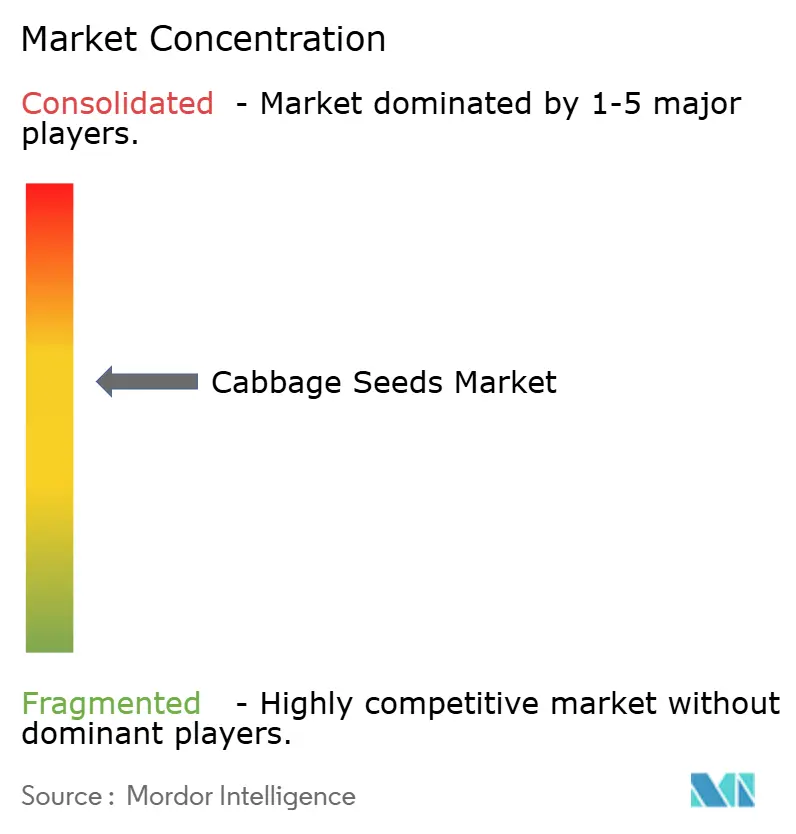
The cabbage seeds market remained moderately consolidated in 2025, dominated by key players such as Bayer AG, Syngenta Group, Groupe Limagrain, Rijk Zwaan Zaadteelt en Zaadhandel BV, and Bejo Zaden BV. These companies maintain their market positions through extensive breeding capabilities, robust distribution networks, and diversified vegetable seed portfolios, ensuring their presence in major cabbage-producing regions. Despite the dominance of these global leaders, the market continues to offer significant opportunities for regional and domestic breeders. These smaller players compete by developing locally adapted varieties, focusing on targeted trait development, and fostering close relationships with commercial growers. This dynamic sustains a competitive environment while reflecting a relatively concentrated group of leading suppliers.
Companies such as Syngenta Group, Bayer AG, Groupe Limagrain, Rijk Zwaan Zaadteelt en Zaadhandel BV, Bejo Zaden BV, Sakata Seed Corporation, Takii and Co., Ltd., East-West Seed, and Enza Zaden are enhancing their market positions through advancements in breeding technologies, improved seed quality, and the introduction of varieties tailored to evolving grower requirements. Competition increasingly focuses on attributes like disease resistance, climate adaptability, uniformity, shelf life, and harvest reliability, rather than solely on the breadth of product portfolios. As cabbage cultivation becomes more specialized, companies are differentiating themselves through accelerated breeding programs, stringent quality standards, and varieties designed for specific production systems and end-market needs.
Regional and mid-sized breeders continue to play a crucial role in the cabbage seeds market, addressing the diverse agronomic and commercial needs of growers across various geographies. Domestic companies often benefit from a deeper understanding of local disease pressures, climatic conditions, and regulatory frameworks governing seed approvals. The market also presents growth opportunities in segments such as heat-tolerant hybrids, stress-resilient genetics, and varieties with improved post-harvest performance. These factors enable both multinational seed companies and specialized local suppliers to compete effectively, resulting in a moderately concentrated market structure rather than one dominated solely by a few global players.
Cabbage Seeds Industry Leaders
Bayer AG
Syngenta Group
Groupe Limagrain
Rijk Zwaan Zaadteelt en Zaadhandel BV
Bejo Zaden BV
- *Disclaimer: Major Players sorted in no particular order
Cabbage Seeds Market Companies Covered in this Report
- Bayer AG
- Syngenta Group
- BASF SE
- Advanta Seeds (UPL Limited)
- East-West Seed
- Sakata Seed Corporation
- Rijk Zwaan Zaadteelt en Zaadhandel BV
- Groupe Limagrain
- Enza Zaden
- Bejo Zaden BV
- Takii and Co., Ltd.
- Namdhari Seeds Pvt. Ltd.
- Kaveri Seeds
- Mahyco
- Nongwoo Bio Company Ltd

Recent Industry Developments in Cabbage Seeds Market
- May 2026: Sakata Seed Corporation has announced six new varieties under its “Misaki” packaged seed series for the 2026 autumn season in Japan. These varieties cover several vegetable crops, including cabbage, and are designed to offer disease resistance, heat tolerance, stable growth, and extended harvestability. Sales are scheduled to begin in July 2026 through both retail and online channels.
- September 2025: Row 7 Seed Company introduced Sugarcone, a new cabbage variety characterized by its naturally sweet flavor, tender texture, and cone-shaped head. Developed to enhance taste and reduce cooking time, this variety underscores the industry's growing emphasis on consumer-preferred cabbage traits and product differentiation.
- January 2025: Sakata Seed Corporation has launched “Hatsumizuki,” a new Chinese cabbage variety in Japan. This variety offers features such as cold tolerance, field holding ability, disease resistance, stable head formation under warm winter conditions, and compatibility with reduced-labor, non-binding cultivation systems.


Global Cabbage Seeds Market Report Scope
The cabbage seeds market comprises the production, breeding, development, and sale of cabbage seeds, including hybrid and open-pollinated varieties, used for commercial and protected cultivation to enhance yield, quality, disease resistance, and adaptability across diverse growing conditions.
The Cabbage Seeds Market Report is Segmented by Breeding Technology (Hybrids and Open Pollinated Varieties and Hybrid Derivatives), by Cultivation Mechanism (Open Field and Protected Cultivation), and by Geography (North America, Europe, Asia-Pacific, South America, the Middle East, and Africa). The Market Forecasts are Provided in Terms of Value (USD) and Volume (Metric Tons).
| Hybrids |
| Open Pollinated Varieties and Hybrid Derivatives |
| Open Field |
| Protected Cultivation |
| North America | United States |
| Canada | |
| Rest of North America | |
| South America | Brazil |
| Argentina | |
| Rest of South America | |
| Europe | Germany |
| United Kingdom | |
| France | |
| Spain | |
| Italy | |
| Russia | |
| Rest of Europe | |
| Asia-Pacific | China |
| India | |
| Japan | |
| Australia | |
| South Korea | |
| Rest of Asia-Pacific | |
| Middle East | Saudi Arabia |
| United Arab Emirates | |
| Turkey | |
| Rest of Middle East | |
| Africa | South Africa |
| Egypt | |
| Rest of Africa |
| By Breeding Technology | Hybrids | |
| Open Pollinated Varieties and Hybrid Derivatives | ||
| By Cultivation Mechanism | Open Field | |
| Protected Cultivation | ||
| By Geography | North America | United States |
| Canada | ||
| Rest of North America | ||
| South America | Brazil | |
| Argentina | ||
| Rest of South America | ||
| Europe | Germany | |
| United Kingdom | ||
| France | ||
| Spain | ||
| Italy | ||
| Russia | ||
| Rest of Europe | ||
| Asia-Pacific | China | |
| India | ||
| Japan | ||
| Australia | ||
| South Korea | ||
| Rest of Asia-Pacific | ||
| Middle East | Saudi Arabia | |
| United Arab Emirates | ||
| Turkey | ||
| Rest of Middle East | ||
| Africa | South Africa | |
| Egypt | ||
| Rest of Africa | ||


Key Questions Answered in the Report
What is the current value of the cabbage seeds sector worldwide?
The cabbage seeds market size is estimated at USD 274.95 million in 2025, USD 290.90 million in 2026, and projected to reach USD 386.74 million by 2031, growing at a CAGR of 5.86% from 2026 to 2031.
Which breeding technology leads global demand for cabbage seed?
Hybrids lead demand, holding 61.4% of revenue in 2025, because commercial growers need better uniformity, stronger germination, and higher resistance performance.
Why is protected cultivation becoming more important for seed suppliers?
Protected cultivation is growing at a 7.4% CAGR through 2031, faster than the total market, because greenhouse and polyhouse systems need specialized varieties for dense planting and stable output.
Which region is growing fastest for cabbage seed sales?
Asia-Pacific is the fastest-growing region at a 6.9% CAGR through 2031 and also held the largest 38.7% share in 2025.
Page last updated on:


 Your data is secure and never sold or shared.


