
Asparagus Seed Market Size and Share
Market Overview
| Study Period | 2021 - 2031 |
|---|---|
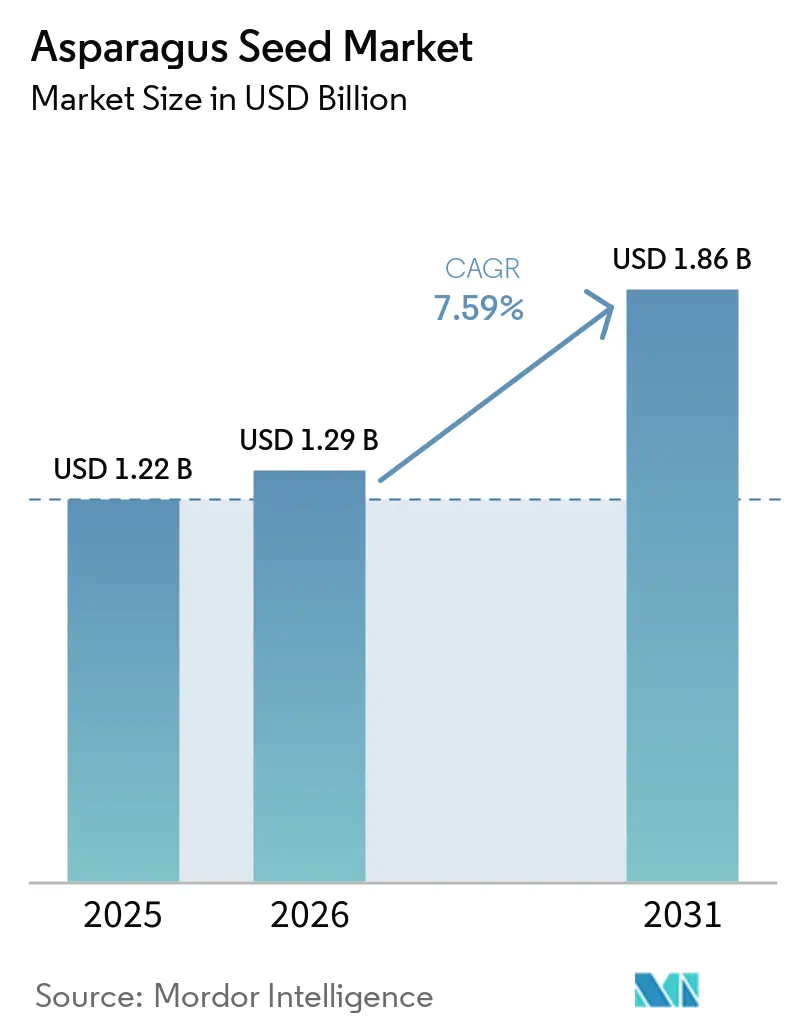
| Market Size (2026) | USD 1.29 Billion |
| Market Size (2031) | USD 1.86 Billion |
| Growth Rate (2026 - 2031) | 7.59 % |
| Fastest Growing Market | Asia-Pacific |
| Largest Market | North America |
| Market Concentration | Medium |
Major Players *Disclaimer: Major Players sorted in no particular order Image © Mordor Intelligence. Reuse requires attribution under CC BY 4.0. | |
Asparagus Seed Market Analysis by Mordor Intelligence
The asparagus seed market size was valued at USD 1.22 billion in 2025 and is projected to grow to USD 1.29 billion in 2026, reaching USD 1.86 billion by 2031, at a 7.59% CAGR over 2026-2031. The faster expansion of the asparagus seed market shows that demand is being supported more by hybrid conversion and new geography adoption than by acreage growth in traditional producing countries. Germany’s asparagus cultivation area was 22,500 hectares in 2025, which shows that mature markets are resetting while seed demand is shifting toward replacement cycles and higher-value genetics[1]Source: Statistisches Bundesamt, “Spargelanbau in Deutschland geht zurück,” Statistisches Bundesamt, destatis.de. Growers replacing aging open-pollinated beds with all-male hybrids are creating a recurring replant cycle that supports seed demand even in flat fields. Peru’s fresh asparagus exports reached 105,600 metric tons in 2025, up 9% year over year, which confirms that export-oriented production systems outside Europe continue to support commercial planting intensity and seed use. Competition in the asparagus seed market remains shaped by long breeding timelines, disease-resistance needs, and certification capability, which supports established breeders while still leaving room for regional specialists and retail-oriented suppliers.
Key Report Takeaways
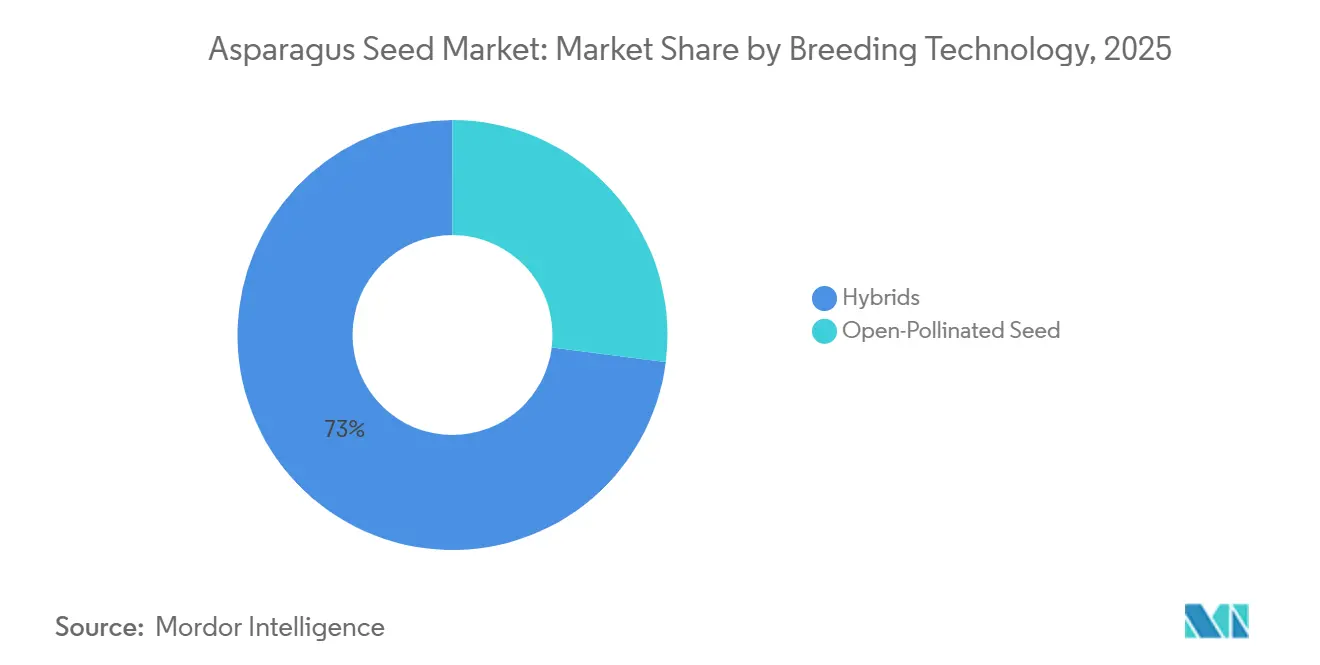
- By breeding technology, hybrid seeds held 73% of the asparagus seed market size in 2025, while hybrid seeds remained the fastest-growing technology segment at a CAGR of 7.6% through 2031.
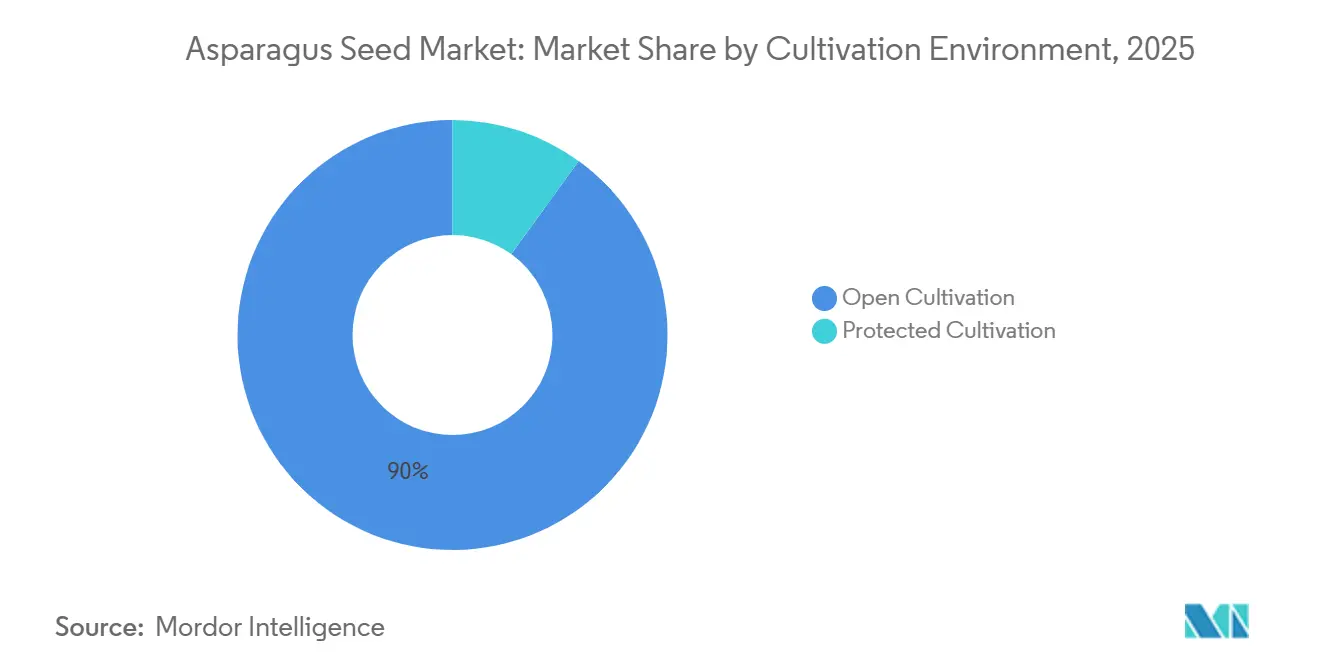
- By cultivation environment, open-field cultivation led the market with a 90% market share in 2025, while protected cultivation was the fastest-growing segment, with a 8.5% CAGR through 2031.
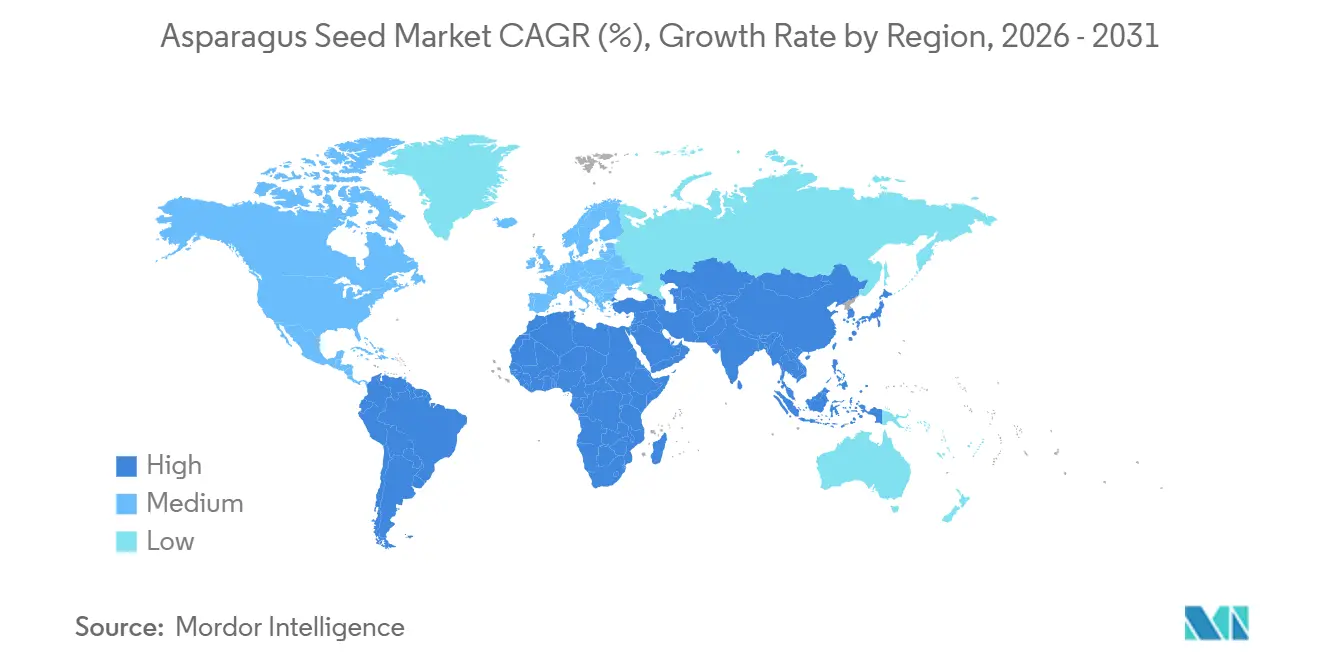
- By geography, North America held 41.7% asparagus seed market share in 2025, while Asia-Pacific is projected to grow at a 7.9% CAGR through 2031.
Note: Market size and forecast figures in this report are generated using Mordor Intelligence’s proprietary estimation framework, updated with the latest available data and insights as of January 2026.
Market Trends and Insights
Drivers Impact Analysis of Asparagus Seed Market*
| Driver | (~) % Impact on CAGR Forecast | Geographic Relevance | Impact Timeline |
|---|---|---|---|
| Hybrid Shift Toward All-Male High-Yield Seed | +2.2% | Global, with highest intensity in United States, Germany, China, and Peru | Long term (≥ 4 years) |
| Demand for Disease-Resistant and Climate-Resilient Breeding | +1.5% | Global, China and India in Asia-Pacific, United States and Mexico in North America and spillover to Middle East and Africa | Medium term (2-4 years) |
| Protected Cultivation Expands Premium Spear Windows | +1.1% | China and Japan in Asia-Pacific, Saudia Arabia in Middle East and Africa, and Spain in Europe | Medium term (2-4 years) |
| Organic and Premium Fresh Asparagus Acreage Expansion | +0.8% | Germany, the United States, France, and Peru in North America and the European Union | Long term (≥ 4 years) |
| Replant-Tolerant Genetics Gain Importance | +0.5% | Germany, Netherlands, Peru, and United States in Europe and South America | Medium term (2-4 years) |
| Traceable Certified Seed Unlocks Export Channels | +0.6% | Global, concentrated in Netherlands, United States, China,and Peru | Short term (≤ 2 years) |
| Source: Mordor Intelligence | |||
Hybrid Shift Toward All-Male High-Yield Seed
The move from mixed-breed open-pollinated seeds to all-male hybrids remains the most durable demand driver in the asparagus seed market. All-male plants allocate more energy to spear production than to seed formation, improving yield and crop uniformity in commercial fields. Limgroup stated in 2025 that hybrid varieties yield at least 50% more than conventional material than commercial use. This yield gap is especially important because large growers now evaluate seed on lifetime return rather than only on planting cost. The replacement effect is also important because many older plantations in Europe and North America are reaching the end of their productive life and are being replanted with hybrids. That means the asparagus seed market is gaining value per hectare even where total area does not rise. The pattern is already well established in mature growing systems and still leaves room for conversion in less developed production bases
Demand for Disease-Resistant and Climate-Resilient Breeding
Disease resistance and climate resilience have become key factors influencing purchasing decisions in the asparagus seed market. Diseases such as Fusarium crown and root rot, stem blight, and challenges such as heat or water stress now play a more significant role in growers' variety selection than in previous years. A 2025 research study published in Frontiers in Plant Science highlights that the limited genetic variation in Asparagus officinalis can slow the progress of resistance stacking, favoring breeders with access to diverse germplasm and advanced genomic tools. A 2025 study in Phytopathology Research identified cell-type-specific immune responses during Phomopsis asparagi infection, providing breeders with more targeted approaches for resistance development. In February 2024, Fox Seeds announced that molecular markers and genomic selection are integral to its Guelph breeding program. This integration not only enhances resistance improvement but also offers a competitive edge in accelerating commercial development. As disease pressures increase, growers in affected regions are more inclined to replace varieties sooner, driving repeat demand in the asparagus seed market.
Protected Cultivation Expands Premium Spear Windows
Protected cultivation is creating a higher-value segment of demand within the asparagus seed market. Greenhouse, high tunnel, and low tunnel systems extend the marketing window and enhance spear appearance, enabling growers to achieve better returns during premium sales periods. In China and Japan, growers using covered systems prefer varieties with strong early growth, uniform spear size, and tighter tip closure, underscoring the importance of advanced hybrid genetics. According to Global Plant Genetics' 2026 portfolio update, the Guelph Equinox variety has demonstrated strong performance under plastic, leading to increased production. Walker Brothers, in their 2025 discussion on controlled-environment asparagus, noted that indoor systems can improve yields, allow multiple annual harvests, and reduce pest and disease pressure. Growers investing in covered infrastructure are also less price-sensitive when selecting seeds, making protected cultivation a smaller but highly valuable segment within the asparagus seed market.
Organic and Premium Fresh Asparagus Acreage Expansion
Premium fresh and organic distribution channels continue to drive higher-value demand in the asparagus seed market. These channels prioritize traits such as uniformity, tight tips, lower fiber content, and consistent visual quality, which are more commonly achieved through purpose-bred hybrids. In Germany, domestic white asparagus was priced at an average of EUR 9.36 per kilogram (USD 10.3) in 2024, indicating that premium pricing remained stable despite pressure on total acreage. In California, organic asparagus achieved 20% higher prices than conventional products during the 2025 spring season, providing a clear incentive for growers to select varieties that perform well under lower-input conditions. Seed companies are addressing this demand by developing varieties focused on premium spear quality and extended seasonal windows. This trend suggests that value growth in the asparagus seed market can persist even with modest volume growth, driven by a shift toward improved genetics rather than solely expanding planted areas.
Restraints Impact Analysis of Asparagus Seed Market*
| Restraint | (~) % Impact on CAGR Forecast | Geographic Relevance | Impact Timeline |
|---|---|---|---|
| High Hybrid Seed Costs for Growers | -0.8% | Global, heaviest in Asia-Pacific in India, Middle East and Africa in Egypt, South America in Peru and Mexico | Long term (≥ 4 years) |
| Persistent Soil-Borne and Foliar Disease Pressure | -1.0% | Global, especially United States, China, Spain and Peru | Long term (≥ 4 years) |
| Cross-Border Certification and Phytosanitary Friction | -0.6% | Netherlands, France, Japan and Chile | Medium term (2-4 years) |
| Narrow Genetic Base Slows Trait Stacking | -0.7% | Germany, China, Netherlands and United States | Long term (≥ 4 years) |
| Source: Mordor Intelligence | |||
High Hybrid Seed Costs for Growers
High upfront seed costs remain a significant barrier in the asparagus seed market, particularly in price-sensitive commercial systems. Hybrid asparagus seeds are substantially more expensive than open-pollinated alternatives, posing a challenge for a crop with a long payback period. In many emerging production regions, growers face substantial initial investments for establishment while waiting until the third year for a commercial-scale harvest. Walker Brothers has emphasized the lengthy establishment period of asparagus and the associated financing challenges for growers. While the economics of hybrid seeds often prove favorable over the full lifespan of the plantation, this long-term value does not always offset the financial pressures of the first year. This challenge is most pronounced in regions such as India, Egypt, Peru, and Mexico, where cash flow management is stricter, and access to financing is less reliable. Consequently, hybrid seed adoption is slower in these areas, despite their strong long-term production potential. This cost-related obstacle continues to limit a portion of the addressable demand in the asparagus seed market.
Persistent Soil-Borne and Foliar Disease Pressure
Disease pressure remains a significant biological constraint in the asparagus seed market. Fusarium crown and root rot remains the most critical production challenge, as it reduces plant vigor, shortens plantation lifespan, and complicates replanting decisions. A 2024 Plant and Soil study by Springer highlighted that Fusarium infection disrupts multiple metabolic pathways in asparagus, with damage extending beyond what is typically observed through field scoring. Despite advancements in research, practical cultural and chemical control measures remain limited in many production systems. Additionally, foliar diseases such as stem blight pose another challenge, as they require resistance strategies distinct from those targeting root-zone pathogens. Consequently, some growers opt to delay replanting, reduce cultivated acreage, or accept lower yields rather than transitioning immediately to new seed. These practices directly constrain volume growth in the asparagus seed market.
*Our forecasts treat driver/restraint impacts as directional, not additive. The impact forecasts reflect baseline growth, mix effects, and variable interactions.
Asparagus Seed Market Segment Analysis
By Breeding Technology:
Impact of Hybrid Genetics on Commercial Planting EconomicsHybrid seeds accounted for 73% of the asparagus seed market share in 2025, highlighting the significant shift in commercial planting toward improved genetics. This shift is primarily driven by performance advantages, as all-male hybrids deliver higher yields and better spear uniformity than conventional alternatives. The large growers now assess planting material based on lifetime field economics rather than focusing solely on first-year seed costs. Hybrids are the fastest-growing segment, with a CAGR of 7.6% during the forecast period, driven by the strong performance of hybrid varieties such as Atlas F1 and Grande F1 in global field trials under challenging production conditions. Additionally, Fox Seeds has incorporated molecular marker-assisted selection and genomic selection into its breeding programs, enhancing the speed and precision of future hybrid releases. Certification systems, such as CCIA standards, further support the adoption of hybrid seeds in regulated trade channels[2]Source: California Crop Improvement Association, “Asparagus Crop Standards,” California Crop Improvement Association, ccia.ucdavis.edu .
Open-pollinated seeds continue to hold a smaller share of the asparagus seed market, catering to home gardening, heritage demand, and cost-sensitive growers. Varieties such as Mary Washington remain available in retail catalogs through sellers such as Burrell Seed Growers, LLC, and Everwilde Farms, indicating that demand for open-pollinated seeds has not completely disappeared. However, hybrids remain the fastest-growing technology segment through 2031, driven by increasing adoption in regions such as South America and Asia-Pacific.



By Cultivation Environment:
Open Field Dominance and Growth in Protected CultivationOpen field cultivation remained the predominant environment, with a market share of 90% in 2025, as the largest commercial acreage in the asparagus seed market continued to rely on broad-field systems. Key production regions such as Peru’s coastal export corridors, Michigan’s asparagus belt, and Germany’s Lower Saxony region remained dependent on open-field cultivation for commercial viability. This approach remains appealing due to its lower infrastructure costs and the economic manageability of larger cultivation areas. In 2025, Michigan’s Asparagus Advisory Board reported strong demand during the harvest season, underscoring the ongoing importance of open field supply in major commercial channels.
Protected cultivation is the fastest-growing segment, with a 8.5% CAGR during the forecast period, and is emerging as a significant value driver in the asparagus seed industry. Covered systems in countries such as China, Japan, Saudi Arabia, and Spain enable growers to extend production year-round. Growers adopting these systems are often more inclined to invest in higher-performing genetics, as the economic benefits of premium harvest windows are substantial. In 2024, Bejo Zaden invested EUR 1 million (USD 1.1 million) to acquire a former hydrangea greenhouse in Velden, aiming to expand seed production and establish dedicated asparagus propagation capacity. Such development highlight the increasing significance of protected cultivation in driving value growth, even if its share of total acreage remains comparatively smaller in the asparagus seed market.
Geography Analysis
North America Asparagus Seed Market
In 2025, North America accounted for 41.7% of the asparagus seed market, making it the largest regional market. The United States and Canada contributed to this position through high hybrid adoption rates, established commercial planting systems, and a robust retail seed distribution network. The region is indicating steady expansion from a mature base. Additionally, Washington growers reported first harvests in 2025 from Canadian variety seeds planted in 2022, demonstrating ongoing planting activity in the region.
APAC Asparagus Seed Market
The Asia-Pacific region is the fastest-growing market, with a projected CAGR of 7.9% through 2031. China plays a key role in this growth due to the expansion of protected cultivation and improved hybrid performance under plastic, which has increased commercial confidence. Strong results for Grande F1 in Changxing, while Global Plant Genetics highlighted Guelph Equinox as suitable for Asian growing conditions under plastic. Japan supports the region with its demand for premium fresh asparagus, while India drives interest in disease-resistant hybrid varieties as production systems diversify.
EMEA and South America Asparagus Seed Market
South America is growing, with Peru one of the fast growing countries in the region. According to Agrodata, Peru exported 105,600 metric tons of fresh asparagus in 2025. The aging UC-157 plantations in Peru are nearing the end of their productive lifecycle, creating opportunities for seed replacement with next-generation hybrids. Europe remains a breeding hub for asparagus seeds, despite a long-term decline in Germany’s cultivated area. The Middle East and Africa driven by increased adoption of protected horticulture. In these regions, phytosanitary compliance continues to influence the scalability of seed suppliers in the asparagus seed market.

Competitive Landscape
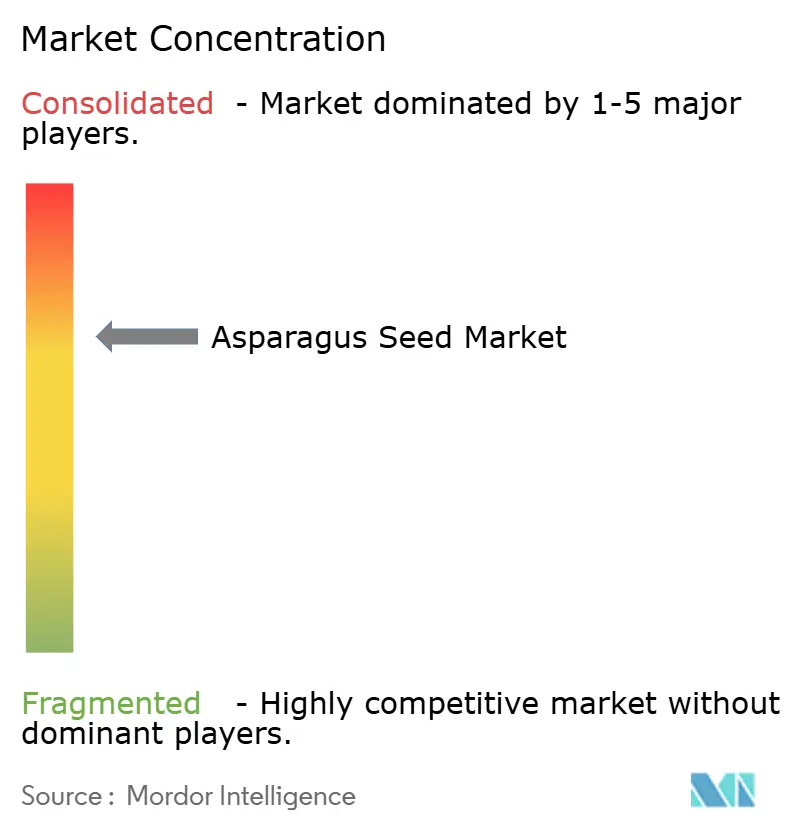
The asparagus seed market is moderately concentrated, with prominent players including Limgroup B.V., Walker Brothers Seeds and Plants, LLC, Bejo Zaden B.V., Fox Seeds Inc., and Global Plant Genetics Ltd. These companies maintain their competitive positions through long breeding cycles, specialized greenhouse and field-trial requirements, and multi-country regulatory registrations required for effective competition. Limgroup has maintained visibility through product launches and portfolio events associated with Mosalim, Ruralim, and the K-8217 line. Walker Brothers has reinforced its position through extensive international trials and large-scale hybrid seed production.
Below the top tier, competition in the asparagus seed market is influenced by factors such as channel access, certification, customer reach, and breeding capabilities. Retail-oriented suppliers like Territorial Seed Company, Johnny’s Selected Seeds, West Coast Seeds, Burrell Seed Growers, LLC, and Ferry-Morse Seed Company demonstrate that strong commercial positions can be achieved without full breeding ownership. These companies compete by offering diverse assortments, high-quality crowns, strong catalog presence, and customer trust. For instance, Johnny’s Selected Seeds included asparagus crowns in its 2026 product expansion, while Territorial Seed Company maintained a broad asparagus crown lineup in North America[3]Source: Johnny’s Selected Seeds, “New for 2026,” Johnny’s Selected Seeds, johnnyseeds.com. This retail depth ensures that the asparagus seed market remains accessible, despite the high barriers to entry in breeding.
Since 2024, leading players have continued to invest in breeding, propagation, and market positioning. Global Plant Genetics updated its asparagus portfolio in March 2026, emphasizing Guelph Equinox for protected cultivation and new plantings. Bejo Zaden enhanced its production capabilities through the acquisition of a greenhouse in Velden in 2024, which added dedicated asparagus propagation capacity. Fox Seeds has also adopted a genomics-led breeding approach, focusing on traits such as disease resistance, climate resilience, and harvesting compatibility, in addition to yield improvements.
Asparagus Seed Industry Leaders
Limgroup B.V.
Walker Brothers Seeds and Plants, LLC
Bejo Zaden B.V.
Fox Seeds Inc.
Global Plant Genetics Ltd.
- *Disclaimer: Major Players sorted in no particular order
Asparagus Seed Market Companies Covered in this Report
- Limgroup B.V.
- Bejo Zaden B.V.
- Walker Brothers Seeds and Plants, LLC
- Fox Seeds Inc.
- Global Plant Genetics Ltd.
- Cutter Asparagus Seed
- Golden Valley Seed Inc.
- Südwestdeutsche Saatzucht GmbH and Co. KG
- Territorial Seed Company
- Johnny's Selected Seeds
- Harris Seeds
- Kitazawa Seed Company
- Ferry-Morse Seed Company
- Burrell Seed Growers, LLC
- West Coast Seeds

Recent Industry Developments in Asparagus Seed Market
- June 2026: Limgroup entered a distribution partnership with TERIS and A.M.A. to expand the commercialization of its F1 hybrid asparagus genetics across the United States and Canada. The collaboration strengthens Limgroup’s market reach in North America and enhances grower access to advanced asparagus seed varieties supported by local technical and distribution networks.
- June 2026: Rijk Zwaan has inaugurated its Trial Centre Open Field in the Netherlands, a research and demonstration facility designed to support breeding activities for 20 open-field crops. The facility includes dedicated areas for asparagus breeding and seed production trials. This investment enhances the company’s breeding infrastructure and aims to facilitate the development and evaluation of advanced asparagus varieties for commercial growers.
- December 2025: Limgroup has introduced Ruralim, a new asparagus variety designed for commercial growers. This variety is characterized by vigorous foliage, uniform grading, and high yield potential. The launch enhances Limgroup’s asparagus genetics portfolio and demonstrates its ongoing investment in breeding programs aimed at improving productivity, crop quality, and grower performance.


Global Asparagus Seed Market Report Scope
Asparagus seeds are small, black, wrinkly, and spherical seeds produced by female asparagus plants (Asparagus officinalis) in red berries during the summer. They are used to grow hardy, perennial, nutrient-packed vegetable plants. The Asparagus seed market is segmented by breeding technology (hybrid, open-pollinated seeds), by cultivation environment (open field and protected cultivation), and by geography (North America, South America, Europe, Asia-Pacific, Middle East, and Africa). The market forecasts are provided in terms of value (USD) and volume (metric tons).
| Hybrid Seeds |
| Open-Pollinated Seeds |
| Open Field Cultivation |
| Protected Cultivation |
| North America | United States |
| Canada | |
| Mexico | |
| Rest of North America | |
| South America | Peru |
| Brazil | |
| Argentina | |
| Rest of South America | |
| Europe | Germany |
| Netherlands | |
| France | |
| Spain | |
| Italy | |
| United Kingdom | |
| Russia | |
| Rest of Europe | |
| Asia-Pacific | China |
| Japan | |
| India | |
| Australia | |
| New Zealand | |
| Rest of Asia-Pacific | |
| Middle East | Saudi Arabia |
| United Arab Emirates | |
| Rest of Middle East | |
| Africa | South Africa |
| Egypt | |
| Rest of Africa |
| By Breeding Technology | Hybrid Seeds | |
| Open-Pollinated Seeds | ||
| By Cultivation Environment | Open Field Cultivation | |
| Protected Cultivation | ||
| By Geography | North America | United States |
| Canada | ||
| Mexico | ||
| Rest of North America | ||
| South America | Peru | |
| Brazil | ||
| Argentina | ||
| Rest of South America | ||
| Europe | Germany | |
| Netherlands | ||
| France | ||
| Spain | ||
| Italy | ||
| United Kingdom | ||
| Russia | ||
| Rest of Europe | ||
| Asia-Pacific | China | |
| Japan | ||
| India | ||
| Australia | ||
| New Zealand | ||
| Rest of Asia-Pacific | ||
| Middle East | Saudi Arabia | |
| United Arab Emirates | ||
| Rest of Middle East | ||
| Africa | South Africa | |
| Egypt | ||
| Rest of Africa | ||


Key Questions Answered in the Report
What is the current value of the asparagus seed market in 2026 and forecasted value in 2031?
The asparagus seed market is valued at USD 1.29 billion in 2026 and is forecast to reach USD 1.86 billion by 2031.
What is driving growth in asparagus seed demand?
Growth is being driven by hybrid conversion, stronger demand for disease-resistant and climate-resilient varieties, protected cultivation, and rising interest in premium fresh and organic asparagus.
Which breeding technology leads commercial planting?
Hybrid seeds lead commercial planting and held 73% of revenue in 2025 because growers prioritize yield, uniformity, and stronger long-term field economics.
Which region leads global revenue and which one grows the fastest?
North America held the largest share at 41.7% in 2025, while Asia-Pacific is the fastest-growing region with a projected 7.9% CAGR through 2031
What is the main production risk affecting growers?
Fusarium crown and root rot remains the main biological risk because it weakens roots, reduces field life, and makes replanting more difficult in major growing regions.
Page last updated on:





