
AI-powered Visual Inspection Market Size and Share
Market Overview
| Study Period | 2020 - 2031 |
|---|---|
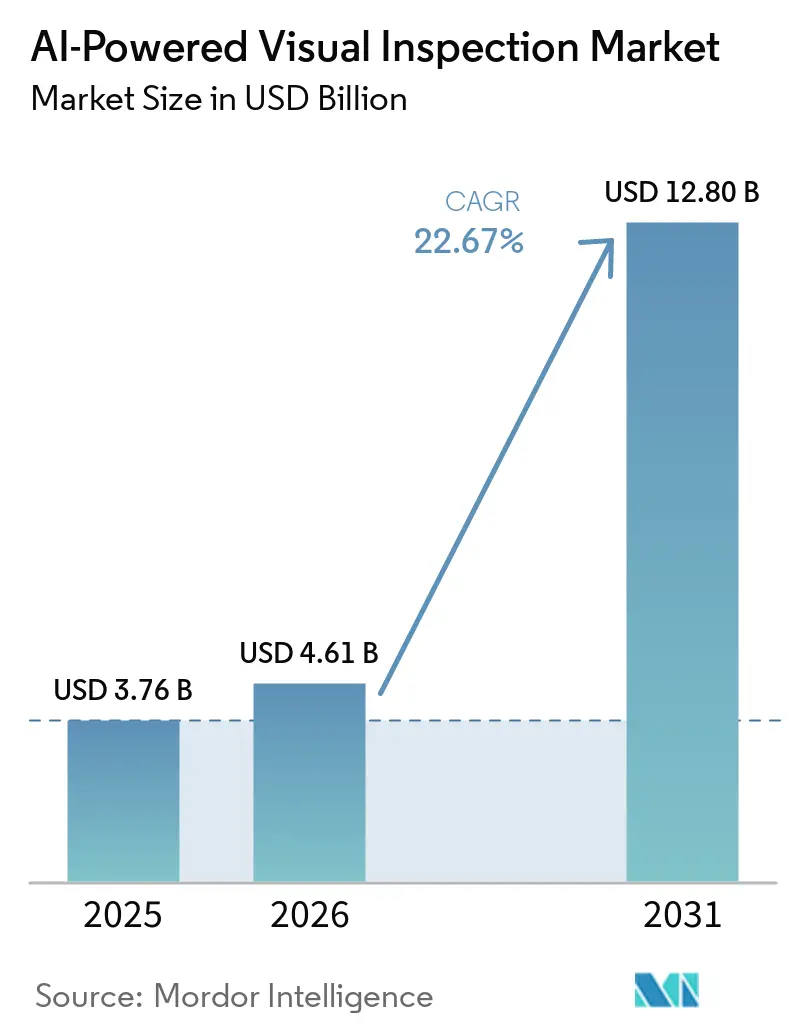
| Market Size (2026) | USD 4.61 Billion |
| Market Size (2031) | USD 12.80 Billion |
| Growth Rate (2026 - 2031) | 22.67 % |
| Fastest Growing Market | Asia-Pacific |
| Largest Market | Asia-Pacific |
| Market Concentration | Low |
Major Players *Disclaimer: Major Players sorted in no particular order Image © Mordor Intelligence. Reuse requires attribution under CC BY 4.0. | |
AI-powered Visual Inspection Market Analysis by Mordor Intelligence
The AI-powered Visual Inspection Market size is expected to grow from USD 3.76 billion in 2025 to USD 4.61 billion in 2026 and is forecast to reach USD 12.80 billion by 2031 at 22.67% CAGR over 2026-2031. The shift in buyer behavior is now clear, as manufacturers are moving from isolated proofs of concept to broader rollouts across multiple plants and production lines. The strongest pull comes from production settings where defect tolerance is very tight, throughput is very high, and the cost of a missed defect rises sharply at the pack, module, wafer, or finished assembly level. Competition is also changing, as buyers weigh integrated hardware, software, and service accountability against cloud-based platforms that make model governance and multi-site deployment easier to manage. Recent acquisitions show that established vendors are acquiring AI capabilities to shorten product development cycles and strengthen inspection portfolios, rather than waiting for slower internal buildouts. The main barrier is no longer whether the models can detect faults, but whether manufacturers can validate them, connect them to legacy production systems, and satisfy documentation and oversight requirements at scale.
Key Report Takeaways
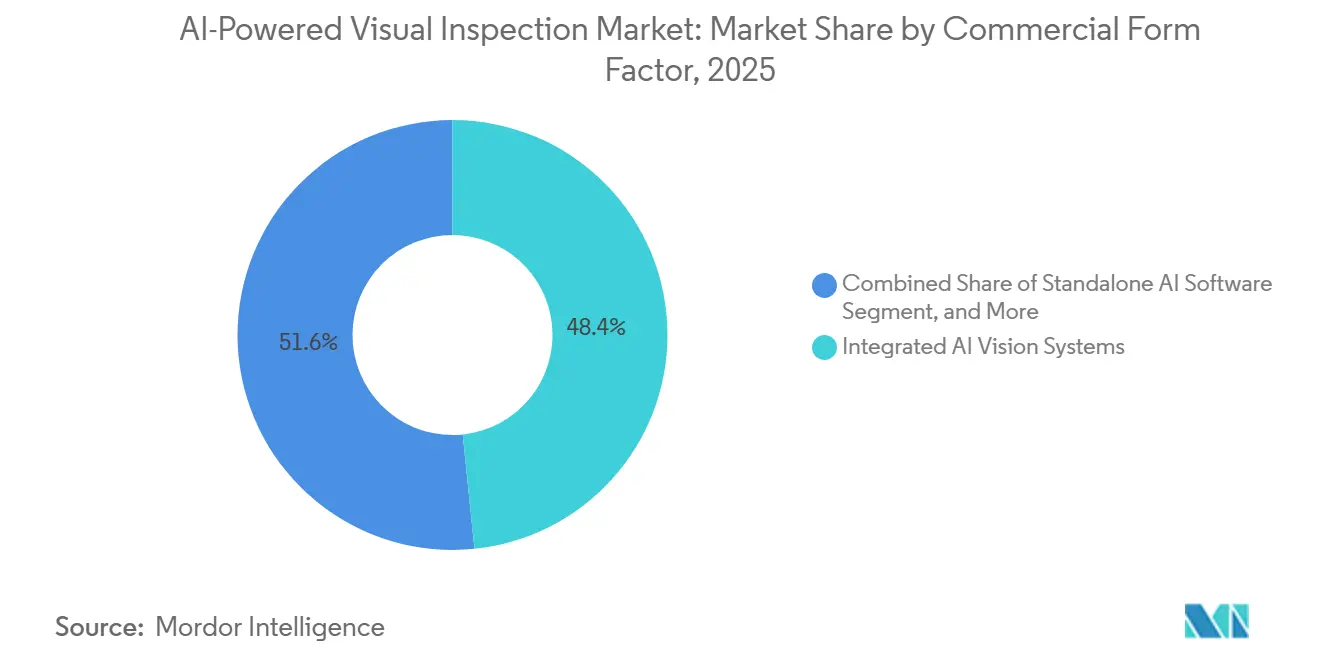
- By commercial form factor, Integrated AI Vision Systems held 48.37% of the AI-powered Visual Inspection Market share in 2025, while AI Vision Platform and API are projected to expand at a 23.49% CAGR through 2031.
- By deployment architecture, Edge and Embedded AI accounted for 36.74% share in 2025, while Cloud and SaaS are projected to grow at a 23.25% CAGR through 2031.
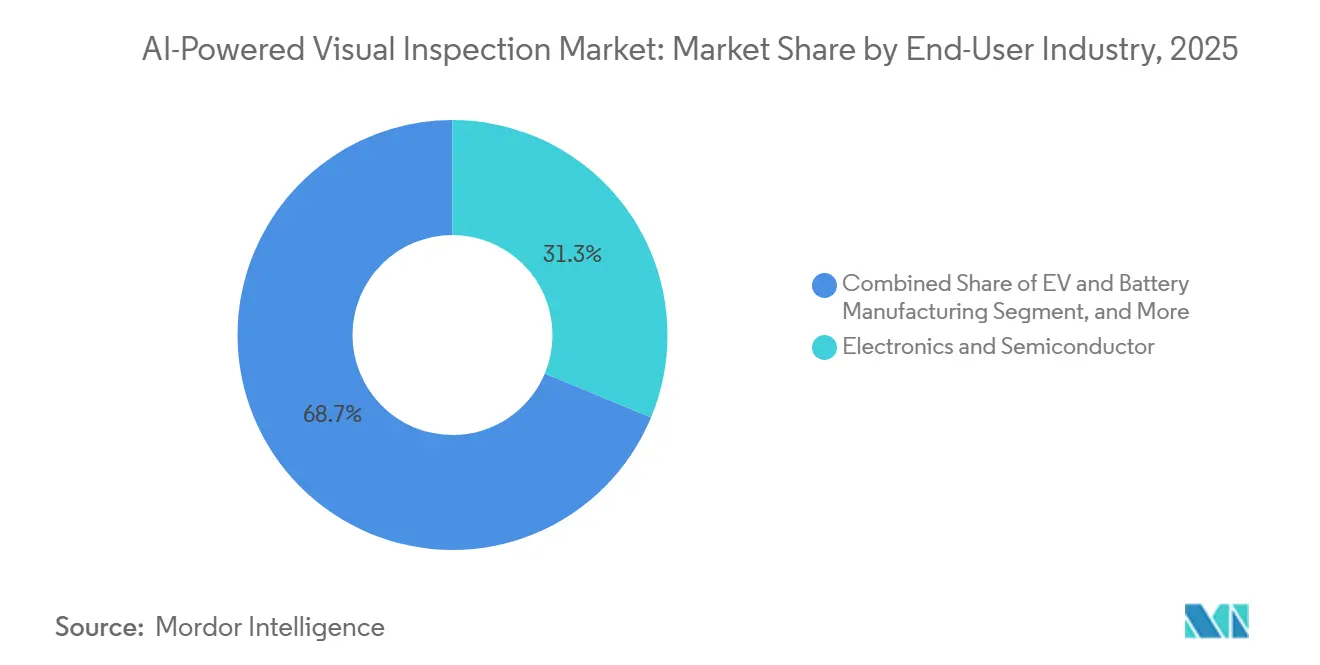
- By end-user industry, Electronics and Semiconductor captured 31.27% share in 2025, while EV and Battery Manufacturing is projected to advance at a 22.81% CAGR through 2031.
- By geography, Asia Pacific held a 41.97% share of the AI-powered Visual Inspection Market in 2025 and is projected to expand at a 22.78% CAGR through 2031.
Note: Market size and forecast figures in this report are generated using Mordor Intelligence’s proprietary estimation framework, updated with the latest available data and insights as of January 2026.
Market Trends and Insights
Drivers Impact Analysis of AI-powered Visual Inspection Market*
| Driver | (~) % Impact on CAGR Forecast | Geographic Relevance | Impact Timeline |
|---|---|---|---|
| Deep Learning Models Achieving Super-Human Accuracy in Defect Detection and Classification | +4.5% | Global, concentrated in Asia-Pacific and North America | Short term (≤ 2 years) |
| EV and Battery Manufacturing Creating High-Throughput Inspection Demand at Tighter Defect Tolerances | +3.8% | Asia-Pacific core, China and South Korea, spill-over to Europe and North America | Medium term (2-4 years) |
| Declining Edge AI Hardware Costs Enabling Factory-Floor Deployment at Scale | +3.2% | Global, early gains in Asia-Pacific and North America | Short term (≤ 2 years) |
| Global Labor Shortages in Quality Inspection Roles Accelerating AI Automation | +2.8% | North America, Europe, Japan | Medium term (2-4 years) |
| Digital Factory and Industry 4.0 Investments Expanding AI Inspection Budgets | +2.1% | Global, led by North America and Europe | Medium term (2-4 years) |
| Regulatory Traceability Mandates in Pharmaceutical and Medical Device Manufacturing | +1.5% | North America and Europe | Long term (≥ 4 years) |
| Source: Mordor Intelligence | |||
Deep Learning Models Achieving Super-Human Accuracy in Defect Detection and Classification
The AI-powered Visual Inspection Market is benefiting from a point where accuracy is no longer the main question in many controlled industrial settings. A January 2026 review in Sensors documented several deployments above 95% accuracy, including 99.9% precision for engine part inspection using R-CNN and 98% detection and classification accuracy for assembly inspection using YOLOv8. This changes the basis of competition in the AI-powered Visual Inspection Market, because buyers now pay closer attention to training effort, labeling time, and model transfer across product variants. Cognex reinforced that direction in April 2026 when it launched the In-Sight 6900 Vision Controller with a Few Sample Classification tool that needs only 10 to 20 training images for production use. The practical effect is that the AI-powered Visual Inspection Market can move from long setup cycles to much faster industrial adoption, overcoming the image scarcity that used to block deployment. The same Sensors review also noted that 77% of machine learning-based vision implementations remained at the prototype or pilot scale, underscoring why faster validation and lower data preparation effort matter so much for commercial scale-up.
EV and Battery Manufacturing Creating High-Throughput Inspection Demand At Tighter Defect Tolerances
The AI-powered Visual Inspection Market is seeing especially strong pull from battery production, where throughput and defect tolerance create a difficult operating environment for manual or rule-based inspection. A 38GWh-per-year western gigafactory processes nearly 6 million cylindrical cells per day, while electrode overhang tolerances range into the hundreds of microns and contamination thresholds reach single-digit microns. The economics are also direct, because the cited study showed that a 2.5% battery pack field failure rate during warranty translates to nearly USD 7.50 per kWh in cost exposure versus USD 0.05 per kWh for inline 2D X-ray inspection. That gap is driving the value of the AI-powered Visual Inspection Market in battery cell, tab, weld, and pack workflows, where a single weak cell can affect the entire pack. UnitX Labs has also shown that purpose-built AI systems can process 16,000 pieces per day with sub-second cycle times in battery tab and weld inspection, which supports the view that this vertical needs highly specialized throughput. As a result, the AI-powered Visual Inspection Market is gaining ground in a sector where quality yield improvement does not rise in a straight line, but rather compounds with pack reliability and safety expectations.
Declining Edge AI Hardware Costs Enabling Factory-Floor Deployment At Scale
The AI-powered Visual Inspection Market is also expanding as edge deployment becomes easier to justify at the line level. The change is visible in commercial product launches that combine higher AI performance, embedded compute, and deployment formats that reduce dependence on separate industrial PCs. Cognex launched the In-Sight 6900 Vision Controller in April 2026 with up to 157 TOPS of AI performance, and followed in May 2026 with the In-Sight 3900 Vision System that delivers up to 4x faster processing and up to 25MP imaging than the prior generation.[1]Cognex Corporation, “Cognex Launches In-Sight Vision Controller Powered by NVIDIA,” Cognex Investor Relations, investor.cognex.com These launches matter for the AI-powered Visual Inspection Market because they lower practical barriers around space, determinism, and deployment complexity on fast production lines. They also support a broader shift in the AI-powered Visual Inspection Market toward hardware-software combinations that can run inference at line speed while still fitting into standardized factory equipment stacks. In that setting, falling deployment friction is as important as falling component cost, because it widens the buyer base beyond very large manufacturers that once had the staff and budget to support custom AI rollouts.
Global Labor Shortages in Quality Inspection Roles Accelerating AI Automation
Labor pressures in manufacturing quality functions are also driving the AI-powered Visual Inspection Market. ETQ’s 2025 Pulse of Quality in Manufacturing found that 70% of manufacturers were affected by labor shortages, and 88% reported a negative effect on product or service quality. This matters because manual inspectors cannot keep pace with modern production lines that often move from a few parts per minute to thousands of units per hour. The AI-powered Visual Inspection Market, therefore, serves not only a productivity goal, but also a continuity need in plants where inspection staffing gaps can quickly turn into scrap, rework, or missed defects. GFT Technologies showed that the next stage of automation would be in April 2026, when it launched a solution for a major US automotive manufacturer that combined AI defect detection with robotic removal of faulty parts from the production line. That kind of closed-loop action widens the role of the AI-powered Visual Inspection Market from pass-fail detection to direct production response, thereby increasing its operational value in labor-constrained environments.
Restraints Impact Analysis of AI-powered Visual Inspection Market*
| Restraint | (~) % Impact on CAGR Forecast | Geographic Relevance | Impact Timeline |
|---|---|---|---|
| High Cost and Effort of Labeled Training Data Acquisition and Model Validation | -2.5% | Global | Medium term (2-4 years) |
| Integration Complexity With Legacy MES, ERP, and SCADA Systems | -2.0% | Global, pronounced in Europe and North America | Medium term (2-4 years) |
| Cybersecurity and IP Concerns for Cloud-Connected AI Inspection Platforms | -1.5% | Global, particularly semiconductor and defense sectors | Long term (≥ 4 years) |
| Model Drift and Revalidation Burden in High-Mix, Low-Volume Manufacturing Environments | -1.2% | Global | Long term (≥ 4 years) |
| Source: Mordor Intelligence | |||
High Cost and Effort of Labeled Training Data Acquisition and Model Validation
The AI-powered Visual Inspection Market still faces a major constraint, the high cost and effort required to build defect libraries tailored to product, surface, and failure mode. That burden grows in regulated environments where validation must be documented and retained in a form that can pass audit review. The FDA guidance finalized in September 2025 on Computer Software Assurance for production and quality system software reinforced the need for risk-based validation, which raises the workload for AI-enabled quality systems used in pharmaceutical manufacturing.[2]U.S. Food and Drug Administration, “Computer Software Assurance for Production and Quality System Software,” U.S. Food and Drug Administration, fda.gov The problem is repeated across the AI-powered Visual Inspection Market when manufacturers run many product variants, as each changeover can trigger new labeling, testing, and validation activities. Vendors are responding with synthetic defect generation and few-shot workflows, including Cognex’s Few Sample Classification feature and Overview AI’s OV Auto-Defect Creator Studio, both aimed at reducing dependence on large real-world defect libraries. Even so, the AI-powered Visual Inspection Market is likely to face longer deployment cycles in aerospace, medical device, and pharmaceutical settings than in automotive or consumer electronics, because compliance work does not shrink as quickly as model training effort.
Integration Complexity With Legacy MES, ERP, And SCADA Systems
The AI-powered Visual Inspection Market also slows when inspection outputs cannot connect cleanly with the systems that already run production records, alarms, traceability, and enterprise planning. In many plants, the inspection layer must work with a mix of legacy SCADA, MES, and ERP environments that were never designed around modern vision AI workflows. That raises implementation cost in the AI-powered Visual Inspection Market because the work does not stop at image capture or classification, but extends into data handoff, audit readiness, and closed-loop production response. Cognex’s OneVision platform has gained traction partly because it centralizes model training, governance, and deployment across the In-Sight hardware ecosystem, which reduces part of the coordination burden in multi-site environments. Even with that progress, the AI-powered Visual Inspection Market still faces friction in factories that require bidirectional exchange with legacy production systems, especially when inspection records must map directly into existing documentation structures. That integration burden favors larger vendors and managed service providers that can support both the vision layer and the surrounding production data environment over the long term.
*Our forecasts treat driver/restraint impacts as directional, not additive. The impact forecasts reflect baseline growth, mix effects, and variable interactions.
AI-powered Visual Inspection Market Segment Analysis
By Commercial Form Factor:
Integrated Systems Lead While Cloud Consumption ExpandsIntegrated AI Vision Systems accounted for 48.37% of the commercial form factor segment in 2025, giving them the largest position within the AI-powered Visual Inspection Market. Their lead reflects buyer preference for packaged systems that combine cameras, illumination, embedded compute, inspection software, and service accountability into a single validated unit. That structure lowers integration risk for plants where cycle times are measured in milliseconds and downtime from a failed handoff between vendors is unacceptable. It is especially relevant in automotive and electronics settings, where operators want deterministic line performance and a clear support model from a single supplier. The AI-powered Visual Inspection Market has therefore rewarded turnkey offerings that shorten commissioning time and reduce uncertainty around warranty, training, and service ownership.
The AI Vision Platform and API segment is projected to grow at a 23.49% CAGR through 2031, making it the fastest-growing form factor in the AI-powered Visual Inspection Market. This reflects a buyer group that wants model portability, centralized governance, and faster rollout across multiple facilities rather than deeper control over each hardware node. Cognex strengthened that direction when OneVision reached general availability in May 2026, after more than 100 customers used the platform during beta, with many moving from a single line to a multi-site rollout in days. Standalone AI Software remains relevant for manufacturers that already own vision hardware and only need a more advanced model layer, while managed inspection services suit buyers who prefer to outsource development, validation, and operations. Across these choices, the AI-powered visual inspection industry is moving toward greater commercial flexibility, but the strongest demand still comes from solutions that offer fast deployment and reliable production accountability.



By Deployment Architecture:
Edge Inference Holds the Line While Cloud Management ScalesEdge and Embedded AI held a 36.74% share in 2025, keeping it in the lead across deployment models in the AI-powered Visual Inspection Market. The reason is operational rather than conceptual, because high-speed production lines often need inspection decisions in extremely short time windows that cannot tolerate communication delay. Embedded deployment also keeps control close to the line, which matters when manufacturers want deterministic inspection behavior and direct interaction with automation hardware. The AI-powered Visual Inspection Market has therefore maintained a strong edge bias in use cases where each image decision must occur at production speed and in physical proximity to the asset. Cognex’s recent edge product launches, including the In-Sight 6900 and In-Sight 3900, support that direction by tying higher AI performance to deployment formats built for industrial environments.
Cloud and SaaS are projected to expand at a 23.25% CAGR through 2031, making it the fastest-growing architecture as the AI-powered Visual Inspection Market shifts toward centralized model lifecycle management. Manufacturers increasingly treat training, retraining, and governance as enterprise capabilities rather than local site tasks handled line by line. This is why hybrid models are gaining ground, because they pair edge inference for line speed with cloud orchestration for version control, performance tracking, and broader deployment. OneVision captures that pattern by allowing models to be trained centrally and then deployed across compatible In-Sight hardware at production speed. Within the AI-powered visual inspection industry, on-premise server and workstation setups still fill an important middle position for customers that need local control without fully embedding intelligence at every camera node.
By End-User Industry:
Semiconductors Anchor Demand While EV and Batteries Set The PaceElectronics and Semiconductor commanded 31.27% share in 2025, which made it the largest end-user base in the AI-powered Visual Inspection Market. This position rests on a long installed base of automated optical inspection that is now being upgraded with AI to handle smaller defect geometries and more variable surface conditions. In wafer and die workflows, the cost of a missed defect is amplified by yield sensitivity and the value of downstream process steps, which supports continued spending on advanced classification tools. The AI-powered Visual Inspection Market also benefits here from customers that already understand machine vision economics and are ready to replace rule-based logic where it no longer performs well enough. As a result, semiconductor demand gives the AI-powered Visual Inspection Market a stable commercial anchor even while newer verticals expand faster.
EV and Battery Manufacturing is projected to grow at a 22.81% CAGR through 2031, which makes it the fastest-growing end-user segment in the AI-powered Visual Inspection Market size. The segment combines high volume, micron-level tolerance, and safety consequences that raise the cost of quality escapes at cell, module, and pack level. The battery production study cited in Nature Communications makes that logic clear, because even modest failure rates create much larger financial exposure than the cost of inline inspection. NATURE.COM Pharmaceutical and medical device adoption is also building as validation expectations become clearer, while automotive remains a large volume user in weld inspection, assembly verification, and dimensional measurement. Food and beverage, packaging, printing, textile, and other industrial workflows are also widening the AI-powered visual inspection industry as system complexity falls and AI-enabled inspection becomes easier to fit into daily production practice.
Geography Analysis
APAC AI-powered Visual Inspection Market
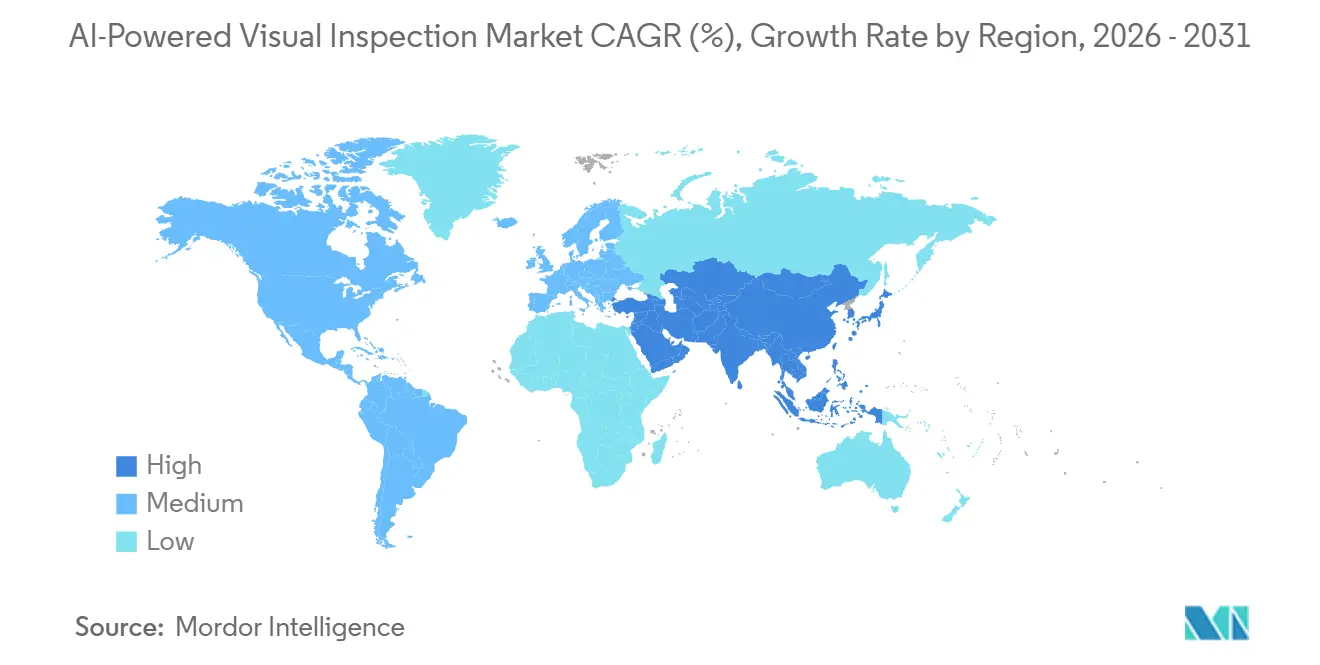
Asia Pacific accounted for 41.97% of the AI-powered Visual Inspection Market share in 2025 and is projected to expand at a 22.78% CAGR through 2031. The region combines dense semiconductor fabrication, large consumer electronics assembly capacity, and rapid expansion of battery manufacturing, creating a very broad installed base for industrial inspection systems. South Korea and Taiwan remain important because advanced memory, display, and logic production place exceptional demands on defect detection accuracy and process consistency. China adds another major layer of demand as lithium-ion battery output rises and domestic EV producers tighten internal quality expectations for export markets. Japan and India are also expanding regional opportunities as industrial policy and electronics manufacturing investments add more assets that can support AI-enabled inspection over time.
North America AI-powered Visual Inspection Market
North America ranked second in the AI-powered Visual Inspection Market in 2025. The US remains a major commercialization hub, with Cognex, Landing AI, Instrumental, and AWS all shaping enterprise adoption pathways across manufacturing verticals. Semiconductor reshoring under the CHIPS and Science Act is expanding domestic wafer fabrication capacity, thereby increasing inspection opportunities across front-end and back-end processes. Buyers in regulated sectors are also placing greater weight on validation and traceability, which aligns with the broader quality software expectations outlined in FDA guidance for production and quality system software.[3]U.S. Food and Drug Administration, “Computer Software Assurance for Production and Quality System Software,” U.S. Food and Drug Administration, fda.gov
Europe, North America and Middle East AI-powered Visual Inspection Market
Europe held a meaningful share of the AI-powered Visual Inspection Market in 2025, supported by Germany, the UK, France, and Italy, and their established automotive and industrial production bases. The region benefits from mature quality systems and a user base that already understands the value of inspection automation in precision manufacturing. At the same time, the EU AI Act is lengthening procurement cycles in some critical manufacturing settings because buyers must assess documentation, risk controls, and human oversight before large deployments move forward. That compliance burden can slow orders, but it also creates an advantage for vendors with audit-ready platforms and long records in regulated or quality-sensitive industries. The rest of the world remains smaller today, though greenfield smart factory investment in Mexico and industrial diversification programs in the Gulf are widening future demand as system costs fall and integration capability improves.

Competitive Landscape
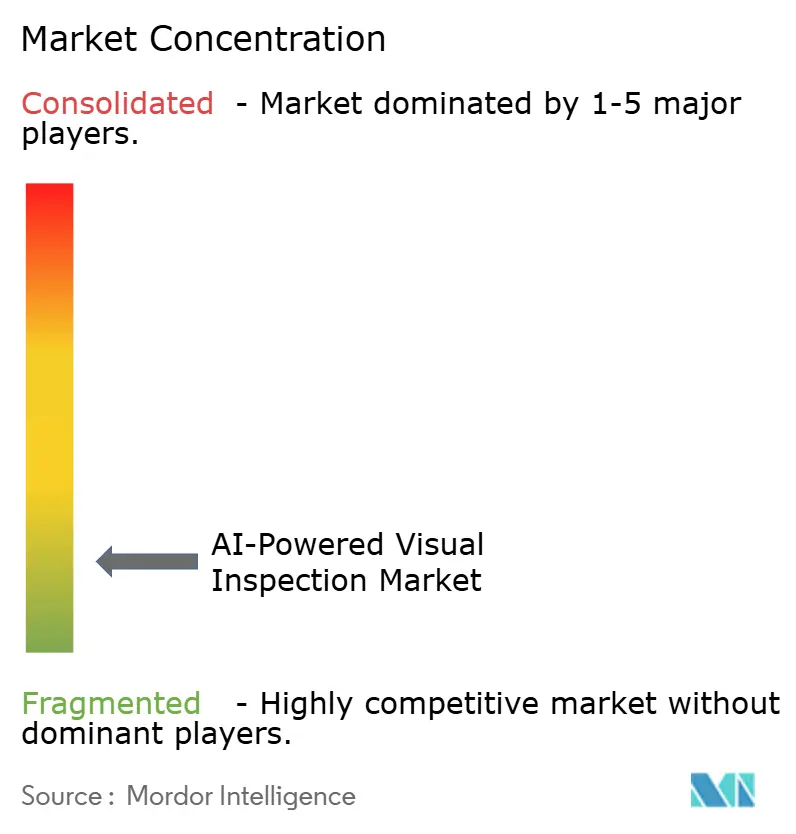
The AI-powered Visual Inspection Market remains fragmented, with hardware-centered specialists, cloud platform providers, and software-focused innovators all competing across different buying models. Cognex, Keyence, Basler AG, Teledyne Technologies, and Omron remain important on the hardware and embedded vision side, while AWS, Google, and Microsoft extend competition through cloud-based computer vision and model services. Alongside them, companies such as Landing AI, Neurala, Visionify, and Qualitas Technologies compete by simplifying model building, reducing training effort, or focusing on narrower industrial workflows. The AI-powered Visual Inspection Market lacks a single vendor with decisive strength across all form factors, deployment architectures, and end-user verticals, leaving room for both specialists and large platform companies. That structure also explains why acquisitions have become a practical route to capability expansion rather than a secondary option.
Hexagon’s April 2026 agreement to acquire Waygate Technologies for USD 1.45 billion shows how established industrial technology players are broadening into adjacent inspection categories by leveraging stronger AI and non-destructive testing capabilities. Camtek’s April 2026 acquisition of Visual Layer points to a similar strategy in semiconductor inspection, where AI analytics can improve throughput, classification, and the potential for recurring software revenue. Renesas added another competitive angle in May 2026 when it completed its acquisition of Irida Labs, bringing edge-embedded Vision AI software closer to its processor and cloud development stack.[4]Evertiq, “Renesas Completes Acquisition of Greek Vision AI Software Firm Irida Labs,” Evertiq, evertiq.com These moves show that the AI-powered Visual Inspection Market is increasingly contested through stack expansion, in which chip, hardware, and software capabilities are being brought closer together.
Smaller players still have room to build position in the AI-powered Visual Inspection Market by focusing on demanding workflows that larger vendors do not serve as efficiently. Landing AI’s September 2025 collaboration with ABB Robotics is a strong example, because it integrated LandingLens into ABB’s software suite and reduced robot vision AI training and deployment time by up to 80%. That type of partnership helps software-led firms scale without carrying the same hardware investment burden as full-stack equipment suppliers. A meaningful white space also remains for self-supervised and federated learning approaches that can improve models without concentrating sensitive image data in a single location. Procurement standards in quality-sensitive sectors continue to favor vendors with proven validation, traceability, and long operating histories, meaning the AI-powered Visual Inspection Market still rewards specialization, installed-base trust, and the ability to support customers after deployment.
AI-powered Visual Inspection Industry Leaders
Keyence Corporation
Cognex Corporation
Teledyne Technologies Incorporated
Omron Corporation
Siemens AG
- *Disclaimer: Major Players sorted in no particular order
AI-powered Visual Inspection Market Companies Covered in this Report
- Cognex Corporation (ViDi Suite)
- Landing AI (LandingLens)
- MVTec Software GmbH (HALCON / Deep Learning Tools)
- ISRA VISION GmbH (Atlas Copco Group)
- Keyence Corporation
- Microsoft Corporation (Azure AI Vision)
- Google LLC (Cloud Vision AI / Vertex AI Vision)
- Amazon Web Services Inc. (Lookout for Vision / Rekognition)
- Instrumental Inc.
- Zebra Technologies Corporation (Matrox Imaging)
- Basler AG (Basler AI)
- Teledyne Technologies Incorporated (DALSA AI Vision)
- Neurala Inc.
- Sight Machine Inc.
- Omron Corporation (AI Vision Systems)
- Datalogic S.p.A.
- Visionify Inc.
- Qualitas Technologies
- Pleora Technologies
- Radiant Vision Systems LLC

Recent Industry Developments in AI-powered Visual Inspection Market
- June 2026: Ondas Inc. entered a definitive agreement to acquire Cyberhawk, a global leader in drone-based inspection, visual data management, and AI-enabled analytics for utility and industrial infrastructure, for approximately USD 125 million (approximately 95% in cash). The transaction, expected to close in Q3 2026, extends Ondas's AI inspection capability from manufacturing environments into critical infrastructure monitoring, including utility, energy, and industrial asset inspection worldwide.
- May 2026: DIMAAG acquired Akridata, a specialist in AI vision systems and edge-to-core AI infrastructure, adding advanced computer vision, edge processing, intelligent data capture hardware, and human-assisted inspection workflows to its industrial AI portfolio. The combination extends DIMAAG's deployment footprint across med tech, automotive, rail, government, and industrial inspection markets with a geographic presence in the US, Japan, and India.
- May 2026: Renesas Electronics completed the acquisition of Irida Labs, a Greece-based embedded software company developing lightweight Vision AI tools for edge deployment under the PerCV.ai brand, used in industrial inspection, robotics guidance, and safety systems. The deal integrates Irida Labs' capabilities into Renesas's RZ/V microprocessor line and the Renesas 365 cloud development platform launched in March 2026.
- May 2026: Cognex Corporation released OneVision to general availability, reporting that more than 100 customers worldwide had used the platform during its beta phase to accelerate AI vision deployment, many progressing from single-line applications to multi-site rollouts in days. The cloud platform enables centralized model training, governance, and deployment across the Cognex In-Sight hardware ecosystem.


Global AI-powered Visual Inspection Market Report Scope
The AI-powered Visual Inspection Market encompasses software, hardware, platforms, and services that leverage artificial intelligence technologies, including machine learning, deep learning, computer vision, and generative AI, to automate the inspection, detection, classification, measurement, and verification of products, components, and manufacturing processes. These solutions analyze images, video streams, and sensor data to identify defects, anomalies, dimensional deviations, assembly errors, surface imperfections, and traceability information with minimal human intervention, enabling improved quality control, operational efficiency, and production consistency across industrial environments.
The AI-powered Visual Inspection Market is Segmented by Commercial Form Factor (Integrated AI Vision Systems, Standalone AI Software, AI Vision Platform and API, and AI Inspection Services), Deployment Architecture (Edge/Embedded AI, On-Premise Server/Workstation, Cloud/SaaS, and Hybrid), End-User Industry (Electronics and Semiconductor, EV and Battery Manufacturing, Pharmaceutical and Medical Devices, Automotive, Food and Beverage, Aerospace and Defense, Other End-User Industries), and Geography (North America, Europe, Asia Pacific, Rest of World). The Market Forecasts are Provided in Terms of Value (USD).
| Integrated AI Vision Systems |
| Standalone AI Software (License and Subscription) |
| AI Vision Platform and API (Cloud Consumption) |
| AI Inspection Services (Professional Services and Managed Inspection) |
| Edge / Embedded AI |
| On-Premise Server / Workstation |
| Cloud / SaaS |
| Hybrid (Edge + Cloud) |
| Electronics and Semiconductor |
| EV and Battery Manufacturing |
| Pharmaceutical and Medical Devices |
| Food and Beverage |
| Automotive (ICE and General Manufacturing) |
| Aerospace and Defense |
| Others (Packaging, Printing, Textile, and More) |
| North America | United States |
| Canada | |
| Mexico | |
| Europe | Germany |
| United Kingdom | |
| France | |
| Italy | |
| Rest of Europe | |
| Asia-Pacific | China |
| Japan | |
| South Korea | |
| India | |
| Rest of Asia-Pacific | |
| Rest of World | Middle East and Africa |
| South America |
| By Commercial Form Factor | Integrated AI Vision Systems | |
| Standalone AI Software (License and Subscription) | ||
| AI Vision Platform and API (Cloud Consumption) | ||
| AI Inspection Services (Professional Services and Managed Inspection) | ||
| By Deployment Architecture | Edge / Embedded AI | |
| On-Premise Server / Workstation | ||
| Cloud / SaaS | ||
| Hybrid (Edge + Cloud) | ||
| By End-User Industry | Electronics and Semiconductor | |
| EV and Battery Manufacturing | ||
| Pharmaceutical and Medical Devices | ||
| Food and Beverage | ||
| Automotive (ICE and General Manufacturing) | ||
| Aerospace and Defense | ||
| Others (Packaging, Printing, Textile, and More) | ||
| By Geography | North America | United States |
| Canada | ||
| Mexico | ||
| Europe | Germany | |
| United Kingdom | ||
| France | ||
| Italy | ||
| Rest of Europe | ||
| Asia-Pacific | China | |
| Japan | ||
| South Korea | ||
| India | ||
| Rest of Asia-Pacific | ||
| Rest of World | Middle East and Africa | |
| South America | ||


Key Questions Answered in the Report
What is the 2026 size of the AI-powered Visual Inspection Market?
The AI-powered Visual Inspection Market stands at USD 4.61 billion in 2026 and is forecast to reach USD 12.80 billion by 2031 at a 22.67% CAGR.
Which region leads demand for AI-powered visual inspection solutions?
Asia Pacific led with 41.97% share in 2025 and is also projected to post the fastest regional growth at 22.78% CAGR through 2031.
Which end-user group is growing fastest in AI-powered visual inspection?
EV and battery manufacturing is the fastest-growing end-user segment, with a projected 22.81% CAGR through 2031 because battery quality failures carry high cost and safety consequences.
Why are integrated AI vision systems still the largest commercial form factor?
They reduce integration risk by bundling hardware, illumination, compute, software, and service support into one validated system, which suits high-speed production environments.
What is slowing wider deployment across factories?
The main constraints are the cost of labeled training data, repeated model validation effort, and the challenge of integrating AI inspection outputs with legacy MES, ERP, and SCADA environments.
How is competition changing across vendors?
Competition is shifting from pure detection accuracy toward deployment speed, model governance, installed-base fit, and strategic acquisitions that bring AI software closer to hardware and semiconductor platforms.
Page last updated on:


 Your data is secure and never sold or shared.


