
Industrial X-ray Inspection Equipment And Imaging Software Market Size and Share
Market Overview
| Study Period | 2020 - 2031 |
|---|---|
| Market Size (2026) | USD 0.98 Billion |
| Market Size (2031) | USD 1.39 Billion |
| Growth Rate (2026 - 2031) | 7.29 % |
| Fastest Growing Market | Asia Pacific |
| Largest Market | Asia Pacific |
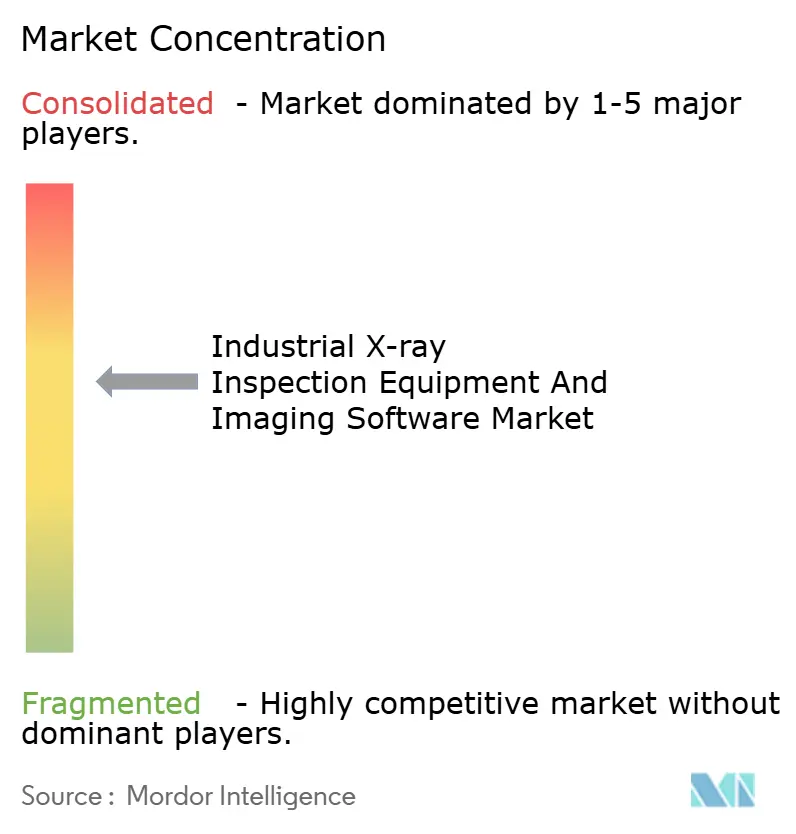
| Market Concentration | Medium |
Major Players *Disclaimer: Major Players sorted in no particular order Image © Mordor Intelligence. Reuse requires attribution under CC BY 4.0. | |
Industrial X-ray Inspection Equipment And Imaging Software Market Analysis by Mordor Intelligence
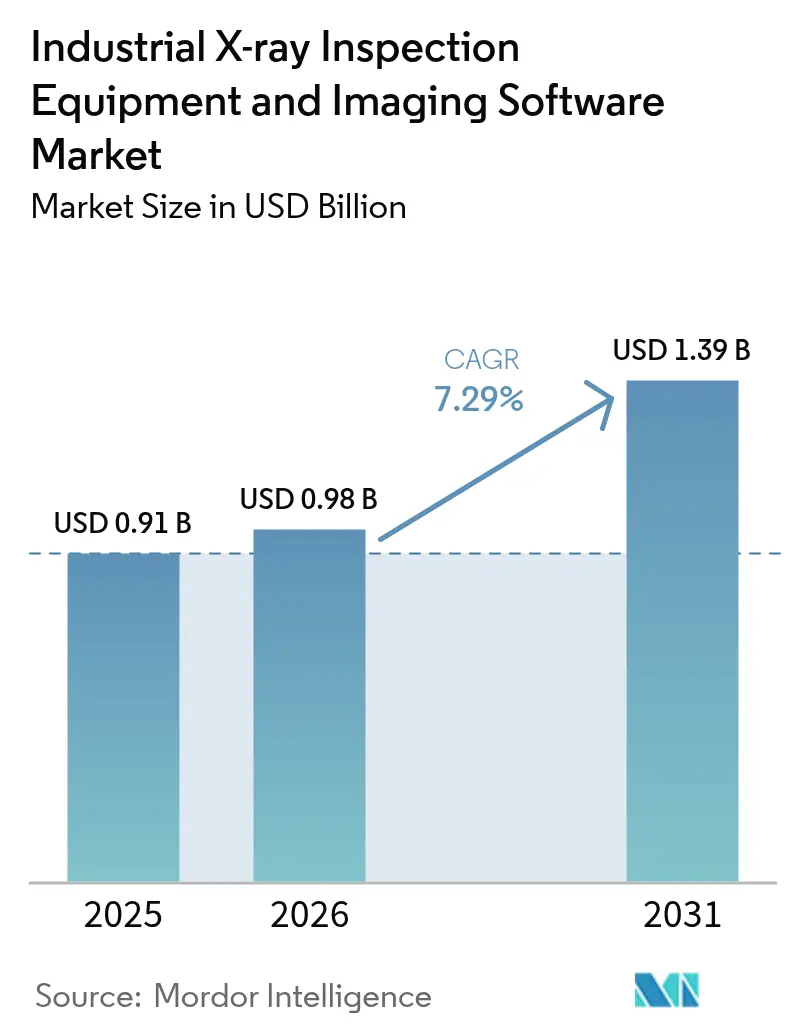
The industrial x-ray inspection equipment and imaging software market size was valued at USD 0.91 billion in 2025 and estimated to grow from USD 0.98 billion in 2026 to reach USD 1.39 billion by 2031, at a CAGR of 7.29% during the forecast period (2026-2031). Three structural shifts drive rising demand: the rapid migration from analog film to digital and computed tomography, the increased use of artificial intelligence for real-time defect recognition, and stricter zero-defect mandates across the aerospace and semiconductor supply chains. Together, these factors enlarge the installed base, push average selling prices higher for computed-tomography units, and redirect value creation toward subscription-based analytics platforms that monetize image data long after equipment installation. Capital expenditure continues to favor high-power tubes and large-area digital detectors, yet recurring software revenue now underpins vendor profitability, creating space for cloud-native entrants that disaggregate analytics from hardware. Demand is geographically concentrated in the Asia-Pacific region, where government incentives for semiconductor self-sufficiency are accelerating the adoption of inline CTs. Meanwhile, North America and Europe are investing in portable systems for aging oil and gas infrastructure, as well as for aerospace maintenance.[1]
Key Report Takeaways
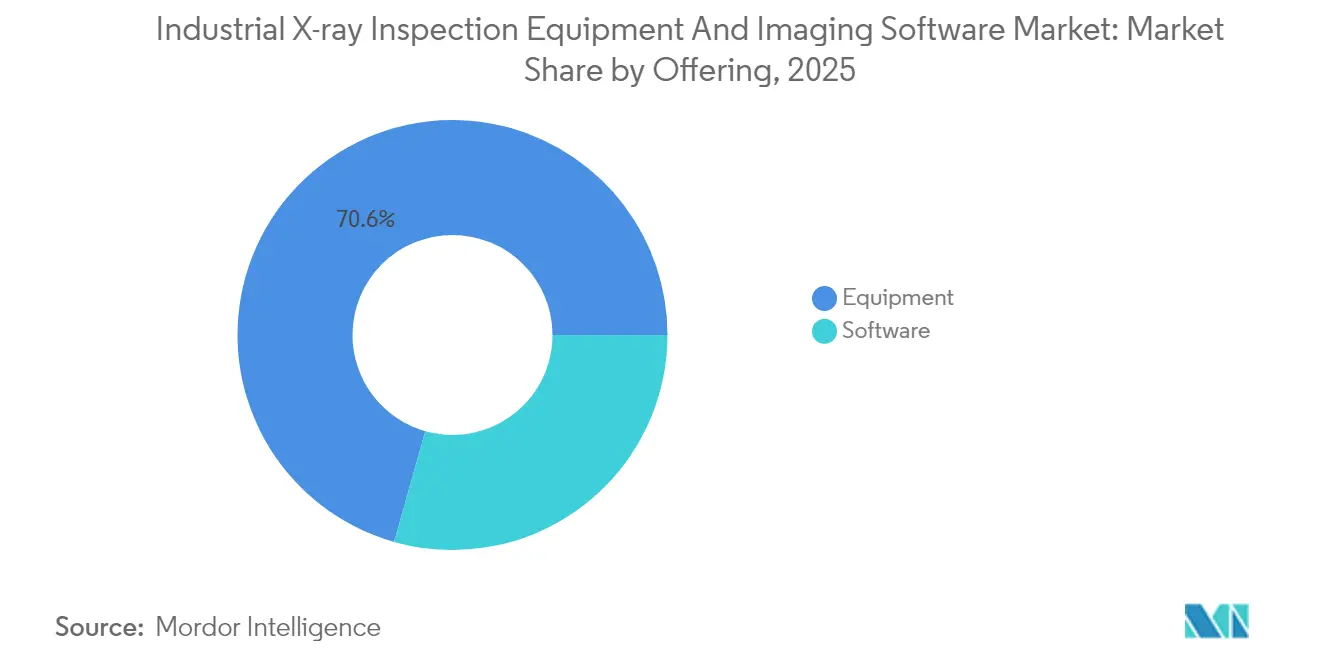
- By offering, equipment captured 70.62% of revenue in 2025; software is projected to expand at an 10.86% CAGR through 2031.
- By technology, direct radiography commanded 45.63% of revenue in 2025; computed tomography is forecast to rise at a 9.54% CAGR through 2031.
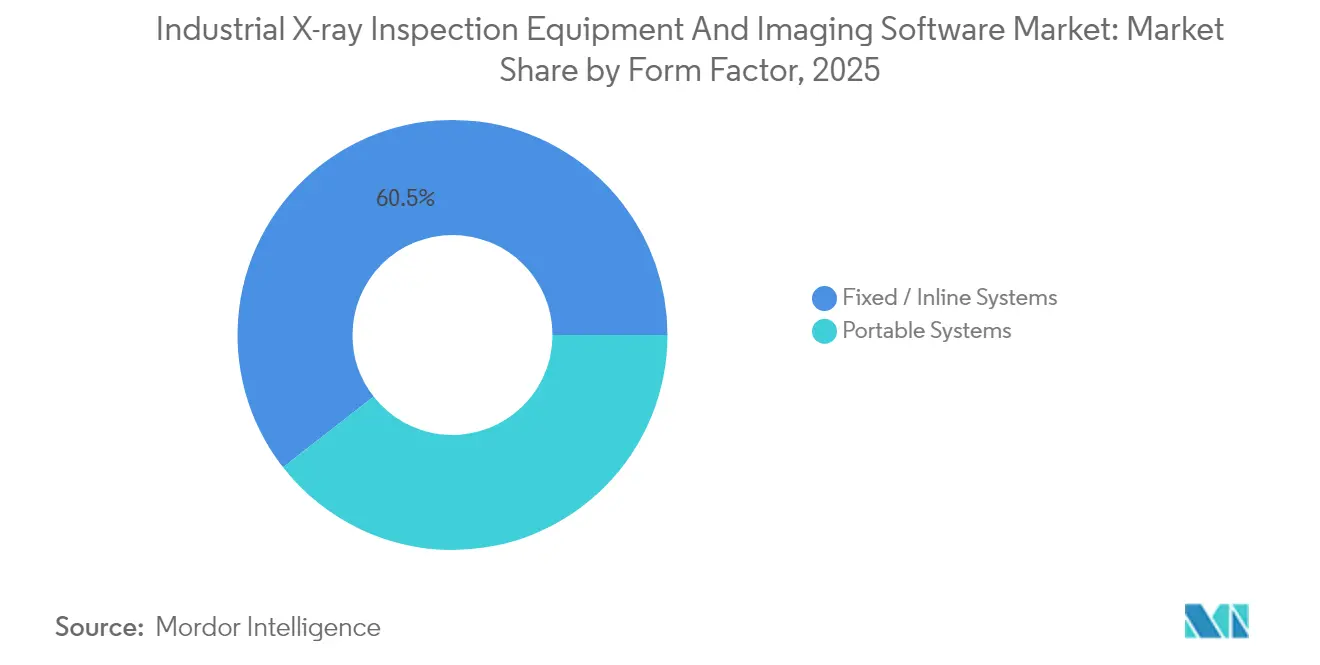
- By form factor, fixed or inline systems accounted for 60.55% of revenue in 2025, while portable systems are expected to advance at a 10.21% CAGR through 2031.
- By dimension, 3D or CT captured 54.42% of the revenue in 2025 and is expected to advance at a 11.98% CAGR through 2031.
- By end-user industry, the aerospace sector led with a 26.64% share in 2025, whereas the semiconductor and electronics sectors are set to grow at a 10.55% CAGR through 2031.
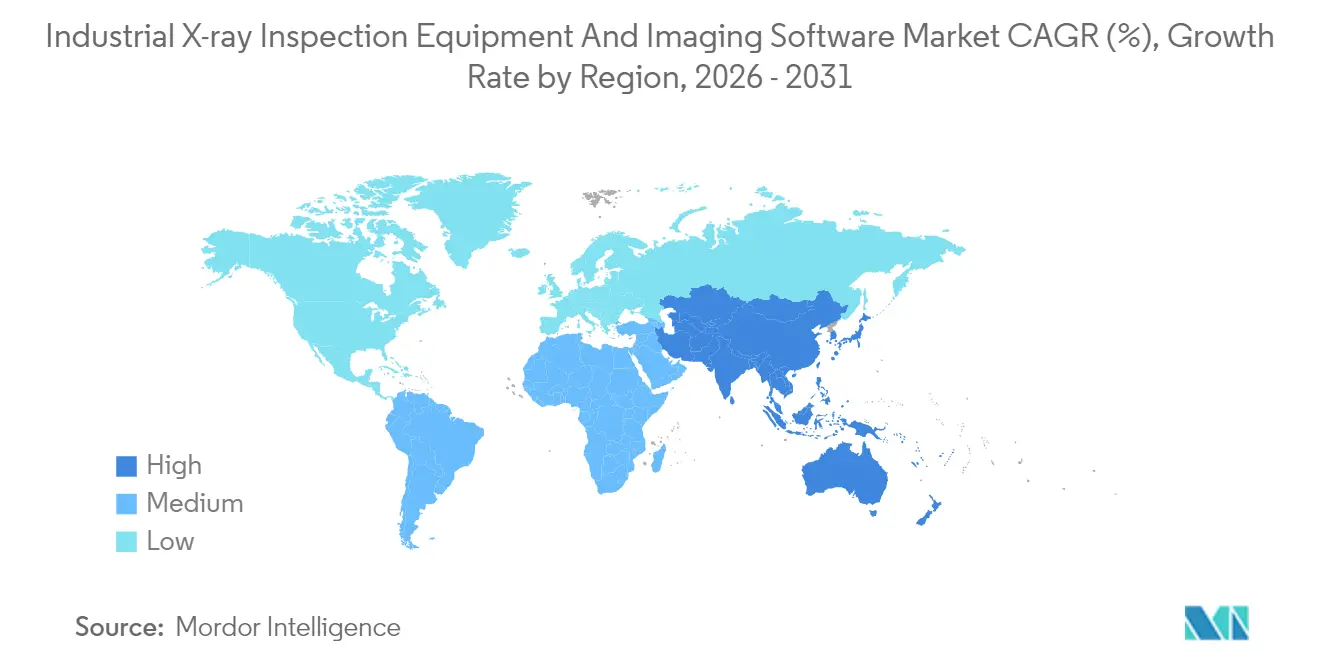
- By geography, the Asia-Pacific region held 36.45% of the revenue in 2025 and is projected to expand at a 9.31% CAGR through 2031.
Note: Market size and forecast figures in this report are generated using Mordor Intelligence’s proprietary estimation framework, updated with the latest available data and insights as of 2026.
Market Trends and Insights
Drivers Impact Analysis of Industrial X-ray Inspection Equipment And Imaging Software Market*
| Driver | (~) % Impact on CAGR Forecast | Geographic Relevance | Impact Timeline |
|---|---|---|---|
| Growing demand for portable and miniaturised systems | +1.2% | Global, with a concentration in the North America and Middle East oil and gas sectors | Medium term (2-4 years) |
| Migration from film to digital radiography | +1.5% | Global, led by Asia-Pacific and Europe automotive hubs | Short term (≤ 2 years) |
| Expansion of EV battery and semiconductor inspection needs | +2.1% | Asia-Pacific core (China, South Korea, Japan), spillover to North America | Long term (≥ 4 years) |
| Integration of AI-based automated defect recognition | +1.8% | Global, early adoption in North America aerospace and Europe automotive | Medium term (2-4 years) |
| Regulatory push for zero-defect manufacturing | +0.9% | North America and Europe aerospace, Asia-Pacific semiconductor | Long term (≥ 4 years) |
| Reshoring and supply-chain localisation initiatives | +0.7% | North America and Europe, with selective gains in Mexico and Eastern Europe | Medium term (2-4 years) |
| Source: Mordor Intelligence | |||
Growing Demand for Portable and Miniaturised Systems
Portable x-ray units are replacing fixed cabinets in pipeline integrity management and composite-airframe repair, as they eliminate the cost of transporting large parts. Waygate Technologies’ DXR Flex bendable detector, introduced in 2024, wraps around curved turbine blades and pressure vessels, shrinking inspection time by 40%. This validates on-site deployment for operators who have rarely had radiography capability in the field. Updated American Petroleum Institute guidelines now recognize portable digital radiography for weld inspections, enhancing regulatory acceptance. Battery-powered generators and miniaturized tubes have pushed the total system weight below 15 kg, enabling single-technician operation on remote desert or offshore platforms. Vendors now pair hardware rentals with cloud analytics, turning inspection into a pay-per-use service that lowers the entry barrier for small contractors.
Migration From Film to Digital Radiography
Digital radiography eliminates chemical processing delays and offers immediate image review, trimming cycle times from 20 minutes to less than 3 minutes per part. Dürr NDT’s D-DR series, launched in 2024, uses 14-bit amorphous-silicon detectors that reveal 0.1 mm pores in aluminum battery housings, a detail film struggles to capture. Publication of ISO 17636-2 unified acceptance criteria for welds, allowing cross-border certification and further lowering film dependence.[2] While niche nuclear applications favor archival film, dropping consumable costs and higher dynamic range make film a shrinking share of the industrial x-ray inspection equipment and imaging software market.
Expansion of EV Battery and Semiconductor Inspection Needs
Inline CT is now mandatory for lithium-ion cells above 100 Ah in China, driving system installs at CATL, BYD, and Gotion plants. Semiconductor packaging houses in South Korea and Taiwan are deploying sub-micron CT to verify chiplet stacking, with SEMI noting an 85% increase in CT purchases in 2024.[3] Detector supply has tightened, prompting Varex Imaging to add capacity in Utah and Switzerland. Volumetric imaging reveals lithium plating, voids, and alignment errors that are invisible to 2D systems, making computed tomography the metrology tool of record for advanced packaging lines.
Integration of AI-Based Automated Defect Recognition
Convolutional neural networks trained on radiographic datasets exceed 95% accuracy for porosity, cracks, and inclusions, matching the judgment of Level III radiographers while operating at 200 parts per hour. Teledyne DALSA’s Sherlock platform added unsupervised learning in 2024, enabling anomaly detection when labeled data are scarce. Cloud-deployed models standardize inspection outcomes across global plants, cut rework, and partly offset the shortage of certified personnel. Regulatory limits still require human review in aerospace, but automotive and electronics lines already approve parts automatically during peak shifts.
Restraints Impact Analysis of Industrial X-ray Inspection Equipment And Imaging Software Market*
| Restraint | (~) % Impact on CAGR Forecast | Geographic Relevance | Impact Timeline |
|---|---|---|---|
| High capital cost of advanced systems | -1.4% | Global, acute in South America, the Middle East, and Africa | Short term (≤ 2 years) |
| Shortage of skilled radiography professionals | -0.9% | Global, most severe in North America and Europe | Medium term (2-4 years) |
| Complex global radiation safety compliance | -0.6% | Global, fragmented across Asia-Pacific, the Middle East, and Africa | Long term (≥ 4 years) |
| Cybersecurity risks in connected inspection lines | -0.4% | North America and Europe automotive, Asia-Pacific electronics | Medium term (2-4 years) |
| Source: Mordor Intelligence | |||
High Capital Cost of Advanced Systems
Computed-tomography units cost USD 500,000–2 million, restricting adoption to OEMs with multi-year budgets and squeezing out small foundries that account for 40% of potential users. Leasing penetration is below 15%, compared to 35% in medical imaging, because residual-value models are still in their infancy and detector technology advances rapidly. Import tariffs of 10–25% across Brazil, India, and parts of Africa add further strain on cash-constrained buyers, pushing them toward ultrasonic or eddy-current alternatives that sacrifice defect sensitivity for affordability.
Shortage of Skilled Radiography Professionals
Nearly half of certified Level II and III radiographers in North America are older than 55, according to 2024 ASNT data.[4] Training requires 2,000 supervised hours, yet program enrollment has decreased by 12% since 2020, as younger talent is drawn to software development rather than physical inspection trades. Aerospace primes still require human sign-off, creating bottlenecks during production ramps. Wage inflation averaging 7% annually erodes the cost advantage of in-house inspection, prompting consolidation into centralized labs and heightening the appeal of AI-augmented workflows that reduce the manual image interpretation load.
*Our forecasts treat driver/restraint impacts as directional, not additive. The impact forecasts reflect baseline growth, mix effects, and variable interactions.
Industrial X-ray Inspection Equipment And Imaging Software Market Segment Analysis
By Offering:
Software Outpaces Hardware Revenue GrowthThe industrial x-ray inspection equipment and imaging software market size for equipment reached a commanding 70.62% revenue share in 2025, underscoring the significant capital requirements for generators, detectors, and motion stages. Software, however, is forecast to expand at a rate of 10.86% annually through 2031, nearly double the rate of growth for hardware. Vendors now sell subscription analytics that transform image data into predictive-maintenance insights, decoupling revenue growth from the hardware replacement cycle. Cloud deployment removes processor load from plant floors, enabling continuous algorithm updates and extending the effective service life of installed detectors.
Recurring software billing improves cash flow predictability, attracting venture funding to algorithm specialists that license AI engines to legacy hardware providers. Equipment vendors respond by embedding edge processors in detector arrays, processing images locally, and transferring only compressed metadata to the cloud. This fusion blurs category lines while heightening the need for cybersecurity controls, as mandated by IEC 62443, which automotive Tier 1 suppliers are now required to implement. As a result, software differentiation rather than tube wattage determines purchasing decisions, and portable systems with built-in analytics gain favor in field inspections where network latency impedes cloud roundtrips.

By Technology:
Computed Tomography Gains as 2D Reaches MaturityDirect radiography accounted for 45.63% of 2025 revenue, thanks to its speed on high-volume weld and casting lines. However, computed tomography is accelerating at a 9.54% CAGR, driven by the needs of the EV battery and semiconductor industries. Film radiography recedes into niche nuclear roles as ISO 17636-2 validates digital modalities worldwide. Computed radiography sits in a shrinking middle ground, priced lower than DR but unable to match its throughput or dynamic range.
CT’s volumetric insight is invaluable for aluminum high-pressure die casting, where porosity often lies beyond the 2D detection depth. The International Automotive Task Force has added volumetric inspection clauses for safety-critical structures, which are expected to accelerate CT orders in Germany and China. Semiconductor lines now rely on CT for void detection in microbumps as small as 2 μm, transforming CT from a failure analysis tool to an in-line metrology technique. Detector improvements, coupled with reconstruction algorithms, trimmed scan times by 35% in 2025, narrowing the cost-per-image gap with 2D systems and expanding CT accessibility.
By Form Factor:
Portability Gains in Field InspectionFixed or inline systems represented 60.55% of 2025 revenue because automotive, battery, and electronics lines demand rigid enclosures integrated with conveyors. Yet, portable systems are set to deliver a 10.21% CAGR as oil and gas, aerospace maintenance, and civil infrastructure owners pursue on-site imaging. The portability premium, typically 25% over comparable fixed units, rewards ruggedized housings, battery operation, and 5G connectivity.
Nikon’s 12 kg battery-powered CT scanner, launched in 2024, streams volumetric data to tablets through secure 5G links, enabling remote expert review during aircraft turnaround and trimming maintenance downtime by up to 5 days. Meanwhile, fixed systems are evolving into modular workcells that accommodate a diverse range of part sizes, thereby enhancing capital utilization and efficiency. Data architecture is a decisive variable: inline units connect to manufacturing-execution software for closed-loop feedback, whereas portable kits cache data locally to support inspection sites with limited bandwidth.
By Dimension:
3D Systems Dominate as Complexity RisesThree-dimensional systems claimed 54.42% of dimensional revenue in 2025, and their 11.98% CAGR makes them the fastest-growing segment. Two-dimensional imaging still prevails in high-speed food and automotive body-in-white lines, where defects are planar; however, additive manufacturing and multilayer electronics require volumetric mapping. SEMI’s 2024 guideline on CT metrology for 3D ICs codified performance targets, locking CT into semiconductor roadmaps.
Hybrid laminography now addresses printed-circuit boards, delivering 3D slices at 2D cycle times, while temperature-controlled CT suites penetrate aerospace engine plants for lattice-filled turbine blades. Facility upgrades add USD 100,000–200,000 to project budgets, yet the payback emerges through scrap reductions and faster design iterations. As a result, the industrial x-ray inspection equipment and imaging software market share for 3D units is projected to widen throughout the decade.
By End-User Industry:
Semiconductor Overtakes Aerospace in GrowthAerospace accounted for 26.64% of 2025 revenue, reflecting stringent AS9100 and NADCAP regimes that require radiographic verification of critical forgings. Semiconductor and electronics are, however, advancing at a 10.55% CAGR and set to outpace aerospace by 2031. Chiplet architectures and 3D stacking make CT the only nondestructive solution for verifying microbump coplanarity, driving the industrial x-ray inspection equipment and imaging software market size for semiconductor inspection higher each year.
The automotive sector remains the second-largest customer group, buoyed by the growth of battery cells and aluminum lightweighting; however, traditional internal-combustion inspection lines are plateauing. Oil and gas spending stabilizes as pipeline construction slows in North America, whereas wind-turbine blade inspection lifts the nascent energy and power segment. Food safety regulations under the FDA’s Food Safety Modernization Act shift liability upstream, adding low-cost 2D scanners but only modest CT volumes due to price sensitivity.
Geography Analysis
APAC Industrial X-ray Inspection Equipment and Imaging Software Market
Asia-Pacific generated 36.45% of 2025 revenue and is on track for a 9.31% CAGR through 2031. China’s USD 12 billion semiconductor equipment incentive has catalyzed the placement of high-throughput CT lines at domestic foundries, while South Korean memory makers scale 3D NAND and high-bandwidth memory packaging that mandates volumetric inspection. Japanese suppliers, led by Nikon and Rigaku, export high-margin systems across Southeast Asia, leveraging national expertise in x-ray optics to cement regional leadership. India adds incremental demand as EV gigafactories rise, though import duties and a shortage of certified technicians temper adoption.
North America Industrial X-ray Inspection Equipment and Imaging Software Market
North America contributed roughly 28.15% of 2025 revenue, driven by aerospace primes and a surge in EV battery plants qualifying for Inflation Reduction Act subsidies. Inline CT deployment at factories in Michigan and Tennessee faces 12–18 month lead times for scanners and detectors, yet federal tax credits de-risk capital outlays. Canada sustains a demand for portable X-rays to inspect pipeline integrity, and Mexico supports aluminum casting programs that supply U.S. assembly plants.
Europe Industrial X-ray Inspection Equipment and Imaging Software Market
Europe accounted for nearly 24.78% of the 2025 turnover. Germany, France, and Italy maintain strong aerospace and automotive clusters, but capital budgets favor software upgrades over new equipment amid flat production volumes. The European Union Artificial Intelligence Act imposes algorithm transparency rules that may selectively delay AI adoption within the region.
MEA and South America Industrial X-ray Inspection Equipment and Imaging Software Market
South America, the Middle East, and Africa collectively accounted for approximately 10.62% of the revenue. Brazil’s Embraer orders CT units for regional-jet components, but currency volatility restrains procurement cycles. Saudi Aramco and ADNOC run extensive portable-system fleets for pipeline inspection; however, the renewable-energy pivot reduces new-build pipeline opportunities. South Africa relies on ultrasonic testing for mining equipment due to the sparse availability of CT service networks, which limits the regional penetration of the industrial X-ray inspection equipment and imaging software market.
Regulatory Landscape
Industrial X-ray inspection deployments operate under radiation safety rules that differ by jurisdiction, which affects equipment design, site licensing, and operator qualification. In the United States, industrial radiography is governed by US Nuclear Regulatory Commission requirements under 10 CFR Part 34, while India regulates industrial radiography under the Atomic Energy (Radiation Protection) Rules, 2004 through the Atomic Energy Regulatory Board (AERB), including licensing workflows via the eLORA portal. Some US states also add facility registration and audit requirements, such as Minnesota rules for industrial X-ray programs.
Standards updates are also tightening technical performance and documentation requirements for both equipment and software. EN ISO 15708-4:2025 formalized qualification requirements for industrial computed tomography (CT) systems, and ISO 32543-2:2026 defined an edge method for focal spot measurement in industrial X-ray systems. On the software side, the European Union AI Act timeline adds governance pressure for data-driven defect recognition and analytics used in inspection workflows, reinforcing the need for traceability, transparency, and controlled model change management alongside traditional radiation compliance.
Value Chain Analysis
The value chain starts with upstream component suppliers for X-ray tubes and high-voltage generators, digital detector arrays, motion stages or manipulators, and shielding and safety interlocks. System OEMs and integrators then assemble cabinets, inline cells, or portable kits, and configure reconstruction, defect recognition, and reporting software for the application. They frequently bundle installation qualification and calibration services aligned to customer standards, including ISO 17636-2 and CT qualification practices aligned with EN ISO 15708-4.
Downstream demand is concentrated among high-consequence and high-throughput users, including aerospace production and MRO, automotive castings and EV battery lines, semiconductor and electronics (AXI and CT metrology), oil and gas field inspection, and third-party NDT labs that monetize capacity as a service. Bottlenecks tend to cluster around critical components and commissioning. Detector availability can introduce lead-time volatility when flat-panel supply tightens, and high-energy tube production depends on specialized vacuum and sealing capabilities that limit rapid scaling for 300 kV+ platforms. After delivery, commissioning can be delayed by local radiation safety approvals and controlled-area readiness, and increasingly by digital readiness as connected inspection lines integrate with QMS/MES and require secure data handling. As a result, vendors emphasize the midstream layer through application engineering, software integration, and aftermarket service contracts, while buyers mitigate risk by dual-sourcing key components where possible and standardizing reporting outputs to improve cross-site comparability.
Competitive Landscape
The top five vendors, YXLON International, Waygate Technologies, Nikon Corporation, North Star Imaging, and Varex Imaging, collectively hold a solid yet non-dominant revenue slice, placing market concentration in the moderate band. System integrators offer turnkey cabinets with proprietary reconstruction engines, while component specialists such as Hamamatsu Photonics deliver x-ray tubes and detectors to multiple integrators, creating vertical codependence and stabilizing prices. Hardware specifications have converged, shifting competition toward AI algorithms, augmented-reality interfaces, and cloud analytics subscriptions.
Waygate Technologies’ bendable detector arrays cut turbine-blade inspection time by 40%, compelling rivals to invest in detector flexibility. Varex Imaging is scaling detector output by 25% through 2026 to ease supply constraints in semiconductor inspection, signaling capacity as a competitive lever. Patent filings exceeded 200 in 2024, centering on CZT sensors and scatter-correction methods, but fragmented enforcement tempers litigation risk. ISO 17025 calibration capability and NADCAP accreditation continue to serve as non-tariff barriers, favoring incumbents with global service networks that can support multinational customers.
Software-only disruptors, such as Cognex and Teledyne DALSA, decouple analytics from hardware, allowing for greater flexibility and scalability. Their licensing models enable end-users to refurbish legacy cabinets with modern AI, thereby extending asset life and reducing integrator lock-in. Food-industry contaminant detection and battery-cell inline CT offer white-space opportunities where cycle-time demands exceed existing capabilities, opening paths for startups to carve niche positions before incumbents retool.
Industrial X-ray Inspection Equipment And Imaging Software Industry Leaders
-
YXLON International
-
General Electric Company
-
Nikon Corporation
-
North Star Imaging Inc.
-
Carestream Health Inc.
- *Disclaimer: Major Players sorted in no particular order
Industrial X-ray Inspection Equipment And Imaging Software Market Companies Covered in this Report
- YXLON International GmbH
- General Electric Company (Waygate Technologies)
- Nikon Corporation
- North Star Imaging Inc.
- Carestream Health Inc.
- Dürr NDT GmbH and Co. KG
- Olympus Corporation
- Teledyne DALSA Inc.
- Rigaku Corporation
- Hamamatsu Photonics K.K.
- L3Harris Security and Detection Systems
- Vidisco Ltd
- Bosello High Technology S.r.l.
- Canon Inc.
- Hitachi Ltd.
- Varex Imaging Corporation
- Comet Yxlon GmbH
- Nordson DAGE (Nordson Corporation)
- Waygate Technologies (Baker Hughes)
- VJ Technologies Inc.
- Mettler-Toledo International Inc.
Read Analysis of Industrial X-ray Inspection Equipment And Imaging Software Companies
Market Opportunities and Future Outlook
Software-defined inspection workflows and standards-aligned reporting create near-term whitespace where customers need faster qualification and more consistent results across plants. Examples include North Star Imaging (ITW) releasing efX 3.0 in April 2026 with project-based workflows and stated ASTM E1695 compliance, and Hexagon releasing VGSTUDIO MAX 2026.2 in July 2026 with multi-part measurement synchronization and ISO 5459:2024 datum-fit alignment. These releases point to a shift toward auditable metrology and automated reporting rather than image viewing alone, supporting opportunities for vendors that can package reconstruction, defect recognition, and traceability into validated workflows for aerospace, automotive castings, and electronics lines operating under zero-defect expectations.
Detector innovation and capacity additions also create headroom in semiconductor and electronics inspection, where throughput and resolution constraints are acute. Rayence introduced its Flash Series high-speed CMOS X-ray detectors in March 2026 for semiconductor AXI and 3D CT use cases, while Vieworks expanded its Hwaseong manufacturing site in November 2025, doubling production floor area to 11,818 square meters, signaling continued scaling of detector supply capability. At the same time, industrial CT qualification requirements set by EN ISO 15708-4:2025 and focal-spot measurement specification under ISO 32543-2:2026 raise the value of compliant system documentation, calibration services, and upgradeable platforms, particularly for buyers balancing high CT capex with the need to keep installed systems current through software and detector refreshes.
Recent Industry Developments in Industrial X-ray Inspection Equipment And Imaging Software Market
- July 2026: Hexagon released VGSTUDIO MAX 2026.2, adding multi-part measurement synchronization and ISO 5459:2024 datum-fit compliance features. The update strengthens CT metrology throughput for high-mix production environments where multiple parts must be measured consistently within a shared reference strategy.
- December 2025: Nikon Corporation announced a suite of hardware and software enhancements for its XT V Series X-ray and CT systems, including X.Tract 2.0 and High.Contrast Filter 2.0. The release emphasizes software-led image quality and usability upgrades that can lift performance without forcing a full hardware replacement cycle.
- May 2024: Comet Yxlon introduced the CA20 platform for X-ray inspection applications. Adding a new system platform supports integrators and end users looking to refresh inline and cabinet inspection capabilities while aligning configurations to specific throughput, safety, and automation needs.
Industrial X-ray Inspection Equipment And Imaging Software Market Report Scope and Research Methodology
Market Definition and Coverage
This market covers the revenues generated from industrial X-ray inspection systems and the imaging software used to capture, reconstruct, view, and analyze inspection images for non-destructive testing in industrial settings.
Scope exclusions: We do not count outsourced inspection services and lab testing fees when they are sold as standalone services rather than as equipment or software revenue.
Segments Covered in This Report
- By Offering
- Equipment
- Software
- By Technology
- Film Radiography
- Computed Radiography
- Direct Radiography
- Computed Tomography
- By Form Factor
- Portable Systems
- Fixed / Inline Systems
- By Dimnesion
- 2D X-ray Systems
- 3D / CT Systems
- By End-user Industry
- Aerospace
- Automotive and Manufacturing
- Oil and Gas
- Semiconductor and Electronics
- Energy and Power
- Construction
- Food Industry
- Other End-user Industries
- By Geography
- North America
- United States
- Canada
- Mexico
- South America
- Brazil
- Argentina
- Rest of South America
- Europe
- Germany
- United Kingdom
- France
- Italy
- Spain
- Russia
- Rest of Europe
- Asia-Pacific
- China
- Japan
- India
- South Korea
- South-East Asia
- Rest of Asia-Pacific
- Middle East and Africa
- Middle East
- Saudi Arabia
- United Arab Emirates
- Turkey
- Rest of Middle East
- Africa
- South Africa
- Nigeria
- Rest of Africa
- Middle East
- North America
Data Sources, Market Sizing, and Validation
Desk Research
Desk research was used to set the outer limits of the market and to keep the model tied to observable industrial activity. We relied on public sources such as US Census Bureau manufacturing data, Eurostat industrial production, UN Comtrade trade flows for X-ray related equipment categories, and IAEA publications that discuss industrial radiography and safety practices, which help frame the addressable demand pool.
We also reviewed standards and safety guidance that shape adoption and replacement cycles, along with peer reviewed technical journals that track the shift toward digital radiography and CT in quality control. To cross-check supplier scale and regional exposure, we used public company filings, investor decks, product brochures, and trusted press coverage, followed by light use of paid subscriptions for company financials and patent landscaping where disclosures were limited. These examples are illustrative only, and many other public and proprietary sources were referred to during data collection, validation, and clarification.
Primary Interviews and Surveys
Primary interviews focused on confirming what actually sells in the field and how pricing and software attachment rates behave across industrial end-use categories. We spoke with equipment OEMs, channel partners, plant quality teams, and NDT specialists across major manufacturing regions, and the discussions were used to validate adoption drivers for 2D systems versus CT, portable versus fixed or inline setups, and the split between perpetual and recurring software revenue.
Distribution of primary research fieldwork respondents
| Company type | Respondent position | Region |
|---|---|---|
| Top tier: 27% | CXOs: 19% | APAC: 50% |
| Mid tier: 51% | Functional/Unit leaders: 22% | EMEA: 29% |
| Smaller Players: 22% | Managers: 59% | Americas: 21% |
Market-Sizing & Forecasting
Sizing starts with a top-down build where industrial output and capex signals are translated into inspection system demand, and then filtered through adoption by end-use industries that use NDT at higher rates. Once that demand pool is shaped, we corroborate totals using selective bottom-up checks such as supplier revenue splits, sampled system ASPs by configuration, and channel feedback on annual unit shipments, with adjustments applied when the two views do not align.
Inputs used in the model include (illustratively) manufacturing production trends, electronics and automotive output indicators, aerospace build and MRO activity, the shift from film to digital radiography and CT, and typical replacement and calibration cycles for X-ray sources and detectors. Software revenue uses a separate logic that tracks attach rates to new systems and the growth of recurring imaging, analytics, and visualization licenses, before being reconciled back to the total market. For forecasting, scenario analysis is used around capex sensitivity and regulatory or quality mandates, then a simple multivariate regression check is applied to keep the forward curve consistent with the strongest demand drivers shared by interviewees. When bottom-up inputs are incomplete for smaller suppliers, gaps are filled using conservative ranges based on product mix and regional selling patterns, followed by another round of expert validation.
Data Validation & Update Cycle
Validation is done by comparing the modeled totals against independent signals such as trade movements for relevant equipment categories, capacity additions in high inspection industries, and observed pricing changes for key system configurations. Outliers are flagged, assumptions are revisited, and follow-up calls are triggered when a variance cannot be explained by mix, currency timing, or a one-time contract.
Before sign-off, the model goes through multi-step analyst review so calculation logic, units, and year mapping stay consistent across regions and offerings. The study is refreshed annually, and interim updates are made when major events shift demand, supply, or pricing. Right before delivery, a final pass is completed so clients receive the most current view available at that time.
Mordor Intelligence's Industrial X Ray Inspection Equipment and Imaging Software Market Size Compared With Other Published Estimates
Published market sizes for industrial X-ray inspection equipment and imaging software often differ because the scope lines are drawn differently and the revenue is not always counted the same way across offerings. Variations commonly come from how CT is treated versus conventional radiography, whether software is counted as recurring revenue or only as bundled licenses, and how the base year currency and inflation adjustments are handled.
In this market, the largest gap drivers tend to be whether adjacent NDT services are included, whether broad "X-ray inspection systems" definitions pull in unrelated food or security inspection equipment, and whether pricing is modeled as a flat ASP or adjusted for configuration shifts toward CT and automated defect recognition. The table also reflects refresh cadence, because faster changes in electronics and automotive production can move inspection system orders within a year and change the run-rate quickly.
Benchmark comparison
| Source | Market Size | Gaps in Research Methodology |
|---|---|---|
| Mordor Intelligence | USD 0.98 B (2026) | |
| Global Consultancy A | USD 0.85 B (2025) | Uses a 2025 base and appears to emphasize equipment-heavy revenues, with software treated more as bundled functionality, which can understate recurring imaging and analytics licenses. |
| Industry Publisher B | USD 0.97 B (2025) | Reports factory-gate style equipment and software totals with a broad end-user list, and the definition can drift if related inspection services or adjacent inspection categories are blended into the same bucket. |
The spread is mostly explained by how software monetization is counted and whether the definition stays limited to industrial radiography and CT used for NDT. By keeping services out, separating software attach and renewal behavior, and validating the demand curve with production-linked signals before finalizing assumptions, the estimate remains traceable to repeatable steps, a modeling choice applied by Mordor Intelligence.
Key Questions Answered in the Report
How fast is the industrial X-ray inspection equipment and imaging software market expected to grow through 2031?
The market is projected to expand at a 7.29% CAGR, reaching USD 1.39 billion by 2031.
Which technology segment is growing the quickest?
Computed tomography is forecast to post the highest growth, advancing at a 9.54% CAGR because volumetric imaging uncovers defects invisible to 2D systems.
Why is software revenue expanding faster than equipment sales?
Subscription-based analytics, AI-driven defect recognition, and cloud deployment generate recurring revenue streams that grow at an annual rate of 10.86%, nearly double the growth rate of hardware.
Which region offers the strongest growth outlook?
The Asia-Pacific region leads with a projected 9.31% CAGR, driven by semiconductor self-sufficiency programs and EV battery capacity expansions.
What is the primary restraint on wider CT adoption?
High capital costs, with systems priced at USD 500,000–2 million, limit uptake among small and medium enterprises despite favorable long-term economics.
How are vendors addressing the shortage of skilled radiographers?
They embed AI algorithms that automate defect classification, reducing the need for manual interpretation and enabling less-experienced operators to achieve reliable results.