
Adversarial Algorithmic Competition and Defensive AI Market Size and Share
Market Overview
| Study Period | 2020 - 2031 |
|---|---|
| Market Size (2026) | USD 4.33 Billion |
| Market Size (2031) | USD 15.99 Billion |
| Growth Rate (2026 - 2031) | 29.86 % |
| Fastest Growing Market | Asia-Pacific |
| Largest Market | North America |
| Market Concentration | Medium |
Major Players *Disclaimer: Major Players sorted in no particular order Image © Mordor Intelligence. Reuse requires attribution under CC BY 4.0. | |
Adversarial Algorithmic Competition and Defensive AI Market Analysis by Mordor Intelligence
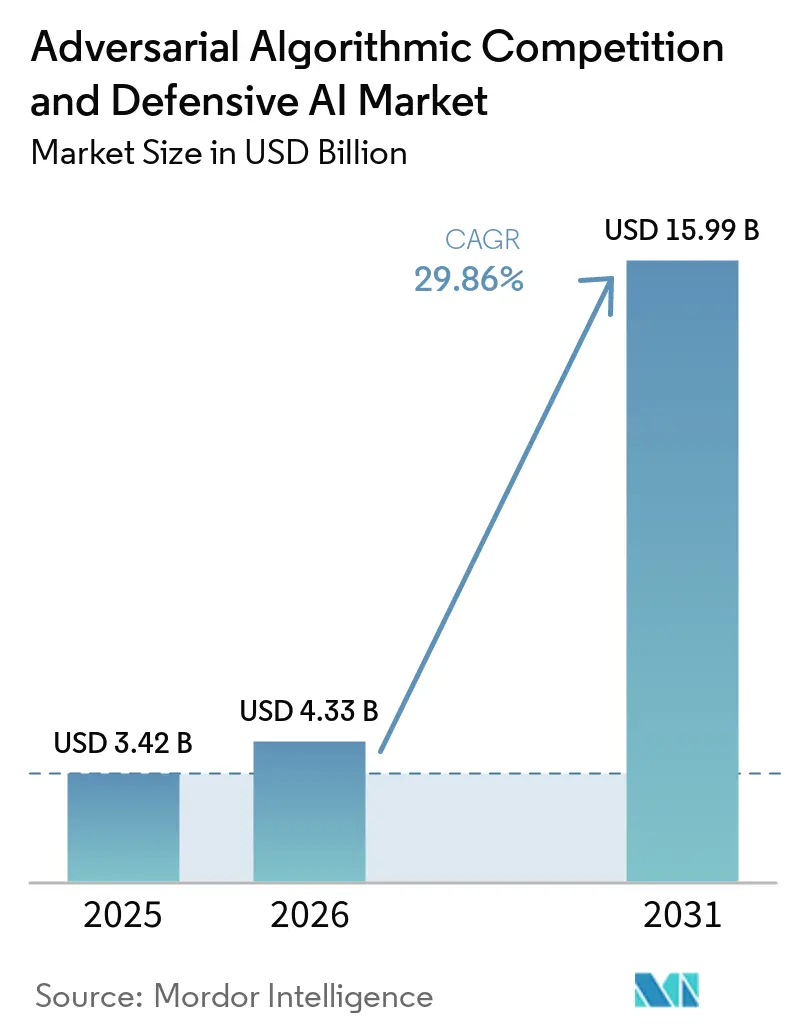
The adversarial algorithmic competition and defensive AI market size is expected to grow from USD 3.42 billion in 2025 to USD 4.33 billion in 2026 and is forecast to reach USD 15.99 billion by 2031 at 29.86% CAGR over 2026-2031. The market is moving forward because generative and agentic AI tools are now being used within regulated workflows, where failure, misuse, and unauthorized access carry direct legal and operational consequences. Attack methods are also changing quickly, as prompt injection, jailbreak attempts, model tampering, and the misuse of tool-connected agents now affect not only standalone models but also full business processes built around them. This is pushing buyers to move beyond one-time assessments and toward continuous testing, runtime monitoring, and stronger governance that can document how AI systems are evaluated before and after deployment. The adversarial algorithmic competition and defensive AI market is also being shaped by a clear divide between large enterprises that can fund broad platform adoption and smaller organizations that prefer automated and subscription-based security models. North America remains the largest revenue base, Asia-Pacific is expanding the fastest, and the strongest opportunities continue to lie where compliance pressure, AI deployment depth, and security accountability are rising simultaneously.
Key Report Takeaways
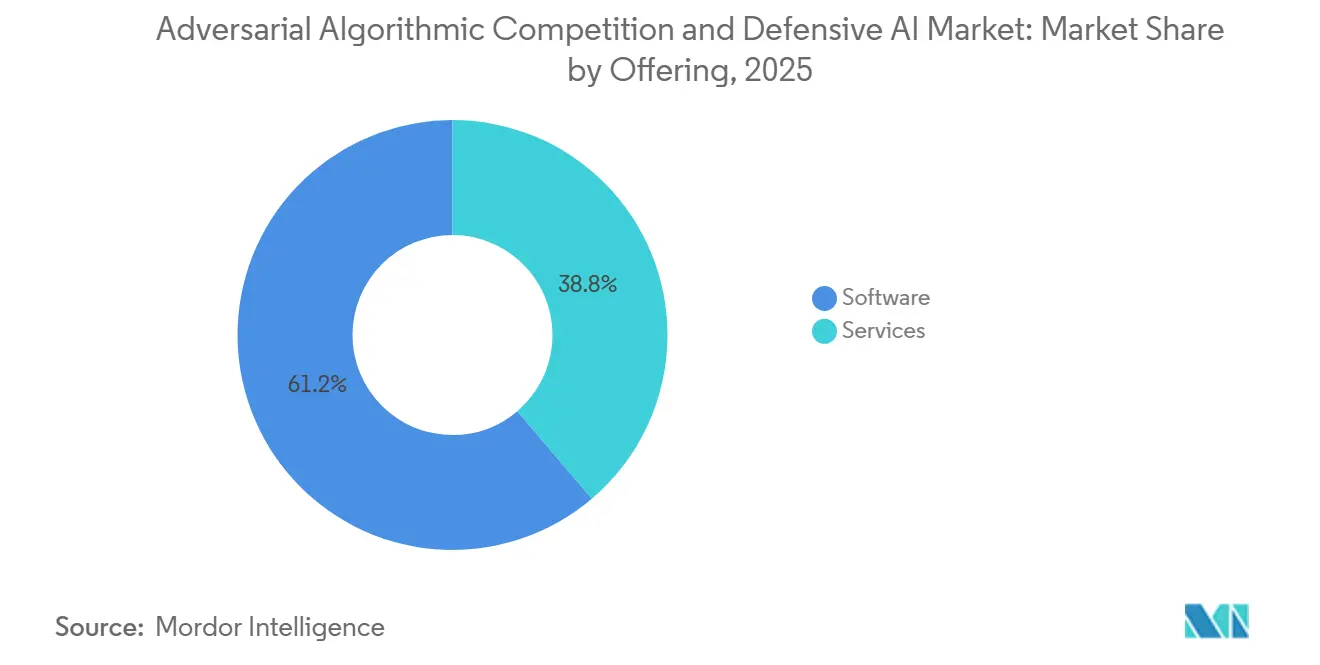
- By offering, software held 61.22% share of the adversarial algorithmic competition and defensive AI market in 2025, while services are projected to expand at a 30.91% CAGR through 2031.
- By security assessment focus, Threat Intelligence and Threat Analysis held a 19.14% share in 2025, while Continuous AI Security Monitoring is projected to record the fastest growth at a 31.02% CAGR through 2031.
- By deployment, cloud accounted for 54.18% of revenue in 2025, while hybrid deployment is projected to expand at a 31.13% CAGR through 2031.
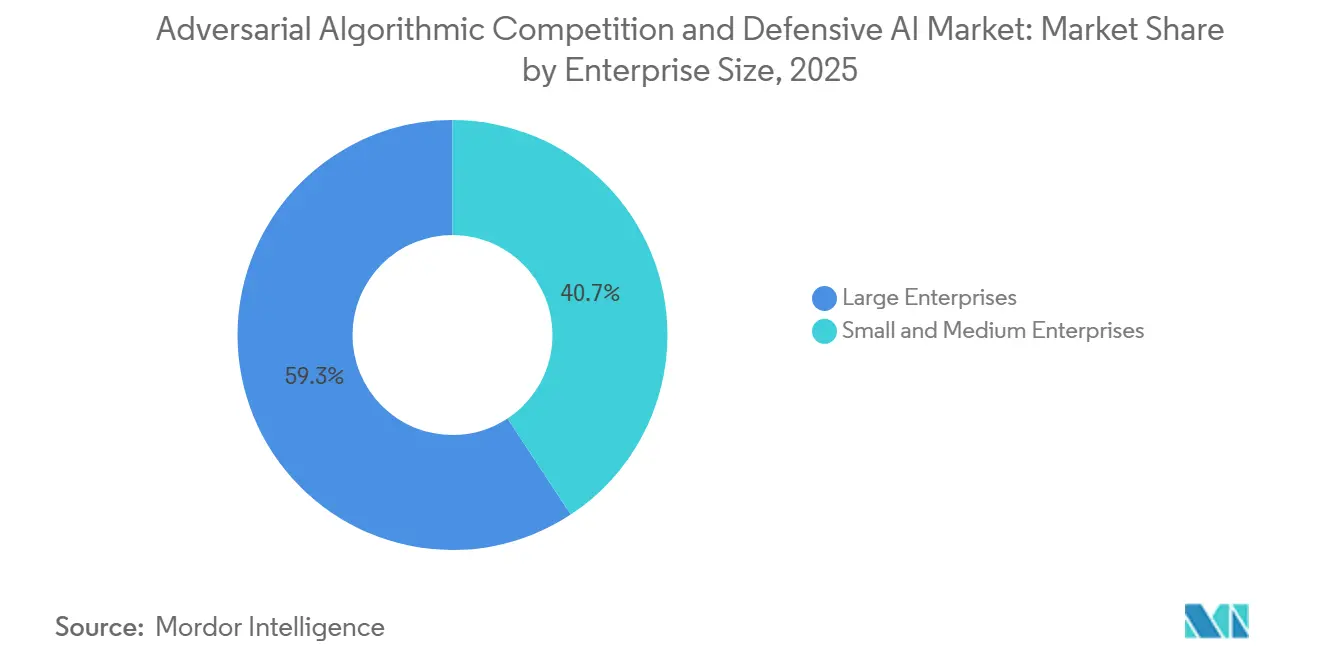
- By enterprise size, large enterprises held 59.27% share in 2025, while small and medium enterprises are projected to grow at a 31.24% CAGR through 2031.
- By end-user industry, BFSI accounted for 17.11% share in 2025, while healthcare and life sciences are projected to advance at a 31.35% CAGR through 2031.
- By geography, North America held 32.18% of the adversarial algorithmic competition and defensive AI market share in 2025, while Asia-Pacific is projected to expand at a 31.46% CAGR through 2031.
Note: Market size and forecast figures in this report are generated using Mordor Intelligence’s proprietary estimation framework, updated with the latest available data and insights as of January 2026.
Market Trends and Insights
Drivers Impact Analysis of Adversarial Algorithmic Competition and Defensive AI Market*
| Driver | (~) % Impact on CAGR Forecast | Geographic Relevance | Impact Timeline |
|---|---|---|---|
| Rapid Adoption of Generative and Agentic AI in Regulated Workflows | +7.2% | Global, with concentrated demand in North America and EU | Short term (≤ 2 years) |
| Rising Frequency of Prompt Injection, Jailbreak, and Model Tampering Attacks | +6.8% | Global | Short term (≤ 2 years) |
| Regulatory Pressure for AI Safety, Auditability, and Robustness Testing | +5.4% | EU, North America, APAC core | Medium term (2-4 years) |
| Expansion of AI Governance Programs in Large Enterprises | +4.2% | North America, EU, APAC | Medium term (2-4 years) |
| Demand for Continuous Red Teaming in DevSecOps and MLOps Pipelines | +3.1% | North America, EU, with spill-over to APAC | Medium term (2-4 years) |
| Increasing Use of AI in High-Stakes Decision Systems | +2.0% | Global | Long term (≥ 4 years) |
| Source: Mordor Intelligence | |||
Rapid Adoption Of Generative and Agentic AI in Regulated Workflows
Regulated sectors have moved past early pilots, and the adversarial algorithmic competition and defensive AI market are benefiting from how AI is now tied to customer service, compliance, fraud review, and clinical support tasks that require stronger oversight.[1] In financial services, the Cambridge Center for Alternative Finance reported in April 2026 that 71% of surveyed institutions were actively adopting GenAI, 52% were actively adopting agentic AI, and 48% identified adversarial AI threats as a top concern. Healthcare showed a similar pattern, as NVIDIA reported that 69% of organizations were using generative AI or large language models in 2026, up from 54% in 2025, while 40% said HIPAA, FDA approval processes, and GDPR were shaping their agentic AI approach. This matters because agentic systems do not stay within a single model boundary; they connect to tools, databases, and application layers, widening the number of points where misuse can occur. As a result, the adversarial algorithmic competition and defensive AI market is seeing stronger demand for testing that covers full workflows rather than isolated model behavior.
Rising Frequency Of Prompt Injection, Jailbreak, and Model Tampering Attacks
Attack methods are becoming more effective, and that is a direct growth driver for the adversarial algorithmic competition and defensive AI market.[2] A June 2026 study in Scientific Reports recorded aggregate jailbreak attack success rates of 91.1% to 94.6% across several open-weight 7-billion-parameter model families, using prompts that remained readable enough to bypass simple filtering rules. The 2025 review of prompt injection attacks also noted that 53% of enterprise deployments rely on retrieval-augmented generation and agentic pipelines, which increases the risk that poisoned or manipulated external content can influence model behavior at runtime. The same review highlighted that system prompt leakage and vector and embedding weaknesses had become distinct areas of concern, showing that the attack taxonomy is expanding rather than settling into a stable pattern. Research discussed in that framework also showed that 5 carefully crafted poisoned documents among millions could achieve a 90% attack success rate, which helps explain why the adversarial algorithmic competition and the defensive AI market are moving toward continuous, automated red teaming.
Regulatory Pressure For AI Safety, Auditability, and Robustness Testing
Regulation is now one of the clearest demand triggers for the adversarial algorithmic competition and defensive AI market. The EU AI Act becomes fully applicable to high-risk AI systems on August 2, 2026, and Article 9 requires a documented risk management system with testing procedures, while Articles 54a and 55 make adversarial testing a direct obligation for systemic-risk general-purpose AI models and frontier model providers. The same framework imposes penalties of EUR 35 million (USD 39.55 million) or 7% of worldwide annual turnover for non-compliance, which shifts adversarial testing from a technical preference to a board-level compliance issue. In parallel, NIST released a concept note on April 7, 2026, for an AI Risk Management Framework profile focused on trustworthy AI in critical infrastructure, providing procurement teams with a more operational way to define testing requirements. Vendors that can tie reports to legal articles and NIST measurement criteria are, therefore, better positioned in the adversarial algorithmic competition and defensive AI market, as they help buyers demonstrate documented coverage rather than general intent.[3]
Expansion of AI Governance Programs in Large Enterprises
Large organizations are building more formal governance structures around AI, which supports broader adoption in the adversarial algorithmic competition and defensive AI markets. The Cloud Security Alliance stated in March 2026 that companies without formal AI governance structures face higher incident costs and stronger regulatory exposure, which is moving governance from a narrow security discussion into a wider enterprise risk issue. In financial services, the Cambridge Center for Alternative Finance reported that 50% of institutions and 57% of regulators flagged adversarial AI-related cyber threats as a top concern, underscoring the close link between governance and security spending. Governance review boards that include legal, security, and business owners are also becoming more visible in purchasing decisions, and that tends to favor platforms that combine testing, monitoring, evidence generation, and workflow integration. This shift supports larger contract scopes inside the adversarial algorithmic competition and defensive AI market, even when procurement cycles take longer.[4]
Restraints Impact Analysis of Adversarial Algorithmic Competition and Defensive AI Market*
| Restraint | (~) % Impact on CAGR Forecast | Geographic Relevance | Impact Timeline |
|---|---|---|---|
| Shortage of Specialized Adversarial AI Security Talent | -2.8% | Global, most acute in North America and EU | Short term (≤ 2 years) |
| High Cost of Continuous Testing, Tooling, and Expert Services | -2.2% | Global, with highest pressure in SME segments | Medium term (2-4 years) |
| Explainability Gaps and Liability Uncertainty in Autonomous AI Defenses | -1.6% | EU, North America | Medium term (2-4 years) |
| Fragmented Data Provenance and Cross-Border Compliance Constraints | -1.2% | APAC, EU, cross-border deployments | Long term (≥ 4 yea |
| Source: Mordor Intelligence | |||
Shortage of Specialized Adversarial AI Security Talent
The adversarial AI skills gap remains a practical limit on how fast the adversarial algorithmic competition and defensive AI market can scale. The Linux Foundation found in its 2025 global tech talent report that 68% of surveyed organizations were understaffed in AI and ML, while only 25% reported dedicated AI security management capabilities. Fortinet reinforced this pattern in 2025, reporting that 97% of IT decision-makers planned to deploy AI security solutions, yet 48% cited the lack of staff with enough AI expertise as the primary implementation challenge. CyberSeek also showed in June 2025 that the United States cybersecurity workforce supply-demand ratio stood at 74%, and recruiting periods for AI-specific security roles ran 21% longer than those for traditional security positions. This is pushing organizations toward automated tools and managed services, which support some spending categories inside the adversarial algorithmic competition and defensive AI market, even while it slows full in-house adoption.
High Cost Of Continuous Testing, Tooling, and Expert Services
Cost is another real barrier because continuous testing requires specialized labor, repeat simulation workloads, and frequent updates as attack patterns change. The OpenSSF MLSecOps whitepaper, published in August 2025, argued for adversarial checks across the full machine learning lifecycle, and that kind of coverage naturally raises tooling and operational requirements compared with one-time assessments. The economic risk is evident in adjacent threat categories as well; Ironscales reported in fall 2025 that 85% of surveyed organizations had experienced deepfake-related incidents in the prior 12 months, with average losses exceeding USD 280,000 per incident and 20% reporting losses exceeding USD 500,000. Large enterprises can absorb these costs more easily because they already manage wider AI portfolios and larger compliance programs, while smaller firms still favor subscription tiers and narrower scopes. That cost gap means the adversarial algorithmic competition and defensive AI market still depend on vendors that can package strong coverage into simpler, lower-friction service models.
*Our forecasts treat driver/restraint impacts as directional, not additive. The impact forecasts reflect baseline growth, mix effects, and variable interactions.
Adversarial Algorithmic Competition and Defensive AI Market Segment Analysis
By Offering:
Software Leads While Services Scales FasterSoftware held 61.22% share of the adversarial algorithmic competition and defensive AI market in 2025. That position came from red teaming platforms, model security testing tools, deepfake detection products, and defensive monitoring systems that are replacing manual and fragmented workflows. The biggest shift inside software is platform convergence, as buyers prefer a single environment that can scan models, monitor posture, run adversarial tests, and support runtime controls. Palo Alto Networks showed that direction when it introduced Prisma AIRS in April 2025 and later expanded the platform during Cyber Week 2026 with broader coverage for AI agents, applications, models, and datasets. The value of that integrated design is not only technical, because the adversarial algorithmic competition and the defensive AI market now reward platforms that can also generate audit-ready evidence aligned with compliance expectations. Buyers in regulated sectors increasingly want proof that testing records, governance actions, and runtime findings can be documented in a form that satisfies internal risk reviews and external obligations.
Services are projected to expand at a 30.91% CAGR through 2031, making it the fastest-growing segment in the adversarial algorithmic competition and defensive AI market. The core reason is simple: many enterprises still lack internal teams that can keep up with evolving attack methods, new model releases, and frequent workflow updates. CrowdStrike moved early on that demand when it launched AI Red Team Services in November 2024, positioning the service around proactive assessments for AI systems and large language models aligned with OWASP-style attack paths. Managed service demand also rises because each prompt change, model update, or external tool connection can create a fresh testing requirement that internal teams may not be ready to handle on schedule. That is why the services side of the adversarial algorithmic competition and defensive AI industry is expanding fastest, even while software remains the larger revenue pool.
By Security Assessment Focus:
Threat Analysis Leads While Continuous Monitoring Expands FastestThreat Intelligence and Threat Analysis accounted for the largest security assessment sub-segment, with a 19.14% share in 2025. Enterprises still begin with threat understanding because model misuse, prompt injection, privacy leakage, poisoning, and synthetic media abuse do not follow one common attack pattern. Large clients now expect multi-focus programs that combine several testing lenses rather than isolated checks against a single known weakness. The Cambridge Center for Alternative Finance reported that 50% of financial institutions and 57% of regulators saw adversarial AI-related cyber threats as a top concern, which helps explain why early threat analysis remains a priority. In practice, buyers use this assessment layer to decide where deeper testing should sit across models, prompts, training pipelines, and tool-connected agents. That front-end role keeps threat analysis central to commercial demand even as newer categories gain speed.
Continuous AI Security Monitoring is projected to expand at a 31.02% CAGR through 2031, making it the fastest-growing focus area in the adversarial algorithmic competition and defensive AI market. Static pre-deployment testing can miss issues that only appear after the model begins to handle live data, changing prompts, and real user behavior. OpenSSF stated in August 2025 that security checks should be embedded across the full ML lifecycle, from data ingestion through monitoring at inference time. Microsoft reinforced that move in May 2026 by open-sourcing RAMPART, which turns agent safety scenarios and adversarial findings into repeatable CI pipeline tests rather than one-off exercises. As more teams treat security testing as an engineering control instead of a periodic review, this part of the adversarial algorithmic competition and defensive AI market is likely to keep outpacing every other assessment category.
By Deployment:
Cloud Stays Largest While Hybrid Builds MomentumCloud deployment commanded 54.18% share in 2025, giving it the largest position in the adversarial algorithmic competition and defensive AI market. Cloud is the natural fit for simulation-heavy testing because buyers can scale compute, storage, and workflow orchestration without building separate local environments. It also lets organizations keep testing closer to the public cloud infrastructure, where many AI applications already run, which lowers friction around data movement and operational coordination. Check Point reported in 2026 that 77% of organizations had updated their cloud security strategy in response to AI adoption, yet only 26% had the architecture to enforce that strategy. That enforcement gap supports continued demand for cloud-native posture management and monitoring across the adversarial algorithmic competition and defensive AI market.
Hybrid deployment is projected to grow at a 31.13% CAGR through 2031. Regulated enterprises are increasingly splitting workloads, keeping sensitive production systems in private or local environments while using public cloud resources for development, experimentation, and some forms of testing. Broadcom stated in its 2026 private cloud outlook that high-security, latency-sensitive, and data-intensive workloads continue to show a strong preference for private cloud infrastructure. That trend matters for the adversarial algorithmic competition and defensive AI market because vendors now need deployment flexibility rather than a single delivery model. On-premises demand remains relevant in defense and critical infrastructure, but most current expansion is centered on hybrid designs that combine sovereignty, control, and scalable test capacity.
By Enterprise Size:
Large Enterprises Lead While Smaller Firms Gain QuicklyLarge enterprises held a 59.27% share in 2025, making them the largest customer group in the adversarial algorithmic competition and defensive AI market. Their lead comes from deeper AI adoption, greater compliance exposure, and broader model portfolios, which create more points where testing and monitoring are required. These buyers also tend to operate formal governance structures, and the Cloud Security Alliance has shown that missing governance controls can increase incident costs and regulatory exposure. In regulated environments such as banking, financial institutions are already dealing with broad adversarial AI concerns, as reflected in the Cambridge Center for Alternative Finance findings. Because of that, large enterprises usually prefer broader platforms that combine governance, testing, runtime visibility, and documentation in a single purchase decision. This keeps them at the center of present revenue even as the buyer base widens.
Small and medium enterprises are projected to expand at a 31.24% CAGR through 2031, making them the fastest-growing segment in the adversarial algorithmic competition and defensive AI market size outlook. Their growth is supported by subscription-based tools, automation, and cloud delivery, which reduce some of the staffing and capital burden seen in larger custom programs. The EU AI Act also recognizes the need for support for smaller firms, and Article 62 calls for member-state measures to help SMEs deploy high-risk AI. Canada’s 2026 SME AI deployment toolkit under the G7 process also reflects the wider policy push to make responsible AI adoption more practical for mid-market organizations. This means smaller buyers are entering the adversarial algorithmic competition and defensive AI industry through packaged offerings that can run structured tests without requiring a fully dedicated AI security team.
By End-user Industry:
BFSI Holds The Largest Share While Healthcare And Life Sciences Grows The FastestBFSI accounted for 17.11% share in 2025, the highest among end-user groups in the adversarial algorithmic competition and defensive AI market. Financial institutions are adopting AI across fraud detection, credit scoring, customer interactions, and compliance tasks, all of which carry direct accountability and review requirements. The Cambridge Center for Alternative Finance reported in April 2026 that 75% of traditional financial institutions had adopted GenAI, and 52% were actively adopting agentic AI. The EU AI Act classifies credit scoring, fraud detection, and loan approval systems as high risk from August 2026, thereby strengthening testing requirements for those use cases. In the United States, the OCC, Federal Reserve, and FDIC updated model risk management guidance in April 2026 and signaled additional work on AI, generative AI, and agentic AI. The same Cambridge report also showed that only 2% of financial sector regulators had reached the transforming stage of AI maturity, compared with 14% of industry respondents, which helps explain the demand for third-party testing and audit support.
Healthcare and life sciences are projected to advance at a 31.35% CAGR through 2031, giving it the fastest growth profile in the adversarial algorithmic competition and defensive AI market size by end use. NVIDIA reported in 2026 that 70% of healthcare organizations were actively using AI, up from 63% in 2025. The same study found that 40% of respondents said HIPAA, FDA approval requirements, and GDPR were the main factors shaping their approach to agentic AI implementation. IT and telecom, retail and e-commerce, and industrial manufacturing are also increasing AI use, but their immediate buying pattern is generally less compliance-intensive than in banking or clinical settings. Government and public sector demand still contributes a smaller revenue base today, yet it remains strategically important because sovereign and defense use cases require stronger controls around isolated environments, runtime behavior, and high-consequence model decisions.
Geography Analysis
North America Adversarial Algorithmic Competition and Defensive AI Market
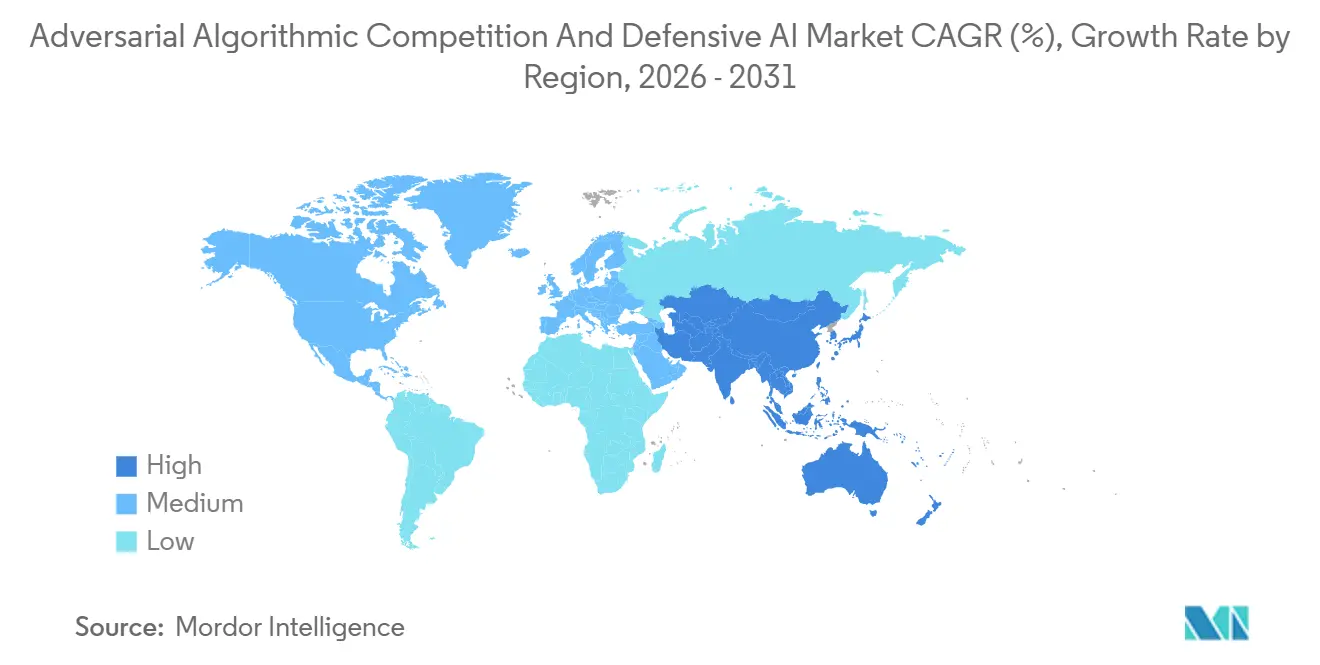
North America accounted for 32.18% of the adversarial algorithmic competition and defensive AI market in 2025, making it the largest regional revenue base. The region benefits from a dense mix of AI-first enterprises, advanced cybersecurity vendors, and regulated sectors that are moving faster on formal AI oversight. NIST strengthened that environment through its AI Risk Management Framework work, including the GenAI profile released in 2024 and the April 2026 concept note for a critical infrastructure profile that is now shaping procurement language. Canada also added momentum through its 2026 SME AI deployment toolkit linked to the G7 process, which supports more structured adoption among mid-sized organizations. Mexico remains earlier in the cycle, but financial services digitization and the regional expansion of United States-led AI platforms are helping build a broader demand base for adversarial algorithmic competition and the defensive AI market.
APAC Adversarial Algorithmic Competition and Defensive AI Market
Asia-Pacific is projected to grow at a 31.46% CAGR through 2031, the fastest among all regions in the adversarial algorithmic competition and defensive AI market. Its momentum comes not only from AI adoption but also from the fact that enterprises often face multiple compliance frameworks across the region simultaneously. Japan enacted Act No. 53 of 2025 on June 4, 2025, and later established the National AI Basic Plan in September 2025, which encourages more structured assurance for AI development and use. China introduced its first policy framework on agentic AI in May 2026, and amendments to the Cybersecurity Law clarified AI governance within cybersecurity regulation, raising maximum fines to CNY 50 million (USD 6.9 million) or 5% of prior-year turnover. South Korea’s AI Basic Act adds another binding layer in 2026, and together these frameworks are increasing the frequency with which regional enterprises procure testing and assurance capabilities.
EMEA and South America Adversarial Algorithmic Competition and Defensive AI Market
Europe remains structurally important in the adversarial algorithmic competition and defensive AI market because regulation has moved from policy discussion into direct implementation. The EU AI Act becomes fully applicable on August 2, 2026, and its treatment of high-risk systems has created a clear procurement trigger in financial services, healthcare, critical infrastructure, and education. Germany, the United Kingdom, and France anchor current demand, while Southern and Eastern Europe are following compliance timelines more closely than pure AI maturity curves. The Middle East and Africa, led by Saudi Arabia and the UAE, and South America, led by Brazil and Argentina, are still smaller contributors today, but they are becoming useful entry markets for vendors that want early platform positions before larger compliance cycles arrive.
Competitive Landscape
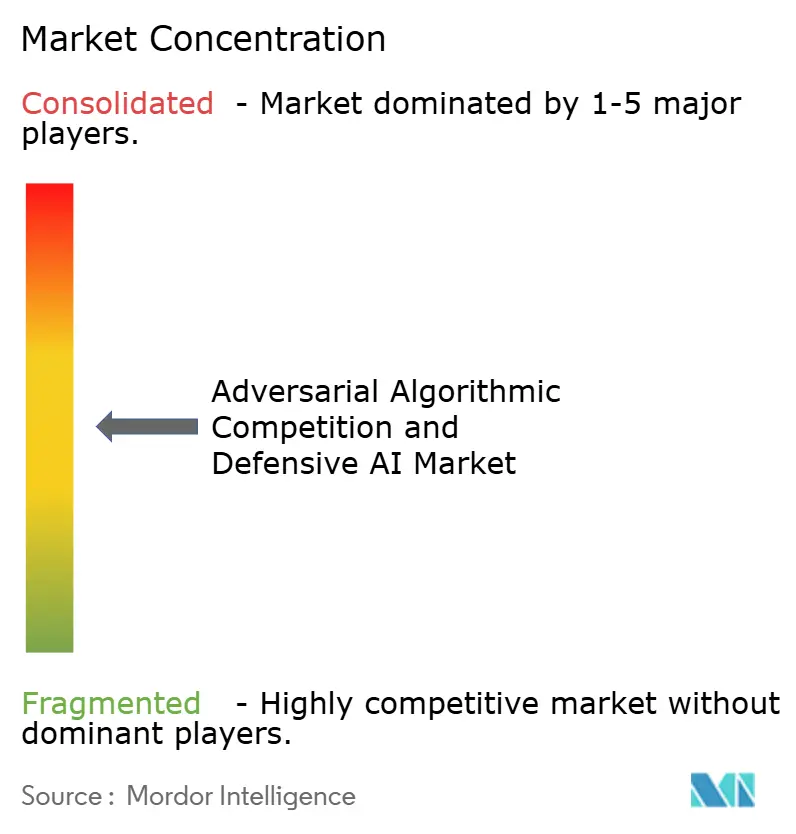
The adversarial algorithmic competition and defensive AI market remains moderately fragmented, with specialized AI security vendors competing alongside the AI security divisions of larger cybersecurity platforms. Pure-play firms such as HiddenLayer, Noma Security, and Adversa AI tend to move faster on narrow attack surfaces, while larger vendors such as Palo Alto Networks, CrowdStrike, and Microsoft bring broader sales reach, installed customer bases, and more integrated workflows. Palo Alto Networks accelerated that platform strategy in 2025, completing the acquisition of Protect AI after first introducing Prisma AIRS in April 2025. HiddenLayer also strengthened its position in 2025 through patents tied to multimodal model protection, adversarial attack detection, distributed detection methods, and model output steering. At the same time, Article 55 of the EU AI Act is forcing frontier model providers to internalize greater testing capability, while also prompting their enterprise customers to request similar controls in downstream deployments.
Current white-space areas in the adversarial algorithmic competition and defensive AI market include runtime monitoring for agent behavior, subscription-friendly automated red teaming for smaller firms, and compliance evidence that works across several jurisdictions. The market is also shifting toward deployment-gate security, where adversarial testing is integrated directly into MLOps and DevSecOps pipelines rather than treated as a periodic external exercise. Microsoft strengthened that direction in May 2026 when it open-sourced RAMPART and Clarity, turning agent safety review and regression testing into part of the software workflow. CrowdStrike made a parallel move in March 2026 by launching the Charlotte AI AgentWorks Ecosystem, which lets customers build and deploy security agents through the Falcon platform. These moves show that competition is no longer only about isolated detection features, because buyers now value platform fit, workflow coverage, and the ability to keep up with agentic AI at production scale.
The competitive field is also attracting companies that focus on specific governance and runtime gaps inside the adversarial algorithmic competition and defensive AI market. Noma Security highlighted that it would open in June 2026 with Agent Access Control, designed to govern AI agents and Model Context Protocol servers across the enterprise. Palo Alto Networks added to its own platform depth in April 2026 with Prisma AIRS 3.0, expanding coverage across agents, applications, models, and datasets. As a result, winners are likely to be the vendors that can combine runtime visibility, integrated testing, governance reporting, and flexible deployment without forcing buyers to stitch together too many separate tools.
Adversarial Algorithmic Competition and Defensive AI Industry Leaders
-
Microsoft Corporation
-
Google LLC
-
Amazon Web Services Inc.
-
Palo Alto Networks Inc.
-
CrowdStrike Holdings, Inc.
- *Disclaimer: Major Players sorted in no particular order
Adversarial Algorithmic Competition and Defensive AI Market Companies Covered in this Report
- Microsoft Corporation
- Google LLC
- Amazon Web Services Inc.
- International Business Machines Corporation
- Palo Alto Networks Inc.
- CrowdStrike Holdings, Inc.
- SentinelOne, Inc.
- Darktrace plc
- Check Point Software Technologies Ltd.
- Fortinet, Inc.
- Rapid7, Inc.
- Trend Micro Incorporated
- Cisco Systems, Inc.
- BlackBerry Limited
- Elastic N.V.
- Vectra AI, Inc.
- Noma Security Ltd.
- Protect AI, Inc.
- Adversa AI Ltd.
- HiddenLayer, Inc.
Recent Industry Developments in Adversarial Algorithmic Competition and Defensive AI Market
- June 2026: Noma Security launched Noma Agent Access Control, enabling security teams to discover, govern, and enforce access policies for AI agents and Model Context Protocol servers across the enterprise, directly addressing the autonomous agent governance gap that has emerged as organizations scale agentic AI deployments beyond pilot environments.
- May 2026: Anthropic launched Claude Security in public beta with CrowdStrike, Palo Alto Networks, SentinelOne, Trend Micro, and Wiz as technology launch partners, embedding Claude Opus 4.7 directly into enterprise security platforms for autonomous code scanning and vulnerability discovery. Accenture, BCG, Deloitte, Infosys, and PwC simultaneously launched deployment practices around the tool.
- May 2026: Microsoft open-sourced RAMPART and Clarity, 2 tools designed to embed agentic safety and adversarial testing directly into the software development workflow. RAMPART builds on the PyRIT framework to convert red-team findings into repeatable CI pipeline regression tests, while Clarity provides structured pre-development safety assessment for AI systems.
- April 2026: Palo Alto Networks unveiled Prisma AIRS 3.0 at Cyber Week 2026, expanding platform coverage to every AI agent, application, model, and dataset from creation to action, alongside Next-Generation Trust Security for post-quantum certificate lifecycle automation and an updated Prisma SASE for agentic AI environments.
Global Adversarial Algorithmic Competition and Defensive AI Market Report Scope
The Adversarial Algorithmic Competition and Defensive AI market refers to platforms and services that focus on testing, defending, and securing artificial intelligence models against adversarial attacks, manipulation, and exploitation. These solutions include AI red teaming platforms, model security testing tools, deepfake detection systems, and defensive AI monitoring platforms designed to identify vulnerabilities, simulate adversarial threats, and strengthen AI resilience.
The Adversarial Algorithmic Competition and Defensive AI market report is segmented by Offering (Software, [AI Red Teaming Platforms, Model Security Testing Platforms, Deepfake Detection Platforms, Defensive AI Monitoring Platforms] and Services), Security Assessment Focus (Prompt Injection and Jailbreak Testing, Model Theft and Privacy Testing, Training Pipeline and Data Poisoning Testing, Deepfake and Synthetic Media Defense, Continuous AI Security Monitoring), Deployment (Cloud, On-Premises, and Hybrid), Enterprise Size (Large Enterprises, and Small and Medium Enterprises), End-user Industry (BFSI, Healthcare and Life Sciences, Information Technology and Telecom, Retail and E-commerce, Industrial Manufacturing, Government and Public Sector, and Other End-user Industries), and Geography (North America, South America, Europe, Asia-Pacific, Middle East, and Africa). The Market Forecasts are Provided in Terms of Value (USD).
Segmentation Overview
| Software | AI Red Teaming Platforms |
| Model Security Testing Platforms | |
| Deepfake Detection Platforms | |
| Defensive AI Monitoring Platforms | |
| Services |
| Prompt Injection and Jailbreak Testing |
| Model Theft and Privacy Testing |
| Training Pipeline and Data Poisoning Testing |
| Deepfake and Synthetic Media Defense |
| Continuous AI Security Monitoring |
| Cloud |
| On-Premises |
| Hybrid |
| Large Enterprises |
| Small and Medium Enterprises |
| BFSI |
| Healthcare and Life Sciences |
| Information Technology and Telecom |
| Retail and E-commerce |
| Industrial Manufacturing |
| Government and Public Sector |
| Other End-user Industries |
| North America | United States | |
| Canada | ||
| Mexico | ||
| South America | Brazil | |
| Argentina | ||
| Rest of South America | ||
| Europe | Germany | |
| United Kingdom | ||
| France | ||
| Italy | ||
| Spain | ||
| Russia | ||
| Rest of Europe | ||
| Asia-Pacific | China | |
| India | ||
| Japan | ||
| South Korea | ||
| Australia | ||
| Rest of Asia-Pacific | ||
| Middle East and Africa | Middle East | Saudi Arabia |
| United Arab Emirates | ||
| Rest of Middle East | ||
| Africa | South Africa | |
| Nigeria | ||
| Rest of Africa | ||
| By Offering | Software | AI Red Teaming Platforms | |
| Model Security Testing Platforms | |||
| Deepfake Detection Platforms | |||
| Defensive AI Monitoring Platforms | |||
| Services | |||
| By Security Assessment Focus | Prompt Injection and Jailbreak Testing | ||
| Model Theft and Privacy Testing | |||
| Training Pipeline and Data Poisoning Testing | |||
| Deepfake and Synthetic Media Defense | |||
| Continuous AI Security Monitoring | |||
| By Deployment | Cloud | ||
| On-Premises | |||
| Hybrid | |||
| By Enterprise Size | Large Enterprises | ||
| Small and Medium Enterprises | |||
| By End-user Industry | BFSI | ||
| Healthcare and Life Sciences | |||
| Information Technology and Telecom | |||
| Retail and E-commerce | |||
| Industrial Manufacturing | |||
| Government and Public Sector | |||
| Other End-user Industries | |||
| By Geography | North America | United States | |
| Canada | |||
| Mexico | |||
| South America | Brazil | ||
| Argentina | |||
| Rest of South America | |||
| Europe | Germany | ||
| United Kingdom | |||
| France | |||
| Italy | |||
| Spain | |||
| Russia | |||
| Rest of Europe | |||
| Asia-Pacific | China | ||
| India | |||
| Japan | |||
| South Korea | |||
| Australia | |||
| Rest of Asia-Pacific | |||
| Middle East and Africa | Middle East | Saudi Arabia | |
| United Arab Emirates | |||
| Rest of Middle East | |||
| Africa | South Africa | ||
| Nigeria | |||
| Rest of Africa | |||
Key Questions Answered in the Report
What is the current and forecast value of the adversarial algorithmic competition and defensive AI space?
It stood at USD 3.42 billion in 2025, reached USD 4.33 billion in 2026, and is forecast to reach USD 15.99 billion by 2031 at a 29.86% CAGR.
Which offering category leads revenue today?
Software led in 2025 with a 61.22% share because buyers are consolidating testing, monitoring, and governance tasks into integrated platforms.
Which security assessment area is growing the fastest?
Continuous AI Security Monitoring is projected to grow at a 31.02% CAGR through 2031 as enterprises move from one-time reviews to persistent production oversight.
Which customer group is driving the most spending right now?
Large enterprises held 59.27% share in 2025 because they run broader AI portfolios, face heavier compliance obligations, and can fund integrated controls.
Which end-user vertical offers the strongest immediate demand?
BFSI held the largest share at 17.11% in 2025, while healthcare and life sciences is growing faster at a 31.35% CAGR because of tighter clinical and privacy requirements.
Which region shows the best near-term expansion potential?
Asia-Pacific is projected to grow at a 31.46% CAGR through 2031 as enterprises respond to a more fragmented and fast-evolving regional regulatory environment.