
Generative Artificial Intelligence (AI) In Cyber Defense Market Size and Share
Market Overview
| Study Period | 2020 - 2031 |
|---|---|
| Market Size (2026) | USD 20.58 Billion |
| Market Size (2031) | USD 66.05 Billion |
| Growth Rate (2026 - 2031) | 26.27 % |
| Fastest Growing Market | Asia-Pacific |
| Largest Market | North America |
| Market Concentration | Medium |
Major Players *Disclaimer: Major Players sorted in no particular order Image © Mordor Intelligence. Reuse requires attribution under CC BY 4.0. | |
Generative Artificial Intelligence (AI) In Cyber Defense Market Analysis by Mordor Intelligence
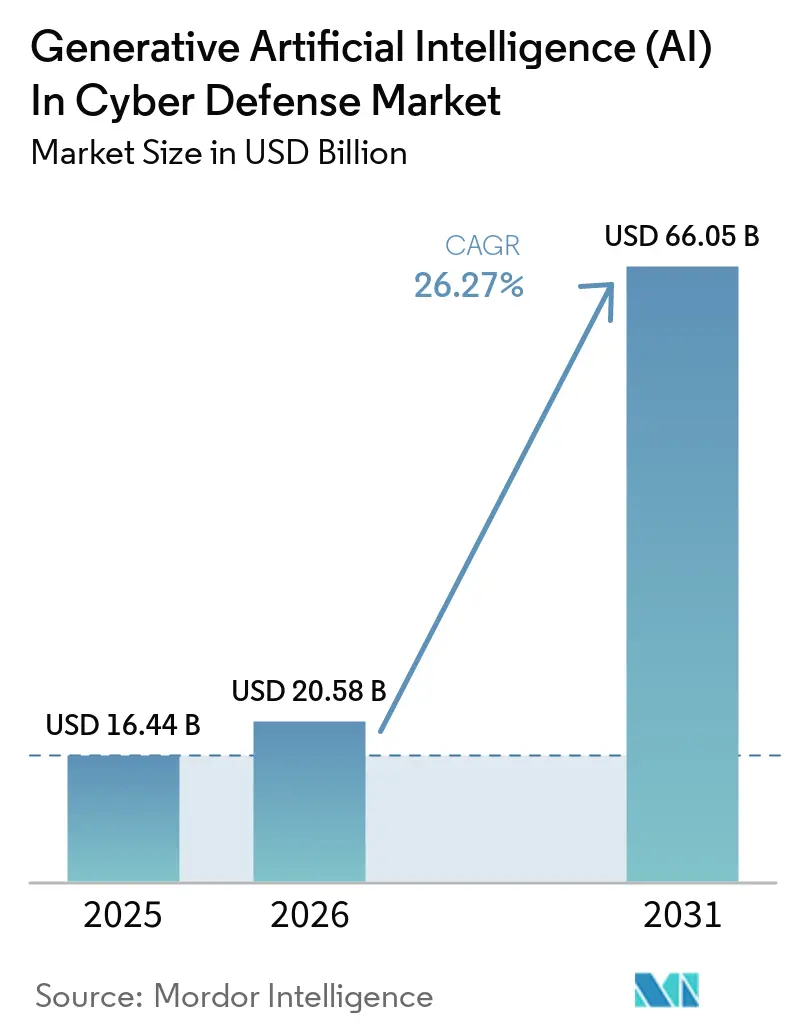
The Generative Artificial Intelligence (AI) in Cyber Defense Market size is expected to increase from USD 16.44 billion in 2025 to USD 20.58 billion in 2026 and reach USD 66.05 billion by 2031, growing at a CAGR of 26.27% over 2026-2031. Growth is being supported by the faster spread of AI-enabled phishing, deepfake social engineering, and automated reconnaissance, which has reduced the usefulness of rule-based security tools in live environments. Enterprises are also buying these platforms to relieve pressure on security teams that must manage rising alert volumes, fragmented telemetry, and a shortage of experienced analysts. Demand is expanding beyond detection alone, as buyers now expect audit logs, explainable actions, and governance controls that align with regulated operating models. Competition is becoming tighter as established platform vendors embed frontier models into broad security suites, while AI-native firms focus on exposure management, LLM security, and autonomous investigation workflows. This creates room for strong growth in software, managed services, hybrid deployment, and AI governance tools across the forecast period.
Key Report Takeaways
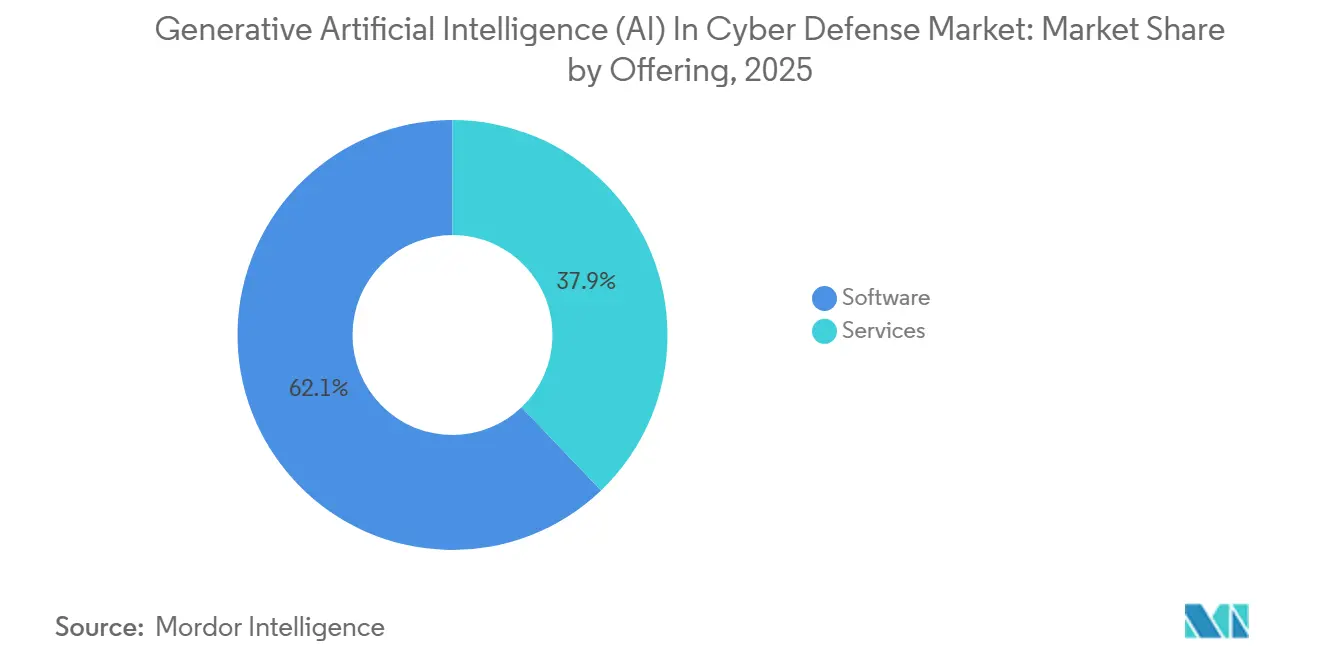
- By offering, software held 62.14% share of the generative artificial intelligence (AI) in cyber defense market in 2025, while services are projected to expand at a 27.41% CAGR through 2031.
- By application, Security Operations and SOC Augmentation accounted for 20.18% share in 2025, while Exposure Management and Security Posture Analysis are projected to grow at a 27.52% CAGR through 2031 in the Generative Artificial Intelligence (AI) in Cyber Defense Market.
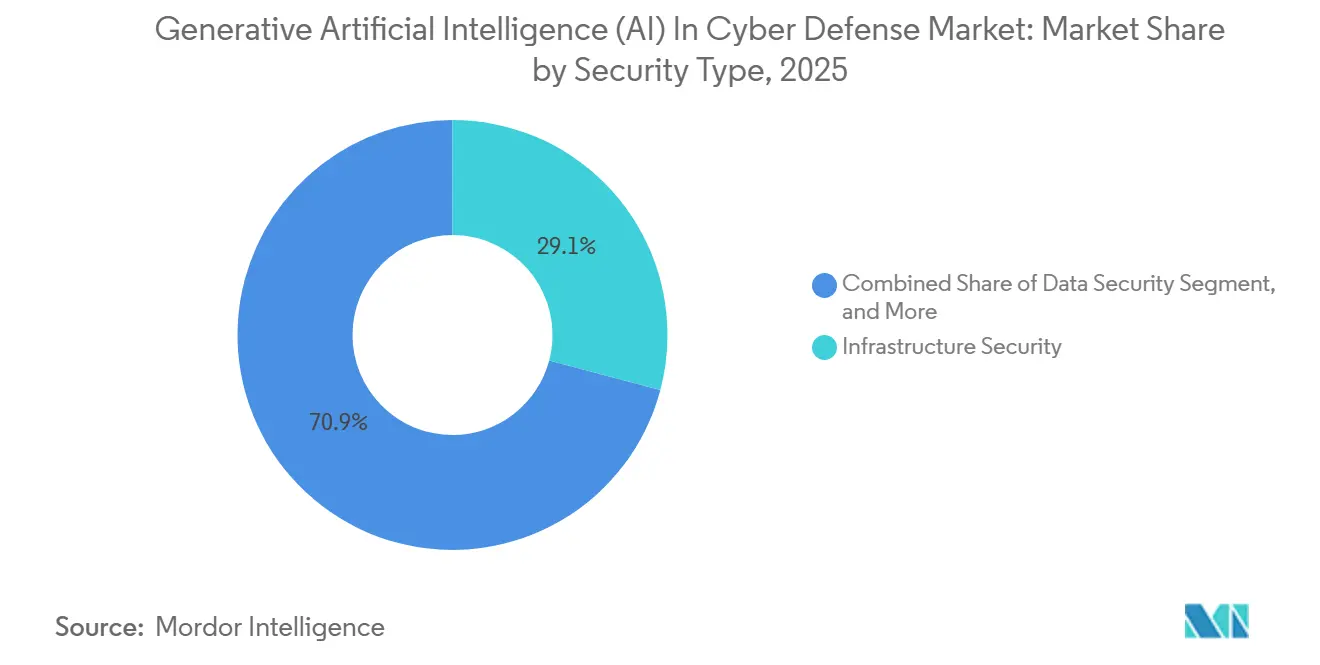
- By security type, Infrastructure Security held 29.11% share share of the generative artificial intelligence in cyber defense market in 2025, while Data Security is projected to advance at a 27.63% CAGR through 2031.
- By deployment, cloud accounted for 55.12% share share of the generative AI in cyber defense market in 2025, while hybrid is expected to expand at a 27.74% CAGR through 2031.
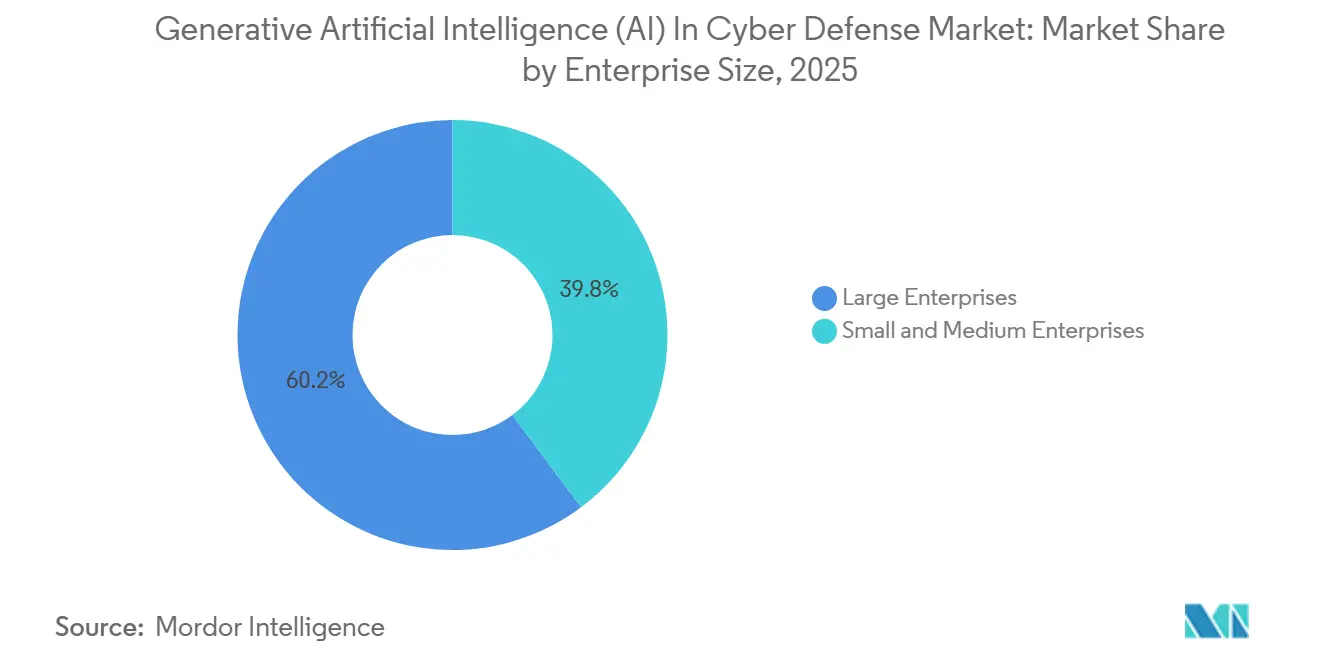
- By enterprise size, large enterprises held 60.21% share share of the generative artificial intelligence (AI) in cyber defense market in 2025, while small and medium enterprises are projected to grow at a 27.85% CAGR through 2031.
- By end-user industry, BFSI held 18.14% share share of the generative AI in cyber defense market in 2025, while healthcare and life sciences are projected to expand at a 27.96% CAGR through 2031.
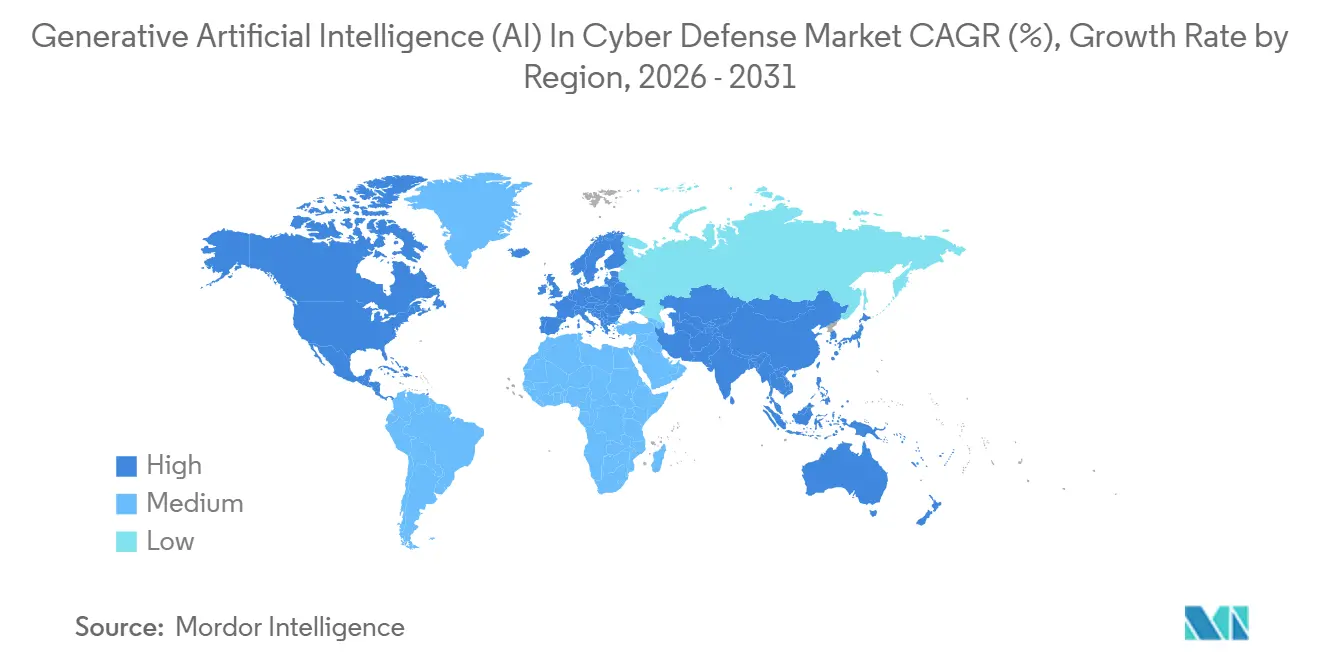
- By geography, North America held 33.19% share share of the generative artificial intelligence (AI) in cyber defense market in 2025, while Asia-Pacific is projected to record the highest CAGR at 28.07% through 2031.
Note: Market size and forecast figures in this report are generated using Mordor Intelligence’s proprietary estimation framework, updated with the latest available data and insights as of January 2026.
Market Trends and Insights
Drivers Impact Analysis of Generative Artificial Intelligence (AI) In Cyber Defense Market*
| Driver | (~) % Impact on CAGR Forecast | Geographic Relevance | Impact Timeline |
|---|---|---|---|
| Rising AI-Enabled Attack Volume and Speed | +5.5% | Global | Short term (≤ 2 years) |
| Expansion of AI Attack Surface Across Model, Data, and API Layers | +4.8% | Global, with intensity in North America and Europe | Short term (≤ 2 years) |
| Security Operations Center Automation to Offset Analyst Shortages | +4.1% | Global, with early gains in North America, UK, and Australia | Medium term (2-4 years) |
| AI Governance and Auditability Requirements in Regulated Industries | +3.2% | North America and EU, spill-over to APAC core | Medium term (2-4 years) |
| Confidential Computing Demand for Multi-Tenant GenAI Workloads | +2.4% | North America, Europe, APAC core | Long term (≥ 4 years) |
| Adversarial Red Teaming and Simulation Demand | +1.8% | Global, with early concentration in North America | Medium term (2-4 years) |
| Source: Mordor Intelligence | |||
Rising AI-Enabled Attack Volume And Speed
The Generative Artificial Intelligence (AI) in Cyber Defense Market is benefiting from a sharp rise in AI-assisted phishing, deepfake impersonation, and automated reconnaissance that outpace human-led review cycles. Zscaler reported 413,524 AI-generated phishing site instances across January to December 2025, based on signals collected at a very large scale across its network, which shows how quickly attackers are industrializing these campaigns.[1] IBM also reported that 1 in 6 breaches in 2025 involved AI-driven attacks, mainly to scale phishing and social engineering, confirming that offensive AI already has a measurable operational impact. The UK National Cyber Security Center stated that AI will almost certainly increase both the volume and impact of cyberattacks, especially in social engineering, where grammar and translation errors are no longer reliable warning signs for employees. The Generative Artificial Intelligence (AI) in Cyber Defense Market is therefore shifting toward detection, triage, and response engines that work at machine speed rather than analyst speed. Buyers are also placing greater value on tools that can track high-volume AI-generated lures across email, identity, browser, and cloud channels in a single workflow.[2]
Expansion of AI Attack Surface Across Model, Data, and API Layers
The Generative Artificial Intelligence (AI) in Cyber Defense Market is also being driven by the spread of enterprise AI deployments, which create new risks across prompt layers, model behavior, training data, and connected APIs. OWASP identified prompt injection as the leading vulnerability class in its 2025 Top 10 for Large Language Model Applications, which pushed many enterprises to treat AI-specific monitoring as a core control rather than an experimental add-on.[3] CrowdStrike stated in December 2025 that the AI prompt and agent interaction layer had become one of the fastest-growing enterprise attack surfaces, which reinforced demand for controls built for AI-native workflows. Each new AI application multiplies the boundaries of trust across models, identities, data lineage, and tool calls, making repurposed perimeter controls less effective in the Generative Artificial Intelligence (AI) in Cyber Defense Market. This change is moving spending toward platforms that can observe model behavior, validate prompts, monitor agent interactions, and flag suspicious API movement in real time. It is also expanding the role of AI security beyond classic cyber defense to include model governance and runtime policy enforcement.
Security Operations Center Automation to offset Analyst Shortages
The Generative Artificial Intelligence (AI) in Cyber Defense Market is gaining momentum amid a long-standing shortage of skilled security staff, making automation a practical necessity rather than a discretionary upgrade. The SANS 2025 SOC survey showed that 79% of respondents already used AI or machine learning tools in the SOC, yet only 36% had integrated them into a defined workflow, indicating a significant operational gap that vendors can still address. Fortinet's 2026 analysis noted that organizations using AI and security automation identified and contained breaches 98 days faster than organizations using manual methods, and it cited average savings of USD 2.22 million per incident. SentinelOne then moved the category further in June 2026 when it opened Purple AI Agentic Investigation to all customers, showing that autonomous deep-forensic investigation is already becoming a live commercial capability. The Generative Artificial Intelligence (AI) in Cyber Defense Market is therefore moving from AI as an analyst assistant toward AI as a primary investigation layer. This change matters most for organizations that must reduce false positives, accelerate triage, and stretch limited senior talent across larger telemetry estates.[4]
AI Governance and Auditability Requirements in Regulated Industries
The Generative Artificial Intelligence (AI) in Cyber Defense Market is also being shaped by governance requirements in financial services, healthcare, and critical infrastructure, where explainable, auditable security decisions are becoming part of the buying process. The EU AI Act made high-risk AI obligations enforceable from August 2, 2026, and Article 15 requires accuracy, robustness, and cybersecurity controls that directly raise the value of audit trails and continuous monitoring. NIST published the preliminary draft of NISTIR 8596 in December 2025 to provide a Cybersecurity Framework profile for artificial intelligence, serving as a reference point for enterprises to manage AI system risk and use AI in cyber defense. IBM reported in 2025 that 63% of organizations lacked governance policies to manage AI or limit shadow AI, and 97% of AI model breaches occurred in organizations without adequate AI access controls. These conditions are widening the demand for Generative Artificial Intelligence (AI) in Cyber Defense Market, logging tools, AI posture management, external testing, and governance services that can withstand regulatory review. Vendors that can explain autonomous actions in plain language are likely to hold a stronger position as oversight becomes more formal through the forecast period.
Restraints Impact Analysis of Generative Artificial Intelligence (AI) In Cyber Defense Market*
| Restraint | (~) % Impact on CAGR Forecast | Geographic Relevance | Impact Timeline |
|---|---|---|---|
| Lack of Standardized Benchmarks for AI Security Validation | -2.2% | Global | Short term (≤ 2 years) |
| Liability Uncertainty for Autonomous Security Actions | -1.9% | North America and EU | Medium term (2-4 years) |
| Integration Friction With Legacy Security Stacks | -1.5% | Global, with concentration in Europe and APAC | Medium term (2-4 years) |
| High Tuning Effort for False Positive Reduction in Dynamic AI Environments | -1.2% | Global | Short term (≤ 2 years) |
| Source: Mordor Intelligence | |||
Lack of Standardized Benchmarks for AI Security Validation
The Generative Artificial Intelligence (AI) in Cyber Defense Market still faces slower enterprise adoption because buyers lack a widely accepted way to compare vendor performance under live adversarial conditions. NISTIR 8596 is still in preliminary form, which means one of the most visible public frameworks for AI cybersecurity alignment has not yet reached final status. MITRE's AI Assurance Landscape mapped more than 50 frameworks and 66 assurance needs, which shows that the field has many overlapping references but not one standard benchmark that enterprises can use with confidence in procurement. OWASP's Artificial Intelligence Security Verification Standard effort adds useful testable requirements, but it does not yet carry the same institutional weight as more mature enterprise security standards. The Generative Artificial Intelligence (AI) in Cyber Defense Market, therefore, still relies too heavily on vendor demonstrations and case studies, which can lengthen sales cycles and favor large incumbents with established brands. This also weakens buyers' ability to connect AI security spend with measurable insurance or board-level risk outcomes.
Liability Uncertainty For Autonomous Security Actions
The Generative Artificial Intelligence (AI) in Cyber Defense Market is also constrained by legal and operational uncertainty around systems that block traffic, quarantine credentials, or terminate sessions without direct human approval. Article 14 of the EU AI Act requires meaningful human oversight for high-risk AI systems, which creates tension for security tools that derive value from reducing response latency. IBM's 2025 findings showed that 97% of AI-related breaches occurred where proper AI access controls were missing, supporting the view that poorly governed autonomy can widen risk rather than reduce it. Legal teams and procurement teams in regulated sectors are therefore still more comfortable with human-in-the-loop approvals for high-impact actions, even when vendors can automate the technical step. The Generative Artificial Intelligence (AI) in Cyber Defense Market may continue to see stronger adoption of assisted response than fully autonomous response until safe operating boundaries become clearer. This restraint does not stop growth, but it slows the shift toward the highest-value use cases in finance, healthcare, and critical infrastructure.
*Our forecasts treat driver/restraint impacts as directional, not additive. The impact forecasts reflect baseline growth, mix effects, and variable interactions.
Generative Artificial Intelligence (AI) In Cyber Defense Market Segment Analysis
By Offering:
Software Held The Lead While Services Posted The Fastest GrowthSoftware held 62.14% of the Generative Artificial Intelligence (AI) in Cyber Defense market in 2025, confirming that AI-native platforms remain the primary procurement unit for enterprise buyers. This part of the Generative Artificial Intelligence (AI) in Cyber Defense Market includes security copilots, AI security platforms, threat intelligence tools, security analytics engines, and vulnerability management platforms that now sit closer to the center of the security stack. Platform bundling is reinforcing that lead, as Microsoft announced that Security Copilot would be included with Microsoft 365 E5 through a phased rollout starting April 20, 2026, lowering the incremental barrier to AI security adoption across its installed base. Microsoft also stated in May 2026 that its multi-model agentic scanning harness discovered 16 previously unknown vulnerabilities in the Windows networking stack, indicating that software platforms are moving from assistance to direct discovery and validation work. As a result, buyers in the Generative Artificial Intelligence (AI) in Cyber Defense industry are increasingly treating software as a control layer that consolidates threat interpretation, investigative support, and remediation guidance across a single environment.
Services are projected to expand at a 27.41% CAGR through 2031, making them the fastest-growing offering in the Generative Artificial Intelligence (AI) in Cyber Defense Market. Growth is coming from managed AI security operations, adversarial red teaming, AI governance support, and continuous monitoring programs that many internal teams still cannot run on their own. IBM entered the OpenAI Daybreak Cyber Partner Program in June 2026 and launched an AI-powered application security service under Project Lightwell, backed by a USD 5 billion commitment from IBM and Red Hat, which shows how services are being rebuilt around AI-enabled delivery. The stronger growth rate for services also reflects the reality that many enterprises need help turning AI platforms into repeatable operating models with audit trails, policy controls, and measurable outcomes. The Generative Artificial Intelligence (AI) in Cyber Defense industry is therefore moving toward a blended model in which software builds the platform layer, while services supply the scarce expertise that keeps it effective.
By Application:
SOC Workflows Led Spending While Exposure Management Grew FasterSecurity Operations and SOC Augmentation accounted for 20.18% of the Generative Artificial Intelligence (AI) in Cyber Defense Market in 2025, which made it the largest application area by current spending. This share reflects the immediate pressure to reduce analyst overload before buyers expand into broader use cases such as simulation, content generation, and posture management. The SANS 2025 SOC survey found wide AI adoption but limited workflow maturity, which helps explain why SOC augmentation continues to attract first-wave budgets in the Generative Artificial Intelligence (AI) in Cyber Defense Market. Threat intelligence, security content generation, and security automation remain closely linked follow-on purchases, because organizations that start with SOC copilots usually extend AI into adjacent tasks along the incident response cycle. Adversarial simulation and red teaming are also gaining budget priority as AI-assisted attacks change faster than static playbooks can keep pace.
Exposure Management and Security Posture Analysis is projected to expand at a 27.52% CAGR through 2031, making it the fastest-growing application in the Generative Artificial Intelligence (AI) in Cyber Defense Market. That pattern shows that mature security teams are moving marginal investment toward identifying exploitable gaps before they are used, rather than simply adding more alert review capacity. SentinelOne launched Wayfinder Frontier AI Services in April 2026 by pairing Anthropic's Claude Opus 4.7 with offensive and defensive experts for continuous attack surface discovery and prioritized remediation, which is a direct example of how this application is being commercialized. Generative models can now connect cloud, identity, endpoint, and model-layer signals quickly enough to produce clearer exposure maps than manual analysis could previously. The Generative Artificial Intelligence (AI) in Cyber Defense Market is therefore widening from reactive security support into proactive risk quantification and AI-specific posture management.
By Security Type:
Infrastructure Security Led While Data Security AcceleratedInfrastructure Security held 29.11% of the Generative Artificial Intelligence (AI) in Cyber Defense market size in 2025, which kept it as the largest security type in the Generative Artificial Intelligence (AI) in Cyber Defense Market. Buyers still treat network, cloud, and endpoint protection as the first layer that must be hardened before model-level controls can deliver full value. Within this segment, network security is being reshaped by behavioral detection that looks for abnormal lateral movement rather than known signatures, which matters more as attackers vary patterns with generative tools. Cloud security is also attracting significant investment because enterprises must protect AI factories, multi-tenant inference environments, and the links between training data repositories and live models. Application security and identity and access management remain important adjacent layers, especially as zero-trust programs begin to incorporate AI-assisted anomaly detection for access decisions.
Data Security is projected to grow at a 27.63% CAGR through 2031, which makes it the fastest-growing security type in the Generative Artificial Intelligence (AI) in Cyber Defense Market. The driver is clear, because training datasets, model weights, prompts, and inference outputs are now treated as high-value business assets rather than secondary technical artifacts. IBM reported in 2025 that 13% of organizations had security incidents involving AI models or applications, and 97% of those incidents happened where proper AI access controls were absent. SentinelOne expanded its AI Security Platform in February 2026 with Data Security Posture Management capabilities that span data ingestion through runtime execution, which shows how leading vendors are repositioning classic data protection for AI-specific risk. The Generative Artificial Intelligence (AI) in Cyber Defense Market is therefore moving away from static data classification toward continuous discovery, access control, and policy enforcement across AI pipelines.

By Deployment:
Cloud Stayed Dominant While Hybrid Expanded FasterCloud held 55.12% of the Generative Artificial Intelligence (AI) in Cyber Defense market share in 2025, indicating that most deployments still favor SaaS delivery, elastic compute, and continuous telemetry ingestion. The Generative Artificial Intelligence (AI) in Cyber Defense Market favors cloud deployment because model updates, cross-tenant intelligence sharing, and real-time data processing are easier to scale within that architecture. Major platforms released or expanded in 2025 and 2026, including Microsoft Security Copilot and CrowdStrike Falcon AIDR, were designed as cloud-native services, which reinforces hyperscaler dependency at the product layer. On-premises deployment still matters in defense, government, and classified environments where data-handling rules limit the use of public cloud infrastructure. That keeps Cloud in the lead while also preserving space for mixed architectures in highly controlled settings.
Hybrid is projected to expand at a 27.74% CAGR through 2031, making it the fastest-growing deployment model in the Generative Artificial Intelligence (AI) in Cyber Defense Market. This reflects the needs of regulated enterprises that want AI scalability but cannot place every sensitive workload into shared public environments. The Confidential Computing Consortium argued in April 2026 that hardware-enforced trust should be treated as a foundational part of AI security infrastructure, supporting hybrid models that more tightly protect sensitive inference and data movement. CrowdStrike and NVIDIA also unveiled a Secure-by-Design AI Blueprint in March 2026 that embedded Falcon protection into NVIDIA OpenShell's agent runtime, demonstrating how hybrid and confidential architectures are moving into practical deployment. The Generative Artificial Intelligence (AI) in Cyber Defense Market is therefore likely to see hybrid become the preferred route for healthcare, financial services, and defense buyers that need both innovation speed and tighter control.
By Enterprise Size:
Large Enterprises Controlled Spend While SMEs Posted Stronger GrowthLarge enterprises held 60.21% of the Generative Artificial Intelligence (AI) in Cyber Defense market share in 2025, which reflected their ability to fund multi-vendor suites, dedicated AI testing, and customized copilot integration. This part of the Generative Artificial Intelligence (AI) in Cyber Defense Market has been led by organizations that can justify higher upfront spending because the financial exposure from large-scale breaches is material. IBM reported that the average breach cost in the United States reached USD 10.22 million in 2025, which helps explain why large enterprises can support multi-million-dollar security modernization programs. Microsoft's broader rollout of Security Copilot and launch of the Microsoft 365 E7 Frontier Suite in 2026 also showed that premium AI security capabilities are being packaged with large organizations in mind. Procurement in this segment is moving away from point tools toward platform consolidation, as large buyers seek fewer vendors, more integrated data, and clearer governance.
Small and medium enterprises are projected to grow at a 27.85% CAGR through 2031, making them the fastest-growing size cohort in the Generative Artificial Intelligence (AI) in Cyber Defense Market. The main reason is that AI-powered managed detection and response is reaching a point where pricing and operating models no longer require in-house frontier AI expertise. SentinelOne partnered with LevelBlue in June 2026 to deliver managed detection and response and AI-powered SIEM services, demonstrating how AI security is packaged for buyers with limited internal staffing. SMEs also face rising pressure from supply chain security expectations and compliance requirements that are moving outward from larger regulated enterprises. The Generative Artificial Intelligence (AI) in Cyber Defense Market is therefore broadening beyond large enterprise buyers as managed channels lower adoption friction and operational complexity.
By End-User Industry:
BFSI Anchored Demand While Healthcare And Life Sciences Grew FasterBFSI held 18.14% of the Generative Artificial Intelligence (AI) in Cyber Defense Market in 2025, which made it the largest end-user vertical by current adoption. The sector combines high breach costs, dense oversight, and mature digital operations, which makes the business case for AI-enabled defense easier to validate than in many other verticals. IBM reported that financial services breaches averaged USD 5.56 million in 2025, which supports continued spending on faster detection, fraud prevention, and response automation. Government and public administration, IT and telecommunication, energy and utilities, and oil and gas also contribute strong demand because they operate high-value systems and face persistent attack pressure. The White House directed federal agencies in June 2026 to identify grant support for AI vulnerability detection, indicating that public-sector use of AI security tools is also receiving policy attention.
Healthcare and life sciences are projected to expand at a 27.96% CAGR through 2031, making them the fastest-growing vertical in the Generative Artificial Intelligence (AI) in Cyber Defense Market. IBM reported that healthcare breaches averaged USD 7.42 million in 2025 and had a 279-day lifecycle, which kept the sector at the highest breach cost level for the 14th straight year. The American Hospital Association stated in February 2026 that the number of individuals affected by health data breaches rose from 27 million in 2020 to 259 million in 2024, which shows how quickly exposure has grown. That combination of rising AI adoption, long breach lifecycles, and the sensitivity of patient data is pushing hospitals, payers, and life sciences organizations toward earlier procurement planning. The Generative Artificial Intelligence (AI) in Cyber Defense Market is therefore seeing healthcare move from a cautious adopter into one of the strongest growth engines across the forecast period.
Geography Analysis
North America Generative Artificial Intelligence (AI) in Cyber Defense Market
North America held 33.19% of the Generative Artificial Intelligence (AI) in Cyber Defense market size in 2025, which kept it as the largest regional segment in the Generative Artificial Intelligence (AI) in Cyber Defense Market. The United States continues to anchor demand because large enterprises, federal agencies, and major vendors are concentrated in the same ecosystem. The White House issued an executive order in June 2026 that directed federal support toward advanced AI innovation and security, including grant pathways for AI vulnerability detection, thereby reinforcing policy backing for this area. Canada also added to the regional base when Budget 2025 allocated CAD 925.6 million, USD 662.1 million, over five years for large-scale sovereign AI infrastructure, which strengthens demand for related AI security controls. The region's strength is further reinforced by the presence of Microsoft, CrowdStrike, Palo Alto Networks, SentinelOne, IBM, and Google, which continue to release and expand commercial platforms faster than in most other geographies.
Europe and APAC Generative Artificial Intelligence (AI) in Cyber Defense Market
Europe remains the second-largest regional block in the Generative Artificial Intelligence (AI) in Cyber Defense Market, while Asia-Pacific is projected to record the fastest CAGR at 28.07% through 2031. Europe's demand pattern is strongly shaped by the EU AI Act, whose high-risk provisions became enforceable on August 2, 2026, and created direct demand for monitoring, logging, and governance tools. Germany, the United Kingdom, and France remain the main regional anchors, with German industry investing in AI-powered operational technology protection and the UK National Cyber Security Center guiding enterprise adoption through published threat assessments. Asia-Pacific is expanding faster because digital transformation, state-backed cyber priorities, and cloud-native growth are widening the addressable base across China, India, Japan, South Korea, and Australia. NRI Secure Technologies reported in February 2026 that Japan's generative AI utilization rate rose from 65.3% in 2024 to 83.2% in 2025, suggesting a significant future conversion opportunity as current use deepens from internal work to system-level security deployment.
South America and MEA Generative Artificial Intelligence (AI) in Cyber Defense Market
South America remains an emerging market for Generative Artificial Intelligence (AI) in Cyber Defense, with Brazil and Argentina as the main demand centers. Brazil is the more advanced adopter because banks and digital finance providers are using AI-powered fraud monitoring and cyber defense in response to tighter digital banking and data protection expectations. The Middle East and Africa are more uneven, with Saudi Arabia and the United Arab Emirates investing aggressively in AI and cyber defense, while much of Sub-Saharan Africa remains earlier in its deployment maturity. The Generative Artificial Intelligence (AI) in Cyber Defense Market is still likely to deepen gradually across both regions as fintech growth, cloud buildout, sovereign digital programs, and compliance expectations create a larger base for AI-native security tools.
Competitive Landscape
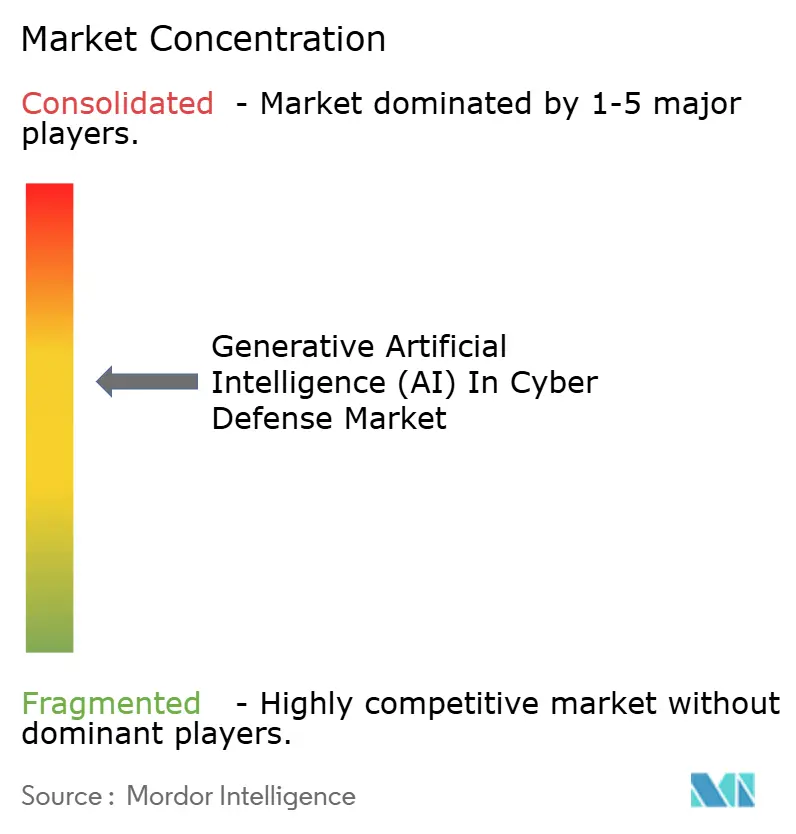
The Generative Artificial Intelligence (AI) in Cyber Defense Market is moderately consolidated, with a small group of large platform vendors holding strong positions while specialist providers continue to compete across narrower use cases. Microsoft, CrowdStrike, Palo Alto Networks, SentinelOne, IBM, and Google benefit from installed customer bases, deeper telemetry pools, and broader product packaging that can raise switching costs. At the same time, AI-native challengers are using focused products in exposure management, LLM security, and governance to win attention where incumbent suites still have gaps. The Generative Artificial Intelligence (AI) in Cyber Defense Market is therefore competitive on two levels, with platform breadth deciding large enterprise deals and niche depth deciding fast-moving workflow categories. This structure keeps the market from becoming highly concentrated even though the largest vendors hold clear advantages in distribution and integration.
Large vendors are using three main tactics, platform bundling, frontier model partnerships, and targeted acquisitions, to reinforce their positions in the Generative Artificial Intelligence (AI) in Cyber Defense Market. Palo Alto Networks completed the Portkey acquisition in May 2026 to build an AI gateway into Prisma AIRS, which strengthened its control plane for securing agents, applications, and model interactions. CrowdStrike launched the Charlotte AI AgentWorks Ecosystem in March 2026 with partners including AWS, Anthropic, NVIDIA, OpenAI, and Salesforce, demonstrating how partner-led ecosystems are becoming part of security platform strategy. SentinelOne opened Purple AI Agentic Investigation to all customers in June 2026, pushing the category toward zero-click autonomous investigation rather than AI-assisted inquiry alone. These moves show that vendors are competing not only on detection quality, but also on autonomy, governance, and how quickly they can operationalize new model capabilities across live security workflows.
White-space opportunities remain concentrated around sovereign inference protection, multi-agent orchestration security, and affordable AI governance tools for smaller organizations in the Generative Artificial Intelligence (AI) in Cyber Defense Market. This gives focused firms room to build positions without trying to replace full platform suites from day one. The agentic SOC is likely to remain the main battleground, because the vendors that can automate investigation while preserving oversight should gain an advantage as budgets move from pilots into scaled deployment. The Generative Artificial Intelligence (AI) in Cyber Defense Market is also rewarding vendors that can combine runtime monitoring, clear audit trails, and
Generative Artificial Intelligence (AI) In Cyber Defense Industry Leaders
-
Microsoft Corporation
-
International Business Machines Corporation
-
Palo Alto Networks, Inc.
-
CrowdStrike, Inc.
-
Fortinet, Inc.
- *Disclaimer: Major Players sorted in no particular order
Generative Artificial Intelligence (AI) In Cyber Defense Market Companies Covered in this Report
- Microsoft Corporation
- International Business Machines Corporation
- Google LLC
- CrowdStrike, Inc.
- Palo Alto Networks, Inc.
- SentinelOne, Inc.
- Darktrace Holdings Limited
- Fortinet, Inc.
- Zscaler, Inc.
- Trellix
- Check Point Software Technologies Ltd.
- Cisco Systems, Inc.
- Trend Micro Incorporated
- Sophos Limited
- Rapid7, Inc.
- Tenable Holdings, Inc.
- BlackBerry Limited
- Abnormal Security Corporation
- Snyk Limited
- Lakera Inc.
Recent Industry Developments in Generative Artificial Intelligence (AI) In Cyber Defense Market
- June 2026: IBM announced its entry into the OpenAI Daybreak Cyber Partner Program and launched a new AI-powered application security service under Project Lightwell, backed by a USD 5 billion commitment from IBM and Red Hat, designed to identify and validate software vulnerabilities at machine speed, with a focus on the open-source software supply chain.
- June 2026: SentinelOne opened Purple AI Agentic Investigation to all customers, enabling zero-click, autonomously initiated deep-forensic threat investigations on the Singularity Platform, and the company simultaneously introduced Singularity Credits as a unified currency for AI-powered security work across the platform.
- June 2026: CrowdStrike extended Falcon AIDR across AI gateway partners including Databricks, Google Cloud, Microsoft Azure, Kong, and LiteLLM, delivering a centralized AI security control plane across enterprise API ecosystems and enabling correlated threat detection at scale.
- June 2026: Palo Alto Networks and Databricks announced an integration of Prisma AIRS API with Databricks Unity AI Gateway, embedding runtime security for AI agents, models, MCP Servers, and applications, enabling enterprises to scale AI workloads without sacrificing policy-driven visibility or compliance posture.
Global Generative Artificial Intelligence (AI) In Cyber Defense Market Report Scope
The Generative Artificial Intelligence (AI) in Cyber Defense market comprises platforms and services that leverage generative AI to enhance cybersecurity operations, automate threat detection, and strengthen defenses against evolving cyber risks. These solutions include AI-driven copilots, threat intelligence platforms, vulnerability management systems, and security analytics tools that generate actionable insights, automate workflows, and simulate adversarial attacks to improve resilience.
The Generative Artificial Intelligence (AI) in Cyber Defense market report is segmented by Offering (Software [Security Copilots, AI Security Platforms, Threat Intelligence Platforms, Security Analytics Platforms, Vulnerability Management Platforms], and Services), Application (Security Operations and SOC Augmentation, Threat Intelligence and Threat Analysis, Vulnerability Management and Exposure Analysis, Security Content Generation, Security Automation and Orchestration, Adversarial Simulation and Red Teaming), Security Type (Infrastructure Security [Network Security, Cloud Security, Endpoint Security] Application Security; Identity and Access Management; Data Security), Deployment (Cloud, On-Premises, and Hybrid), Enterprise Size (Large Enterprises, and Small and Medium Enterprises), End-user Industry (Government and Public Administration, Industrial Manufacturing, Retail and E-Commerce, Transportation and Logistics, Energy and Utilities, Oil and Gas, IT and Telecommunication, Media and Entertainment, Education and Research Institutions, Healthcare and Life Sciences, Banking, Financial Services, and Insurance (BFSI)), and Geography (North America, South America, Europe, Asia-Pacific, Middle East, and Africa). The Market Forecasts are Provided in Terms of Value (USD).
Segmentation Overview
| Software | Security Copilots |
| AI Security Platforms | |
| Threat Intelligence Platforms | |
| Security Analytics Platforms | |
| Vulnerability Management Platforms | |
| Services |
| Security Operations and SOC Augmentation |
| Threat Intelligence and Threat Analysis |
| Vulnerability Management and Exposure Analysis |
| Security Content Generation |
| Security Automation and Orchestration |
| Adversarial Simulation and Red Teaming |
| Infrastructure Security | Network Security |
| Cloud Security | |
| Endpoint Security | |
| Application Security | |
| Identity and Access Management | |
| Data Security |
| Cloud |
| On-Premises |
| Hybrid |
| Large Enterprises |
| Small and Medium Enterprises |
| Government and Public Administration |
| Industrial Manufacturing |
| Retail and E-Commerce |
| Transportation and Logistics |
| Energy and Utilities |
| Oil and Gas |
| IT and Telecommunication |
| Media and Entertainment |
| Education and Research Institutions |
| Healthcare and Life Sciences |
| Banking, Financial Services, and Insurance (BFSI) |
| North America | United States | |
| Canada | ||
| Mexico | ||
| South America | Brazil | |
| Argentina | ||
| Rest of South America | ||
| Europe | Germany | |
| United Kingdom | ||
| France | ||
| Italy | ||
| Spain | ||
| Russia | ||
| Rest of Europe | ||
| Asia-Pacific | China | |
| India | ||
| Japan | ||
| South Korea | ||
| Australia | ||
| Rest of Asia-Pacific | ||
| Middle East and Africa | Middle East | Saudi Arabia |
| United Arab Emirates | ||
| Rest of Middle East | ||
| Africa | South Africa | |
| Nigeria | ||
| Rest of Africa | ||
| By Offering | Software | Security Copilots | |
| AI Security Platforms | |||
| Threat Intelligence Platforms | |||
| Security Analytics Platforms | |||
| Vulnerability Management Platforms | |||
| Services | |||
| By Application | Security Operations and SOC Augmentation | ||
| Threat Intelligence and Threat Analysis | |||
| Vulnerability Management and Exposure Analysis | |||
| Security Content Generation | |||
| Security Automation and Orchestration | |||
| Adversarial Simulation and Red Teaming | |||
| By Security Type | Infrastructure Security | Network Security | |
| Cloud Security | |||
| Endpoint Security | |||
| Application Security | |||
| Identity and Access Management | |||
| Data Security | |||
| By Deployment | Cloud | ||
| On-Premises | |||
| Hybrid | |||
| By Enterprise Size | Large Enterprises | ||
| Small and Medium Enterprises | |||
| By End-user Industry | Government and Public Administration | ||
| Industrial Manufacturing | |||
| Retail and E-Commerce | |||
| Transportation and Logistics | |||
| Energy and Utilities | |||
| Oil and Gas | |||
| IT and Telecommunication | |||
| Media and Entertainment | |||
| Education and Research Institutions | |||
| Healthcare and Life Sciences | |||
| Banking, Financial Services, and Insurance (BFSI) | |||
| By Geography | North America | United States | |
| Canada | |||
| Mexico | |||
| South America | Brazil | ||
| Argentina | |||
| Rest of South America | |||
| Europe | Germany | ||
| United Kingdom | |||
| France | |||
| Italy | |||
| Spain | |||
| Russia | |||
| Rest of Europe | |||
| Asia-Pacific | China | ||
| India | |||
| Japan | |||
| South Korea | |||
| Australia | |||
| Rest of Asia-Pacific | |||
| Middle East and Africa | Middle East | Saudi Arabia | |
| United Arab Emirates | |||
| Rest of Middle East | |||
| Africa | South Africa | ||
| Nigeria | |||
| Rest of Africa | |||
Key Questions Answered in the Report
What is the current size of the Generative Artificial Intelligence (AI) in Cyber Defense Market?
The market size is USD 20.58 billion in 2026 and is projected to reach USD 66.05 billion by 2031, growing at a 26.27% CAGR over 2026-2031.
What is driving growth in generative AI for cyber defense?
The main drivers are faster AI-enabled attacks, a wider AI attack surface across models and APIs, analyst shortages, and stronger governance requirements in regulated sectors.
Which offering leads adoption and which one grows faster?
Software led with 62.14% share in 2025, while services are projected to grow faster at a 27.41% CAGR through 2031.
Why is cloud leading while hybrid is growing faster?
Cloud leads because AI security platforms benefit from scalable compute and continuous telemetry processing, while hybrid is growing faster because regulated buyers need tighter control over sensitive workloads.
Which industries are the most important buyers?
BFSI led with 18.14% share in 2025 because of high breach costs and regulatory pressure, while healthcare and life sciences are projected to grow fastest at a 27.96% CAGR through 2031.
Which regions matter most for future expansion?
North America led with 33.19% share in 2025, while Asia-Pacific is projected to grow fastest at a 28.07% CAGR as digital transformation and government-led security priorities widen adoption.