
Causal AI Market Size and Share
Market Overview
| Study Period | 2019 - 2030 |
|---|---|
| Market Size (2025) | USD 79.69 Million |
| Market Size (2030) | USD 456.80 Million |
| Growth Rate (2025 - 2030) | 41.80 % |
| Fastest Growing Market | Asia Pacific |
| Largest Market | North America |
| Market Concentration | Medium |
Major Players *Disclaimer: Major Players sorted in no particular order Image © Mordor Intelligence. Reuse requires attribution under CC BY 4.0. | |
Causal AI Market Analysis by Mordor Intelligence
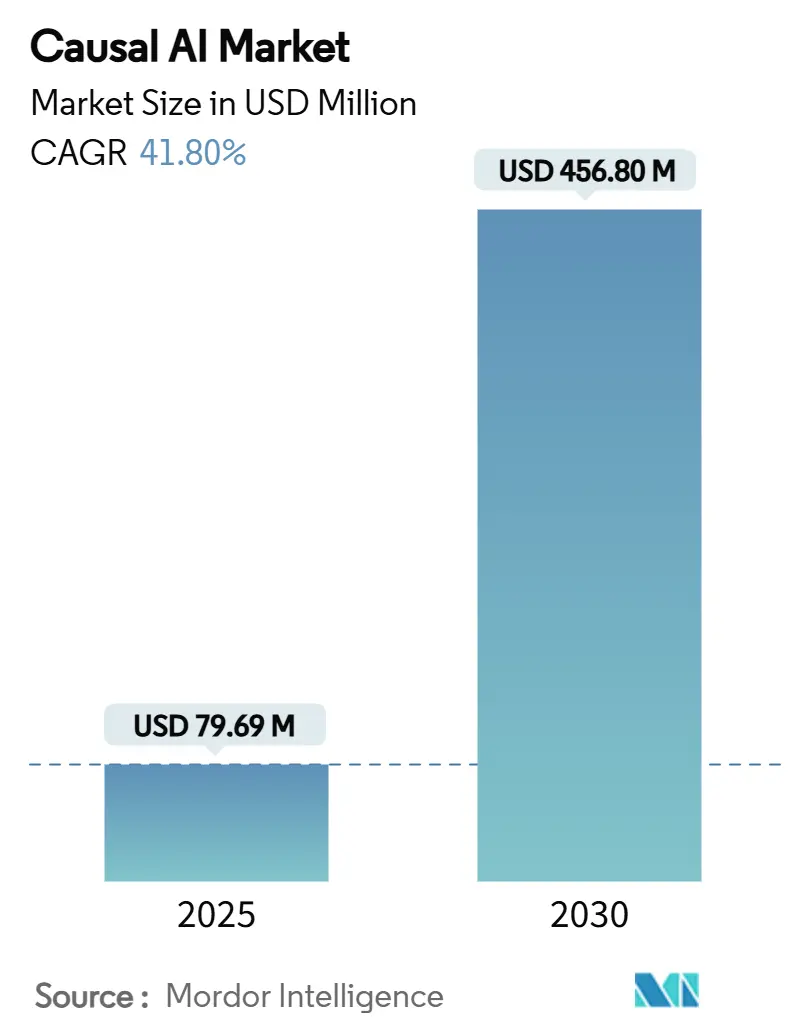
The causal AI market size reached USD 79.69 million in 2025 and is projected to grow to USD 456.8 million by 2030, representing a 41.8% CAGR. Rapid migration from correlation-based analytics toward genuine cause-and-effect reasoning underpins this expansion, as enterprises seek models that remain stable when operating conditions shift. Integration of large language models with causal inference accelerates hypothesis generation, while rising regulatory scrutiny across healthcare and finance elevates explainability from an option to a requirement. North America continues to lead in adoption, although the Asia-Pacific region records the fastest growth due to sovereign AI programs and substantial infrastructure investment. Platform vendors that simplify causal workflows enjoy early-mover advantage, yet talent scarcity and legacy-system integration costs temper the pace of enterprise rollout.
Key Report Takeaways
- By offering, the platforms segment held 66.17% of the causal AI market share in 2024.
- By deployment, the on-premises segment is projected to grow at 43.93% CAGR between 2025-2030.
- By application, the risk and compliance analytics segment led with 24.76% revenue share of the causal AI market in 2024.
- By industry vertical, the healthcare segment is projected to grow at 48.71% CAGR between 2025-2030.
- By geography, the North America segment retained 43.12% share of the causal AI market size in 2024.
Global Causal AI Market Trends and Insights
Drivers Impact Analysis*
| Driver | (~) % Impact on CAGR Forecast | Geographic Relevance | Impact Timeline |
|---|---|---|---|
| Rising demand for explainable AI | +8.2% | North America & EU, expanding to APAC | Medium term (2-4 years) |
| Deployment of decision-intelligence platforms | +7.8% | Global, concentrated in developed markets | Short term (≤ 2 years) |
| Cloud-native causal AI toolkits | +6.5% | Global, led by North America | Short term (≤ 2 years) |
| Convergence of causal inference with LLMs | +9.1% | Global, early adoption in tech hubs | Medium term (2-4 years) |
| Shift to on-prem causal AI | +5.4% | EU & APAC, selective North America adoption | Long term (≥ 4 years) |
| Energy-efficient causal discovery | +4.2% | Global, focus on sustainability-driven regions | Long term (≥ 4 years) |
| Source: Mordor Intelligence | |||
Rising Demand for Explainable AI in Regulated Sectors
Financial and healthcare regulators increasingly mandate transparent reasoning chains for automated decisions. The EU AI Act places high-risk systems under strict disclosure rules, prompting banks to embed causal engines into fraud-detection pipelines that now cut false positives by 85%[1]OpenAI, “Microsoft Invests in OpenAI,” openai.com. In medicine, Dynamic Uncertain Causality Graph deployments completed more than 1 million diagnoses with only 17 errors, satisfying both performance and auditability metrics. Insurers and credit-rating agencies follow similar paths as supervisory authorities emphasize accountability. Vendors that deliver built-in explanation modules therefore, win procurement contests, while black-box models lose competitiveness. The regulatory pull converts compliance costs into long-term market catalysts.
Growing Deployment of Decision-Intelligence Platforms
Decision-intelligence suites operationalize causal reasoning by linking cause-effect insights to recommended actions. Utilities using these platforms prevented 40,000 customer outages by triangulating weather, sensor, and maintenance records[2]Distributech, “Eversource Predicts Outages with AI,” distributech.com. Manufacturers recorded 30% maintenance-cost reductions and 70% fewer breakdowns after integrating causal root-cause analytics into plant-floor systems. Embedded user-interface wizards mask statistical complexity, so domain experts gain direct access to powerful inferences. The accessibility advantage broadens adoption beyond data-science teams, anchoring multi-year service contracts and recurring subscription revenue for vendors. As performance benchmarks proliferate, platform switching costs climb, reinforcing first-mover gains.
Cloud-Native Causal AI Toolkits by Hyperscalers
Hyperscalers accelerate feature rollouts by embedding causal libraries into managed notebooks, vector databases, and AutoML pipelines. Oracle Database 23ai offers vector data types and natural-language queries that simplify data-prep steps for causal workflows[3]Oracle, “Oracle Database 23ai,” cdotrends.com. Microsoft’s ongoing investment in OpenAI underwrites research into cause-effect reasoning at foundation-model scale. Capital deployment reaches record levels: a USD 30 billion infrastructure partnership led by BlackRock signals long-term commitment to AI-ready datacenters. Competitive leapfrogging yields rapid cost declines and richer toolsets for enterprise buyers, although dependency on single-provider ecosystems presents lock-in risk.
Convergence of Causal Inference with LLMs
Researchers demonstrate that GPT-4 outperforms humans on collider-graph tasks, avoiding associative biases in chain reasoning. Multi-agent causal discovery frameworks blend structured-data search with textual metadata extraction, achieving state-of-the-art scores across public datasets. LinkedIn’s causal predictive optimization engine combines generative AI with constraint-based models, outperforming prior B2B sales systems. The Causal-Copilot agent integrates 20 algorithms to deliver end-to-end tabular and time-series analysis in natural language. These advances compress project timelines and reduce specialist head-count needs, directly expanding the addressable user base.
Restraints Impact Analysis*
| Restraint | (~) % Impact on CAGR Forecast | Geographic Relevance | Impact Timeline |
|---|---|---|---|
| Talent gap in causal-inference skill sets | -6.8% | Global, acute in emerging markets | Medium term (2-4 years) |
| High integration cost with legacy analytics | -4.3% | Developed markets with established IT infrastructure | Short term (≤ 2 years) |
| Lack of benchmarking standards | -3.1% | Global, regulatory focus in EU & North America | Long term (≥ 4 years) |
| Regulatory risk around counterfactuals | -2.9% | EU & North America, expanding globally | Long term (≥ 4 years) |
| Source: Mordor Intelligence | |||
Talent Gap in Causal-Inference Skill Sets
Causal AI demands statistical depth that traditional machine-learning curricula rarely cover. Less than one-quarter of data-science graduates list do-calculus or counterfactual analysis among their core skills, and hiring premiums exceed 35% over standard ML roles. Emerging markets face amplified scarcity because few universities offer specialized coursework, delaying pilot projects and inflating external-consulting spend. Corporations invest in internal academies and sponsor PhD programs, but graduation pipelines trail demand. Vendor-hosted low-code interfaces ease some pressure, yet advanced tuning still requires experts. The skills deficit, therefore, persists as a principal drag on adoption pace.
High Integration Cost with Legacy Analytics
Enterprises with large business-intelligence estates confront multi-layer retrofits before causal AI can operate on governed data. Data-lineage gaps, fragmented metadata, and batch-oriented ETL flows lack the granularity that causal engines require. Total cost of ownership rises because infrastructure upgrades often triple initial software license fees. Banks and hospitals report 12- to 18-month rollout cycles, during which parallel systems must be maintained to avoid operational disruption. API-first architectures and managed connectors gradually lower friction, but organizations rich in bespoke code remain vulnerable to budget overruns that stall projects mid-stream.
*Our forecasts treat driver/restraint impacts as directional, not additive. The impact forecasts reflect baseline growth, mix effects, and variable interactions.
Segment Analysis
By Deployment: On-Premises Gains Strategic Momentum
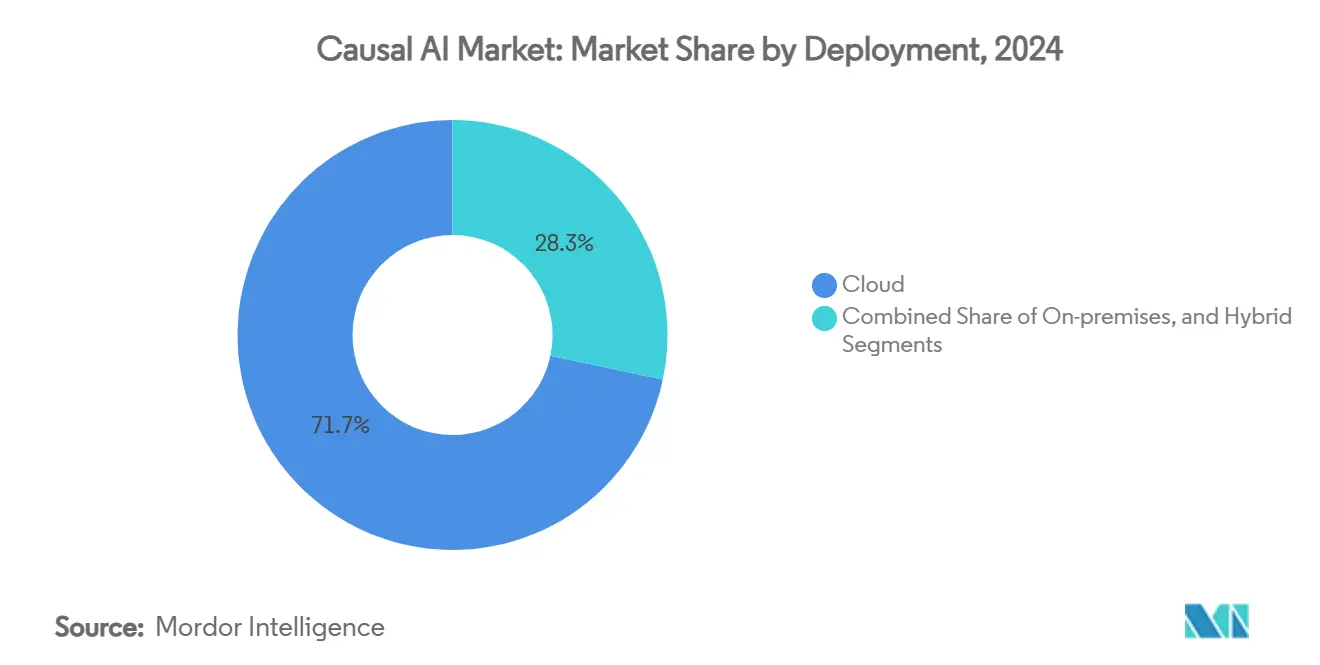
Cloud deployments retained 71.69% slice of the causal AI market size in 2024, reflecting ease of entry and elastic compute access during model experimentation. Hyperscalers entice customers through free-tier notebooks and managed pipelines that simplify initial onboarding. Yet on-premises installations record the strongest 43.93% CAGR as boards elevate data-control risk and total-cost assessments. Enterprises moving inference workloads behind firewalls eliminate data-egress fees and negotiate predictable hardware depreciation schedules. Hybrid architectures serve as transitional bridges; teams prototype in the cloud, then repatriate stable workflows to local clusters.
Hardware innovation speeds this pivot. Containerized AI appliances combine inference-optimized GPUs with pre-tuned causal libraries, enabling IT staff to spin up secure environments in days rather than months. National-security and healthcare organizations mandate on-prem hosting for sensitive records, embedding causal AI into existing high-availability clusters. In Asia-Pacific, sovereign-AI mandates reinforce the trajectory, while European GDPR rules encourage local processing zones. The resulting diversification widens the addressable base for vendors offering deployment-agnostic toolchains that flex across public cloud, private cloud, and bare-metal nodes.



By Application: Precision Medicine Leads Innovation
Risk and compliance analytics maintained 24.76% revenue share in 2024, capitalizing on banks’ appetite for transparent fraud detection that satisfies supervisory audits. Deployments demonstrate 85% reductions in false positives, cutting manual review costs. Healthcare use cases leapfrog other segments, posting a 46.64% CAGR to 2030 as causal diagnostics move from pilot to clinical routine. The Dynamic Uncertain Causality Graph achieves 95% precision across 1,000 disease categories, surpassing black-box rivals and securing regulatory clearance[4]Zhan Zhang et al., “Dynamic Uncertain Causality Graph,” arxiv.org. Marketing teams exploit causal uplift modeling to isolate drivers of conversion, allowing budget reallocation toward high-impact campaigns. Supply-chain managers pair causal root-cause analysis with digital twins, trimming unplanned downtime by 30% in discrete-manufacturing plants.
Public-sector agencies experiment with policy-impact simulators that can evaluate thousands of hypothetical interventions, though production uptake remains early. Fraud-detection algorithms migrate beyond finance into insurance and healthcare billing, where causal disambiguation distinguishes accidental anomalies from deliberate abuse. Telecommunications carriers pilot causal network-fault analytics to shorten mean-time-to-repair, aligning with expectations that AI can unlock USD 11 billion in annual telco revenue by 2025. Collectively, application diversity illustrates the broad portability of causal reasoning once domain-specific constraints are encoded.
By Industry Vertical: Healthcare Drives Transformation
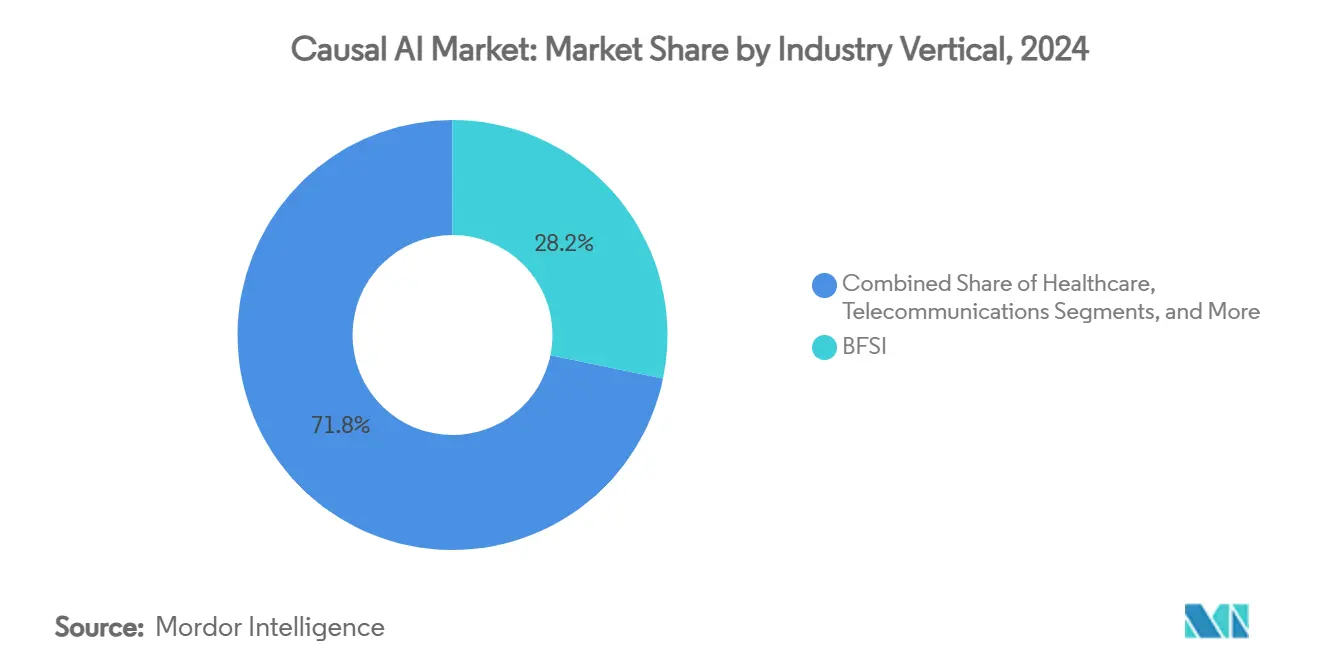
BFSI accounted for 28.25% share of the causal AI market size in 2024 as financial institutions battle sophisticated cyber-enabled fraud and tighter Basel regulatory disclosures. Stress-testing teams embed counterfactual engines to model contagion scenarios across macroeconomic variables. Healthcare, advancing at 48.71% CAGR, benefits from abundant structured electronic-medical-record data and precise outcome metrics. Hospitals integrate causal triage tools that recommend personalized treatment paths, lowering adverse-event rates. Pharmaceutical research divisions deploy causal discovery to prioritize drug-target hypotheses, accelerating time-to-clinic.
Manufacturing firms embed causal engines into quality-control lines, linking process parameters to defect rates and detecting upstream disturbances earlier than traditional SPC charts. Retailers adopt uplift-focused recommender systems that drive double-digit increases in cross-sell conversions. Telecommunications operators roll causal inference into customer-churn models, verifying whether promotional offers reduce attrition rather than coinciding with external factors. Government agencies in emerging economies pilot causal allocation models to optimize limited healthcare resources, demonstrating social impact potential. Energy utilities continue to apply causal algorithms to outage-prediction frameworks, improving grid resilience while meeting decarbonization mandates.
By Offering: Platforms Drive Market Foundation
Platforms represented 66.17% of causal AI market share in 2024 as enterprises opted for turnkey stacks that hide statistical complexity. The dominance stems from vendors bundling data preparation, causal discovery, and explainability dashboards into a single subscription, shortening deployment cycles. Major cloud providers package vector databases and AutoML orchestration, while pure-play specialists focus on domain-tailored libraries. Services, although smaller in absolute value, expand at 46.82% CAGR because the acute talent gap pushes firms to seek external implementation help. Consulting integrators create standardized playbooks that accelerate proof-of-concept to production handoff and incorporate continuous-improvement loops. Combined, the symbiosis between platform feature velocity and service expertise propels overall market maturity.
Platform vendors differentiate through pre-built domain templates, healthcare diagnostics, risk-rating engines, and manufacturing quality control that cut model training time. APIs expose counterfactual queries directly to business applications, enabling line-of-business teams to embed real-time causal checks. Service partners leverage platform telemetry to benchmark client performance, feeding anonymized insights back into product roadmaps, thus creating virtuous feedback cycles. As user communities grow, marketplace ecosystems for algorithm plugins and data connectors emerge, further locking customers into flagship platforms. Consequently, outsourced service revenue acts as a lead-generation engine for recurring platform licenses, consolidating vendor footholds across verticals.
Geography Analysis
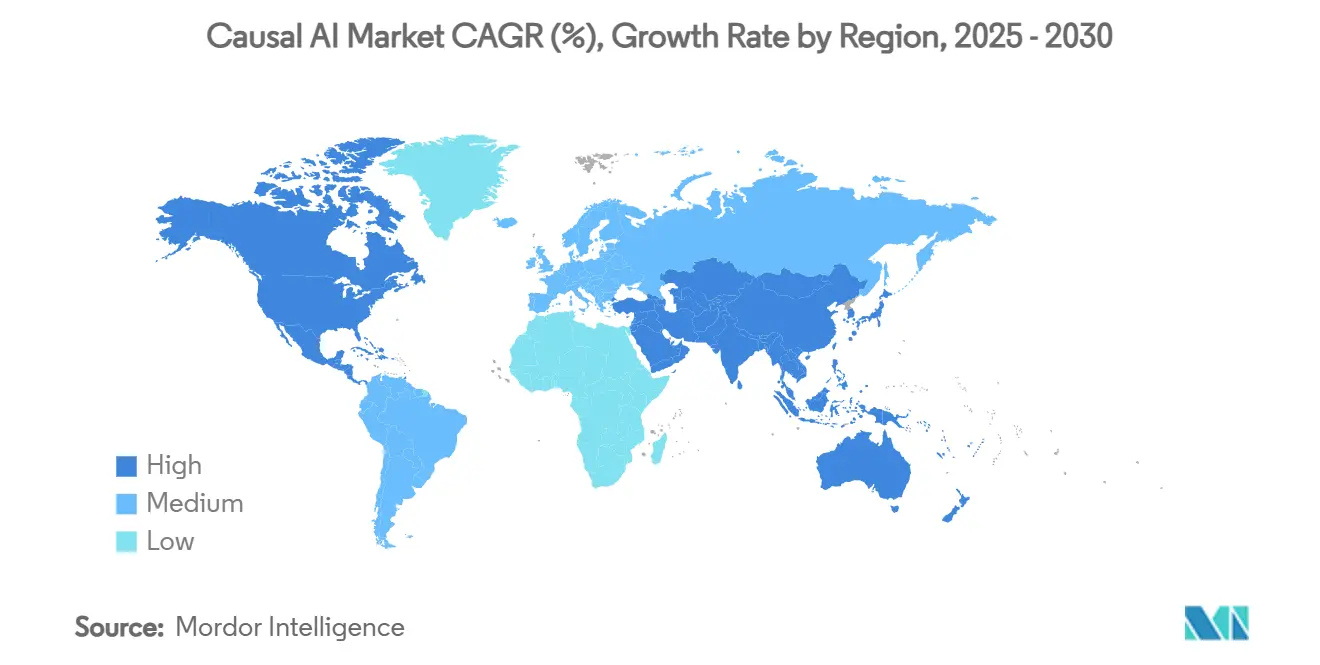
North America’s 43.12% share in 2024 reflects deep venture-capital pools, research-university ecosystems, and early regulatory frameworks that reward explainability. Flagship deals such as Microsoft’s USD 1 billion reinforcement of OpenAI and a USD 30 billion AI-infrastructure consortium led by BlackRock showcase financial muscle backing the region’s leadership. United States defense contracts valued at up to USD 200 million per supplier further endorse causal reasoning for mission-critical scenarios. The region, however, faces rising wage pressure for scarce causal specialists and competitive headwinds from Asia-Pacific sovereign initiatives.
Asia-Pacific records a 44.05% CAGR through 2030, translating policy ambition into capex outlays for datacenters and semiconductor fabs. China’s Interim AI Measures Act mandates security reviews and data-legitimacy checks, creating protected demand for transparent causal AI engines. India’s digital-lending market, expected to hit USD 515 billion by 2030, depends on explainable credit-scoring to satisfy Reserve Bank scrutiny, incentivizing local build-outs. Japan pursues voluntary guidelines, and South Korea’s AI Basic Act, taking effect in 2026, imposes risk assessments on high-impact systems, both of which align with causal explainability goals. Asian Development Bank projects highlight causal analytics for resource optimization across transport and climate programs.
Europe represents a balanced growth corridor where the EU AI Act codifies transparency and risk-management obligations into law. Organizations lean toward on-premises deployment models to address GDPR data-locality clauses, a tailwind for vendors delivering flexible installation topologies. National funding schemes in Germany and France subsidize AI skills academies, indirectly relieving the talent bottleneck. South America and the Middle East and Africa remain early-stage but demonstrate leapfrog potential by adopting best-practice templates refined in other regions. Energy-exporting economies earmark AI budgets for grid reliability and predictive-maintenance use cases, while public-health ministries pilot causal-based resource allocation to maximize vaccination coverage.

Competitive Landscape
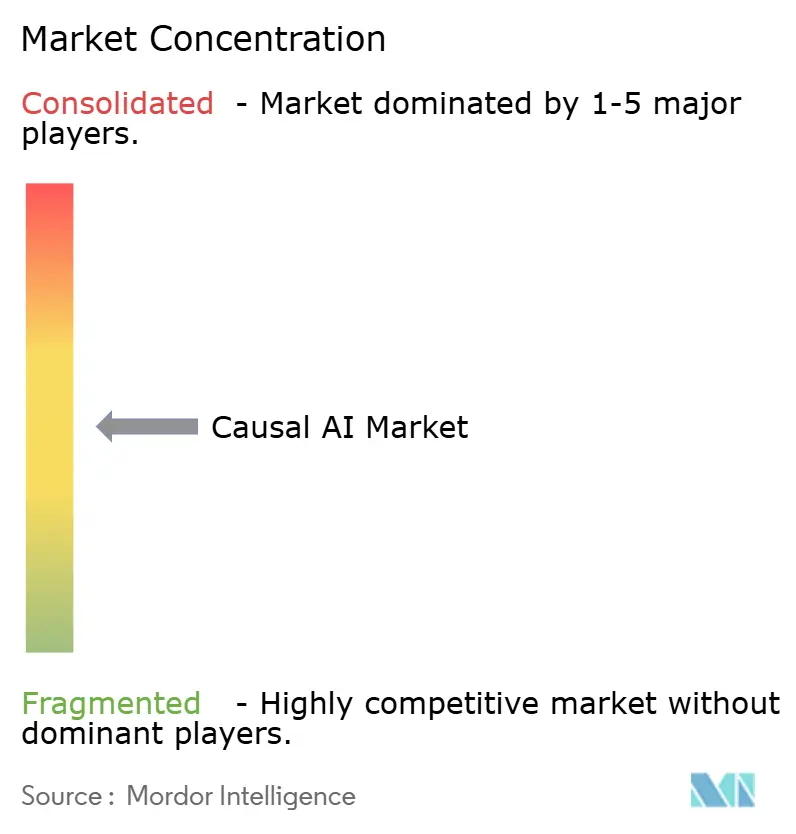
The causal AI market is fragmented as hyperscalers battle specialized pure-plays for mindshare. Microsoft, Google, and AWS embed causal components into broader AI portfolios, bundling data-warehousing, governance, and observability to lock in customers. Oracle extends this strategy with Database at AWS availability, enabling zero-ETL pipelines and native vector search for smoother causal workflows. Pure-play vendors such as causaLens differentiate through academic-grade inference libraries and domain-tailored templates, while Fiddler AI focuses on observability, adding USD 18.6 million in funding to harden governance modules.
Mergers accelerate as majors seek talent and intellectual property; researchers catalog 80 significant AI acquisitions since 2024, many targeting causal assets. Strategic alliances, exemplified by Teradata’s tie-up with DataRobot, integrate causal modules with enterprise analytics estates, reducing vendor-selection friction. White-space remains in industry-specific applications: telecom network optimization and retail personalization show unmet demand for causal reasoning at scale. Winning vendors combine algorithmic rigor with low-code usability and pre-certified compliance artifacts, satisfying both data-science and risk-management stakeholders.
The go-to-market motion increasingly revolves around ecosystem building. Marketplace plugins encourage third-party developers to contribute causal diagnostics, driving network effects. Reference-architecture programs with global-systems integrators extend reach into regulated industries that insist on certified implementation partners. Competitive differentiation now hinges on cross-functional value: end-to-end monitoring, auto-documentation, and run-time guardrails become as critical as raw model accuracy.
Causal AI Industry Leaders
Microsoft Corporation
International Business Machines Corporation
Google LLC
Amazon Web Services, Inc.
Impulse Innovations Limited (causaLens)
- *Disclaimer: Major Players sorted in no particular order

Recent Industry Developments
- July 2025: Oracle Database AWS became generally available across AWS Regions, providing zero-ETL integration and AI Vector Search that streamline causal AI deployments.
- March 2025: BlackRock’s AI Infrastructure Partnership added NVIDIA and xAI, mobilizing USD 30 billion in committed capital with a potential USD 100 billion target for AI datacenters.
- January 2025: Fiddler AI raised USD 18.6 million in Series B extension funding to expand observability and safety features vital for causal AI governance.
- September 2024: Microsoft, BlackRock, and Global Infrastructure Partners launched a joint AI datacenter initiative to meet compute demand for causal workloads.
- July 2024: Teradata integrated DataRobot’s platform with VantageCloud and ClearScape Analytics to accelerate causal AI model operationalization.


Global Causal AI Market Report Scope
| Platforms/Tools |
| Services |
| Cloud |
| On-premises |
| Hybrid |
| Risk and Compliance Analytics |
| Marketing and Customer Insight |
| Supply-Chain and Operations Optimisation |
| Precision Medicine and Clinical Decision Support |
| Fraud Detection and Security Monitoring |
| Policy Simulation and Public Sector Planning |
| Healthcare |
| BFSI |
| Manufacturing and Industrial |
| Retail and eCommerce |
| Telecommunications |
| Government and Public Sector |
| Energy and Utilities |
| North America | United States | |
| Canada | ||
| Mexico | ||
| South America | Brazil | |
| Argentina | ||
| Rest of South America | ||
| Europe | Germany | |
| United Kingdom | ||
| France | ||
| Italy | ||
| Rest of Europe | ||
| Asia-Pacific | China | |
| Japan | ||
| India | ||
| South Korea | ||
| Rest of Asia-Pacific | ||
| Middle East and Africa | Middle East | Saudi Arabia |
| United Arab Emirates | ||
| Turkey | ||
| Rest of Middle East | ||
| Africa | South Africa | |
| Rest of Africa | ||
| By Offering | Platforms/Tools | ||
| Services | |||
| By Deployment | Cloud | ||
| On-premises | |||
| Hybrid | |||
| By Application | Risk and Compliance Analytics | ||
| Marketing and Customer Insight | |||
| Supply-Chain and Operations Optimisation | |||
| Precision Medicine and Clinical Decision Support | |||
| Fraud Detection and Security Monitoring | |||
| Policy Simulation and Public Sector Planning | |||
| By Industry Vertical | Healthcare | ||
| BFSI | |||
| Manufacturing and Industrial | |||
| Retail and eCommerce | |||
| Telecommunications | |||
| Government and Public Sector | |||
| Energy and Utilities | |||
| By Geography | North America | United States | |
| Canada | |||
| Mexico | |||
| South America | Brazil | ||
| Argentina | |||
| Rest of South America | |||
| Europe | Germany | ||
| United Kingdom | |||
| France | |||
| Italy | |||
| Rest of Europe | |||
| Asia-Pacific | China | ||
| Japan | |||
| India | |||
| South Korea | |||
| Rest of Asia-Pacific | |||
| Middle East and Africa | Middle East | Saudi Arabia | |
| United Arab Emirates | |||
| Turkey | |||
| Rest of Middle East | |||
| Africa | South Africa | ||
| Rest of Africa | |||


Key Questions Answered in the Report
What is the current value of the causal AI market?
The causal AI market size reached USD 79.69 million in 2025 and is projected to climb to USD 456.8 million by 2030.
Which region grows fastest in causal AI adoption?
Asia-Pacific records the highest 44.05% CAGR through 2030, driven by aggressive sovereign AI programs and infrastructure investment.
Why are on-premises deployments gaining momentum?
Enterprises pivot on-premises to achieve data sovereignty and reduce operational costs by up to 70% compared with cloud-only hosting.
Which application leads growth?
Precision medicine and clinical decision support posts a 46.64% CAGR to 2030, leveraging causal diagnostics that achieve 95% accuracy across diverse diseases.
What is the main barrier to broader causal AI adoption?
A pronounced talent gap in advanced causal inference skills limits enterprise rollout, with hiring premiums exceeding 35% over traditional ML roles.
Page last updated on:





