

Baby Care Products Market Analysis by Mordor Intelligence
The baby care products market size is expected to grow from USD 177.7 billion in 2026 to USD 186.4 billion in 2027 and is forecast to reach USD 233.2 billion by 2032 at 4.58% CAGR over 2027-2032. In volume terms, the market size is expected to grow from 51.65 billion Units in 2026 to 53.25 billion Units in 2027 and is forecast to reach 62.03 billion Units by 2032 at 3.1% CAGR over 2027-2032.
Premium infant formula and hygiene products offer scope for higher spending, but diaper affordability limits what some U.S. households can buy. In Indonesia, online marketplaces give baby-care brands a growth route, illustrated by Cussons Baby. The U.S. ByHeart infant-formula recall following a multistate botulism outbreak began in November 2025, adding a product-safety constraint. Growth therefore depends on affordable diaper offers and formula safety control, alongside premium positioning.
Key Report Takeaways
- By product type, baby food and beverages held a 42.38% baby care products market share in 2026, while baby skin care is forecast to be the fastest-growing segment at 6.27% CAGR over 2027-2032.
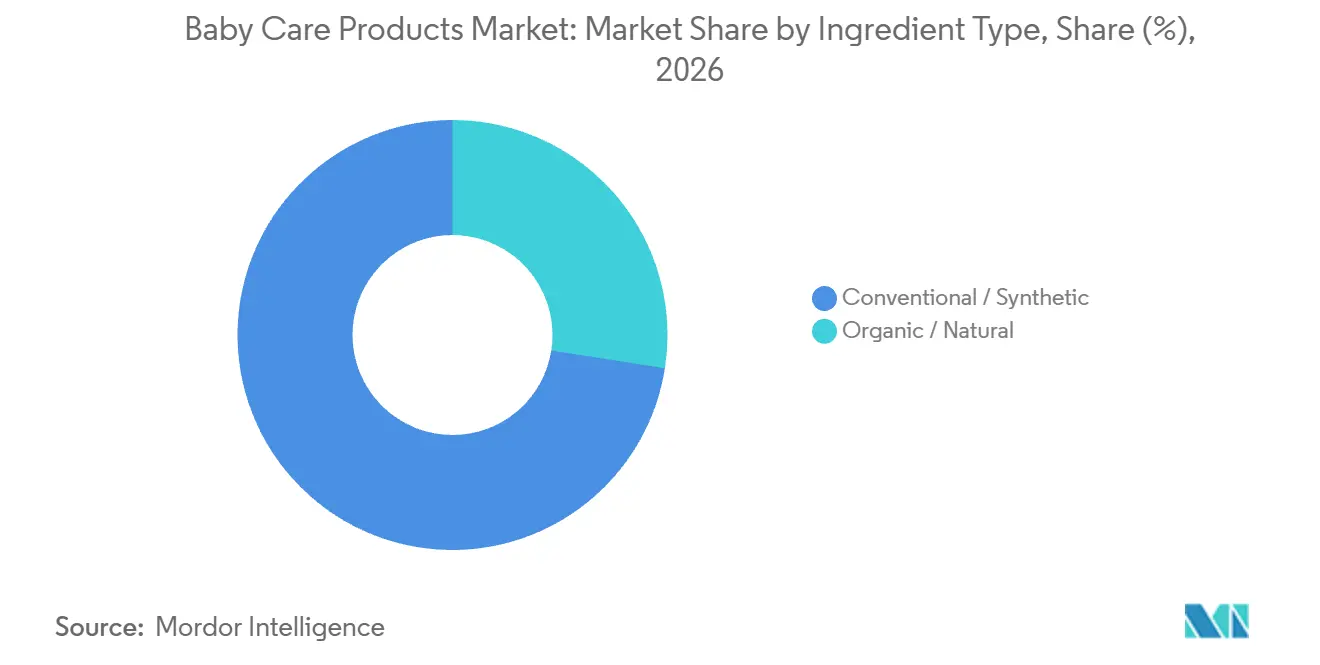
- Within the ingredient mix, conventional / synthetic products led with a 72.53% share of the baby care products market size in 2026, whereas organic / natural products are forecast to grow fastest at 6% CAGR over 2027-2032.
- Across age groups, toddlers (1-3 years) led with a 61.86% share in 2026, while infants (0-1 year) are forecast to grow fastest at 5.25% CAGR over 2027-2032.
- Distribution channels were led by supermarkets / hypermarkets with a 36.23% share in 2026, and online retail stores are forecast to be the fastest-growing segment at 6.3% CAGR over 2027-2032.
- Geographically, North America held a 35.15% share in 2026, while Asia-Pacific is forecast to grow fastest at 5.05% CAGR over 2027-2032.
Note: Market numbers in this report are based on Mordor Intelligence's proprietary estimation framework, which combines nine months of actuals with Q4 projections for base year 2026.
Market Trends and Insights
Drivers Impact Analysis of Baby Care Products Market*
| Driver | (~) % Impact on CAGR Forecast | Geographic Relevance | Impact Timeline |
|---|---|---|---|
| Concerns over infant hygiene and health | +1.8% | United States of America | Short term (≤ 2 years) |
| Premiumization of baby care SKUs | +2.1% | India and United States | Medium term (2-4 years) |
| Growing infant population | +0.4% | Canada's domestic market | Short term (≤ 2 years) |
| Preference for organic and chemical-free products | +1.5% | United States of America | Medium term (2-4 years) |
| Innovations in product offerings | +0.3% | Americas, Europe and Asia-Pacific | Medium term (2-4 years) |
| Digital parenting influence | +0.2% | Indonesia's domestic market | Short term (≤ 2 years) |
| Source: Mordor Intelligence | |||
Concerns over infant hygiene and health
Meeting infant hygiene needs requires a product offer that households can sustain throughout diaper use. The National Diaper Bank Network's 2026 survey found diaper insecurity among 40% of 1,006 surveyed U.S. households with a diaper-wearing child under 4. Respondents purchased diapers at least sometimes and performed at least 25% of diaper changes at home. Insecurity included insufficient supply, difficulty affording diapers or running out because households could not afford enough. For suppliers, this need creates an opening for accessible diaper provision, with affordability determining how much unmet need can become fulfilled demand. A product strategy centered only on higher unit value would leave this distinct hygiene requirement underserved.
Premiumization of baby care SKUs
Premium baby-care demand extends beyond newborn purchases, giving differentiated products a longer commercial window. A study reported in 2025 found that 62% of surveyed Indian parents opted for premium brands through at least age 2, regardless of price point. Bubs Australia reported continued growth in its U.S. premium goat infant formula segment in the year ended June 30, 2026. Separately, the company's total U.S. revenue increased 24% in that fiscal year. Bubs' performance demonstrates premium demand at the infant stage, while the Indian preference points to toddler retention as a further opportunity for differentiated brands.
Growing infant population
A rising birth cohort creates a local volume opportunity by adding potential first-year users of baby-care products. Statistics Canada reported a preliminary 372,521 live births in Canada in 2025, up 1.6% from 2024 among mothers usually resident in Canada. A larger pool of users can support unit sales even if spending per child is unchanged. The 2025 cohort enters toddlerhood during the early forecast years, extending the duration of the Canadian opportunity. The initial lift reaches formula, baby food and diaper sellers in Canada before toddler categories, giving suppliers a sequence of age-specific sales opportunities.
Preference for organic and chemical-free products
Organic positioning creates a measurable demand opportunity when it translates parental preferences into purchases of food and formula. U.S. consumer sales of organic baby food and formula reached USD 1.72 billion in 2025, up 8.8%, as parents prioritized organic for babies and toddlers.[1] These products represented 11% of U.S. organic grocery consumer sales in the same year. The growth occurred within a category that already represented a substantial portion of organic grocery spending. This gives organic grocery suppliers a case for dedicated baby-food and formula investment, with demand spanning infant feeding and toddler nutrition.
Restraints Impact Analysis of Baby Care Products Market*
| Restraint | (~) % Impact on CAGR Forecast | Geographic Relevance | Impact Timeline |
|---|---|---|---|
| Potential health concerns related to chemical residues | -0.6% | United States of America | Short term (≤ 2 years) |
| Stringent regulatory environment | -0.5% | United States of America | Medium term (2-4 years) |
| Falling birth-rates in OECD nations | -0.4% | Germany and France | Long term (≥ 4 years) |
| Complexity of ingredient formulations | -0.3% | United States of America | Medium term (2-4 years) |
| Source: Mordor Intelligence | |||
Potential health concerns related to chemical residues
Potential elevated lead contamination can prompt a baby-food recall before any illness is reported. In May 2025, Publix recalled GreenWise Pear, Kiwi, Spinach & Pea baby food in 4-ounce pouches over potential elevated lead contamination. Bowman Andros LLC produced the affected pouches, which Publix removed from shelves across its 8-state U.S. operating area. Publix offered a full refund to customers returning the affected product to a local store. The commercial cost extended beyond customer returns to foregone selling opportunities for both Bowman Andros and Publix across the affected product line's distribution footprint.
Stringent regulatory environment
New formula suppliers face a commercial timing barrier even when they have a product ready for introduction. U.S. manufacturers must notify the FDA at least 90 days before introducing a new infant formula into interstate commerce. They may not market that formula until 90 days after filing a complete submission, making completeness central to the entry timetable. For an entrant, the interval separates product preparation from the point when sales can begin, limiting the speed of its response to a demand opening. Established and new suppliers must therefore align introduction schedules with the filing requirement, leaving a mandatory delay before the new offer can reach buyers.
*Our forecasts treat driver/restraint impacts as directional, not additive. The impact forecasts reflect baseline growth, mix effects, and variable interactions.
Baby Care Products Market Segment Analysis
By Product Type:
Nutrition Scale and Higher-Value Skin CareBaby food and beverages accounted for a 42.38% share of the baby care products market size in 2026, making it the largest segment. In 2025 reporting, First Pacific described Indofood's Nutrition & Special Foods division as a leading baby food producer in Indonesia. The division reported annual capacity of approximately 25,000 metric tons across baby, child, family and maternal nutrition products. Its baby-food range includes cereals and snacks such as rice puffs, crackers and biscuits for infants and toddlers. The division also makes cereal drinks for families and milk for expectant and lactating mothers, placing its Indonesian baby-food operation within a broader nutrition portfolio.
Baby skin care is forecast to be the fastest-growing segment at 6.27% CAGR over 2027-2032. Pigeon reported growth in its Japan Baby Care business, covering childcare and women's products, in the first half of 2026. It identified skin care among the high-value-added product categories that led the increase, connecting the care offer with company-reported commercial momentum. Akachan Honpo began selling Pigeon's 470 g Baby Milk Lotion Vaseline-in exclusively in its nationwide Japanese stores and online shop on November 28, 2025. The retailer attributed the larger format to customer requests for daily use, making pack size part of the value proposition alongside the skin-care formulation.


By Ingredient Type:
Conventional Materials Anchor Production ScaleConventional / synthetic products represented a 72.53% baby care products market share in 2026, making them the largest segment. In provisional FY2025 figures, Focus International Group reported producing 109 million baby pull-ups at its China facility. Its product portfolio used conventional materials including nonwoven fabrics and hot-melt adhesives during the reported period. The link between these conventional inputs and the producer's finished-pull-up volume illustrates their use at commercial scale.
Organic / natural products are forecast to be the fastest-growing segment at 6% CAGR over 2027-2032. Once Upon a Farm reported approximately USD 134 million in U.S. retail sales for its organic pouch portfolio in the 52 weeks ended December 28, 2025, using SPINS U.S. MULO data. That portfolio extends from babies into older child nutrition, creating several uses for a common format and organic brand identity. For suppliers, age-specific nutrition can differentiate products within the pouch range, directing expansion toward distinct feeding needs while retaining a common format.
By Age Group:
Toddler Scale and Infant Nutrition GrowthToddlers (1-3 years) held the largest segment share at 61.86% in 2026. Once Upon a Farm reported the highest U.S. retail sales velocity for Baby & Toddler Snacks in the 12 weeks ended December 28, 2025, citing SPINS U.S. MULO data. Toddler Bars were among the product lines named in that velocity ranking. Once Upon a Farm's Dry Baby Snacks ranked second in the category by dollar sales for that period. The velocity result gives toddler snacks a product-level selling proposition, while the separate dollar-sales ranking places the broader dry-snack business within its retail category.
Infants (0-1 year) are forecast to be the fastest-growing segment at 5.25% CAGR over 2027-2032. Danone reported competitive double-digit growth in infant milk formula across Latin America in Q2 2026. Its 2025 filing described a Latin American Specialized Nutrition business serving infants and adults, with Aptamil among the global brands distributed across markets. For Danone, further formula sales can build on that regional nutrition presence, with a distinct first-year feeding proposition alongside products serving adult needs.
By Distribution Channel:
Store Productivity and Online Unit GrowthSupermarkets / hypermarkets held the largest segment share at 36.23% in 2026. Once Upon a Farm's retail customers include grocery chains such as Kroger and Publix. Across its baby-aisle cooler program, management estimated an annual run rate of approximately USD 12,000 in-store retail sales per cooler, based on the 6 weeks ended December 28, 2025. The coolers feature pouches and baby food meals, connecting a dedicated fixture with product presentation at the point of purchase. This gives supermarket suppliers a fixture-level sales proposition for discussing baby-food space with grocery customers.
Online retail stores are forecast to be the fastest-growing segment at 6.3% CAGR over 2027-2032. Butong Group's online baby-care product sales in China rose from 73.2 million units in the 6 months ended June 30, 2024, to 107.3 million units in the 6 months ended June 30, 2025. The company sold these products online while outsourcing their production, demonstrating a sales model with external manufacturing. Coordination with production partners therefore becomes central to fulfilling higher online unit demand, connecting a brand's digital expansion with a dependable flow of externally manufactured finished goods.
Geography Analysis
North America Baby Care Products Market
North America accounted for a 35.15% share of the baby care products market size in 2026. The U.S. Census Bureau estimated 3,618,898 U.S. residents aged 0 on July 1, 2025. Ontex Group NV tripled its North American production capacity for baby pants in 2025, adding a product-specific manufacturing expansion within the region. These conditions connect a substantial newborn cohort with an expanding supply base for baby hygiene, giving manufacturers both a demand population and a route to serve it. Additional baby-pants manufacturing capability creates an opening to serve this cohort as children move through early childhood, with orders determining the return on that capacity.
Asia-Pacific Baby Care Products Market
Asia-Pacific is forecast to be the fastest-growing geography at 5.05% CAGR over 2027-2032, with Indonesia illustrating the combination of brand development and digital sales. PZ Cussons reported 10.2% Indonesia revenue growth in the year ended May 31, 2026, driven by Cussons Baby with improvements in both price/mix and volume. Its Indonesia e-commerce revenue grew over 50% in the same period, with strong growth in TikTok Shop and Shopee. For this Indonesian business, marketplace growth accompanied a stronger overall sales mix, supporting a strategy that takes differentiated baby-care ranges into online channels.
In South America, Kimberly-Clark's 2025 Brazil diaper relaunch preceded 22% premium sales growth and a 40-basis-point share gain over the latest 3 months of 2026 versus a year earlier, supporting local portfolio renewal. In Europe, EU rules prohibit nutrition and health claims on infant formula and require operators to notify national authorities when placing infant formula on the market. Those duties make the permissible product message part of the commercial offer, constraining how formula producers communicate differentiation to parents. In Middle East and Africa, Shoprite ended June 2026 with 8 stand-alone Little Me stores in South Africa after net closures of 3, while positioning the brand within Checkers Hyper. That format change shifts the local expansion question toward placing baby-care specialism within a larger grocery setting.

Regulatory Framework and Outlook
This comparison covers selected jurisdictions from the perspective of an established manufacturer producing and selling baby cosmetics locally. Policy attractiveness turns on the work required to register, demonstrate safety and keep product claims compliant. Recurring obligations and ingredient controls influence how readily a product proposition can be maintained across countries, making regulatory execution part of the commercial operating model.
Regulatory Table of Baby Care Products Market
| Decision factor | United States | Brazil | Germany | China | Saudi Arabia |
|---|---|---|---|---|---|
| Primary authority | FDA | Anvisa | Competent state and local cosmetics supervisory authorities | National Medical Products Administration | Saudi Food and Drug Authority |
| Key instruments or direction | MoCRA facility registration and product listing, with specified small-business exemptions | RDC 907/2024 and 2026 restricted/prohibited substance lists | EU Cosmetics Regulation 1223/2009 and § 3 Kosmetik-Verordnung | Manufacturing licensing and child-specific quality and safety provisions | SFDA.CO/GSO 1943:2024 and SFDA.CO/GSO 2528:2024 |
| Commercial effect | Biennial facility renewals and annual listing updates for covered firms | Simplified shampoo/soap notification; registration for children's sunscreen and insect repellent | Premarket safety report and manufacturing/import-location notifications | Licensed local production and children's-cosmetics compliance | Ghad listing and compliance with latest safety requirements and circulars |
| Current policy attractiveness | Medium | High | Medium | Low | Medium |
| Future direction of policy attractiveness | No change | No change | Easing | No change | No change |
| Source: Mordor Intelligence | |||||
Recurring filings support Medium attractiveness and continuity in the United States, while Germany's premarket safety work also merits Medium, with prospective easing under the June 2026 provisional simplification agreement requiring formal approval. China's licensing and child-specific safety duties support Low attractiveness, with announced procedural optimization balanced by stronger risk controls through 2030. Brazil earns High for its simplified shampoo and soap route, while continuing substance-list screening supports continuity after the 2026 updates. Saudi Arabia's Ghad listing and safety/claims requirements support Medium attractiveness and continuity around those operative duties.
Value Chain Stages
The value chain compares how material suppliers, finished-product manufacturers and retailers earn revenue while resolving different operating constraints. On February 17, 2025, Avgol, an Indorama Ventures company, opened a nonwovens production line in Mocksville, North Carolina, completing a USD 100 million investment.[2] Its stated customer industries included baby diapers, adult incontinence and feminine care, linking baby-product inputs to a broader hygiene-material manufacturing base. That shared input base makes material capability and dependable conversion into finished products complementary sources of commercial value.
Value Chain Analysis Table of Baby Care Products Market
| Primary activity | Key participants | Value capture | Bottleneck | Resilience response |
|---|---|---|---|---|
| Material supply | Ingredient suppliers such as BASF; nonwoven producers such as Avgol, an Indorama Ventures company | Ingredient and nonwoven material sales | Matching formulation and fabric specifications with available capacity | Qualify suitable material alternatives before increasing production |
| Finished-product manufacturing | Baby hygiene manufacturers such as Unicharm Corp. and Kimberly-Clark Corp. | Branded product sales, recognized on delivery by Unicharm | Maintaining product consistency as production changes | Validate process changes against finished-product requirements |
| Retail distribution | Grocery retailers such as Walmart U.S. | Retail merchandise sales | Potential merchandise transport disruption or delay | Arrange alternative replenishment routes for affected merchandise |
| Source: Mordor Intelligence | ||||
In fiscal 2025, Unicharm recognized product-sale revenue when its customers obtained control on delivery, connecting manufacturing earnings to a completed downstream handoff. Retail execution adds another dependency because Walmart identifies supplier raw-material availability and merchandise transport delays as risks to its wider operations. A transport delay could consequently defer a delivery-based manufacturer's revenue recognition while disrupting retailer access to merchandise, exposing both stages before the consumer purchase.
Competitive Landscape
Competition is moderately concentrated around multinational nutrition and personal-care suppliers, alongside brands addressing particular feeding and hygiene needs. Nestlé S.A. supplies infant nutrition, Kimberly-Clark Corp.'s portfolio includes Huggies, and Unicharm Corp. sells Moony and Mamy Poko baby diapers. Kenvue sells Johnson's Baby shampoo and lotion in the United States, while Procter and Gamble Co. develops Pampers preemie diapers. Nestlé reported declining Infant Nutrition sales in its Zone Americas in 2025, citing Gerber challenges and Nido supply constraints in the first half. That result shows how a broad branded portfolio can remain exposed to product-level operating constraints, creating a competitive opening around dependable execution.
On November 3, 2025, Kimberly-Clark agreed to acquire Kenvue. Shareholders of both companies approved the necessary proposals on January 29, 2026, and closing remained subject to regulatory approvals and other customary conditions. The transaction remained pending on October 13, 2026. A completed combination would bring Kimberly-Clark's Huggies and Kenvue's U.S. Johnson's Baby shampoo and lotion under one owner, broadening the brands that supplier could offer in retail assortment negotiations.
The November 2025 ByHeart infant-formula recall in the United States followed a multistate botulism outbreak. On December 12, 2025, the FDA sent warning letters to Walmart, Target, Kroger and Albertsons after they continued selling the recalled formula for days or weeks. The warnings focused on retailer handling of the withdrawn product, connecting the formula brand's product problem with its route to buyers. The letters show that retailers can face regulatory action when recalled formula stays on sale, making withdrawal speed a channel-level exposure for formula brands. For established infant-nutrition suppliers such as Nestlé, this makes retail recall communication a competitive capability alongside formula production.
Baby Care Products Industry Leaders
-
Nestlé S.A.
-
Kimberly-Clark Corp.
-
Unicharm Corp.
-
Kenvue
-
Procter and Gamble Co.
- *Disclaimer: Major Players sorted in no particular order

Baby Care Products Market Companies Covered in this Report
- Procter and Gamble Co.
- Kimberly-Clark Corp.
- Kenvue
- Unicharm Corp.
- Nestlé S.A.
- Danone S.A.
- Abbott Laboratories
- Royal FrieslandCampina N.V.
- Unilever PLC
- Himalaya Global Holdings Ltd.
- Beiersdorf AG
- Expanscience Labs (Mustela)
- Artsana S.p.A. (Chicco)
- Honasa Consumer Ltd. (Mamaearth)
- The Honest Company Inc.
- Pigeon Corp.
- Kao Corp.
- Dabur India Ltd.
- Meiji Co. Ltd.
- Abena A/S (Bambo Nature)
Key Opportunities for Market Participants
These opportunities compare how baby-care producers can turn different regulatory timelines into saleable product readiness. An active packaging framework, a future disclosure duty and a nutrient-modernization plan call for different levels of commitment. Manufacturers can advance changes with defined requirements while preserving flexibility where the eventual product specification depends on a scientific review.
Market Opportunities Table of Baby Care Products Market
| Opportunity | Why now | Buyer / lead segment | Recommended play | Main barrier | Likely beneficiaries |
|---|---|---|---|---|---|
| Evidence-backed infant-formula options | FDA planned nutrient-modernization work to begin during 2026 | U.S. infant-formula buyers | Prepare formulation options supported by scientific evidence | Final nutrient revisions depend on the review | Formula producers such as Abbott Laboratories |
| Baby-care products with adapted packaging | EU packaging rules began phased application on August 12, 2026 | Buyers of packaged baby-care products in the EU | Align pack redesign with each applicable implementation phase | Preserving pack function while changing its design | Diaper brands such as Procter and Gamble Co. |
| Ingredient-transparent children's diapers | California's enacted AB 1901 disclosure schedule | California children's-diaper buyers | Build traceable records for intentionally added ingredients in covered diapers | Traceability of intentionally added ingredients | Diaper producers such as Procter and Gamble Co. |
| Source: Mordor Intelligence | |||||
California's AB 1901 will require children's-diaper manufacturers to disclose intentionally added ingredients in covered products online from January 2029 and on packaging from July 2029.[3] This creates an executable opening for brands that can make ingredient information ready for both digital and physical product presentation. It directs effort toward traceability for the finished diaper, while nutritional reformulation remains conditional on the outcome of the FDA's planned review.
Recent Industry Developments in Baby Care Products Market
- Oct 2026: Kimberly-Clark Corp. launched its Big Dreams diapers and wipes collection on October 19 exclusively in Amazon's U.S. stores.
- Sep 2026: California enacted AB 1901, requiring children's-diaper manufacturers to disclose intentionally added ingredients online from January 2029 and on packaging from July 2029.
- Jun 2026: Pura announced a relaunch of its diaper and wipes range on June 30, with enhanced product features and new packaging.
Baby Care Products Market Report Scope and Research Methodology
Market Definition and Coverage
The baby care products market measures annual consumer spending on finished products bought for infant and toddler care at retail point of sale worldwide. It covers products for their skin, hair, hygiene and toiletry needs, including diapers and wipes, and foods and beverages formulated for them.
Scope exclusions: Baby gear and durable baby kits such as strollers, car seats, monitors, and safety gates, baby apparel and toys, and raw ingredients and packaging sold separately to product manufacturers are excluded.
Segments Covered in This Report
- By Product Type
- Baby Skin Care
- Baby Hair Care
- Baby Toiletries
- Bath and Fragrances
- Diapers and Wipes
- Baby Food and Beverages
- By Ingredient Type
- Organic / Natural
- Conventional / Synthetic
- By Age Group
- Infants (0-1 Year)
- Toddlers (1-3 Years)
- By Distribution Channel
- Supermarkets / Hypermarkets
- Pharmacies / Drug Stores
- Online Retail Stores
- Other Distribution Channels
- By Geography
- North America
- United States
- Canada
- Mexico
- Rest of North America
- South America
- Brazil
- Argentina
- Colombia
- Chile
- Rest of South America
- Europe
- United Kingdom
- Germany
- France
- Italy
- Spain
- Russia
- Sweden
- Belgium
- Poland
- Netherlands
- Rest of Europe
- Asia-Pacific
- China
- Japan
- India
- Thailand
- Singapore
- Indonesia
- South Korea
- Australia
- New Zealand
- Rest of Asia-Pacific
- Middle East and Africa
- United Arab Emirates
- South Africa
- Saudi Arabia
- Nigeria
- Egypt
- Morocco
- Turkey
- Rest of Middle East and Africa
- North America
Data Sources, Market Sizing, and Validation
Desk Research
The United Nations Children's Fund's child health publications, World Bank fertility indicators, Eurostat birth and fertility statistics, and U.S. Department of Agriculture Economic Research Service organic market reports provide evidence on child health context, cohort trends, organic product positioning, and regional differences. National statistical releases can inform age-group and country-level demand estimates, while regulatory materials from food and product-safety authorities help track requirements affecting infant nutrition and personal-care products. These sources are used alongside trade and customs information, association publications, patent records, and peer-reviewed research to examine product innovation, supply chains, and market context.
Company filings, annual reports, investor presentations, and reputable business press provide cross-checks on product portfolios, retail reach, pricing or mix commentary, and reported operating trends. These company-level disclosures and industry sources help interpret market signals alongside the market model. The named sources are illustrative and not exhaustive, and further sources inform collection, validation and clarification.
Primary Interviews and Surveys
Interviews and structured surveys with senior executives, category and regional business leaders, and managers responsible for product, sales, marketing, procurement, and retail accounts can test secondary findings on product mix, channel use, pricing, and regional demand. Responses can clarify missing segment or country inputs and explain differences between reported company activity and consumer retail sales, with estimates triangulated against demographic, regulatory, company, and trade evidence before gaps are addressed through documented assumptions or additional source checks.
Distribution of primary research fieldwork respondents
| Company type | Respondent position | Region |
|---|---|---|
| Top tier: 36% | CXOs: 22% | APAC: 40% |
| Mid tier: 42% | Functional/Unit leaders: 34% | EMEA: 28% |
| Smaller Players: 22% | Managers: 44% | Americas: 32% |
Market-Sizing & Forecasting
The estimate starts with a top-down model of worldwide consumer retail spending on finished products for infants and toddlers, then checks selected country and product totals through channel evidence and sampled retail price times unit-volume estimates. The value series uses retail prices and product mix across baby skin and hair care, toiletries including diapers and wipes, and baby food and beverages. The volume series tracks units sold separately, so price and mix changes can move value differently from unit demand. Births and the population aged 0 to 3 indicate the potential user base, household income and food or consumer-price measures inform spending capacity and price movement, retail-channel development indicates access, and organic product and regulatory signals help explain mix and category growth. Product, ingredient, age, channel, and regional shares are built from reported category sales, product ranges, retail availability, demographic distributions, and channel evidence, with totals reconciled to the global market. A multivariate regression can relate historical value and unit demand to these indicators where observations support it, while scenario analysis addresses structural changes such as fertility shifts, regulatory changes, and channel adoption. Primary respondents can check whether variable-level forecast assumptions reflect product and retail conditions. Where country, product, or channel data are missing, analysts can use adjacent-period trends and comparable markets, document the assumption, and test it against available company disclosures and sampled price-volume checks before carrying it into the estimate.
Data Validation & Update Cycle
Analysts triangulate the market model against independent demographic, retail, company, regulatory, and trade signals, then investigate unusual growth, share movements, and differences between value and unit trends before sign-off. A second analyst reviews source definitions, calculations, boundary consistency, and the explanation for each material variance, with re-contact or further source checks triggered when respondent evidence conflicts with published data or a key input changes. The model is refreshed annually, updated between cycles when material events alter demand or supply, and reviewed in a fresh pre-delivery pass.
Mordor Intelligence's Baby Care Products Market Estimate Compared With Other Published Estimates
Published estimates can differ in the transactions and products they count and the inputs used to model demand. The baby care products market measures annual consumer spending on finished products bought for infant and toddler care at retail point of sale worldwide.
Key Gap Drivers include the study's defined coverage and market-specific modeling choices. A multivariate regression can relate historical value and unit demand to these indicators where observations support it, while scenario analysis addresses structural changes such as fertility shifts, regulatory changes, and channel adoption.
Benchmark comparison
| Source | Market Size | Gaps in Research Methodology |
|---|---|---|
| Mordor Intelligence | Value: USD 186.4 B (2027) / Volume: 53.25 billion Units (2027) | |
| Global Consultancy A | USD 130 B (2025) | The earlier measurement year can contribute to the lower estimate as market activity grows. |
| Global Consultancy B | USD 223.83 B (2026) | The stated product pool includes feeding accessories beyond this report's finished-product categories. |
Mordor Intelligence's analysts triangulate the market model against independent demographic, retail, company, regulatory, and trade signals, then investigate unusual growth, share movements, and differences between value and unit trends before sign-off.
Key Questions Answered in the Report
What is the Baby Care Products market size and growth outlook?
The market is expected to reach USD 186.4 billion in 2027 and USD 233.2 billion by 2032, at 4.58% CAGR over 2027-2032.
Which forces support demand for baby-care products?
Premium-brand preferences and organic nutrition purchases support demand. A study reported in 2025 found that 62% of surveyed Indian parents chose premium brands through at least age 2, regardless of price point.
Which baby-care product category leads sales?
Baby food and beverages held the largest share at 42.38% in 2026. Baby skin care is forecast to grow fastest at 6.27% CAGR over 2027-2032.
Which companies participate in the baby-care industry?
Major participants include Nestlé S.A., Kimberly-Clark Corp., Unicharm Corp., Kenvue, and Procter and Gamble Co., covering nutrition and personal care.
What challenge can slow new infant-formula offerings?
In the United States, manufacturers must notify the FDA at least 90 days before interstate introduction and may not market a new formula until 90 days after filing a complete submission.
Which region leads baby-care sales and which is growing fastest?
North America held a 35.15% share in 2026. Asia-Pacific is forecast to be the fastest-growing geography at 5.05% CAGR over 2027-2032.