
Baby Bassinet Market Size and Share
Market Overview
| Study Period | 2020 - 2031 |
|---|---|
| Market Size (2026) | USD 1.27 Billion |
| Market Size (2031) | USD 1.68 Billion |
| Growth Rate (2026 - 2031) | 5.84 % |
| Fastest Growing Market | Asia-Pacific |
| Largest Market | North America |
| Market Concentration | Medium |
Major Players *Disclaimer: Major Players sorted in no particular order Image © Mordor Intelligence. Reuse requires attribution under CC BY 4.0. | |
Baby Bassinet Market Analysis by Mordor Intelligence
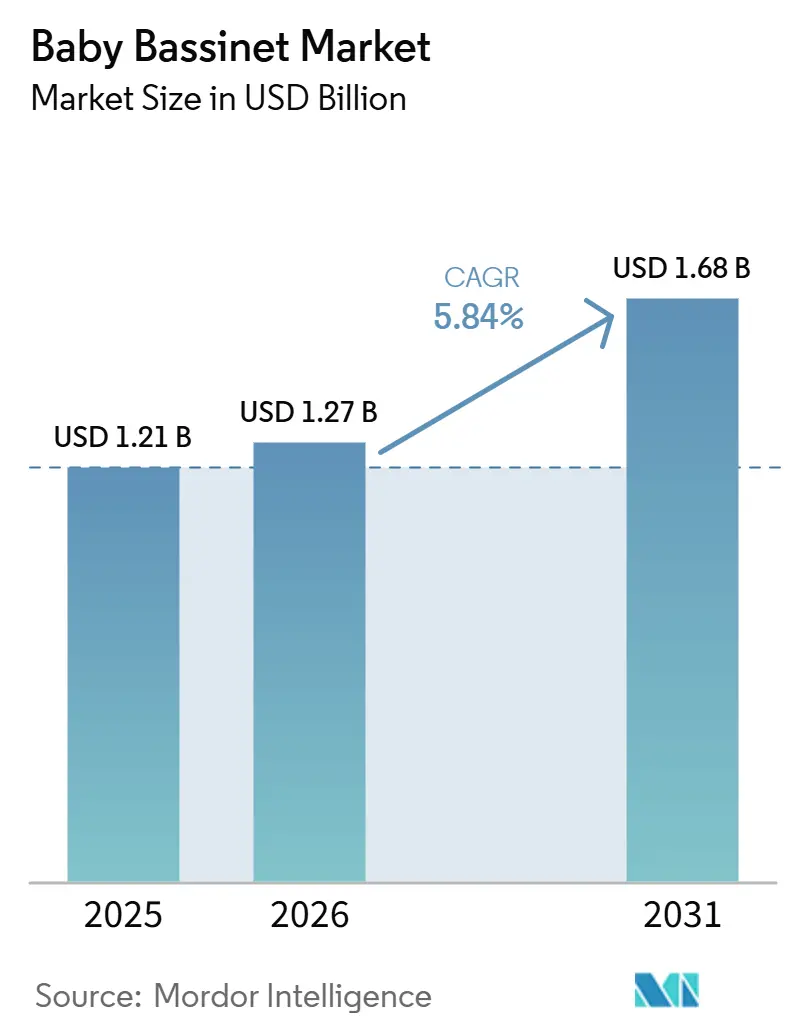
The baby bassinet market is expected to grow from USD 1.21 billion in 2025 to USD 1.27 billion in 2026 and is forecast to reach USD 1.68 billion by 2031, at a 5.84% CAGR over 2026-2031. Bassinets remain a staple baby-registry item, which helps stabilize first-purchase demand. The United States Consumer Product Safety Commission (CPSC), on December 12, 2025, finalized a direct final rule incorporating ASTM F2194-25 as the mandatory bassinet and cradle safety standard, effective February 21, 2026, extending sleep surface angle restrictions to all bassinet types, including stationary models, and applying new requirements to aftermarket mattresses[1]. This regulatory shift is simultaneously raising the quality floor and narrowing the addressable product field to compliant designs, creating a market dynamic that rewards early-movers in design compliance.
Key Report Takeaways
- By product type, bedside bassinets led with 66.41% of the baby bassinet market share in 2025, while In-Bed bassinets are projected to expand at a 6.86% CAGR through 2031.
- By portability, portable bassinets held 63.25% of the baby bassinet market share in 2025 and are projected to sustain a 6.56% CAGR through 2031, reflecting continued leadership in both scale and growth velocity.
- By connectivity, traditional bassinets accounted for 79.51% of the baby bassinet market share in 2025, whereas smart and connected bassinets are forecast to grow at a 7.35% CAGR through 2031.
- By distribution channel, offline channels held 57.81% of the baby bassinet market share in 2025, whereas online channels are forecast to grow at a 7.13% CAGR through 2031.
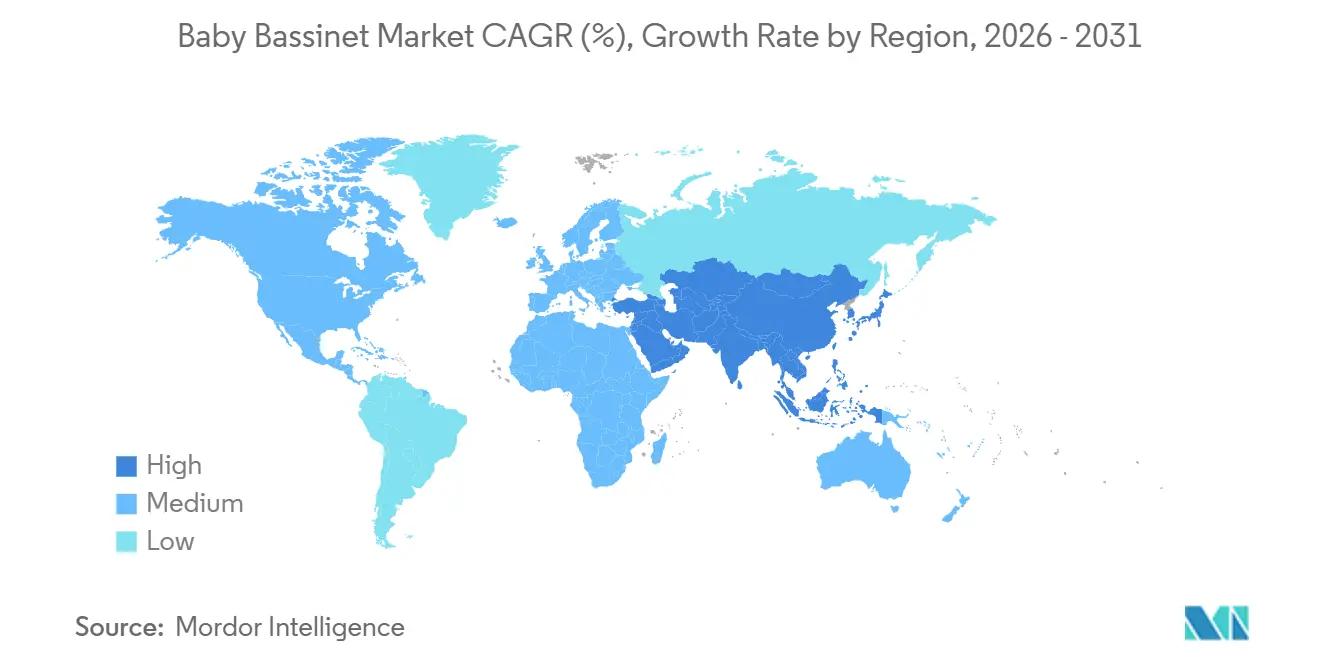
- By geography, North America led the baby bassinet market with 36.25% share in 2025, while Asia-Pacific is projected to expand at a 7.42% CAGR through 2031.
Note: Market size and forecast figures in this report are generated using Mordor Intelligence’s proprietary estimation framework, updated with the latest available data and insights as of January 2026.
Market Trends and Insights
Drivers Impact Analysis of Baby Bassinet Market*
| Driver | (~) % Impact on CAGR Forecast | Geographic Relevance | Impact Timeline |
|---|---|---|---|
| Rising Safe Sleep Awareness and Infant Safety Compliance | +1.3% | Global, with concentrated effect in North America and Europe | Short term (≤ 2 years) |
| Growth of Space-Saving In-Bed and Bedside Bassinets | +0.8% | North America, Europe, Asia-Pacific urban cores | Medium term (2-4 years) |
| Premiumization Through Smart and Connected Features | +1.2% | North America, Europe, East Asia | Medium term (2-4 years) |
| Expansion of Online-First Nursery Product Discovery and Purchase | +0.9% | Global, with early gains in Southeast Asia and Middle East and Africa | Medium term (2-4 years) |
| Hospital, NICU, and Postpartum Demand for Trusted Sleep Products | +0.5% | North America, Europe, Gulf Cooperation Council | Long term (≥ 4 years) |
| Increasing Demand for Low-Emission, Non-Toxic, and Sustainable Materials | +0.6% | Europe, NORDICS, North America | Long term (≥ 4 years) |
| Source: Mordor Intelligence | |||
Rising Safe Sleep Awareness and Infant Safety Compliance
Safe sleep education has moved beyond public health messaging and now influences product design, store acceptance, and brand positioning in the baby bassinet market. CPSC data covering 2019 to 2021 showed an annual average of more than 170 infant deaths tied to nursery products, with unsafe sleep environments and soft bedding remaining a major concern, which keeps safety compliance central to parent decision-making[2]. The December 2025 direct final rule that incorporates ASTM F2194-25, effective February 21, 2026, extends tighter sleep-surface angle requirements to all bassinets and also covers aftermarket mattresses, thereby materially raising the compliance bar for the baby bassinet market. That change narrows shelf access for legacy or weakly engineered products and shifts retailer preference toward brands that can document conformity early. It also strengthens the commercial value of trust, because products associated with clinical safety language or hospital use carry stronger word-of-mouth momentum in the baby bassinet market.
Growth of Space-Saving In-Bed and Bedside Bassinets
Compact homes and shared-bedroom sleeping patterns continue to drive demand for in-bed and bedside formats across the baby bassinet market. These products fit the daily routines of new parents because they keep infants within reach during feeding, monitoring, and overnight recovery, while still preserving a separate infant sleep surface. The Couplet Care Bassinet entered commercial hospital use in the United States in October 2024. Hospitals used it to keep infants closer to their mothers during care and to reduce the need to move infants outside the hospital room. That evidence supports the broader baby bassinet market because it connects bedside sleep architecture with measurable workflow and care benefits instead of only consumer convenience. As a result, formats that support room sharing without bed sharing are likely to remain a durable growth base for the baby bassinet market through the forecast period.
Premiumization Through Smart, Connected, and Sustainable Materials
Smart and Connected bassinets are the fastest-growing connectivity segment in the baby bassinet market, with a 7.35% CAGR through 2031, indicating that parents are placing greater value on automated soothing and monitoring functions. The premium tier is also being shaped by product claims tied to clinical validation, as Happiest Baby states that SNOO became the first baby bed to receive FDA De Novo authorization for keeping sleeping infants in the supine position[3]. Mainstream players are also expanding feature depth, as Graco launched SmartSense in May 2024 with cry detection and more than 1,000 combinations of sound, motion, and vibration, at an MSRP of USD 399.99. At the same time, material safety is becoming part of the premium proposition, because a low-emission, non-toxic positioning now matters more for products kept in parental bedrooms overnight, and brands increasingly highlight certifications such as GREENGUARD Gold. This combination of connected functions, safety-led product language, and cleaner material positioning is raising average price acceptance in the baby bassinet market.
Expansion of Online-First Nursery Product Discovery and Purchase
Online channels are projected to grow at a 7.13% CAGR through 2031, indicating that digital discovery is expanding faster than the baby bassinet market as a whole. Parents increasingly form purchase intent before entering a store, using brand websites, product pages, sleep education content, and review-based comparison as their first screening tools. Direct digital relationships are especially valuable in the baby bassinet market because they allow brands to collect consumer feedback, observe usage patterns, and support product iteration after launch. Happiest Baby links this model to connected usage data and to remote patient monitoring integration with Medicaid Managed Care Plans, demonstrating how digital infrastructure can support both consumer and institutional pathways. Even so, offline retail still matters because many families continue to validate build quality, mattress firmness, and ease of use in person before making a final purchase in the baby bassinet market.
Restraints Impact Analysis of Baby Bassinet Market*
| Restraint | (~) % Impact on CAGR Forecast | Geographic Relevance | Impact Timeline |
|---|---|---|---|
| Short Product Replacement Cycle and Low Repeat Purchase Frequency | -0.7% | Global | Short term (≤ 2 years) |
| Safety Recall Risk and Product Liability Exposure | -0.5% | North America and Europe primarily | Medium term (2-4 years) |
| Space Constraints in Urban Homes and Small Apartments | -0.4% | Asia-Pacific urban cores, Europe, North America metros | Short term (≤ 2 years) |
| Fragmented Price Sensitivity Across Emerging Markets | -0.4% | Asia-Pacific excluding China and Japan, South America, and the Middle East and Africa | Medium term (2-4 years) |
| Source: Mordor Intelligence | |||
Short Product Replacement Cycle and Price Sensitivity in Emerging Markets
The baby bassinet market still faces a hard usage limit because bassinets generally serve infants for only 4 to 6 months, which restricts repeat purchase frequency at the household level. That structure keeps demand closely tied to first-time parents, later births, and institutional buyers, rather than to steady replacement demand across a long ownership cycle. Price pressure is stronger outside high-income markets, where even mid-range bassinets can compete directly with essential household spending and therefore remain discretionary for many families. This challenge is more visible in the baby bassinet industry, where premium product design has advanced faster than cost localization, leaving a wide gap between mainstream global portfolios and the needs of value-oriented buyers. Until more brands build purpose-made offerings for lower price tiers without weakening core safety standards, this demand constraint will continue to limit the full expansion potential of the baby bassinet market.
Safety Recall Risk and Space Constraints in Urban Homes
Safety failures pose an unusually high commercial risk in the baby bassinet market because the end user is a non-verbal infant, and product failure can have severe consequences. That risk is rising rather than fading, because the 2026 compliance shift increases redesign pressure on legacy structures and leaves less room for weak engineering or accessory mismatches. At the same time, urban housing patterns create a separate limit, since smaller apartments reduce the space available for a dedicated infant sleep unit, even when parents value safe sleep arrangements. This is pushing the baby bassinet market toward hybrid, foldable, and convertible designs, but it also caps the number of standalone units that can fit naturally into many homes. In practical terms, brands in the baby bassinet industry must balance safety, compactness, and ease of placement, because failing on any one of those points can narrow adoption.
*Our forecasts treat driver/restraint impacts as directional, not additive. The impact forecasts reflect baseline growth, mix effects, and variable interactions.
Baby Bassinet Market Segment Analysis
By Product Type:
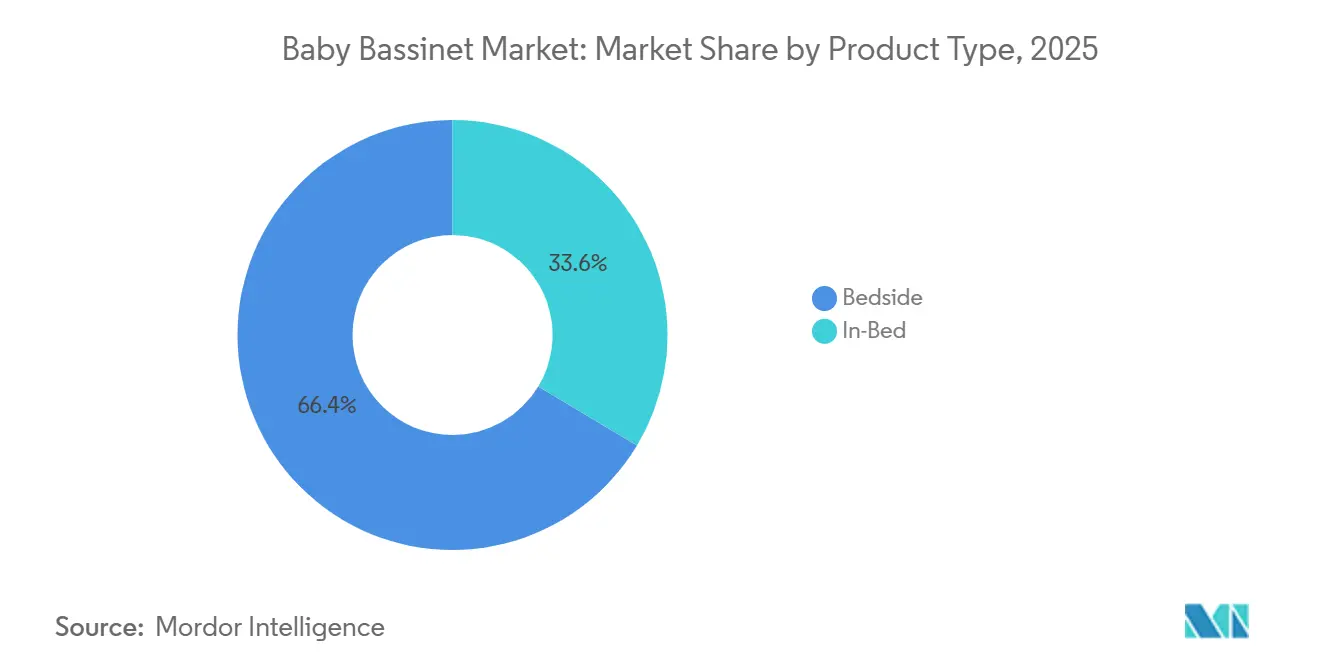
Bedside Leadership Remains Strong While In-Bed Demand Expands FasterBedside bassinets accounted for 66.41% share of the baby bassinet market size in 2025, which confirms that proximity with separation remains the dominant format preference within the baby bassinet market. Their appeal stems from a simple use case: parents can respond quickly at night without having to place the infant on the adult sleep surface. Swivel construction, lowering walls, and easier access during recovery also help explain why this segment has become the default choice for many first-time buyers. In practice, bedside designs sit at the center of category messaging because they combine safety, convenience, and parental reassurance in a single format. That combination keeps Bedside as the anchor segment even as the baby bassinet market moves into a more compliance-driven phase.
In-Bed bassinets are forecast to grow at a 6.86% CAGR through 2031, which makes them the faster-moving product type within the baby bassinet market. Their momentum comes from small-home living patterns and from parents' interest in keeping infant care close during the first months after birth. This format also benefits from guidance that supports room sharing without bed sharing, providing a durable behavioral foundation rather than a short-lived style effect. The baby bassinet market is therefore seeing a two-speed pattern in product type, where Bedside holds the larger installed demand base and In-Bed captures the faster forward expansion. Brands that manage both use cases well are likely to hold stronger positions as compliance, compactness, and convenience become increasingly intertwined in the baby bassinet market.
By Portability:
Portable Designs Lead on Present Scale and Future Use CasesPortable bassinets held a 63.25% share in 2025, indicating this segment already has the largest share base and reflects some of the clearest use-case demand in the baby bassinet market. Parents value products that can move between rooms, fold easily, and fit into changing routines without added setup friction. This matters even more in homes where the bassinet is used in both daytime and nighttime settings rather than in a single fixed nursery position. The segment therefore benefits from urban apartment living, multi-room use, and travel-ready expectations that are now part of many new-parent purchasing decisions. As a result, portable formats remain central to how the baby bassinet market balances practicality and daily convenience.
Portable bassinets are also projected to grow at a 6.56% CAGR through 2031, which shows that leadership in the baby bassinet market is not shifting away from this format. That dual position is notable because many two-part segment structures show scale in one format and faster growth in the other, yet portability is currently holding both back. Products that fold flat, assemble without tools, and remain easy to move are winning first-purchase attention across mainstream buyers. Non-portable designs still matter, especially where style, room aesthetics, and furniture-like presentation influence buying behavior, but their role is narrower in functional terms. Material claims such as low-emission construction and GREENGUARD Gold support premium non-portable positioning, yet portability continues to define the more scalable demand path in the baby bassinet market.
By Connectivity:
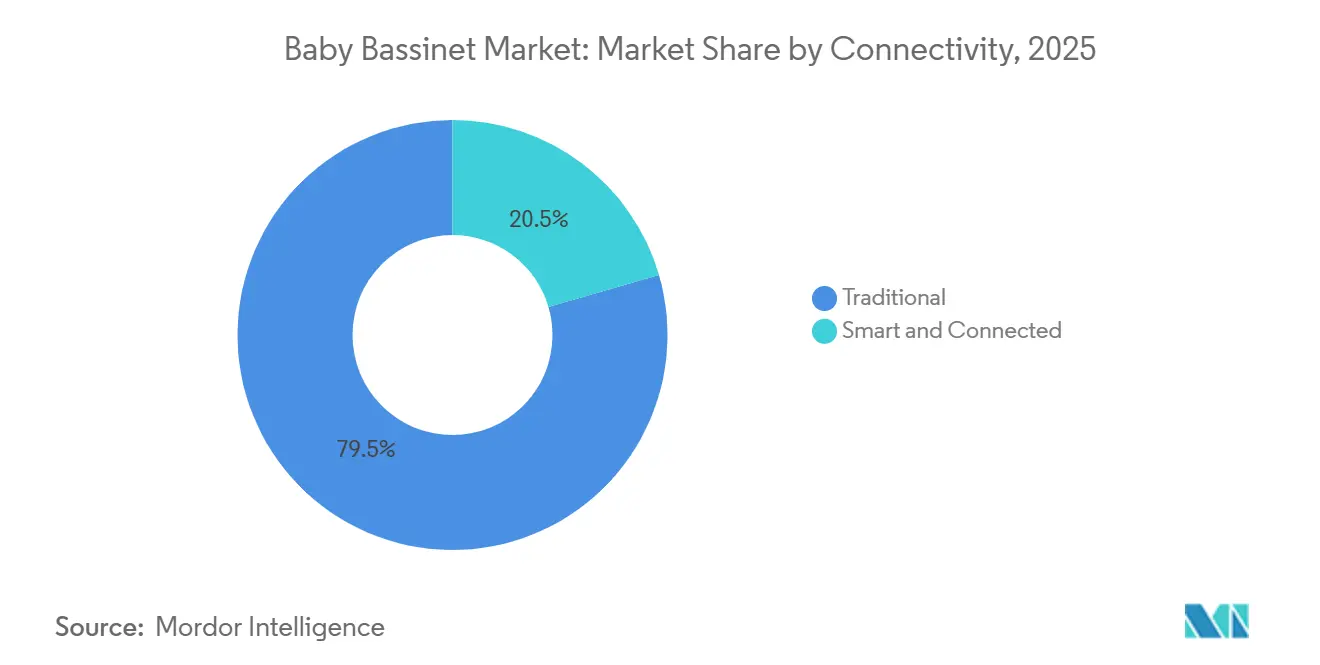
Traditional Volume Holds While Smart Value Builds QuicklyTraditional bassinets held a 79.51% share in 2025, indicating that the baby bassinet market still depends heavily on price-accessible, familiar, and non-connected products. This segment remains the entry point for a broad range of households across both developed and emerging regions. Standard models are easier to position in mainstream retail, and they avoid the price jump that often comes with app integration, sensors, or automated motion. That keeps Traditional bassinets important to the total category volume even as feature expectations continue to rise. In the near term, the baby bassinet market still needs the Traditional segment to drive mass demand and entry-level adoption.
Smart and Connected bassinets are forecast to grow at a 7.35% CAGR through 2031, which makes them the fastest-growing segment in the baby bassinet market. Their appeal lies in the promise of automatic soothing, reduced nighttime interruptions, and a more responsive sleep environment during the early infant stage. Happiest Baby states that SNOO received FDA De Novo authorization and has also tied its hospital pathway to measurable clinician time savings, which gives the premium smart tier a level of clinical differentiation that is still uncommon in the baby bassinet market. Graco has also widened access to smart functionality with SmartSense at MSRP USD 399.99, which is materially lower than the SNOO price point and can pull more buyers into the connected category over time. This means the baby bassinet industry is not moving away from traditional volume overnight. Still, it is building a clear premium and mid-premium smart layer that will carry more of the baby bassinet market’s forward value growth.
By Distribution Channel:
Offline Volume Stays Important While Online Shapes the Next Growth LayerOffline channels held a 57.81% share in 2025, indicating that physical retail remained the largest segment of the baby bassinet market. Parents often want to assess mattress firmness, structure, height, finish quality, and the feel of moving parts before committing to a product that will be used every night. This is especially relevant in a category where safety and building confidence strongly influence conversion. Baby specialty stores, therefore, remain important because they offer guided comparison and curated product selection. For that reason, offline retail continues to anchor current volume in the baby bassinet market, even as digital channels accelerate.
Online channels are forecast to grow at a 7.13% CAGR through 2031, indicating that the next growth layer in the baby bassinet market will be shaped more by digital influence and conversion. Brands gain more than transaction margin in this channel because they also collect product feedback, observe customer questions, and build long-term engagement through owned platforms. Happiest Baby’s connected ecosystem shows how direct relationships can extend beyond purchase into service, monitoring, and institutional linkage, which gives online capability a broader strategic role in the baby bassinet market. The likely outcome is not a full shift away from stores, but rather a more blended channel structure in which online discovery and offline validation work together. That makes channel execution a core competitive factor for the baby bassinet market rather than a simple route-to-market decision.
Geography Analysis
North America Baby Bassinet Market
North America held 36.25% of the baby bassinet market share in 2025, making it the largest regional contributor. The region benefits from strong awareness of infant sleep safety, broad retail availability, and a well-developed brand mix spanning mass, premium, and specialist price points. The United States remains the main volume engine because nursery product purchasing is mature and regulatory visibility is high. The December 2025 rule that made ASTM F2194-25 the mandatory bassinet and cradle safety standard, effective February 21, 2026, is now actively shaping product qualification and shelf readiness across the region. That keeps North America important not only for demand, but also for compliance-led product strategy in the baby bassinet market.
Europe Baby Bassinet Market
Europe remains a substantial part of the baby bassinet market and is defined by strong safety expectations, design sensitivity, and growing interest in sustainable materials. Germany, France, and the United Kingdom remain the largest individual markets in the region, while the NORDICS support a more premium design-led niche within the broader baby bassinet market. Consumers in these countries place more weight on material narratives, bedroom fit, and non-toxic positioning, which supports higher-value product mixes. Certifications and emissions-related claims are therefore more visible in European competition, especially for brands selling bedside and furniture-like models[4].
APAC, MEA and South America Baby Bassinet Market
Asia-Pacific is projected to post a 7.42% CAGR through 2031, and the baby bassinet market size for this region is therefore set to expand faster than any other geography. Growth is being supported by urbanization, more dual-income households, and wider exposure to structured infant sleep products through modern retail and digital channels. The region still spans many price points and adoption stages, which means volume expansion does not always match Western spending levels on a per-unit basis. Even so, the demand base is widening steadily, and that keeps Asia-Pacific central to the future shape of the baby bassinet market. South America, the Middle East, and Africa remain smaller in current scale. Still, their younger demographics and rising brand awareness support longer-term participation in the baby bassinet market, where distribution and pricing are better aligned with local markets.
Competitive Landscape
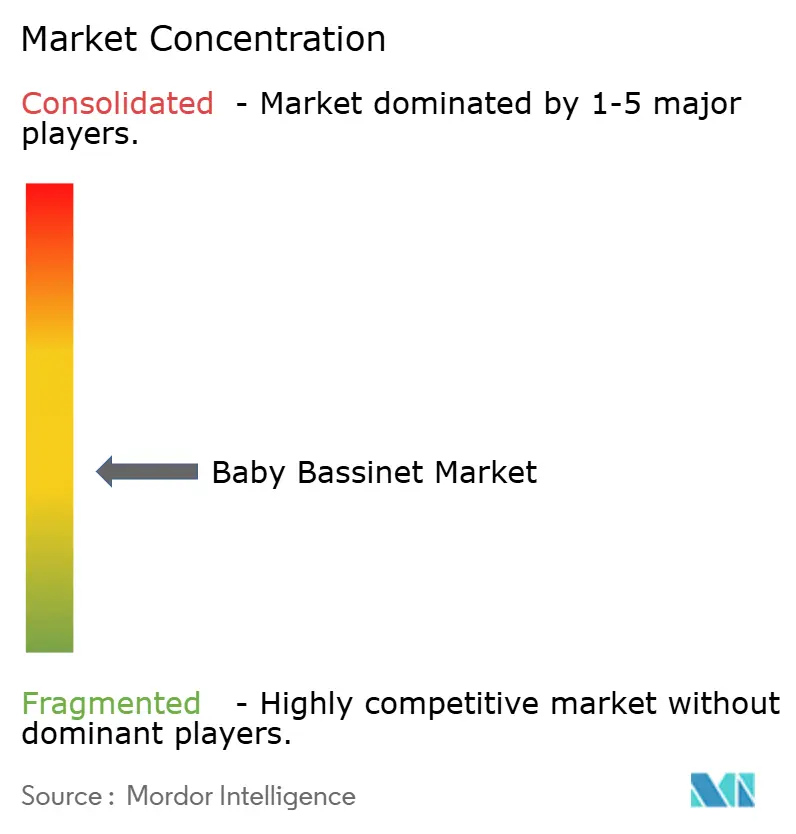
The baby bassinet market is moderately fragmented, with companies competing across distinct price tiers, channel models, and product philosophies rather than around a single, uniform offer. Graco and Chicco remain important mass-market names because they combine broad retail reach with pricing that aligns with mainstream buying behavior. Their advantage comes from familiarity, channel access, and the ability to refresh products across a large installed demand base. Specialist and premium players compete differently, often leaning on a narrower format focus, stronger technology messaging, or cleaner material positioning. This makes the baby bassinet market competitive in layered ways, where volume, innovation, and trust do not always align with the same companies.
HALO holds one of the clearest positions in bedside sleep, and its recent product line shows how brands are expanding across several price points within one format family. The company launched the BassiNest Connected Swivel Sleeper 3.0 in March 2025 at USD 399.99, then the BassiNest Swivel Sleeper 4.0 in February 2026 at MSRP USD 279.99, followed by the BassiNest 4.0 Air in March 2026 at MSRP USD 349.99. That sequence shows a clear strategy to expand coverage across connected, core, and breathable-material positions in the baby bassinet market. Transom Capital’s add-on activity around HALO Dream, BreathableBaby, Baby Merlin, and Child Craft also shows that platform building remains active around trusted nursery brands.
Happiest Baby occupies a different place in the baby bassinet market because SNOO combines premium pricing with a regulatory and clinical narrative that other brands do not yet match. Happiest Baby states that SNOO received FDA De Novo authorization and that clinical research across 44 United States hospitals in 22 states found 2.2 hours of clinician time savings per shift, which strengthens its position in hospital and NICU discussions as well as in premium consumer marketing. Graco has taken a broader-access route into smart functionality through SmartSense, which brings automated soothing features into a lower smart price band and could widen connected adoption over time. The strongest white-space area in the baby bassinet market still appears to be affordable smart models below USD 250 and institutional designs built specifically for postpartum, nursery, and NICU use. Rental models also remain relevant, but the broader competitive outcome in the baby bassinet market will depend most on whether brands can combine safety readiness, compelling features, and accessible pricing without weakening trust.
Baby Bassinet Industry Leaders
-
Graco Children’s Products Inc.
-
Chicco (Artsana Group)
-
Happiest Baby, Inc.
-
BabyBjörn AB
-
HALO Innovations, Inc.
- *Disclaimer: Major Players sorted in no particular order
Baby Bassinet Market Companies Covered in this Report
- Graco Children’s Products Inc.
- Chicco (Artsana Group)
- Newell Brands Inc.
- Happiest Baby, Inc.
- BabyBjörn AB
- Delta Children
- Kids2, LLC
- Goodbaby International Holdings Limited
- HALO Innovations, Inc.
- 4moms
- Dream On Me, Inc.
- Baby Delight, Inc.
- Arm’s Reach Concepts, Inc.
- Kolcraft Enterprises, Inc.
- DaVinci Baby
- Summer Infant, Inc.
- Fisher-Price (Mattel, Inc.)
- Stokke AS
- UPPAbaby
- Micuna S.L.
Recent Industry Developments in Baby Bassinet Market
- March 2026: HALO introduced the BassiNest Swivel Sleeper 4.0 Air, featuring the proprietary DreamWeave breathable mattress pad, a 3D mesh, foam-free, latex-free pad with food-grade polymer construction and zero adhesives, at MSRP USD 349.99, available across Babylist, Amazon, Target, and Walmart.
- February 2026: HALO launched the BassiNest Swivel Sleeper 4.0, redesigned with reinforced structural strength, CPSC-aligned sleep surface stability, and HALO’s signature 360° swivel and patented lowering wall, priced at MSRP USD 279.99.
- December 2025: The United States Consumer Product Safety Commission published a direct final rule adopting ASTM F2194-25 as the mandatory safety standard for bassinets and cradles, effective February 21, 2026, extending sleep surface angle restrictions to all bassinet types and introducing aftermarket mattress compliance requirements.
- March 2025: HALO launched the BassiNest Connected Swivel Sleeper 3.0, equipped with AutoSoothe technology that detects cries and automatically responds with gentle rocking, vibration, and calming sounds, at USD 399.99.
Global Baby Bassinet Market Report Scope
Segmentation Overview
| In-Bed |
| Bedside |
| Portable |
| Non-Portable |
| Smart and Connected |
| Traditional |
| Offline | Baby Specialty Stores |
| Hypermarkets and Supermarkets | |
| Department Stores | |
| Other Offline Retail | |
| Online | Company Website/D2C |
| E-Commerce |
| North America | Canada |
| United States | |
| Mexico | |
| South America | Brazil |
| Peru | |
| Chile | |
| Argentina | |
| Rest of South America | |
| Europe | United Kingdom |
| Germany | |
| France | |
| Spain | |
| Italy | |
| BENELUX (Belgium, Netherlands, and Luxembourg) | |
| NORDICS (Denmark, Finland, Iceland, Norway, and Sweden) | |
| Rest of Europe | |
| Asia-Pacific | India |
| China | |
| Japan | |
| Australia | |
| South Korea | |
| South East Asia (Singapore, Malaysia, Thailand, Indonesia, Vietnam, and the Philippines) | |
| Rest of Asia-Pacific | |
| Middle East and Africa | United Arab Emirates |
| Saudi Arabia | |
| South Africa | |
| Nigeria | |
| Rest of the Middle East and Africa |
| By Product Type | In-Bed | |
| Bedside | ||
| By Portability | Portable | |
| Non-Portable | ||
| By Connectivity | Smart and Connected | |
| Traditional | ||
| By Distribution Channel | Offline | Baby Specialty Stores |
| Hypermarkets and Supermarkets | ||
| Department Stores | ||
| Other Offline Retail | ||
| Online | Company Website/D2C | |
| E-Commerce | ||
| By Geography | North America | Canada |
| United States | ||
| Mexico | ||
| South America | Brazil | |
| Peru | ||
| Chile | ||
| Argentina | ||
| Rest of South America | ||
| Europe | United Kingdom | |
| Germany | ||
| France | ||
| Spain | ||
| Italy | ||
| BENELUX (Belgium, Netherlands, and Luxembourg) | ||
| NORDICS (Denmark, Finland, Iceland, Norway, and Sweden) | ||
| Rest of Europe | ||
| Asia-Pacific | India | |
| China | ||
| Japan | ||
| Australia | ||
| South Korea | ||
| South East Asia (Singapore, Malaysia, Thailand, Indonesia, Vietnam, and the Philippines) | ||
| Rest of Asia-Pacific | ||
| Middle East and Africa | United Arab Emirates | |
| Saudi Arabia | ||
| South Africa | ||
| Nigeria | ||
| Rest of the Middle East and Africa | ||
Key Questions Answered in the Report
What is the current outlook for the Baby Bassinet Market?
The Baby Bassinet Market is expected to grow from USD 1.21 billion in 2025 to USD 1.27 billion in 2026 and reach USD 1.68 billion by 2031 at a 5.84% CAGR.
Which product type leads demand in baby bassinets?
Bedside bassinets led with 66.41% share in 2025, reflecting strong demand for products that keep infants close while maintaining a separate sleep surface.
Which segment is growing fastest in connected infant sleep products?
Smart and Connected bassinets are forecast to grow at 7.35% CAGR through 2031, making them the fastest-growing connectivity segment.
Why does safety regulation matter so much in this category?
Safety rules are directly shaping shelf access and product design, especially after the ASTM F2194-25 standard became mandatory in the United States on February 21, 2026.
Which sales channel is gaining momentum fastest?
Online channels are projected to grow at 7.13% CAGR through 2031, even though offline retail still held the larger 57.81% share in 2025.
Which region offers the strongest growth opportunity through 2031?
Asia-Pacific is projected to expand at 7.42% CAGR through 2031, making it the fastest-growing geography in the Baby Bassinet Market.