
Electric Baby Swing Cradle Market Size and Share
Market Overview
| Study Period | 2021 - 2031 |
|---|---|
| Market Size (2026) | USD 1.58 Billion |
| Market Size (2031) | USD 2.22 Billion |
| Growth Rate (2026 - 2031) | 7.11 % |
| Fastest Growing Market | Asia-Pacific |
| Largest Market | Asia-Pacific |
| Market Concentration | Medium |
Major Players *Disclaimer: Major Players sorted in no particular order Image © Mordor Intelligence. Reuse requires attribution under CC BY 4.0. | |
Electric Baby Swing Cradle Market Analysis by Mordor Intelligence
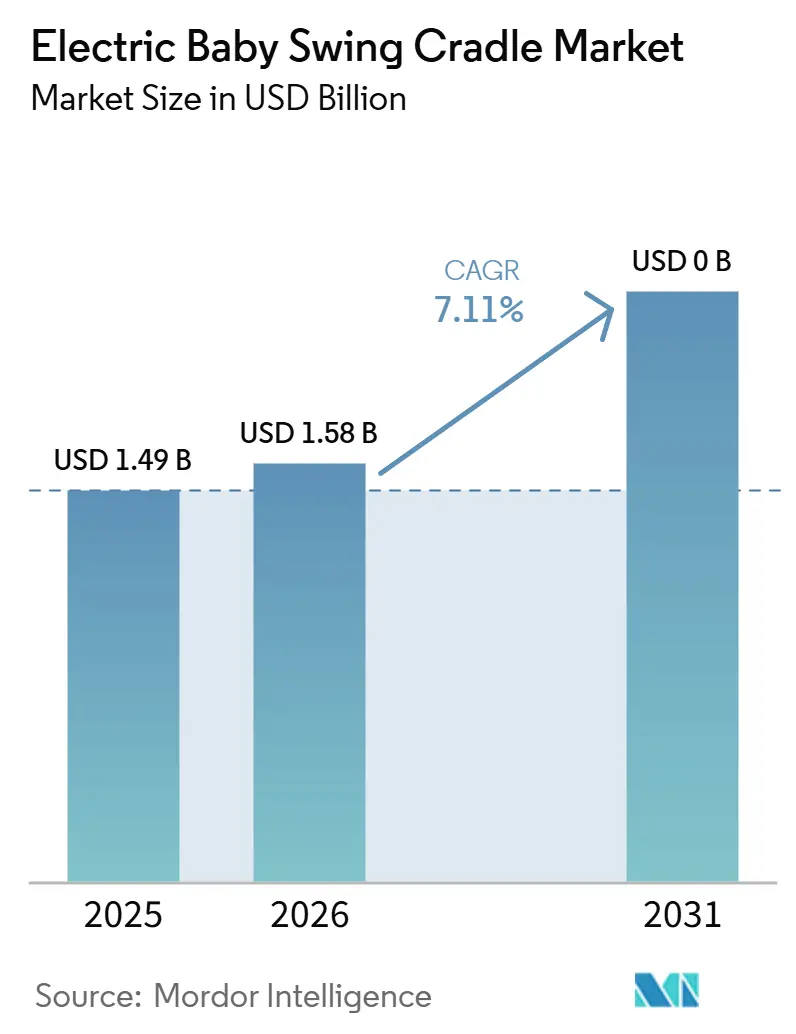
The electric baby swing cradle market is expected to grow from USD 1.49 billion in 2025 to USD 1.58 billion in 2026 and is forecast to reach USD 2.22 billion by 2031 at 7.11% CAGR over 2026–2031. The electric baby swing cradle market is moving beyond basic convenience products and toward responsive soothing systems that support infant sleep, supervised calming, and hands-free care during working hours at home. Higher childcare costs and the continued presence of dual-income households are strengthening the case for home-use automation, especially for urban families that need practical support during busy routines. Smart motion control, cry detection, Bluetooth audio, and app-based operation are widening the gap between entry-level and premium products, changing price ladders and product positioning in the electric baby swing cradle market. At the same time, stricter United States safety regulations and a wave of recalls are raising the value of certified products, which helps established brands defend shelf space and digital visibility. Competitive opportunity in the electric baby swing cradle market is now centered on convertible designs, compact footprints, and cleaner institutional-grade use cases that existing brands have not yet addressed at scale.
Key Report Takeaways
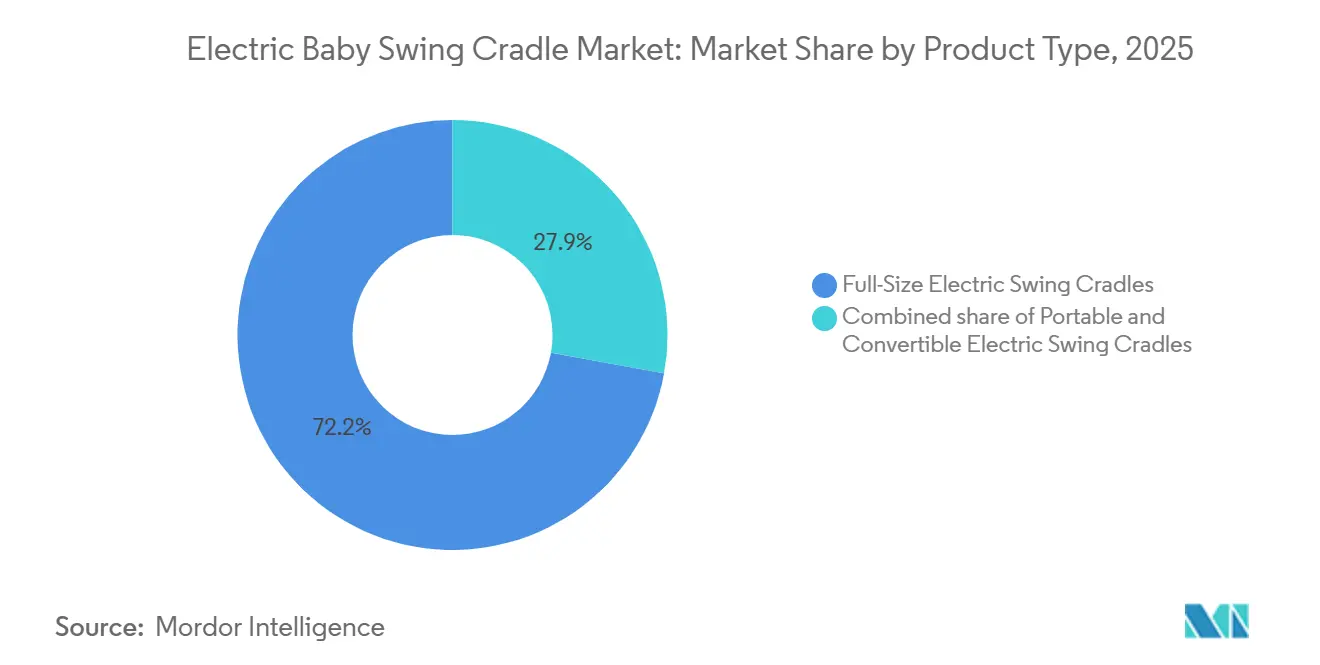
- By product type, full-size electric swing cradles led with 72.15% of the electric baby swing cradle market share in 2025, while portable electric swing cradles are projected to expand at a 7.78% CAGR through 2031.
- By end-user, residential held 83.41% of the electric baby swing cradle market share in 2025, whereas daycare centers are forecast to expand at a 7.50% CAGR through 2031.
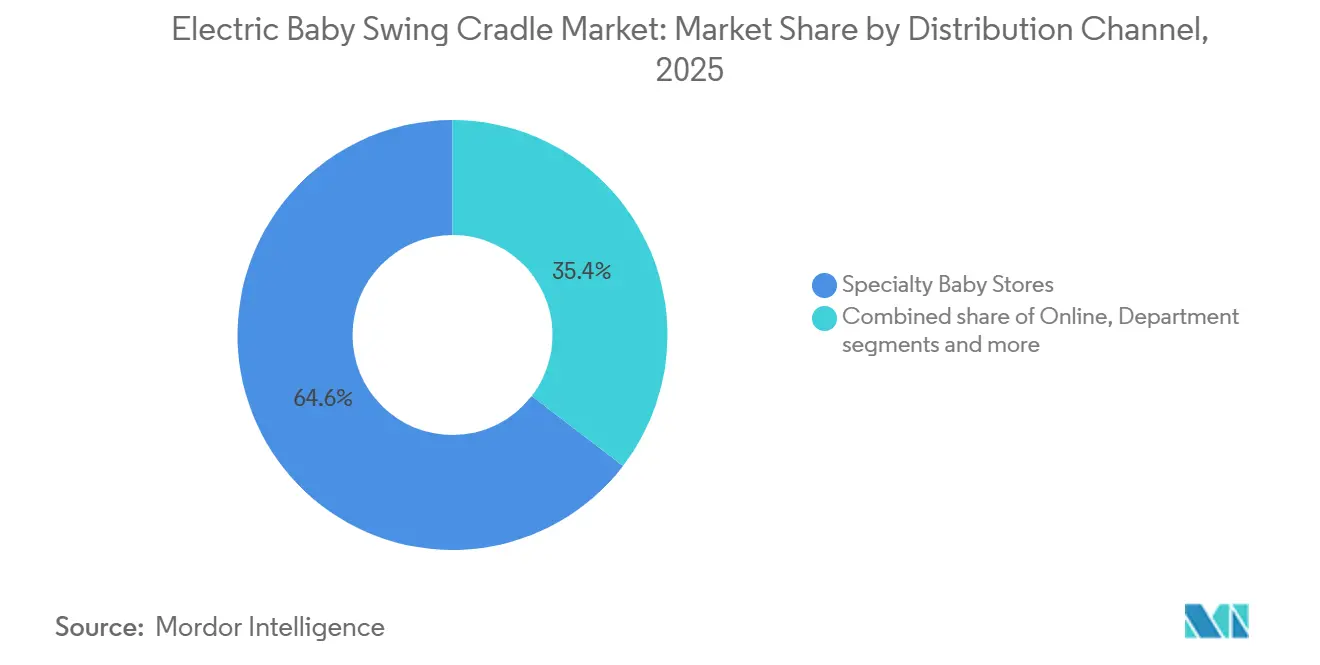
- By distribution channel, specialty baby stores commanded 64.58% of the electric baby swing cradle market share in 2025, while online channels are projected to expand at an 8.32% CAGR through 2031.
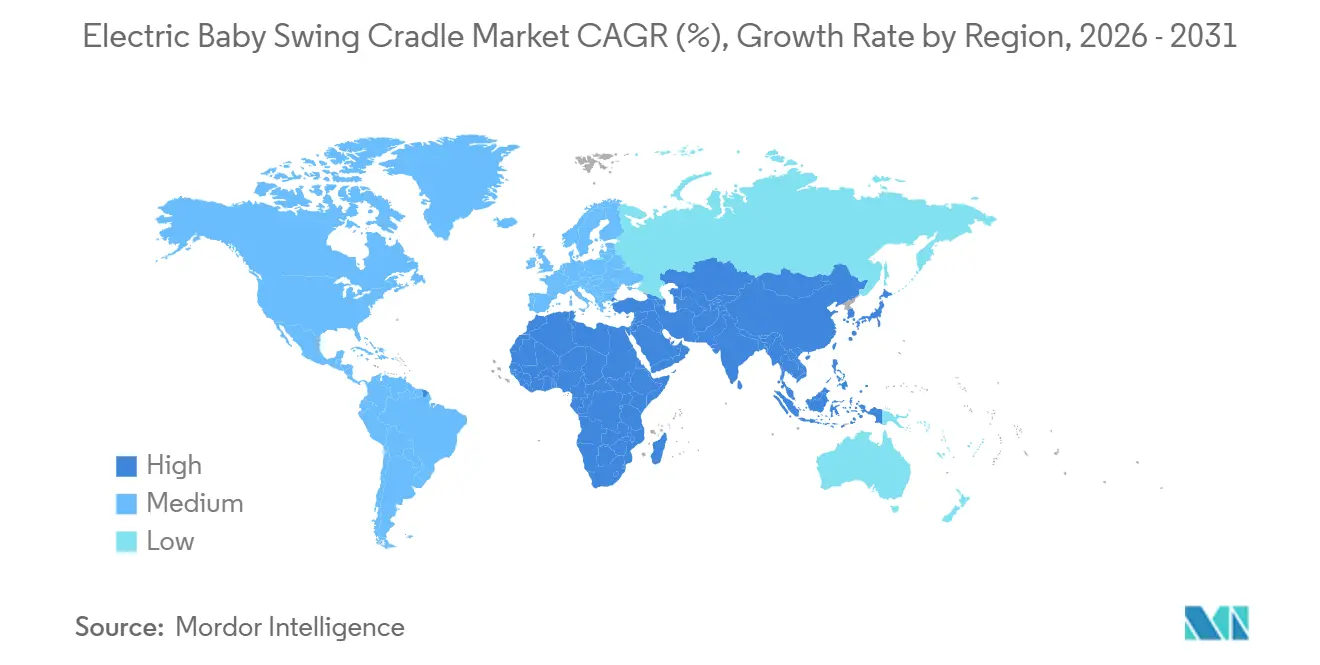
- By geography, Asia-Pacific accounted for 40.12% of the electric baby swing cradle market share in 2025 and is also the fastest-growing region, projected to expand at an 8.06% CAGR through 2031.
Note: Market size and forecast figures in this report are generated using Mordor Intelligence’s proprietary estimation framework, updated with the latest available data and insights as of January 2026.
Market Trends and Insights
Drivers Impact Analysis of Electric Baby Swing Cradle Market*
| Driver | (~) % Impact on CAGR Forecast | Geographic Relevance | Impact Timeline |
|---|---|---|---|
| Rising Dual-Income Households Favor Hands-Free Infant Soothing | +1.4% | Global, strongest in North America and Asia-Pacific urban centers | Medium term (2-4 years) |
| Smart Motion, Bluetooth, and App Control Lift Premium Adoption | +1.8% | North America, Europe, urban South Korea, and Japan | Medium term (2-4 years) |
| E-Commerce Expands Discovery, Comparison, and Cross-Border Access | +1.2% | Global, led by China, India, Southeast Asia, and Latin America | Short term (≤ 2 years) |
| Compact Nursery Gear Demand Rises in Smaller Urban Homes | +0.7% | Asia-Pacific core, with spillover to Europe and North America metros | Medium term (2-4 years) |
| Safety-Certified Multifunctional Cradles Gain Trust in Premium Nurseries | +0.6% | North America, Europe, the United Kingdom, Germany, and the Nordics | Long term (≥ 4 years) |
| Premium Infant Wellness Spending Strengthens Electric Format Upgrades | +0.9% | North America, China, and Australia | Long term (≥ 4 years) |
| Source: Mordor Intelligence | |||
Rising Dual-Income Households Favor Hands-Free Infant Soothing
Dual-income family formation is a structural demand base for the electric baby swing cradle market, not a short-lived cycle. The Federal Reserve reported in 2026 that 35% of the United States parents earning USD 100,000 or more used paid childcare, and that median monthly childcare payments reached USD 1,083, which keeps pressure on families to manage part of infant care more efficiently at home[1]. That backdrop supports demand for supervised soothing devices that can ease short periods of hands-on rocking during work-from-home and return-to-office schedules. The electric baby swing cradle market also benefits from rising female labor participation and families' efforts to balance income growth with childcare gaps. OECD data shows that fertility and household patterns remain uneven across Asia-Pacific, suggesting that brands that align with local family structures and urban living conditions can build demand faster than those that rely on a single global playbook.
Smart Motion, Bluetooth, and App Control Lift Premium Adoption
Smart connectivity is lifting the price ceiling in the electric baby swing cradle market by making premium units more clearly different from basic motion products. Graco introduced the SmartSense Soothing Swing in May 2024 with patented cry-detection technology that responds to more than 1,000 combinations of motion and sound, demonstrating how brands are turning software and sensing into product value[2]. Scientific Reports published 2025 research on an IoT smart cradle that achieved 98.1% motion detection accuracy and 93.2% cry detection accuracy, while also identifying 23°C to 24°C and 45% to 55% relative humidity as better sleep conditions[3]. Those results give manufacturers a stronger product case when they position connected swings around sleep quality and responsive care rather than simple entertainment. The UPPAbaby and 4moms integration also shows that connected swing technology is becoming part of broader premium nursery ecosystems instead of standing alone as a niche add-on.
E-Commerce Expands Discovery, Comparison, and Cross-Border Access
Digital retail is lowering market-entry barriers in the electric baby swing cradle market, allowing newer brands to reach buyers without first building a full physical store network. Product reviews, safety disclosures, and side-by-side comparison tools make online channels useful for parents who research heavily before purchase. The model also helps international brands enter new countries more quickly when they combine digital exposure with a limited specialty retail base. Joie used this path in its August 2024 United States launch, entering through specialty retail and digital channels while also signaling future expansion into swings and rockers. As online visibility improves, the electric baby swing cradle market becomes more open to cross-border challengers that can prove certification, product quality, and clear use cases.
Compact Nursery Gear Demand Rises in Smaller Urban Homes
Space limits in urban homes are shaping product design and purchase decisions in the electric baby swing cradle market. Families in smaller homes are giving greater weight to foldability, ease of storage, and the ability to move a swing between rooms without losing motorized soothing features. Graco’s January 2026 Soothe 'n Sway Bluetooth 3-in-1 Swing reflects that response with a compact fold, a detachable seat, and a format built for tight nursery layouts[4]. This design direction supports portable and convertible products because they fit both residential routines and supervised shared spaces more easily than larger fixed units. It also gives the electric baby swing cradle market a practical growth path in cities where buyers cannot dedicate permanent space to a full nursery setup.
Restraints Impact Analysis of Electric Baby Swing Cradle Market*
| Restraint | (~) % Impact on CAGR Forecast | Geographic Relevance | Impact Timeline |
|---|---|---|---|
| Short Usage Window Limits Perceived Lifetime Value | -0.7% | Global, most acute in price-sensitive South America and Southeast Asia | Long term (≥ 4 years) |
| Recall Sensitivity and Safety Liability Slow Purchase Intent | -0.5% | North America and Europe, where product safety scrutiny is highest | Short term (≤ 2 years) |
| Compliance Burden Across National Safety Standards Raises Cost-to-Serve | -0.4% | Global, most significant for brands operating across North America, Europe, and the Asia-Pacific | Medium term (2-4 years) |
| Low-Cost Uncertified Imports Pressure Branded Price Realization | -0.5% | Global, most severe in Asia-Pacific, and price-competitive online channels | Short term (≤ 2 years) |
| Source: Mordor Intelligence | |||
Short Usage Window Limits Perceived Lifetime Value
The electric baby swing cradle market faces a built-in value challenge because most products are used primarily from birth to 6 months and often have maximum weight limits of 9 kg to 13 kg. That narrow use period makes parents compare the purchase against baby products that remain useful for much longer. The main industry response is a shift toward convertible products that can work across multiple infant stages or be repurposed as rocker-style seating. This response helps defend pricing, but it also raises product cost, which can reduce accessibility for the buyers most sensitive to the short-use argument. The electric baby swing cradle market is, therefore, pushing product development toward formats that extend usable life without straying too far from price.
Recall Sensitivity and Safety Liability Slow Purchase Intent
Product liability remains a clear headwind for the electric baby swing cradle market because recalls and enforcement actions directly affect parent trust. Fisher-Price recalled more than 2.1 million Snuga Infant Swings in October 2024 after 5 infant deaths were reported in connection with improper sleep use, which kept category safety concerns highly visible. CPSC also issued multiple 2025 actions against swing products sold online for incline angles above 10 degrees and for failure to provide warnings in compliance with federal rules, which widened concern about uncertified imports and marketplace listings. CPSC also updated 16 C.F.R. Part 1223, which took effect in September 2024 and made structural, restraint, incline-angle, and labeling requirements more explicit, raising the burden on suppliers while also giving compliant brands a clearer trust signal.
*Our forecasts treat driver/restraint impacts as directional, not additive. The impact forecasts reflect baseline growth, mix effects, and variable interactions.
Electric Baby Swing Cradle Market Segment Analysis
By Product Type:
Full-Size Units Anchor Volume While Portable Formats Drive GrowthFull-size electric swing cradles accounted for 72.15% of the market in 2025, reflecting entrenched consumer preference for feature-rich, stationary soothing platforms in dedicated nursery settings. Their dominant position is supported by premium MSRP bands (typically USD 150–350), multi-speed motor systems, and an expanding smart-feature suite covering cry detection, Bluetooth audio, and smart home integration—capabilities that remain difficult to compress into portable formats without technical trade-offs. Graco's SmartSense Soothing Swing and the UPPAbaby MamaRoo Smart Swing represent the premium tier of full-size products, with the MamaRoo now targeting USD 299–349 after the 4moms brand integration, reflecting a deliberate upward ASP repositioning. Portable electric swing cradles are the fastest-growing sub-segment, with a 7.78% CAGR through 2031, driven by urban housing compression and the preference for soothing gear that repositions across rooms and daycare settings without sacrificing motorized motion.
Joie International launched the Whimsy portable swing in November 2025 and its Serina 2-in-1 Swing & Rocker in EU markets—featuring lift-off seats that convert between swing and portable rocker—directly validating the commercial logic of portable convertible formats. Convertible electric swing cradles are the smallest sub-segment by share but address the usage-window restraint by extending product utility across infant developmental stages; Scientific Reports (2025) documented that adaptive rocking combined with real-time environmental sensing meaningfully improves infant sleep outcomes, providing a clinical narrative that multi-modal convertible platforms can leverage in premium positioning.

By End-User:
Residential Demand Leads While Institutional Use Builds GraduallyResidential use accounted for 83.41% of the market in 2025, confirming that the electric baby swing cradle market remains largely driven by household demand. The largest buyer group remains working families who use the product as a supervised calming aid during home routines, during remote work periods, or during times between direct caregiver attention. Federal Reserve data support this pattern because higher-income parents continue to spend heavily on paid care, which increases the value of at-home support tools that reduce small but frequent care burdens. Scientific Reports also supports the home-use case by showing that sensor-led rocking and environmental control can measurably improve infant sleep outcomes. That combination keeps residential buyers at the center of the electric baby swing cradle market even as product expectations become more technical.
Daycare centers are forecast to expand at 7.50% CAGR through 2031, making them the fastest-growing end-user segment in the electric baby swing cradle market. The appeal for daycare operators is direct because motorized soothing can reduce some of the repetitive manual rocking demand in infant rooms when used appropriately under supervision. This makes procurement logic different from household logic, since institutions focus more on labor efficiency, room management, and replacement cycles than on one-time family use. Hospitals and maternity centers remain a smaller niche. Still, they highlight an important gap: the current offer set has not fully addressed quick-clean surfaces, infection-resistant materials, and integrated sleep-monitoring alerts. The electric baby swing cradle industry has room to grow through this institutional pathway if brands can turn clinical and operational requirements into certified commercial products.
By Distribution Channel:
Specialty Stores Hold Trust While Online Channels Gain SpeedSpecialty baby stores commanded 64.58% of the electric baby swing cradle market in 2025, reflecting how carefully parents approach this purchase. Buyers often want live demonstrations, product education, and direct reassurance on safety before choosing a unit in the USD 150 to USD 300 or higher range. CPSC actions against multiple online-sold swing products across 2024 and 2025 have strengthened that preference because curated retail environments now look safer to many first-time parents than open marketplace listings. ASTM F2088 compliance, now enforced through the updated federal standard, is moving from a legal requirement to a visible trust marker in the store environment.
Online channels are projected to expand at a 8.32% CAGR through 2031, making them the fastest-growing channel in the electric baby swing cradle market. Digital discovery helps parents quickly compare certifications, dimensions, and features, which is especially important in categories with a growing spread of smart features. Online channels also make it easier for newer international brands to test market demand before committing to a full retail build-out. Joie’s United States launch through specialty and digital channels shows how brands can use this model to enter a mature market with less upfront distribution weight. Supermarkets, hypermarkets, department stores, and other retailers play a smaller role, but they still help brands reach value-seeking buyers and gift-driven shoppers.
Geography Analysis
APAC Electric Baby Swing Cradle Market
Asia-Pacific accounted for 40.12% of the electric baby swing cradle market share in 2025, and the electric baby swing cradle market size in the region is projected to grow at 8.06% CAGR through 2031. The region leads because it combines large infant populations with fast urban change and growing demand for convenience-led nursery products. OECD data shows wide fertility variation across Asia-Pacific, but that does not weaken the value outlook because spending per child is rising in many urban markets even where birth rates are low. This supports the electric baby swing cradle market in countries where premium features, compact formats, and digital retail can scale together. It also explains why the Asia-Pacific is the only region in the current report that leads both in present share and forward growth.
North America and Europe Electric Baby Swing Cradle Market
North America remains the second-largest regional cluster in the electric baby swing cradle market, thanks to strong brand presence, high product awareness, and active safety enforcement. The United States supports premium demand through large branded distribution systems and a consumer base willing to pay for connected, soothing products when the functionality appears credible and safe. Federal safety action has also shaped the regional market by pushing buyers and retailers toward better-documented products and away from uncertain online imports. Europe presents a different pattern, with greater emphasis on certification, compact product architecture, and energy-efficient design, as seen in Chicco’s market positioning for compact fold-and-USB-powered swing products.
MEA and South America Electric Baby Swing Cradle Market
South America, the Middle East, and Africa remain earlier-stage regions in the electric baby swing cradle market. Still, each has clear openings tied to urban retail growth and imported premium baby gear. Brazil anchors South American demand, while the UAE and Saudi Arabia support a smaller but more premium-oriented demand base centered on certified and connected infant products. Africa is still at an early adoption stage, and growth there depends more on organized retail reach and brand accessibility than on rapid feature upgrades. Across these regions, cross-border digital selling is likely to remain the most efficient route for market entry and brand testing before larger store commitments.
Competitive Landscape
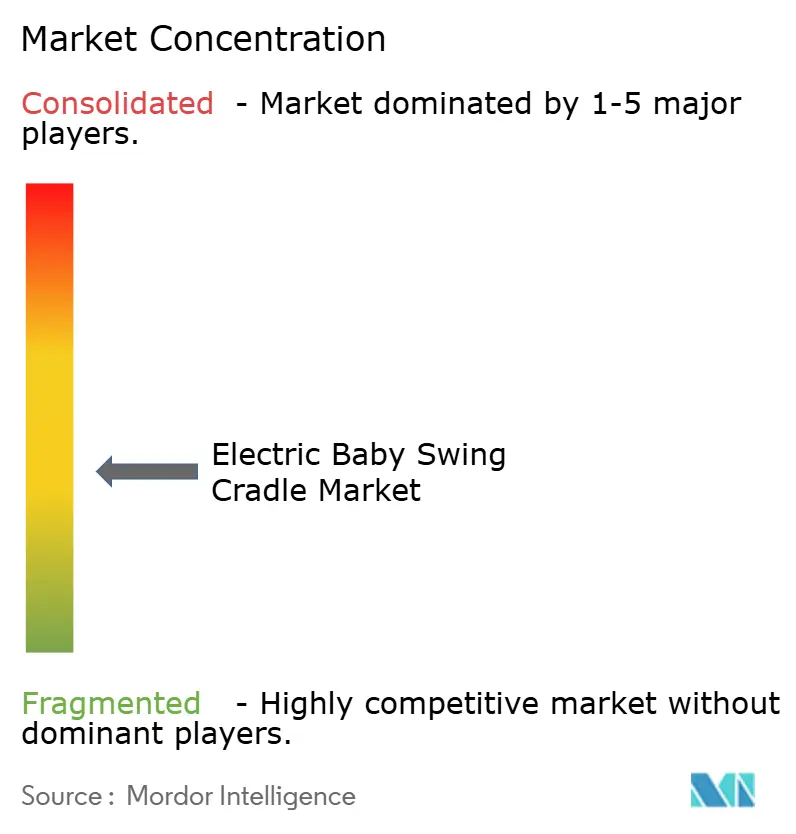
The electric baby swing cradle market remains moderately fragmented, with Graco, Fisher-Price, and Ingenuity setting broad pricing and distribution patterns. At the same time, Joie, Chicco, Hauck, Combi, Mamas & Papas, Delta Children, Nuna, and UPPAbaby compete through design, positioning, and regional strength. No single brand appears to dominate the electric baby swing cradle market across all channels and price bands, keeping competition active in both the mass and premium tiers. The most important structural move in the recent period was UPPAbaby’s integration of 4moms in May 2025, which brought the MamaRoo Smart Swing into a wider premium product and service ecosystem. That move matters because it links connected swing technology with an established stroller and lifestyle network, which can improve brand stickiness after the swing's short use life. Newell Brands also signaled competitive pressure in its baby business through 2025 performance commentary, showing that even scaled incumbents are dealing with channel change and stronger international competition.
Three strategy patterns are shaping the electric baby swing cradle market. The first is smart-feature differentiation, where brands are using cry detection, responsive motion, Bluetooth audio, and connected controls to defend premium pricing and reduce direct price comparison. Graco’s SmartSense Soothing Swing is the clearest example because it uses patented cry-detection technology and an extensive soothing-response library. The second is convertibility and format flexibility, where brands try to extend use cases across swing, rocker, soother, or toddler-seat functions. Graco’s January 2026 Soothe 'n Sway and Joie’s swing and rocker commitment both reflect that push toward more adaptable products.
The third strategy pattern is tighter control of omnichannel presentation in the electric baby swing cradle market, with brands using specialty stores for trust and digital channels for reach. Newell Brands’ 10-K shows that Graco continues to target mass merchants, warehouse clubs, and specialty stores, which confirms that broad but managed distribution still matters. A major white-space area remains institutional procurement, as no current leader has scaled a product built on hospital-grade materials, quick-clean surfaces, and integrated neonatal monitoring alerts. Another durable barrier is compliance documentation, since ASTM F2088 and related United States enforcement have turned regulation into a visible commercial asset for certified suppliers. Over time, the strongest outside challenge may come from adjacent connected-device companies that already understand sensor hardware, app control, and smart-home integration.
Electric Baby Swing Cradle Industry Leaders
-
4moms
-
Artsana S.p.A.
-
BabyBjörn AB
-
Badger Basket Company
-
Bright Starts, Inc.
-
Brevi Milano S.p.A.
- *Disclaimer: Major Players sorted in no particular order
Electric Baby Swing Cradle Market Companies Covered in this Report
- 4moms
- Artsana S.p.A.
- BabyBjörn AB
- Badger Basket Company
- Bright Starts, Inc.
- Brevi Milano S.p.A.
- Chicco
- Combi Corporation
- Delta Children
- Fisher-Price
- Graco
- Hauck GmbH and Co. KG
- Ingenuity
- Joie International Co. Ltd.
- Kids2, LLC
- Mamas and Papas
- Mattel, Inc.
- Munchkin, Inc.
- Nuna International B.V.
- Newell Brands Inc.
Recent Industry Developments in Electric Baby Swing Cradle Market
- June 2025: CPSC recalled ZRWD-branded infant swings for suffocation hazard, violations of the Safe Sleep for Babies Act, and missing lithium coin battery warnings under Reese's Law. Approximately 1,000 units were sold exclusively on Amazon.com from December 2023 through December 2024 at an average price of approximately USD 110.
- May 2025: UPPAbaby finalized the integration of 4moms into the UPPAbaby brand. The MamaRoo Smart Swing, owned by over 2 million consumers, transitioned fully into the UPPAbaby ecosystem with unified product education, warranty services, and distribution through UPPAbaby Hub Service Centers—marking a new era of smart-gear product consolidation in the premium segment.
- May 2025: CPSC recalled Nezmdi-branded infant swings for suffocation hazard (incline angle >10 degrees, violating the Safe Sleep for Babies Act) and missing battery warnings under Reese's Law. Approximately 1,200 units were sold exclusively on Amazon.com from September 2024 through February 2025 at an average price of approximately USD 70.
- April 2025: COMEONROA-branded electric infant swings recalled by CPSC for suffocation risk and failure to meet mandatory warning requirements under the Safe Sleep for Babies Act. Products were sold on Walmart.com by Eonroacoo from January 2024 through February 2025 at approximately USD 80.
Global Electric Baby Swing Cradle Market Report Scope
Electric baby swing cradles are motorized infant-soothing devices that replicate a parent’s rhythmic motion via electric mechanisms, providing hands-free comfort and supporting infant calming during wakeful periods. Unlike manual rockers or passive bouncers, these products use electric motors and, in premium formats, smart sensors, app connectivity, and cry-detection technology to deliver adjustable swing speed, vibration, and responsive soothing across multiple motion patterns. The electric baby swing cradle market is segmented by product type, end user, distribution channel, and geography. By product type, the market is segmented into full-size electric swing cradles, portable electric swing cradles, and convertible electric swing cradles. By end user, the market is segmented into residential, hospitals and maternity centers, daycare centers, and other end users. By distribution channel, the market is segmented into online, specialty baby stores, supermarkets and hypermarkets, department stores, and other distribution channels. By geography, the market is segmented into North America, South America, Europe, Asia-Pacific, and the Middle East and Africa. The report provides the market size in USD for all the above-mentioned segments.
Segmentation Overview
| Full-Size Electric Swing Cradles |
| Portable Electric Swing Cradles |
| Convertible Electric Swing Cradles |
| Residential |
| Hospitals and Maternity Centers |
| Daycare Centers |
| Other End Users |
| Online |
| Specialty Baby Stores |
| Supermarkets and Hypermarkets |
| Department Stores |
| Other Distribution Channels |
| North America | Canada |
| United States | |
| Mexico | |
| South America | Brazil |
| Peru | |
| Chile | |
| Argentina | |
| Rest of South America | |
| Europe | United Kingdom |
| Germany | |
| France | |
| Spain | |
| Italy | |
| BENELUX (Belgium, Netherlands, and Luxembourg) | |
| NORDICS (Denmark, Finland, Iceland, Norway, and Sweden) | |
| Rest of Europe | |
| Asia-Pacific | India |
| China | |
| Japan | |
| Australia | |
| South Korea | |
| South East Asia (Singapore, Malaysia, Thailand, Indonesia, Vietnam, and the Philippines) | |
| Rest of Asia-Pacific | |
| Middle East and Africa | United Arab Emirates |
| Saudi Arabia | |
| South Africa | |
| Nigeria | |
| Rest of the Middle East and Africa |
| By Product Type | Full-Size Electric Swing Cradles | |
| Portable Electric Swing Cradles | ||
| Convertible Electric Swing Cradles | ||
| By End User | Residential | |
| Hospitals and Maternity Centers | ||
| Daycare Centers | ||
| Other End Users | ||
| By Distribution Channel | Online | |
| Specialty Baby Stores | ||
| Supermarkets and Hypermarkets | ||
| Department Stores | ||
| Other Distribution Channels | ||
| By Geography | North America | Canada |
| United States | ||
| Mexico | ||
| South America | Brazil | |
| Peru | ||
| Chile | ||
| Argentina | ||
| Rest of South America | ||
| Europe | United Kingdom | |
| Germany | ||
| France | ||
| Spain | ||
| Italy | ||
| BENELUX (Belgium, Netherlands, and Luxembourg) | ||
| NORDICS (Denmark, Finland, Iceland, Norway, and Sweden) | ||
| Rest of Europe | ||
| Asia-Pacific | India | |
| China | ||
| Japan | ||
| Australia | ||
| South Korea | ||
| South East Asia (Singapore, Malaysia, Thailand, Indonesia, Vietnam, and the Philippines) | ||
| Rest of Asia-Pacific | ||
| Middle East and Africa | United Arab Emirates | |
| Saudi Arabia | ||
| South Africa | ||
| Nigeria | ||
| Rest of the Middle East and Africa | ||
Key Questions Answered in the Report
What is the 2031 value outlook for electric baby swing cradles?
The category is forecast to reach USD 2.22 billion by 2031, up from USD 1.58 billion in 2026, with a 7.11% CAGR from 2026 to 2031.
Which product format leads sales today?
Full-size electric swing cradles led in 2025 with a 72.15% share, but buyers still favored stationary products with broader feature sets and stronger in-home use cases.
Which product format is growing the fastest?
Portable electric swing cradles are projected to grow at a 7.78% CAGR through 2031 as families place greater emphasis on compact size, room-to-room use, and flexible layouts.
Why are smart features becoming more important in this category?
Brands are using cry detection, motion response, Bluetooth audio, and connected controls to justify premium pricing, and Scientific Reports published 2025 findings that support measurable sleep-related benefits from sensor-led cradle systems.
Which sales channel is gaining the most momentum?
Online channels are projected to expand at 8.32% CAGR through 2031 because they improve product discovery, feature comparison, and market access for both buyers and new entrant brands.
What is the biggest risk for brands in this space?
Safety liability remains the clearest risk, as recalls and stricter enforcement under updated United States swing regulations can slow purchase intent and raise the value of certification and compliance proof.