
Apparel Market Size and Share

Apparel Market Analysis by Mordor Intelligence
The Apparel Market size is expected to grow from USD 1.44 trillion in 2026 to USD 1.48 trillion in 2027 and is forecast to reach USD 1.72 trillion by 2032 at 3.05% CAGR over 2027-2032.
Participation, digital discovery and material innovation are widening apparel use across casual, performance and premium occasions. Asia-Pacific combines dense retail networks with rising branded demand, while Brazil shows how local marketplaces can accelerate sportswear discovery. Brands are responding with cooling fabrics, recycled inputs, celebrity-led capsules and more localized assortments. Online formats expand cross-border testing, while stores remain important for fit, touch and immediate ownership. Commercial advantage will favor operators and capable regional partners that connect traceable materials, reliable replenishment and channel-specific service without losing price relevance.
Key Report Takeaways
- Casual Wear accounted for a 36.7% share of the Apparel Market size in 2026, while Sportswear is the fastest-growing product type at a 4.45% CAGR during 2027-2032.
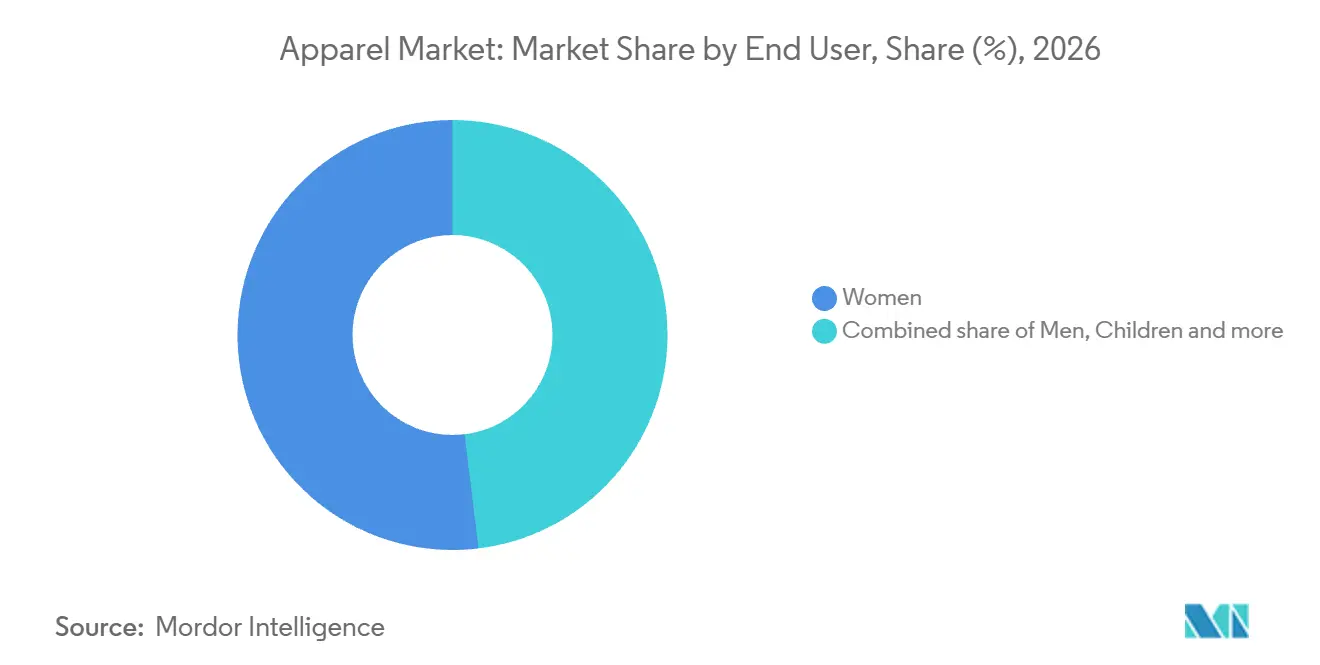
- Women represented a 51.93% Apparel Market share in 2026, and Children is forecast to grow fastest among end users at a 2.94% CAGR during 2027-2032.
- Cotton accounted for a 40.97% share of the Apparel Market size in 2026, with Nylon leading fabric-material growth at a 4.9% CAGR during 2027-2032.
- Mass held an 88.45% Apparel Market share in 2026, while Premium is forecast to expand fastest at a 4.87% CAGR during 2027-2032.
- Offline Stores represented a 69.51% Apparel Market share in 2026, whereas Online Stores are forecast to grow fastest at a 4.55% CAGR during 2027-2032.
- Across geographies, Asia-Pacific accounted for a 36.99% share of the Apparel Market size in 2026, and South America is forecast to grow fastest at a 5.7% CAGR during 2027-2032.
Note: Market numbers in this report are based on Mordor Intelligence's proprietary estimation framework, which combines nine months of actuals with Q4 projections for base year 2026.
Market Trends and Insights
Drivers Impact Analysis of Apparel Market*
| Driver | (~) % Impact on CAGR Forecast | Geographic Relevance | Impact Timeline |
|---|---|---|---|
| Technological innovations in fabric and design | +3.8% | United States, Europe, East Asia | Medium term (2-4 years) |
| Significant growth in sports participation rate | +2.8% | United States, Australia, Pacific | Short term (≤ 2 years) |
| Influence of social media and celebrity endorsements | +2.2% | North America, Europe, Asia-Pacific | Short term (≤ 2 years) |
| Globalization of fashion trends | +1.5% | North America, Europe, Asia-Pacific | Medium term (2-4 years) |
| Growing demand for sustainable and eco-friendly apparel | +1.2% | Europe, United States, Japan | Long term (≥ 4 years) |
| Consumer's inclination towards luxury apparel | +1% | United States, Europe, China | Medium term (2-4 years) |
| Source: Mordor Intelligence | |||
Technological innovations in fabric and design
Performance and comfort demands are pushing apparel innovation beyond conventional knitted and woven fabrics. Nike introduced FlyWeb in June 2025 as a TPU, 3D-printed performance apparel material, the first time it applied 3D printing to high-performance sports apparel for an athlete. In October 2025, Nike introduced Aero-FIT, which channels more than double the airflow of legacy materials and uses 100% textile waste. In March 2026, lululemon launched ShowZero, a yarn technology that makes sweat virtually invisible when wet while adding breathability, moisture management and quick drying.[2] These advances give brands functional reasons to command attention in sportswear and premium basics. They also raise design, testing and scale-up requirements, so suppliers that can reproduce performance consistently will capture more value than those offering undifferentiated fabric capacity.
Significant growth in sports participation rate
Sports participation is broadening the customer base for performance apparel in the United States and Australia-Pacific. SFIA reported that 250 million Americans took part in at least one sport, fitness or leisure activity in 2025, up 1.2% year over year.[1] Road running alone reached 52.3 million U.S. participants in 2025, more than 1 million above the prior year. Community rugby league participation in Australia and the Pacific grew 7.5% to 1.12 million participants in 2025. These gains expose more buyers to technical tops, footwear-linked apparel and team uniforms, while repeat participation supports replacement cycles. Retailers can therefore widen performance assortments beyond elite athletes, but regional sports preferences still require localized sizing, climate choices and club partnerships.
Influence of social media and celebrity endorsements
Celebrity partnerships are turning social reach into coordinated apparel launches. American Eagle launched a 90-plus-piece Travis Kelce collaboration in August 2025 with a global campaign across all social platforms. Its first Lamine Yamal campaign on June 10, 2026, ran denim creative across Instagram, TikTok, YouTube, Pinterest and Snapchat. The retailer then announced a Yamal drop on September 9, 2026, spanning denim, cargo pants, jackets, underwear, outerwear, sweater tees and flannel shirts. The sequence links endorsement, platform distribution and a broader product basket, giving brands more ways to test cultural relevance. Buyers gain faster access to trend-led capsules, while retailers must coordinate inventory and creative timing across digital and physical channels.
Globalization of fashion trends
Fashion signals now travel across markets through shared media, platforms and coordinated launches. U.S. Polo Assn. launched a polo-shirt campaign across 190 countries in Spring 2026, presenting the sport-derived shirt as an everyday style essential. H&M launched a 25-piece womenswear collection inspired by The White Lotus in selected stores worldwide and online in February 2025. Zalando’s 2025 Trend Forecast used search data from more than 50 million European customers across 29 markets to identify five emerging fashion trends and their cultural drivers. These examples let brands reuse a recognizable concept while adapting color, sizing and channel mix to local demand. The commercial advantage is faster cross-border assortment testing, but cultural translation and regional inventory planning remain necessary to avoid treating a global signal as uniform purchase behavior.
Restraints Impact Analysis of Apparel Market*
| Restraint | (~) % Impact on CAGR Forecast | Geographic Relevance | Impact Timeline |
|---|---|---|---|
| Proliferation of counterfeit products | -3% | United Kingdom, United States, China | Medium term (2-4 years) |
| High cost associated with luxury brands | -2.5% | United States, Europe, China | Short term (≤ 2 years) |
| Fluctuating raw material prices | -2% | South Asia, East Asia, Europe | Medium term (2-4 years) |
| Supply chain disruptions | -1.95% | Middle East maritime routes, Europe, United States | Short term (≤ 2 years) |
| Source: Mordor Intelligence | |||
Proliferation of counterfeit products
Counterfeit clothing diverts price-sensitive demand away from legitimate apparel. The UK Intellectual Property Office found that 27% of consumers who knowingly bought counterfeit clothing purchased at least quarterly in 2025, up from 22% in 2023, and 81% bought deliberately, mainly for lower prices. In the same UK counterfactual, only 17% would have bought the original at full price if counterfeits were unavailable, while 37% would choose a cheaper brand and 32% would go without. Amazon reported in April 2026 that proactive controls blocked more than 99.9% of suspected infringing listings before brand-owner reports in its global online store. Such controls can reduce exposure on digital channels, but they do not remove counterfeit supply across every route. Brands therefore continue to absorb monitoring, enforcement and trust-repair costs while legitimate sales remain vulnerable to substitution.
High cost associated with luxury brands
Luxury pricing is narrowing the pool of aspirational apparel shoppers. Bain-Altagamma reported that pricing pressure pulled aspirational consumers back, while the high-end tier contracted at a -1% to -3% CAGR from 2023 to 2025 and apparel held through accessible players. The evidence covers personal luxury goods overall, so the apparel implication is strongest where buyers compare price with perceived value. Zara is described in 2026 as offering fashionable designs at more affordable prices than luxury ready-to-wear collections. That mid-market response gives shoppers an attainable substitute and lets retailers capture demand without matching luxury positioning. Luxury labels still face slower conversion among price-sensitive customers, leaving assortment architecture and entry-level products to absorb part of the affordability gap.
*Our forecasts treat driver/restraint impacts as directional, not additive. The impact forecasts reflect baseline growth, mix effects, and variable interactions.
Apparel Market Segment Analysis
By Product Type:
Casual Wear Leads While Sportswear AcceleratesCasual Wear accounted for a 36.7% share of the Apparel Market size in 2026. The Buckle operated 442 stores in 42 U.S. states as of May 2, 2026, selling medium-to-better-priced casual apparel through stores and e-commerce. Denims represented 42.5% of Buckle’s fiscal 2025 net sales and tops including sweaters another 28.9%. Fast Retailing reported UNIQLO Japan same-store sales up 5.1% in FY2026, driven by functional and trend-led casual products. This installed base and broad everyday use keep casual apparel central to replenishment, wardrobe building and accessible trend adoption.
Sportswear is the fastest-growing product type, forecast at a 4.45% CAGR during 2027-2032. adidas reported 12% growth in Lifestyle revenues in 2025, driven by double-digit growth in Originals and Sportswear, while apparel sales grew 15%. lululemon opened 44 net new company-operated stores in fiscal 2025, ending with 811 stores. Sportswear’s buyer base spans training, running and lifestyle use, which supports technical replacement as well as everyday wear. Formal Wear serves occasion-led purchases, while Nightwear/Loungewear and Intimate address comfort and personal-use routines. These contrasts leave sportswear positioned around active use and technical replacement, while the remaining types depend more on occasion and routine-specific demand.


By End User:
Women Lead as Children’s Apparel ExpandsWomen represented a 51.93% Apparel Market share in 2026. lululemon reported that its women’s range represented 63% of global net revenue in fiscal 2025. That company mix is broader than apparel alone, but it shows the spending scale available to women-focused assortments. Women’s ranges can therefore support breadth across casual, premium and performance occasions, with fit and style localization shaping conversion. The breadth of use cases also supports more frequent assortment refreshes than a single-occasion wardrobe. Suppliers serving women’s categories must balance volume with a wide fit and style matrix.
Children is the fastest-growing end user, forecast at a 2.94% CAGR during 2027-2032. Carter’s reported Q2 fiscal 2026 net sales of USD 615.5 million, up 5.2% year over year, and Q1 sales of USD 681.1 million, up 8.1%, with strong demand across children’s apparel channels. Its brands held about 9% of the U.S. apparel market for ages zero to 10 in December 2025. Men represented a 37.98% share in 2026 and BOSS Menswear revenue rose 3% in fiscal 2025, showing a resilient branded role. Children’s growth is tied to replacement and age progression, whereas men’s demand remains anchored in branded wardrobe continuity.
By Fabric Material:
Cotton Dominates While Nylon Gains Technical MomentumCotton accounted for a 40.97% share of the Apparel Market size in 2026. USDA projected global cotton mill use at 119.1 million 480-pound bales in 2025/26, with China and India accounting for 55% of use. FAO estimated 2025 global cotton production at 27 million metric tons, with nearly 10 million metric tons traded and production valued around USD 46 billion. This scale supports cotton’s broad use across everyday and premium garments, while exposure to weather and commodity cycles keeps sourcing discipline important. Mills and brands can use cotton’s familiarity to support volume, but input planning remains a cost and continuity decision.
Nylon is the fastest-growing fabric material, forecast at a 4.9% CAGR during 2027-2032. Aquafil reported ECONYL nylon at 60.4% of fiber revenues in FY2025, up from 54.8% in 2024, and Speedo launched Ocean Flex swimwear in October 2025 using recycled nylon and recycled spandex. Polyester remains an affordability and durability choice with apparel as its dominant end use. Denim retains a lifestyle identity, while other plant and synthetic fibers serve growing niches such as flax, hemp, acrylic and elastane applications. Nylon’s technical and recycled positioning gives performance brands a differentiation path that is less available in commodity basics.
By Category:
Mass Scale Supports Volume While Premium OutpacesMass accounted for an 88.45% Apparel Market share in 2026. Fast Retailing reported that UNIQLO had 2,499 stores worldwide in FY2026 and offered functional products at affordable prices. That footprint gives mass apparel broad buyer access and supports high-frequency basics when households prioritize value. Scale in procurement and distribution remains the main commercial advantage for this category, producing dependable volume while price competition limits room for undifferentiated products. Mass operators therefore win through availability, cost discipline, repeatable basics and broad size coverage more than scarcity.
Premium is forecast to grow fastest, at a 4.87% CAGR during 2027-2032. Ralph Lauren reported more than 20% fourth-quarter fiscal 2026 growth in combined Women’s Apparel, Outerwear and Handbags in constant currency. HUGO BOSS operates in the premium segment through around 8,000 physical points of sale and 74 digital markets, while BOSS Menswear revenue rose 3% in fiscal 2025. LVMH’s Fashion and Leather Goods group recorded 1% organic revenue growth in Q2 2026, with rapid acceleration in the United States. Premium growth therefore depends on brand heat, full-price selling and selective distribution rather than mass reach.
By Distribution Channel:
Offline Scale Meets Faster Online GrowthOffline Stores accounted for a 69.51% Apparel Market share in 2026. H&M Group reported just over 30% of sales online and operated 4,101 stores at November 30, 2025. UNIQLO Japan had 794 stores and UNIQLO International 1,725 stores at the end of August 2025. Physical networks provide fitting, immediate ownership and local discovery, which support categories where touch and trial matter. Retailers can use stores as service and fulfillment nodes while preserving high-traffic visibility, and store density also helps manage returns and build local trust.
Online Stores are forecast to grow fastest, at a 4.55% CAGR during 2027-2032. Zalando’s three consumer fashion apps grew business-to-consumer gross merchandise value in Q2 2026, while active customers reached 62.5 million, up 18.3%. H&M Group had e-commerce sites in 62 markets and stores in 82 markets as of August 31, 2026. Zalando’s 2025 ZEOS logistics partnership helped Next increase international online sales by 33% and reduce fulfillment costs by 6.5%. Digital reach expands assortment testing and cross-border demand capture, but returns, fulfillment speed and product-data quality determine whether traffic converts profitably.
Geography Analysis
Asia-Pacific Apparel Market
Asia-Pacific accounted for a 36.99% share of the Apparel Market size in 2026. Fast Retailing’s FY2026 outlet table listed 782 UNIQLO stores in Japan, 851 in China, 129 in South Korea, 40 in Australia and 20 in India. UNIQLO revenue grew 11.3% in Greater China and 30.7% across South Korea, Southeast Asia, India and Australia in FY2026. The region combines dense store networks with rising branded demand, giving suppliers scale across both mature and expanding markets. Assortment localization remains necessary because climate, income and cultural preferences vary across the region.
South America Apparel Market
South America is the fastest-growing geography, forecast at a 5.7% CAGR during 2027-2032. Lojas Renner reported apparel profit of BRL 7.05 billion (USD 1.26 billion) in Brazil in 2025, up 12.3% from 2024. Mercado Livre recorded 160.4 million searches for sports shirts in Brazil during 2025. These signals combine retailer earnings with digital product discovery, showing how local brands and marketplaces can convert sports and lifestyle interest into apparel demand. Investment in local fulfillment and mobile merchandising can capture this momentum while currency and logistics remain operating variables that require disciplined local service planning and inventory coordination.
North America presents a more pressured demand environment, with Under Armour reporting fiscal 2026 regional revenue of USD 2.9 billion, down 8% year over year. Europe shows a different balance, as adidas reported 10% currency-neutral brand revenue growth in 2025 supported by locally relevant assortments and activations. Middle East and Africa include value-led omnichannel structures, with Mr Price Group reporting apparel at 79.6% of retail sales and 253 stores in Africa alongside 2,929 stores in South Africa. These geographies therefore require distinct playbooks for performance recovery, localized design and value distribution. Global suppliers can share core capabilities, but channel and price architecture must follow each region’s operating conditions.

Regulatory Framework and Outlook
For a global apparel brand and importer, the selected jurisdictions differ in labeling detail, due diligence, product data and conformity requirements. The table compares countries from each main region where current instruments or scheduled changes have a direct commercial effect. Ratings use the same participant perspective and separate current attractiveness from future direction.
Regulatory Table of Apparel Market
| Decision factor | United States | Germany | China | India | Brazil | Saudi Arabia |
|---|---|---|---|---|---|---|
| Primary authority | Federal Trade Commission | BAFA and German federal authorities | SAMR and National Standardization Administration | Bureau of Indian Standards and Textiles Committee | INMETRO | SASO |
| Key instruments or direction | Fiber, marketer, origin and care labeling rules retained | Supply Chain Due Diligence Act and planned EU textile ESPR delegated act | GB/T 45812-2025 and RFID-label standard effective March 1, 2027 | Product standards and draft durable fiber, care, origin and traceability labeling | Portaria 118 textile labeling regulation | Textile Products Technical Regulation Issue 2 and Product Safety System |
| Commercial effect | Label data and care disclosures must be maintained across products | Due diligence affects supplier processes, lead times, prices and contract terms | Quality classification and future RFID coding extend data and supply-chain tasks | Product-specific benchmarks apply, with broader traceability duties pending notification | Permanent Portuguese labels must show identity, origin, fibers, care and size | Suppliers need label data and conformity certification before placement |
| Current policy attractiveness | Medium | Medium | Medium | Medium | Medium | Medium |
| Future direction of policy attractiveness | No change | Hardening | Hardening | Hardening | No change | Hardening |
| Source: Mordor Intelligence | ||||||
The United States is relatively stable because the FTC retained the Care Labeling Rule while continuing fiber and origin disclosures, supporting a Medium rating and No change direction, whereas Germany is Medium with Hardening direction because due diligence remains active and the Commission plans a Q4 2027 textile ESPR act with digital-product-passport duties. China is Medium and Hardening because its current quality standard is supplemented by a scheduled RFID-label standard on March 1, 2027, while India is Medium and Hardening because BIS benchmarks operate today and a draft regulation would add durable-fiber and traceability information after notification. Brazil is Medium with No change because INMETRO’s Portaria 118 remains the operative textile-labeling rule in the 2026-2027 planning horizon.[3] Saudi Arabia is Medium and Hardening because mandatory conformity certification is paired with broader product-safety and market-surveillance tools.
Value Chain Stages
The value chain moves from fiber production through textile conversion, garment assembly and route-to-market execution. Each stage captures a different supplier or operator margin, and the main resilience choices involve material flexibility, geographic spread and lead-time control. The table compares where value is created, where disruption concentrates and how participants respond.
Value Chain Analysis Table of Apparel Market
| Primary activity | Key participants | Value capture | Bottleneck | Resilience response |
|---|---|---|---|---|
| Fiber and yarn inputs | Fiber and yarn producers such as Lenzing Group, Indorama Corporation and Toray Industries | Fiber, filament and yarn sales plus technical-material premiums | Demand softness and price volatility can compress upstream utilization and margins | Blend regenerated, recycled and synthetic inputs, and serve multiple textile applications to diversify demand |
| Textile processing and fabric formation | Yarn, fabric and dyeing suppliers such as Hyosung TNC, Gildan Activewear and Toray Industries | Fabric conversion, dyeing, finishing and integrated textile services | Material shortages and volatile input prices affect fabric continuity and cost | Use advance purchasing, integrated processing and regional supplier alternatives to protect production schedules |
| Garment manufacturing and assembly | Apparel buyers and contract manufacturers such as Nike, adidas and Gildan Activewear | Cut-and-sew production, quality integration and finished-garment sales | Concentrated manufacturing networks and long replenishment lead times can delay launches | adidas expanded local-for-local sourcing in Greater China, India, Brazil and Argentina, while Gildan ramped an integrated Bangladesh complex |
| Distribution, retail and replenishment | Brand retailers, wholesalers and logistics operators such as adidas, Nike and Gildan Activewear | Wholesale, direct-to-consumer sales, fulfillment and service | Ocean dependence, inventory timing and channel coordination can slow delivery | Use owned and partner distribution centers, diversified channels and regional inventory positioning |
| Source: Mordor Intelligence | ||||
Value capture shifts from material differentiation to manufacturing reliability and then to customer access, data and fulfillment. Integrated operators can retain more conversion margin, while brands that outsource rely on supplier coordination and quality systems. The chain is becoming more regional in sourcing and distribution as companies shorten lead times and spread operational exposure. Future advantage will come from combining traceable materials with flexible production and responsive channels.
Competitive Landscape
The competitive landscape combines global mass retailers, sportswear specialists, luxury houses and focused lifestyle brands. VF Corporation, H&M Group, Fast Retailing Co. Ltd. (Uniqlo), Nike Inc., Adidas AG, Roadget Business Pte. Ltd. (Shein), Inditex Trent Retail India Private Limited, Puma SE, Kering SA, LVMH Moet Hennessy Louis Vuitton, PVH Corp., Levi Strauss & Co., Gap Inc., Lululemon Athletica Inc., Ralph Lauren Corporation, American Eagle Outfitters, Inc., Hanesbrands LLC, Under Armour Inc., Hugo Boss AG and Columbia Sportswear Company span different price points, product systems and channels. VF Corporation reported Q1 FY2026 revenue flat year over year, with revenue excluding Vans up 6% while Vans fell 14%. Scale is distributed across several leaders rather than one dominant supplier, while brand identity, technical design, sourcing reach and direct-to-consumer access create durable barriers. The structure leaves room for challengers that can combine cultural relevance with reliable delivery.
Competitive responses are visible in both operating results and channel choices. Fast Retailing reported UNIQLO Japan same-store sales up 8.1% in FY2025 and UNIQLO International revenue up 11.6%. NIKE, Inc. reported FY2025 revenue of USD 46.3 billion, down 10%, while NIKE Brand apparel revenue fell 6%. adidas brand currency-neutral revenue grew 13% in 2025 and apparel sales grew 15% through locally relevant collections, collaborations and product launches. These results show how international expansion, technical brand systems and localized product calendars produce different outcomes across the same market. They also make execution quality a visible differentiator for buyers and retail partners.
The direction of competition favors companies that can connect product innovation with localized demand and dependable omnichannel execution. H&M Group’s FY2025 net sales rose 2% in local currencies with 4,101 stores, and just over 30% of sales came online. Sportswear specialists can defend technical niches, while mass retailers use store density and accessible pricing to protect volume. Luxury groups compete through brand heat, scarcity and full-price selling, and digital platforms compress discovery time for smaller labels. Regulatory scrutiny of counterfeits, sustainability claims and supply-chain transparency raises the value of traceable sourcing and credible product information while buyers face more fragmented brand propositions and must judge performance, trust and service together.
Apparel Industry Leaders
-
VF Corporation
-
H&M Group
-
Fast Retailing Co. Ltd. (Uniqlo)
-
Nike Inc.
-
Adidas AG
- *Disclaimer: Major Players sorted in no particular order

Apparel Market Companies Covered in this Report
- VF Corporation
- H&M Group
- Fast Retailing Co. Ltd. (Uniqlo)
- Nike Inc.
- Adidas AG
- Roadget Business Pte. Ltd. (Shein)
- Inditex Trent Retail India Private Limited
- Puma SE
- Kering SA
- LVMH Moet Hennessy Louis Vuitton
- PVH Corp.
- Levi Strauss & Co.
- Gap Inc.
- Lululemon Athletica Inc.
- Ralph Lauren Corporation
- American Eagle Outfitters, Inc.
- Hanesbrands LLC
- Under Armour Inc.
- Hugo Boss AG
- Columbia Sportswear Company
Key Opportunities for Market Participants
The strongest opportunities connect near-term compliance work with product and material shifts already entering apparel operations. The comparison focuses on where a buyer can act, what evidence makes the opening timely and which barrier could delay commercialization. Regulatory windows offer a way to build data and collection capabilities before requirements mature, while recycled and heat-adaptive materials create product differentiation.
Market Opportunities Table of Apparel Market
| Opportunity | Why now | Buyer / lead segment | Recommended play | Main barrier | Likely beneficiaries |
|---|---|---|---|---|---|
| Digital product passports for apparel | The European Commission plans an ESPR delegated act for textile apparel in Q4 2027, while DPP requirements remain under definition | EU apparel manufacturers, producers, importers and distributors | Build item-level material, supplier and repair data pipelines before the delegated act | Data fields and implementation details are still being defined | Traceability platforms, compliant brands and EU retail partners |
| Textile EPR collection and recycling services | The revised EU Waste Framework Directive entered into force on October 16, 2025, requiring Member State EPR schemes within 30 months | EU fashion brands, collection operators and recycling buyers | Partner on take-back, sorting and fiber-recovery networks aligned to national schemes | Country-level scheme design and collection infrastructure must be coordinated | Recyclers, logistics providers and brands with verified recovery systems |
| Textile-to-textile recycled polyester | adidas is introducing textile-to-textile recycled polyester from the 2026 seasons and targets 10% of polyester volume from textile waste by 2030 | Sportswear and performance-apparel buyers | Secure recycled feedstock and qualify yarns in high-volume performance ranges | Feedstock consistency and processing capacity constrain scale-up | Recyclers, yarn suppliers and sportswear brands |
| Low-GHG materials for mass apparel | Fast Retailing is switching UNIQLO and GU products toward low-GHG materials, reaching 19.4% of materials in FY2025 against an approximately 50% FY2030 target | Mass casual-wear and functional-apparel buyers | Scale lower-emission fibers through core basics and supplier scorecards | Broad assortment conversion requires supplier capacity and cost control | Fiber innovators, mills and value retailers |
| Heat-adaptive performance apparel | Nike says Aero-FIT, made from 100% recycled textile waste, debuted in 2026 football kits and is extending across product lines | Elite sportswear, team-kit and heat-adaptive apparel buyers | Pilot cooling fabrics in team kits, training tops and climate-exposed workwear | Product-line validation and repeatable manufacturing must keep pace with performance claims | Technical textile developers, sportswear brands and team suppliers |
| Source: Mordor Intelligence | |||||
The central opening is the convergence of traceability and material innovation. Regulatory deadlines make data and recovery capabilities commercially urgent, while recycled and heat-adaptive products give those systems a visible consumer and buyer use case. Suppliers that can prove material origin and repeat performance should be better positioned for long-term brand programs.
Recent Industry Developments in Apparel Market
- Aug 2026: H&M opened its first Paraguay store at Paseo La Galería in Asunción, expanding its apparel retail presence in South America.
- Mar 2026: adidas launched FIFA World Cup 2026 away jerseys globally, extending its major tournament apparel offering.
- Mar 2026: Fast Retailing and Xymax began operating a 75%-25% joint venture that manages commercial facilities for UNIQLO and GU stores.
Apparel Market Report Scope and Research Methodology
Market Definition and Coverage
The global apparel market measures annual consumer spending on clothing sold at retail through offline stores and online stores. It covers clothing for men, women, and children across all product forms and fabric materials at mass and premium price tiers worldwide.
Scope exclusions: Footwear, bags, jewelry, and other fashion accessories are excluded.
Segments Covered in This Report
- By Product Type
- Formal Wear
- Casual Wear
- Sportswear
- Nightwear/Loungewear
- Intimate
- Other Product Types
- By End User
- Men
- Women
- Children
- By Fabric Material
- Cotton
- Polyester
- Nylon
- Denim
- Other Fabric Types
- By Category
- Mass
- Premium
- By Distribution Channel
- Offline Stores
- Online Stores
- By Geography
- North America
- United States
- Canada
- Mexico
- Rest of North America
- Europe
- Germany
- United Kingdom
- Italy
- France
- Spain
- Netherlands
- Poland
- Belgium
- Sweden
- Rest of Europe
- Asia-Pacific
- China
- India
- Japan
- Australia
- Indonesia
- South Korea
- Thailand
- Singapore
- Rest of Asia-Pacific
- South America
- Brazil
- Argentina
- Colombia
- Chile
- Peru
- Rest of South America
- Middle East and Africa
- South Africa
- Saudi Arabia
- United Arab Emirates
- Nigeria
- Egypt
- Morocco
- Turkey
- Rest of Middle East and Africa
- North America
Data Sources, Market Sizing, and Validation
Desk Research
Public evidence is assembled from sources such as the Food and Agriculture Organization's cotton production and trade indicators, the Sports & Fitness Industry Association's participation counts, the U.S. Census Bureau's retail e-commerce series, and UN Trade and Development's fiber trade analysis to anchor material supply, activity, channel and trade variables. These sources are read alongside the two published market estimates used for comparison so that retail demand, fiber mix, online selling and regional conditions are interpreted within the clothing boundary.
Supplementary company annual reports, 10-K filings, investor materials, customs statistics and reputable trade press are used to cross-check retailer coverage, channel signals, input costs and reported developments before an estimate is accepted. The named sources are not exhaustive and further sources inform collection, validation and clarification.
Primary Interviews and Surveys
Primary work is designed around interviews with apparel brand and retailer executives, sourcing and merchandising leaders, channel managers, textile suppliers and regional specialists across APAC, EMEA and the Americas. A structured guide tests secondary findings at the variable level, records reasons for disagreement, fills gaps with bounded ranges or documented assumptions, and triangulates demand, channel and material signals before the model is updated.
Distribution of primary research fieldwork respondents
| Company type | Respondent position | Region |
|---|---|---|
| Top tier: 30% | CXOs: 15% | APAC: 40% |
| Mid tier: 45% | Functional/Unit leaders: 35% | EMEA: 32% |
| Smaller Players: 25% | Managers: 50% | Americas: 28% |
Market-Sizing & Forecasting
The model starts with a top-down value estimate of global retail clothing sales and allocates it across product type, end user, fabric material, category, distribution channel and the five reported regions. Retail sales by channel, population and household purchasing power, apparel participation and replacement activity, online retail momentum, cotton and man-made fiber indicators, and regional retail development are used as observable drivers, while company filings and channel checks provide selective bottom-up checks such as supplier roll-ups and sampled average selling price times volume. A multivariate regression links these drivers to historical apparel value, with exponential smoothing applied where a short series is more stable and scenario analysis used when input or channel evidence moves outside the observed range. Segment shares are derived from the strongest combination of published splits, channel and material indicators, and respondent checks, then reconciled to the global total. Missing inputs remain bounded and are flagged for follow-up rather than filled with unsupported precision. Experts review the variable-level forecasts and challenge the direction and scale of each driver before the geographic and segment outputs are accepted.
Data Validation & Update Cycle
Analysts triangulate the retail value against independent signals from official retail series, fiber and trade statistics, participation data, company filings and channel observations, then investigate unusual year-on-year movements, share reversals and variance between top-down totals and selective supplier or channel checks. Each draft passes a source review, arithmetic and unit check, model reasonableness review and senior analyst sign-off, with re-contact triggered when a material discrepancy cannot be resolved from documented evidence. The dataset is refreshed annually, updated between cycles when a material event changes demand, supply, regulation or channel structure, and given a fresh pre-delivery review so the latest source year, definitions and forecast assumptions are carried through consistently.
Mordor Intelligence's Apparel Market Estimate Compared With Other Published Estimates
Published estimates can differ in the transactions and products they count and the inputs used to model demand. The global apparel market measures annual consumer spending on clothing sold at retail through offline stores and online stores.
Key Gap Drivers include the study's defined coverage and market-specific modeling choices. Retail sales by channel, population and household purchasing power, apparel participation and replacement activity, online retail momentum, cotton and man-made fiber indicators, and regional retail development are used as observable drivers, while company filings and channel checks provide selective bottom-up checks such as supplier roll-ups and sampled average selling price times volume.
Benchmark comparison
| Source | Market Size | Gaps in Research Methodology |
|---|---|---|
| Mordor Intelligence | USD 1.48 T (2027) | |
| Global Consultancy A | USD 1.84 T (2025) | At its 2025 base, this estimate is 24.3% above this report's 2027 value of USD 1.48 T, 2 years later. Its published segmentation covers top wear, bottom wear and innerwear and includes a luxury category, which is broader than the approved clothing product boundary and can lift the earlier estimate. |
| Global Consultancy B | USD 2.54 T (2033) | At its 2033 base, this estimate is 71.6% above this report's 2027 value of USD 1.48 T, 6 years earlier. The source uses a later forecast endpoint and lists luxury and ethnic-wear categories alongside mass and premium apparel, so additional covered categories and the later period can raise the published total. |
Mordor Intelligence's analysts triangulate the retail value against independent signals from official retail series, fiber and trade statistics, participation data, company filings and channel observations, then investigate unusual year-on-year movements, share reversals and variance between top-down totals and selective supplier or channel checks.
Key Questions Answered in the Report
What is the Apparel market size and forecast?
The Apparel Market size is expected to grow from USD 1.44 trillion in 2026 to USD 1.48 trillion in 2027 and reach USD 1.72 trillion by 2032 at a 3.05% CAGR during 2027-2032.
Which forces are shaping apparel demand?
SFIA reported 250 million Americans participated in at least one sport, fitness or leisure activity in 2025, while Nike introduced FlyWeb 3D-printed performance apparel in June 2025.
Which product type leads the industry?
Casual Wear held a 36.7% Apparel Market share in 2026, and Sportswear is forecast to grow fastest at a 4.45% CAGR during 2027-2032.
Which companies are active in the sector?
H&M Group operated 4,101 stores at November 30, 2025, while adidas reported 15% apparel-sales growth in 2025.
What challenge and outlook should apparel buyers expect?
Counterfeit-clothing purchases at least quarterly reached 27% among relevant UK buyers in 2025, while the market still benefits from technical innovation and expanding digital channels.
Which geography offers the strongest growth outlook?
Asia-Pacific held a 36.99% Apparel Market share in 2026, while South America is forecast to grow fastest at a 5.7% CAGR during 2027-2032.