
Welding Consumables Market Size and Share
Market Overview
| Study Period | 2020 - 2031 |
|---|---|
| Market Size (2026) | USD 17.70 Billion |
| Market Size (2031) | USD 23.08 Billion |
| Growth Rate (2026 - 2031) | 5.45 % |
| Fastest Growing Market | Middle East and Africa |
| Largest Market | Asia Pacific |
| Market Concentration | Medium |
Major Players *Disclaimer: Major Players sorted in no particular order Image © Mordor Intelligence. Reuse requires attribution under CC BY 4.0. | |
Welding Consumables Market Analysis by Mordor Intelligence
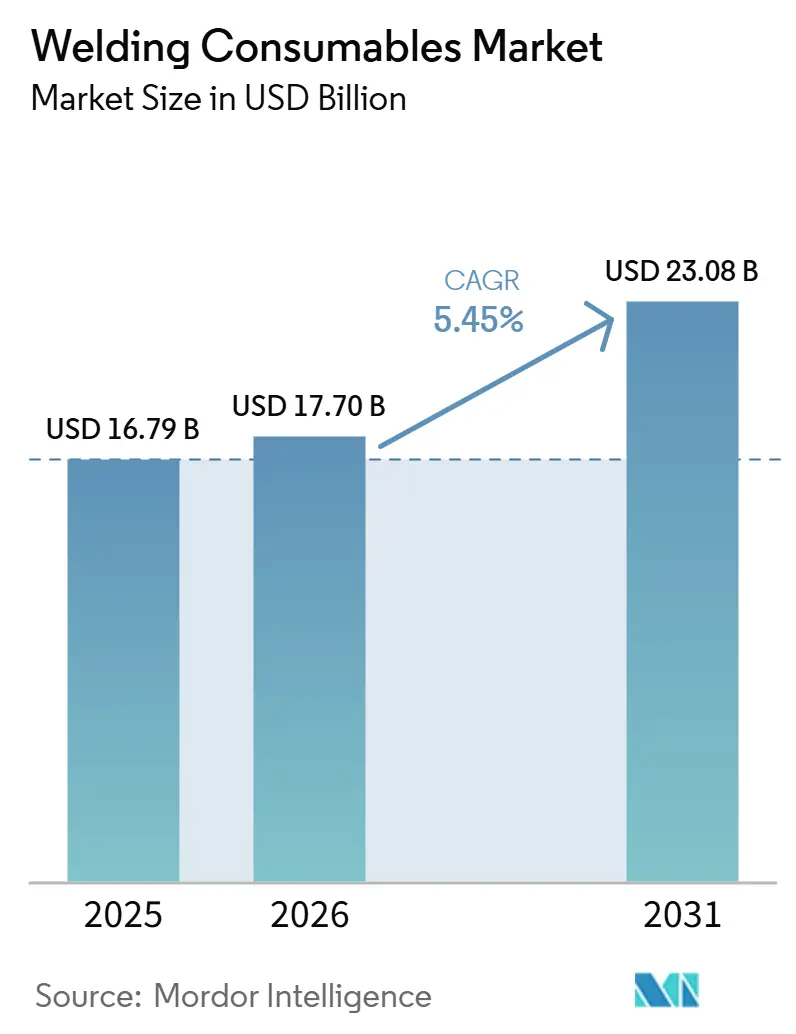
The Welding Consumables Market size was valued at USD 16.79 billion in 2025 and is estimated to grow from USD 17.70 billion in 2026 to reach USD 23.08 billion by 2031, at a CAGR of 5.45% during the forecast period (2026-2031).
Sustained investment in steel-intensive infrastructure, industrial manufacturing, energy projects, and shipbuilding is driving the welding consumables market, increasing demand for qualified electrodes, wires, fluxes, and shielding consumables. The rising adoption of welding automation across North America, Europe, and parts of Asia-Pacific is accelerating the shift toward premium solid wires, flux-cored wires, and robotic welding consumables that support consistent weld quality and higher productivity. At the same time, stricter quality requirements in offshore energy, pressure vessels, and structural fabrication are supporting demand for certified low-hydrogen and high-performance consumables. India’s finished steel consumption is expected to increase by 9.8% in 2025, reinforcing fabrication activity across the construction and infrastructure markets. However, volatility in nickel, molybdenum, and other alloying material prices continues to increase production costs for stainless and high-alloy consumables. In addition, alternative joining technologies, such as friction stir welding, are reducing filler consumption in selected aluminum applications. Despite these challenges, the expansion of offshore wind projects, heavy fabrication activity, and robotic welding installations is expected to sustain demand for technologically advanced welding consumables with superior mechanical properties and compatibility with automated processes.
Key Report Takeaways
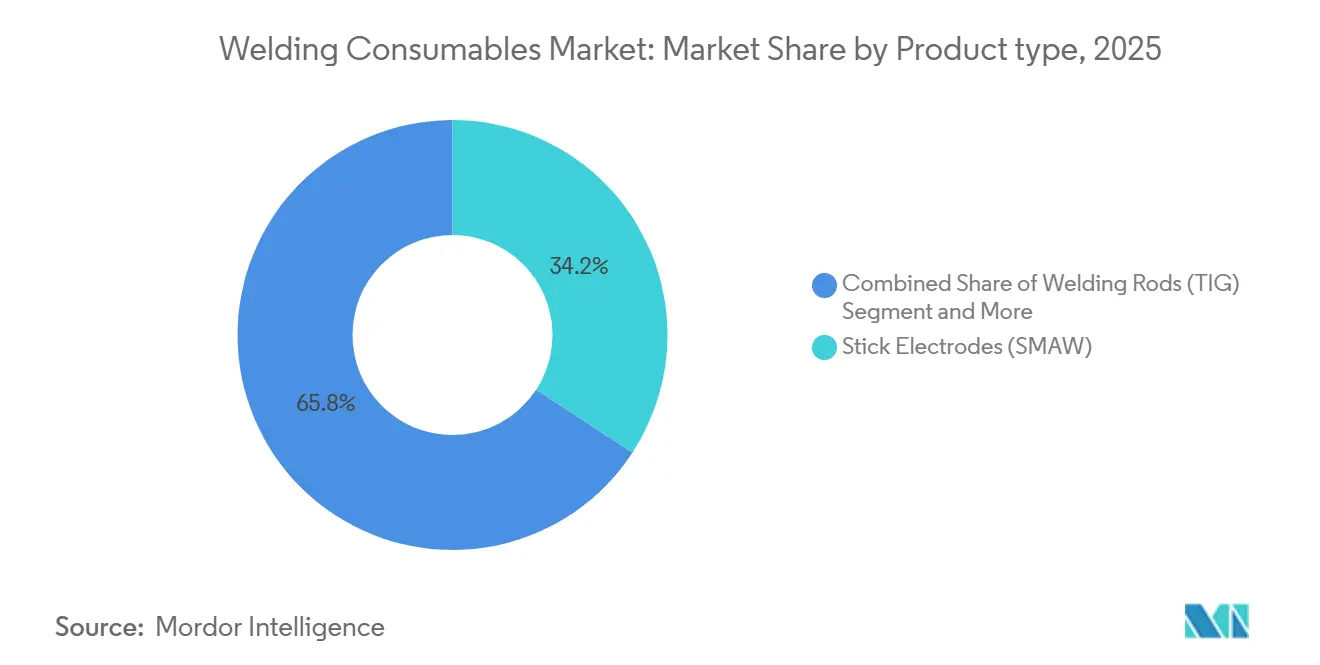
- By product type, stick electrodes held 34.20% of the welding consumables market share in 2025, while flux-cored wires are projected to be the fastest-growing, with a 8.20% CAGR through 2031.
- By material, steel consumables accounted 45.20% of the welding consumables market size in 2025, while aluminum products are set to record a 9.50% CAGR through 2031.
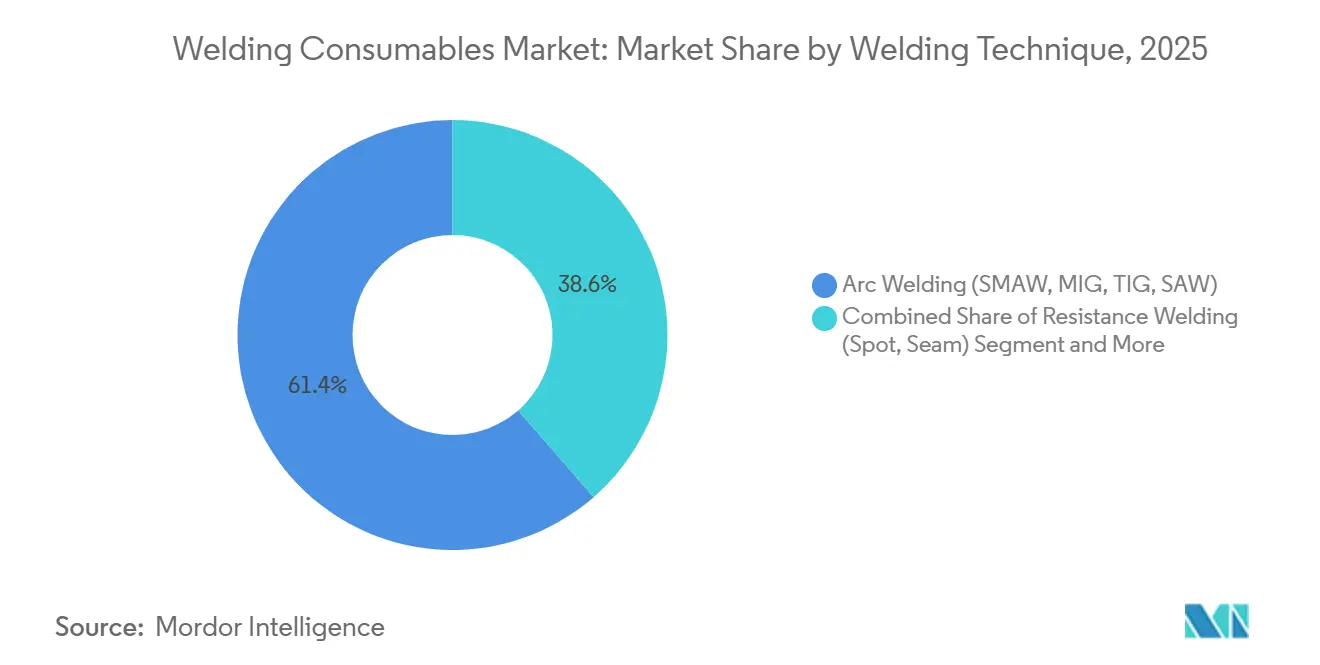
- By welding technique, arc processes captured 61.40% market share in 2025, while laser and electron-beam methods are projected to post an 11.60% CAGR through 2031.
- By end-use industry, building and construction led with a 29.90% market share in 2025, whereas shipbuilding and offshore applications are projected to grow at a 11.40% CAGR through 2031.
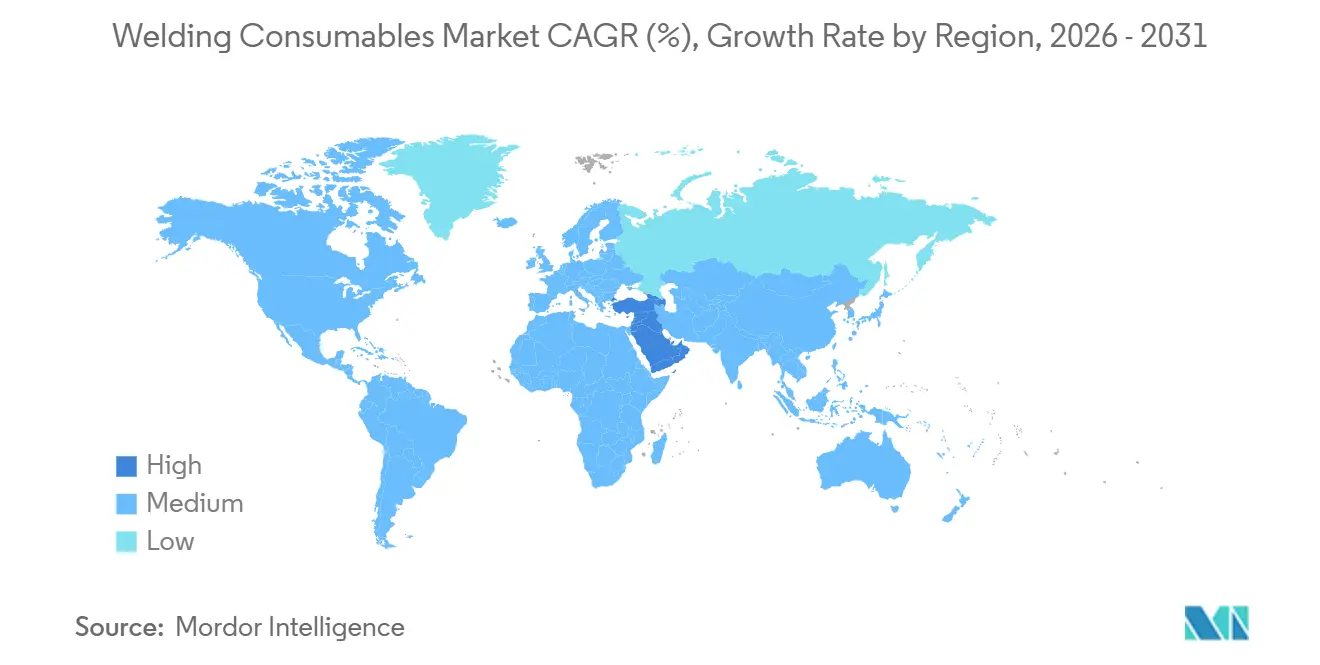
- By geography, Asia-Pacific accounted for 44.50% of global demand in 2025, while the Middle East & Africa market is anticipated to grow fastest at an 7.80% CAGR to 2031.
Note: Market size and forecast figures in this report are generated using Mordor Intelligence’s proprietary estimation framework, updated with the latest available data and insights as of January 2026.
Market Trends and Insights
Drivers Impact Analysis of Welding Consumables Market*
| Driver | (~) % Impact on CAGR Forecast | Geographic Relevance | Impact Timeline |
|---|---|---|---|
| Infrastructure Build-Out Driving Steel Fabrication Demand | +1.5% | Asia-Pacific core, with spillover to the Middle East, Africa, and South America | Long term (≥ 4 years) |
| Welding Automation Raising Premium Wire And Flux Demand | +1.1% | Global, especially North America and Europe | Medium term (2-4 years) |
| Offshore Wind Foundations Requiring High-Toughness Consumables | +0.9% | Europe, Asia-Pacific, and North America | Long term (≥ 4 years) |
| Lightweight Vehicles Increasing Aluminum Filler Metal Use | +0.7% | North America and Europe, with spillover to Asia-Pacific | Medium term (2-4 years) |
| Green-Steel Mandates Supporting Low-Hydrogen Electrode Innovation | +0.5% | Europe, Asia-Pacific, and North America | Long term (≥ 4 years) |
| High-Performance Alloy Demand in Aerospace and Oil and Gas | +0.4% | North America, Europe, and Asia-Pacific | Medium term (2-4 years) |
| Source: Mordor Intelligence | |||
Infrastructure Build-Out Across Asia-Pacific Driving Steel Fabrication Demand
Asia-Pacific remains the largest market for welding consumables, supported by sustained investments in infrastructure, transportation, industrial facilities, and energy projects across China, India, and Japan. China is expected to consume approximately 892 million metric tons of finished steel in 2025, with demand driven by transportation infrastructure, energy projects, industrial upgrades, and advanced manufacturing. India’s finished steel consumption is projected to increase by 9.8% in 2025, reaching 163.7 million metric tons in FY 2025–26, with construction and infrastructure accounting for 68% of domestic steel demand. The country’s National Infrastructure Pipeline (NIP) includes 9,142 projects across 34 subsectors, supporting sustained demand for structural steel fabrication. Meanwhile, Japan continues to invest in transportation infrastructure, industrial modernization, offshore wind, and disaster-resilient construction, which supports demand for high-performance welding consumables used in heavy fabrication and high-quality structural applications. Across the Asia-Pacific region, these infrastructure and industrial investments are increasing the use of low-hydrogen electrodes, flux-cored wires, and submerged arc welding (SAW) consumables for thick-section structural welding. Stringent engineering specifications for bridges, railways, offshore structures, and industrial facilities continue to favor premium consumables over conventional grades.
Welding Automation Raising Premium Wire And Flux Demand
The American Welding Society projects a need for 320,500 additional welding professionals in the United States by 2029. The workforce totaled 771,000 workers, and more than 157,000 were at or near retirement age in 2025. This shortage encourages fabricators to use robotic MIG/MAG and flux-cored arc welding cells for repeatable joint designs. Automated cells require close control of wire diameter, arc stability, and spatter performance. The United States Department of Labor approved AWS’s Welding Automation Specialist Apprenticeship in 2025, which supports training for deploying automated welding. HD Hyundai Heavy Industries is using rail-mounted welding robots in South Korean shipyards, where one operator can supervise up to 8 robots.[1]
Offshore Wind Foundations Requiring High-Toughness Consumables
Global offshore wind capacity reached 92.5 GW at the end of 2025, after 9.3 GW was connected during the year. GWEC expects annual offshore wind additions to double in 2026 and projects a 24% CAGR from 2026 through 2031. Large monopiles for 15-20 MW turbines can weigh up to 2,800 tons and use walls thicker than 100 mm. These structures require submerged-arc and flux-cored consumables with Charpy toughness ratings of -40°C or -60°C. Research on offshore jacket plates found that gas-shielded flux-cored arc welding can deliver adequate CTOD fracture toughness for critical joints. A 2026 study also reported that hybrid laser-arc welding combined with narrow-gap SAW can reduce filler volume while retaining required mechanical performance on 80 mm offshore plates.
Lightweight Vehicles Increasing Aluminum Filler Metal Use
Vehicle manufacturers are increasing the use of aluminum in body structures and battery enclosures to meet weight targets. Battery electric vehicle enclosures require sealed joints, and the quality of their welds is a safety consideration. Research published in 2026 found that laser welding with an aluminum filler metal can mitigate the risks of porosity and hot cracking in AA8011 aluminum sheet joints. Secondary aluminum die-cast alloys can introduce composition variation that requires close control of filler chemistry. Automotive structures, therefore, create an opportunity for suppliers that qualify fillers to AWS A5.10 and EN ISO 18273. EN ISO 15614-2 procedure qualification also raises the switching cost for substitute fillers in structural aluminum work.
Restraints Impact Analysis of Welding Consumables Market*
| Restraint | (~) % Impact on CAGR Forecast | Geographic Relevance | Impact Timeline |
|---|---|---|---|
| Raw-Material Price Volatility Raising Costs | -0.7% | Global, especially stainless-steel applications | Short term (≤ 2 years) |
| Fume-Emission Rules Raising Compliance Spending | -0.5% | North America and Europe, with spillover to Asia-Pacific | Medium term (2-4 years) |
| Solid-State Joining Reducing Consumable Intensity | -0.4% | North America, Europe, and Asia-Pacific, particularly aerospace and automotive | Long term (≥ 4 years) |
| Near-Net Additive Parts Reducing Aerospace Welding Steps | -0.3% | North America and Europe | Long term (≥ 4 years) |
| Source: Mordor Intelligence | |||
Raw-Material Price Volatility Raising Costs
Nickel and molybdenum are important alloying inputs for stainless, duplex, and nickel-based welding consumables. Their supply is geographically concentrated, which makes costs sensitive to policy changes, mine output, and downstream demand. Nickel traded near USD 14,000-15,500 per tonne for much of 2025 and reached USD 18,756 per ton on January 23, 2026. Grades such as 316L stainless and 2205 duplex carry higher alloy surcharges when ferro-molybdenum prices rise. Producers serving long-term supply contracts cannot always recover these increases through list-price changes. The welding consumables market, therefore, faces margin pressure when nickel and molybdenum costs rise together during periods of stronger stainless demand.[2]
Fume-Emission Rules Raising Compliance Spending
The International Agency for Research on Cancer classifies welding fumes as carcinogenic to humans. OSHA limits hexavalent chromium exposure to 5 micrograms per cubic meter as an 8-hour time-weighted average and sets an action level of 2.5 micrograms per cubic meter. These requirements can trigger engineering controls, air monitoring, and medical surveillance at stainless welding facilities. ANSI Z49.1 calls for ventilation planning, local exhaust ventilation, and fume monitoring in welding operations. EU Directive 2017/164/EU also establishes indicative exposure limits for manganese and other welding-fume components. Smaller fabrication shops can face slower procurement decisions because ventilation, respiratory protection, and industrial hygiene programs add operating costs.
*Our forecasts treat driver/restraint impacts as directional, not additive. The impact forecasts reflect baseline growth, mix effects, and variable interactions.
Welding Consumables Market Segment Analysis
By Product Type:
Stick Electrodes Lead While Flux-Cored Wires Grow FasterStick electrodes accounted 34.20% of the welding consumables market in 2025, supported by their portability, modest equipment requirements, and broad approval under AWS A5.1 and ISO 2560. These factors continue to support demand for welding electrodes across field repair, construction, and infrastructure applications. They remain widely used in field repair, pipe joining, and seismic-grade infrastructure projects where power or shielding gas may be unreliable. Their use in outdoor and remote work helps maintain a large installed base despite the faster adoption of wire-fed processes. Welding wires for GMAW and MIG applications held the second-largest volume, supported by automotive body joining and light structural fabrication. Submerged-arc wire-flux combinations have the highest revenue intensity per kilogram because they serve heavy-section offshore and pressure-vessel welding. The welding consumables market size for certified SAW sets benefits from the demanding requirements of thick, critical joints.
Flux-cored wires are the fastest-growing product type, registering a 8.20% CAGR, as robotic and semi-automatic cells replace manual SMAW on repetitive welds. Gas-shielded FCAW grades lead flux-cored volumes because they provide high deposition rates, all-position capability, and compatibility with arc-monitoring systems. Self-shielded variants remain useful for open-site construction and repair work where gas delivery is impractical. Connected welding platforms are also encouraging the use of traceable consumable lots. QR-coded wire reels can link a consumable batch to a weld record, which supports procurement requirements in nuclear and aerospace supply chains. This combination of automation, documentation, and stable feed performance supports higher-value flux-cored product lines within the welding consumables market.

By Material Type:
Steel Leads While Aluminum Gains ImportanceSteel consumables accounted for 45.60% of the welding consumables market in 2025 because carbon steel, high-strength low-alloy steel, and stainless steel remain central to structural, vessel, and pipeline fabrication. The shift toward electric arc furnace steelmaking raises the importance of low-hydrogen grades for thick microalloyed steel sections. Tighter carbon equivalents can increase the risk of hydrogen-induced cracking when welding procedures are not controlled. Low-hydrogen electrodes and qualified wire formulations, therefore, remain important in green steel fabrication. Stainless fillers are governed by EN ISO 14343 and AWS A5.9, while nickel-alloy wires are covered by EN ISO 18274. These qualifications raise switching costs for established suppliers.
Aluminum products are the fastest-growing material category in the welding consumables market, registering a 9.50% CAGR, driven by EV battery enclosures and lightweight vehicle structures, which increase demand for qualified fillers. Laser welding with filler can help manage porosity and hot cracking in selected aluminum assemblies. Nickel-based products represent a smaller-volume category but have the highest unit value in oil- and gas-fired heat exchangers, nuclear steam generators, and aerospace combustion parts. Copper, titanium, and cobalt consumables are used in narrower applications, including electrical joining, aerospace structures, and hardfacing. These specialties are closely tied to capital projects and qualification requirements. The material mix supports a wide range of price points across the welding consumables industry.
By Welding Technique:
Arc Processes Remain Central While Laser Welding ExpandsArc welding held 61.40% of the welding consumables market in 2025 across SMAW, MIG/MAG, TIG, and SAW processes. The process group is used across many base-metal thicknesses, joint configurations, and welding positions. Narrow-gap SAW is especially important for offshore wind foundations because it can weld thick plates with controlled heat input. A study of 80 mm S355ML plates reported that a hybrid laser-arc and narrow-gap SAW sequence reduced weld volume and filler use while retaining required mechanical properties. Resistance welding is filler-light because it primarily uses shaped electrode tips instead of deposited filler metal. Oxy-fuel welding continues to serve repair work and locations with unreliable electricity, although its value share is declining as fabrication electrifies.
Laser and electron-beam processes are the fastest-growing category of techniques, registering a 11.60% CAGR, supported by battery enclosure welding and aerospace joining. These results support adoption in applications that need tightly controlled heat input and precision. The welding consumables market does not grow in direct proportion to laser adoption because filler use per laser joint can be lower than in arc welding. Friction stir welding can also reduce filler requirements in some aerospace and automotive aluminum structures. Additive manufacturing of near-net aerospace parts may reduce certain welding steps, though it does not eliminate joining in all fabrication tasks.[3]
By End-Use Industry:
Construction Leads While Shipbuilding and Offshore ExpandBuilding and construction accounted for 29.90% of the welding consumables market in 2025, driven by demand for structural steel in bridges, metro systems, tunnels, and commercial buildings. India consumed 163.7 million tons of finished steel in fiscal 2025-26, with construction and infrastructure accounting for 68% of that demand. This activity creates a recurring need for standard, certified products for structural joints. Automotive and transportation accounted for the second-largest end-use category, driven by steel body joining, resistance spot welding, and the growing use of aluminum in EV structures. Oil and gas, energy infrastructure, and heavy machinery generate steady demand for high-strength and corrosion-resistant products. Aerospace and defense remain smaller by volume but use higher-value chromium-nickel TIG rods, nickel-alloy electrodes, and specialty titanium fillers under strict NADCAP and AS9100 requirements.
The shipbuilding and offshore segment is the fastest-growing end-use category in the welding consumables market, registering an 11.40% CAGR because new vessel construction and offshore wind foundations require high-specification products. HD Hyundai Heavy Industries reported that its robot-enabled shipyard output rose from 500 tons to 750 tons per day. Higher output favors products with stable wire feeding and consistent arc behavior. Offshore structures also require toughness-qualified wire-and-flux combinations for low-temperature service. These demands increase the value of process support and certification alongside the physical consumables. Shipbuilding, therefore, provides a clear growth path for premium flux-cored and submerged-arc grades.
Geography Analysis
APAC Welding Consumables Market
Asia-Pacific accounted for 44.50% of the regional welding consumables market in 2025, led by China, India, Japan, and South Korea. India’s steel demand grew 9.8% in 2025, while finished steel consumption reached 163.7 million tons in fiscal 2025-26. China commissioned 6.6 GW of the 9.3 GW of offshore wind capacity added globally in 2025. Japan and South Korea support premium shipbuilding products that meet KR, NK, and DNV approval requirements. Indonesia, Vietnam, Thailand, and the Philippines add demand through manufacturing and commercial construction. In January 2025, voestalpine Böhler Welding said it would expand its footprint in Indian manufacturing and application technology and add solid-wire capacity.
North America and Europe Welding Consumables Market
North America and Europe form the technology-focused portion of the welding consumables market. AWS workforce data indicates a large welding labor gap in North America, which is increasing the use of robotic and collaborative welding systems. Canada supports demand through pipelines and hydroelectric construction, while Mexico supplies automotive production linked to the United States. European fabricators face occupational exposure requirements that increase demand for certified low-fume products. Germany, the United Kingdom, and Italy concentrate on automotive, aerospace, and energy equipment fabrication. Nordic offshore wind and subsea pipeline activity supports low-temperature-impact-qualified consumables approved by DNV and Lloyd’s Register.
MEA and South America Welding Consumables Market
The Middle East and Africa are the fastest-growing regions in the welding consumables market, registering a 7.80% CAGR, supported by manufacturing, infrastructure, and civil construction programs in the GCC. Deepwater projects in West Africa and the Gulf of Oman require high-nickel and corrosion-resistant products for subsea equipment. Turkey is a major regional supplier of coated electrodes to North Africa, Gulf markets, and sub-Saharan Africa. South America has steady investment-led demand from Brazil’s offshore pre-salt work, hydroelectric construction, and automotive supply chain. Argentina and Peru support demand through mining equipment maintenance and pipeline fabrication. Imported premium products create an opportunity for suppliers that can offer AWS- or ISO-certified grades for public-sector procurement.
Mordor Intelligence provides coverage of the welding consumables market across other key regional markets. Detailed country-level analysis extends to United States incorporating local coverage and market participation, as required.
Competitive Landscape
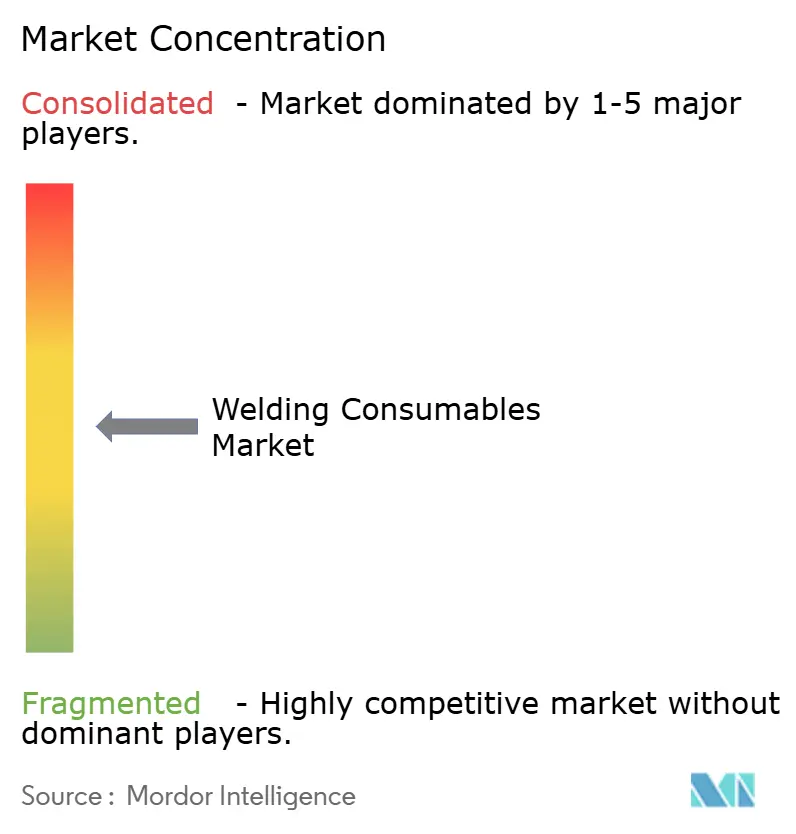
The welding consumables market has medium concentration in the premium tier and fragmentation in the mid- and lower tiers. Lincoln Electric, ESAB, Kobe Steel’s Kobelco Welding, Hyundai Welding, and voestalpine Böhler Welding compete through approved product portfolios, distribution, and application engineering. ESAB completed its USD 1.5 billion acquisition of Eddyfi Technologies in June 2026. The transaction expanded ESAB from welding and fabrication into inspection and monitoring for aerospace, nuclear, and energy infrastructure. Eddyfi was expected to contribute USD 270 million in revenue and USD 80 million in adjusted EBITDA in 2026. This combination makes it harder for commodity suppliers to compete where fabrication records and inspection data are purchased together.
Lincoln Electric’s RISE strategy targets high-single-digit to low-double-digit revenue CAGR through 2031, with 300-400 basis points expected from acquisitions in automation, specialty materials, and geographic expansion. The company acquired the remaining 65% interest in Alloy Steel Australia in August 2025, bringing the wear-plate and digital-monitoring supplier fully into its portfolio. ESAB also agreed to acquire EWM GmbH for EUR 275 million (USD 302 million) in June 2025. Process-specific metallurgy remains an entry barrier in offshore applications where proprietary high-strength and high-toughness welding methods support demanding specifications. These moves favor suppliers that combine consumables with equipment, automation, technical service, and traceability.
Opportunities include certified low-hydrogen and low-fume products for electric arc furnace steel fabrication, aluminum fillers for EV battery enclosures, and specialty nickel and duplex products for Gulf deepwater and LNG projects. Manufacturers in China and India are expanding certification coverage for standard products, putting pressure on margins for commodity SMAW and MIG wire. DNV, Lloyd’s Register, and AWS qualification processes maintain a barrier around premium applications. QR-coded reels and data-linked weld records are becoming increasingly relevant in procurement contexts that require traceability. International Institute of Welding frameworks could make qualifications more consistent across borders and help certified producers in the Asia-Pacific enter higher-value markets. The competitive balance, therefore, remains strongest for companies that can support both the product and the qualification process.
Welding Consumables Industry Leaders
-
Lincoln Electric Holdings Inc.
-
ESAB Corporation
-
Illinois Tool Works Inc. (Miller Welding)
-
voestalpine Böhler Welding GmbH
-
Kobe Steel Ltd. (Kobelco Welding)
- *Disclaimer: Major Players sorted in no particular order
Welding Consumables Market Companies Covered in this Report
- Lincoln Electric Holdings Inc.
- ESAB Corporation
- Illinois Tool Works Inc. (Miller Welding)
- voestalpine Böhler Welding GmbH
- Kobe Steel Ltd. (Kobelco Welding)
- Hyundai Welding Co. Ltd.
- Tianjin Bridge Welding Materials Group Co., Ltd.
- Air Liquide S.A. (Welding Division)
- Ador Welding Ltd.
- Gedik Welding Inc.
- Welding Alloys Group
- Selectrode Industries Inc.
- Sandvik Materials Technology (Alleima)
- Panasonic Welding Systems
- TASETO Co., Ltd.
- Nippon Steel Welding & Engineering
- Oerlikon (CD&R-owned)
- Daihen Corporation
- Great Welding Ltd.
- Kiswel Co. Ltd.
Recent Industry Developments in Welding Consumables Market
- June 2026: ESAB Corporation completed its USD 1.45 billion acquisition of Eddyfi Technologies, a global leader in advanced non-destructive testing and monitoring. The deal expands ESAB's total addressable market by approximately USD 5 billion and positions the company as a complete fabrication-through-inspection provider in aerospace, nuclear, and energy infrastructure, with Eddyfi expected to contribute approximately USD 270 million in revenue and USD 80 million in adjusted EBITDA in 2026.
- August 2025: Lincoln Electric Holdings acquired the remaining 65% stake in Alloy Steel Australia (Int) Pty Ltd., achieving full ownership of the company, which had annual revenue of USD 50 million and manufactured proprietary wear-plate solutions and digital monitoring systems for the Asia-Pacific mining sector. Lincoln Electric plans to scale the technology globally beyond Asia-Pacific.
- June 2025: ESAB Corporation signed a definitive agreement to acquire EWM GmbH, a German leader in heavy industrial welding equipment and advanced automation, for EUR 275 million (USD 302 million). The transaction was designed to accelerate growth in equipment sales in Europe and North America.
- January 2025: Voestalpine Böhler Welding announced the expansion of its manufacturing and application technology footprint in India, with EUR 3 million (USD 3.33 million) invested in 3 production locations over the prior 5 years. It also announced plans to add solid-wire manufacturing capability as part of a local-for-local strategy.
Global Welding Consumables Market Report Scope
The Welding Consumables Market is Segmented by Product Type (Stick Electrodes, Welding Rods, and More), by Material Type (Steel, Aluminum, Nickel-Based, and Others), by Welding Technique (Arc Welding, Resistance Welding, and More), by End-Use Industry (Building & Construction, Oil & Gas, and More), and by Geography (North America, Europe, and More). The Report Offers Market Size and Value (USD) Forecasts for all the Above Segments.
Segmentation Overview
| Stick Electrodes (SMAW) |
| Welding Rods (TIG) |
| Submerged Arc Welding (SAW) Flux & Wire Sets |
| Flux-Cored Wires |
| Welding Wires (GMAW/MIG/ Solid Wires) |
| Others (Oxy-fuel Welding Rods, Welding Powder, Shielding Gases, Tips, etc.) |
| Steel Welding Consumables (carbon, Stainless) |
| Aluminum Welding Consumables |
| Nickel-Based Welding Consumables |
| Others (Copper, Titanium, Cobalt) |
| Arc Welding (SMAW, MIG, TIG, SAW) |
| Resistance Welding (Spot, Seam) |
| Oxy-Fuel Welding |
| Others (Laser Welding, Electron Beam Welding) |
| Building & Construction |
| Automotive & Transportation |
| Shipbuilding & Offshore |
| Oil & Gas, Energy Infrastructure |
| Heavy Machinery & Industrial Equipment |
| Aerospace & Defense |
| Others (Railway, Consumer Goods) |
| North America | United States |
| Canada | |
| Mexico | |
| South America | Brazil |
| Argentina | |
| Rest of South America | |
| Europe | United Kingdom |
| Germany | |
| France | |
| Italy | |
| Spain | |
| BENELUX (Belgium, Netherlands, and Luxembourg) | |
| NORDICS (Denmark, Finland, Iceland, Norway, and Sweden) | |
| Rest of Europe | |
| Asia-Pacific | China |
| India | |
| Japan | |
| Australia | |
| South Korea | |
| ASEAN (Indonesia, Thailand, Philippines, Malaysia, Vietnam) | |
| Rest of Asia-Pacific | |
| Middle East and Africa | Saudi Arabia |
| United Arab Emirates | |
| Turkey | |
| Egypt | |
| South Africa | |
| Rest of Middle East and Africa |
| By Product Type | Stick Electrodes (SMAW) | |
| Welding Rods (TIG) | ||
| Submerged Arc Welding (SAW) Flux & Wire Sets | ||
| Flux-Cored Wires | ||
| Welding Wires (GMAW/MIG/ Solid Wires) | ||
| Others (Oxy-fuel Welding Rods, Welding Powder, Shielding Gases, Tips, etc.) | ||
| By Material Type | Steel Welding Consumables (carbon, Stainless) | |
| Aluminum Welding Consumables | ||
| Nickel-Based Welding Consumables | ||
| Others (Copper, Titanium, Cobalt) | ||
| By Welding Technique | Arc Welding (SMAW, MIG, TIG, SAW) | |
| Resistance Welding (Spot, Seam) | ||
| Oxy-Fuel Welding | ||
| Others (Laser Welding, Electron Beam Welding) | ||
| By End-Use Industry | Building & Construction | |
| Automotive & Transportation | ||
| Shipbuilding & Offshore | ||
| Oil & Gas, Energy Infrastructure | ||
| Heavy Machinery & Industrial Equipment | ||
| Aerospace & Defense | ||
| Others (Railway, Consumer Goods) | ||
| By Geography | North America | United States |
| Canada | ||
| Mexico | ||
| South America | Brazil | |
| Argentina | ||
| Rest of South America | ||
| Europe | United Kingdom | |
| Germany | ||
| France | ||
| Italy | ||
| Spain | ||
| BENELUX (Belgium, Netherlands, and Luxembourg) | ||
| NORDICS (Denmark, Finland, Iceland, Norway, and Sweden) | ||
| Rest of Europe | ||
| Asia-Pacific | China | |
| India | ||
| Japan | ||
| Australia | ||
| South Korea | ||
| ASEAN (Indonesia, Thailand, Philippines, Malaysia, Vietnam) | ||
| Rest of Asia-Pacific | ||
| Middle East and Africa | Saudi Arabia | |
| United Arab Emirates | ||
| Turkey | ||
| Egypt | ||
| South Africa | ||
| Rest of Middle East and Africa | ||
Key Questions Answered in the Report
What is the projected value of welding consumables by 2031?
The welding consumables market is projected to reach USD 23.08 billion by 2031, growing at a 5.45% CAGR from 2026, with demand supported by infrastructure, automation, and qualified offshore fabrication work. It also reflects continued demand for steel fabrication, qualified low-hydrogen products, and wire-feed systems used in automated operations. Higher-value products serve offshore foundations, shipbuilding, energy equipment, and other joints that require documented performance. Raw-material price volatility and tighter fume controls remain constraints on purchasing and supplier margins. Product approvals continue to influence supplier selection in critical fabrication work globally.
Which product category is growing fastest?
Flux-cored wires are the fastest-growing product type in the welding consumables market, registering a 8.20% CAGR, because automated and robotic welding cells need stable feeding, repeatable arcs, and lower-spatter performance.
Why are low-hydrogen welding products important?
Low-hydrogen electrodes and wires help manage cracking risk in thick micro-alloyed steel sections, particularly as electric arc furnace steelmaking expands.
Which end-use is expanding most quickly?
Shipbuilding and offshore is the fastest-growing end-use in the welding consumables market, registering a 11.40% CAGR, because vessels and offshore wind foundations require qualified flux-cored and submerged-arc products.
What limits demand for filler metals in some applications?
Friction stir welding and laser welding can reduce filler metal use per joint, and additive manufacturing can eliminate some joining steps for near-net-shape parts.
Why do premium suppliers retain an advantage?
AWS, DNV, and other approvals, combined with technical service and traceability, make it difficult to replace qualified products in critical applications.