
Copper Market Size and Share
Copper Market Analysis by Mordor Intelligence
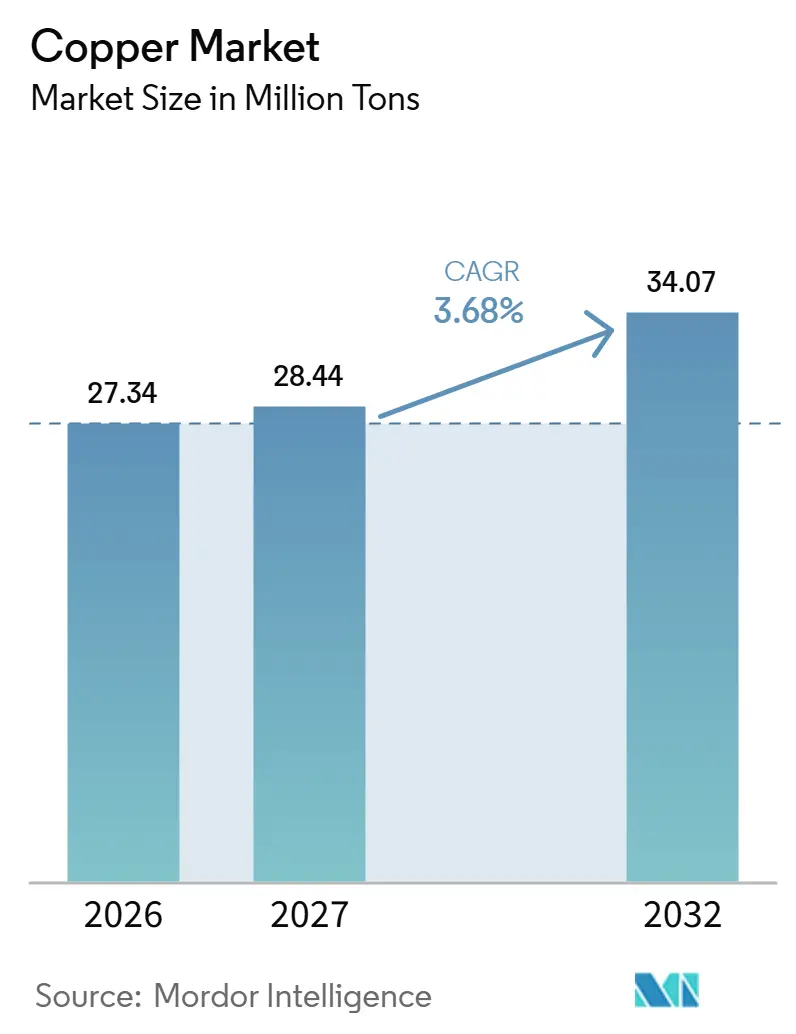
The copper market size is estimated at 27.34 million tons in 2026 and is projected to be 28.44 million tons in 2027, reaching 34.07 million tons by 2032, growing at a CAGR of 3.68% from 2027 to 2032.
Electrification and urban construction support demand through power networks and copper cables, including network expansion in India. The global copper price rally beginning in December 2025 amid United States tariff uncertainty, mine disruptions and fund buying exposed weak physical demand in China. Rising electrical requirements coexist with price pressure on fabricators securing metal. Recycling investments add processing capability, while staged expansion contracts tie further supply responses to investment approval. Grid and construction demand sustain volume while elevated prices squeeze fabricators’ working capital, so commissioned processing capacity has more immediate commercial value than conditional projects.
Key Report Takeaways
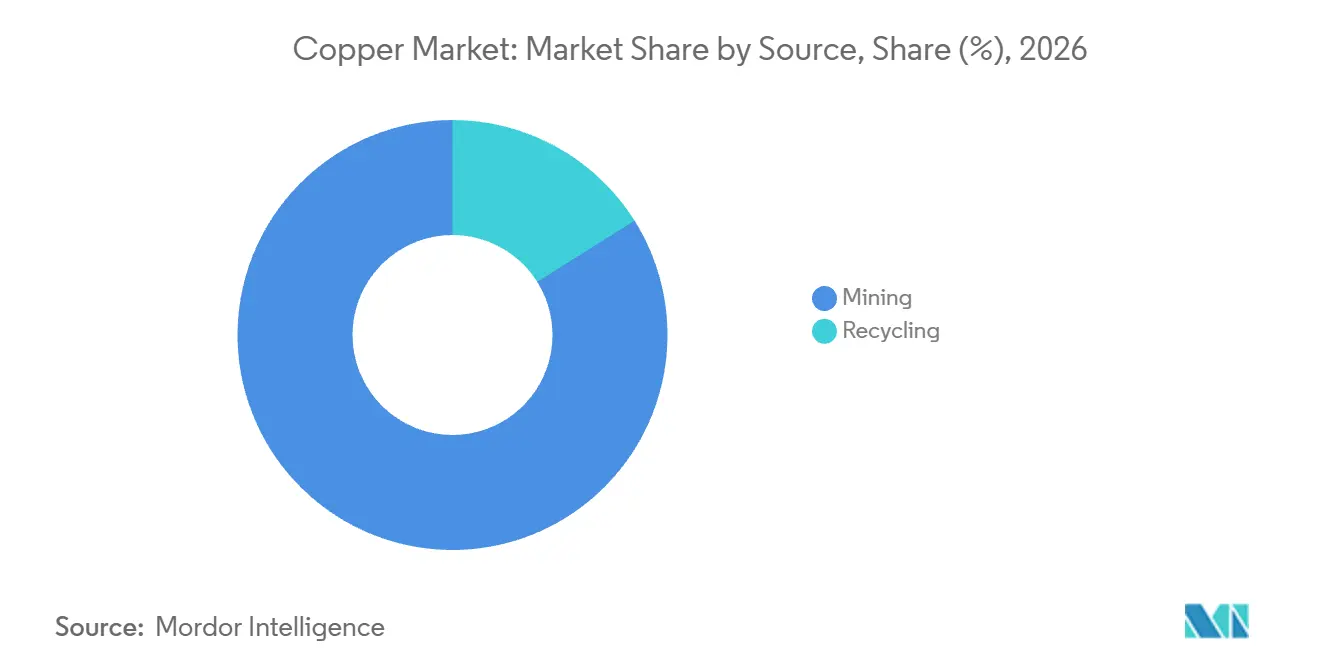
- By source, mining led with an 83.93% copper market share in 2026, while recycling is the fastest-growing segment with a forecast CAGR of 5.12% from 2027 to 2032.
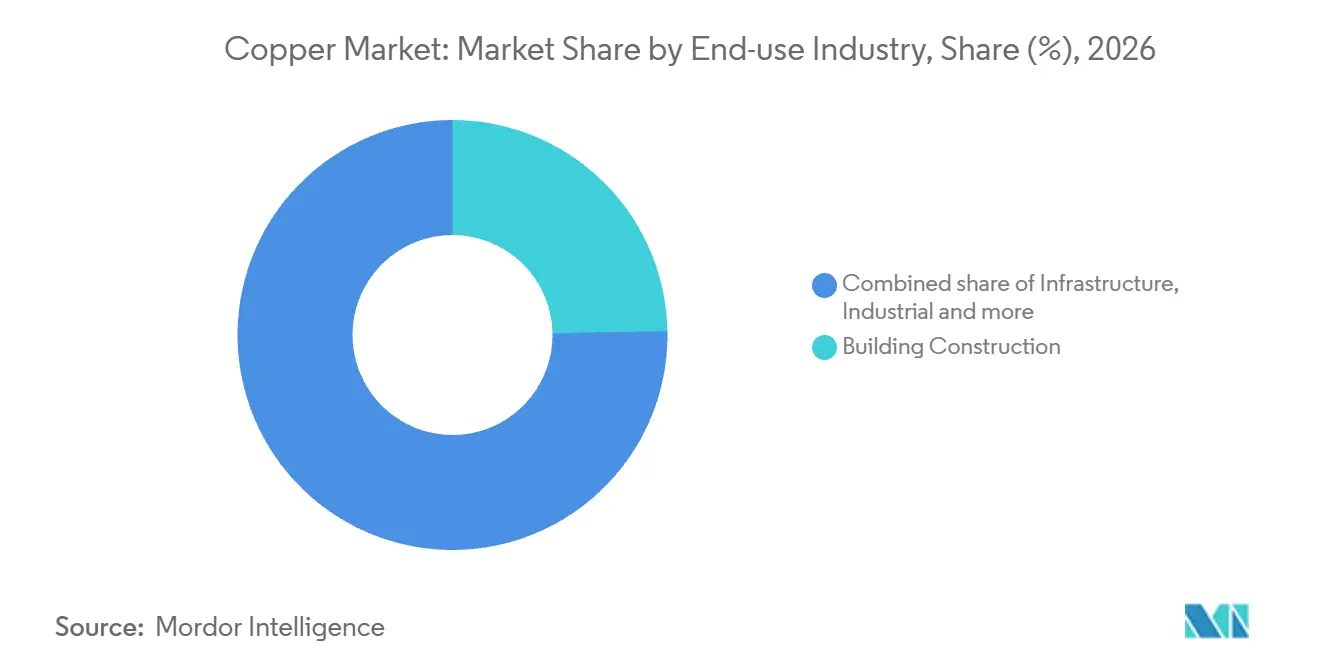
- Among end-use industries, building construction accounted for a 24.71% share of the copper market size in 2026, with infrastructure forecast to grow fastest at a 4.14% CAGR from 2027 to 2032.
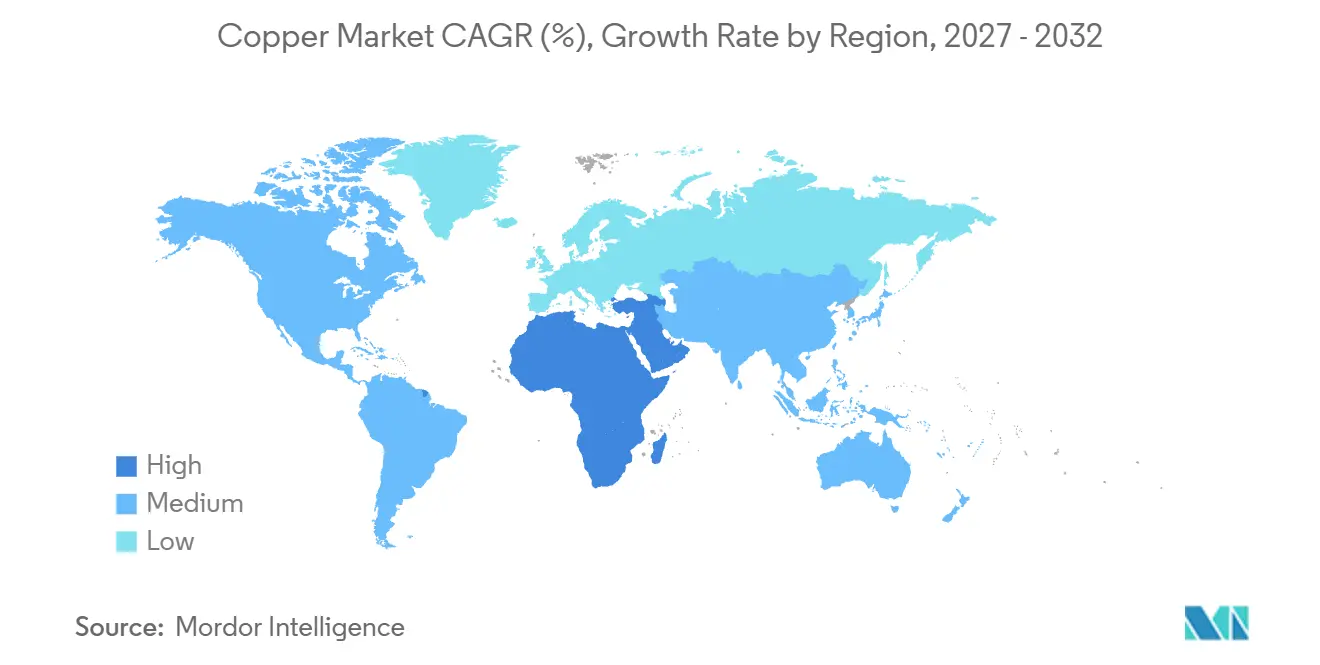
- Geographically, Asia-Pacific led with a 70.41% share in 2026, whereas Middle East and Africa is forecast to grow fastest at a 4.91% CAGR from 2027 to 2032.
Note: Market numbers in this report are based on Mordor Intelligence's proprietary estimation framework, which combines nine months of actuals with Q4 projections for base year 2026.
Market Trends and Insights
Drivers Impact Analysis of Copper Market*
| Driver | (~) % Impact on CAGR Forecast | Geographic Relevance | Impact Timeline |
|---|---|---|---|
| Expanding Demand from Renewable Energy and Grid Electrification | +2% | United States of America | Long term (≥ 4 years) |
| Rapid Growth in Copper-Intensive EV Adoption | +1.4% | China and Viet Nam | Medium term (2-4 years) |
| Urban Infrastructure Expansion in Emerging Markets | +1.1% | Mumbai Metropolitan Region | Long term (≥ 4 years) |
| HVDC Submarine Cables for Offshore Wind | +0.8% | Northeast coast of England | Medium term (2-4 years) |
| Antimicrobial Copper Adoption in Healthcare | +0.1% | Province of Ontario | Long term (≥ 4 years) |
| Source: Mordor Intelligence | |||
Expanding Demand from Renewable Energy and Grid Electrification
Copper demand from electrification depends on which parts of the power system receive investment. Global renewable-capacity additions reached 800 GW in 2025, up 16% from 2024, according to International Energy Agency (IEA) findings reported by pv magazine. Georgia Power advanced 25 major transmission projects in Georgia, United States, in 2025, including 5 line upgrades and 20 substation enhancements.[1] S&P Global forecasts rising copper demand from 2025 to 2040 across renewable power, transmission and distribution, electric vehicles (EVs), storage and developing-country electrification. The mix of line upgrades and substation enhancements gives copper suppliers an existing-network channel alongside generation-led construction.
Rapid Growth in Copper-Intensive EV Adoption
Electric-car adoption strengthens the demand base that copper suppliers can address through the vehicle industry. The IEA estimates new electric-car sales rose 20% to more than 20 million worldwide in 2025. Its electric-car category includes battery-electric and plug-in hybrid cars. An S&P Global study, reported by study sponsor Vale Base Metals, forecasts EV-based copper demand rising from 2.6 million metric tons in 2025 to 6.3 million in 2040. Growing new-car sales provide a near-term production signal alongside that longer-term outlook for metal demand. A larger installed fleet does not by itself recreate the recurring flow of copper requirements, so new-vehicle manufacturing anchors the demand.
Urban Infrastructure Expansion in Emerging Markets
The World Bank projects India’s urban population to reach 800 million by 2050. In April 2026, Adani Electricity Mumbai Infrastructure Limited, a subsidiary of Adani Energy Solutions Limited, commissioned a 1,000 MW high-voltage direct current (HVDC) link between Kudus and Aarey serving Mumbai and its metropolitan region. The link combines a 30-kilometer overhead line with a 50-kilometer underground corridor designed for the densely built environment. For a 13-kilometer cable route in central London, NG Bailey’s Freedom business specified a non-standard 1,600 mm² copper cable. Its feasibility review found that a standard design would require multiple aluminum cables in a wider trench. Where trench width limits dense-city routes, this design trade-off gives copper cable suppliers an opening despite the material’s higher cost.
HVDC Submarine Cables for Offshore Wind
Offshore wind connections create copper orders when cable manufacturers build transmission systems for individual projects. In 2025, NKT said Dogger Bank C’s 320 kV HVDC power cables were manufactured using copper with a lower carbon footprint than ordinarily processed copper. Dogger Bank C is a phase of the Dogger Bank Wind Farm, located between 130 and 190 kilometers from England’s northeast coast. NKT specifies a 270-kilometer route length and 1,200 MW power capacity for the phase’s cable system. NKT said it completed export-cable trenching in 2025 with Helix Robotics Solutions. Executing these connections creates discrete copper requirements, giving producers able to meet the specified material characteristics a route into offshore cable orders.
Restraints Impact Analysis of Copper Market*
| Restraint | (~) % Impact on CAGR Forecast | Geographic Relevance | Impact Timeline |
|---|---|---|---|
| Stringent Environmental Regulations and Permitting Delays | -0.9% | Province of British Columbia | Long term (≥ 4 years) |
| Copper Price Volatility Driven by Speculative Trading | -0.6% | China, United States, Indonesia and Chile | Short term (≤ 2 years) |
| Competition from Lightweight Alternative Conductors | -0.2% | Germany and China | Long term (≥ 4 years) |
| Source: Mordor Intelligence | |||
Stringent Environmental Regulations and Permitting Delays
Permitting can delay infrastructure needed to support copper mine development. BC Hydro reported that delayed environmental approval for Teck Highland Valley Copper Partnership’s mine-life extension pushed the associated transmission project’s planned in-service date from December 2026 to August 2027.[2] Approval moved from October 2024 to June 2025, causing work to miss a spring 2025 outage window and shift to fall 2025. In 2025, British Columbia described mine permitting as usually taking 1 to 2 years after environmental assessment certificate issuance. As a mitigation, British Columbia combined assessment and permitting applications for Teck Highland Valley Copper Partnership’s mine-life-extension project in 2025. The transmission delay illustrates a remaining construction-season risk for copper mine developers even when assessment and permitting are combined.
Copper Price Volatility Driven by Speculative Trading
The global copper rally that began in December 2025 combined United States tariff uncertainty, mine disruptions and increased fund activity. On January 29, 2026, speculative buying drove the London Metal Exchange benchmark up 11% to a record USD 14,527.5 per metric ton. Reuters reported Chinese speculators at the forefront of the rally, industrial demand weakening at elevated prices and weak physical demand in China. This divergence makes a higher quoted price an unreliable signal of stronger consumption by industrial customers. For fabricators buying metal at elevated benchmarks, an unchanged physical requirement can demand more financing while exposing quotations to a reversal. Metal-carrying and quotation costs can restrain fabrication even when the underlying application requirement persists.
*Our forecasts treat driver/restraint impacts as directional, not additive. The impact forecasts reflect baseline growth, mix effects, and variable interactions.
Copper Market Segment Analysis
By Source:
Primary Supply Scale and Complex Recycling FeedstocksMining accounted for an 83.93% share of the copper market size in 2026. Global primary refined copper production reached 23.32 million metric tons in 2025, compared with 5.35 million metric tons of secondary refined output. Primary refining provides a substantial processing base linking mined sources with downstream fabrication. The production mix makes primary-smelter and refinery throughput the main supply dependency for fabricators buying refined metal.
Recycling is the fastest-growing segment, with a forecast CAGR of 5.12% from 2027 to 2032. Aurubis AG began production at its Hamburg Complex Recycling plant in July 2026, adding capability to process complex recycling materials and smelter intermediates.[3] Its process combines several smelting capabilities in one unit, enabling materials containing copper, lead and sulfur to be processed in a single plant. This gives the expansion a feedstock-access mechanism, since the facility can treat materials for which Aurubis AG identified only a limited worldwide pool of buyers. The Hamburg expansion opens a growth route through complex inputs, so recoverable feedstock variety matters alongside processing capacity.

By End-use Industry:
Building Scale and Utility Construction CadenceBuilding construction represented a 24.71% copper market share in 2026. China’s mandatory residential project code GB 55038-2025, effective May 1, 2025, requires copper conductors for each residence’s household distribution-box incoming and outgoing power lines. The incoming line must have a cross-sectional area of at least 10 mm². China’s National Bureau of Statistics reported that the country’s real estate development enterprises completed 603.5 million square meters of buildings in 2025, down 18.1% from 2024. For suppliers serving Chinese residential projects, the mandated conductor material limits substitution within that application, leaving construction volume as the more immediate source of sales risk.
Infrastructure is the fastest-growing segment, with a forecast CAGR of 4.14% from 2027 to 2032. State Grid Corporation of China accelerated new power-grid construction in the first half of 2026. Its company-wide fixed-asset investment rose 12.6% from the same 2025 period. Construction alongside investment growth points to larger equipment orders for suppliers serving State Grid in China, making executed network projects a concrete outlet for infrastructure-linked copper demand.
Geography Analysis
Asia-Pacific Copper Market
Asia-Pacific held a 70.41% share of the copper market size in 2026, making it the largest region. The International Wrought Copper Council (IWCC) forecast China’s national refined copper demand at 15.48 million metric tons in 2026, with growth of 1% after its projected 3.1% increase for 2025. Australia contributes a refined-metal supply base through BHP’s wholly owned Copper South Australia operation, which produced and sold copper cathodes in fiscal 2026. China’s forecast 1% increase implies roughly 150,000 metric tons of additional refined demand in 2026, giving suppliers a substantial incremental volume opportunity even at modest national growth.
Middle East and Africa Copper Market
Middle East and Africa is the fastest-growing region, with a forecast CAGR of 4.91% from 2027 to 2032. Saudi Energy commissioned 49 transmission substations in Saudi Arabia during the first half of 2026. Preliminary International Copper Study Group (ICSG) data put Africa’s refined copper usage at 111,400 metric tons for January through July 2026, broadly level with the same 2025 period. In Oman, cable maker Oman Cables Industry reported better domestic-market and renewables-channel sales volumes in the first quarter of 2026. Gulf grid projects offer a copper-demand channel that a broadly level African usage aggregate would obscure.
North America’s supply exposure is illustrated by the United States’ net import reliance for refined copper, at 57% of apparent consumption in 2025. In Europe, weaker European Union demand expectations contributed to ICSG’s slight reduction of its global 2026 consumption outlook in October 2026, while Atlantic Copper’s main activity in Spain was refined-cathode sales in 2025. South America’s downstream fabrication channel includes Brazil, where conductors rated up to 1,000 volts accounted for a preliminary 50.4% of copper wire and cable production in 2025. Chile’s sales of refined copper to domestic manufacturers declined in January through August 2026 from the same 2025 period. The mix makes delivery security central for United States fabricators and low-voltage production a Brazilian sales channel, while lower refined-metal sales to Chilean manufacturers and weaker European Union expectations temper downstream expansion.
Mordor Intelligence provides coverage of the copper market across other key regional markets. Detailed country-level analysis extends to China incorporating local coverage and market participation, as required.
Regulatory Framework and Outlook
Selected jurisdictions are compared by the permitting and operating conditions facing primary copper-smelter operators. In the United States, specified duties for qualifying existing major-source smelters constructed or reconstructed on or before May 13, 2024, apply by May 13, 2027, as applicable. Necessary performance tests under § 63.1449(a) must occur within 180 days of the deadline, while Proclamation 10987 of October 24, 2025, defers each Copper Rule deadline by 2 years for Freeport-McMoRan Miami Inc.’s Miami Smelter. China’s primary-material smelting permit standard requires denial for sites in legally prohibited areas or facilities designated for closure, making plant eligibility a separate commercial gate.
Regulatory Table of Copper Market
| Decision factor | China | United States | Germany | Brazil | South Africa |
|---|---|---|---|---|---|
| Primary authority | Ministry of Ecology and Environment and competent permit issuers | Environmental Protection Agency (EPA) or delegated state, local or tribal authority | Regierungspräsidien for Baden-Württemberg sites with at least one Industrial Emissions Directive installation | Competent federal, state or municipal licensing authority | Municipal licensing authorities, subject to delegation and statutory exceptions |
| Key instruments or direction | HJ 863.3-2017 and GB 25467-2010 for covered primary-material operations | 40 CFR part 63, subpart QQQ for qualifying major hazardous-air-pollutant sources | EU non-ferrous-metal best available techniques Decision 2016/1032 and adopted Industrial Emissions Directive implementation law | Complementary Law 140/2011 and General Environmental Licensing Law 15.190/2025 | Air Quality Act § 22 and GN 893 subcategory 4.16, excluding inorganic-chemical activities under Category 7 |
| Commercial effect | Permits, monitoring and applicable emissions controls; water controls cover direct or indirect discharges beyond the facility’s legal boundary | Emission, work-practice, monitoring and reporting duties with source-specific compliance schedules | Permit conditions reference best available techniques; management-system duty from October 21, 2026, with details set by separate federal ordinance | Licensing for qualifying potentially polluting activities under one competent authority | Provisional or full atmospheric-emission license for listed activities, with applicable process-emission limits |
| Current policy attractiveness | Medium | Medium | Medium | Medium | Medium |
| Future direction of policy attractiveness | No change | Hardening | Hardening | No change | No change |
| Source: Mordor Intelligence | |||||
China’s existing primary-material permitting and emissions duties support continuity, with the October 2025 air-standard review establishing revision work rather than a changed operating obligation. Proclamation 10987 defers each Copper Rule deadline for the Miami Smelter by 2 years, while EPA’s Unified Agenda entry recorded reconsideration of the 2024 rule at the proposed-rule stage, scheduling a July 2026 notice. Germany’s management-system duty from October 21, 2026, adds organizational compliance, while Brazil’s operative general licensing framework keeps jurisdiction-based approval central to entry, with the August 2026 court-hearing postponement adding legal-planning uncertainty. For South African sulfide-feed operations such as Palabora Copper’s smelter, the August 2026 proposal left subcategory 4.16 unchanged, supporting continuity of applicable licensing and process controls.
Value Chain Stages
The copper value chain compares mining, metallurgical processing and rod fabrication by their earnings mechanisms and supply constraints. Codelco reported 1.33 million metric tons of its own fine copper production in 2025, while KGHM’s 2025 Polish structure included mines, smelters, refineries and a rod plant. Integration can connect these activities within one company, while each stage retains a different relationship between material availability and supplier earnings.
Value Chain Analysis Table of Copper Market
| Primary activity | Key participants | Value capture | Bottleneck | Resilience response |
|---|---|---|---|---|
| Mining and concentrating | Mining companies such as Codelco, Freeport-McMoRan and KGHM | Concentrate sales | Extraction and ore-feed interruptions, as reported by Codelco in 2025 | Reinforce safety, reliability and operational continuity |
| Smelting and refining | Metallurgical producers such as Aurubis AG and KGHM | Treatment and refining charges, copper premiums and cathode sales | Negative spot treatment and refining charges in the 9 months ended June 2026 | Diversify mine suppliers and use long-term delivery contracts |
| Rod fabrication | Rod sellers such as Freeport-McMoRan and KGHM, and integrated cable producers such as Nexans | Rod-product sales | Coordinating cathode and scrap feed with rod requirements | Contract core copper volumes annually across producers |
| Source: Mordor Intelligence | ||||
Aurubis, citing CRU, reported negative spot treatment and refining charges for copper concentrates during the first 9 months of fiscal 2025/26, ended June 30, 2026. In August 2026, it reported contractual concentrate cover well into the first quarter of fiscal 2026/27, supported by its market position, long-term contracts and supplier diversification. Nexans used annual contracts with various copper producers for predetermined amounts covering its main requirements. Access to suitable feed can thus become the commercial bottleneck, separating additional processing capacity from the ability to capture stronger earnings.
Competitive Landscape
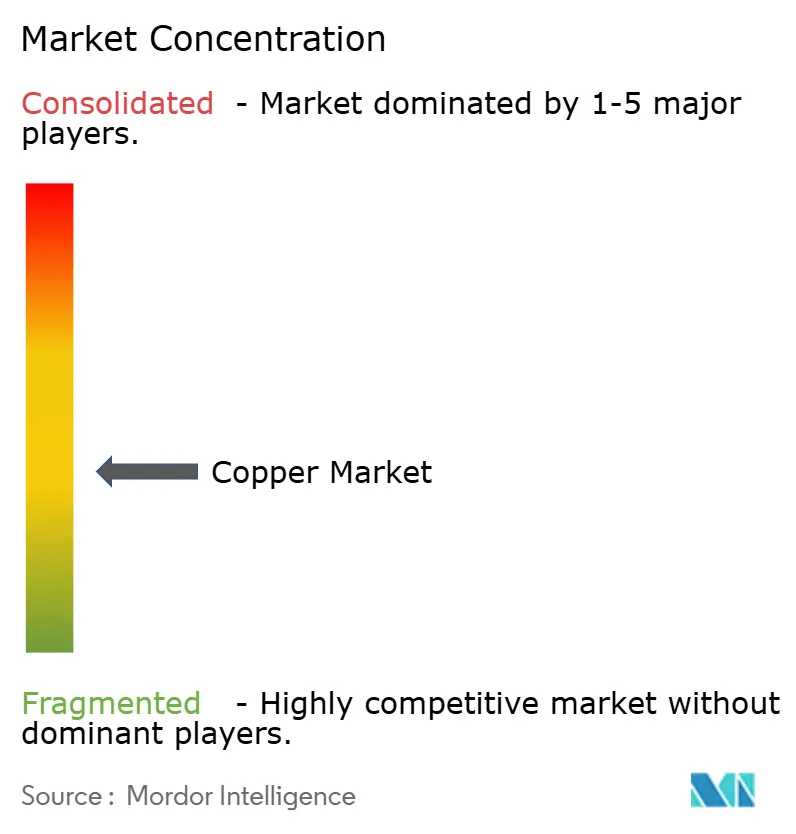
Glencore, BHP, Codelco, Freeport-McMoRan and Grupo Mexico (Southern Copper Corporation) form a leading producer group within a competitive field spanning mining and metallurgy. The structure is moderately concentrated, with large operating businesses facing execution risk across their own assets as well as competition for new projects. Glencore reported 397,000 metric tons of own-sourced copper production in the first half of 2026, up 15% from the first half of 2025. Higher mining rates and improved grades at African Copper and higher grades at Antamina drove the increase, partly offset by Mount Isa’s planned July 2025 copper-mine closure. Its higher output ties near-term competitive supply to mining rates and grades, making operating execution as important as expansion plans.
BHP awarded China Nerin a staged design and supply contract in July 2026 for the proposed Olympic Dam smelter and refinery expansion in South Australia. The supply portion depends on BHP approving a potential 2027 final investment decision, so the award does not establish additional processing output. At its fourth-quarter 2025 Capital Markets Day, Glencore outlined expanded copper portfolio guidance and a pathway to become one of the world’s largest producers over the following decade. Processing expansion offers buyers seeking refined metal a more direct route to additional supply than a producer-scale ambition alone.
Freeport-McMoRan reported consolidated copper production of 786 million pounds in the second quarter of 2026, illustrating its operating presence within the producer group. Southern Copper Corporation, 88.9% owned by Grupo Mexico, operates mining and metallurgical facilities in Mexico and Peru. Its total copper production, including mined copper and third-party concentrate, was 964,955 tons in 2025, down 1.3% from 977,200 tons in 2024. In August 2026, Codelco and Pucobre formed Chile’s Tovaku company with 40% and 60% stakes, respectively, identifying detailed engineering, environmental and sectoral permits, and early works as next phases. For these partners, securing the permits needed for future construction is the competitive hurdle beyond agreeing ownership.
Copper Industry Leaders
-
Glencore
-
BHP
-
Codelco
-
Freeport-McMoRan
-
Grupo Mexico (Southern Copper Corporation)
- *Disclaimer: Major Players sorted in no particular order
Copper Market Companies Covered in this Report
- Antofagasta plc
- Aurubis AG
- BHP
- Codelco
- First Quantum Minerals
- Freeport-McMoRan
- Glencore
- Grupo Mexico (Southern Copper Corporation)
- Hindustan Copper Limited
- Jiangxi Copper Corporation Limited
- KAZ Minerals
- KGHM
Key Opportunities for Market Participants
Grid-related opportunities compare how refined-copper producers can reach fabricators through different infrastructure approval routes. ANEEL scheduled a Brazilian transmission auction for October 30, 2026, covering 8 lots in 7 states. Aurubis AG manufactures copper cathodes in Hamburg, Germany, and Pirdop, Bulgaria, positioning it for potential demand through downstream fabricators.
Market Opportunities Table of Copper Market
| Opportunity | Why now | Buyer / lead segment | Recommended play | Main barrier | Likely beneficiaries |
|---|---|---|---|---|---|
| Refined copper for Brazilian transmission equipment | October 2026 auction for transmission concessions | Cable and electrical-equipment fabricators serving concession developers | Build conditional cathode offers around concession award schedules | Award-to-fabrication timing | Cathode producers such as Aurubis AG and equipment fabricators |
| Copper supply for EU grid-cable programs | December 2025 EU grid and permitting proposals | Cable fabricators serving EU utilities and grid operators | Qualify cathode supply with fabricators before project approvals | Uncertain timing of proposed permitting reform | Cathode producers such as Aurubis AG and cable fabricators |
| Copper supply aligned with Chinese grid construction | September 2026 direction to accelerate major grid approvals and construction | Fabricators serving grid-company construction programs | Link delivery commitments to approved fabrication schedules | Project approval and construction execution | Cathode producers such as Aurubis AG and electrical-equipment fabricators |
| Source: Mordor Intelligence | |||||
The Brazilian transmission auction scheduled for October 30, 2026, gives cathode suppliers a dated point around which to stage offers to equipment fabricators. A concession award would identify the developers whose equipment programs could generate refined-metal orders. This makes award-linked Brazilian transmission supply the central opening, while the EU proposals and China’s grid direction provide earlier-stage signals rather than dated purchase commitments.
Recent Industry Developments in Copper Market
- Oct 2026: Germany promulgated the Industrial Emissions Directive implementation law on October 19, generally effective October 21, introducing an environmental management-system duty for covered copper smelters with details set by separate federal ordinance.
- Oct 2026: Faraday Copper closed its acquisition of the San Manuel copper project in Arizona, United States, from a wholly owned subsidiary of BHP Group Limited on October 15.
- Oct 2026: Argentina’s RIGI Evaluation Committee approved Glencore-owned Minera Agua Rica’s Agua Rica project in Catamarca for the large-investment incentive regime on October 2.
Copper Market Report Scope and Research Methodology
Market Definition and Coverage
The global copper market measures annual consumption of refined copper metal, in tons, supplied from mined and recycled material. It covers refined copper delivered to fabricators and other industrial users worldwide, with demand classified by end-use industry and region.
Scope exclusions: Copper ore and concentrate, unrefined copper-bearing scrap, and copper alloys, pipes, tubes, and other copper-containing goods sold after refined copper is consumed are excluded.
Segments Covered in This Report
- By Source
- Mining
- Recycling
- By End-use Industry
- Building Construction
- Infrastructure
- Industrial
- Transportation
- Consumer Products and Electronic Equipment
- Others
- By Geography
- Asia-Pacific
- China
- Japan
- India
- South Korea
- Rest of Asia-Pacific
- North America
- United States
- Canada
- Mexico
- Europe
- Germany
- United Kingdom
- France
- Italy
- Rest of Europe
- South America
- Brazil
- Argentina
- Rest of South America
- Middle East and Africa
- Saudi Arabia
- South Africa
- Rest of Middle East and Africa
- Asia-Pacific
Data Sources, Market Sizing, and Validation
Desk Research
Public sources such as the International Copper Study Group's production and usage outlook and the International Wrought Copper Council's demand forecasts help track refined supply, trade and global consumption. The International Copper Association's resource library and Nornickel's annual commodity-market review add context on end-use demand and reported refined copper consumption.
Company annual reports, regulatory filings, investor materials, and reputable press provide supplementary checks on operating output, recycling capacity, project timing, and changes in downstream demand. For example, annual reporting can help distinguish refined metal use from mined output or later fabricated products. These named sources are not exhaustive, and further sources inform collection, validation and clarification.
Primary Interviews and Surveys
Interviews and structured surveys can draw on refined copper producers and refiners, recyclers, fabricators, and purchasing or planning specialists in major consuming regions. Respondents can check secondary evidence on refined consumption, source mix, end-use and regional allocation, clarify gaps where records use different product stages, and triangulate uncertain inputs against supply, trade and fabrication indicators.
Distribution of primary research fieldwork respondents
| Company type | Respondent position | Region |
|---|---|---|
| Top tier: 35% | CXOs: 20% | APAC: 45% |
| Mid tier: 40% | Functional/Unit leaders: 35% | EMEA: 25% |
| Smaller Players: 25% | Managers: 45% | Americas: 30% |
Market-Sizing & Forecasting
A top-down estimate begins with global refined-copper consumption and reconciles it with refined availability, trade and reported use, counting metal once at delivery for consumption. Mine and recycled refined supply, fabrication and semi-fabricated output, construction and infrastructure activity, industrial production, and transportation electrification provide indicators for the total and its source, end-use and regional shares. Scenario analysis carries these drivers through the forecast period, with separate paths for mature building demand and faster electrification uses. Where data are incomplete, analysts can bridge from the latest reliable year using documented production, trade and demand trends. Selective bottom-up supplier and refiner volume roll-ups and channel checks test the global total and regional splits, while experts can review whether the variable-level forecasts fit operating and purchasing conditions. Any gap between these checks and the top-down estimate is reconciled against coverage, timing and possible double counting before shares are finalized.
Data Validation & Update Cycle
Analysts triangulate consumption estimates against independent production, trade, usage and fabrication signals, then investigate anomalies and material variances before sign-off. Multi-step review checks units, coverage, timing and the refined-metal delivery boundary, with re-contact triggered when source definitions conflict, a major input changes or a variance remains unexplained. The dataset is refreshed annually, revisited between cycles after material market events, and given a fresh pre-delivery review.
Mordor Intelligence's Copper Market Sizing Compared With Other Published Estimates
Published estimates can differ in the transactions and products they count and the inputs used to model demand. It covers refined copper delivered to fabricators and other industrial users worldwide, with demand classified by end-use industry and region.
Key Gap Drivers include the study's defined coverage and market-specific modeling choices. Mine and recycled refined supply, fabrication and semi-fabricated output, construction and infrastructure activity, industrial production, and transportation electrification provide indicators for the total and its source, end-use and regional shares.
Benchmark comparison
| Source | Market Size | Gaps in Research Methodology |
|---|---|---|
| Mordor Intelligence | 28.44 million tons (2027) | |
| Industry Association A | 26.14 million metric tons (2024) | At its 2024 base, this estimate is 8.1% below this report's 2027 value of 28.44 million tons, 3 years later. The earlier figure is a forecast of global reported refined copper demand, measured three years before the report year. |
| Mining Company Annual Report B | 26.4 million metric tons (2024) | At its 2024 base, this estimate is 7.2% below this report's 2027 value of 28.44 million tons, 3 years later. The earlier figure is a retrospective global refined copper consumption estimate, measured three years before the report year. |
Mordor Intelligence's analysts triangulate consumption estimates against independent production, trade, usage and fabrication signals, then investigate anomalies and material variances before sign-off.
Key Questions Answered in the Report
What is the copper market size and growth outlook?
The size is projected at 28.44 million tons in 2027 and 34.07 million tons by 2032, with a CAGR of 3.68% from 2027 to 2032.
What drives demand for copper?
Grid investment and electric-car adoption are key drivers. Georgia Power advanced 25 major transmission projects in Georgia, United States, in 2025.
Which source leads refined-copper consumption?
Mining held an 83.93% share in 2026. Recycling is forecast to grow fastest at a 5.12% CAGR from 2027 to 2032.
Which companies lead the copper industry?
Leading companies include Glencore, BHP, Codelco, Freeport-McMoRan and Grupo Mexico (Southern Copper Corporation).
What could constrain copper demand?
Price volatility and permitting delays are key risks, with weak physical demand in China reported during the price rally that began in December 2025.
Which region leads copper consumption, and which grows fastest?
Asia-Pacific led with a 70.41% share in 2026. Middle East and Africa is forecast to grow fastest at a 4.91% CAGR from 2027 to 2032.