
Market Overview
| Study Period | 2020 - 2031 |
|---|---|
| Market Size (2026) | USD 69.68 Billion |
| Market Size (2031) | USD 86.96 Billion |
| Growth Rate (2026 - 2031) | 4.53 % |
| Fastest Growing Market | Middle East and Africa |
| Largest Market | Asia Pacific |
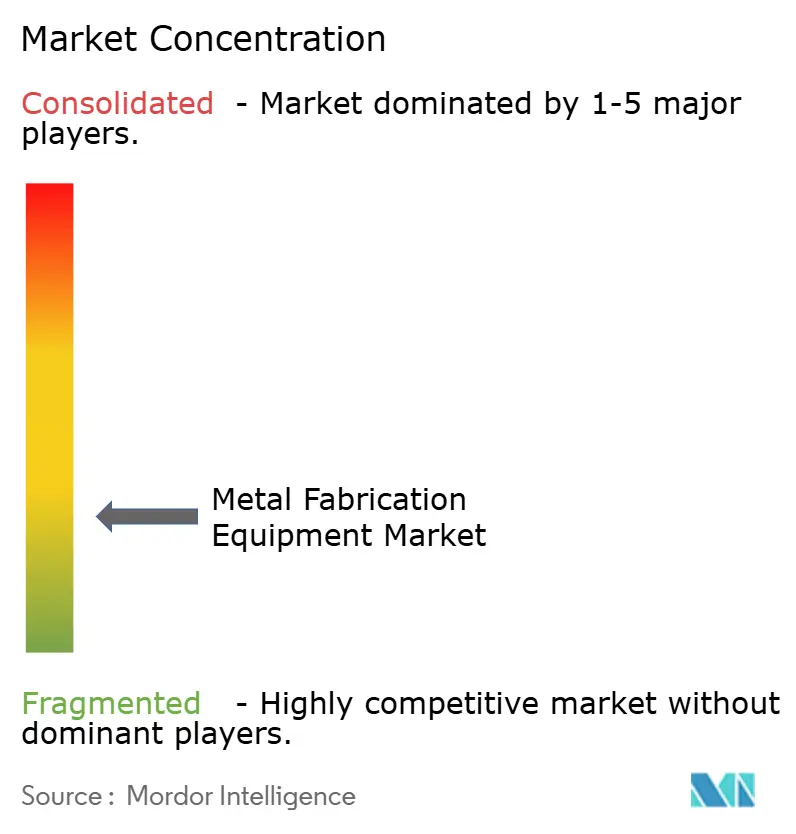
| Market Concentration | Low |
Major Players *Disclaimer: Major Players sorted in no particular order Image © Mordor Intelligence. Reuse requires attribution under CC BY 4.0. | |
Metal Fabrication Equipment Market Analysis by Mordor Intelligence
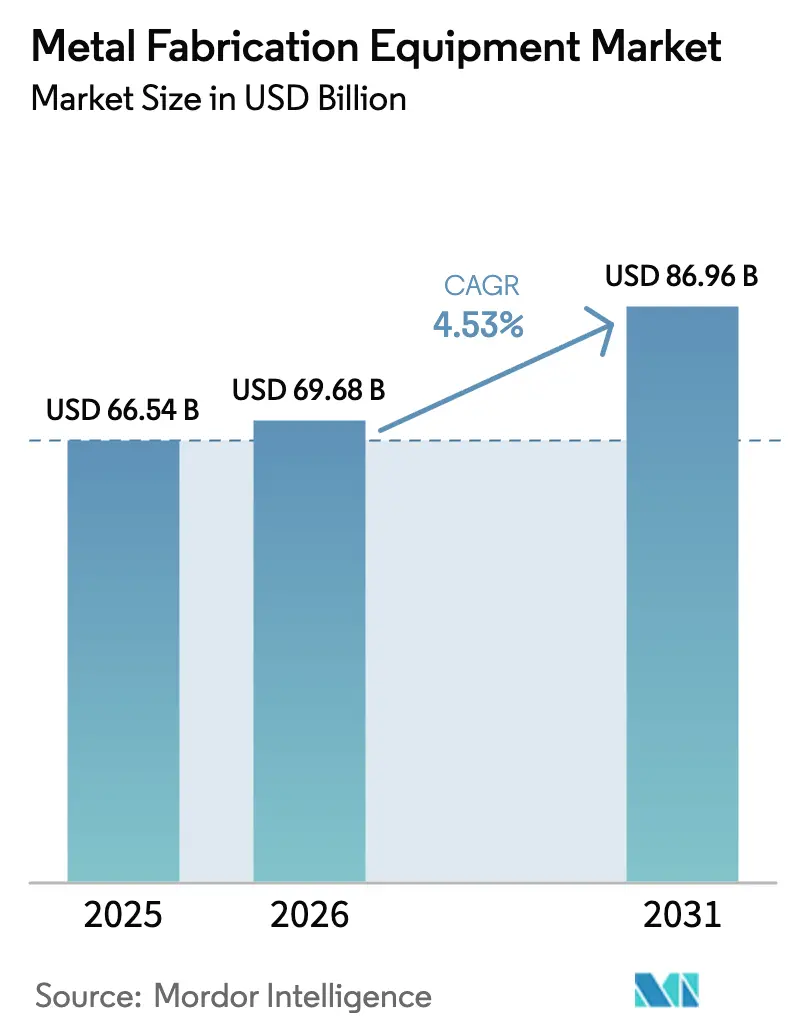
The Metal Fabrication Equipment Market size was valued at USD 66.54 billion in 2025 and is estimated to grow from USD 69.68 billion in 2026 to reach USD 86.96 billion by 2031, at a CAGR of 4.53% during the forecast period (2026-2031).
Robust capital spending in renewable-energy projects, vehicle electrification, and large-scale infrastructure upgrades underpins this steady expansion. Vendors supplying high-power fiber-laser cutters, servo-press brakes, and integrated robotic welding cells are benefiting from shorter product-refresh cycles in automotive plants, the boom in offshore wind towers, and the need to machine recycled alloys with unpredictable carbon content. Equipment purchases are also moving closer to end-markets as manufacturers reshore heavy fabrication to reduce logistics risk and comply with domestic-content rules. Meanwhile, rising cybersecurity threats and raw-material price swings continue to influence procurement timing, pushing buyers to favor machines that include predictive-maintenance software and remote-patch capabilities.
Key Report Takeaways
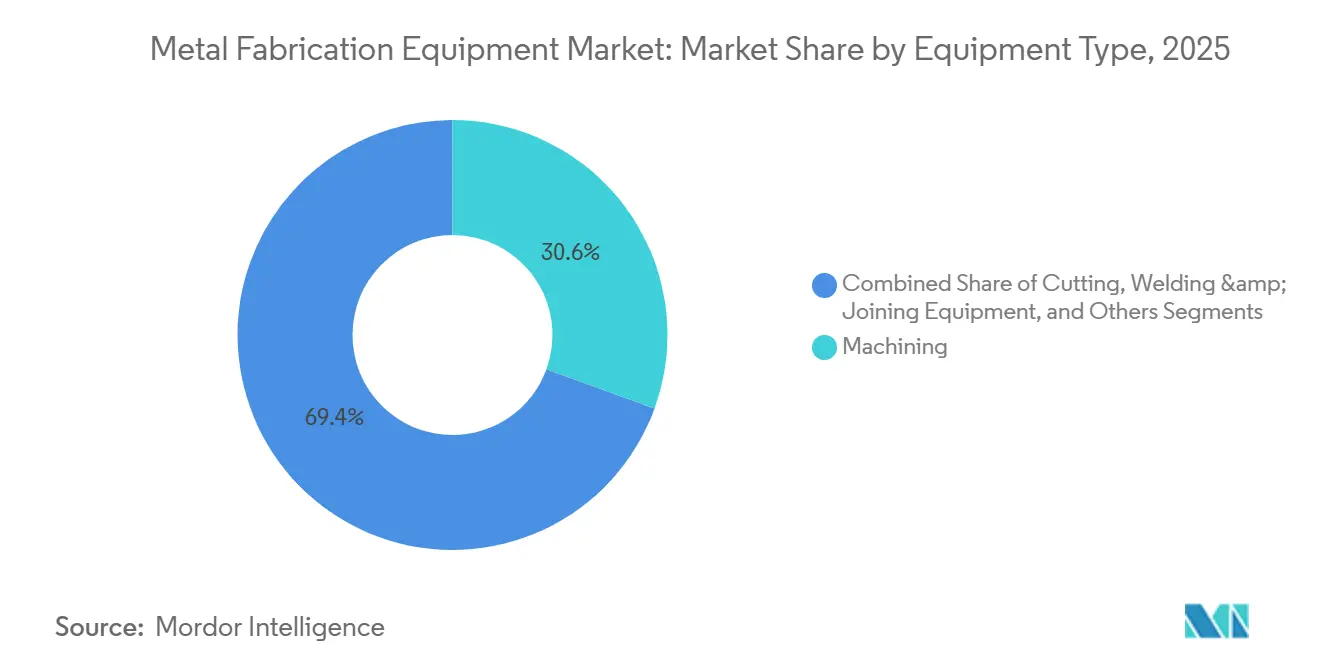
By equipment type, machining captured 30.56% of 2025 revenue; cutting systems are projected to post the fastest 6.78% CAGR to 2031.
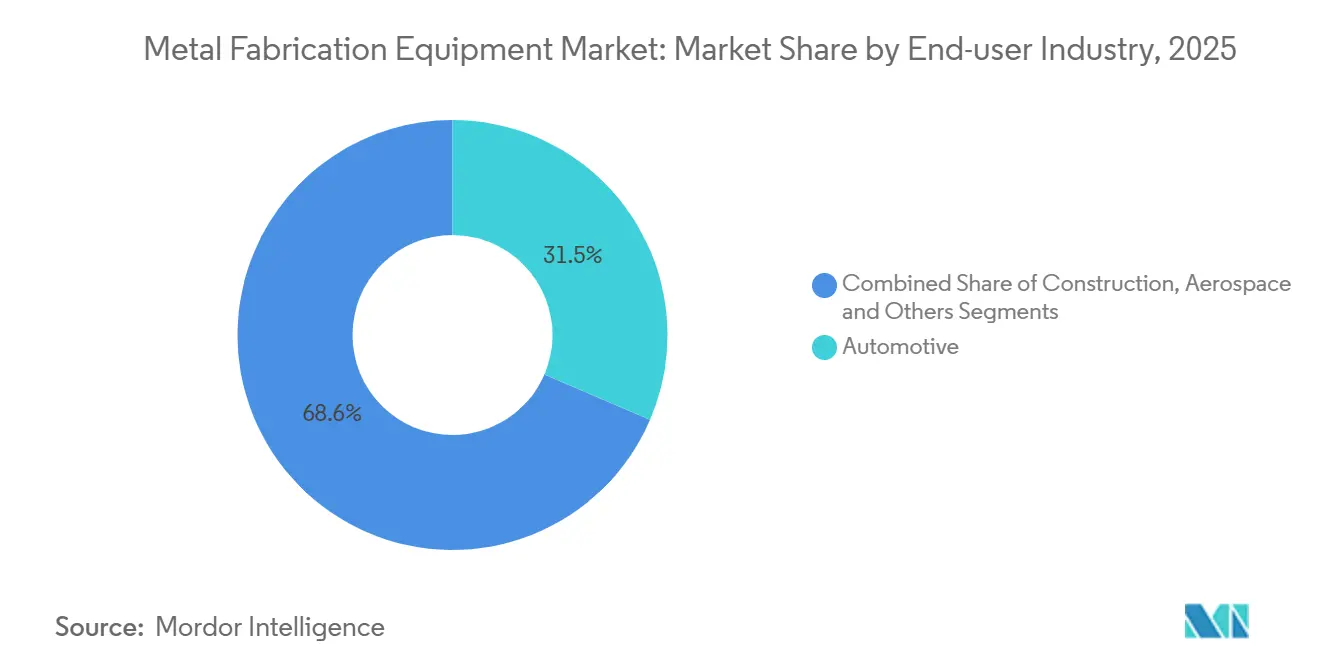
By end-user industry, automotive held 31.45% of 2025 demand, while energy and oil-and-gas applications are set to expand at a 7.56% CAGR through 2031.
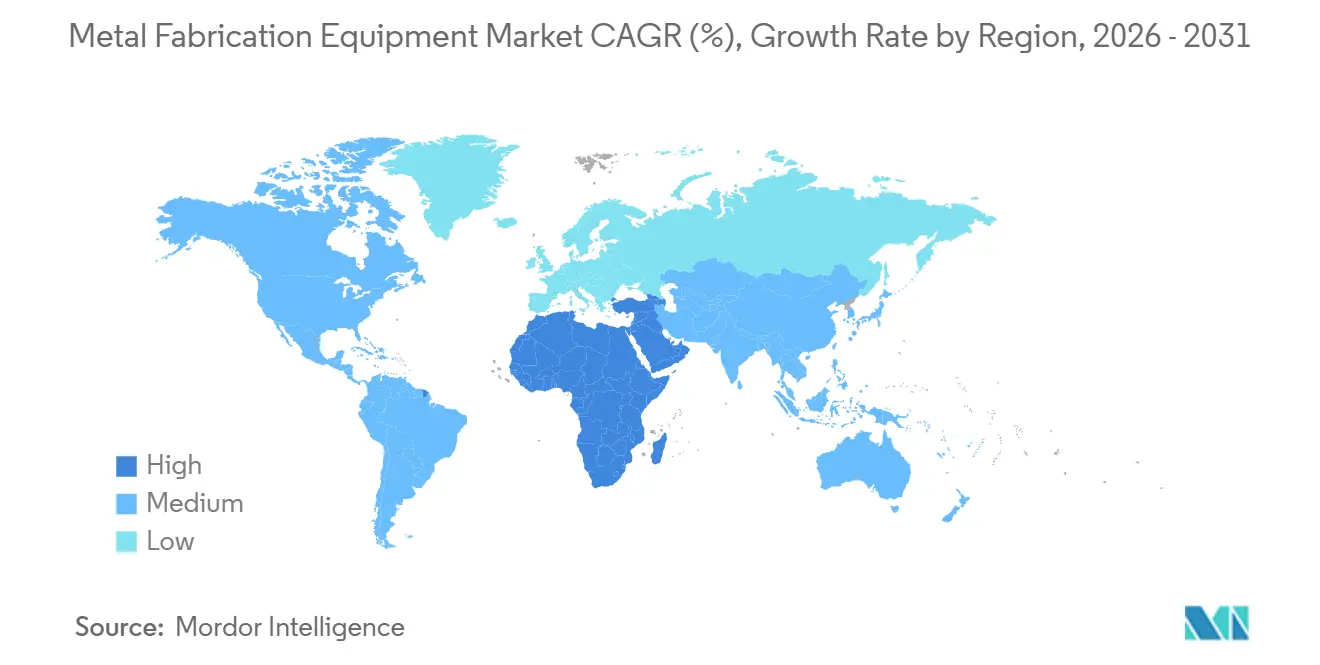
By geography, Asia-Pacific commanded 46.76% of 2025 revenue; the Middle East and Africa region is forecast to grow at a 6.23% CAGR to 2031.
Trumpf, Amada, DMG MORI, and Yamazaki Mazak together accounted for 42% of global 2025 sales.
Note: Market size and forecast figures in this report are generated using Mordor Intelligence’s proprietary estimation framework, updated with the latest available data and insights as of January 2026.
Market Trends and Insights
Drivers Impact Analysis of Metal Fabrication Equipment Market*
| Drivers | (~) % Impact on CAGR Forecast | Geographic Relevance | Impact Timeline |
|---|---|---|---|
| Growing automotive production & model refresh cycles | +1.2% | China, India, ASEAN, North America EV hubs | Medium term (2-4 years) |
| Expanding construction & infrastructure investments | +1.0% | Middle East, India, ASEAN, select North America corridors | Long term (≥ 4 years) |
| Rising demand from aerospace manufacturing | +0.8% | North America, France, UK, Germany, ASEAN final-assembly sites | Medium term (2-4 years) |
| Near-shoring of heavy-fabrication supply chains | +0.7% | United States, Mexico, Poland, Czech Republic, Turkey | Short term (≤ 2 years) |
| Offshore wind-turbine tower build-outs | +0.5% | North Sea basin, Taiwan, Japan, South Korea, U.S. Atlantic | Long term (≥ 4 years) |
| Hybrid additive-subtractive fabrication cells | +0.3% | U.S. aerospace clusters, European precision-engineering zones, select China R&D hubs | Long term (≥ 4 years) |
| Source: Mordor Intelligence | |||
Growing Automotive Production & Model Refresh Cycles
Automakers are compressing model-refresh intervals from seven to under four years, driving frequent retooling of press lines, laser cutters, and robotic welding cells. North American battery-electric vehicle plants now specify up to twelve servo presses and multiple fiber-laser blanking systems for each new platform. Tier-1 suppliers report that every one million incremental battery-electric cars requires about 240 CNC machining centers and 320 robotic welding stations. Incentive programs in India and ASEAN further accelerate orders for high-precision gear-cutting machines. As designs shift toward structural battery packs, demand rises for equipment capable of forming thin-gauge aluminum with repeatability below ±0.05 millimeters.
Expanding Construction & Infrastructure Investments
Megaprojects across Saudi Arabia, India, and Indonesia necessitate heavy-duty press brakes, waterjet cutters, and automated submerged-arc welders to meet compressed commissioning schedules. NEOM alone will consume more than 26 million metric tons of fabricated steel by 2030, requiring on-site plate-forming and laser-cutting capacity[1]. Climate-resilient public works programs in the United States and Europe add stainless-steel demand for flood barriers and elevated rail corridors. The rise of prefabricated, modular buildings also boosts orders for CNC plasma cutters that can process 150-millimeter plate without secondary beveling. Suppliers offering turnkey cells that blend forming, joining, and inspection enjoy the largest order backlogs.
Rising Demand from Aerospace Manufacturing
Firm backlogs at Airbus and Boeing secure nine years of production, compelling their supply chains to lock in capacity for titanium bulkheads and Inconel engine mounts [2]. Five-axis machining centers with envelope sizes above one meter are now standard in turbine-blade shops, while laser-weld cells deliver porosity below 0.5% in fuel-tank structures. U.S. and French engine programs require additional directed-energy deposition systems for on-site blade repair, cutting material waste by more than 60%. European gear-hobbing specialists report double-digit order growth linked to narrow-body aircraft landing-gear programs. The sector’s rigorous compliance environment rewards vendors that integrate digital-twin simulation and component genealogy tracking into their machine controls.
Near-Shoring of Heavy-Fabrication Supply Chains
U.S. reshoring announcements surged 78% year-on-year in 2024, and each USD 1 billion of relocated fabrication creates equipment demand worth nearly USD 180 million. Automotive, appliance, and defense OEMs prioritize suppliers within 500 miles to minimize freight risk and comply with domestic-content requirements. Mexican press-brake distributors enjoy record backlogs as U.S. buyers diversify away from Asian imports. In Eastern Europe, Czech and Polish job shops install high-power fiber lasers to serve German machinery builders facing skilled-labor gaps. Fast-track delivery expectations favor machine suppliers with regional warehouses and field-service teams.
Restraints Impact Analysis of Metal Fabrication Equipment Market*
| Restraints | (~) % Impact on CAGR Forecast | Geographic Relevance | Impact Timeline |
|---|---|---|---|
| Volatile raw-steel & non-ferrous prices | -0.9% | Europe, Japan, ASEAN, global import-reliant markets | Short term (≤ 2 years) |
| High cap-ex requirement for next-gen CNC systems | -0.7% | Small and mid-size fabricators worldwide | Medium term (2-4 years) |
| Shortage of skilled welders & machinists | -0.6% | North America, Europe, Australia, India, Vietnam | Long term (≥ 4 years) |
| Cyber-security risk in connected machine tools | -0.4% | Germany, United States, Japan, South Korea | Medium term (2-4 years) |
| Source: Mordor Intelligence | |||
Volatile Raw-Steel & Non-Ferrous Prices
Hot-rolled coil steel fluctuated between USD 650 and USD 950 per metric ton in 2024, causing fabricators to renegotiate contracts quarterly and delay machine purchases by more than four months [3]. Aluminum tracked a 31% price swing, squeezing margins in aerospace and EV battery-enclosure work. Copper peaked above USD 10,000 per metric ton in March 2025 before easing, complicating material forecasts for electrical-equipment shops. Many European service centers cut inventories by 18%, stretching lead times for downstream cutters and brake operators. Such volatility forces buyers to favor equipment suppliers offering leasing or pay-per-use models that preserve cash.
High Cap-Ex Requirement for Next-Gen CNC Systems
Five-axis machining centers with adaptive control and digital-twin interfaces list above USD 500,000, exceeding the capital ceiling of 62% of North American job shops. Advanced fiber-laser systems above 8 kW cost up to USD 1.8 million with automated load-unload modules. Leasing rates climbed 14% in 2024 as interest costs rose, locking out smaller enterprises that lack collateral. Financing hurdles lengthen the payback period to more than five years in cyclical construction and energy end-markets. Vendors responding with subscription software, modular automation kits, and residual-value guarantees gain traction among capital-constrained buyers.
*Our forecasts treat driver/restraint impacts as directional, not additive. The impact forecasts reflect baseline growth, mix effects, and variable interactions.
Metal Fabrication Equipment Market Segment Analysis
By Equipment Type:
Cutting Systems Lead Growth MomentumMachining retained the largest 30.56% metal fabrication equipment market share in 2025, underscoring its central role in shaping complex engine blocks, turbine disks, and industrial gearboxes. Demand concentrates in five-axis and high-torque horizontal centers capable of maintaining positional accuracy below ±4 microns across extended shifts. Meanwhile, cutting systems are forecast to expand at a 6.78% CAGR to 2031, marking the highest pace within the metal fabrication equipment market. Fiber-laser platforms above 8 kW deliver cut speeds surpassing 100 meters per minute on 3-millimeter mild steel, offering a 40% throughput edge over plasma while producing heat-affected zones under 20 microns. Suppliers bundling nesting software with automatic nozzle changers provide quantifiable material savings that justify the USD 1.5 million investment.
Welding and joining lines transition toward fiber-laser and friction-stir processes to meet porosity limits in battery housings and LNG cryogenic tanks. Across all categories, automation modules such as robotic load/unload, in-process metrology, and vision-guided seam tracking differentiate offerings and position vendors for the next cycle of capacity additions.
By End-User Industry:
Energy Projects Outpace Traditional Automotive DemandAutomotive accounted for a commanding 31.45% of 2025 demand within the metal fabrication equipment market, anchored by continuous investment in battery-electric vehicle platforms and lightweight body-in-white architectures. Plants retooling for structural packs install multi-servo press lines and laser blanking centers that shorten die-changeovers to under three minutes. Yet the fastest-growing customer group is energy and oil-and-gas, projected at a 7.56% CAGR through 2031. Floating LNG modules, subsea manifolds, and offshore wind towers require heavy-plate rolling, high-current submerged-arc welding, and robotic cladding of corrosion-resistant alloys.
Rail, shipbuilding, and agricultural machinery add steady base-load demand, often sourcing mid-range plasma cutters and forging presses that balance cost and performance. Vendors tailoring service packages - spare-parts availability, remote diagnostics, and operator training - anchor their competitive edge across these varied end-user ecosystems.
Geography Analysis
APAC Metal Fabrication Equipment Market
Asia-Pacific captured 46.76% of global 2025 revenue, affirming its status as the volume leader in the metal fabrication equipment market. China’s dual-circulation policy targets 70% domestic self-sufficiency in CNC systems by 2027, spurring large government-backed orders for local builders. India’s incentive schemes converted INR 259 billion (USD 3.1 billion) into subsidies for fiber-laser cutters and servo presses, producing a 34% jump in equipment imports from Japan and Germany. ASEAN countries benefit from electronics and automotive FDI, with Vietnam alone attracting USD 8.2 billion in 2024 for metal-intensive assembly lines.
MEA Metal Fabrication Equipment Market
The Middle East and Africa region will log the fastest 6.23% CAGR through 2031. Saudi Arabia’s Public Investment Fund channels USD 500 billion into NEOM, procuring on-site laser and plate-rolling assets for its steel-heavy infrastructure. The UAE expands modular construction techniques for post-Expo 2030 projects, favoring turnkey robotic welding cells that minimize skilled-labor requirements. South Africa accelerates renewable-energy fabrication to localize solar-tracker frames and wind towers.
The Americas and Europe Metal Fabrication Equipment Market
North America’s second reshoring wave produces a 78% surge in announced relocations during 2024, concentrating demand in the U.S. Midwest and Mexican automotive corridor. Buyers prioritize machines with remote monitoring compliant with IEC 62443 to mitigate ransomware risk. Canada’s aerospace clusters maintain demand for five-axis machining centers with spindle speeds above 30,000 rpm. Europe transitions to low-carbon steel, pushing fabricators to adopt adaptive machining centers capable of compensating for recycled alloy variability. Germany remains the regional anchor despite a 3.1% contraction in 2024 output, while Italy, Spain, and Poland grow through export-oriented equipment production. South America remains modest in scale, yet Brazil’s automotive sector sustains regular purchase cycles for press brakes and welding robots.
Regulatory Landscape
Regulation and compliance for metal fabrication equipment are shaped by machine-safety rules, emissions requirements, and a growing set of expectations around cybersecurity and digital documentation. In the European Union, Regulation (EU) 2023/1230 on machinery replaces the prior Machinery Directive framework and becomes mandatorily applicable from 20 January 2027, adding explicit attention to digital instructions, cybersecurity, and criteria around substantial modifications alongside core essential health and safety requirements.
In the United States, employers operating presses, forging, and related fabrication equipment must align with OSHA requirements such as 29 CFR 1910.217 (mechanical power presses) and 29 CFR 1910.218 (forging machines). These requirements emphasize point-of-operation guarding and safety-system controls. Environmental compliance can also influence fabrication operations and capex timing, including requirements under 40 CFR Part 63 (6X NESHAP) for facilities with potential hazardous air pollutant emissions from metal finishing, and EPA compliance timelines affecting upstream integrated iron and steel operations (for example, a revised deadline moving certain monitoring-frequency requirements for BOPF units from 3 April 2025 to 3 April 2027).
Value Chain Analysis
The value chain runs from upstream metals (steel, aluminum, and specialty alloys) to components and subassemblies such as controls, drives, lasers, tooling, welding power sources, and sensors. OEMs then build machining, cutting, welding/joining, and forming systems, while downstream channels include distributors, integrators, and service partners that install, automate, and maintain equipment at job shops and captive fabricators.
Demand flows next to end users including automotive, aerospace, construction/infrastructure, shipbuilding, rail, and energy and oil and gas. Buyers increasingly bundle automation, software, training, and lifecycle service into purchase decisions. Standards bodies and industry associations also help normalize process qualification and interoperability across the chain, with the International Institute of Welding (IIW) collaborating with ISO on welding-related standards work (for example via ISO/TC 44). ISO 15608:2025, published in October 2025, updates the uniform grouping system for metallic materials used in welding, heat treatment, and NDT planning. On the commercial side, 2026 activity reflects pull-through from automation and digital platforms in downstream fabrication, including AI-enabled robotic welding controls and additive-capable systems that widen demand beyond traditional subtractive workflows.
Competitive Landscape
Incumbent leaders Trumpf, Amada, DMG MORI, and Yamazaki Mazak jointly held 42% of 2025 global revenue, but regional suppliers continue to fragment the mid-range segment of the metal fabrication equipment market. Trumpf’s TruConnect suite links lasers, press brakes, and storage towers into one dashboard, reducing programming time by 30% and strengthening customer lock-in. DMG MORI’s CELOS X platform packages predictive maintenance and tool-life analytics on a subscription, shifting value from hardware margin to recurring software revenue.
Chinese entrants such as Shenyang Machine Tool and Han’s Laser narrow the technology gap in 3- to 5-axis machines, leveraging domestic scale to compete aggressively on price. European specialists like Prima Industrie and Salvagnini focus on flexible manufacturing systems that fit into space-constrained job shops. Hybrid additive-subtractive cells emerge as a battleground: Mazak’s HYBRID Multi-Tasking line sold 340 units in 2024, while Desktop Metal and EOS push directed-energy deposition paired with in-situ milling for aerospace repairs.
Strategic M&A consolidates automation expertise. Lincoln Electric’s USD 230 million purchase of Baker Industries adds turnkey integration to its welding portfolio, while Bystronic’s buyout of Swiss automation firm Antil introduces robotic palletizing to its high-power laser cutters. Compliance with IEC 62443 standards becomes a market gatekeeper; Siemens and Rockwell embed zero-trust architectures into CNC controllers to assuage OEM cyber-security audits. Vendors able to pair edge-AI optimization with secure connectivity position themselves to capture growth across reshoring and renewable-energy expansions.
Metal Fabrication Equipment Industry Leaders
-
Trumpf
-
Shenyang Machine Tool
-
Okuma
-
DMG Mori
-
Colfaxcorp
- *Disclaimer: Major Players sorted in no particular order
Metal Fabrication Equipment Market Companies Covered in this Report
- Trumpf
- Amada
- DMG MORI
- Yamazaki Mazak
- Bystronic
- Shenyang Machine Tool
- Okuma
- FANUC
- Lincoln Electric
- ESAB Corp.
- Hypertherm
- Doosan Machine Tools
- Haas Automation
- Atlas Copco
- Colfax (Howden)
- Koike Aronson
- Mitsubishi Electric (MC Machinery)
- Prima Industrie
- Salvagnini
- Sandvik
Market Opportunities and Future Outlook
White space is most visible where fabricators need measurable throughput gains but cannot staff around skilled-labor constraints. This supports opportunities for higher automation levels, adaptive controls, and connected software across cutting, welding/joining, and hybrid cells. Samsung Heavy Industries commissioning an automated Pipe Robofab facility (6,500 square meters, 100,000 piping spools per year) that uses AI-driven vision and robotics underscores this direction, reinforcing demand for robotic welding and cutting cells that can manage variable fit-up and geometry.
Novarc Technologies launched NovAI Autonomy and the NovHub platform to enable real-time, vision-based adaptation for robotic welding on ABB and Yaskawa systems, which strengthens the business case for upgrading legacy welding stations to sensor-rich, software-defined cells. Material and infrastructure investments also create pull for equipment that can process advanced and recycled alloys and for digital maintenance toolchains that reduce downtime. SSAB announced a SEK 3.3 billion investment in a new quenching line at Oxelosund to increase capacity for specialized wear and protection steels, and Jindal Stainless commissioned a 1.2 MTPA stainless steel melt shop in Indonesia along with an additional INR 900 crore commitment for downstream cold-rolling expansions, both of which add to the installed base for heavy forming, cutting, and welding equipment in stainless and specialty grades. In parallel, ArcelorMittal entered a strategic collaboration with Amazon Web Services to deploy AI and cloud technologies for predictive maintenance and quality control across steelmaking sites, supporting demand for secure connectivity, analytics, and remote service capabilities as part of equipment lifecycle offerings.
Recent Industry Developments in Metal Fabrication Equipment Market
- June 2026: DMG MORI Ultrasonic Lasertec GmbH opened a 1,400 square-meter expansion at its Stipshausen, Germany site covering production, logistics, and R&D. The added footprint supports higher output and faster iteration for advanced machining and laser-based platforms, tightening lead times for customers running precision and hard-to-machine materials.
- October 2025: TRUMPF increased its stake in STOPA Anlagenbau GmbH from 25.1% to 74.9%, deepening control over automation and storage elements used in connected sheet-metal lines. The move strengthens TRUMPFs ability to deliver integrated smart-factory cells that link lasers, bending, and material handling under a unified architecture.
- May 2024: Okuma America expanded its channel footprint via a distribution partnership with Maquinas e Solucoes Servicos de Representacao e Manutencao de Equipamentos Ltda (M&S) in Brazil. Broader local coverage improves access to machining centers and service support in a key South American manufacturing market, helping reduce response times for installation, training, and aftermarket needs.
Metal Fabrication Equipment Market Report Scope and Research Methodology
Market Definition and Coverage
For this study, the market covers revenue generated from metal fabrication equipment used to cut, shape, join, and finish metal parts in industrial production, including automated and conventional systems sold to end users across regions.
Scope exclusions: we exclude raw metal materials, aftermarket consumables (such as gases and welding wire), and stand-alone hand tools that are not sold as fabrication equipment.
Segments Covered in This Report
- By Equipment Type / Process
- Machining
- Machining Centres
- Lathe Machines
- Drilling, Grinding, Honing & Lapping
- Gear-Cutting Machines
- Other Handling & Cutting Equipment
- Cutting
- Laser Cutting
- Plasma Cutting
- Waterjet
- Others (Sawing & Cut-off Machines, etc)
- Welding & Joining Equipment
- Arc Welding
- Oxy-fuel Welding
- Laser-Beam Welding
- Other Welding Types
- Forming
- Sheet metal forming (press brakes/bending, punching/notching, shearing, stamping, roll forming)
- Bulk forming (forging)
- Other Presses & Metal-Forming Machines
- Other Equipment Types (Material Handling, Workholding & Automation, etc.)
- Machining
- By End-user Industry
- Automotive
- Construction
- Aerospace
- Electrical & Electronics
- Industrial Machinery / Heavy Equipment
- Shipbuilding & Marine
- Rail
- Energy / Oil & Gas
- Other Industries (HVAC & appliances, metal furniture, etc)
- By Geography
- North America
- United States
- Canada
- Rest of North America
- South America
- Brazil
- Argentina
- Rest of South America
- Europe
- United Kingdom
- Germany
- France
- Italy
- Spain
- Rest of Europe
- Asia-Pacific
- China
- India
- Japan
- Australia
- ASEAN (Indonesia, Thailand, Philippines, Malaysia, Vietnam)
- Rest of Asia-Pacific
- Middle East and Africa
- Saudi Arabia
- United Arab Emirates
- Turkey
- South Africa
- Rest of Middle East and Africa
- North America
Data Sources, Market Sizing, and Validation
Desk Research
Desk research helped us anchor the model to real manufacturing activity and trade signals before we spoke to industry participants. We referenced public sources such as UN Comtrade, the World Bank, OECD industrial production statistics, the US Census Bureau manufacturing data, and Eurostat, and these were used to map demand intensity by region and end-use production cycles.
We also reviewed company annual reports, investor presentations, product catalogs, and trusted press coverage to understand equipment mix and typical pricing movement across cycles. Where needed, paid subscriptions for company financials and news and financials were used to speed up cross-checks on revenues and shipment commentary, and patent databases were used to track technology direction that affects average selling prices (ASPs). The desk sources listed here are not exhaustive, and we consulted additional public references for data collection, validation, and clarification.
Primary Interviews and Surveys
Primary work was used to test assumptions that are difficult to observe in public data, especially on order patterns, mix shifts between cutting, welding, forming, and machining, and how pricing changes are passed through. Interviews and surveys covered equipment suppliers, channel partners, and large end users across APAC, EMEA, and the Americas, and the feedback was then used to refine growth drivers and confirm near-term demand signals.
Distribution of primary research fieldwork respondents
| Company type | Respondent position | Region |
|---|---|---|
| Top tier: 34% | CXOs: 14% | APAC: 39% |
| Mid tier: 49% | Functional/Unit leaders: 36% | EMEA: 35% |
| Smaller Players: 17% | Managers: 50% | Americas: 26% |
Market-Sizing & Forecasting
Our sizing starts with a top-down build where industrial production indicators and machinery investment patterns are used to reconstruct the addressable demand pool for fabrication equipment by region, then split by the key process groups tracked in the study. To keep totals realistic, we use selective bottom-up approximations, including sampled supplier revenue roll-ups, channel checks on units moved, and ASP times volume logic for representative equipment categories.
Key inputs used in the model include manufacturing output trends in automotive, construction, aerospace, and electrical and electronics, import and export movement for relevant machinery categories, capacity additions in fabrication shops, and utilization-driven replacement cycles. Pricing is handled through an ASP ladder that reflects automation share, CNC adoption, and inflation-linked component costs, and then it is converted into USD using consistent exchange-rate timing for the stated year. For forecasting, we rely on scenario analysis supported by a small set of leading indicators, and assumptions are adjusted when interview feedback points to changes in backlog, lead times, or capital spending plans. When bottom-up signals are incomplete for smaller markets, we bridge gaps using proxy ratios tied to industrial output and trade intensity, and then recheck against regional sanity metrics.
Data Validation & Update Cycle
Validation is done through multiple checks so the final number is not dependent on a single data series. Model outputs are compared against independent signals such as machinery trade movement, manufacturing production indexes, and disclosed order intake direction, and any large variance triggers a review of assumptions on mix, utilization, or pricing.
Before sign-off, the work goes through stepwise analyst review where calculations, currency conversions, and year labeling are rechecked and outliers are challenged. Reports are refreshed annually, and interim updates are made when material events affect demand or pricing, such as major policy shifts, sharp currency moves, or a clear change in industrial output. Right before delivery, we complete a fresh pass so clients receive the most current view available.
Mordor Intelligence's Global Metal Fabrication Equipment Market Estimate Compared With Other Published Estimates
Published market sizes for metal fabrication equipment often differ because the boundary of what counts as equipment, the year used for currency conversion, and the way ASP progression is treated are not uniform across studies. Differences also show up when some estimates lean more on shipment proxies, while others lean more on investment sentiment, which can move faster than actual equipment sales.
In this study, the refresh cadence and currency timing are controlled tightly so the stated year is not distorted by short-term exchange rate spikes, and the ASP ladder is validated through repeated checks with suppliers and buyers, which is a key reason the Mordor Intelligence number can land away from other published figures. Another gap driver is scope, where some publications may fold in adjacent workshop tools or broader machine tool classes, and then apply a single growth rate even when cutting, welding, and forming do not move in the same way during a cycle.
Benchmark comparison
| Source | Market Size | Gaps in Research Methodology |
|---|---|---|
| Mordor Intelligence | USD 69.68 B (2026) | |
| Global Industry Publisher A | USD 66.47 B (2026) | Uses a lower 2026 starting value, likely influenced by a narrower equipment scope and a more conservative ASP uplift approach, which can reduce the value captured even when unit demand is similar. |
| Industry Research Publisher B | USD 68.30 B (2024) | Anchors the series on a 2024 base year, and differences can come from exchange-rate timing and how the study transitions from 2024 actuals to 2025 onward growth, which affects comparability to a 2026-based estimate. |
Overall, the spread across sources is mainly explained by year alignment, what is counted as fabrication equipment versus adjacent categories, and how pricing and mix upgrades are carried into the base year. By keeping the inputs traceable to industrial activity, trade signals, and interview-validated pricing logic, the result stays balanced and repeatable when the model is updated.
Key Questions Answered in the Report
What is the current size of global metal-fabrication equipment sales and how fast will it expand through 2031?
Sales reached USD 69.68 billion in 2026 and are projected to rise to USD 86.96 billion by 2031, reflecting a 4.53% CAGR.
Which equipment category is posting the quickest growth and what drives that momentum?
Cutting systems, led by high-power fiber-laser platforms, are on track for a 6.78% CAGR thanks to faster throughput, narrower kerf widths, and rising demand for thin-gauge components in electric vehicles and aerospace assemblies.
Which customer segment is expected to generate the largest incremental demand over the next five years?
Energy and oil-and-gas projects show the fastest expansion at a 7.56% CAGR as floating LNG terminals, subsea manifolds, and offshore wind towers require heavy-plate rolling and high-current welding solutions.
Why are Asia-Pacific manufacturers ramping up purchases of fiber-laser cutters and servo-press brakes?
China’s push for 70% CNC self-sufficiency and India’s subsidy programs are spurring upgrades to meet tighter tolerances and higher production volumes while reducing reliance on imported machine tools.