
Water and Utilities Cybersecurity Market Size and Share
Market Overview
| Study Period | 2020 - 2031 |
|---|---|
| Market Size (2026) | USD 3.89 Billion |
| Market Size (2031) | USD 8.94 Billion |
| Growth Rate (2026 - 2031) | 18.11 % |
| Fastest Growing Market | Asia-Pacific |
| Largest Market | North America |
| Market Concentration | Medium |
Major Players *Disclaimer: Major Players sorted in no particular order Image © Mordor Intelligence. Reuse requires attribution under CC BY 4.0. | |
Water and Utilities Cybersecurity Market Analysis by Mordor Intelligence
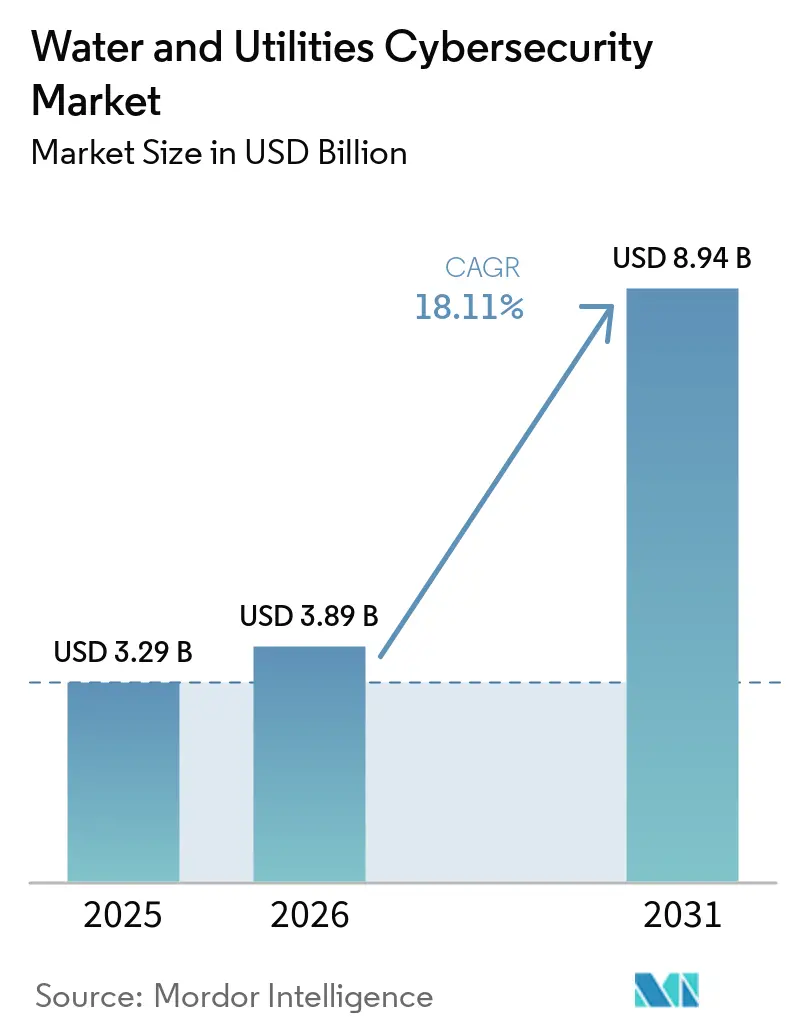
The water and utilities cybersecurity market size was valued at USD 3.29 billion in 2025 and estimated to grow from USD 3.89 billion in 2026 to reach USD 8.94 billion by 2031, at a CAGR of 18.11% during the forecast period 2026-2031. The water and utilities cybersecurity market is expanding as utilities connect more operational assets to enterprise networks, remote dashboards, and cloud environments, which increases exposure across treatment, distribution, and monitoring systems. The water and utilities cybersecurity market is also benefiting from the fact that cyber risk in this sector now carries direct operational, public health, and management consequences, which is pushing security spending higher on a more regular basis. Buying patterns in the water and utilities cybersecurity market are moving toward platforms that combine OT visibility, network protection, access control, and compliance reporting in one operating model. The studied market is also seeing faster demand for managed and professional services because many utilities still lack enough in-house OT security expertise to run these tools well. North America remains the largest revenue base, Asia-Pacific is the fastest-growing regional opportunity, and competition is tightening among OT specialists, industrial automation vendors, and broader IT security firms.
Key Report Takeaways
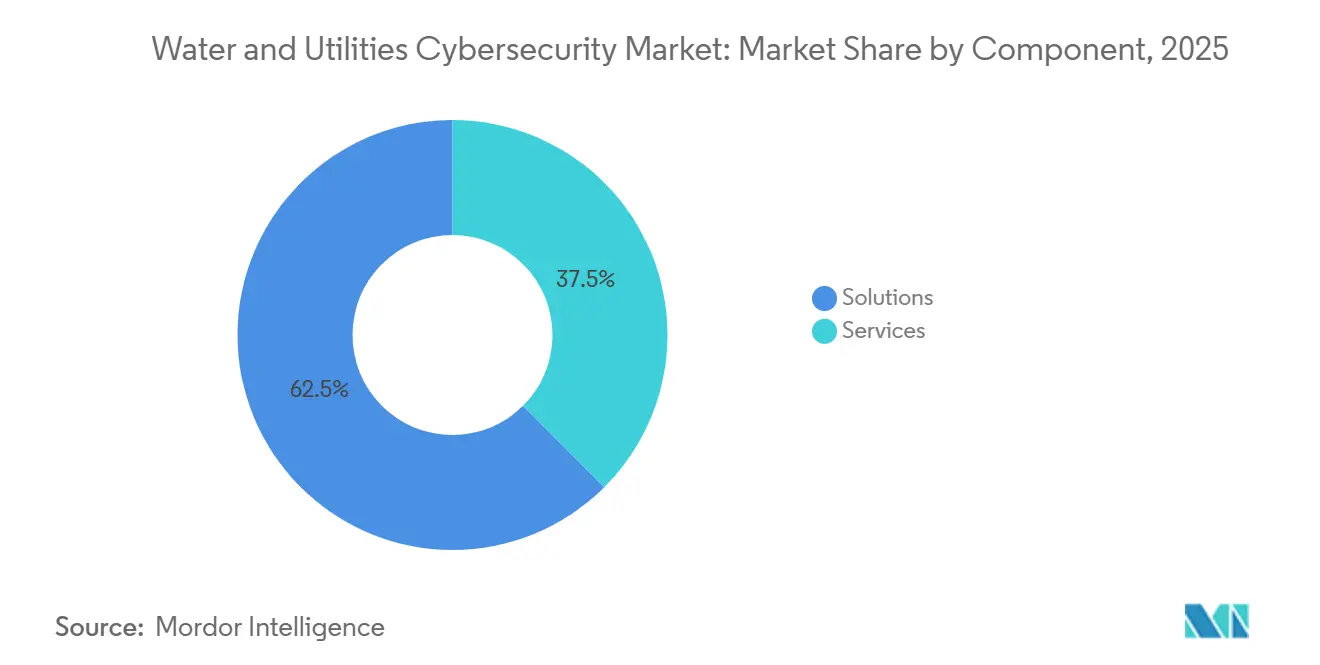
- By component, solutions led with 62.48% share in 2025, while services is projected to expand at a 20.12% CAGR through 2031 in the water and utilities cybersecurity market.
- By security type, network security held the largest 34.29% share in 2025, while cloud security is projected to record the highest CAGR at 22.81% through 2031.
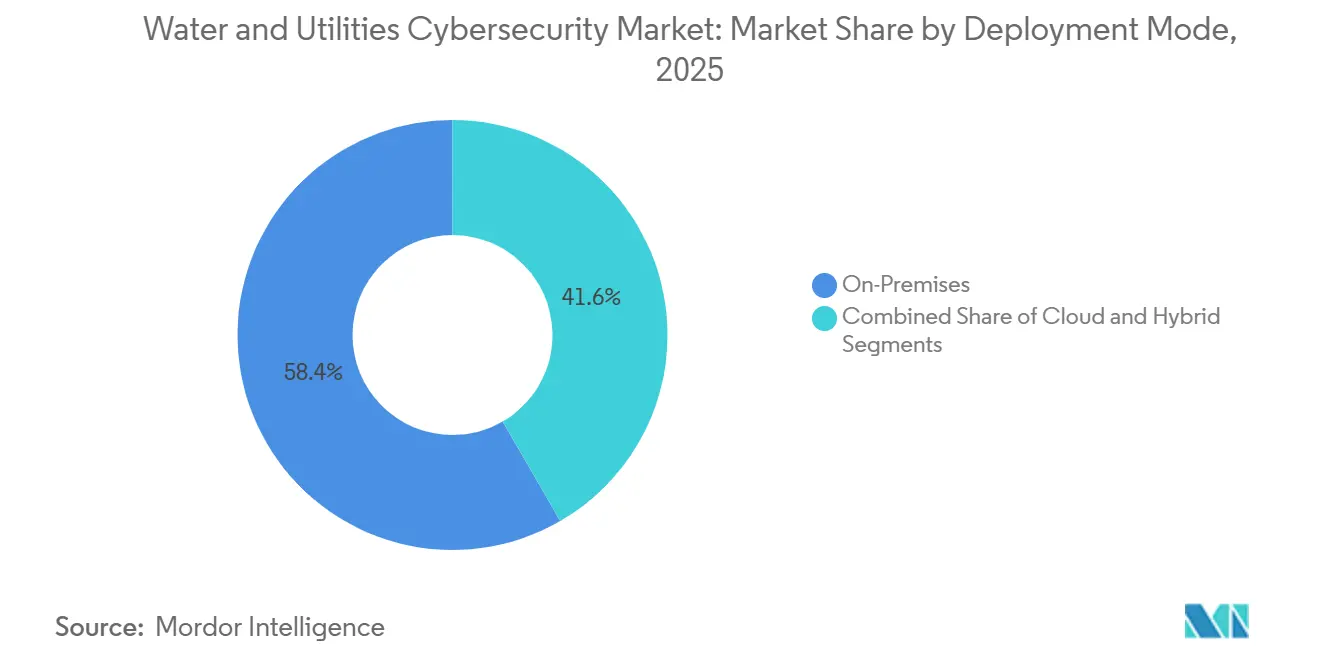
- By deployment mode, on-premises accounted for 58.36% share in 2025, while cloud deployment is expected to grow at a 21.42% CAGR through 2031.
- By application, water treatment plants held the leading 38.68% share in 2025, while remote monitoring and control centers are projected to expand at a 20.54% CAGR through 2031.
- By geography, North America held 38.25% of the water and utilities cybersecurity market share in 2025, while Asia-Pacific is projected to advance at a 23.87% CAGR through 2031.
Note: Market size and forecast figures in this report are generated using Mordor Intelligence’s proprietary estimation framework, updated with the latest available data and insights as of January 2026.
Market Trends and Insights
Drivers Impact Analysis of Water and Utilities Cybersecurity Market*
| DRIVER | (~) % IMPACT ON CAGR FORECAST | GEOGRAPHIC RELEVANCE | IMPACT TIMELINE |
|---|---|---|---|
| Rising OT and IT Convergence in Water Operations | +3.2% | Global | Medium term (2-4 years) |
| Escalating Ransomware Pressure on Water Utilities | +2.8% | North America and EU | Short term (≤ 2 years) |
| Expansion of Smart Meters and Remote Monitoring | +2.5% | APAC core, spill-over to North America and EU | Medium term (2-4 years) |
| Compliance-Driven Security Modernization Spending | +2.1% | North America and EU | Short term (≤ 2 years) |
| Growth of Managed Security Services for Small Utilities | +1.8% | North America | Medium term (2-4 years) |
| Need for Zero Trust Controls Across OT Vendor Access | +1.6% | Global | Long term (≥ 4 years) |
| Source: Mordor Intelligence | |||
Rising OT and IT Convergence in Water Operations
Water systems that once depended on separation from enterprise environments now send telemetry to corporate networks and cloud-based SCADA dashboards, which changes how the water and utilities cybersecurity market is being prioritized by operators. Fortinet found that 52% of organizations placed OT security under the CISO or CSO in 2025, up from 16% in 2022, which shows a clear governance shift in connected industrial environments. That change matters because utilities can no longer treat OT protection as a separate engineering issue when operational data, remote access, and business systems are increasingly linked.[1]Fortinet and WaterISAC, “2025 State Of Operational Technology And Cybersecurity Report,” WaterISAC, waterisac.org The water and utilities cybersecurity market is gaining from this shift because passive asset discovery, protocol inspection, and anomaly detection tools become necessary once older isolation models weaken. Vendors that connect OT visibility to enterprise security operations centers are therefore improving their position in procurement decisions across the water and utilities cybersecurity market.
Escalating Ransomware Pressure on Water Utilities
Ransomware has become a direct growth driver for the water and utilities cybersecurity market because attacks on industrial and municipal environments now create service, billing, and recovery disruption at the same time. Dragos reported 3,300 ransomware attacks targeting industrial organizations in 2025, with the water sector remaining among the persistently targeted verticals. Honeywell also stated that ransomware attacks targeting industrial operators rose 46% in the first quarter of 2025, which reinforced the need for faster detection and response across essential infrastructure. The practical effect is that even attacks centered on business systems can interrupt customer service, payment functions, and manual operating continuity without deep OT expertise from the attacker. That reality is widening the addressable scope of the water and utilities cybersecurity market because every connected utility environment now needs stronger resilience across both IT and OT layers.
Expansion of Smart Meters and Remote Monitoring Infrastructure
The spread of smart metering and remote monitoring is widening the number of connected endpoints that utilities must secure, which is opening another durable demand layer in the water and utilities cybersecurity market. The EU Radio Equipment Directive framework came into force on August 1, 2025, and it requires most radio-enabled smart meters to comply with cybersecurity requirements under EN 18031. In early 2026, the National Vulnerability Database published CVE-2025-63624, a critical SQL injection flaw in an IoT smart water meter monitoring platform that allowed unauthenticated remote code execution.[2]National Vulnerability Database and MITRE, “CVE-2025-63624, IoT Smart Water Meter Platform SQL Injection Flaw,” National Vulnerability Database, nvd.nist.gov Large municipal metering programs in Asia are also raising the number of field devices, gateways, and head-end systems that sit between customer data and operating workflows. As these architectures scale, the water and utilities cybersecurity market is benefiting because a compromised head-end can expose both billing information and operational parameters in the same event.
Compliance-Driven Security Modernization Spending
Regulatory pressure is shortening buying cycles and turning more cybersecurity spending into a mandatory item across the water and utilities cybersecurity market. The EPA AWIA 2025-2026 compliance cycle requires community water systems serving populations above 3,301 to certify completion of risk and resilience assessments on staggered deadlines through 2025 and 2026. In Europe, the NIS2 Directive classifies water and wastewater as essential entities and imposes 24-hour incident notification, supply chain security obligations, and management liability for non-compliance. New York State added another layer in July 2025 with proposed cybersecurity regulations for water and wastewater systems and a USD 2.5 million SECURE grant program. As a result, the water and utilities cybersecurity market is rewarding vendors that can produce audit evidence, workflow documentation, and integrated reporting rather than only technical alerts. This is also strengthening demand for platforms that link cyber controls with governance and risk management processes in a way utilities can defend during reviews and certification cycles.
Restraints Impact Analysis of Water and Utilities Cybersecurity Market*
| RESTRAINT | (~) % IMPACT ON CAGR FORECAST | GEOGRAPHIC RELEVANCE | IMPACT TIMELINE |
|---|---|---|---|
| Budget Constraints Among Small and Rural Utilities | -2.5% | North America, South America, and Middle East and Africa | Short term (≤ 2 years) |
| Legacy SCADA and OT Integration Complexity | -1.8% | Global | Long term (≥ 4 years) |
| Shortage of OT-Savvy Cybersecurity Talent | -1.4% | Global | Long term (≥ 4 years) |
| Data Residency and Low-Latency Deployment Constraints | -0.9% | EU and APAC | Medium term (2-4 years) |
| Source: Mordor Intelligence | |||
Budget Constraints Among Small and Rural Utilities
Budget pressure remains the most persistent adoption barrier for the water and utilities cybersecurity market because many small systems still struggle to fund modern security architecture at the pace threats are rising. The Congressional Research Service noted that the reintroduced Cybersecurity for Rural Water Systems Act of 2025 proposes USD 32.5 million per year through FY2030 for the USDA circuit rider program, including USD 7.5 million annually dedicated to cybersecurity technical assistance. That support is meaningful, but it also shows that a large share of smaller operators still need outside help before they can absorb more advanced tools or service contracts. Shared-service and managed models may reduce costs over time, yet they are still developing and have not fully closed the protection gap across the water and utilities cybersecurity market. Until those models scale further, smaller utilities are likely to remain focused on minimum compliance, selective controls, and slower upgrade cycles.
Legacy SCADA and OT Integration Complexity
Legacy SCADA and OT environments continue to slow the water and utilities cybersecurity market because many utilities are still operating assets designed for long service lives and limited native security. Water infrastructure often relies on PLCs and RTUs built for 10 to 25 years of operation, and many still use protocols such as Modbus and DNP3 that were not designed with modern authentication or encryption in mind. Senate testimony presented in February 2026 identified legacy SCADA reachable through outdated remote-access tools and shared or default credentials as a defining systemic weakness in the sector. In practice, digitalization projects often add new remote access to old architectures before full redesign takes place, which makes compromise propagation easier between IT and OT layers. This is why the water and utilities cybersecurity market still favors passive and agentless monitoring approaches that can work around aging assets without disruptive changes to device firmware or plant operations.
*Our forecasts treat driver/restraint impacts as directional, not additive. The impact forecasts reflect baseline growth, mix effects, and variable interactions.
Water and Utilities Cybersecurity Market Segment Analysis
By Component:
Services Growth Signals a Maturing MarketThe solutions segment held 62.48% of the water and utilities cybersecurity market share in 2025, which reflected the sector’s earlier emphasis on foundational controls such as network monitoring, intrusion detection, and asset discovery. That buying pattern shows that many utilities first addressed basic visibility and segmentation before moving into more advanced operating models. Services are projected to grow at a 20.12% CAGR from 2026 to 2031 because utilities increasingly recognize that tools alone do not deliver protection if OT expertise is thin. This is a clear sign that the water and utilities cybersecurity market is shifting from initial product acquisition toward sustained operational support.
Managed services are becoming more relevant as shared service models emerge for smaller operators and as larger utilities seek continuous monitoring outside normal plant staffing patterns. Professional services are also benefiting from European compliance obligations because utilities must document OT-specific risk management, reporting, and governance processes under NIS2. Cloud-delivered platforms such as Claroty xDome are reducing deployment friction and supporting faster evidence collection, which makes service engagement easier to justify in the water and utilities cybersecurity industry. For the water and utilities cybersecurity market, these favors bundled offers that combine software, ongoing monitoring, response support, and compliance workflows rather than one-time license sales.


By Security Type:
Beyond Perimeter DefenseNetwork security held the largest 34.29% share in 2025 because segmentation between IT and OT environments remains one of the most important controls utilities can deploy against lateral movement and remote compromise. This lead position also shows how much attention the water and utilities cybersecurity market still places on separating critical process networks from broader enterprise exposure. Cloud security is projected to expand at the fastest 22.81% CAGR through 2031 as utilities adopt cloud-based SCADA support functions, remote dashboards, and AMI head-end systems. In parallel, application and control system security, identity and access security, and security monitoring are all gaining traction because utilities are tightening remote access, privileged account use, and event visibility.
Governance, risk, and compliance tools are becoming a more visible buying category inside the water and utilities cybersecurity market as audit readiness becomes part of daily security operations. Honeywell’s June 2026 OT Cybersecurity Suite expansion added AI-powered governance and compliance automation intended to reduce evidence collection time from weeks to hours.[3]Honeywell International Inc., “Honeywell Strengthens OT Cybersecurity Suite For Resilience Against Next Generation Of Industrial Cyber Threats,” Honeywell, honeywell.com IEC 62443 is also shaping how buyers assess control system protection and vendor fit, especially where procurement now ties technical security to formal compliance expectations. As a result, the water and utilities cybersecurity market is moving beyond perimeter defense and toward broader control coverage that connects prevention, detection, reporting, and governance.
By Deployment Mode:
Cloud Momentum Against On-Premises IncumbencyOn-premises deployment retained 58.36% share in 2025 because many mission-critical treatment and control environments still require local operation and cannot depend fully on external connectivity. That installed base remains important in the water and utilities cybersecurity market because low-latency response and operational continuity are still decisive in plant environments. Cloud deployment is projected to grow at a 21.42% CAGR through 2031, which reflects increasing comfort with using cloud infrastructure for reporting, analytics, and non-real-time management tasks. The practical result is not full displacement, but a wider hybrid pattern across the water and utilities cybersecurity market.
Hybrid models are becoming the most workable compromise because utilities can keep real-time OT monitoring near the asset while moving threat intelligence, evidence management, and administrative functions to the cloud. European NIS2 obligations and national critical infrastructure approaches continue to slow a pure cloud shift where data handling, residency, and accountability requirements remain strict. Japan’s revised sector guidance also shows that utilities in Asia-Pacific are formalizing their cyber control expectations as digital water infrastructure expands. In this setting, the water and utilities cybersecurity market increasingly favors vendors that can operate cleanly across on-premises, cloud, and hybrid environments without forcing one architecture on every utility.

By Application:
Treatment Plants Anchor Spending While Remote Monitoring AcceleratesWater treatment plants held the largest application share at 38.68% in 2025 because they remain the highest-criticality operating nodes in the sector. Any manipulation of chemical dosing, filtration settings, or treatment controls can create immediate public health and service consequences, so these sites continue to anchor the water and utilities cybersecurity market. Remote monitoring and control centers are projected to grow at the fastest 20.54% CAGR through 2031 as utilities connect more distributed sensors, telemetry endpoints, and supervisory interfaces. Water distribution systems and wastewater management systems also remain in large demand pools because their connected assets stretch over broad operating footprints. Smart water metering infrastructure and pumping stations and reservoir infrastructure are rising in importance as field-level IoT adoption increases the number of potential entry points outside traditional plant perimeters.
Academic and technology development is now extending deeper into these distributed environments, which supports longer-term expansion in the water and utilities cybersecurity market. Scientific Reports published a 2026 study on blockchain-enabled anomaly detection architecture for water distribution cyber-physical systems, which highlighted growing interest in securing remote and distributed water assets.[4]Scientific Reports, “Secure IIoT Architecture With Blockchain-Enabled Anomaly Detection For Water Distribution Cyber-Physical Systems,” Nature, nature.com That direction supports the view that the water and utilities cybersecurity industry is no longer centered only on plant gateways or perimeter controls. It is broadening toward continuous visibility across treatment nodes, distribution networks, remote telemetry, and connected field infrastructure.
Geography Analysis
The Americas Water and Utilities Cybersecurity Market
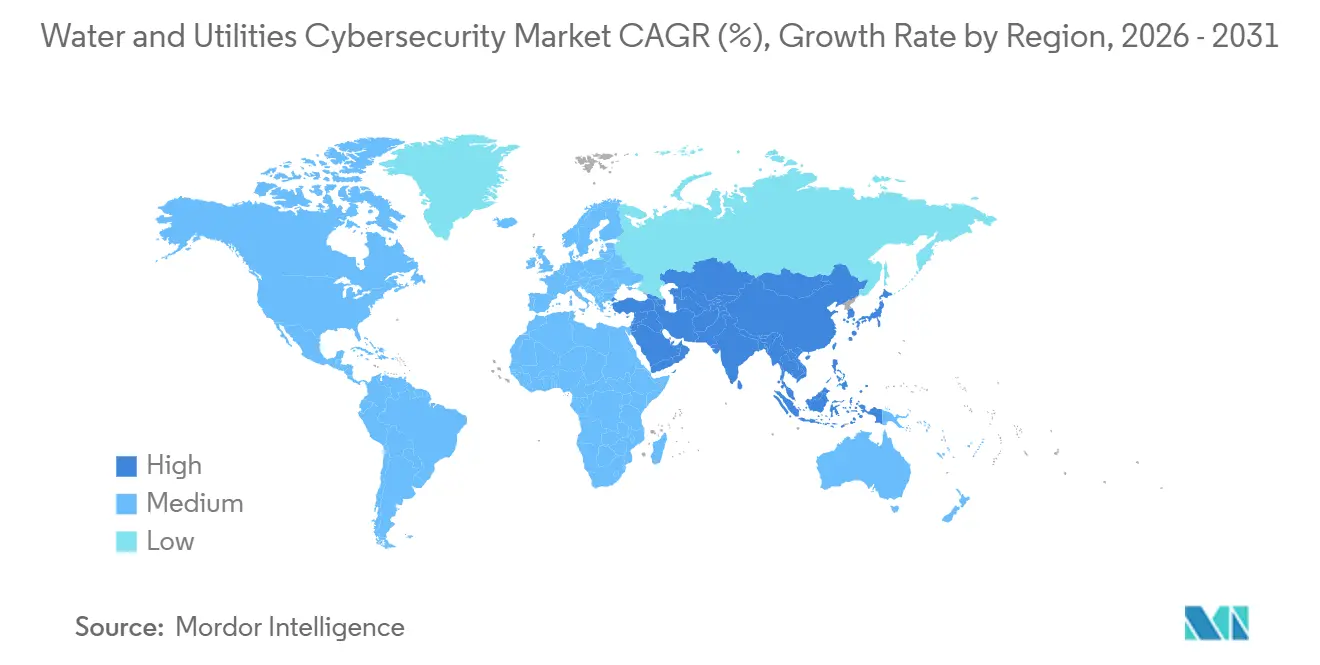
North America held 38.25% share of the global water and utilities cybersecurity market in 2025, which kept the region in the lead on revenue and regulatory maturity. The EPA AWIA 2025-2026 compliance cycle pushed staggered risk and resilience assessment deadlines across thousands of community water systems through 2025 and into mid-2026. New York added another layer in July 2025 by proposing water sector cybersecurity regulations and launching a USD 2.5 million SECURE grant program. Dragos also confirmed in its 2026 year-in-review that water remained a persistently targeted sector, which supports continued urgency in the North American water and utilities cybersecurity market. South America remains a smaller contributor, but Brazil and Argentina are seeing more interest as digital water management programs expand connected utility networks.
Europe Water and Utilities Cybersecurity Market
Europe was the second-largest regional base in the water and utilities cybersecurity market, with Germany, the United Kingdom, and France leading adoption. NIS2 converted cybersecurity from a discretionary program into a legal requirement for water and wastewater entities through incident notification, supply chain obligations, and management accountability. Germany’s B3S WA fourth edition received BSI suitability approval in September 2024 and offers a sector-specific path for more than 6,000 utilities.[5]DVGW e.V., “IT-Sicherheit, Branchenspezifischer Sicherheitsstandard Wasser/Abwasser (B3S WA),” DVGW, dvgw.de Collective defense efforts such as CyberSec@Wasser are also strengthening shared support capacity across the regional water and utilities cybersecurity market.
APAC and MEA Water and Utilities Cybersecurity Market
Asia-Pacific is projected to expand at a 23.87% CAGR through 2031, making it the fastest-growing region in the water and utilities cybersecurity market. Japan revised its water sector information security safety guidance in March 2025, which reflected a more formal compliance environment for facility control systems. Large automated metering and smart city programs are increasing the number of connected utility endpoints across major Asian markets, which is expanding future demand for monitoring, segmentation, and endpoint protection. Singapore’s digital water model and broader utility automation programs across the region are also raising expectations for resilient operating architecture. The Middle East and Africa remain smaller today, but GCC infrastructure protection programs are lifting demand while many African systems still face broader infrastructure and funding limits that slow faster adoption.

Competitive Landscape
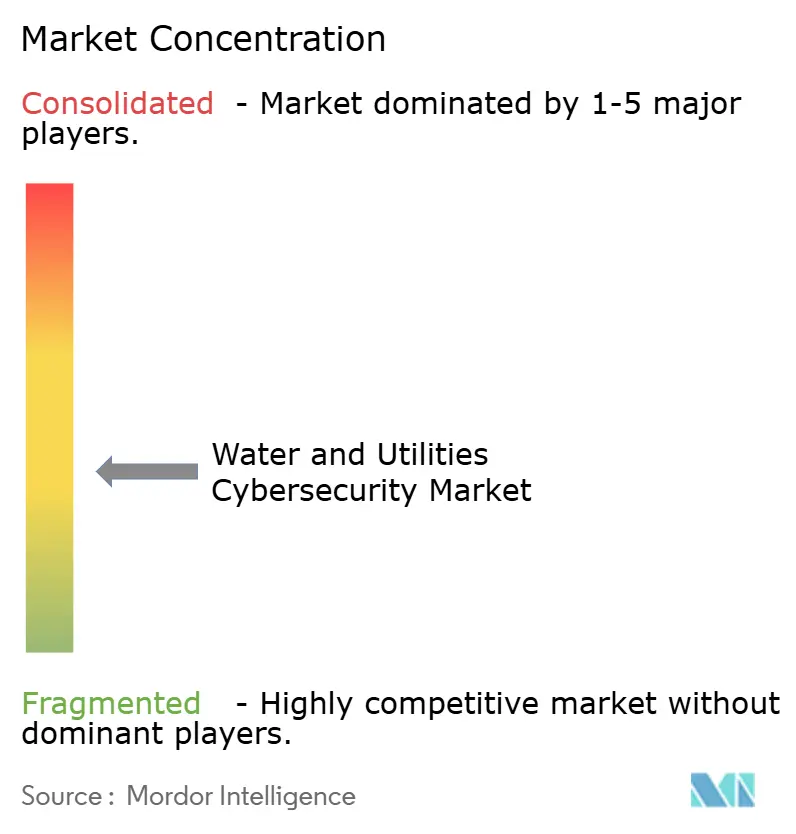
The water and utilities cybersecurity market is moderately fragmented and is shaped by few competitive clusters that increasingly overlap. OT specialists such as Claroty, Dragos, Waterfall Security Solutions, Radiflow, Armis, and Nozomi Networks carry strong credibility because they support industrial protocols and utility operating environments more directly. Industrial automation vendors such as Siemens, Honeywell, Schneider Electric, ABB, Rockwell Automation, and GE Vernova approach the water and utilities cybersecurity market through installed base relationships and embedded security architecture. Enterprise security firms such as Cisco, Palo Alto Networks, CrowdStrike, Fortinet, IBM, Check Point, and Broadcom are extending OT coverage so they can compete across both IT and OT layers. This structure helps speed innovation, but it also makes vendor selection harder for utilities that want integrated, auditable, and operationally safe platforms.
Consolidation accelerated in 2026 and raised the strategic bar in the water and utilities cybersecurity market. Mitsubishi Electric completed its full acquisition of Nozomi Networks in January 2026, and Nozomi stated that net revenue reached USD 101.7 million in 2025, up from USD 74.7 million in 2024. Accenture also announced agreements to acquire a majority stake in Dragos and full ownership of runZero and NetRise, and the 3 companies together generated USD 208 million in annual recurring revenue as of June 2026, representing 53% year-over-year growth. These moves give larger platforms more scale to sell software, managed services, and critical infrastructure expertise into the water and utilities cybersecurity market.
Product strategy is also shifting toward AI-enabled workflow support and managed operations across the water and utilities cybersecurity market. Claroty launched Claire in May 2026 as a CPS-native AI security agent, and Honeywell expanded its OT Cybersecurity Suite in June 2026 with AI-powered proactive defense, governance automation, and 24/7 managed OT SOC services. That direction fits a buyer base where many utilities need faster response and easier compliance evidence without building large internal teams. Emerging challengers such as TXOne Networks and Forescout also fit the water and utilities cybersecurity market well because agentless visibility and simpler deployment remain attractive for mid-sized utilities. Within this scope, Trimble and Broadcom are more adjacent than core, while TXOne and Forescout align more directly with OT visibility, segmentation, and control needs in utility environments.
Water and Utilities Cybersecurity Industry Leaders
Siemens AG
Schneider Electric SE
Honeywell International Inc.
ABB Ltd.
GE Vernova Inc.
- *Disclaimer: Major Players sorted in no particular order
Water and Utilities Cybersecurity Market Companies Covered in this Report
- Siemens AG
- Schneider Electric SE
- Honeywell International Inc.
- ABB Ltd.
- GE Vernova Inc.
- Cisco Systems, Inc.
- Fortinet, Inc.
- IBM Corporation
- Check Point Software Technologies Ltd.
- Rockwell Automation, Inc.
- Claroty Ltd.
- Dragos, Inc.
- Waterfall Security Solutions Ltd.
- Radiflow Ltd.
- Armis, Inc.
- Nozomi Networks Inc.
- Sensus USA Inc.
- Badger Meter, Inc.
- Itron, Inc.
- Trimble Inc.
- Aclara Technologies LLC
- Oracle Corporation
- Broadcom Inc.
- Palo Alto Networks, Inc.
- CrowdStrike Holdings, Inc.

Recent Industry Developments in Water and Utilities Cybersecurity Market
- June 2026: Honeywell expanded its OT Cybersecurity Suite with 5 new capabilities, including an AI-powered Cyber Proactive Defense (CPD) module for real-time OT threat correlation and a 24/7 managed OT Security Operations Center (SOC) service. The expansion also introduced a Cyber Governance Risk and Compliance (GRC) module that reduces compliance audit cycles from weeks to hours using AI and machine learning, directly addressing water utility NIS2 and AWIA obligations.
- May 2026: Claroty launched Claire, the industry's first CPS-native AI security agent, trained on the world's largest CPS data lake and Claroty's decade of industrial security expertise. Claire delivers agentic actions for mission-critical infrastructure protection across water utilities, healthcare, and industrial operators, repositioning Claroty from a managed platform to an autonomous protection engine. Claroty serves over 1,300 customers, including 24 of the Fortune 100, and was named a Leader in the 2026 Gartner Magic Quadrant for CPS Protection Platforms.
- April 2026: Claroty released Visibility Orchestration capabilities in Claroty xDome, transforming CPS asset visibility into a quantifiable, measurable security metric across industrial, healthcare, and water sector environments. The release enables measurable, actionable improvements in data quality and security posture across both cloud and on-premises deployments.
- January 2026: Mitsubishi Electric completed its full acquisition of Nozomi Networks Inc., making the OT, IoT, and CPS security leader a wholly owned subsidiary. Nozomi Networks reported USD 101.7 million in net revenue for 2025, up from USD 74.7 million in 2024, representing 36% year-over-year growth, validating strategic demand for dedicated OT security platforms across water and critical infrastructure sectors.


Global Water and Utilities Cybersecurity Market Report Scope
Water and Utilities Cybersecurity encompasses the protection of digital systems, operational technologies, and communication networks that govern water supply, wastewater treatment, and utility infrastructure. It aims to safeguard the confidentiality, integrity, and availability of these critical systems by addressing a wide range of cyber threats, including ransomware attacks, insider threats, and operational disruptions. By implementing robust cybersecurity measures, this domain ensures the secure and efficient functioning of essential services, protects public health, preserves environmental safety, and guarantees the consistent and reliable delivery of vital resources to communities and industries.
The Water and Utilities Cybersecurity Market Report is Segmented by Component (Solutions, and Services), Security Type (Network Security, Endpoint and Asset Security, Application and Control System Security, Identity and Access Security, Security Monitoring and Threat Detection, and Governance, Risk and Compliance), Deployment Mode (On-Premises, Cloud, and Hybrid), Application (Water Treatment Plants, Water Distribution Systems, Wastewater Management Systems, Smart Water Metering Infrastructure, Remote Monitoring and Control Centers, and Pumping Stations and Reservoir Infrastructure), and Geography (North America, South America, Europe, Asia-Pacific, and Middle East and Africa). The Market Forecasts are Provided in Terms of Value (USD).
| Solutions |
| Services |
| Network Security |
| Endpoint and Asset Security |
| Application and Control System Security |
| Identity and Access Security |
| Security Monitoring and Threat Detection |
| Governance, Risk and Compliance |
| On-Premises |
| Cloud |
| Hybrid |
| Water Treatment Plants |
| Water Distribution Systems |
| Wastewater Management Systems |
| Smart Water Metering Infrastructure |
| Remote Monitoring and Control Centers |
| Pumping Stations and Reservoir Infrastructure |
| North America | United States | |
| Canada | ||
| Mexico | ||
| South America | Brazil | |
| Argentina | ||
| Rest of South America | ||
| Europe | Germany | |
| United Kingdom | ||
| France | ||
| Italy | ||
| Spain | ||
| Russia | ||
| Rest of Europe | ||
| Asia-Pacific | China | |
| Japan | ||
| India | ||
| South Korea | ||
| Australia | ||
| Rest of Asia-Pacific | ||
| Middle East and Africa | Middle East | Saudi Arabia |
| United Arab Emirates | ||
| Turkey | ||
| Rest of Middle East | ||
| Africa | South Africa | |
| Rest of Africa | ||
| By Component | Solutions | ||
| Services | |||
| By Security Type | Network Security | ||
| Endpoint and Asset Security | |||
| Application and Control System Security | |||
| Identity and Access Security | |||
| Security Monitoring and Threat Detection | |||
| Governance, Risk and Compliance | |||
| By Deployment Mode | On-Premises | ||
| Cloud | |||
| Hybrid | |||
| By Application | Water Treatment Plants | ||
| Water Distribution Systems | |||
| Wastewater Management Systems | |||
| Smart Water Metering Infrastructure | |||
| Remote Monitoring and Control Centers | |||
| Pumping Stations and Reservoir Infrastructure | |||
| By Geography | North America | United States | |
| Canada | |||
| Mexico | |||
| South America | Brazil | ||
| Argentina | |||
| Rest of South America | |||
| Europe | Germany | ||
| United Kingdom | |||
| France | |||
| Italy | |||
| Spain | |||
| Russia | |||
| Rest of Europe | |||
| Asia-Pacific | China | ||
| Japan | |||
| India | |||
| South Korea | |||
| Australia | |||
| Rest of Asia-Pacific | |||
| Middle East and Africa | Middle East | Saudi Arabia | |
| United Arab Emirates | |||
| Turkey | |||
| Rest of Middle East | |||
| Africa | South Africa | ||
| Rest of Africa | |||


Key Questions Answered in the Report
What is the 2026 size of the water and utilities cybersecurity space?
The water and utilities cybersecurity market was valued at USD 3.29 billion in 2025, stands at USD 3.89 billion in 2026, and it is projected to reach USD 8.94 billion by 2031 at an 18.11% CAGR.
Which component is growing fastest in this field?
Services is projected to grow the fastest, at a 20.12% CAGR through 2031, as utilities need managed support and OT-specific expertise.
Which security category led spending in 2025?
Network security led with a 34.29% share in 2025 because segmentation between IT and OT remains a core utility control.
Why are utilities increasing cybersecurity budgets now?
Utilities are responding to tighter compliance rules, more connected OT environments, and heavier ransomware pressure on both operational and business systems.
Which application area draws the largest spend today?
Water treatment plants led with a 38.68% share in 2025 because disruptions there can affect chemical dosing, filtration, and public health outcomes.
Which region is expanding the fastest through 2031?
Asia-Pacific is projected to grow the fastest, at a 23.87% CAGR, supported by digital water infrastructure, smart metering, and broader utility modernization.
Page last updated on:





