
Cybersecurity For Smart Grids and Distributed Energy Resources Market Size and Share
Market Overview
| Study Period | 2020 - 2031 |
|---|---|
| Market Size (2026) | USD 7.96 Billion |
| Market Size (2031) | USD 18.41 Billion |
| Growth Rate (2026 - 2031) | 18.26 % |
| Fastest Growing Market | Asia-Pacific |
| Largest Market | North America |
| Market Concentration | Medium |
Major Players *Disclaimer: Major Players sorted in no particular order Image © Mordor Intelligence. Reuse requires attribution under CC BY 4.0. | |
Cybersecurity For Smart Grids and Distributed Energy Resources Market Analysis by Mordor Intelligence
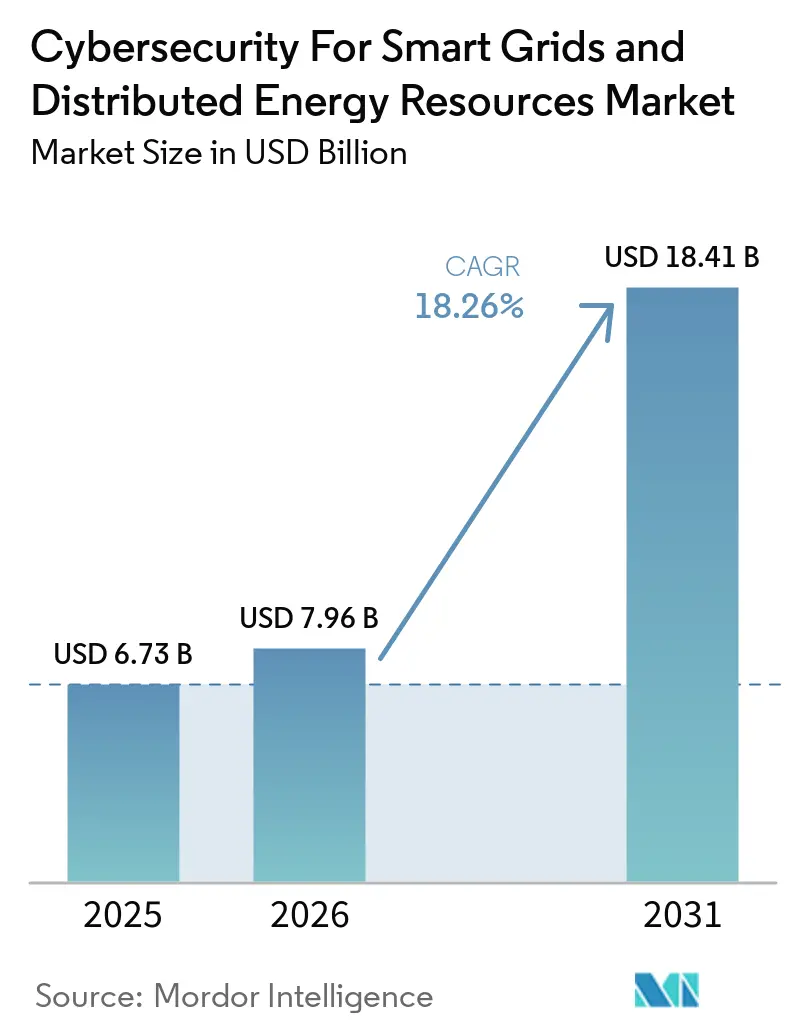
The Cybersecurity for smart grids and distributed energy resources market size was valued at USD 6.73 billion in 2025 and estimated to grow from USD 7.96 billion in 2026 to reach USD 18.41 billion by 2031, at a CAGR of 18.26% during the forecast period (2026-2031). The cybersecurity market for smart grids and distributed energy resources is expanding because utilities are digitalizing transmission and distribution systems faster than their security architectures can keep pace. Procurement is also shifting from isolated perimeter tools toward identity-led monitoring, behavior-based protection, and vendor-managed platforms that meet audit requirements and support long asset lifecycles. The threat picture has become more urgent as ransomware activity, PLC manipulation, and internet exposure across OT environments push utilities to shorten decision cycles for monitoring, access control, and supply chain risk tools. The rise of distributed energy resources and virtual power plants is widening the attack surface beyond substations into customer-owned devices, aggregation platforms, and field endpoints that were not built for hostile network conditions. Competition in the cybersecurity market for smart grids and distributed energy resources is also moving toward integrated OT security delivery, where broad service capabilities, device intelligence, and platform interoperability matter as much as product depth.
Key Report Takeaways
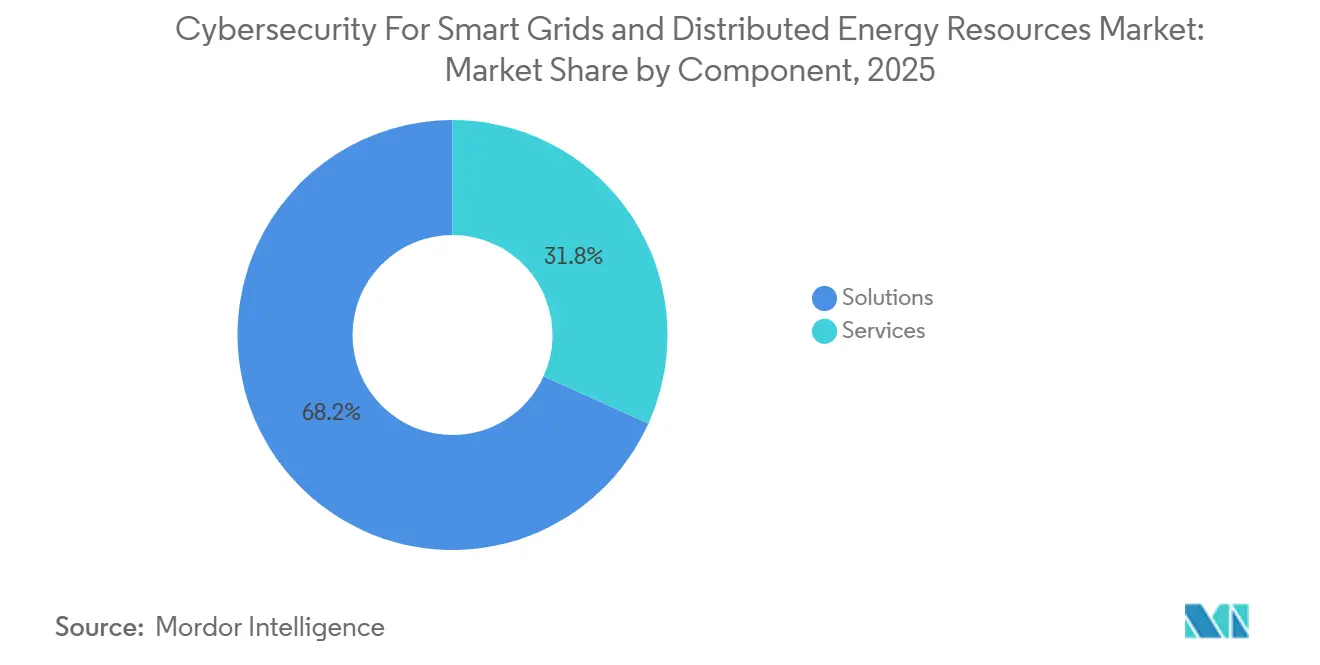
- By component, solutions held 68.24% of the cybersecurity for smart grids and distributed energy resources market share in 2025, while services are projected to expand at a 22.39% CAGR through 2031.
- By deployment mode, on-premises commanded 59.43% share of the cybersecurity for smart grids and distributed energy resources market size in 2025, while cloud deployment is projected to grow at a 22.86% CAGR through 2031.
- By security type, network security accounted for 31.56% share of the cybersecurity for smart grids and distributed energy resources market size in 2025, while endpoint and device security is expected to advance at a 21.42% CAGR through 2031.
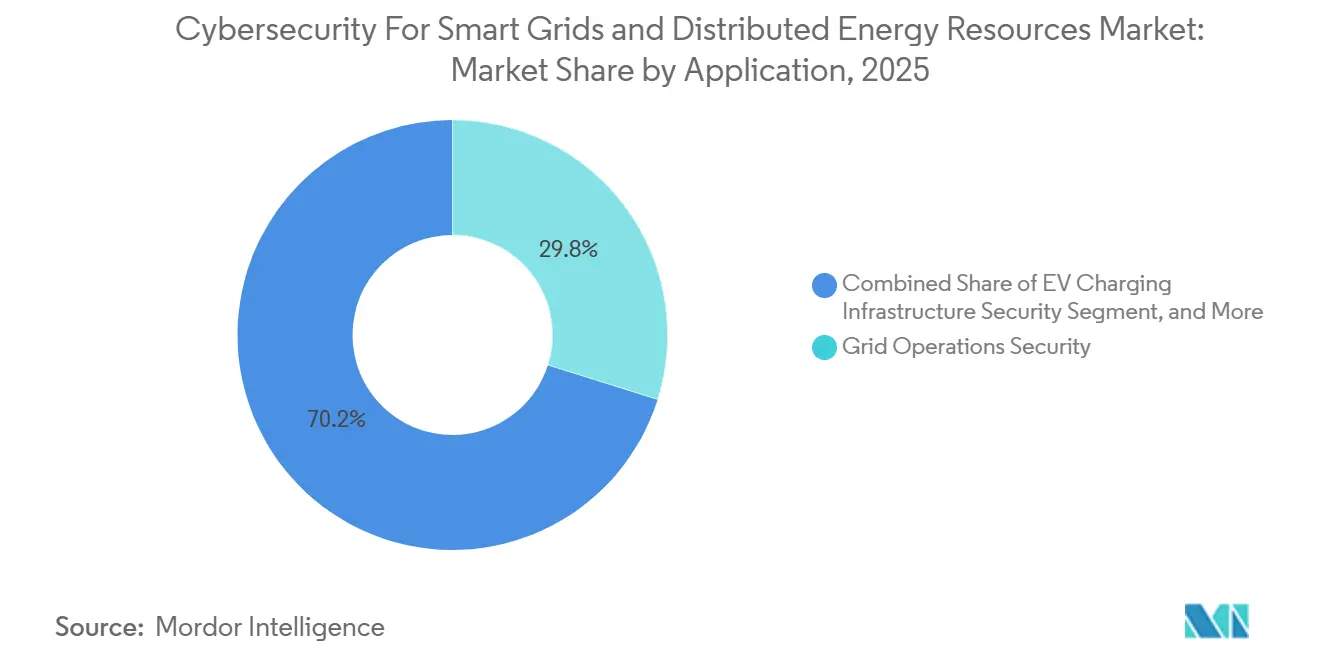
- By application, grid operations security held 29.84% share of the market size in 2025, while AMI security is projected to expand at a 21.51% CAGR through 2031.
- By end user industry, electric utilities accounted for 41.25% of market spending in 2025, while industrial grid operators are projected to record the highest CAGR at 22.67% through 2031.
- By geography, North America held 38.15% of the market in 2025, while the Asia-Pacific is projected to grow at a 23.77% CAGR through 2031.
Note: Market size and forecast figures in this report are generated using Mordor Intelligence’s proprietary estimation framework, updated with the latest available data and insights as of January 2026.
Market Trends and Insights
Drivers Impact Analysis of Cybersecurity For Smart Grids and Distributed Energy Resources Market*
| DRIVER | (~) % IMPACT ON CAGR FORECAST | GEOGRAPHIC RELEVANCE | IMPACT TIMELINE |
|---|---|---|---|
| Rapid Smart Grid Digitization and DER Interconnection | +5.2% | Global, concentrated in North America, Europe, and APAC | Medium term (2-4 years) |
| Rising Grid-Targeted Ransomware and OT Intrusion Risk | +4.1% | Global, highest severity in North America and Europe | Short term (≤ 2 years) |
| Regulatory Hardening of Critical Infrastructure Cybersecurity | +3.4% | North America and EU core, spill-over to Middle East and APAC | Medium term (2-4 years) |
| Expansion of Cloud-Connected Utility Control Environments | +2.6% | APAC core, spill-over to North America and Europe | Medium term (2-4 years) |
| DER Aggregation, Virtual Power Plants, and Prosumers Expanding Attack Surface | +1.9% | Global, led by Europe, North America, and Australia | Long term (≥ 4 years) |
| Zero-Trust and Identity-Centric Access for OT-IT Convergence | +1.4% | North America and Europe, with growing adoption in APAC | Long term (≥ 4 years) |
| Source: Mordor Intelligence | |||
Rapid Smart Grid Digitization and DER Interconnection
The digitalization of transmission and distribution infrastructure is forcing security architectures in the cybersecurity for smart grids and distributed energy resources market to evolve faster than utility buying cycles can adjust. As substations add intelligent electronic devices, remote terminal units, and communication-enabled protection relays, the number of reachable points inside a single grid environment keeps rising. Palo Alto Networks reported that telemetry from more than 60,000 OT firewalls showed a 332% increase in internet-exposed OT devices between 2024 and 2026.[1]Palo Alto Networks, “OT Security Report 2026: Trends, Threats and Active Defense,” Palo Alto Networks, live.paloaltonetworks.com The same analysis said AI-assisted attack cycles can reduce the time between vulnerability disclosure and exploitation from weeks to minutes. That mismatch matters because patching in live OT environments still takes far longer than exposure windows, which leaves each added device class as a possible lateral movement path.
Rising Grid-Targeted Ransomware and OT Intrusion Risk
Threat actors are targeting grid OT environments with the intent to disrupt operations, which is raising the urgency behind spending in the cybersecurity for smart grids and distributed energy resources market. In April 2026, the FBI, CISA, NSA, EPA, Department of Energy, and US Cyber Command confirmed that Iranian-affiliated actors had been disrupting PLCs across US energy sites since at least March 2026. The same advisory said victims in the energy and government sectors suffered operational disruption and financial loss through manipulated HMI and SCADA systems.[2]Federal Agencies, “Joint Cybersecurity Advisory AA26-097A,” American Public Power Association, publicpower.org In December 2025, the ELECTRUM threat group targeted 30 renewable energy sites across Poland's power grid and used wiper malware to disable OT equipment beyond repair. These incidents are making utilities treat OT cyber modernization as a continuity requirement rather than a discretionary upgrade cycle.
Regulatory Hardening of Critical Infrastructure Cybersecurity
Regulation is turning cybersecurity investment into required spending for a large share of the cybersecurity for smart grids and distributed energy resources market. FERC approved Reliability Standard CIP-015-1 on June 26, 2025, which introduced mandatory internal network security monitoring inside Electronic Security Perimeters. NERC CIP-012-2 became enforceable on July 1, 2026, which extended cryptographic protection expectations to communications between control centers. The April 2026 release of CIP-013-4 also tightened supply chain risk management obligations for vendors and software suppliers tied to high and medium-impact Bulk Electric System assets. These milestones favor vendors that can deliver audit-ready monitoring, access control, and supplier risk workflows without long customization cycles.
Expansion of Cloud-Connected Utility Control Environments
Cloud and hybrid utility control environments are creating a new exposure layer that is becoming more visible across the cybersecurity for smart grids and distributed energy resources market. Forescout cited Microsoft Threat Intelligence data showing a 26% increase in cloud and hybrid OT incidents in early 2025. The same analysis said identity-based attacks accounted for more than 97% of incidents in cloud-connected OT environments. This is pushing utilities toward identity governance, real-time session logging, and closer control over remote access pathways. The effect is strongest in greenfield grid programs where operators adopt cloud-first architectures without a large on-premises security baseline already in place.
Restraints Impact Analysis of Cybersecurity For Smart Grids and Distributed Energy Resources Market*
| RESTRAINT | (~) % IMPACT ON CAGR FORECAST | GEOGRAPHIC RELEVANCE | IMPACT TIMELINE |
|---|---|---|---|
| Legacy OT Systems With Limited Native Security Controls | -1.8% | Global, most severe in North America, Europe, and South Asia | Long term (≥ 4 years) |
| High Integration Complexity Across Multi-Vendor Grid Environments | -1.2% | Global, elevated in Europe and North America | Medium term (2-4 years) |
| Skilled Cybersecurity Talent Shortage in Utility OT Environments | -0.9% | Global, most acute in North America, Australia, and Europe | Medium term (2-4 years) |
| Budget Pressure and Long Utility Procurement Cycles | -0.6% | Global, most pronounced in emerging markets and smaller utilities | Short term (≤ 2 years) |
| Source: Mordor Intelligence | |||
Legacy OT Systems With Limited Native Security Controls
Legacy OT equipment remains a structural limit on how quickly the cybersecurity for smart grids and distributed energy resources market can scale inside live grid environments. Many relays, PLCs, and substation automation systems were not built to support modern agents or frequent security updates without operational review. GE Vernova's February 2026 launch of GridBeats APS directly addressed the problem of applying cybersecurity software updates without revalidating protection functions in live substations. That reality keeps known exposures open longer than most enterprise cyber programs would accept and slows the speed of full fleet rollouts. Vendors can monitor and prioritize these risks, but closure still depends on controlled maintenance windows and long asset replacement cycles.
High Integration Complexity Across Multi-Vendor Grid Environments
The cybersecurity for smart grids and distributed energy resources market still has to fit around multi-vendor grid environments built over long utility investment cycles. Utilities often operate a mixed estate of automation hardware, monitoring tools, cloud analytics, and managed services that do not share one operating model. This complicates deployment, evidence collection, and change control when operators need a consistent policy view across substations, control centers, and field assets. It also helps explain why vendors are buying adjacent capabilities instead of relying on narrower tools with limited integration depth. Integration remains a drag on adoption wherever utilities need custom engineering before a platform can move from pilot use to systemwide deployment.
*Our forecasts treat driver/restraint impacts as directional, not additive. The impact forecasts reflect baseline growth, mix effects, and variable interactions.
Cybersecurity For Smart Grids and Distributed Energy Resources Market Segment Analysis
By Component:
Solutions Anchor Compliance Procurement and Services Economics Reshape the MarketServices are projected to grow at a 22.39% CAGR through 2031, which makes them the faster-expanding component in the cybersecurity for smart grids and distributed energy resources market. The shift reflects a practical utility response to workforce pressure, because operators without dedicated security operations centers are leaning on managed detection and response rather than building large in-house teams. SERC ranked shortage of required skillsets among the main reliability and security risks for the bulk electric system in its 2024-2026 regional risk work. That labor gap is changing the commercial model from software ownership toward monitored service delivery, continuous threat handling, and externally supported incident response. It also increases the appeal of vendors that can pair OT telemetry, compliance reporting, and response playbooks within one operating structure.[3]SERC Reliability Corporation, “Addressing the Shortage of Required Skillsets,” SERC, serc.org
Solutions held 68.24% of the cybersecurity for smart grids and distributed energy resources market share in 2025, which shows that certified platforms still anchor utility buying behavior. Utilities continue to prefer integrated tools that can support NERC CIP audit preparation with documented evidence trails, stable controls, and clear ownership lines. Honeywell expanded its OT Cybersecurity Suite in June 2026 with five proactive protection capabilities aimed at critical infrastructure operators in energy and manufacturing. That move shows how incumbents are adding more intelligence, visibility, and compliance support before pure-play OT specialists consolidate a larger share of the analytics layer. In the smart grid cybersecurity industry, this keeps the solutions base large even as services gain faster momentum through the forecast period.


By Deployment Mode:
On-Premises Preserves Compliance Primacy and Cloud Leads GrowthCloud deployment is projected to expand at a 22.86% CAGR through 2031, which makes it the fastest-growing mode in the cybersecurity for smart grids and distributed energy resources market. Forescout cited Microsoft Threat Intelligence data that showed a 26% rise in cloud and hybrid OT incidents in early 2025, yet that rise has not slowed adoption. Instead, it is pushing utilities toward cloud-native security architectures with stronger identity governance, remote session logging, and better oversight of vendor access. Greenfield utility programs in Asia-Pacific are especially relevant because they can adopt cloud-first grid management without a large installed on-premises security base to unwind. Hybrid deployment also remains a practical operating model because utilities want local control for core functions and cloud analytics for scale and visibility.[4]Forescout Technologies, “Securing Modern OT, Visibility, Cloud, and Hybrid Architectures for Industrial Cybersecurity,” Forescout, forescout.com
On-premises commanded 59.43% share of the cybersecurity for smart grids and distributed energy resources market size in 2025, which reflects how regulation still favors defined network boundaries. NERC Standards Compliance guidance tied to July 1, 2026 effective dates kept attention on Electronic Security Perimeters and documented communication protections across utility environments. Zero-trust approaches are gaining interest, but the practical utility question remains how to align identity-based access with boundary-oriented compliance expectations in operational settings. That keeps on-premises deployment relevant for high-impact entities even while cloud tools gain share in analytics, visibility, and vendor-managed monitoring. In the smart grid cybersecurity industry, deployment choices are therefore being shaped by compliance fit as much as by technology preference.
By Security Type:
Network Security Anchors Spend and Endpoint Security Addresses the DER GapNetwork security accounted for 31.56% share of the cybersecurity for smart grids and distributed energy resources market size in 2025, which kept it as the leading control layer across regulated utility environments. Network visibility tools, OT-specific firewalls, and protocol-aware anomaly detection remain the first line of spending because utilities need foundational visibility before they can expand advanced controls. Data security, identity and access security, and application security are also becoming more relevant as SCADA, historian, and enterprise systems connect more tightly. Identity-led controls matter more in the cybersecurity for smart grids and distributed energy resources market because remote access, cloud-connected assets, and vendor sessions have become routine operating requirements. This keeps the security stack broad, but the spending base still starts with network-layer controls that utilities can map directly to monitoring and segmentation needs.
Endpoint and device security is projected to grow at a 21.42% CAGR through 2031, which reflects the widening device attack surface across AMI and DER deployments. Research published in Springer Nature identified spoofing, man-in-the-middle attacks, false data injection, and denial-of-service exposure across AMI network layer. Those risks matter because smart meters, field devices, and connected endpoints extend utility visibility while also multiplying points of weak authentication and remote manipulation. Dragos acquired Phosphorus in June 2026 to extend OT-native protection across connected devices embedded in critical infrastructure and operational networks. That move shows where the cybersecurity for smart grids and distributed energy resources market is opening new room for growth, especially for vendors that can secure large fleets of field assets rather than only the core network perimeter.
By Application:
Grid Operations Security Leads Share and AMI Security Expands FastestGrid operations security held 29.84% of the cybersecurity for smart grids and distributed energy resources market size in 2025, reflecting the commercial and operational importance of distribution infrastructure. The adoption of distribution automation, which incorporates intelligent switches, automated reclosers, and sensor-equipped field devices, has increased the need for enhanced visibility and control. Investments in grid operations encompass SCADA and OT systems security, EMS security, DER and renewable energy security, as well as EV charging infrastructure security. Utilities are prioritizing these application layers as control systems, previously isolated, now exchange data across a broader operational landscape. This shift has expanded the application scope within the cybersecurity for smart grids and distributed energy resources market, with Grid Operations Security maintaining the largest installed demand base.
Advanced Metering Infrastructure (AMI) security is projected to expand at a 21.51% CAGR through 2031, which makes it the fastest-growing application segment. Springer Nature research showed that AMI networks face spoofing, man-in-the-middle attacks, false data injection attacks, and denial-of-service threats across their communication structure. That exposure comes from the same wireless and connected design choices that make smart metering scalable and commercially practical. As more AMI head-end and grid communication environments connect into utility control and enterprise systems, security obligations move beyond pilot stages and into wider operational rollouts. This leaves AMI security as one of the clearest expansion areas within the cybersecurity for smart grids and distributed energy resources market over the forecast period.

By End User Industry:
Electric Utilities Hold Revenue Base and Industrial Operators Drive Faster GrowthIndustrial grid operators are projected to grow at a 22.67% CAGR through 2031, which makes them the fastest-expanding end-user group in the cybersecurity for smart grids and distributed energy resources market. NERC's March 2026 draft security guideline for distributed energy resource aggregators stated that compromise of aggregation platforms, communications pathways, identities, or connected devices can enable unauthorized control actions at scale. That language matters because industrial operators are increasingly part of balancing, aggregation, and virtual power plant activity rather than remaining outside core grid operations. Renewable energy operators and commercial and industrial energy users are also expanding demand because more generation and control functions are being managed through connected field assets. This creates a wider customer base for the cybersecurity for smart grids and distributed energy resources market beyond the traditional regulated utility core.
Electric utilities accounted for 41.25% of end-user spending in 2025, which kept them as the largest revenue base. Their position reflects the breadth of transmission, distribution, and control assets that require certified protection and documented compliance support. The July 2026 enforcement start for CIP-012-2, together with the broader progression of CIP-015 requirements, supports recurring demand for monitoring, communications protection, and evidence-ready controls. Government and public energy infrastructure entities remain smaller customers, while residential prosumer networks are gaining relevance as more distributed devices attach to grid programs. In the smart grid cybersecurity industry, this keeps utilities central to revenue while newer end-user groups shape the next wave of growth.
Geography Analysis
North America Cybersecurity for Smart Grids and Distributed Energy Resources Market
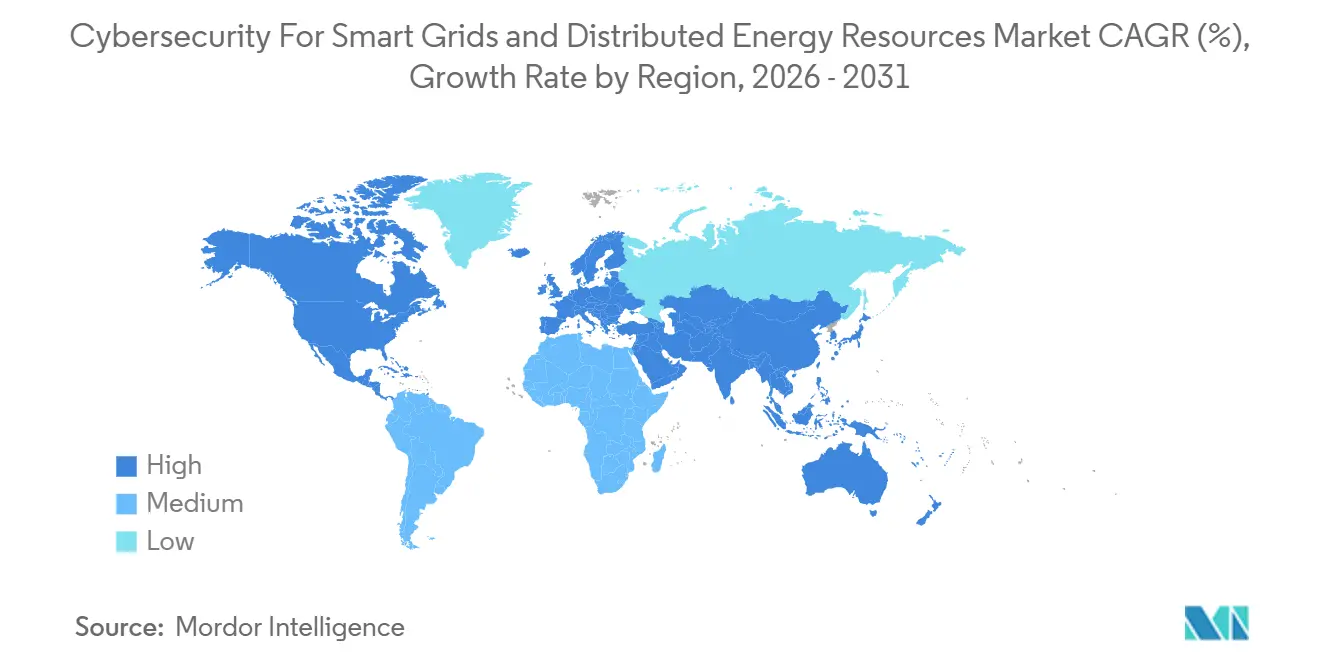
North America held 38.15% of the cybersecurity for smart grids and distributed energy resources market in 2025, which made it the leading regional block. The region remains anchored by the strongest mandatory compliance structure for bulk electric system security, which keeps spending tied to enforceable controls rather than discretionary projects. In April 2026, federal agencies confirmed that Iranian-affiliated actors had been actively disrupting PLCs across US energy sector sites since at least March 2026. That advisory raised the urgency around monitoring, communications protection, and recovery planning because victims experienced operational disruption and financial loss. Canada and Mexico extend the regional demand base through growing grid modernization activity and the wider pull of North American compliance and interoperability expectations.
EMEA and South America Cybersecurity for Smart Grids and Distributed Energy Resources Market
Europe ranked as the second-largest regional block in the cybersecurity for smart grids and distributed energy resources market in 2025. Security buying in the region accelerated after the December 2025 ELECTRUM attack on Poland's distributed power grid disabled OT equipment beyond repair at multiple renewable energy sites.[5]Dragos, “Poland Power Grid Attack, ELECTRUM Targets Distributed Energy 2025,” Dragos, dragos.com Germany, France, and the United Kingdom continue to anchor the largest country demand pools because they combine mature utility infrastructure with broad digitization programs. Eastern and Central Europe are also drawing more attention as operators place higher value on resilience across distributed assets and cross-border energy systems. South America remains an emerging opportunity, while Saudi Arabia and the United Arab Emirates are advancing grid cybersecurity within wider national energy infrastructure programs, and Africa is still at an earlier adoption stage.
APAC Cybersecurity for Smart Grids and Distributed Energy Resources Market
Asia-Pacific is projected to grow at a 23.77% CAGR through 2031, which makes it the fastest-growing region in the cybersecurity for smart grids and distributed energy resources market. The region is benefiting from rapid utility modernization, rising smart meter deployment, and a larger base of greenfield digital infrastructure. India is creating concentrated demand around AMI protection, while China is embedding cybersecurity expectations into grid automation procurement and localization requirements. Japan, South Korea, and Australia also support regional demand because utilities there are moving further into connected grid operations and managed security models.

Competitive Landscape
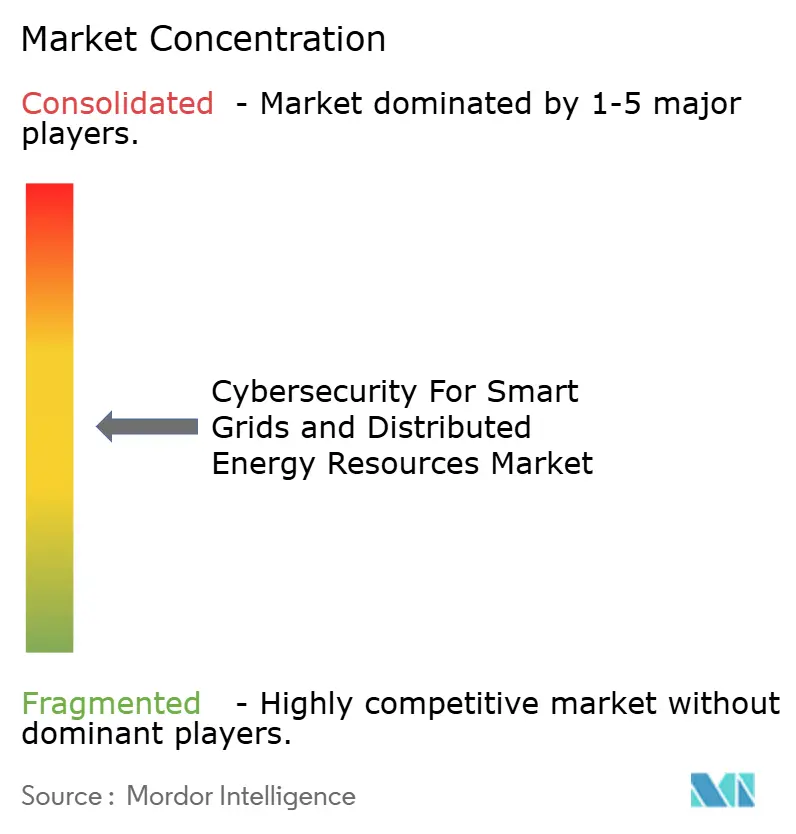
The cybersecurity for smart grids and distributed energy resources market shows moderate fragmentation, with no single vendor holding a decisive position across every security type and application area. Industrial automation companies such as Honeywell International, Siemens, Schneider Electric, ABB, and GE Vernova compete from the advantage of OT-native hardware integration and field familiarity. Cybersecurity specialists such as Fortinet, Palo Alto Networks, Cisco, Claroty, and Dragos compete on threat visibility, protocol awareness, platform integration, and cloud delivery. Buying patterns in the cybersecurity for smart grids and distributed energy resources market increasingly favor vendors that can connect device visibility, monitoring, access control, and compliance workflows inside one operating framework. That is why scale, service depth, and interoperability are becoming more important competitive markers than a single point product category.
Accenture's June 2026 moves to acquire a majority stake in Dragos and 100% of runZero and NetRise at a combined enterprise value of USD 4.175 billion is the clearest signal of consolidation in the cybersecurity for smart grids and distributed energy resources market. The transaction brought together OT threat intelligence, attack surface management, and firmware risk capability under a broader service-led platform model. Dragos also acquired Phosphorus in June 2026 to extend protection across connected devices in operational networks, which shows how endpoint control is becoming a strategic battleground. Honeywell expanded its OT Cybersecurity Suite in June 2026 with five new proactive capabilities, which shows how large incumbents are deepening platform breadth instead of relying only on installed hardware relationships. GE Vernova's February 2026 launch of GridOS for Distribution and GridBeats APS added zero-trust design and easier update management into grid orchestration and substation protection workflows.
Open space remains largest in device-scale DER protection, AMI head-end monitoring, and supply chain risk management for vendor-managed grid assets. These areas are attractive because demand is rising faster than incumbent coverage across all asset classes. Vendors that can show OT-native protocol intelligence and audit-ready evidence are in a stronger position when regulated utilities compare long-term platform choices. The cybersecurity for smart grids and distributed energy resources market therefore remains competitive, but the advantage is shifting toward providers that can combine field relevance, integration depth, and managed execution at scale.
Cybersecurity For Smart Grids and Distributed Energy Resources Industry Leaders
Honeywell International Inc.
Fortinet, Inc.
Palo Alto Networks, Inc.
Schneider Electric SE
Siemens AG
- *Disclaimer: Major Players sorted in no particular order
Cybersecurity For Smart Grids and Distributed Energy Resources Market Companies Covered in this Report
- Honeywell International Inc.
- Fortinet, Inc.
- Palo Alto Networks, Inc.
- Schneider Electric SE
- Siemens AG
- Cisco Systems, Inc.
- Claroty Ltd.
- Eaton Corporation plc
- ABB Ltd.
- General Electric Company
- Accenture plc
- IBM Corporation
- Leidos Holdings, Inc.
- Advanced Micro Devices, Inc.
- Rocket Software, Inc.
- ATandT Inc.
- BAE Systems plc
- Thales Group
- Toshiba Corporation
- Verizon Communications Inc.
- Dragos, Inc.

Recent Industry Developments in Cybersecurity For Smart Grids and Distributed Energy Resources Market
- June 2026: Dragos acquired Phosphorus, extending the Dragos Platform to protect connected devices across critical infrastructure and operational networks, and raising its estimated total addressable market to over USD 50 billion following the transaction. The deal builds on Dragos's October 2024 acquisition of Network Perception, which added OT network visibility, segmentation validation, and compliance capabilities to the platform.
- June 2026: Honeywell International announced the expansion of its OT Cybersecurity Suite with five new proactive protection capabilities, including advanced threat detection and compliance streamlining tools, designed to defend critical infrastructure operators in energy and manufacturing against accelerating sophisticated cyber threats.
- April 2026: The FBI, CISA, NSA, EPA, Department of Energy, and US Cyber Command issued joint advisory AA26-097A, confirming that Iranian-affiliated APT actors had been actively disrupting PLCs across the US energy sector since at least March 2026, with victims in the energy and government sectors experiencing operational disruption and financial loss from manipulated HMI and SCADA systems.
- February 2026: GE Vernova launched GridOS for Distribution, described as the industry's first unified grid orchestration software with zero-trust cybersecurity built in by design, and GridBeats APS, a substation protection and control platform that allows cybersecurity software updates without revalidating protection functions, addressing the configuration management challenge in live substation environments.


Global Cybersecurity For Smart Grids and Distributed Energy Resources Market Report Scope
Cybersecurity for smart grids and distributed energy resources involves protecting the digital systems, communication networks, and control technologies that operate modern electricity grids and decentralized energy assets, such as solar, wind, and battery storage. It ensures the integrity, availability, and confidentiality of grid operations by mitigating cyber threats that could disrupt power delivery, compromise data, or jeopardize critical infrastructure. This enables the secure, resilient, and reliable integration of renewable and distributed energy resources into smart grid ecosystems.
The Cybersecurity for Smart Grids and Distributed Energy Resources Market Report is segmented by Component (Solutions, and Services), Deployment mode (On-Premises, Cloud, and Hybrid), Security Type (Network Security, Endpoint and Device Security, Application Security, Data Security, and Identity and Access Security), Application (Grid Operations Security [Generation, Transmission, Distribution], Advanced Metering Infrastructure (AMI) Security, DER and Renewable Energy Security, Energy Management Systems (EMS) Security, SCADA and OT Systems Security, and EV Charging Infrastructure Security), End User Industry (Electric Utilities, Renewable Energy Operators, Industrial Grid Operators, Commercial and Industrial Energy Users, Residential Prosumer Networks, Government and Public Energy Infrastructure, and Other End User Industries), and Geography, (North America, South America, Europe, Asia-Pacific, Middle East, and Africa). The Market Forecasts are Provided in Terms of Value (USD).
| Solutions |
| Services |
| On-Premises |
| Cloud |
| Hybrid |
| Network Security |
| Endpoint and Device Security |
| Application Security |
| Data Security |
| Identity and Access Security |
| Grid Operations Security (Generation, Transmission, Distribution) |
| Advanced Metering Infrastructure (AMI) Security |
| DER and Renewable Energy Security |
| Energy Management Systems (EMS) Security |
| SCADA and OT Systems Security |
| EV Charging Infrastructure Security |
| Electric Utilities |
| Renewable Energy Operators |
| Industrial Grid Operators |
| Commercial and Industrial Energy Users |
| Residential Prosumer Networks |
| Government and Public Energy Infrastructure |
| Other End User Industries |
| North America | United States |
| Canada | |
| Mexico | |
| South America | Brazil |
| Argentina | |
| Rest of South America | |
| Europe | Germany |
| United Kingdom | |
| France | |
| Italy | |
| Spain | |
| Russia | |
| Rest of Europe | |
| Asia-Pacific | China |
| India | |
| Japan | |
| South Korea | |
| Australia | |
| Rest of Asia-Pacific | |
| Middle East | Saudi Arabia |
| United Arab Emirates | |
| Turkey | |
| Israel | |
| Rest of Middle East | |
| Africa | South Africa |
| Egypt | |
| Rest of Africa |
| By Component | Solutions | |
| Services | ||
| By Deployment Mode | On-Premises | |
| Cloud | ||
| Hybrid | ||
| By Security Type | Network Security | |
| Endpoint and Device Security | ||
| Application Security | ||
| Data Security | ||
| Identity and Access Security | ||
| By Application | Grid Operations Security (Generation, Transmission, Distribution) | |
| Advanced Metering Infrastructure (AMI) Security | ||
| DER and Renewable Energy Security | ||
| Energy Management Systems (EMS) Security | ||
| SCADA and OT Systems Security | ||
| EV Charging Infrastructure Security | ||
| By End User Industry | Electric Utilities | |
| Renewable Energy Operators | ||
| Industrial Grid Operators | ||
| Commercial and Industrial Energy Users | ||
| Residential Prosumer Networks | ||
| Government and Public Energy Infrastructure | ||
| Other End User Industries | ||
| By Geography | North America | United States |
| Canada | ||
| Mexico | ||
| South America | Brazil | |
| Argentina | ||
| Rest of South America | ||
| Europe | Germany | |
| United Kingdom | ||
| France | ||
| Italy | ||
| Spain | ||
| Russia | ||
| Rest of Europe | ||
| Asia-Pacific | China | |
| India | ||
| Japan | ||
| South Korea | ||
| Australia | ||
| Rest of Asia-Pacific | ||
| Middle East | Saudi Arabia | |
| United Arab Emirates | ||
| Turkey | ||
| Israel | ||
| Rest of Middle East | ||
| Africa | South Africa | |
| Egypt | ||
| Rest of Africa | ||


Key Questions Answered in the Report
What is the current and forecast value of the cybersecurity for smart grids and distributed energy resources market?
The cybersecurity for smart grids and distributed energy resources market was valued at USD 6.73 billion in 2025, is estimated at USD 7.96 billion in 2026, and is forecast to reach USD 18.41 billion by 2031 at a CAGR of 18.26%.
Which region is growing fastest in smart grid cybersecurity?
Asia-Pacific is the fastest-growing region, with a projected CAGR of 23.77% through 2031, supported by rapid grid modernization and large smart meter programs.
Which component leads revenue in this sector?
Solutions led revenue with 68.24% share in 2025, reflecting utility demand for integrated, certified platforms that support compliance and long asset lives.
Why are managed services gaining traction with utilities?
Services are projected to grow at a 22.39% CAGR because many utilities prefer outsourced monitoring and response as OT security talent shortages remain a practical constraint.
Which security type is expanding fastest?
Endpoint and device security is projected to grow at a 21.42% CAGR through 2031 as AMI, DER, and other connected field assets widen the device attack surface.
What application area is creating the strongest new opportunity?
AMI security is projected to grow at a 21.51% CAGR because smart metering networks face multiple attack paths and more utility control environments are becoming interconnected.
Page last updated on:





