
Vietnam E-bike Market Size and Share
Market Overview
| Study Period | 2020 - 2031 |
|---|---|
| Forecast Data Period | 2026 - 2031 |
| Base Year Market Size (2025) | USD 66.54 Million |
| Market Size (2026) | USD 70.77 Million |
| Market Size (2031) | USD 96.26 Million |
| Growth Rate (2026 - 2031) | 6.36 % |
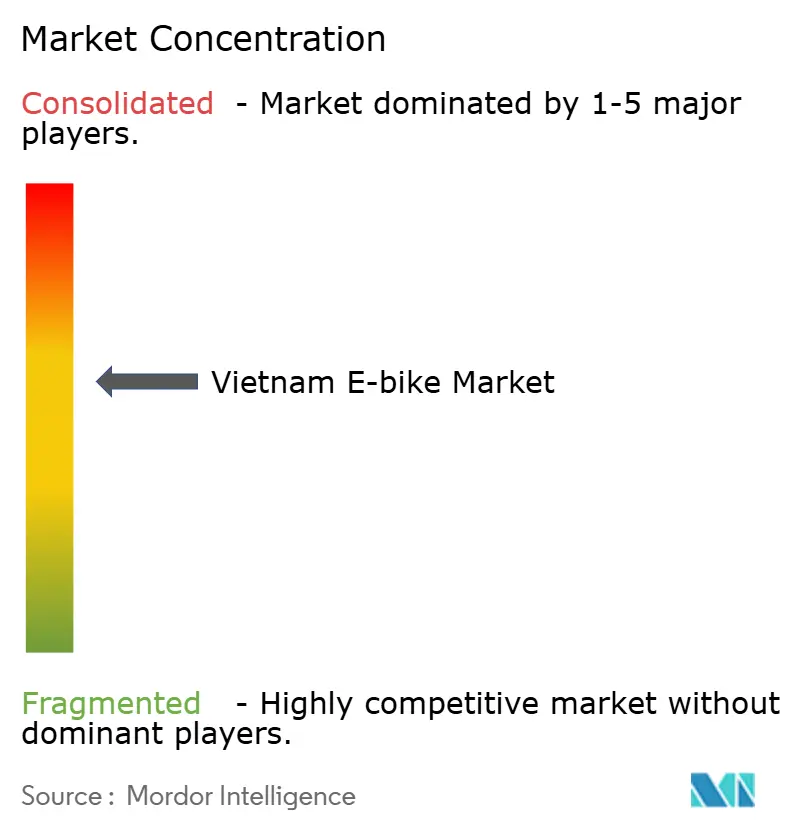
| Market Concentration | Medium |
Major Players
*Disclaimer: Major Players sorted in no particular order Image © Mordor Intelligence. Reuse requires attribution under CC BY 4.0. |
|
Vietnam E-bike Market Analysis by Mordor Intelligence
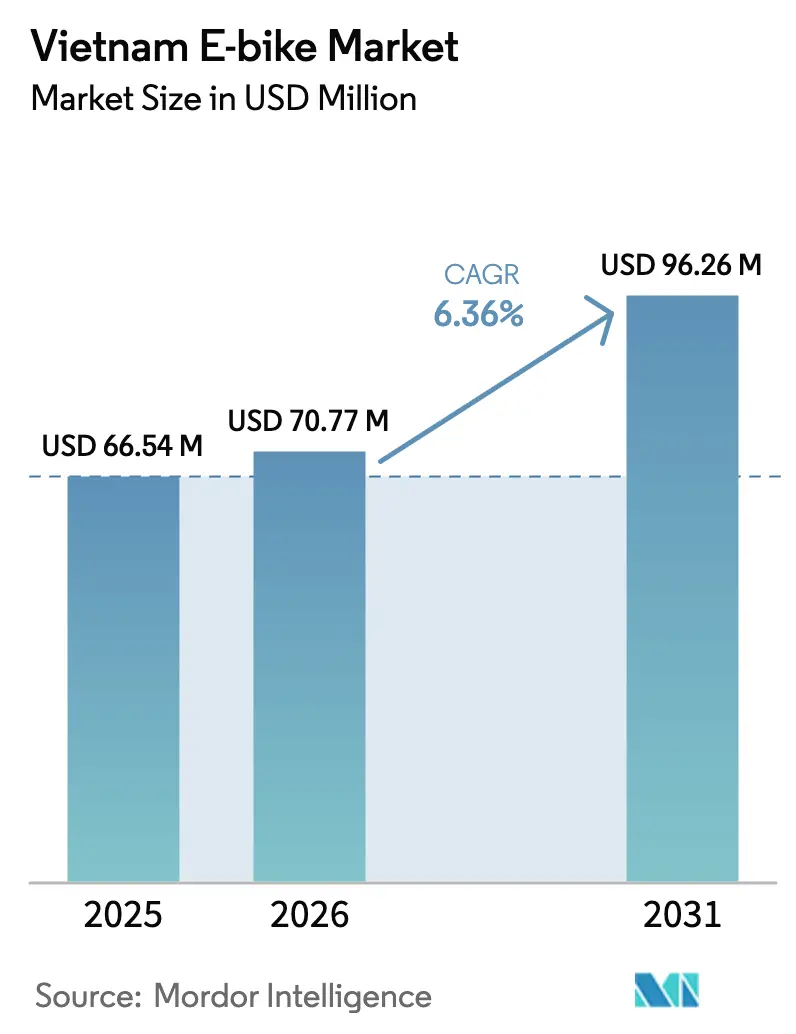
Vietnam e-bike market size in 2026 is estimated at USD 70.77 million, growing from 2025 value of USD 66.54 million with 2031 projections showing USD 96.26 million, growing at 6.36% CAGR over 2026-2031. Demand accelerates as 0% vehicle-registration fees stay in force until 2027, VAT on electric vehicles remains at 8% through 2026, and several municipalities press ahead with mandatory two-wheeler electrification programs. VinFast’s 34% share anchors the network effect created by 150,000 charging points covering all 63 provinces, widening access far beyond the tier-1 cities[1]"More charging stations needed for EVs", Vietnam News, vietnamnews.vn. Faster-charging lithium-ion batteries, supportive lending for technology drivers, and rising middle-income willingness to pay for premium models reinforce the growth trajectory. Meanwhile, international entrants such as Yadea and Dat Bike deepen local manufacturing, tempering price pressure while expanding product variety.
Key Report Takeaways
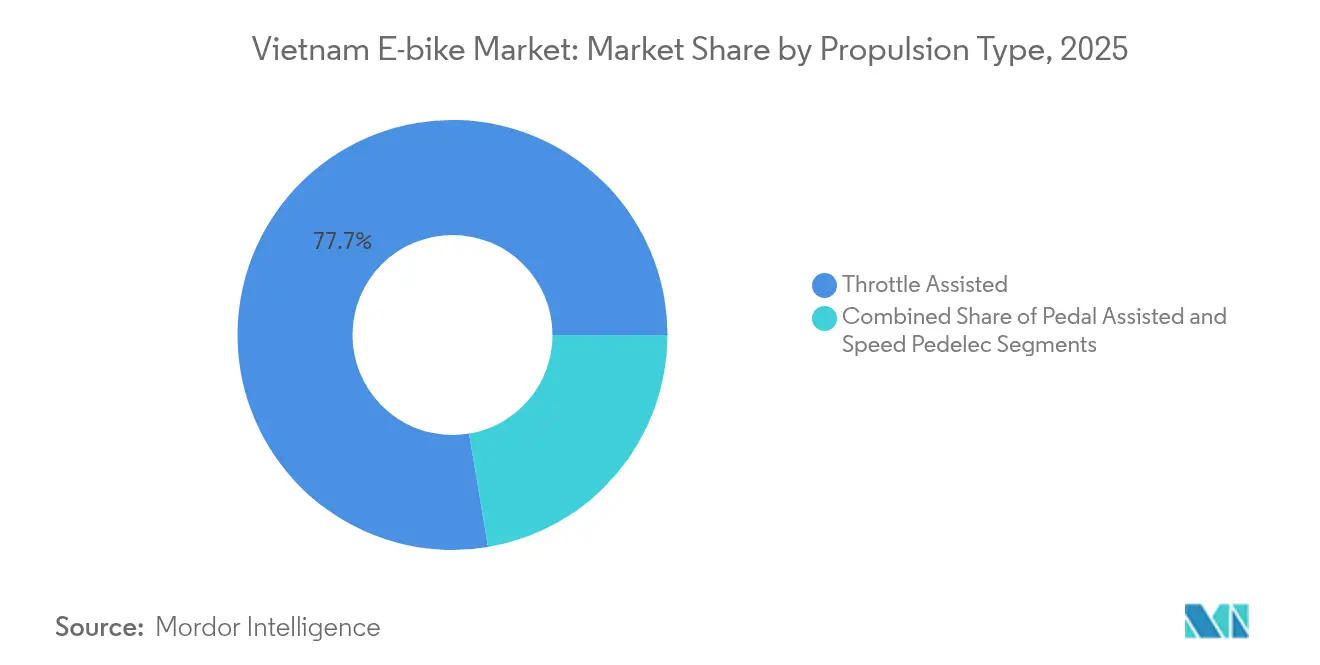
- By propulsion, throttle-assisted models commanded 77.65% of the Vietnam e-bike market share in 2025; Speed Pedelec is projected to post the fastest 8.95% CAGR to 2031.
- By application, city/urban riding held 73.88% revenue share in 2025, whereas the cargo/utility segment is set to grow at a 9.96% CAGR through 2031.
- By battery, lithium-ion technology captured 88.01% share of the Vietnam e-bike market size in 2025 and will expand at a 6.86% CAGR during 2026-2031.
- By sales channel, offline retail dominated with 81.15% share in 2025; online sales are forecast to rise at a 8.79% CAGR.
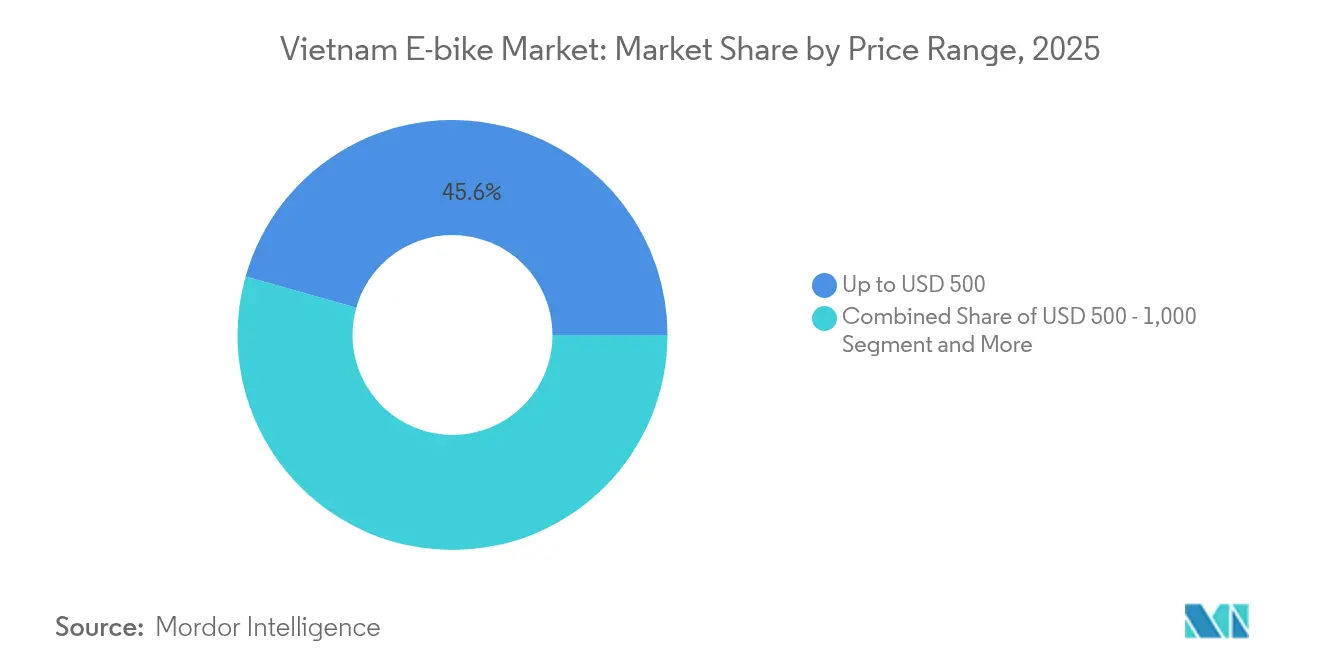
- By price range, sub-USD 500 models still hold 45.62% share, even though the USD 1,000 - 1,500 tier is the fastest growing, advancing at a 9.41% CAGR.
- By end use, personal and family use led with 62.62% of revenue in 2025, while commercial delivery will grow at an 7.86% CAGR through 2031.
Note: Market size and forecast figures in this report are generated using Mordor Intelligence’s proprietary estimation framework, updated with the latest available data and insights as of 2026.
Vietnam E-bike Market Trends and Insights
Drivers Impact Analysis*
| Driver | (~) % Impact on CAGR Forecast | Geographic Relevance | Impact Timeline |
|---|---|---|---|
| Government Incentives and 0% Registration Fees | +1.8% | Ho Chi Minh City, Hanoi, Da Nang, Hai Phong, Can Tho | Medium term (2-4 years) |
| Urban Air-Quality and Congestion Concerns | +1.5% | Ho Chi Minh City, Hanoi, Da Nang, Hai Phong | Long term (≥ 4 years) |
| Expanding Charging and Battery-Swap Networks | +1.2% | All 63 provinces, concentrated in urban centers | Medium term (2-4 years) |
| Logistics-On-E-Bike Boom | +0.9% | Ho Chi Minh City, Hanoi, Da Nang, major urban centers | Short term (≤ 2 years) |
| Licence-Exempt School-Commute Demand | +0.6% | Urban and suburban areas nationwide | Short term (≤ 2 years) |
| Local Battery Manufacturing Scale-Up | +0.4% | Ha Tinh, Bac Giang, industrial zones | Long term (≥ 4 years) |
| Source: Mordor Intelligence | |||
Government Incentives and 0% Registration Fees
The 0% registration-fee policy, extended to 2027, lowers upfront costs by 8-12% and compounds with the temporary VAT cut to 8%, immediately narrowing the price gap against gasoline motorcycles[2]“VinFast Announces 4Q24 Global Deliveries, January 2025 Domestic Deliveries,” VinFast Auto, vinfastauto.us. Ho Chi Minh City complements the national measure with loan subsidies for 400,000 technology drivers converting to electric platforms, while preferential parking and congestion-charge exemptions further lift total cost-of-ownership economics. Together, these fiscal incentives slice 40,000-60,000 VND from daily operating costs for delivery riders.
Urban Air-Quality and Congestion Concerns
Pollution “red alerts” in Ho Chi Minh City and Hanoi have hastened plans to make 25% of all registered two-wheelers electric by 2030. City councils are weighing partial motorbike bans in central districts and pilot congestion pricing that would exempt zero-emission models. As urban commuters experience poor air quality readings, public sentiment favours cleaner mobility, reinforcing policy momentum.
Expanding Charging and Battery-Swap Networks
VinFast’s 150,000 public charge points combined with a planned 30,000-50,000 petrol-station conversions in partnership with Vietnam Oil Corporation sharply reduce range anxiety. Two-minute battery swaps pioneered by Selex and piloted by leading ride-hailing fleets demonstrate uptime parity with petrol bikes, making electric delivery viable at scale.
Logistics-on-E-bike Boom
Xanh SM has achieved 32% penetration of ride-hailing trips on electric two-wheelers, showcasing superior net-promoter scores versus petrol rivals and sparking rapid copycat programs by Grab and Be. For last-mile couriers, per-route fuel savings of 40,000-60,000 VND support profit-driven migration even without subsidies[3]“Đổi 400.000 xe máy sang xe điện: TP.HCM đề xuất chính sách cho vay, miễn thuế,” Thanh Niên, thanhnien.vn.
Restraints Impact Analysis*
| Restraint | (~) % Impact on CAGR Forecast | Geographic Relevance | Impact Timeline |
|---|---|---|---|
| Low Consumer Awareness of Li-Ion Lifespan | -0.8% | Rural and suburban areas nationwide | Short term (≤ 2 years) |
| Lack of Unified Safety / Homologation Norms | -0.6% | Manufacturing and import centers | Medium term (2-4 years) |
| Petrol-Bike Resale Glut Suppresses Switch | -0.4% | Urban centers with high motorcycle density | Short term (≤ 2 years) |
| Apartment Grid Limits Slow Home-Charging | -0.3% | Urban high-density residential areas | Medium term (2-4 years) |
| Source: Mordor Intelligence | |||
Low Consumer Awareness of Li-ion Lifespan
Many shoppers still assume batteries require replacement within three years despite test data showing 90% capacity retention after 200,000 km, discouraging first-time buyers and particularly affecting rural households with limited exposure to e-bike education programs. Manufacturer-backed 10-year warranties and battery-as-a-service plans are gradually offsetting misconceptions but the knowledge gap remains a headwind.
Lack of Unified Safety / Homologation Norms
The Vietnam Register’s overhaul of inspection protocols from July 2025 refocuses compliance on battery integrity and software, but ambiguous transitional rules elevate certification costs for smaller importers. Apartment-block bans on in-unit charging after several high-profile fires deepen consumer caution, though they simultaneously encourage public charging and battery-swap adoption.
*Our forecasts treat driver/restraint impacts as directional, not additive. The impact forecasts reflect baseline growth, mix effects, and variable interactions.
Segment Analysis
By Propulsion Type: Speed Pedelec Gains Momentum
In 2025, throttle-assisted units dominated with a 77.65% slice of the Vietnam e-bike market share, echoing riders’ familiarity with motorcycle-style acceleration. Speed pedelec, however, is forecasted to pace the segment at 8.95% CAGR and could lift its contribution to the Vietnam e-bike market size meaningfully by 2031. Urban commuters appreciate pedal-assist exercise benefits and higher top speeds that shorten daily trips.
VinFast’s Evo series and Honda’s ICON e target this niche with sub-25 million VND price tags. Meanwhile, clear licensing categories effective January 2025 simplify road-use compliance, unlocking latent demand among young professionals. Speed Pedelecs also attract health-conscious riders keen to blend fitness with commuting, fueling aftermarket upgrades such as regenerative braking. International brands introduce 3 kW motors and fast-charge packs, signalling confidence in this higher-performance lane of the Vietnam e-bike market.



By Application Type: Commercial Delivery Transformation
City/Urban riding held a commanding 73.88% share in 2025, but the cargo/utility segment is projected to lead growth at a 9.96% CAGR through 2031. The forthcoming ban on 400,000 petrol bikes dedicated to app-based services in Ho Chi Minh City anchors structural demand. Platform operators are adopting battery-swap formats to reach petrol-bike parity in downtime, while fintech partners tailor micro-loans whose instalments are offset by fuel savings. As a result, Commercial Delivery’s share of the Vietnam e-bike market is poised to double within five years.
Beyond tech drivers, postal and pharmacy chains are piloting dedicated e-bike fleets to comply with ESG commitments. Visibility of branded delivery e-bikes also normalises the technology for households, indirectly widening retail demand.
By Battery Type: Lithium-ion Dominance Strengthens
Lithium-ion packs captured 88.01% of 2025 revenues and continue to grow at a 6.86% CAGR as local cell output rises. Scaling investment such as VinGroup’s Ha Tinh plant guarantees 1 million packs annually, pushing down cost per kWh and lifting the lithium-ion segment’s weight in Vietnam e-bike market size calculations.
Partnerships with solid-state innovators promise safer, denser chemistries by 2027, which could extend single-charge ranges toward 160 km. Lead-acid solutions now serve a shrinking, ultra-budget space and face headwinds from upcoming urban restrictions on hazardous waste disposal.
By Sales Channel: Online Acceleration Continues
Offline outlets still own 81.15% of 2025 transactions, reflecting the cultural premium placed on in-person inspection. Yet Online channels are forecast to advance at a 8.79% CAGR to 2031, buoyed by immersive virtual showrooms and doorstep test-ride services.
Younger buyers favour shop-from-home convenience, and integrated e-wallet financing shortens purchase cycles. Retailers respond through omnichannel models, unifying physical service points with digital engagement to protect share.
By Price Range: Premium Segment Emergence
Sub-USD 500 products represent 45.62% of the Vietnam e-bike market share, but the USD 1,000 - 1,500 band is the star, delivering a 9.41% CAGR due to broader middle-class incomes and incentive-driven affordability. Advanced connectivity, disc brakes, and longer-life packs make mid-range models compelling upgrades.
Competitive launches such as Yadea’s Velax at 29.9 million VND intensify rivalry just below premium thresholds, while bundled insurance and extended warranties reinforce value-for-money perceptions.
By End Use: Commercial Applications Accelerate
Personal and family use remains dominant at 62.62% of the Vietnam e-bike market 2025 turnover. Yet, Commercial Delivery is expanding faster at 7.86% CAGR by 2031, aided by cost savings of 40,000-60,000 VND per day for app-based couriers. Municipal fleet-conversion targets and bank-partnered subsidy schemes underpin a durable pipeline for enterprise orders.
Institutional uptake, from universities to municipal services, adds new pockets of demand and showcases total-lifecycle cost merits that resonate with individual consumers, reinforcing a virtuous adoption loop for the Vietnam e-bike market.
Geography Analysis
Ho Chi Minh City is the largest market, propelled by the 400,000-bike conversion program and dense charging coverage. Hanoi follows, leveraging metro-rail connectivity gaps that favour two-wheeler first- and last-mile links. Secondary cities such as Da Nang, Hai Phong, and Can Tho are emerging growth centres as charging networks mature and local taxi fleets test electric transition pilots.
Northern industrial provinces have become focal points for manufacturing capacity. Bac Giang hosts Yadea’s USD 100 million, 2 million-unit plant due online in late 2025, while Ha Tinh’s battery complex cements a vertically integrated supply chain that feeds the national market and potential ASEAN exports. Coastal logistics further enable component inflows and outbound shipments, reinforcing Vietnam’s aspirations as a regional production hub for e-two-wheelers.
Rural areas remain constrained by sparse public charging and lower disposable income; however, licence-exempt rules facilitating school commutes are spurring incremental demand. Government rural-mobility programs paired with falling lithium-ion prices are expected to unlock latent purchasing power, broadening geographic penetration of the Vietnam e-bike market over the forecast horizon.
Competitive Landscape
Vietnam’s e-bike market in 2025 is being shaped by a mix of global giants and local innovators. Giant Manufacturing, Yadea Technology, PEGA LTT, AIMA Inc., and Bianchi stand out as key players, each taking a different path in a market that is growing quickly, both as a domestic opportunity and as a manufacturing hub for global supply chains.
Giant is investing heavily in Vietnam with a new USD 120 million plant in Bình Dương, aimed at supplying not only local demand but also international markets. Known for premium quality, Giant is positioning itself as a leader in the high-end e-bike space. Yadea, already well-established with factories in Vietnam since 2019, is doubling down with expanded production and an eye on exports to Europe and Southeast Asia. Meanwhile, homegrown brand PEGA LTT continues to lead the affordable segment. Having pioneered e-bikes in Vietnam, PEGA offers solid, practical models that appeal to everyday commuters.
AIMA Inc., another major Chinese player, is entering Vietnam aggressively through local partnerships, focusing on stylish and connected models at competitive price points. Bianchi, though smaller in volume, brings strong appeal in the niche premium segment, selling imported Italian-designed e-bikes through select high-end retail channels. Technology remains a key battleground. Yadea and Giant are pushing ahead with long-range batteries and advanced connectivity.
Vietnam E-bike Industry Leaders
-
Giant Manufacturing Co., Ltd.
-
Yadea Technology Group Co.,Ltd.
-
PEGA LTT
-
AIMA Inc
-
Bianchi
- *Disclaimer: Major Players sorted in no particular order

Recent Industry Developments
- April 2024: Giant Group announces USD 120 million expansion in Bình Dương to establish a new bicycle factory in the VSIP III industrial park.
- January 2024: Yadea announced a USD 100 million investment to build a major new production and assembly facility in Bắc Giang Province, which will produce 2 million electric two‑wheelers per year and include an on-site R&D center.


Vietnam E-bike Market Report Scope
An electric bike, also known as an e-bike, is a bicycle that has an electric motor that helps the user to pedal. A bike-mounted rechargeable battery will supply the motor with power.
Vietnam's E-bike Market is segmented by propulsion type, application type, and battery type. By propulsion type, the market is segmented by Pedal Assisted and Throttle Assisted. By application type, the market is segmented by City/Urban, Trekking (E-mountain bikes/MTB), and Cargo. By battery type, the market is segmented into lithium-ion batteries and lead-acid batteries. For each segment, the market sizing and forecast have been done based on the value (USD).
| Pedal Assisted |
| Speed Pedelec |
| Throttle Assisted |
| Cargo / Utility |
| City / Urban |
| Trekking / Mountain |
| Lead-acid Battery |
| Lithium-ion Battery |
| Online |
| Offline |
| Up to USD 500 |
| USD 500 to USD 1,000 |
| USD 1,000 to USD 1,500 |
| Above USD 1,500 |
| Commercial Delivery | Retail and Goods Delivery |
| Food and Beverage Delivery | |
| Service Providers | |
| Personal and Family Use | |
| Institutional | |
| Others |
| By Propulsion Type | Pedal Assisted | |
| Speed Pedelec | ||
| Throttle Assisted | ||
| By Application Type | Cargo / Utility | |
| City / Urban | ||
| Trekking / Mountain | ||
| By Battery Type | Lead-acid Battery | |
| Lithium-ion Battery | ||
| By Sales Channel | Online | |
| Offline | ||
| By Price Range | Up to USD 500 | |
| USD 500 to USD 1,000 | ||
| USD 1,000 to USD 1,500 | ||
| Above USD 1,500 | ||
| By End Use | Commercial Delivery | Retail and Goods Delivery |
| Food and Beverage Delivery | ||
| Service Providers | ||
| Personal and Family Use | ||
| Institutional | ||
| Others | ||


Key Questions Answered in the Report
How big is the Vietnam e-bike market in 2026?
The Vietnam e-bike market is valued at USD 70.77 million in 2026 and is projected to grow at a 6.36% CAGR to reach USD 96.26 million in 2031.
Which propulsion type leads Vietnam’s e-bike sales?
Throttle Assisted models dominate, holding 77.65% of 2025 unit share, though Speed Pedelec is the fastest growing at a 8.95% CAGR.
Why are commercial delivery fleets shifting to e-bikes?
App-based couriers save 40,000-60,000 VND in daily operating costs, benefit from city incentives and can refuel in two minutes via battery-swap networks, making electric delivery financially attractive.
What role do government incentives play?
A 0% registration fee through 2027 and reduced 8% VAT slash upfront prices by up to 12%, significantly accelerating adoption in both personal and commercial segments.
Which battery technology is most common?
Lithium-ion packs control 88.01% of the market thanks to domestic production scale and improving cost-per-kWh economics, while lead-acid options retreat to ultra-budget niches.
Are online channels important for e-bike sales?
Yes. Although physical dealers still manage 81.15% of sales, online purchases are rising at a 8.79% CAGR as virtual showrooms and doorstep test rides gain popularity.
Page last updated on:





