
United States Property Management Services Market Size and Share
Market Overview
| Study Period | 2020 - 2031 |
|---|---|
| Forecast Data Period | 2026 - 2031 |
| Base Year Market Size (2025) | USD 84.73 Billion |
| Market Size (2026) | USD 88.07 Billion |
| Market Size (2031) | USD 106.83 Billion |
| Growth Rate (2026 - 2031) | 3.94 % |
| Market Concentration | Low |
Major Players *Disclaimer: Major Players sorted in no particular order Image © Mordor Intelligence. Reuse requires attribution under CC BY 4.0. | |
United States Property Management Services Market Analysis by Mordor Intelligence
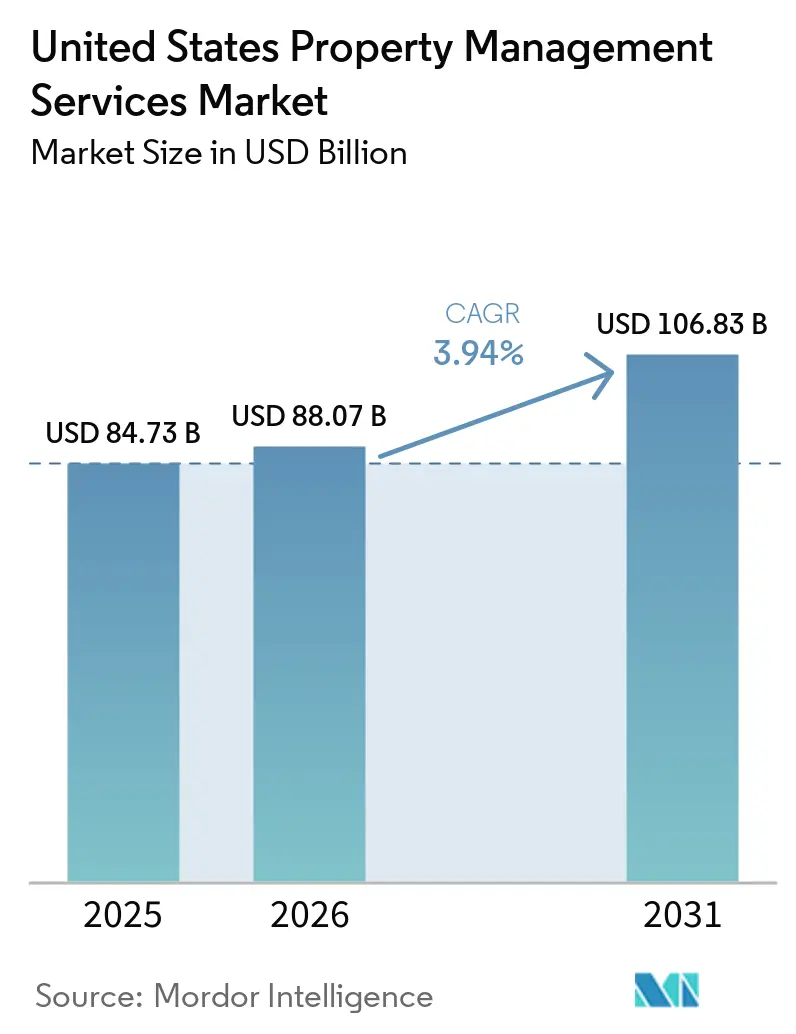
The United States Property Management Services Market size is expected to grow from USD 84.73 billion in 2025 to USD 88.07 billion in 2026 and is forecast to reach USD 106.83 billion by 2031 at 3.94% CAGR over 2026-2031.
Growth rests on resilient rental demand, institutional ownership of both single-family and multifamily assets, and renewed leasing activity in premium office buildings. Federal Reserve surveys show 27% of U.S. adults rent their homes, underpinning a large tenant base that requires professional oversight. Institutional investors use scale to drive professional management, while environmental, social, and governance (ESG) regulations accelerate demand for compliance-oriented services. Technology adoption, especially artificial-intelligence tools that automate leasing, maintenance, and resident engagement, further supports efficiency and tenant retention. Competitive intensity is rising as national firms buy tech-enabled specialists to widen service breadth and geographic reach[1].
Key Report Takeaways
- By property type, residential assets held 49.87% of the US property management services market share in 2024. Commercial properties are projected to log the fastest 4.89% CAGR through 2030.
- By service type, tenant and resident services captured 34.54% revenue share in 2024. Other services, led by compliance and legal work, are forecast to grow at 4.68% CAGR to 2030.
- By geography, the Southeast commanded 20.32% of 2024 revenue, while the West is set to expand at a 5.02% CAGR.
United States Property Management Services Market Trends and Insights
Drivers Impact Analysis*
| Drivers | (~) % Impact on CAGR Forecast | Geographic Relevance | Impact Timeline |
|---|---|---|---|
| Expansion of single-family rental portfolios | +1.2% | Sunbelt states, Western U.S., Southeast | Long term (≥4 years) |
| Rising demand from Class-A commercial real estate | +0.8% | California, New York, Texas major metros | Medium term (2-4 years) |
| Aging U.S. housing stock needs maintenance | +0.7% | Northeast, Midwest legacy markets | Long term (≥4 years) |
| Growing institutional outsourcing by pension/SWF investors | +0.6% | National, major metropolitan areas | Long term (≥4 years) |
| Adoption of AI-enabled leasing & service tech | +0.4% | Tech-forward markets, urban centers | Short term (≤2 years) |
| ESG & green-lease compliance pressure | +0.3% | California, New York, and federal properties | Medium term (2-4 years) |
| Source: Mordor Intelligence | |||
Expansion of Single-Family Rental (SFR) Portfolios
Institutional investment in single-family housing has evolved from bulk purchases of foreclosed properties in the early 2010s to structured build-for-rent programs by 2024. The GAO estimated institutional holdings at 170,000–300,000 homes by 2015, with portfolios expanding further as funds increased acquisitions. American Homes 4 Rent, for instance, managed 61,336 homes and recorded USD 1.729 billion in rental revenue in 2024. These large portfolios require consistent leasing, maintenance, and regulatory compliance across properties, strengthening demand for professional management. This trend supports recurring service revenue and greater pricing power for residential property managers and integrated REIT platforms in the US property management services market[2].
Rising Demand from Class-A Commercial Real Estate
Premium office properties are attracting renewed tenant interest as employers prioritize amenity-rich workplaces that support hybrid working. CBRE reported 18% growth in leasing revenue in 2024, including a 28% increase in New York office leasing. To strengthen their competitive appeal, owners of trophy buildings are investing in concierge services, smart-building systems, and tailored tenant experiences. These offerings require specialized management and larger operating budgets, enabling professional property managers to earn higher fees. Building performance assessments and amenity improvements also generate opportunities for energy management and workplace consulting services. Together, these factors support recurring revenue growth for firms managing Class-A assets in the US property management services market.
Aging U.S. Housing Stock Drives Demand for Professional Maintenance
The median age of occupied homes exceeded 41 years in 2024, according to Census Bureau data, increasing the need for regular repairs and planned upkeep. Older properties require consistent maintenance to preserve habitability and meet building codes, while regional shortages of skilled tradespeople make reliable vendor coordination increasingly valuable. Professional property managers address these needs through preventive maintenance programs, bundled repair services, capital expenditure planning, and bulk purchasing arrangements. Demand is particularly pronounced in Northeast and Midwest cities with substantial concentrations of homes built in the mid-20th century. These ongoing maintenance requirements support recurring management fees in the US property management services market.
Growing Property Management Outsourcing by Pension and Sovereign Wealth Funds
Public pension systems and sovereign wealth funds have increased their exposure to U.S. real estate, with allocations exceeding 10% of portfolios in some cases since 2023. Managing properties across multiple cities requires operational resources and local expertise, prompting investors to engage professional property managers. Outsourcing provides consistent reporting, regulatory compliance support, and technology platforms that strengthen portfolio oversight and risk management. Multiyear contracts, often spanning five years, support stable, recurring fee income. Continued institutional investment is expected to expand outsourced management mandates, contributing to growth in the US property management services market.
Restraints Impact Analysis*
| Restraints | (~) % Impact on CAGR Forecast | Geographic Relevance | Impact Timeline |
|---|---|---|---|
| Interest-rate–driven transaction slowdown | -0.9% | National, concentrated in high-value markets | Short term (≤ 2 years) |
| State & city rent-control legislation | -0.5% | California, New York, select urban markets | Medium term (2-4 years) |
| Skilled trade-labor shortages raising OPEX | -0.4% | National, acute in Texas, Florida, California | Medium term (2-4 years) |
| Owners' shift to DIY prop-tech platforms | -0.3% | Suburban markets, smaller property portfolios | Short term (≤ 2 years) |
| Source: Mordor Intelligence | |||
Interest-Rate-Driven Transaction Slowdown
Higher borrowing costs have made acquisitions and development projects harder to finance, slowing the flow of new business to property managers. With fewer assets changing ownership and fewer buildings entering operation, firms have reduced opportunities to secure management appointments and earn onboarding or construction oversight fees. Smaller providers that depend on transaction-related assignments are particularly exposed to this slowdown. Existing contracts continue to generate recurring income, although weaker deal activity constrains additional revenue opportunities and moderates growth in the US property management services market.
State & City Rent-Control Legislation
State and municipal rent-control measures restrict rental increases and introduce additional requirements for tenancy management and eviction procedures. AvalonBay has identified these regulations as a material business risk, reflecting their potential to constrain rental income and reduce pricing flexibility. For property managers, navigating local rules requires dedicated compliance expertise, accurate documentation, and ongoing investment in reporting systems. Firms charging fees as a percentage of collected rent face limited revenue growth alongside higher administrative expenses, particularly where regulated properties account for a large share of their portfolios. Although strong compliance capabilities can help attract owners, these cost and revenue pressures weigh on profitability in the US property management services market.
*Our forecasts treat driver/restraint impacts as directional, not additive. The impact forecasts reflect baseline growth, mix effects, and variable interactions.
Segment Analysis
By Property Type: Residential Dominance Drives Institutional Scale
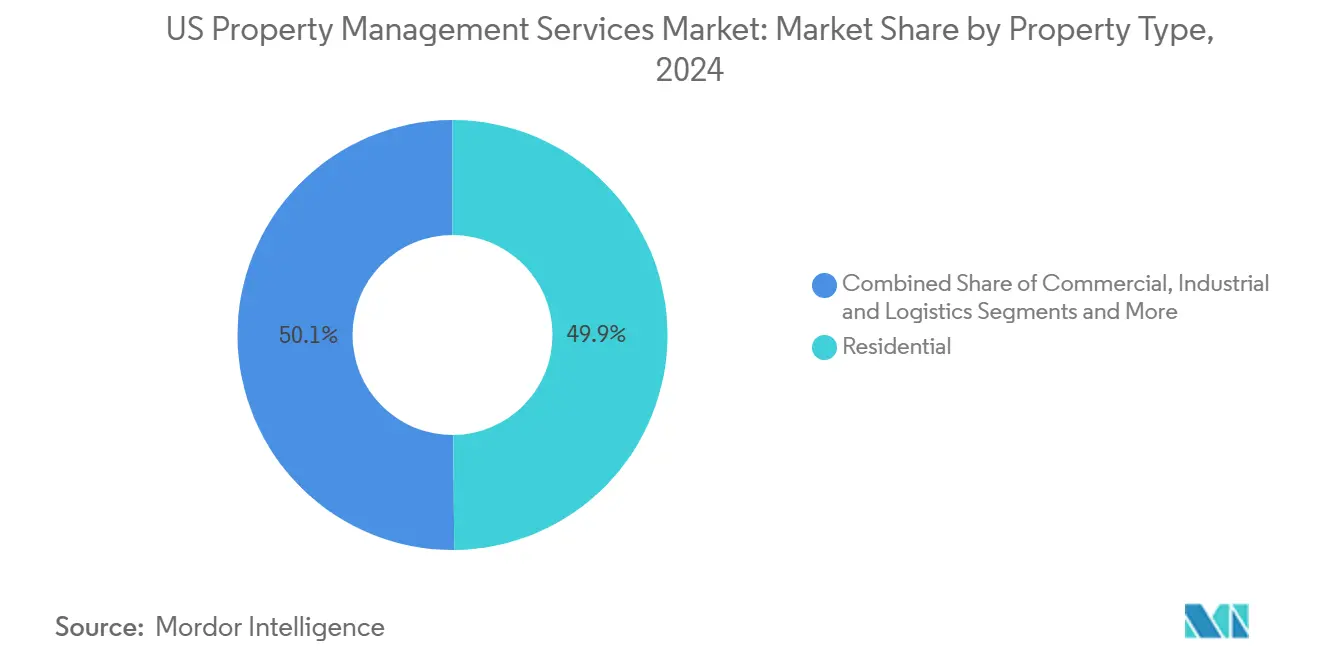
Residential properties accounted for 49.9% of 2024 revenue, making them the largest slice of the US property management services market share. Institutional single-family rentals and multifamily portfolios deliver predictable, recurring fees based on rent rolls, while amenity-rich communities drive ancillary income from parking, storage, and smart-home subscriptions. Commercial properties are projected to register a 4.89% CAGR and will narrow the gap as leasing rebounds in Class-A offices and experiential retail.
The residential segment gains from large property portfolios held by REITs such as Invitation Homes, which invested USD 425.2 million in property upgrades in 2024. Portfolio scale enables better vendor pricing, wider technology adoption, and faster service responses, making professional management a core requirement for institutional owners. In the commercial segment, growth is supported by corporate demand for higher-quality space and the integration of flexible workspaces into conventional buildings. Industrial and logistics properties offer additional opportunities as e-commerce companies prioritize locations closer to consumers and require specialized maintenance and security procedures. Collectively, these factors support balanced growth across the US property management services market.

By Service Type: Compliance Services Accelerate Growth
Tenant and resident services generated 34.5% of segment revenue in 2024 and remain the core of the US property management services market. Activities include marketing, leasing, rent collection, and resident engagement. Other services, consisting of legal, compliance, and renewal work, are set to grow the fastest at 4.68% CAGR.
Regulatory expansion drives this outperformance. The EPA’s building-performance standards now require benchmarking, public disclosure, and retrofit planning across more than 40 jurisdictions. Managers with in-house compliance teams and digital dashboards capture the rising demand for specialized reporting. Maintenance and facility services are also leveraging Internet-of-Things sensors for predictive analytics, creating cross-selling opportunities. As complexity rises, full-service providers gain fee share at the expense of niche operators in the US property management services market[3].
Geography Analysis
The Southeast accounted for 20.3% of 2024 industry revenue, buoyed by sustained in-migration, corporate relocations, and a comparatively light regulatory touch that appeals to institutional capital. Florida, Georgia, North Carolina, and South Carolina sit at the center of this trend, offering large pipelines of single-family rental homes and garden-style multifamily projects that require professional oversight. Investors appreciate the region’s lower operating costs and expanding tenant base, which together create predictable fee income for managers operating in the US property management services market.
The West is projected to deliver the fastest 5.02% CAGR through 2030, powered by technology-sector expansion and premium property values in California, Washington, and Nevada. Owners face complex building-performance rules and ESG disclosure mandates, prompting demand for managers with deep compliance and PropTech capabilities. High asset values also translate into elevated management fees, reinforcing the West as an attractive growth frontier despite its regulatory hurdles.
The Northeast, Midwest, and Southwest collectively provide a balanced foundation of mature markets. In the Northeast, high property values and complex rent-control requirements favor larger operators with strong legal expertise. Midwest cities offer demand for affordable maintenance and capital-improvement planning, driven by aging housing stock. Meanwhile, the Southwest, particularly Texas and Arizona, continues to draw new residents and institutional investment, supporting regional management platforms across residential, commercial, and industrial properties. These regional dynamics underpin nationwide growth in the US property management services market, with each region requiring a distinct growth strategy.
Competitive Landscape
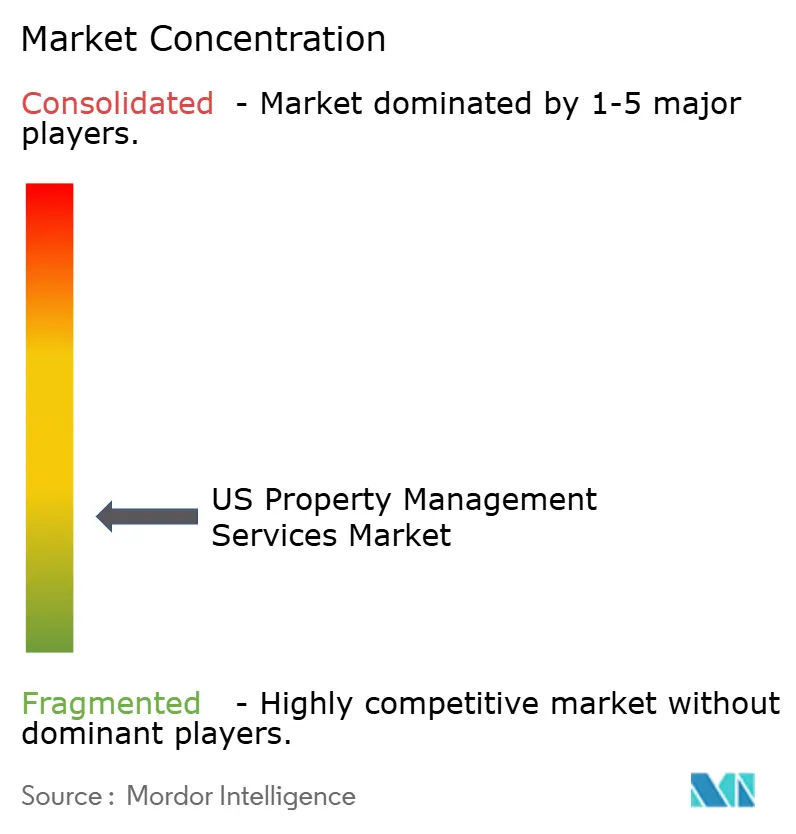
National managers, regional specialists, and tech-oriented newcomers contend for a share in a fragmented but consolidating arena. CBRE’s USD 400 million purchase of Industrious in January 2025 created a Building Operations & Experience segment comprising 7 billion-plus square feet under oversight, illustrating how scale plus flexible-workspace capabilities differentiate full-service platforms.
Strategic acquisitions remain a favorite playbook. Firms seek data-rich portfolios, ESG advisory practices, and AI application suites that accelerate tenant service and reduce operating costs. Integration of these capabilities often unlocks new fee pools, such as compliance consulting and smart-building retrofits, thereby raising switching barriers for owners.
Technology disruptors focus on cloud-based leasing, maintenance marketplaces, and predictive analytics that promise lower costs and enhanced tenant satisfaction. While many start-ups cater to small landlords, larger incumbents have begun white-labeling similar tools, blurring competitive lines. Specialized managers of healthcare and logistics facilities, such as Medical Properties Trust with 439 U.S. hospitals, carve niches where domain expertise outweighs pure scale. These varied strategies collectively propel continuous innovation across the US property management services market.
United States Property Management Services Industry Leaders
-
Greystar Real Estate Partners
-
CBRE Group, Inc.
-
Lincoln Property Company
-
Jones Lang LaSalle (JLL)
-
Cushman & Wakefield plc
- *Disclaimer: Major Players sorted in no particular order
Recent Industry Developments
- February 2025: American Homes 4 Rent reported USD 1.729 billion in 2024 rental revenue while managing 61,336 single-family homes across 24 states.
- February 2025: AvalonBay Communities raised its full-year core FFO growth outlook to 3.7% and increased projected development starts to USD 1.05 billion.
- January 2025: CBRE Group completed the acquisition of the remaining equity in Industrious National Management Company for approximately USD 400 million, folding the business into its new Building Operations & Experience segment.
- December 2024: UDR posted rental income of USD 1.664 billion and maintained 60,000 apartments across 21 U.S. markets.
United States Property Management Services Market Report Scope
A property management company deals directly with the tenants or prospects, saving the property owner's time, as they do not have to worry about marketing the rentals, negotiating with the tenants, handling maintenance and repair issues, collecting rent, responding to tenant complaints, and even pursuing evictions. A property management company brings experience in terms of handling property and provides the owner with optimal solutions.
The US property management market is segmented by end user (commercial and residential) and service (marketing, property evaluation, tenant services, maintenance, and other services). The report offers market size and forecasts for the US market in value (USD) for all the above segments.
| Commercial |
| Residential |
| Industrial & Logistics |
| Institutional & Mixed-Use |
| Marketing & Leasing |
| Property Evaluation & Due Diligence |
| Tenant & Resident Services (Renting, Leasing, etc.) |
| Maintenance, Repair & Facility Management |
| Lease Administration & Compliance |
| Other Services (Compliance, Legal Services, Renewals, etc.) |
| Northeast |
| Midwest |
| Southeast |
| West |
| Southwest |
| By Property Type | Commercial |
| Residential | |
| Industrial & Logistics | |
| Institutional & Mixed-Use | |
| By Service Type | Marketing & Leasing |
| Property Evaluation & Due Diligence | |
| Tenant & Resident Services (Renting, Leasing, etc.) | |
| Maintenance, Repair & Facility Management | |
| Lease Administration & Compliance | |
| Other Services (Compliance, Legal Services, Renewals, etc.) | |
| By Geography | Northeast |
| Midwest | |
| Southeast | |
| West | |
| Southwest |
Key Questions Answered in the Report
What was the US property management services market size in 2025?
It reached USD 84.73 billion in 2025, with a 3.94% CAGR forecast through 2030.
Which property type led revenue in 2024?
Residential assets held the top position with 49.87% market share.
Which service category is expanding the quickest?
Compliance, legal, and renewal services are projected to grow at 4.68% CAGR to 2030.
Why is California so important to property managers?
High property values, strict ESG mandates, and extensive tenant-protection laws support premium fee opportunities.
How are interest rates affecting the sector?
Higher borrowing costs have delayed property sales, reducing onboarding and development-management fees in the short term.
What role does technology play in market growth?
AI-enabled leasing, predictive maintenance, and smart-home integrations enhance efficiency and tenant experience, supporting margin expansion.