
US Property Management Market Size and Share
Market Overview
| Study Period | 2020 - 2031 |
|---|---|
| Forecast Data Period | 2026 - 2031 |
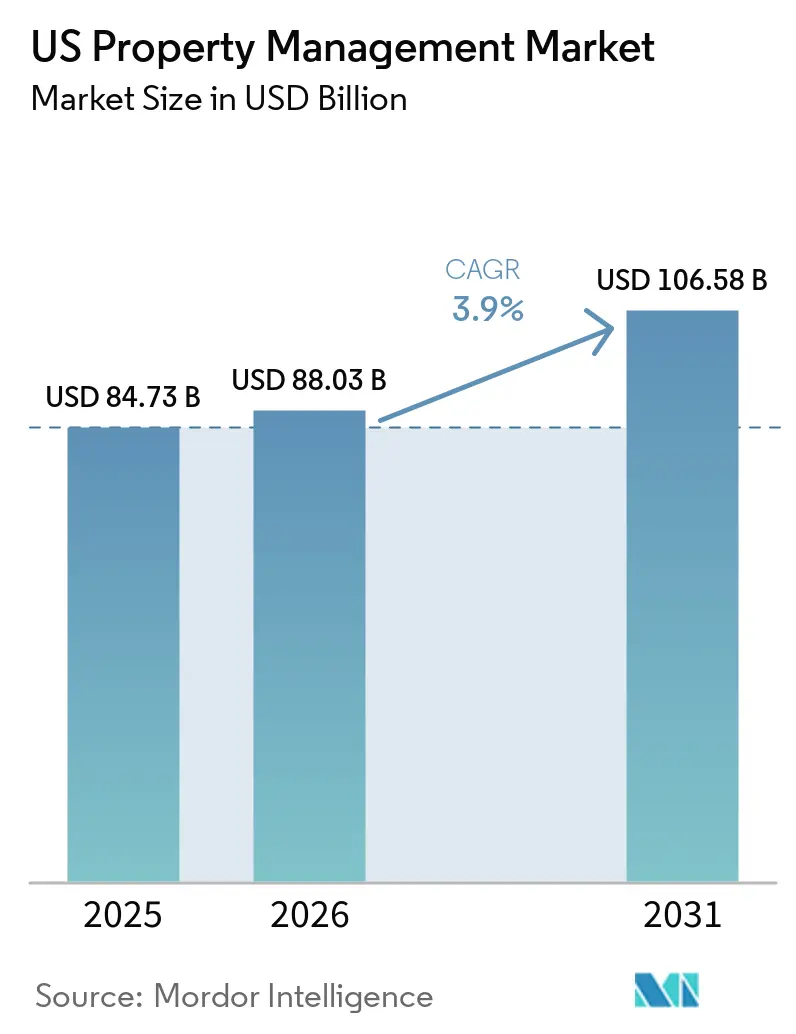
| Base Year Market Size (2025) | USD 84.73 Billion |
| Market Size (2026) | USD 88.03 Billion |
| Market Size (2031) | USD 106.58 Billion |
| Growth Rate (2026 - 2031) | 3.90 % |
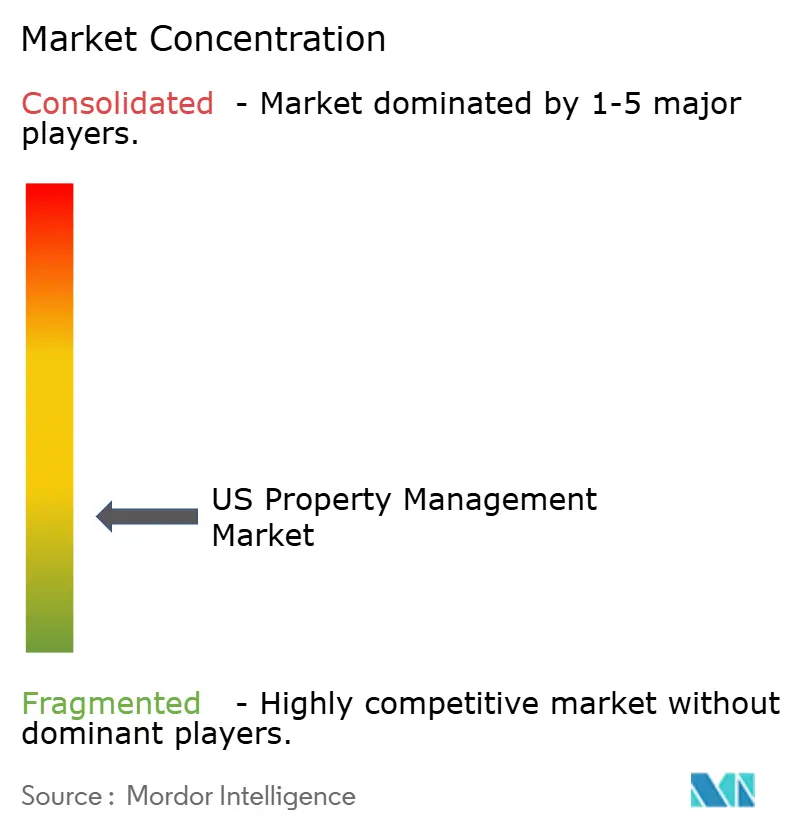
| Market Concentration | Low |
Major Players *Disclaimer: Major Players sorted in no particular order Image © Mordor Intelligence. Reuse requires attribution under CC BY 4.0. | |
US Property Management Market Analysis by Mordor Intelligence
The US Property Management Services Market size was valued at USD 84.73 billion in 2025 and estimated to grow from USD 88.03 billion in 2026 to reach USD 106.58 billion by 2031, at a CAGR of 3.9% during the forecast period (2026-2031). Growth rests on resilient rental demand, institutional ownership of both single-family and multifamily assets, and renewed leasing activity in premium office buildings. Federal Reserve surveys show 27% of U.S. adults rent their homes, underpinning a large tenant base that requires professional oversight. Institutional investors use scale to drive professional management, while environmental, social, and governance (ESG) regulations accelerate demand for compliance-oriented services. Technology adoption, especially artificial-intelligence tools that automate leasing, maintenance, and resident engagement, further supports efficiency and tenant retention. Competitive intensity is rising as national firms buy tech-enabled specialists to widen service breadth and geographic reach[1]Board of Governors, “Report on the Economic Well-Being of U.S. Households,” federalreserve.gov.
Key Report Takeaways
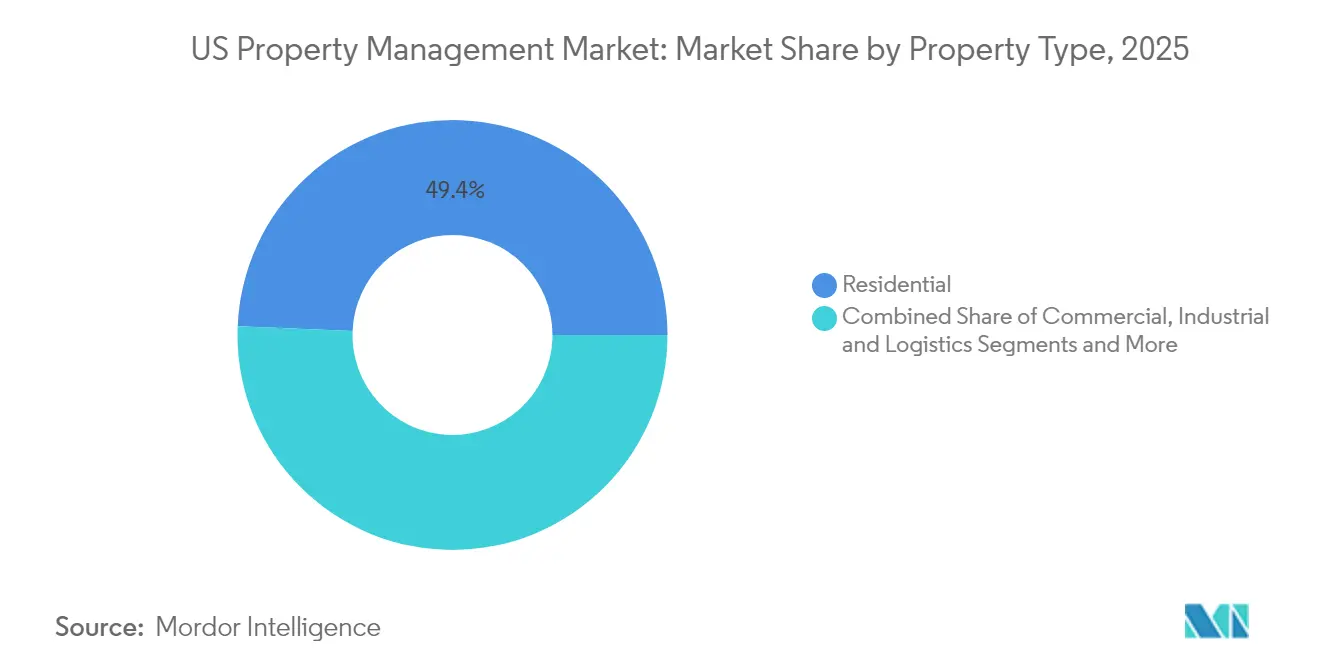
- By property type, residential assets held 49.35% of the US property management services market share in 2025. Commercial properties are projected to log the fastest 4.82% CAGR through 2031.
- By service type, tenant and resident services captured 34.12% revenue share in 2025. Other services, led by compliance and legal work, are forecast to grow at 4.6% CAGR to 2031.
- By geography, the Southeast commanded 20.10% of 2025 revenue, while the West is set to expand at a 4.93% CAGR.
Note: Market size and forecast figures in this report are generated using Mordor Intelligence’s proprietary estimation framework, updated with the latest available data and insights as of 2026.
US Property Management Market Trends and Insights
Drivers Impact Analysis*
| Driver | (~) % Impact on CAGR Forecast | Geographic Relevance | Impact Timeline |
|---|---|---|---|
| Expansion of single-family rental portfolios | +1.2% | Sunbelt states, Western U.S., Southeast | Long term (≥4 years) |
| Rising demand from Class-A commercial real estate | +0.8% | California, New York, Texas major metros | Medium term (2-4 years) |
| Aging U.S. housing stock needs maintenance | +0.7% | Northeast, Midwest legacy markets | Long term (≥4 years) |
| Growing institutional outsourcing by pension/SWF investors | +0.6% | National, major metropolitan areas | Long term (≥4 years) |
| Adoption of AI-enabled leasing & service tech | +0.4% | Tech-forward markets, urban centers | Short term (≤2 years) |
| ESG & green-lease compliance pressure | +0.3% | California, New York, and federal properties | Medium term (2-4 years) |
| Source: Mordor Intelligence | |||


Expansion of Single-Family Rental (SFR) Portfolios
Institutional ownership of single-family homes grew from bulk foreclosure purchases in the early 2010s to sophisticated build-for-rent programs by 2024. The GAO traced holdings of 170,000-300,000 homes by 2015, with larger footprints today as funds accelerate acquisitions. American Homes 4 Rent, for example, managed 61,336 homes and generated USD 1.729 billion rental revenue in 2024. Scale drives demand for standardized leasing, maintenance, and compliance processes that individual landlords rarely provide. Consequently, residential specialists and integrated REIT platforms gain pricing power and recurring revenue inside the US property management services market[2]U.S. Government Accountability Office, “Rental Housing: Institutional Investors in the Single-Family Market,” gao.gov.
Rising Demand from Class-A Commercial Real Estate
Premium office assets are regaining tenant attention as employers seek high-amenity space to support hybrid work models. CBRE recorded 18% leasing revenue growth in 2024, including a 28% jump in office leasing in New York. Owners of trophy buildings deploy concierge teams, smart-building platforms, and curated tenant experiences to differentiate supply. These value-added services typically require large management budgets, allowing professional firms to command higher fees. Performance benchmarking and amenity upgrades also create cross-selling potential for energy management and workplace consulting. The result is durable revenue growth for managers focused on Class-A portfolios within the US property management services market.
Aging U.S. Housing Stock Needs Professional Maintenance
The median age of occupied homes exceeded 41 years in 2024, according to Census Bureau data. Older properties demand systematic upkeep to remain habitable and code-compliant. Regional shortages of skilled trades heighten the need for coordinated vendor networks and preventive maintenance programs. Professional managers provide bundled repair services, capital-planning tools, and purchasing leverage that individual owners cannot replicate. This maintenance imperative is particularly acute in Northeast and Midwest cities where housing stock dates to the mid-20th century, reinforcing steady fee growth in the US property management services market.
Growing Institutional Outsourcing by Pension/SWF Investors
Public pension systems and sovereign wealth funds have expanded U.S. real estate allocations above 10% of their portfolios since 2023. Many lack in-house resources to run day-to-day property operations across multiple cities. Outsourcing offers standardized reporting, local compliance knowledge, and technology platforms that improve risk control. Management contracts typically span five years, creating sticky fee income. As allocation momentum continues, outsourced mandates are expected to add several basis points to overall growth in the US property management services market.
Restraints Impact Analysis*
| Restraint | (~) % Impact on CAGR Forecast | Geographic Relevance | Impact Timeline |
|---|---|---|---|
| Interest-rate–driven transaction slowdown | -0.9% | National, concentrated in high-value markets | Short term (≤ 2 years) |
| State & city rent-control legislation | -0.5% | California, New York, select urban markets | Medium term (2-4 years) |
| Skilled trade-labor shortages raising OPEX | -0.4% | National, acute in Texas, Florida, California | Medium term (2-4 years) |
| Owners' shift to DIY prop-tech platforms | -0.3% | Suburban markets, smaller property portfolios | Short term (≤ 2 years) |
| Source: Mordor Intelligence | |||
Interest-Rate-Driven Transaction Slowdown
Elevated borrowing costs since late 2023 have caused a pause in property sales and ground-up development. CBRE noted that investment volume fell sharply even as existing portfolios remained relatively stable. Less trading means fewer property takeovers and new-build assignments for managers who earn onboarding and construction-management fees. Smaller firms that rely on deal flow face near-term revenue stress. Nonetheless, recurring management contracts cushion the impact, allowing the broader US property management services market to continue expanding, albeit at a slower clip until rates normalize.
State & City Rent-Control Legislation
Revisions to rent-stabilization laws in California, New York City, and other metros cap annual rent hikes and lengthen eviction timelines. AvalonBay highlighted these rules as a material business risk that constrains rental revenue and complicates pricing algorithms. Management firms must invest in compliance staff and reporting systems, adding overhead. Fee structures tied to gross rent may compress, especially for operators with heavy exposure to regulated units. Over time, sophisticated compliance capability becomes a competitive differentiator, yet near-term margin pressure weighs on segment growth inside the US property management services market.
*Our forecasts treat driver/restraint impacts as directional, not additive. The impact forecasts reflect baseline growth, mix effects, and variable interactions.
Segment Analysis
By Property Type: Residential Dominance Drives Institutional Scale
Residential properties accounted for 49.35% of 2025 revenue, making them the largest slice of the US property management services market share. Institutional single-family rentals and multifamily portfolios deliver predictable, recurring fees based on rent rolls, while amenity-rich communities drive ancillary income from parking, storage, and smart-home subscriptions. Commercial properties are projected to register a 4.82% CAGR and will narrow the gap as leasing rebounds in Class-A offices and experiential retail.
The residential segment benefits from concentrated holdings by REITs such as Invitation Homes, which invested USD 425.2 million in property upgrades in 2024. Scale improves vendor pricing, technology adoption, and response times, reinforcing professional management as table stakes for institutional owners. Commercial growth is fueled by corporate flight to quality and new flexible-workspace models integrated into traditional buildings. Industrial and logistics assets add further upside as e-commerce firms seek proximity to consumers and rely on specialized maintenance and security protocols. Together, these dynamics sustain balanced momentum in the US property management services market.


By Service Type: Compliance Services Accelerate Growth
Tenant and resident services generated 34.12% of segment revenue in 2025 and remain the core of the US property management services market. Activities include marketing, leasing, rent collection, and resident engagement. Other services, consisting of legal, compliance, and renewal work, are set to grow the fastest at 4.6% CAGR.
Regulatory expansion drives this outperformance. The EPA’s building-performance standards now require benchmarking, public disclosure, and retrofit planning across more than 40 jurisdictions. Managers with in-house compliance teams and digital dashboards capture the rising demand for specialized reporting. Maintenance and facility services are also leveraging Internet-of-Things sensors for predictive analytics, creating cross-selling opportunities. As complexity rises, full-service providers gain fee share at the expense of niche operators in the US property management services market.
Geography Analysis
The Southeast accounted for 20.10% of 2025 industry revenue, buoyed by sustained in-migration, corporate relocations, and a comparatively light regulatory touch that appeals to institutional capital. Florida, Georgia, North Carolina, and South Carolina sit at the center of this trend, offering large pipelines of single-family rental homes and garden-style multifamily projects that require professional oversight. Investors appreciate the region’s lower operating costs and expanding tenant base, which together create predictable fee income for managers operating in the US property management services market.
The West is projected to deliver the fastest 4.93% CAGR through 2031, powered by technology-sector expansion and premium property values in California, Washington, and Nevada. Owners face complex building-performance rules and ESG disclosure mandates, prompting demand for managers with deep compliance and PropTech capabilities. High asset values also translate into elevated management fees, reinforcing the West as an attractive growth frontier despite its regulatory hurdles.
The Northeast, Midwest, and Southwest form a balanced core of mature markets. High property values and intricate rent-control regimes in the Northeast favor large operators with legal depth. Midwest cities present an aging housing stock that needs cost-effective maintenance and capital-improvement planning. The Southwest, led by Texas and Arizona, continues to attract population inflows and institutional funds that establish regional platforms spanning residential, commercial, and industrial assets. Together, these dynamics sustain nationwide momentum in the US property management services market while highlighting varying regional strategies for growth.
Regulatory Landscape
The US property management services market operates under a layered compliance environment spanning federal housing oversight, consumer protection, and state or municipal landlord-tenant rules. In 2025, the Federal Trade Commission (FTC) intensified scrutiny of rental fee transparency, including sending warning letters to 13 property management software providers about advertising mandatory fees and concluding a case against Greystar related to alleged hidden charges and pricing representations. These actions raise expectations for clear, auditable rent and fee disclosures across listings, leasing workflows, and resident communications, pushing managers and their software vendors toward tighter controls and standardized data practices.
Federal housing program rules also shape operating standards for managers of assisted housing. HUD's National Standards for the Physical Inspection of Real Estate (NSPIRE) provides a unified framework for physical condition inspections across multiple HUD programs, increasing emphasis on preventive maintenance, documentation, and contractor oversight. In 2026, additional policy attention on institutional landlords and fee practices, including federal rulemaking activity on rental fees, reinforces the need for compliance-ready reporting, disciplined pricing governance, and consistent tenant-facing disclosures across portfolios.
Value Chain Analysis
The property management value chain in the United States begins with owner acquisition and onboarding (account setup, mandate selection, and due diligence), moves through operating delivery (marketing and leasing, resident services, rent collection, maintenance and facility management, and compliance), and ends with owner reporting and renewal. Key enabling inputs include property management software (accounting, leasing, maintenance ticketing, and resident portals), payments and screening services, and a distributed vendor base of trades, security, janitorial, and building systems contractors. As outsourcing expands among institutional owners and larger portfolios, management firms use centralized operating models, standardized playbooks, and integrated technology stacks to keep per-unit costs controlled and service levels consistent.
Bottlenecks increasingly sit in labor and building systems supply, where staffing constraints and higher field-service costs raise execution risk for turns, repairs, and compliance work. That shift increases the value of preferred vendor networks, portfolio-level procurement, and data-driven maintenance planning, while also raising reliance on platforms that consolidate property data for institutional reporting. Consolidation and platform investment remain visible linkages across the chain, including RealPage acquiring Cherre to strengthen data intelligence for real estate operations and portfolio visibility, and the creation of larger operating platforms through combinations such as PURE Property Management and HomeRiver Group merging to expand national footprint.
Competitive Landscape
National managers, regional specialists, and tech-oriented newcomers contend for a share in a fragmented but consolidating arena. CBRE’s USD 400 million purchase of Industrious in January 2025 created a Building Operations & Experience segment comprising 7 billion-plus square feet under oversight, illustrating how scale plus flexible-workspace capabilities differentiate full-service platforms.
Strategic acquisitions remain a favorite playbook. Firms seek data-rich portfolios, ESG advisory practices, and AI application suites that accelerate tenant service and reduce operating costs. Integration of these capabilities often unlocks new fee pools, such as compliance consulting and smart-building retrofits, thereby raising switching barriers for owners.
Technology disruptors focus on cloud-based leasing, maintenance marketplaces, and predictive analytics that promise lower costs and enhanced tenant satisfaction. While many start-ups cater to small landlords, larger incumbents have begun white-labeling similar tools, blurring competitive lines. Specialized managers of healthcare and logistics facilities, such as Medical Properties Trust with 439 U.S. hospitals, carve niches where domain expertise outweighs pure scale. These varied strategies collectively propel continuous innovation across the US property management services market.
US Property Management Industry Leaders
Greystar Real Estate Partners
CBRE Group, Inc.
Lincoln Property Company
Jones Lang LaSalle (JLL)
Cushman & Wakefield plc
- *Disclaimer: Major Players sorted in no particular order

Market Opportunities and Future Outlook
Fee transparency and compliance execution are expanding opportunity pools for managers that can operationalize audited pricing, listings governance, and consistent disclosure across channels. FTC enforcement activity in 2025 around mandatory fees and rental price representations, including warning letters to property management software providers and the resolution of a case involving Greystar, has sharpened owner focus on systems that can control fee configuration, prevent misleading advertising, and preserve defensible records. Managers that combine lease administration, compliance workflows, and resident communications into a single operating layer can differentiate in regulated markets and among institutional owners looking for standardized risk management.
Technology-enabled operating leverage is also a clear whitespace area, particularly where fragmented portfolios still rely on manual workflows for leasing, maintenance coordination, and reporting. Platform moves such as RealPage acquiring Cherre highlight demand for unified data and analytics that support institutional-grade oversight across asset types and geographies. At the portfolio level, partnerships and consolidation expand addressable doors and allow operators to standardize resident experience and maintenance delivery, as reflected in Greystar's 7,895-unit US portfolio management partnership with Lantower Residential and the formation of PURE HomeRiver through a multi-state footprint. These steps support expansion of scalable third-party management, vendor-network optimization, and compliance-ready reporting, moving value beyond basic rent collection.
Recent Industry Developments
- July 2026: Lincoln Property Company acquired The Spectrum Companies, expanding its platform in the Carolinas. The deal strengthens local leasing and operations coverage and adds scale that can support broader third-party property management mandates in fast-growing Southeast markets.
- February 2026: Greystar announced a strategic partnership with Lantower Residential to assume management of a 7,895-unit multifamily portfolio across the United States. The portfolio transfer consolidates management under a larger operator and highlights how owners use national platforms to standardize resident services, maintenance execution, and reporting across markets.
- December 2024: UDR reported rental income of USD 1.664 billion while maintaining a 60,000-apartment portfolio across 21 US markets. The scale of these stabilized operating portfolios reinforces recurring, contract-driven demand for professional property management and resident services rather than transaction-dependent revenue.


Research Methodology Framework and Report Scope
Market Definition and Coverage
This market covers revenues earned from outsourced property management services in the United States, where a third party manages day to day operations for owners. The scope includes recurring tasks such as marketing and leasing support, tenant services, maintenance coordination, and lease administration.
Scope exclusions: the sizing excludes property sales brokerage and one time construction contracting that is not part of an ongoing management agreement.
Segmentation Overview
- By Property Type
- Commercial
- Residential
- Industrial & Logistics
- Institutional & Mixed-Use
- By Service Type
- Marketing & Leasing
- Property Evaluation & Due Diligence
- Tenant & Resident Services (Renting, Leasing, etc.)
- Lease Administration & Compliance
- Other Services
- By Geography
- Northeast
- Midwest
- Southeast
- West
- Southwest
Data Sources, Market Sizing, and Validation
Desk Research
Desk research started with public data that supports the demand pool and helps set the service perimeter for US property management. We referenced sources such as the US Census Bureau (housing stock and vacancy indicators), Bureau of Labor Statistics (employment and wage trends tied to property operations), Federal Reserve Economic Data (rates and macro series that influence rental and cap rate cycles), and the US Department of Housing and Urban Development for rental market context. For commercial real estate direction, we also reviewed broad filings and releases from public REITs and property operators, plus reputable press and association publications.
To make the market model more complete, we used company annual reports, investor decks, and management contract disclosures to understand how service bundles are priced and how fee structures shift across property types. Where needed, we also leaned on paid subscriptions for company financials and intelligence, and a patent database to scan for workflow automation themes that can affect cost to serve and pricing. These desk sources are not exhaustive, and we checked many other public references for data collection, validation, and clarification.
Primary Interviews and Surveys
Primary work focused on validating what is included in a typical management contract, how fee rates move with rent levels, and what share of owners self manage versus outsource. We spoke with a mix of property managers, asset owners, and service partners across major US regions, so assumptions could be adjusted when local operating intensity and regulation differed.
Distribution of primary research fieldwork respondents
| Company type | Respondent position |
|---|---|
| Top tier: 28% | CXOs: 17% |
| Mid tier: 52% | Functional/Unit leaders: 34% |
| Smaller Players: 20% | Managers: 49% |
Market-Sizing & Forecasting
Sizing used a top down approach where the US managed property base was reconstructed from housing and commercial building indicators, then filtered by outsourcing penetration and typical management fee structures. After building the demand pool, we derived value by applying service mix weights, average fee rates, and the split between recurring management fees and pass through charges that are commonly billed to owners.
To keep totals realistic, we cross checked the results with selective bottom up approximations, such as rolling up sampled manager revenues by property type, then stress testing using implied managed units per employee and fee per door benchmarks. Key model inputs included rental occupancy and vacancy trends, new completions and absorption signals, average rent movement, managed unit counts by major property category, and the share of contracts that include maintenance coordination versus separate vendor billing. For forecasting, we used scenario analysis with low, base, and high cases built around interest rate paths, rent growth, and outsourcing adoption, validated through interviews. If a sub segment had limited disclosure, we filled gaps using proxy ratios from similar property types, then tightened assumptions through follow up calls.
Data Validation & Update Cycle
Outputs were validated using several checks so unusual jumps could be reviewed before sign off. We compared modeled market totals against independent signals such as employment intensity in property operations, disclosed fee rate ranges, and broad rental and commercial occupancy patterns, then reworked assumptions when implied values fell outside realistic bands.
A second analyst review is used to test calculations, units, and year over year movements, followed by targeted re contacts when any variance remains unexplained. The report is refreshed annually, with interim updates when material events occur, such as major regulatory shifts or sharp rate moves. Before delivery, a final pass is completed so clients receive the latest updated view.
Mordor Intelligence's US Property Management Market Size Compared Against Other Published Estimates
Published values for US property management can vary because sources do not treat the market boundary the same way, even when the titles sound similar. Differences typically come from what is counted as a managed service fee versus broader real estate services revenue, the mix of residential and commercial properties included, and whether pass through items are added to the total.
In practice, the biggest gap drivers are whether estimates treat property management as the full operating spend at a property, or only the manager earned service revenue, and how they handle bundled maintenance and facility work. Some sources also anchor on a single base year with a fixed fee rate, while others assume faster fee inflation without checking it against rent growth, occupancy, and manager disclosure trends, which can move the number up quickly. Currency timing is not a major driver since the market is US only, but refresh cadence still matters when rental cycles shift.
Benchmark comparison
| Source | Market Size | Gaps in Research Methodology |
|---|---|---|
| Mordor Intelligence | USD 84.73 B (2025) | |
| Global Consultancy A | USD 24.80 B (2024) | This figure appears to focus on a narrower definition that resembles core management fees only, and it does not clearly show how commercial portfolios, lease administration, and facility related services are treated in the total. |
| Industry Publisher B | USD 22.50 B (2024) | The scope looks oriented toward professional management linked to rental activity, with limited transparency on whether larger commercial and institutional property management revenue is included, and whether maintenance coordination is counted as service revenue or excluded. |
The table shows that the spread is mostly explained by what gets counted as property management revenue, and how bundled service lines are handled. By separating manager earned fees from pass through cost items and then validating fee rate movement against rent and occupancy signals, the sizing stays tied to a repeatable demand pool, which is the approach used by Mordor Intelligence.


Key Questions Answered in the Report
What was the US property management services market size in 2026?
It reached USD 88.03 billion, with a 3.9% CAGR forecast through 2031.
Which property type led revenue in 2025?
Residential assets held the top position with 49.35% market share.
Which service category is expanding the quickest?
Compliance, legal, and renewal services are projected to grow at 4.6% CAGR to 2031.
Why is California so important to property managers?
High property values, strict ESG mandates, and extensive tenant-protection laws support premium fee opportunities.
How are interest rates affecting the sector?
Higher borrowing costs have delayed property sales, reducing onboarding and development-management fees in the short term.
What role does technology play in market growth?
AI-enabled leasing, predictive maintenance, and smart-home integrations enhance efficiency and tenant experience, supporting margin expansion.
Page last updated on:


 Your data is secure and never sold or shared.


