
United States Bread Market Size and Share
Market Overview
| Study Period | 2021 - 2031 |
|---|---|
| Forecast Data Period | 2026 - 2031 |
| Base Year Market Size (2025) | USD 49.77 Billion |
| Market Size (2026) | USD 51.51 Billion |
| Market Size (2031) | USD 60.84 Billion |
| Growth Rate (2026 - 2031) | 3.39 % |
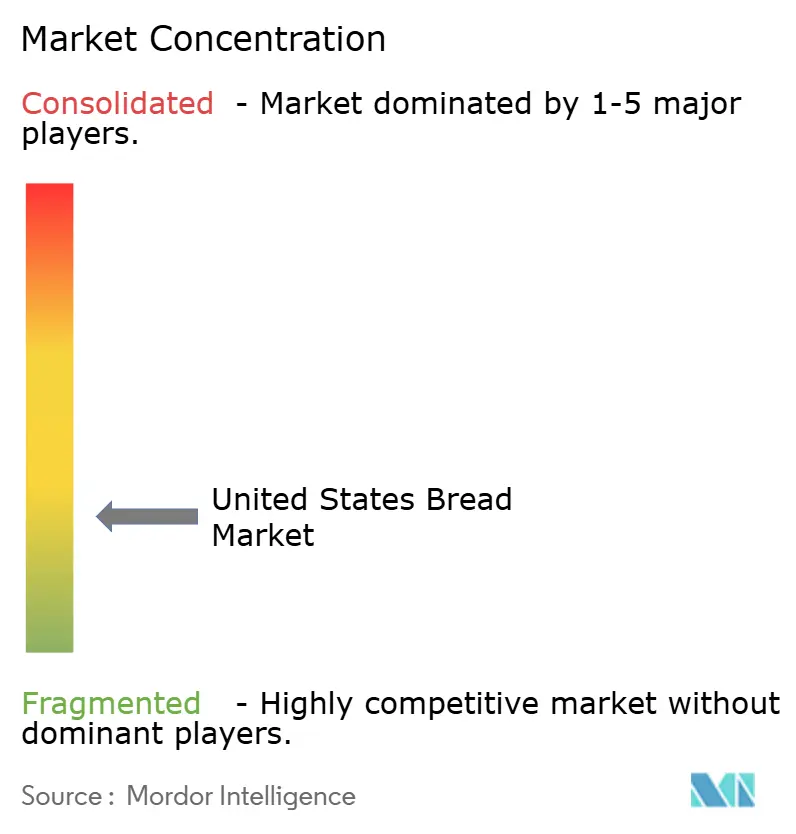
| Market Concentration | Low |
Major Players
*Disclaimer: Major Players sorted in no particular order Image © Mordor Intelligence. Reuse requires attribution under CC BY 4.0. |
|
United States Bread Market Analysis by Mordor Intelligence
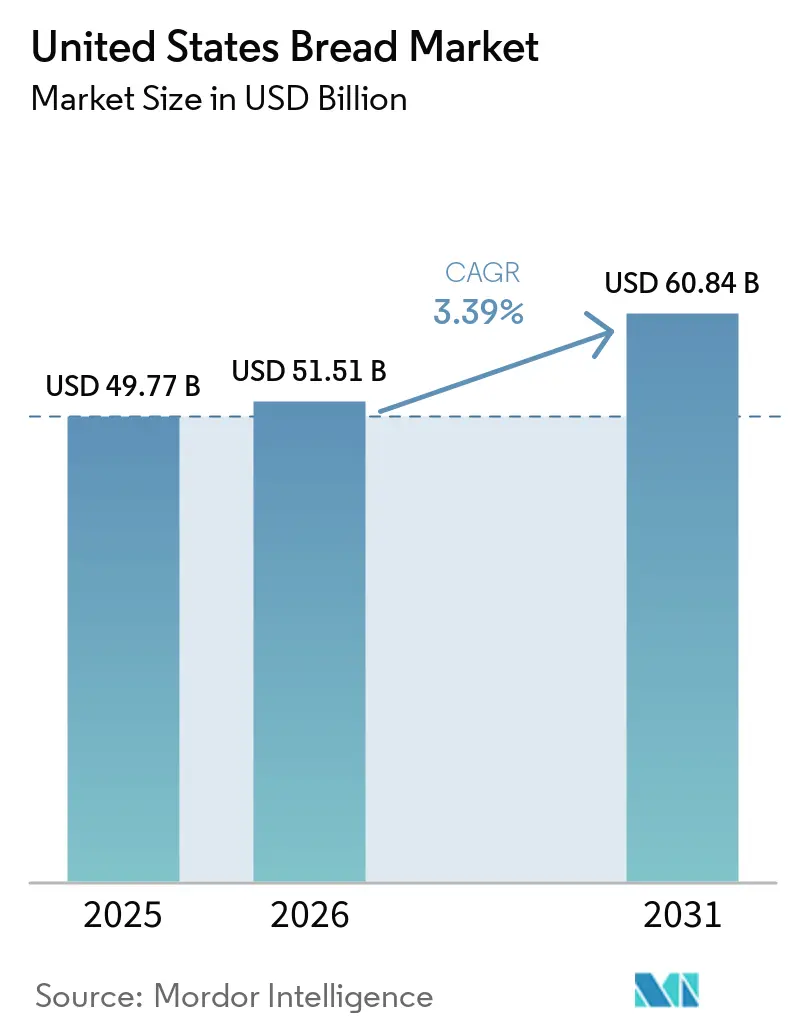
The United States bread market size was valued at USD 49.77 billion in 2025 and estimated to grow from USD 51.51 billion in 2026 to reach USD 60.84 billion by 2031, at a CAGR of 3.39% during the forecast period (2026-2031). The United States bread market retains a broad demand base because bread remains a regular household purchase, but packaged white loaves face slower volume demand as more consumers reduce refined carbohydrates. The commercial opportunity is shifting toward higher-value formats, including protein-enriched, whole-grain, organic, gluten-free, sourdough, and smaller loaves that help households manage waste. Producers are responding by using direct-store delivery networks, in-store bakery programs, and tailored product formats to protect shelf space and improve availability. These strategies require manufacturers to choose between scale-oriented everyday offerings and more specialized products with higher costs, tighter quality requirements, and narrower consumer bases. This leaves the United States bread market with a mixed outlook, in which conventional volume pressure coexists with better pricing and stronger demand for specialty products.
Key Report Takeaways
- By product type, leavened bread held the largest share of the United States bread market, at 71.23% in 2025, while unleavened and flatbread are projected to grow at the fastest CAGR of 4.33% during 2026-2031.
- By ingredient type, wheat bread held the largest share of the United States bread market, at 53.86% in 2025, while multigrain bread is projected to grow at the fastest CAGR of 4.57% during 2026-2031.
- By nature, conventional bread held the largest share of the United States bread market, at 78.25% in 2025, while free-from bread is projected to grow at the fastest CAGR of 4.69% during 2026-2031.
- By distribution channel, off-trade held the largest share of the United States bread market, at 63.87% in 2025, while on-trade is projected to grow at the fastest CAGR of 4.15% during 2026-2031.
Note: Market size and forecast figures in this report are generated using Mordor Intelligence’s proprietary estimation framework, updated with the latest available data and insights as of January 2026.
Worldwide, activity is shaped by contributions from multiple countries and regions, with United states representing one among them. The global report on bread market by Mordor Intelligence reflects how these countries and regional layers combine into a single system.
United States Bread Market Trends and Insights
Drivers Impact Analysis*
| Driver | (~) % Impact on CAGR Forecast | Geographic Relevance | Impact Timeline |
|---|---|---|---|
| Demand for Convenient Meal Solutions | +0.65% | National; strongest in high-density urban metros | Short term (<=2 years) |
| Growth of Organic, Gluten-Free, and Whole-Grain Products | +0.55% | National; premium gains in Northeast and West | Medium term (2-4 years) |
| Foodservice Recovery and Sandwich-Format Demand | +0.50% | National; concentrated in urban and suburban corridors | Short term (<=2 years) |
| Retailer In-Store Bakery and Direct-Store-Delivery Expansion | +0.45% | National; disproportionate benefit in South and Southwest | Medium term (2-4 years) |
| Low-carb, Keto and High-protein Bread Innovation | +0.40% | National; early-adopter strength in West and Northeast | Medium term (2-4 years) |
| Premiumization through Sourdough and Artisan Bread | +0.35% | West Coast, Northeast, with spill-over to Midwest urban centers | Long term (>=4 years) |
| Source: Mordor Intelligence | |||
Demand for Convenient Meal Solutions
Bread remains useful for quick meals, packed lunches, and home-prepared sandwiches, which supports repeat purchases across retail formats and makes product availability especially important in routine household shopping. The American Bakers Association reported that 55% of consumers eat sandwich bread at least once a week and that 94% can be persuaded to make impulse purchases of baked goods[1]. This creates room for take-and-bake products, brioche buns, flavored loaves, and other offerings that provide convenience without sacrificing quality. Smaller packages also address a practical issue for smaller households by reducing the likelihood of leftover product and allowing shoppers to try a premium loaf without committing to a larger purchase. The United States bread market can therefore gain value from convenient formats even when household consumption does not increase materially.
Growth of Organic, Gluten-Free, and Whole-Grain Products
The Dietary Guidelines for Americans 2020-2025 recommends that half of all grain servings come from whole grains, a federal directive that directly validates the health messaging central to multigrain bread marketing. FDA's gluten-free labeling standard (21 CFR Part 101.91), which caps gluten at fewer than 20 ppm, simultaneously serves as a consumer trust signal and a de facto barrier for conventional manufacturers entering the free-from segment without dedicated-facility investment. Dave's Killer Bread's April 2025 launch of organic Sandwich Rolls, USDA organic and Non-GMO Project Verified, with 16g of whole grains and 11g of protein per serving, illustrates how stacking certifications enables retail pricing two to three times that of conventional loaves. Free-from growth is sustained not solely by clinical gluten diagnoses but by aspirational lifestyle adoption, a consumer segment that is less price-sensitive and more loyal. Brands targeting wellness-oriented adopters can maintain premium pricing even as the cost of gluten-free ingredients declines, delivering a compounding gross-margin advantage through the forecast period.
Foodservice Recovery and Sandwich-Format Demand
Foodservice demand supports bread formats that are less easily replaced by standard retail loaves, including burger buns, sub rolls, ciabatta, pita, naan, and par-baked products. Restaurant and institutional buyers often require specific texture, size, and holding performance, which makes reliable supply, production consistency, and accurate order fulfillment important. These specifications can create a barrier for smaller suppliers that lack the equipment, testing capacity, or quality systems required by large accounts. The United States bread market also benefits when operators use products that travel well in delivery orders and retain their texture after preparation. This gives commercial bakers a reason to develop separate foodservice lines rather than relying only on retail volume.
Retailer In-Store Bakery and Direct-Store-Delivery Expansion
In-store bakery programs give retailers a way to present fresh products and attract shoppers to the store perimeter, where differentiated baked goods can support larger baskets. Direct-store-delivery (DSD) networks operating on two- to three-day replenishment cycles for Bimbo Bakeries USA and Flowers Foods serve as competitive moats that smaller regional bakers struggle to match at comparable economics. Grupo Bimbo's Q3 2025 results highlighted record productivity gains from DSD route optimization, contributing to a sequential expansion of the North America EBITDA margin from 7.4% in Q1 to 10.4% in Q3[2]. Thaw-and-sell and par-baked frozen dough programs allow retailers to deliver fresh-baked quality without the labor costs of scratch production, a supply model growing faster than traditional center-store and full-scratch ISB. Compliance with the FDA's Food Safety Modernization Act (FSMA) preventive controls and HACCP protocols governs minimum quality and traceability standards for all DSD and ISB bread suppliers.
Restraints Impact Analysis*
| Restraint | (~) % Impact on CAGR Forecast | Geographic Relevance | Impact Timeline |
|---|---|---|---|
| Health Concerns Around Refined Carbohydrates | -0.35% | National, sharpest in high-income and health-aware urban metros | Long term (≥ 4 years) |
| Wheat, Flour, and Ingredient Price Volatility | -0.30% | National, most acute for smaller regional operators without supply contracts | Short term (≤ 2 years) |
| Perishability, Markdown Exposure, and Fresh-Bread Waste | -0.25% | National, with disproportionate impact in lower-density distribution corridors | Medium term (2-4 years) |
| Private-Label Price Competition and Promotional Dependence | -0.20% | National, concentrated in mass-market supermarket and club-store channels | Medium term (2-4 years) |
| Source: Mordor Intelligence | |||
Health Concerns around Refined Carbohydrates
Per-capita wheat flour consumption fell from 146.6 pounds in 2000 to 126.6 pounds in 2025, the lowest in approximately 40 years, as the USDA's Economic Research Service attributes this decline to persistent consumer adoption of low-carbohydrate dietary patterns, reinforced by evolving medical guidance[3]. The compound headwind of GLP-1 uptake amplifies this structural trend: research published in the Journal of Marketing Research (2026) documented a 5.3% reduction in household grocery spending within six months of GLP-1 adoption, with refined-grain categories among the most affected. Oklahoma State University research confirmed that approximately 70% more GLP-1 users report reduced consumption of starchy food categories than those reporting less. Unlike prior diet cycles, pharmacologically driven appetite suppression carries structural durability; health-driven volume declines in conventional bread cannot be fully offset by premiumization alone. The addressable market for a USD 8 artisan sourdough loaf is fundamentally narrower than that for a USD 3 packaged white loaf, capping the revenue conversion that category value-mix improvement can deliver.
Wheat, Flour and Ingredient Price Volatility
Wheat and flour costs affect both national producers and regional bakeries because flour is a core production input. USDA projected 1.98 billion bushels of U.S. wheat production for 2025/26 from 37.2 million harvested acres, giving the sector a large domestic supply base while leaving it exposed to crop conditions and global commodity movements. Hard red winter wheat is particularly important to commercial flour production, so weather variation in the Plains can affect bakeries across the country and can quickly affect purchasing decisions when inventories are tight. Larger operators can use supply contracts, procurement scale, and route efficiencies to manage volatility more effectively than smaller firms. The United States bread market remains sensitive to these costs because producers must balance price increases against resistance from retailers and consumers.
*Our forecasts treat driver/restraint impacts as directional, not additive. The impact forecasts reflect baseline growth, mix effects, and variable interactions.
Segment Analysis
By Product Type: Leavened Bread Remains the Volume Base While Flatbread Expands
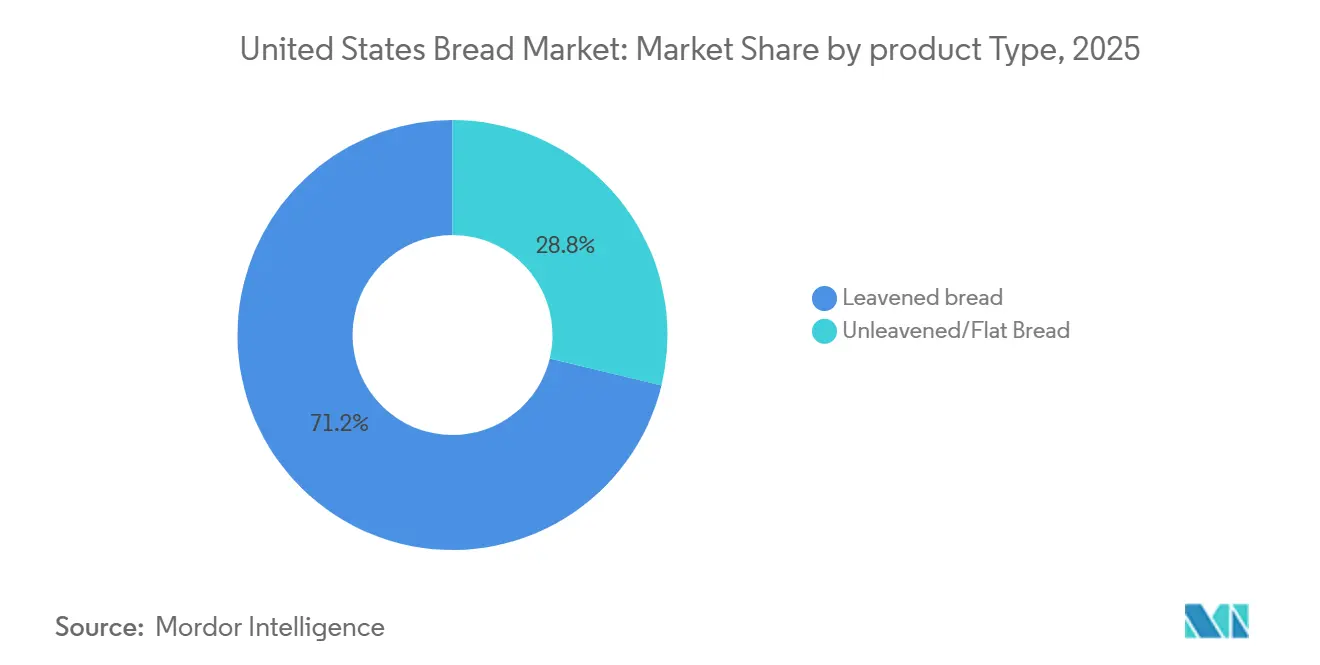
Leavened bread held 71.23% of the United States bread market share in 2025, making it the leading product group across retail and foodservice. Sandwich loaves, buns, baguettes, ciabatta, and similar products have broad household familiarity and fit established store distribution systems. Their position also reflects the large range of eating occasions they serve, from breakfast toast to school lunches and restaurant sandwiches. Product extensions such as smaller loaves, sourdough varieties, and premium buns allow established brands to renew mature formats without moving too far from consumer expectations. Producers must still monitor volume pressure in standard-packaged loaves because health-conscious shoppers and GLP-1 users may choose fewer refined-grain products. In response, suppliers are focusing on fresh quality, portion control, whole-grain claims, and better ingredients rather than treating leavened bread as a single undifferentiated category. The United States bread market retains a stable core in this segment because its underlying formats remain practical for everyday use.
Unleavened and flatbread are projected to grow at a 4.33% CAGR through 2031, the fastest rate among product types. Tortillas, wraps, naan, pita, chapati, roti, and pizza dough benefit from demand for flexible meal formats and from the growth of Hispanic, Middle Eastern, and South Asian food occasions. Gruma has identified wraps, naan, and pizza dough as areas of expansion, indicating that large manufacturers view these formats as durable adjacencies rather than niche products. Flatbread producers can also serve both home cooking and foodservice, giving them more occasions for volume growth than a standard sliced loaf. The segment has room for wider branded offerings that meet diaspora preferences while remaining accessible to mainstream shoppers. Clear positioning will matter because product boundaries are becoming less distinct as bread manufacturers move into wrap-style products and tortilla suppliers enter adjacent baked formats.
By Ingredient Type: Wheat Bread Anchors Demand While Multigrain Gains
Wheat bread accounted for 53.86% of the United States bread market in 2025, supported by established consumer habits and a production system built around domestic wheat supplies. The category includes common white and wheat loaves that remain staples in supermarkets, convenience stores, and foodservice accounts. USDA identifies hard red winter and hard red spring wheat as major classes in the U.S. wheat system, which supports the production base for bread flour. Wheat bread benefits from a familiar taste profile, consistent availability, and a broad range of price points. Its challenge is not a lack of relevance but the need to adapt to consumers who look for more fiber, protein, or visible whole grains. Manufacturers are responding through whole-wheat extensions, smaller loaves, and blends that retain the eating qualities consumers associate with mainstream bread. This keeps wheat bread central to the United States bread industry even as value growth shifts to more specialized options.
Multigrain bread is forecast to grow at a 4.57% CAGR through 2031, leading the ingredient category. The growth aligns with federal dietary guidance that encourages consumers to make half of their grains whole grains. Consumers may add multigrain bread as a second loaf for health-focused meals rather than replace all conventional bread purchases, which can increase basket value. Products that combine whole grains with protein, seeds, or organic certification can appeal to shoppers who read labels closely. This approach also gives brands a basis for premium pricing when the product benefits are clear and the eating experience remains appealing. Rye and ancient-grain products serve narrower audiences, but they provide useful options for companies seeking to differentiate beyond standard wheat formulations. As this segment grows, accurate labeling and consistent ingredient standards will remain important to maintain consumer confidence.
By Nature: Conventional Bread Leads While Free-From Products Advance
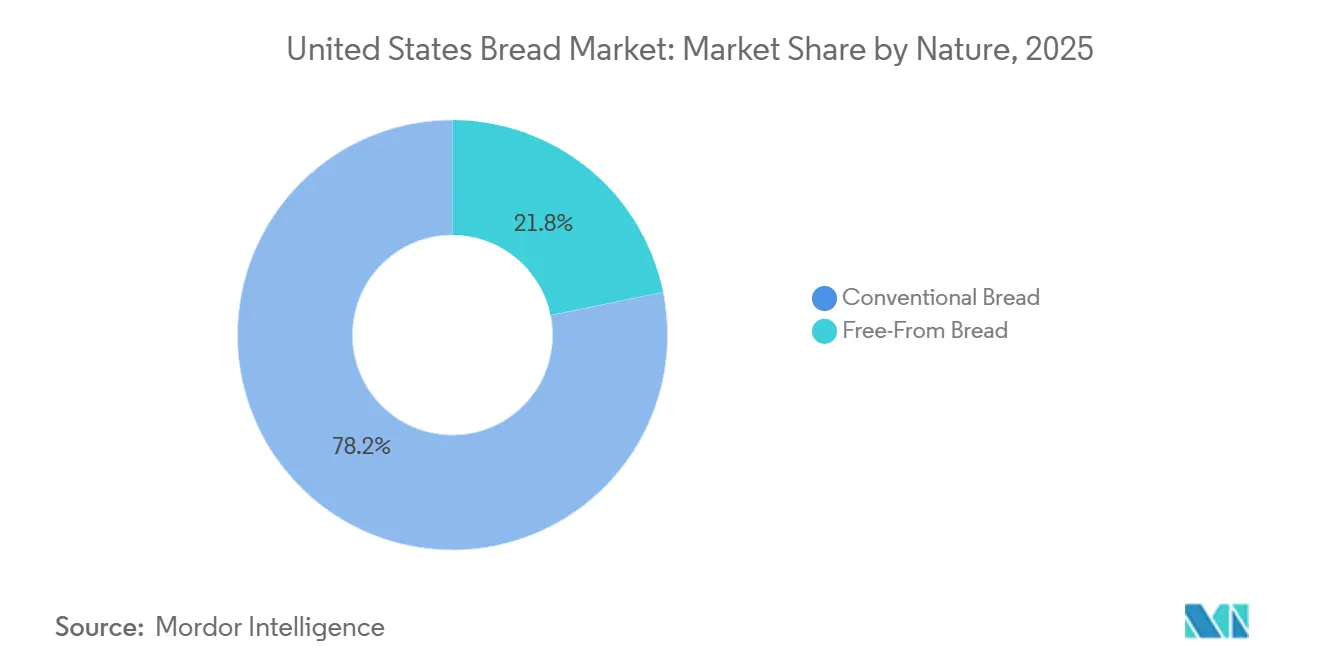
Conventional bread represented 78.25% of the United States bread market in 2025 and remains the largest nature segment because it is widely available, affordable, and familiar. It covers the bulk of standard sliced loaves, buns, rolls, and foodservice breads sold through supermarkets and restaurants. Large direct-store delivery systems support its shelf availability, while value tiers remain important for households seeking predictable prices. Conventional producers are also broadening their offers with high-protein, reduced-carbohydrate, and portion-controlled options to keep existing shoppers within their brand portfolios. The segment faces pressure where shoppers reduce refined-carbohydrate intake or seek products with gluten-free, organic, or clean-label attributes. Its scale nonetheless gives it the production efficiency and distribution reach needed to remain the mainstay of the United States bread market throughout the forecast period.
Free-from bread is expected to grow at a 4.69% CAGR through 2031, the fastest pace by nature. The segment serves consumers with diagnosed gluten-related conditions and a larger group choosing gluten-free products for personal wellness preferences. FDA gluten-free rules provide a clear basis for product claims and make careful manufacturing controls essential for brands that serve medically sensitive consumers. Companies such as Canyon Bakehouse and Schär can compete through specialized formulations and dedicated positioning rather than through the largest distribution network alone. The category also overlaps with functional and low-carbohydrate breads, broadening its relevance in natural and specialty retail. Producers must distinguish between products intended for rigorous dietary needs and those positioned for general lifestyle use, since expectations for formulation, facilities, and pricing can differ.
By Distribution Channel: Off-Trade Retains Scale While On-Trade Builds Momentum
Off-trade channels captured 63.87% of the United States bread market in 2025, making them the largest route to consumers. Supermarkets and hypermarkets are important because they offer a full range of value, premium, organic, and specialty products in one location. Direct-store delivery networks help national suppliers replenish perishable products frequently and maintain shelf presence. Convenience stores provide another channel for smaller packs and immediate-consumption occasions, while online channels give specialty brands access to consumers beyond their normal store footprint. Private-label pressure is strongest in mass retail, especially for standard sandwich bread, so branded suppliers need clear reasons for consumers to trade up. The size of the off-trade means it will continue to shape pricing, merchandising, and product visibility across the United States bread market.
On-trade channels are projected to grow at a 4.15% CAGR through 2031, ahead of off-trade distribution. Restaurants, cafeterias, hotels, and other foodservice operators need consistent supplies of buns, sandwich rolls, specialty loaves, and flatbreads. These customers often prioritize texture, portion control, and product performance after holding or delivery, creating requirements that can be difficult to meet with basic retail products. Foodservice suppliers can build deeper customer relationships by offering par-baked, frozen-dough, and customized formats. The channel also has less direct exposure to private-label pricing than supermarket bread, although operators remain cost conscious. Food safety controls under the Food Safety Modernization Act apply across commercial bread handling and make reliable systems important for channel access.
Geography Analysis
The South accounted for the largest share of the United States bread market in 2025, making it the largest regional cluster in the supply analysis. Large metropolitan areas, including Dallas, Houston, Atlanta, and Charlotte, support dense retail coverage and efficient direct-store delivery routes, while the region combines demand for biscuits and cornbread with growing interest in whole-grain, specialty, and smaller-format breads. Texas and Florida also have large Hispanic and Latino communities, which support demand for tortillas, wraps, and other flatbread products and give suppliers a reason to balance mainstream packaged bread with locally relevant formats. The United States bread market has a strong base in the South because population growth and geographic scale support both volume demand and distribution investment.
The Southwest is identified as the fastest-growing region for 2026-2031 in the supplied material, although no numeric growth rate is provided. Growth in Arizona, Nevada, and New Mexico supports wider retail demand and increases the relevance of Hispanic food formats in mainstream stores. Tortillas and other unleavened breads link demographic change to convenient meal use, while suppliers must align national brand standards with flavors and formats that meet local demand. The opportunity depends on population growth, format mix, retail coverage, foodservice expansion, and tight fresh-product logistics because longer delivery distances can raise waste risk.
The Northeast and West have a distinct role in the United States bread market because shoppers in major coastal cities often adopt premium, organic, artisan, and functional products earlier than many other regions. The Northeast supports demand for bagels, rye, pita, and premium sliced breads, while the West remains important for sourdough, natural products, and health-focused innovation. Bimbo Bakeries USA introduced Thomas’ High Protein Bagels nationwide in October 2025, illustrating the national relevance of protein-oriented breakfast formats. Flowers Foods launched Nature’s Own Wheat + Protein in October 2025, offering 22g of protein and 9g of net carbohydrates per 2-slice serving, which also reflects demand for functional products. The Midwest and Great Plains remain important manufacturing areas because they are close to major wheat-producing states and serve value-oriented consumer demand. Together, these patterns require manufacturers to combine national scale with a portfolio that recognizes regional food preferences, income levels, and distribution conditions.
Competitive Landscape
The United States bread market is fragmented. Grupo Bimbo, through Bimbo Bakeries USA, holds the largest individual position and uses broad route coverage to serve retail customers nationwide. The company has focused on route productivity and distribution efficiency as it manages softer demand for mid-tier packaged bread. Flowers Foods is another major competitor with national brands and a portfolio that reaches mainstream, premium, and better-for-you consumers, while its 2025 acquisition of Simple Mills expanded its presence in better-for-you foods beyond traditional bread and buns. Campbell Soup’s Pepperidge Farm, along with other national and regional suppliers, competes through brand recognition, premium positioning, and established retail relationships.
Regional bakers and private-label suppliers can win accounts through local delivery, retailer partnerships, and specialized production. H&S Bakery, Gonnella Baking Company, Damascus Bakeries, Alpha Baking Company, Rudi’s Organic Bakery, Rotella’s Italian Bakery, and Base Culture illustrate competition through regional focus, foodservice products, organic positioning, artisan formats, and functional offerings. The United States bread market has room for companies that serve the gap between low-priced private label and higher-priced artisan products with benefits such as protein, whole grains, lower carbohydrates, better ingredients, or a smaller format. The competitive field remains broad because scale matters in distribution, but differentiated products and focused customer relationships can still support smaller firms.
Strategic moves show how companies are adjusting to the changing demand profile. Flowers Foods introduced Nature’s Own Wheat + Protein and a Perfectly Crafted Italian Herb loaf in October 2025, combining functional nutrition with premium flavor options. Bimbo Bakeries USA launched Thomas’ High Protein Bagels with 21g of protein per bagel in October 2025, targeting consumers who want higher-protein breakfast products. Gruma has identified expansion in wraps, naan, and pizza dough, extending its presence beyond traditional tortillas. Distribution capability, quality control, and clear consumer benefits will remain the main competitive factors in the United States bread market.
United States Bread Industry Leaders
-
Grupo Bimbo, S.A.B. de C.V.
-
Flowers Foods, Inc.
-
Campbell Soup Company
-
H&S Bakery, Inc.
-
Lewis Bakeries, Inc.
- *Disclaimer: Major Players sorted in no particular order
Recent Industry Developments
- October 2026: Essential Baking expanded its bread portfolio with four organic sandwich sourdough loaves, including Oats & Honey, Multigrain, Artisan White, and Cinnamon. The launch highlights growing demand in the U.S. bread market for organic, sourdough, non-GMO, and premium sandwich bread formats through mass retail channels such as Target.
- October 2026: Rudi’s Bakery launched Gluten Free Daily Power Protein Bread in White and Sourdough variants, along with gluten-free Sandos PB&J pocket sandwiches. The development supports the expansion of gluten-free bread products with added protein and convenience-led frozen sandwich formats in the U.S. bread market.
- October 2026: Sara Lee partnered with Mike’s Hot Honey to launch Sara Lee Mike’s Hot Honey Half Loaf, available for a limited time at grocery retailers across the United States. The launch reflects growing innovation in the U.S. bread market around flavored sliced bread, sweet-heat flavor profiles, and limited-time branded collaborations for breakfast and sandwich occasions.
- May 2026: Oroweat expanded its bread portfolio in the United States with Fiber Power Bread and two Protein Bread variants, including Protein White Bread and Protein Honey Oat Bread. The launch is more directly relevant to the U.S. bread market as it reflects growing demand for nutrition-forward sandwich bread with added fiber and protein for everyday household consumption.
United States Bread Market Report Scope
Bread refers to baked staple food products primarily prepared from flour and water, with or without leavening, and offered in a range of formats, ingredient compositions, and formulations. The United States Bread Market is segmented by product type, ingredient type, nature, and distribution channel. By product type, the market is divided into Leavened Bread and Unleavened/Flat Bread. Leavened Bread is further segmented into Loaves, Baguettes, Burger Buns, Sandwich Slices, Ciabatta, and Other Product Types, while Unleavened/Flat Bread is further segmented into Tortilla, Pita, Chapati/Roti/Paratha, and Others. By ingredient type, the market includes Wheat Bread, Rye Bread, Multigrain Bread, and Other Ingredients. By nature, the market is categorized into Conventional Bread and Free-From Bread. By distribution channel, the market is divided into On-Trade and Off-Trade, with Off-Trade further segmented into Convenience/Grocery Stores, Specialist Retailers, Supermarkets/Hypermarkets, Online Retail, and Other Channels. The market sizing has been done in value terms in USD and volume terms in metric tons for all the abovementioned segments.
| Leavened Bread | Loaves |
| Baguettes | |
| Burger Buns | |
| Sandwich Slices | |
| Ciabatta | |
| Other Product Types | |
| Unleavened/Flat Bread | Tortilla |
| Pita | |
| Chapati/Roti/Paratha | |
| Others |
| Wheat Bread |
| Rye Bread |
| Multigrain Bread |
| Other Ingredients |
| Conventional Bread |
| Free-From Bread |
| On-Trade | |
| Off-Trade | Convenience/Grocery Stores |
| Specialist Retailers | |
| Supermarkets/Hypermarkets | |
| Online Retail | |
| Other Channels |
| By Product Type | Leavened Bread | Loaves |
| Baguettes | ||
| Burger Buns | ||
| Sandwich Slices | ||
| Ciabatta | ||
| Other Product Types | ||
| Unleavened/Flat Bread | Tortilla | |
| Pita | ||
| Chapati/Roti/Paratha | ||
| Others | ||
| By Ingredient Type | Wheat Bread | |
| Rye Bread | ||
| Multigrain Bread | ||
| Other Ingredients | ||
| By Nature | Conventional Bread | |
| Free-From Bread | ||
| By Distribution Channel | On-Trade | |
| Off-Trade | Convenience/Grocery Stores | |
| Specialist Retailers | ||
| Supermarkets/Hypermarkets | ||
| Online Retail | ||
| Other Channels | ||
Key Questions Answered in the Report
What is the forecast for the United States bread market?
The market is valued at USD 49.77 billion in 2025 and is projected to reach USD 60.84 billion by 2031, at a 3.39% CAGR from 2026 to 2031.
Which bread product type is growing fastest in the United States?
Unleavened and flatbread is forecast to grow at a 4.33% CAGR through 2031, supported by demand for tortillas, wraps, pita, naan, and related products.
Which distribution channel is the largest for bread sales?
Off-trade channels account for 63.87% of sales in 2025, supported by supermarkets, hypermarkets, convenience stores, and specialty retailers.
Why are protein-enriched breads gaining attention?
Protein products address demand from consumers seeking higher-protein meal options. Flowers Foods introduced a loaf with 22g of protein per 2-slice serving in October 2025.