
Telecom Network Energy Efficiency Software Market Size and Share
Market Overview
| Study Period | 2020 - 2031 |
|---|---|
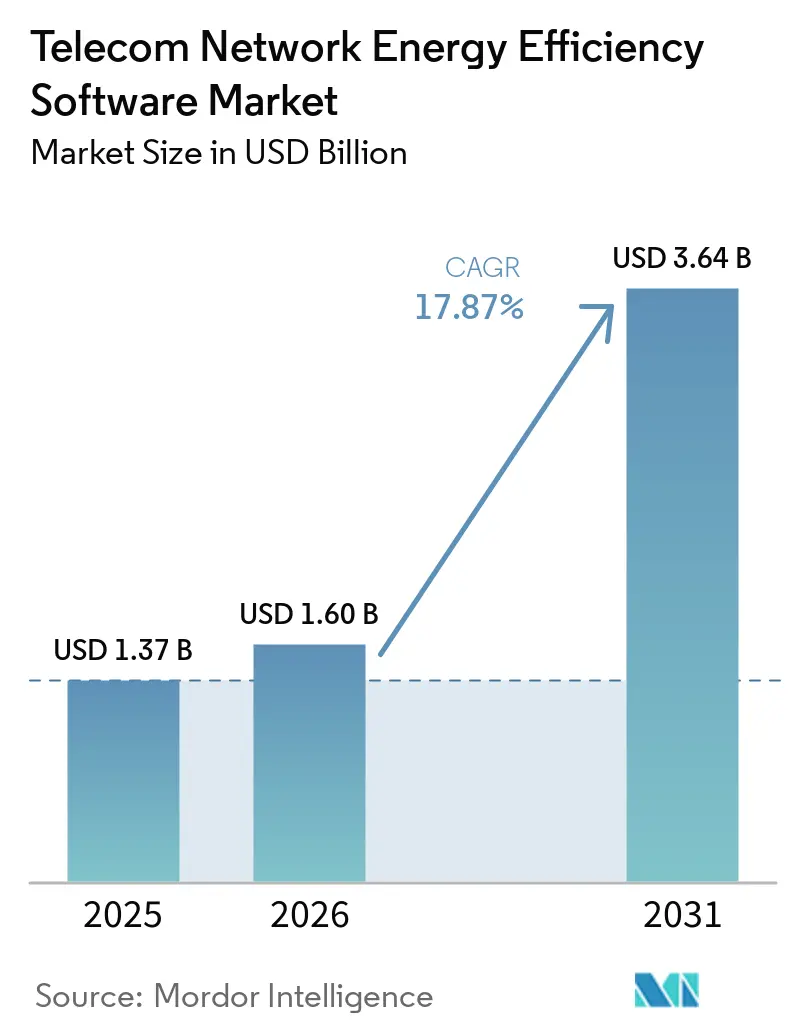
| Market Size (2026) | USD 1.60 Billion |
| Market Size (2031) | USD 3.64 Billion |
| Growth Rate (2026 - 2031) | 17.87 % |
| Fastest Growing Market | Asia-Pacific |
| Largest Market | Europe |
| Market Concentration | Medium |
Major Players *Disclaimer: Major Players sorted in no particular order Image © Mordor Intelligence. Reuse requires attribution under CC BY 4.0. | |
Telecom Network Energy Efficiency Software Market Analysis by Mordor Intelligence
The telecom network energy efficiency software market size was valued at USD 1.37 billion in 2025 and is forecast to reach USD 3.64 billion by 2031 at a CAGR of 17.87% from 2026 to 2031. Growth is being shaped by a direct shift in operator cost priorities, as higher 5G network density increases power consumption, making energy management a recurring operating issue rather than a narrow sustainability program. The telecom network energy efficiency software market is also benefiting from the broader adoption of monitoring, analytics, optimization, and automation tools that help operators manage multi-vendor estates with greater consistency. Europe remained the largest regional contributor in 2025, while Asia-Pacific is set to expand the fastest as network rollouts continue and software adoption moves across a wider set of operators. Competitive activity centers on cloud delivery, AI-led optimization, and platform interoperability, while the pace of adoption depends on how quickly operators close site-level visibility gaps and connect monitoring layers to higher-value optimization workflows.
Key Report Takeaways
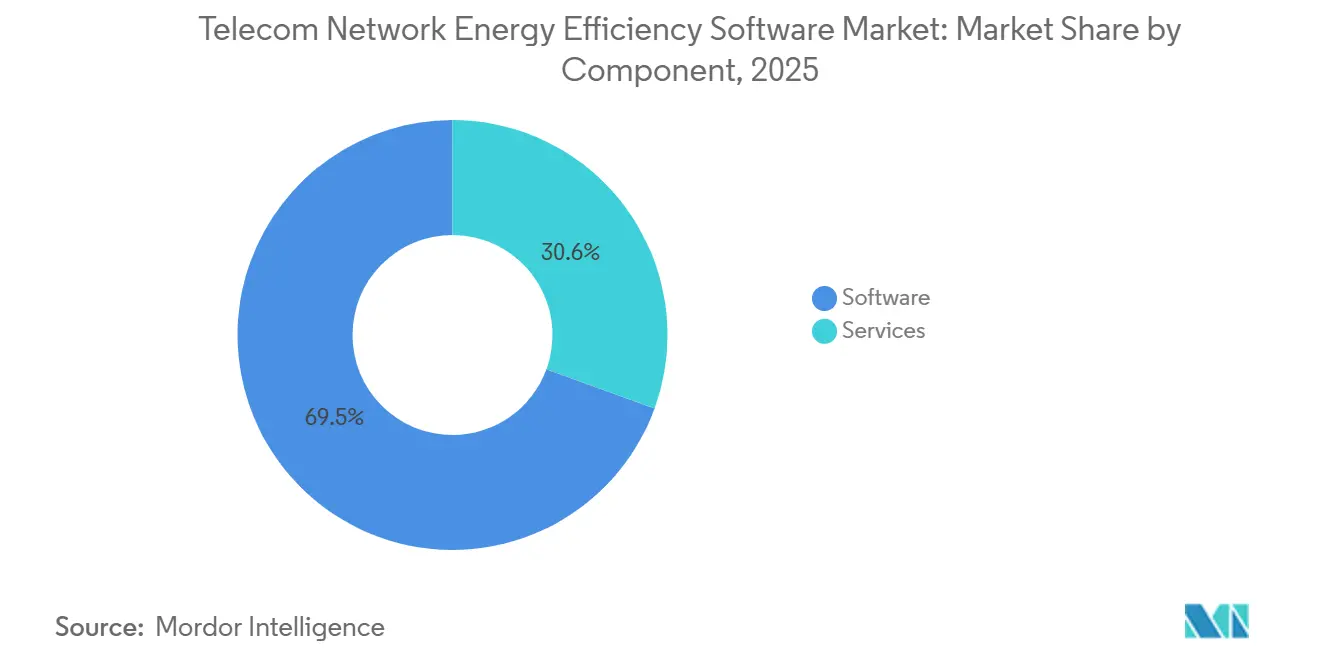
- By component, software accounted for 69.45% share of the telecom network energy efficiency software market revenue in 2025, while services are projected to expand at a 18.25% CAGR through 2031.
- By solution type, Energy Monitoring and Visibility Software accounted for 28.74% share in 2025, while AI-Based Power Optimization Software is expected to grow at an 18.65% CAGR through 2031.
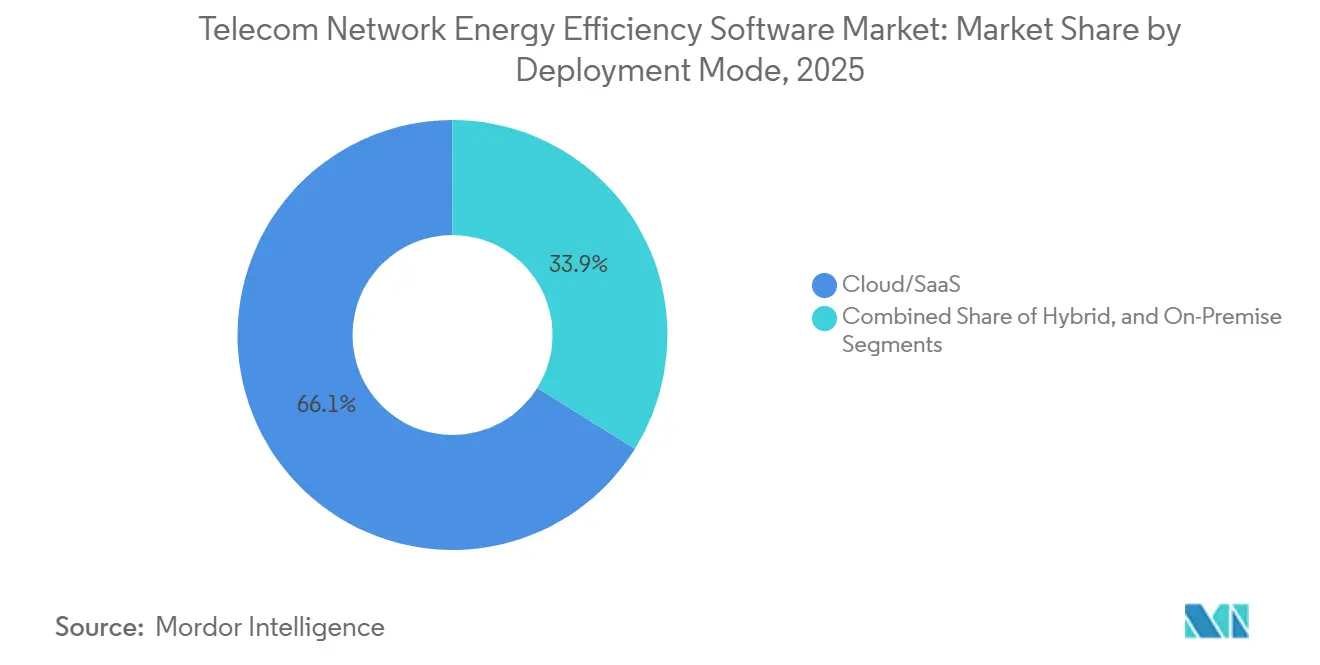
- By deployment mode, Cloud/SaaS captured 66.12% of the market in 2025, while hybrid is projected to record an 18.12% CAGR through 2031.
- By end user, Mobile Network Operators held 30.12% share in 2025, while tower companies are projected to expand at an 18.34% CAGR through 2031.
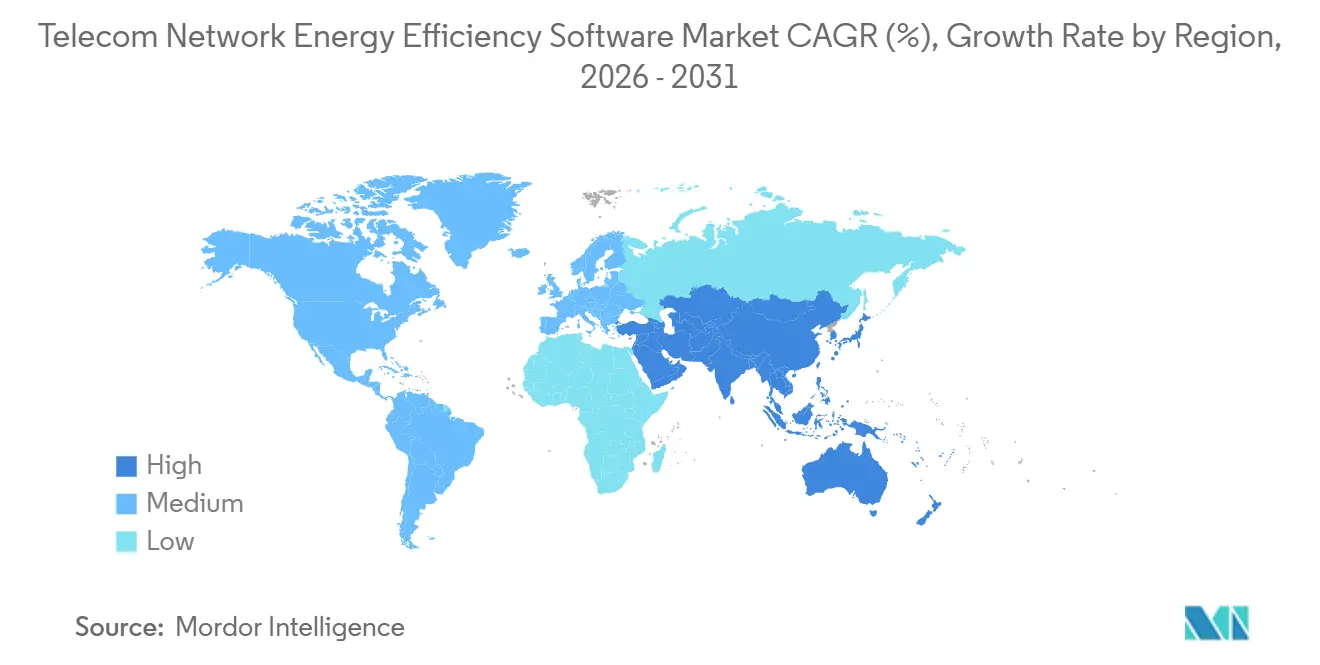
- By geography, Europe held 34.56% of the telecom network energy efficiency software market in 2025, while Asia-Pacific is projected to grow at an 18.45% CAGR through 2031.
Note: Market size and forecast figures in this report are generated using Mordor Intelligence’s proprietary estimation framework, updated with the latest available data and insights as of January 2026.
Market Trends and Insights
Drivers Impact Analysis of Telecom Network Energy Efficiency Software Market*
| Driver | (~) % Impact on CAGR Forecast | Geographic Relevance | Impact Timeline |
|---|---|---|---|
| Rising 5G RAN Energy Intensity | +4.2% | Global | Short term (≤ 2 years) |
| AI-Driven Closed-Loop Power Saving Gains | +3.8% | Global | Short term (≤ 2 years) |
| Cloud SaaS Adoption For Multi-Vendor Network Operations | +3.2% | Global, with early concentration in Europe and Asia-Pacific | Medium term (2-4 years) |
| ESG Reporting And Net-Zero Compliance Pressure | +2.5% | North America and Europe primarily, spill-over to Asia-Pacific and Middle East and Africa | Medium term (2-4 years) |
| Autonomous RAN Optimization For Sleep Mode And Carrier Shutdown | +2.0% | Global | Medium term (2-4 years) |
| Energy Price Volatility In Tower And Edge Operations | +1.8% | Middle East and Africa core, spill-over to Southeast Asia and South America | Short term (≤ 2 years) |
| Source: Mordor Intelligence | |||
Rising 5G RAN Energy Intensity
The telecom network energy efficiency software market is expanding because 5G creates a heavier energy burden than earlier network generations. Higher use of Massive MIMO and denser urban network layers is increasing site-level power needs and raising the cost of operating live networks.[1] A 2025 study showed that 5G energy demand in the United Kingdom could rise sharply by 2030 under different traffic scenarios, with especially high consumption density in urban areas. That operating pattern makes static hardware settings less effective, because demand growth alone does not translate into efficient energy use. The telecom network energy efficiency software market is therefore seeing stronger demand for software that can orchestrate sleep modes, carrier shutdown, and site-level optimization across diverse equipment environments. Vendors that can operate above vendor-specific network management layers are in a stronger position when operators seek savings across mixed estates rather than within a single hardware stack.
AI-Driven Closed-Loop Power Saving Gains
The telecom network energy efficiency software market is also advancing, as AI-based closed-loop tools are now being deployed in live operator environments rather than remaining in pilot phases. Ericsson said its Intelligent Energy Efficiency capabilities reduced daily 5G radio unit power consumption by up to 33% at selected Vodafone UK sites during a 2025 trial.[2] That result matters because it ties software decisions directly to measurable energy outcomes at the radio layer. It also raises switching costs over time, since optimization tools improve as they learn traffic patterns and configuration behavior from each operator's network. The telecom network energy efficiency software market is likely to reward vendors that secure early production deployments and then build a wider service relationship around those models. This is one reason the strongest incumbents are pairing AI software with automation platforms and managed delivery support.
Cloud SaaS Adoption for Multi-Vendor Network Operations
The telecom network energy efficiency software market is benefiting from cloud delivery, as SaaS models shorten implementation cycles and reduce upfront infrastructure costs. Nokia deployed its energy efficiency platform as SaaS with Indosat Ooredoo Hutchison and Globe Telecom in 2025, enabling both operators to use AI-based optimization in multi-vendor RAN environments without on-site software maintenance.[3] This model fits brownfield telecom networks well, because it avoids long recertification and integration cycles tied to local hardware upgrades. It also supports frequent model updates, which are important when traffic patterns and energy settings change across large live networks. The telecom network energy efficiency software market is, therefore, seeing cloud platforms become the first choice where regulation allows external processing and centralized analytics. Hybrid models remain relevant because some operators still need cloud-scale analytics with stronger local control over sensitive telemetry flows.
ESG Reporting and Net-Zero Compliance Pressure
The telecom network energy efficiency software market is also being supported by stronger reporting and emissions targets across major operator groups. More than 300 mobile operators have announced net-zero targets, with 2040 and 2050 as the main milestone years. Deutsche Telekom said it achieved greenhouse gas neutrality for Scope 1 and 2 emissions by the end of 2025, while Tele2 reported a 97% reduction in Scope 1 and 2 emissions against 2019.[4] These commitments increase demand for software that can capture, organize, and report energy data at the network-asset level instead of relying on broad estimates. The telecom network energy efficiency software market benefits when optimization and reporting functions are combined, as procurement teams increasingly seek operational savings and auditable disclosure within a single platform. In Europe, the policy backdrop has strengthened as sustainability guidance for telecom networks moves closer to formal compliance requirements.
Restraints Impact Analysis of Telecom Network Energy Efficiency Software Market*
| Restraint | (~) % Impact on CAGR Forecast | Geographic Relevance | Impact Timeline |
|---|---|---|---|
| Legacy Site Telemetry And Metering Gaps | -1.5% | Global, most acute in Middle East and Africa, South Asia, and Southeast Asia | Medium term (2-4 years) |
| Integration Complexity Across OSS, RAN, And Power Systems | -1.8% | Global | Medium term (2-4 years) |
| Cybersecurity And Data Sovereignty Concerns | -1.2% | European Union, Southeast Asia, Middle East, South Asia | Medium term (2-4 years) |
| Long Payback Period For Retrofits In Brownfield Networks | -1.4% | Developing economies, brownfield-heavy markets globally | Long term (≥ 4 years) |
| Source: Mordor Intelligence | |||
Integration Complexity Across OSS, RAN, And Power Systems
The telecom network energy efficiency software market still faces a significant adoption barrier because energy platforms must connect to OSS environments, RAN systems, and site power infrastructure that often use different data standards. This creates a long engineering cycle before operators can trust savings estimates or automate control actions at scale. Ericsson and Nokia acknowledged this issue in March 2026 when they expanded cooperation across the rApp Ecosystem and SMO Marketplace to improve cross-vendor interoperability for autonomous network applications. That move shows that even leading suppliers see integration friction as a broad market constraint rather than a one-off customer problem. In the telecom network energy efficiency software market, long integration periods can delay budget decisions because operators measure deployment cost through internal engineering time as much as through license fees. This slows rollout even when the business case for lower power consumption is already visible.
Legacy Site Telemetry And Metering Gaps
The telecom network energy-efficiency software market also develops more slowly, as operators lack reliable site-level telemetry. Monitoring gaps weaken software performance because optimization engines depend on consistent inputs from power systems, radio equipment, and fuel or battery assets. In those environments, projected savings are harder to verify, which makes procurement teams more cautious and extends sales cycles. The problem is most visible in tower portfolios spread across difficult operating conditions, where physical monitoring upgrades are often needed before software adoption can scale. The telecom network energy efficiency software market, therefore, depends on a sequence in which measurement infrastructure, visibility software, analytics, and automation are added in stages rather than all at once. That staged path supports long-term demand, but it also slows near-term conversion from operator interest to commercial deployment.
*Our forecasts treat driver/restraint impacts as directional, not additive. The impact forecasts reflect baseline growth, mix effects, and variable interactions.
Telecom Network Energy Efficiency Software Market Segment Analysis
By Component:
Software Holds The Revenue Base While Services Raise Lifetime ValueSoftware accounted for 69.45% of revenue in 2025, making it the core revenue driver of the telecom network energy efficiency software market. This reflected the central role of licensed monitoring, analytics, optimization, and automation platforms in operator spending. Services are projected to grow at an 18.25% CAGR from 2026 to 2031, as operators rely more on integration support, managed optimization, and ongoing model maintenance. The telecom network energy efficiency software market size for software remained larger because most deployments still begin with a platform decision before operators expand into wider managed engagements. Nokia has already positioned its offering around continuous retraining and AI maintenance, which supports the idea that software and services are increasingly moving together rather than competing for the same budget line.
That shift matters for competitive behavior in the telecom network energy efficiency software industry because managed delivery can make vendor relationships more durable after the first implementation stage. Once a provider becomes part of weekly reporting, savings validation, and operating workflows, the cost of switching is no longer limited to replacing software. Staff retraining, service-level alignment, and model reconfiguration are also included in the exit cost. This supports recurring revenue concentration among suppliers that entered live deployments early in 2024 and 2025. In the telecom network energy efficiency software market, services are therefore closing the monetization gap by extending account value after the initial platform sale. The result is a component mix where software anchors present revenue and services support deeper account retention over time.
By Solution Type:
Monitoring Builds The Base While AI Optimization Lifts The Value LayerEnergy Monitoring and Visibility Software held 28.74% of the telecom network energy efficiency software market share in 2025, while AI-Based Power Optimization Software is projected to grow at an 18.65% CAGR through 2031. Monitoring led because operators need a stable observability layer before they can trust analytics, optimization, or automation. That sequence gives monitoring vendors an early advantage, since the first system to collect and organize site data often shapes later purchasing decisions. At the same time, AI optimization is attracting stronger budgets because it links software actions more directly to power savings in live networks. The telecom network energy efficiency software market for AI-based power optimization is growing as operators move beyond visibility and seek repeatable efficiency gains from dynamic network control.
Energy Analytics and Reporting Software is also gaining importance because operators increasingly need auditable outputs for emissions and energy governance. That broadens the role of analytics from an internal operational tool to an external reporting requirement. Energy Management and Automation Software is developing in parallel, especially as operators seek to move software from recommendation to execution. In May 2026, Rakuten Mobile and KDDI were selected for a NEDO-backed program that aims to reduce the power consumption of virtualized base stations and mobile data centers by 40% by 2030, underscoring the scale of automation ambition now building in the sector. The telecom network energy efficiency software market, therefore, supports multiple solution layers simultaneously, because operators enter the stack at different maturity points rather than following a single uniform path. This layered structure reduces the chance that one solution type fully displaces the others.
By Deployment Mode:
Cloud Leads Current Demand While Hybrid Addresses Governance NeedsCloud/SaaS accounted for 66.12% of revenue in 2025, making it the leading deployment model in the telecom network energy efficiency software market. Operators favored cloud delivery because it reduced upfront capital commitments and allowed faster deployment across multi-vendor network environments. Nokia used this model with Globe Telecom and Indosat Ooredoo Hutchison in 2025, showing how operators could apply AI-based optimization without running local software infrastructure at every stage. This made the cloud especially attractive in brownfield settings where operators wanted results without waiting for full internal IT modernization. The telecom network energy efficiency software market has therefore leaned toward SaaS, where speed, scalability, and remote model updates matter more than local hosting preference.
Hybrid is projected to grow at a 18.12% CAGR from 2026 to 2031, reflecting a different operator priority. Some carriers want cloud-scale analytics but still need to keep sensitive telemetry flows or control layers within national or enterprise boundaries. Deutsche Telekom’s sovereign data approach, built on cryptographic controls and local governance safeguards, demonstrates how hybrid architectures can support scalability without removing data oversight from the operator. On-premises deployments still matter in markets where regulation or internal policy restricts external processing of operational network data. In the telecom network energy-efficiency software market, this creates a three-part deployment structure rather than a full shift to the cloud alone. The balance between these modes will continue to depend on local regulation, internal IT maturity, and the sensitivity of network telemetry.

By End User:
MNOs Lead Today While Tower Companies Are The Strongest Growth PocketMobile Network Operators held a 30.12% share in 2025, making them the largest end-user group in the telecom network energy efficiency software market. Their position reflects direct ownership of large RAN estates and broader control over software procurement budgets. Tower companies, however, are projected to grow at a 18.34% CAGR through 2031, underscoring how quickly energy management has moved up the towerco priority list. Diesel exposure, electricity price volatility, and the need to protect site profitability are making software-led efficiency tools more relevant for this group. The telecom network energy efficiency software market for tower companies is growing, as these operators face immediate pressure to achieve savings across large, distributed portfolios.
That shift has broader effects across the telecom network energy-efficiency software industry because tower companies increasingly sit within the operating decisions of their MNO tenants. As towercos improve monitoring and optimization, they can share performance data more directly with customers and support joint discussions around energy targets. MNOs are also beginning to push software performance requirements into tenancy and infrastructure agreements, which raises procurement pressure across the supply chain. Internet Service Providers and Network Infrastructure Providers remain smaller by share, but they are becoming more relevant as edge sites add new power management needs beyond traditional macro towers. In the telecom network energy efficiency software market, this means end-user demand is broadening from classic operator control centers into a wider set of infrastructure owners. The result is a more diverse customer base, even though MNOs still anchor current spending.
Geography Analysis
Europe Telecom Network Energy Efficiency Software Market
Europe held 34.56% of the telecom network energy efficiency software market share in 2025, which made it the leading regional contributor. The region’s position was supported by a stronger policy framework, more visible operator sustainability programs, and earlier commercialization of AI-based energy tools. The European Commission Joint Research Center published the Code of Conduct for the Sustainability of Telecommunications Networks in January 2026, which strengthened the compliance backdrop for network efficiency decisions. BEREC also added support through its infrastructure-sharing framework, which reinforced the region’s push toward more efficient network design and operation. Deutsche Telekom, Telia, and Tele2 all reported major progress on emissions reduction, which shows that energy software procurement in Europe is tied to long-cycle network and governance decisions rather than short-lived cost programs.
APAC Telecom Network Energy Efficiency Software Market
Asia-Pacific is projected to grow at an 18.45% CAGR from 2026 to 2031, making it the fastest-growing regional segment in the telecom network energy efficiency software market. The region combines large network rollouts with a widening set of operator profiles, which supports demand for both SaaS adoption and deeper automation. In May 2026, Rakuten Mobile and KDDI were jointly selected for an NEDO research program focused on reducing power consumption in virtualized base stations and mobile data centers, which shows rising public and commercial support for software-led efficiency programs. Nokia’s live SaaS deployments in Indonesia and the Philippines also give the telecom network energy efficiency software market credible production references in Southeast Asia.
The Americas and MEA Telecom Network Energy Efficiency Software Market
North America remains an important part of the telecom network energy efficiency software market because electricity price pressure supports demand for software that can reduce site and edge power use. The U.S. Energy Information Administration said retail electricity prices were expected to continue rising through 2026, which keeps operators' focus on demand-side control and efficiency software. South America presents a selective opportunity in which urban 5G programs are expanding network density and increasing the need for more disciplined energy management. The Middle East and Africa remain a mixed region, with some operators pursuing greater network autonomy while others are driven more directly by diesel-heavy site economics and the need for stronger monitoring foundations. This leaves the telecom network energy efficiency software market with different purchase priorities by region, where Europe leads on regulation and mature deployment, Asia-Pacific leads on growth, and other regions advance through a mix of cost pressure, infrastructure scale, and local operational constraints.
Competitive Landscape
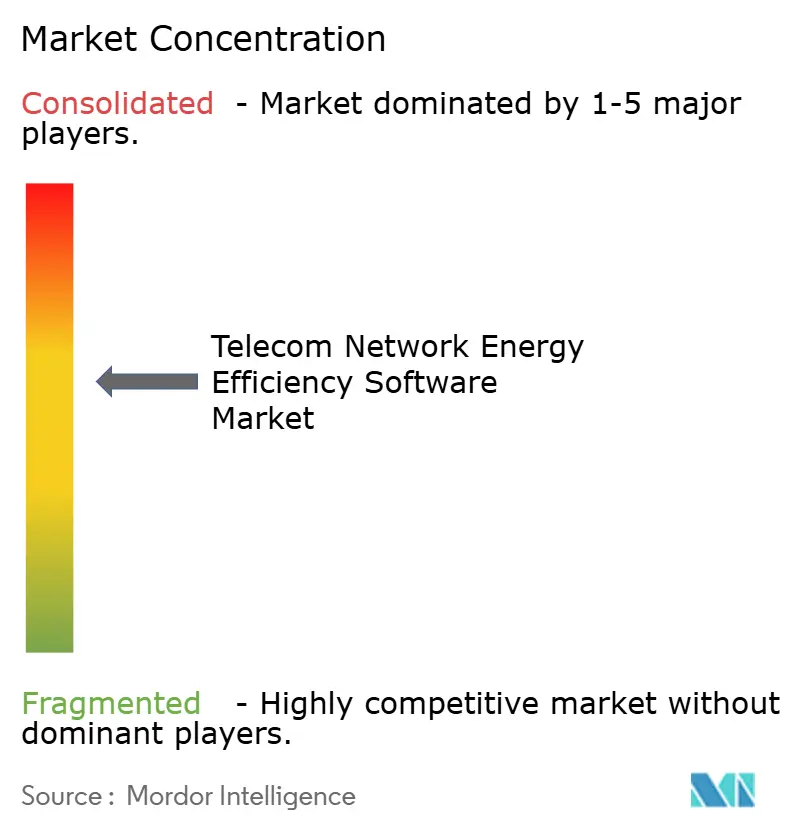
The telecom network energy efficiency software market shows moderate concentration at the enterprise level, where Ericsson, Nokia, and Huawei benefit from large installed bases and broad hardware-software relationships. These companies have an advantage because many operators prefer efficiency tools that can connect with existing radio, automation, and OSS environments without adding a separate vendor layer. In March 2026, Ericsson and Nokia expanded their cooperation between Ericsson’s rApp Ecosystem and Nokia’s SMO Marketplace, strengthening their ability to support cross-vendor autonomous network applications. That move showed that the telecom network energy efficiency software market is shifting from isolated product competition toward platform positioning inside larger multi-vendor operating models. It also increased the importance of interoperability as a competitive lever rather than merely a technical feature.
Huawei is pursuing a different route in the telecom network energy-efficiency software market by combining software, AI, and site infrastructure into a single operating framework. At MWC Barcelona 2026, Huawei launched its New-Generation AI-Powered Green Site and GW-level AIDC solutions, which linked network energy management to broader compute and site optimization goals. Nokia has also stayed active through AI-RAN collaboration with Orange and NVIDIA, which connects network modernization with future efficiency gains in radio processing and AI-enabled operations. Ericsson added another practical deployment example when it launched the next-generation Energy and Enclosure intelligent power platform with Swisscom in March 2026. These moves show that leading suppliers are competing through ecosystem depth, live operator deployments, and tighter links between energy software and broader network transformation.
Specialists are still finding room in the telecom network energy efficiency software market, especially in niches where large incumbents have not yet standardized their offerings. Companies such as Tupl Inc., AirHop Communications, TowerSight AI, and Recenso Services are more likely to compete on speed, domain focus, and narrower use cases than on full platform breadth. TowerSight AI, for example, promotes an AI Energy Management and Trading System that addresses real-time power dispatch across electricity markets, suggesting a possible extension of value beyond direct energy savings. This keeps the telecom network energy efficiency software market open to innovation, even though large vendors still shape the top tier. The strongest white-space areas remain mid-market towerco deployments, edge site orchestration, and tighter links between energy optimization, reporting, and power trading. As a result, competitive intensity is rising, but the structure still favors vendors that can combine trusted network access, measurable savings, and scalable delivery.
Telecom Network Energy Efficiency Software Industry Leaders
-
Huawei Technologies Co., Ltd.
-
Nokia Corporation
-
Telefonaktiebolaget LM Ericsson
-
Cisco Systems, Inc.
-
Schneider Electric SE
- *Disclaimer: Major Players sorted in no particular order
Telecom Network Energy Efficiency Software Market Companies Covered in this Report
- Tupl Inc.
- AirHop Communications, Inc.
- iMBrace Limited
- Recenso Services Ltd.
- TowerSight AI
- Polystar AB
- Nokia Corporation
- Telefonaktiebolaget LM Ericsson
- Huawei Technologies Co., Ltd.
- ZTE Corporation
- Cisco Systems, Inc.
- Siemens AG
- Schneider Electric SE
- ABB Ltd.
- Elisa Industriq
- Vertiv Holdings Co
- Honeywell International Inc.
- Qualcomm Technologies
- Juniper Networks, Inc.
- Mavenir Systems, Inc.
Recent Industry Developments in Telecom Network Energy Efficiency Software Market
- May 2026: Rakuten Mobile and KDDI were jointly selected by Japan's NEDO for an R&D project targeting approximately 40% reduction in data center and virtualized RAN power consumption by 2030, under Japan's post-5G infrastructure development program, the collaboration focuses on simultaneous optimization of virtualized base stations and computing infrastructure to achieve significant power savings at national scale.
- March 2026: Ericsson and Swisscom launched the next-generation Energy and Enclosure intelligent power platform within Swisscom's live network, integrating all site power elements into centralized management with smart diagnostics and real-time automation, following a two-year development collaboration.
- March 2026: Huawei unveiled New-Generation AI-Powered Green Site and GW-level AIDC solutions at MWC Barcelona 2026, targeting zero-carbon network operations and combining energy management software with AI-driven site infrastructure for operators building in the agentic internet era.
- March 2026: Ericsson and Nokia announced a landmark multi-vendor autonomous networks collaboration, with Nokia joining Ericsson's rApp Ecosystem and Ericsson joining Nokia's SMO Marketplace, enabling cross-vendor open RAN automation applications that are deployable across purpose-built, cloud RAN, and Open RAN networks.
Global Telecom Network Energy Efficiency Software Market Report Scope
The Telecom Network Energy Efficiency Software market refers to platforms and services that enable telecom operators and infrastructure providers to monitor, analyze, and optimize energy consumption across mobile networks, towers, and data transmission systems. These solutions provide functionalities such as real-time energy monitoring and visibility, advanced analytics and reporting, AI-driven power optimization, and automated energy management. By embedding sustainability intelligence into telecom operations, these platforms help reduce operational costs, improve network reliability, and align with ESG and decarbonization goals.
The Telecom Network Energy Efficiency Software market report is segmented by Component (Software, and Services), Solution Type (Energy Monitoring and Visibility Software, Energy Analytics and Reporting Software, AI-Based Power Optimization Software, and Energy Management and Automation Software), Deployment Mode (Cloud/SaaS, On-Premises, and Hybrid), End User (Mobile Network Operators, Tower Companies, Internet Service Providers, and Network Infrastructure Providers), and Geography (North America, South America, Europe, Asia-Pacific, Middle East, and Africa). The Market Forecasts are Provided in Terms of Value (USD).
Segmentation Overview
| Software |
| Services |
| Energy Monitoring and Visibility Software |
| Energy Analytics and Reporting Software |
| AI-Based Power Optimization Software |
| Energy Management and Automation Software |
| Cloud/SaaS |
| On-Premises |
| Hybrid |
| Mobile Network Operators |
| Tower Companies |
| Internet Service Providers |
| Network Infrastructure Providers |
| North America | United States | |
| Canada | ||
| Mexico | ||
| South America | Brazil | |
| Argentina | ||
| Rest of South America | ||
| Europe | Germany | |
| United Kingdom | ||
| France | ||
| Italy | ||
| Spain | ||
| Russia | ||
| Rest of Europe | ||
| Asia-Pacific | China | |
| India | ||
| Japan | ||
| South Korea | ||
| Australia | ||
| Rest of Asia-Pacific | ||
| Middle East and Africa | Middle East | Saudi Arabia |
| United Arab Emirates | ||
| Turkey | ||
| Rest of Middle East | ||
| Africa | South Africa | |
| Egypt | ||
| Rest of Africa | ||
| By Component | Software | ||
| Services | |||
| By Solution Type | Energy Monitoring and Visibility Software | ||
| Energy Analytics and Reporting Software | |||
| AI-Based Power Optimization Software | |||
| Energy Management and Automation Software | |||
| By Deployment Mode | Cloud/SaaS | ||
| On-Premises | |||
| Hybrid | |||
| By End User | Mobile Network Operators | ||
| Tower Companies | |||
| Internet Service Providers | |||
| Network Infrastructure Providers | |||
| By Geography | North America | United States | |
| Canada | |||
| Mexico | |||
| South America | Brazil | ||
| Argentina | |||
| Rest of South America | |||
| Europe | Germany | ||
| United Kingdom | |||
| France | |||
| Italy | |||
| Spain | |||
| Russia | |||
| Rest of Europe | |||
| Asia-Pacific | China | ||
| India | |||
| Japan | |||
| South Korea | |||
| Australia | |||
| Rest of Asia-Pacific | |||
| Middle East and Africa | Middle East | Saudi Arabia | |
| United Arab Emirates | |||
| Turkey | |||
| Rest of Middle East | |||
| Africa | South Africa | ||
| Egypt | |||
| Rest of Africa | |||
Key Questions Answered in the Report
What is the current size of the telecom network energy efficiency software market?
The telecom network energy efficiency software market was valued at USD 1.37 billion in 2025 and is projected to reach USD 3.64 billion by 2031 at a 17.87% CAGR.
Which region leads telecom network energy efficiency software adoption?
Europe led in 2025 with a 34.56% share, supported by stronger policy direction and visible operator sustainability programs.
Which region is growing the fastest through 2031?
Asia-Pacific is projected to grow at an 18.45% CAGR, supported by continued network rollout and wider software deployment across operators.
Which deployment model is most widely used?
Cloud/SaaS led with a 66.12% share in 2025 because it lowers upfront infrastructure needs and supports faster rollout.
Which solution type is growing the fastest?
AI-Based Power Optimization Software is the fastest-growing solution type, with an expected 18.65% CAGR through 2031.
Why are tower companies becoming more important buyers?
Tower companies are projected to grow at an 18.34% CAGR because diesel and electricity costs are pushing them to improve site-level efficiency and control operating margins.