
South America ITSM Market Size and Share
Market Overview
| Study Period | 2020 - 2031 |
|---|---|
| Forecast Data Period | 2026 - 2031 |
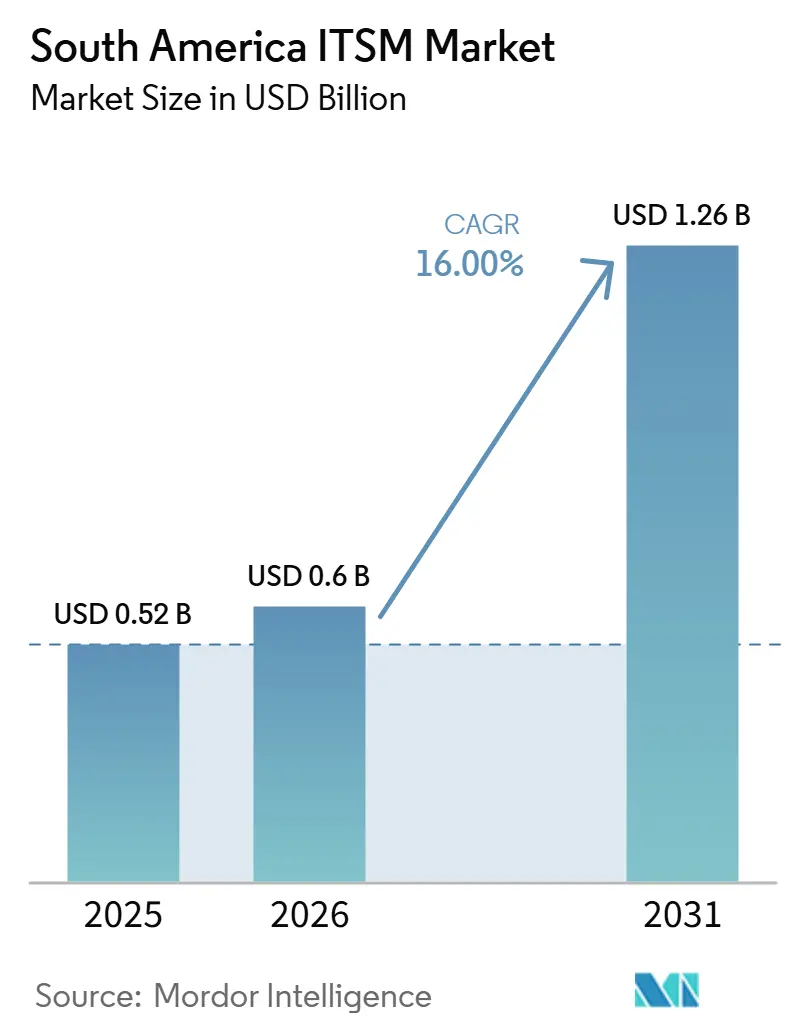
| Base Year Market Size (2025) | USD 0.52 Billion |
| Market Size (2026) | USD 0.6 Billion |
| Market Size (2031) | USD 1.26 Billion |
| Growth Rate (2026 - 2031) | 16.00 % |
| Market Concentration | Medium |
Major Players *Disclaimer: Major Players sorted in no particular order Image © Mordor Intelligence. Reuse requires attribution under CC BY 4.0. | |
South America ITSM Market Analysis by Mordor Intelligence
The South America IT service management market size was valued at USD 0.52 billion in 2025 and is projected to reach USD 1.26 billion by 2031, at a CAGR of 16.00% during 2026-2031. The region is moving away from basic ticketing tools toward broader platforms that integrate IT operations, employee support, and customer-facing workflows in a single environment. Brazil remains the anchor for demand because its larger enterprise technology base supports earlier adoption of platform-led service management across banking, telecom, retail, and other large sectors. Cloud delivery, AI-assisted workflows, and multilingual support are shaping buying decisions as enterprises seek lower infrastructure burden, faster rollouts, and better employee adoption across Portuguese- and Spanish-speaking workforces. Data protection requirements are also affecting vendor selection, as enterprises increasingly prefer providers with local infrastructure and stronger compliance positions. At the same time, currency volatility and uneven digital maturity outside the largest cities continue to slow wider adoption, even as the South America IT service management market continues to open new opportunities in healthcare, public services, and the regional mid-market.
Key Report Takeaways
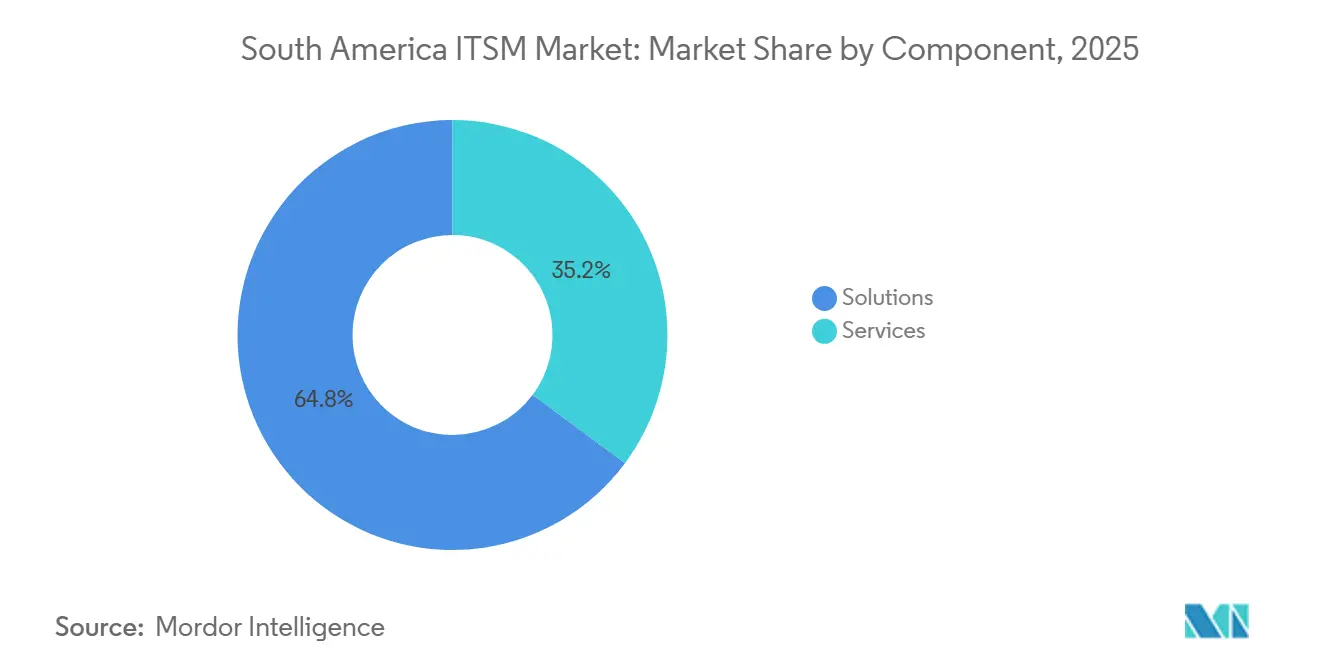
- By component, solutions held 64.82% of the South America IT service management market in 2025, and the services segment is projected to expand at a 17.12% CAGR through 2031.
- By deployment, cloud accounted for 61.82% of the South America IT service management market in 2025 and is expected to grow at a 17.26% CAGR through 2031.
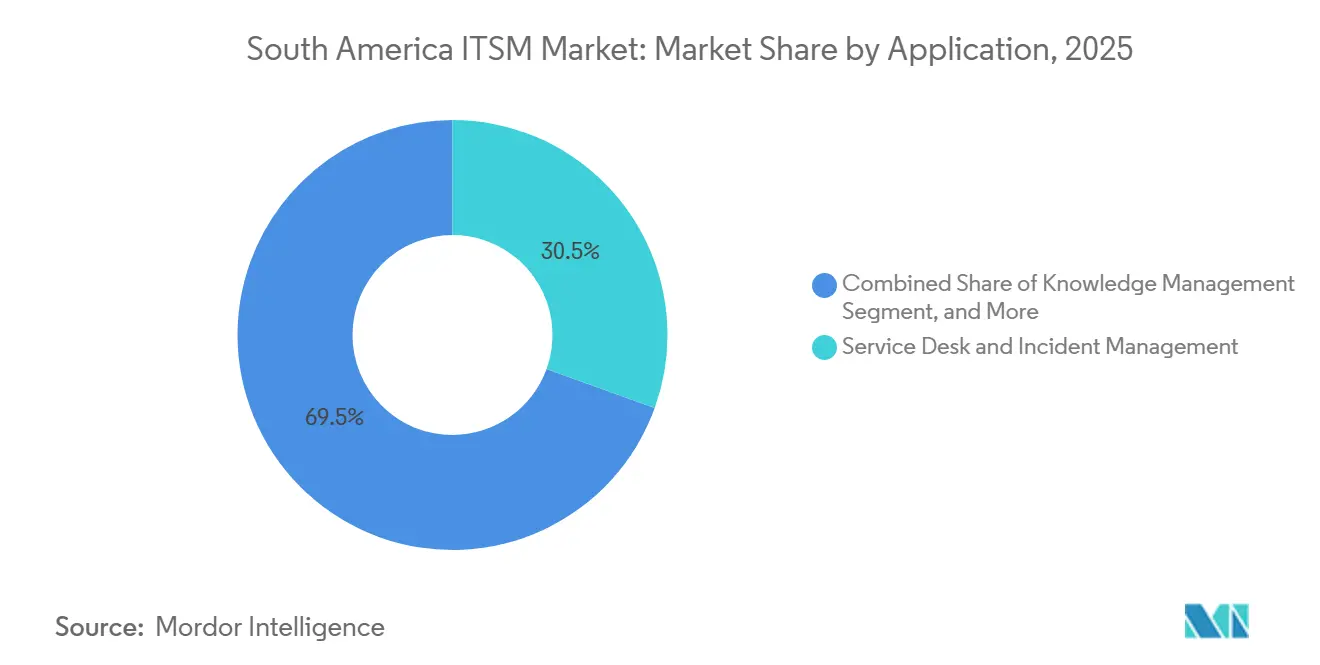
- By application, service desk and incident management captured 30.52% of the South America IT service management market in 2025, while knowledge management is projected to record the fastest CAGR at 17.18% through 2031.
- By end-user industry, BFSI led the South America IT service management market with 24.73% of revenue in 2025, while healthcare is projected to expand at a 17.23% CAGR through 2031.
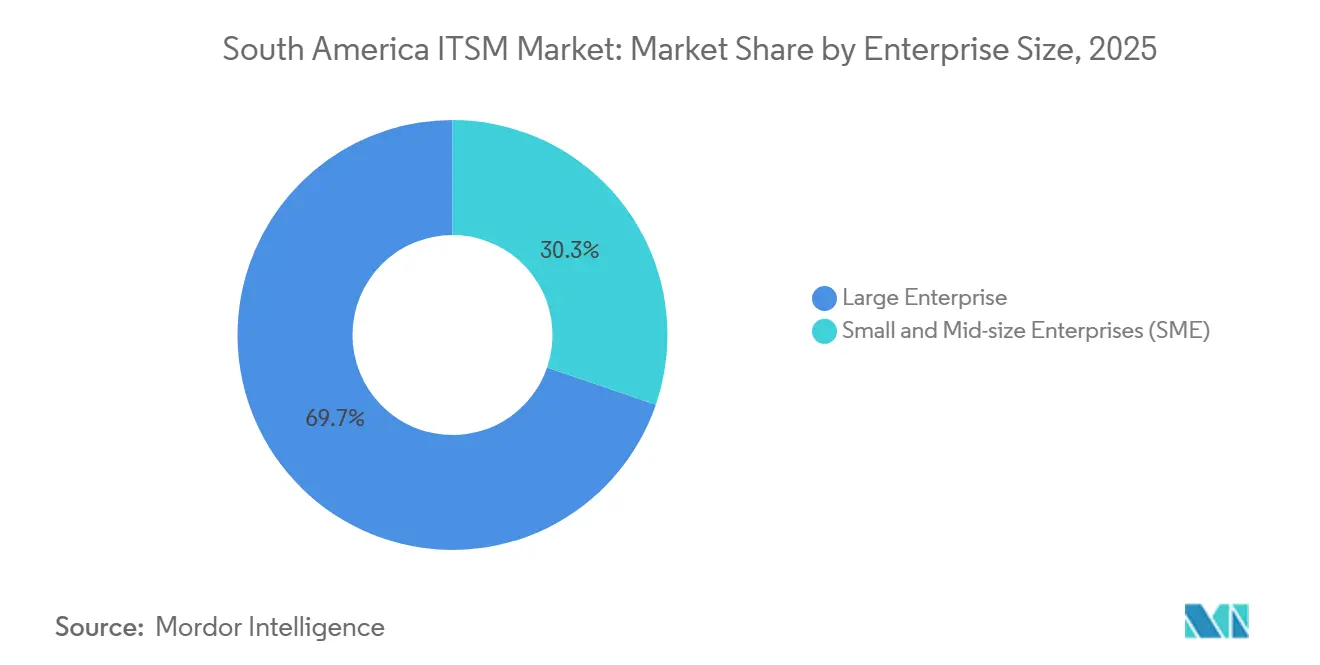
- By enterprise size, large enterprises accounted for 69.74% of the South America IT service management market in 2025, while SMEs are projected to register the highest CAGR at 17.67% through 2031.
- By geography, Brazil held 54.62% share of the South America IT service management market in 2025, while Argentina is projected to grow at a 17.01% CAGR through 2031.
Note: Market size and forecast figures in this report are generated using Mordor Intelligence’s proprietary estimation framework, updated with the latest available data and insights as of January 2026.
Market Trends and Insights
Drivers Impact Analysis of South America ITSM Market*
| Driver | (~) % Impact on CAGR Forecast | Geographic Relevance | Impact Timeline |
|---|---|---|---|
| Increasing Enterprise Digitization in Banking, Retail, and Telecom | +4.2% | Brazil, Argentina, secondary in Colombia and Chile | Short term (≤ 2 years) |
| Demand for Cost-Efficient Cloud ITSM Platforms | +3.5% | South America-wide, concentrated in Brazil and Argentina | Short term (≤ 2 years) |
| Need for Spanish and Portuguese Language Service Experiences | +2.8% | Brazil, Argentina, Colombia, Chile | Medium term (2-4 years) |
| Growing Interest in Centralized Service Delivery for Distributed Operations | +2.1% | Brazil, Argentina, expanding to Colombia and Peru | Medium term (2-4 years) |
| Rising Use of Shared Services and Regional IT Standardization | +1.5% | Brazil, Argentina, rest of South America | Medium term (2-4 years) |
| Expansion of Outsourced IT Support Models Across Mid-Sized Firms | +1.0% | Brazil, Colombia, Chile | Long term (≥ 4 years) |
| Source: Mordor Intelligence | |||
Increasing Enterprise Digitization In Banking, Retail, And Telecom
The South America IT service management market is benefiting from a broad upgrade in enterprise systems across banking, retail, and telecom. Banks and telecom operators are replacing disconnected support processes with platform-based service management to support digital channels that now require faster issue resolution and more stable operations. Brazilian banks allocated a combined technology budget toward digital operations in 2025, and cloud migration allocations rose significantly year over year. The telecom push into 5G is also increasing operational complexity across hybrid, multi-vendor environments, which is driving greater demand for stronger workflow control and incident response. Retailers are seeing a similar need because omnichannel operations require stable backend systems and better coordination across applications, devices, and service teams. As enterprises extend these workflows beyond IT into finance, HR, and supply chain functions, the South America IT service management market gains from deeper platform usage and stronger renewal potential.
Demand For Cost-Efficient Cloud ITSM Platforms
The South America IT service management market is also moving higher because cloud delivery better aligns with the region’s budget priorities than infrastructure-heavy deployments. Many enterprises want subscription models that lower upfront spending and make costs easier to manage during periods of exchange-rate pressure and uneven capital availability. Public cloud infrastructure spending in Brazil reached new heights, with a notable year-over-year increase, confirming that cloud adoption is already well established in the region’s largest technology economy.[1] That shift supports cloud ITSM because SaaS platforms eliminate local infrastructure costs, enable faster scaling, and reduce the need for lengthy implementation cycles. Preconfigured templates and managed deployment models are also making these tools easier for companies without large internal IT teams to adopt. As cloud environments become more central to enterprise operations, the South America IT service management market is seeing stronger demand for structured support, automated ticketing, and platform-led service governance.
Need For Spanish And Portuguese Language Service Experiences
Language support is becoming a practical buying factor in the South America IT service management market because user adoption depends on how easily employees can navigate service catalogs, knowledge articles, and virtual agents. English-only deployments tend to slow self-service usage and increase escalations when most end users work in Portuguese or Spanish. This matters because many regional organizations are not just buying workflow engines, they are trying to improve service quality across broad employee populations. The need is stronger in large, distributed enterprises where standardized service experiences must still feel local to each workforce. It also matters for knowledge management because multilingual repositories are more likely to support repeat issue resolution without human intervention. Vendors that offer stronger localization therefore have a clearer path to wider usage, higher automation rates, and better retention inside the South America IT service management market.
Growing Interest In Centralized Service Delivery For Distributed Operations
The South America IT service management market is benefiting from a broader shift toward centralized service delivery across companies operating in multiple countries or across many domestic locations. Enterprises want one support structure that can standardize response times, workflows, and reporting across different business units. Shared-services organizations in South America achieved 87% satisfaction in regional benchmarking, higher than comparable organizations in Asia, Europe, and North America. That performance supports further expansion of shared-service centers, especially in Brazil and Argentina, where multinational operations are more concentrated. Centralized models also increase the need to connect ITSM platforms with ERP, CRM, HR, and compliance systems, because a single service layer must coordinate a wider set of internal processes. As those integrations deepen, the South America IT service management market benefits from broader license usage and higher switching costs for installed platforms.
Restraints Impact Analysis of South America ITSM Market*
| Restraint | (~) % Impact on CAGR Forecast | Geographic Relevance | Impact Timeline |
|---|---|---|---|
| Currency Volatility Affecting Subscription And Renewal Budgets | -3.5% | Argentina, Brazil, Colombia | Short term (≤ 2 years) |
| Lower ITSM Penetration Outside Large Urban Enterprises | -2.3% | Rest of South America, secondary cities in Brazil and Argentina | Medium term (2-4 years) |
| Budget Constraints Delaying Enterprise Platform Modernization | -1.8% | South America-wide, higher impact in smaller economies | Medium term (2-4 years) |
| Dependence On Local Integrators And Limited In-House Implementation Skills | -1.2% | Brazil mid-market, rest of South America | Long term (≥ 4 years) |
| Source: Mordor Intelligence | |||
Currency Volatility Affecting Subscription and Renewal Budgets
Currency pressure remains one of the clearest restraints on the South America IT service management market because many software contracts are priced in USD while customer revenues are generated in local currency. That mismatch makes multi-year planning more difficult for procurement teams and creates greater hesitation around platform upgrades, renewals, and user expansion. The issue is especially relevant in Argentina, where exchange-rate instability has weighed on confidence in longer software commitments. The OECD noted that Argentina’s IMF Extended Fund Facility supported the lifting of most currency and capital controls, thereby improving the medium-term operating backdrop, even though near-term uncertainty remained.[2] Vendors are responding with local-currency billing and flexible pricing structures, but these steps add commercial complexity and can lengthen the sales process. This is particularly restrictive for mid-sized buyers, which means the South America IT service management market may face slower expansion among the very customer group that offers some of its best long-term upside.
Lower ITSM Penetration Outside Large Urban Enterprises
Adoption outside the largest business centers remains uneven, which limits the pace at which the South America IT service management market can expand across the full regional enterprise base. Many firms in interior states and smaller economies still rely on email, phone, or informal support practices rather than structured service platforms. That leaves a meaningful addressable base untapped, but it also means vendors must work through lower digital maturity and thinner local partner networks. The challenge is not demand alone, it is also delivery, because implementation support and post-sales guidance are harder to scale outside major metros. Managed service models are helping to reduce that gap by giving enterprises access to platform capabilities without building large in-house teams. Even so, the South America IT service management market is likely to see slower revenue growth from these underpenetrated areas until service partners and broader digital readiness improve.
*Our forecasts treat driver/restraint impacts as directional, not additive. The impact forecasts reflect baseline growth, mix effects, and variable interactions.
South America ITSM Market Segment Analysis
By Component:
Solutions Consolidate Dominance As Platform Adoption DeepensSolutions held 64.82% of South America IT service management market share in 2025, which showed how strongly buyers favored integrated platforms over narrow tools. While the services segment is projected to expand at a 17.12% CAGR through 2031, indicating continued preference for unified suites that combine incident management, asset visibility, change workflows, and knowledge support. This direction reflects a practical shift in the South America IT service management market, as enterprises seek fewer disconnected systems and less integration burden. It also aligns with the operational realities of regional IT teams, which often need faster rollouts and simpler governance rather than extensive tool customization.
The solutions lead is also tied to AI functionality, because automated ticket classification, virtual agents, and predictive resolution are easier to deploy within broader platforms than across mixed-point solutions. Enterprises are increasingly looking for a single layer that can extend from IT support to employee services, customer workflows, and compliance tasks. That raises the value of platform licensing and strengthens renewal potential for vendors that already have a foothold in large accounts. Services still account for the remaining component demand, and that keeps implementation, training, and managed support important in the South America IT service management industry. Local system integrators and global consulting firms continue to benefit from this services stream, especially when enterprises expand into more advanced workflows. Even so, the center of value creation remains in software platforms, which keeps the South America IT service management market weighted toward solutions rather than labor-led service contracts.
By Deployment:
Cloud Commands Share, Driving Service Infrastructure ModernizationCloud accounted for 61.82% of 2025 revenue in the South America IT service management market, confirming that SaaS delivery had become the preferred deployment model. It is also the fastest-growing deployment model, with a projected 17.26% CAGR through 2031. Buyers are choosing cloud because it reduces local infrastructure requirements, shortens rollout time, and aligns more naturally with subscription-based budget planning. The South America IT service management market is also seeing cloud benefit from stronger enterprise confidence in regional digital infrastructure. Growth in public cloud spending has reinforced the idea that critical workloads can be managed through hosted models rather than through isolated on-premise environments.
At the same time, cloud is not replacing every other model at the same pace across all verticals. Hybrid deployments are gaining traction in government and regulated financial services settings, where parts of the environment still require local control. On-premise deployments remain relevant for organizations that have already made large infrastructure investments and prefer to extend those assets rather than replace them quickly. Vendors have adjusted to this by strengthening local infrastructure and regional support capabilities, especially in Brazil. ServiceNow’s expansion of its Rio de Janeiro and Brasília data centers shows that major vendors see local hosting as a practical requirement for wider enterprise adoption. As those capabilities improve, the South America IT service management market should see cloud adoption widen further across secondary cities and more performance-sensitive use cases.
By Application:
Service Desk Anchors Revenues, Knowledge Management Leads GrowthService desk and incident management accounted for 30.52% of the South America IT service management market in 2025, making it the core application layer in most deployments. Knowledge management is projected to post the fastest growth at a 17.18% CAGR through 2031, reflecting a wider push toward self-service and AI-assisted resolution. This pattern is logical because most organizations still begin with basic ticketing and incident workflows before moving into more advanced modules. Once those foundations are in place, they tend to build knowledge repositories, virtual support tools, and automation rules that reduce repeat work. The South America IT service management market is therefore evolving from first-stage support use cases into broader service optimization.
Knowledge management is gaining popularity because enterprises want to reduce frontline ticket volumes and make internal support less dependent on scarce specialist talent. Multilingual content matters here because Portuguese and Spanish knowledge bases are more useful for employee self-service than English-only documentation. Regional enterprises are also trying to standardize service catalogs and make recurring issues easier to resolve without manual intervention. The move toward AI-assisted search and response strengthens that case because it improves the usefulness of knowledge libraries at scale. ISG noted that Brazilian enterprises are extending platform usage into more advanced workflows, which supports a broader application mix beyond the service desk. As a result, the South America IT service management market is not just adding new users, it is also increasing the number of use cases within existing accounts.

By End-User Industry:
BFSI Commands Share, Healthcare Drives The Next Growth CycleBFSI led the South America IT service management market with 24.73% of revenue in 2025, while healthcare is projected to record the fastest growth at 17.23% through 2031. Financial institutions remain the largest users because they operate complex digital channels, face strict service continuity demands, and continue to invest in core modernization. Banks also need stronger incident response, change control, and audit visibility across large technology estates. That keeps the South America IT service management market well anchored in BFSI, especially in Brazil, where banking technology spending remains high. The same logic extends to insurance and digital payments, where service downtime can quickly erode customer trust and expose the company to regulatory risks.
Healthcare is moving faster because digital infrastructure inside hospitals and health systems is becoming more complex. The 12th TIC Saúde survey found that 18% of Brazilian healthcare facilities used AI by 2025, and the share rose to 31% in facilities with more than 50 beds. That expansion of digital tools raises the need for structured incident management, service requests, and technology support around clinical and administrative systems. Hospital environments combine legacy applications, connected equipment, and cloud platforms, making service coordination harder than in less-regulated sectors. The Brazilian federal government also launched a public tender in January 2026 for SUS Digital and Agora Tem Especialistas, which points to a broader push in public-sector health digitization. That backdrop supports a stronger healthcare contribution to the South America IT service management market over the forecast period.
By Enterprise Size:
Large Enterprises Anchor The Base, SMEs Register Fastest GrowthLarge enterprises accounted for 69.74% of revenue in 2025, which made them the core demand base for the South America IT service management market. SMEs are projected to grow faster, at a 17.67% CAGR through 2031, as pricing models and managed delivery lower adoption barriers. Large organizations continue to lead because they run broader IT estates, face more reporting obligations, and can spread platform costs across multiple business functions. Many of these companies already use several ITSM modules and are now extending into AI, automation, and cross-functional workflows. That gives the South America IT service management market a stable installed base with room for deeper usage inside large accounts.
The faster SME growth reflects a different pattern. Many mid-sized buyers are adopting formal IT service management for the first time rather than replacing an old incumbent system. That gives cloud-native vendors a better chance to compete on ease of deployment, price, and managed support. ManageEngine said it planned to double its Brazil headcount in 2026 after 36% growth in the country, with that investment aimed at SME and mid-market accounts. Freshworks and Unisys also announced a managed service partnership in February 2025 to broaden enterprise ITSM access through an MSP model. These moves show that the South America IT service management market is no longer centered only on top-tier enterprises, even though that segment still drives most current revenue.
Geography Analysis
Brazil ITSM Market
Brazil captured 54.62% of South America IT service management market share in 2025, which kept it as the region’s clear revenue leader. The country supports the South America IT service management market with the deepest enterprise technology base and the broadest concentration of large buyers in banking, telecom, retail, and manufacturing. Brazil’s total IT investments reached USD 67.8 billion in 2025, up 18.5%, providing the region's largest addressable technology base. Brazilian enterprises are also extending service management platforms beyond the core IT service desk into wider workflow areas. Compliance expectations under the LGPD further support vendors with local infrastructure and stronger data-handling capabilities.
Argentina ITSM Market
Argentina is projected to record the fastest growth, with a 17.01% CAGR through 2031 in the South America IT service management market. The country is benefiting from deregulation and a broader digital services push, creating a more supportive environment for enterprise technology investment. The OECD said Argentina’s IMF program helped lift most currency and capital controls, improving the policy backdrop for longer-term business commitments. Adoption is building across government, telecom, financial institutions, and health systems as organizations move toward more formal digital operations. Even with ongoing macro pressure, the direction of change supports a faster country-level expansion path than the regional average.
Broader South America ITSM Market
The rest of South America held the remaining 2025 revenue share and is growing below the regional average, though the picture is mixed by country and sector. Colombia is seeing support from e-invoicing, 5G activity, and multinational presence in Bogotá, which is raising interest in structured service platforms. Chile remains more digitally mature relative to its size, especially in financial services and mining-related enterprises that already rely on formal service processes. Peru and Ecuador are earlier-stage opportunities where adoption is still concentrated among larger banks and telecom operators. Secondary markets therefore expand more slowly, but they still widen the long-run footprint of the South America IT service management market as partner networks and cloud readiness improve.
Competitive Landscape
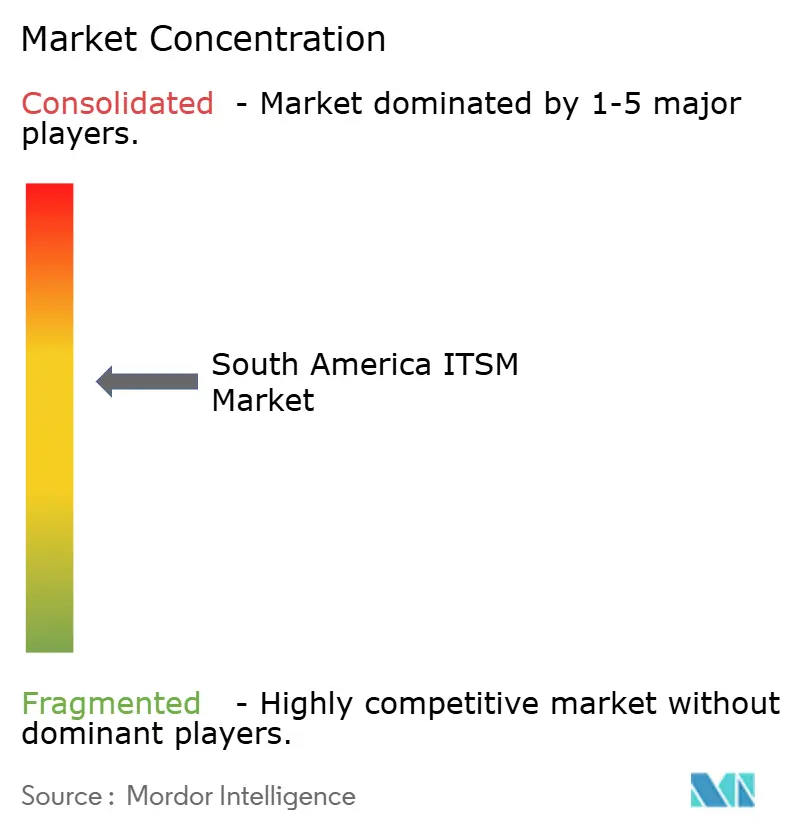
The South America IT service management market remains moderately concentrated at the enterprise tier, where ServiceNow, IBM, and BMC Helix have strong positions in large deployments. Competition centers on AI capability, local infrastructure, workflow depth, and partner reach rather than price alone. ServiceNow has been especially active in Brazil, where it expanded local data center capacity and saw Brazilian firms adopt its platform for more integrated AI-enabled workflows. That move matters because local hosting and stronger platform breadth directly address the needs of regulated and large-scale accounts in the South America IT service management market.
Atlassian has built a strong position among technology-led organizations through Jira Service Management, particularly among software delivery teams seeking tight alignment between development and service workflows. ManageEngine and Freshworks are taking a different route by focusing more directly on mid-market and SME opportunities through easier deployment and partner-led coverage. Freshworks strengthened that path through its partnership with Unisys in February 2025, which expanded managed service access for enterprise customers across many countries. BMC Helix also reinforced its regulated-sector focus by formalizing its Brazilian legal entity and supporting local data residency requirements. These moves show that competition in the South America IT service management market is being shaped by route-to-market choices as much as by product design.
White-space opportunities remain strongest in healthcare outside major cities, provincial and municipal government bodies, and manufacturing operations in Brazil’s interior and Chile’s mining corridors. Global vendors often do not cover these accounts directly because the cost of direct sales and delivery is harder to justify at smaller contract sizes. That gap is giving channel partners and regional service firms a larger role in market expansion. Ivanti’s selection of Bpod as a dedicated South America expansion partner in 2026 is one clear example of that approach.[3] Vendors that combine local language support, implementation presence, and sector references in BFSI and healthcare should be better placed as the South America IT service management market moves deeper into the regional mid-market. The competitive picture is therefore broadening, but it is not yet fully fragmented because large-enterprise buying still favors a limited group of established global platforms.
South America ITSM Industry Leaders
-
ServiceNow, Inc.
-
IBM Corporation
-
BMC Software, Inc.
-
Atlassian Corporation Plc
-
Ivanti, Inc.
- *Disclaimer: Major Players sorted in no particular order
South America ITSM Market Companies Covered in this Report
- ServiceNow, Inc.
- IBM Corporation
- BMC Software, Inc.
- Atlassian Corporation Plc
- Ivanti, Inc.
- Freshworks Inc.
- ManageEngine, a division of Zoho Corporation Pvt. Ltd.
- Broadcom Inc.
- Open Text Corporation
- ASG Technologies Group, Inc.
- SysAid Technologies Ltd.
- Cherwell Software, LLC
- TOPdesk B.V.
- Hornbill Service Management Ltd.
- SymphonyAI Summit
- EasyVista S.A.
- SolarWinds Corporation
- Atlassian Corporation Plc
- Axelos Limited
Recent Industry Developments in South America ITSM Market
- June 2026: Ivanti selected Bpod as its dedicated South America expansion partner to strengthen its regional channel network, placing priority emphasis on Brazil and targeting additional growth in key South America markets.
- April 2026: ISG published the 2026 ISG Provider Lens ServiceNow Ecosystem Partners report for Brazil, confirming that Brazilian enterprises are transitioning from fragmented digital initiatives to integrated, AI-enabled workflows on the ServiceNow platform. The report documented the opening of ServiceNow's new data centers in Rio de Janeiro and Brasília, and noted Brazil's growing strategic importance as a South America hub for the vendor.
- January 2026: The Brazilian federal government launched Edital 1/2026, a public tender to identify technology partners for the SUS Digital and Agora Tem Especialistas programs. The initiative positions ITSM-adjacent digital service management as infrastructure for Brazil's public health system modernization, opening a significant public-sector procurement pipeline.
- October 2025: BMC Helix formalized its Brazilian legal entity following its April 2025 separation from BMC Software. The entity established a local data center serving clients with data residency requirements, including government agencies and regulated financial institutions, and set a target of 15 new Brazil clients per year.
South America ITSM Market Report Scope
The South America IT Service Management Market is Segmented by Component (Solutions, Services), Deployment (Cloud, On-Premise, Hybrid), Application (Service Desk and Incident Management, Asset and Configuration Management, Change and Release Management, Service Request Management, Knowledge Management, Others), End-User Industry (BFSI, Manufacturing, Government and Public Sector, IT and Telecommunications, Retail and E-Commerce, Healthcare, Others), Enterprise Size (Large Enterprises, SME), and Country (Brazil, Argentina, and Rest of South America). The Market Forecasts are Provided in Terms of Value (USD).
Segmentation Overview
| Solutions |
| Services |
| Cloud |
| On-Premise |
| Hybrid |
| Service Desk and Incident Management |
| Asset and Configuration Management |
| Change and Release Management |
| Service Request Management |
| Knowledge Management |
| Other ITSM Applications |
| BFSI |
| Manufacturing |
| Government and Public Sector |
| IT and Telecommunications |
| Retail and E-Commerce |
| Healthcare |
| Travel and Hospitality |
| Other End-User Industries |
| Large Enterprises |
| Small and Mid-Size Enterprises (SME) |
| Brazil |
| Argentina |
| Rest of South America |
| By Component | Solutions |
| Services | |
| By Deployment | Cloud |
| On-Premise | |
| Hybrid | |
| By Application | Service Desk and Incident Management |
| Asset and Configuration Management | |
| Change and Release Management | |
| Service Request Management | |
| Knowledge Management | |
| Other ITSM Applications | |
| By End-User Industry | BFSI |
| Manufacturing | |
| Government and Public Sector | |
| IT and Telecommunications | |
| Retail and E-Commerce | |
| Healthcare | |
| Travel and Hospitality | |
| Other End-User Industries | |
| By Enterprise Size | Large Enterprises |
| Small and Mid-Size Enterprises (SME) | |
| By Country | Brazil |
| Argentina | |
| Rest of South America |
Key Questions Answered in the Report
What is the current size of the South America IT service management space?
The South America IT service management market was valued at USD 520.00 million in 2025 and is projected to reach USD 1,260 million by 2031 at a 16.00% CAGR during 2026-2031.
Which deployment model leads adoption across the region?
Cloud led with 61.82% share in 2025 and is also the fastest-growing deployment model, with a projected 17.26% CAGR through 2031.
Which end-user group drives the most revenue today?
BFSI accounted for 24.73% of revenue in 2025 because banks and financial institutions continue to invest in digital operations, service continuity, and compliance-led technology upgrades.
Which use case is growing the fastest in service management platforms?
Knowledge management is projected to grow at 17.18% CAGR through 2031 as enterprises invest in self-service, multilingual support content, and AI-assisted issue resolution.
Why does Brazil remain the key country for vendors?
Brazil held 54.62% of regional revenue in 2025 and benefits from the largest enterprise technology base, deeper banking and telecom demand, and stronger local infrastructure for cloud delivery.