
North America ITSM Market Size and Share
Market Overview
| Study Period | 2020 - 2031 |
|---|---|
| Forecast Data Period | 2026 - 2031 |
| Base Year Market Size (2025) | USD 4.89 Billion |
| Market Size (2026) | USD 5.56 Billion |
| Market Size (2031) | USD 10.90 Billion |
| Growth Rate (2026 - 2031) | 14.39 % |
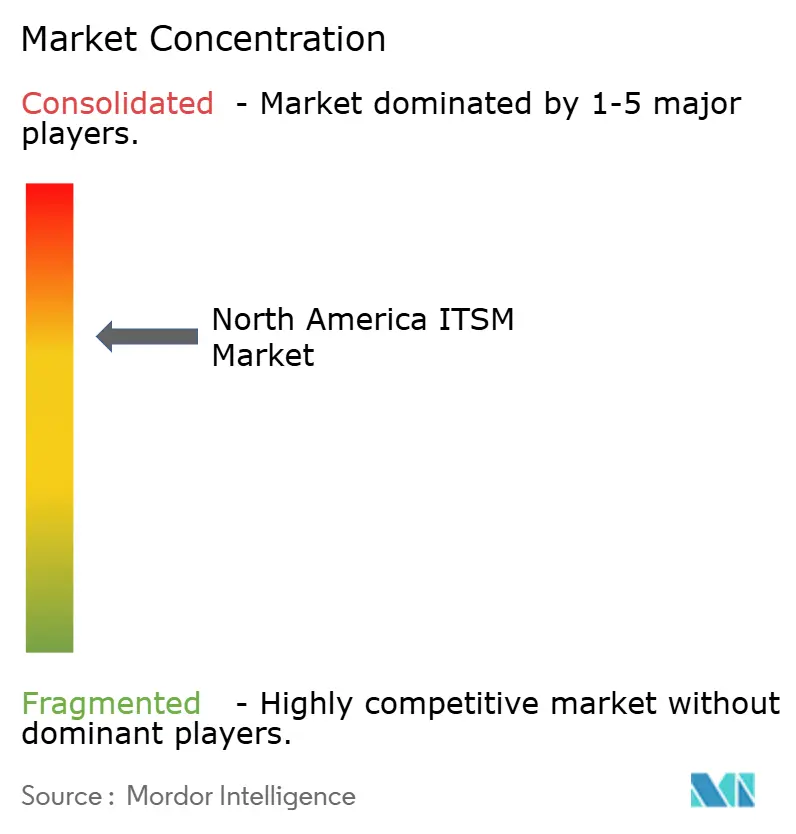
| Market Concentration | Medium |
Major Players *Disclaimer: Major Players sorted in no particular order Image © Mordor Intelligence. Reuse requires attribution under CC BY 4.0. | |
North America ITSM Market Analysis by Mordor Intelligence
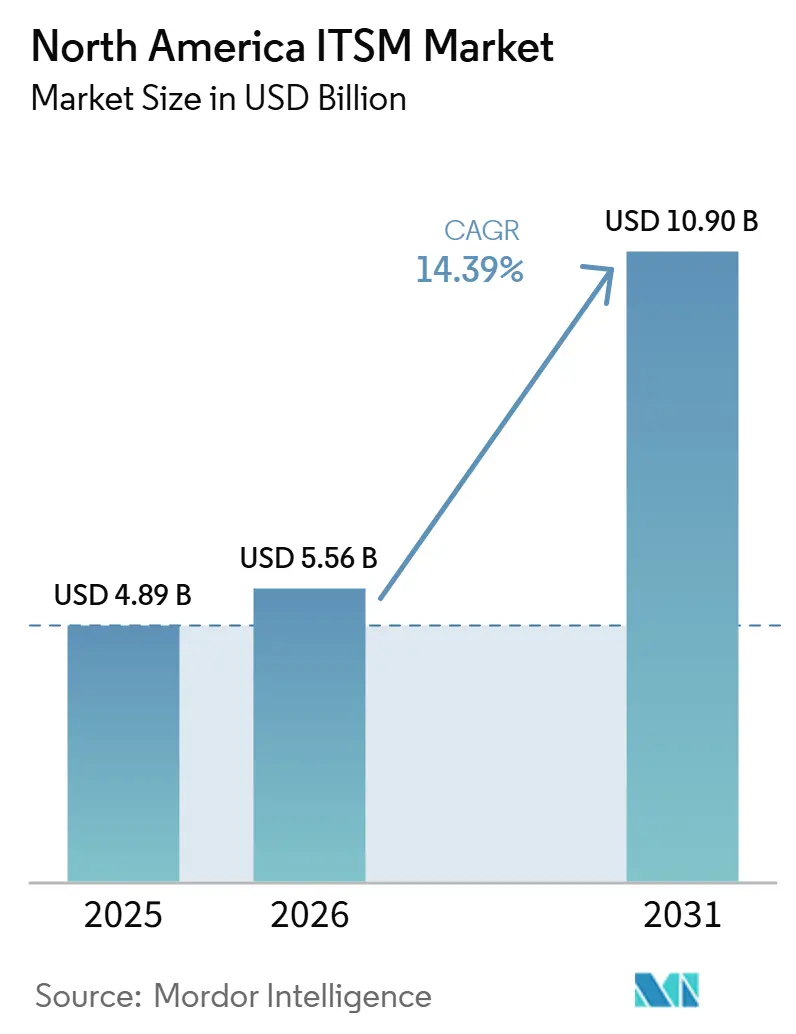
The North America IT service management market size is projected to expand from USD 4.89 billion in 2025 and USD 5.56 billion in 2026 to USD 10.9 billion by 2031, registering a CAGR of 14.39% between 2026 to 2031. Demand is rising early in the forecast window because many enterprises are replacing older service desk environments sooner than planned. Cloud-native platforms, generative AI in ticket handling, and enterprise efforts to bring IT, HR, and customer service workflows onto one control layer are shaping spending across the region. Each migration decision is also prompting a wider redesign cycle, because adjacent service functions often move onto the same platform once the core stack is modernized. The North America IT service management market is also being shaped by tighter links with security, observability, and automation needs, which are raising the value of broader platform contracts. Large-enterprise penetration is already high, yet room for growth remains in healthcare, regulated accounts, and SMEs that can now adopt subscription offerings with lower upfront implementation burdens.
Key Report Takeaways
- By component, solutions held a 62.61% share of the North America ITSM market in 2025, and Services are projected to expand at a 16.12% CAGR through 2031.
- By deployment, cloud held 58.72% share of the North America ITSM market in 2025 and is projected to expand at a 15.89% CAGR through 2031.
- By application, service desk and incident management accounted for 29.73% of the North America ITSM market in 2025, while knowledge management is projected to expand at a 15.56% CAGR through 2031.
- By end-user industry, BFSI held 23.72% share of the North America ITSM market in 2025, while healthcare is projected to expand at a 15.72% CAGR through 2031.
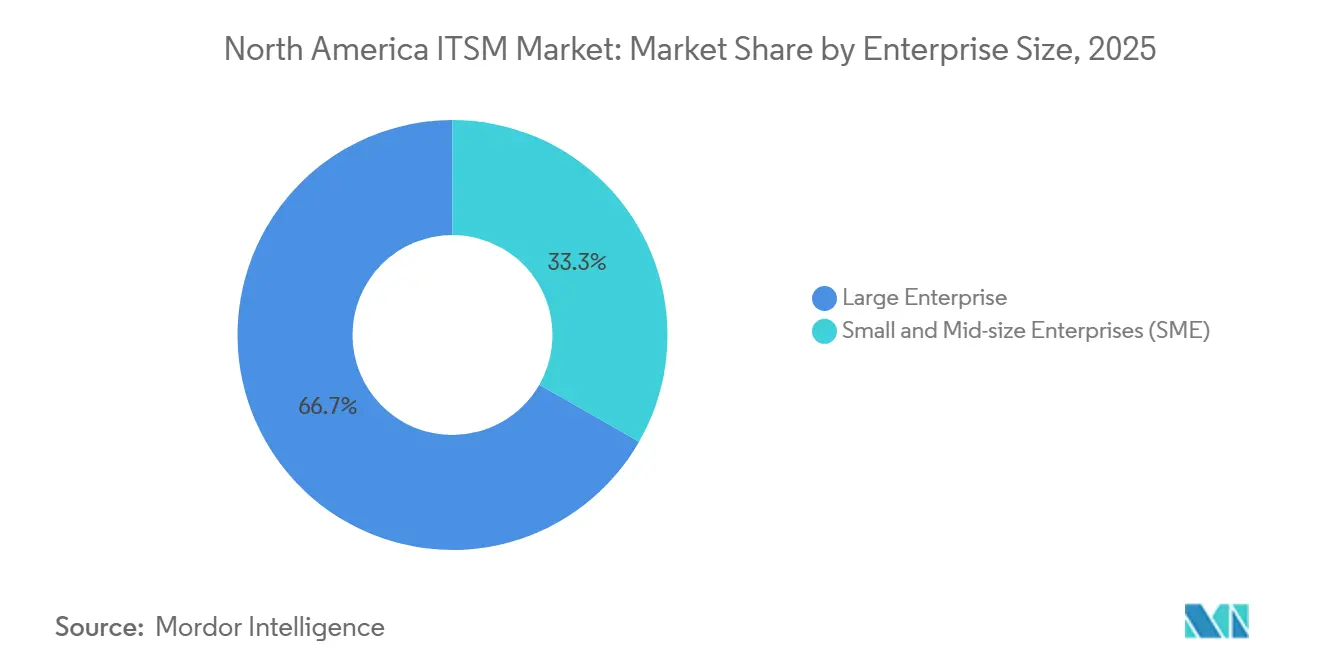
- By enterprise size, large enterprises accounted for 66.73% of the North America ITSM market in 2025, while SMEs are projected to expand at a 16.12% CAGR through 2031.
- By country, the United States held 82.62% of the of the North America ITSM market share in 2025, while Mexico is projected to expand at a 16.98% CAGR through 2031.
Note: Market size and forecast figures in this report are generated using Mordor Intelligence’s proprietary estimation framework, updated with the latest available data and insights as of January 2026.
Market Trends and Insights
Drivers Impact Analysis of North America ITSM Market*
| Driver | (~) % Impact on CAGR Forecast | Geographic Relevance | Impact Timeline |
|---|---|---|---|
| Cloud-First ITSM Modernization Across Large Enterprises | +3.2% | US and Canada primary, Mexico emerging | Short term (≤ 2 years) |
| AI-Assisted Ticket Triage And Workflow Automation | +2.8% | Concentrated in US enterprise and federal, Canada growing | Medium term (2-4 years) |
| Strong Demand For Unified IT, HR, And Customer Service Workflows | +2.1% | US primary, Canada growing in finance and healthcare sectors | Medium term (2-4 years) |
| Regulatory Pressure For Auditability And Service Traceability In Regulated Industries | +1.9% | US with HIPAA, SOX, and FedRAMP, Canada with PIPEDA, Mexico with fintech compliance | Long term (≥ 4 years) |
| High Adoption Of Enterprise Integration With Security And Observability Stacks | +1.5% | US enterprise and federal, Canada growing | Medium term (2-4 years) |
| Rapid Replacement Cycles Driven By Platform Consolidation Initiatives | +1.2% | US primary, Canada growing | Short term (≤ 2 years) |
| Source: Mordor Intelligence | |||
Cloud-First ITSM Modernization Across Large Enterprises
Cloud migration remains the strongest demand catalyst in the North America IT service management market. Many large organizations delayed shifts during 2019-2022 because heavily customized on-premise environments were difficult to move without service disruption. Those delays have now turned into forced transition cycles, because older releases are reaching end-of-life and AI-heavy roadmaps are easier to execute in cloud environments. ServiceNow reported USD 12.88 billion in subscription revenue for fiscal 2025, up 21% year over year, and 603 customers with more than USD 5 million in annual contract value, which shows how deeply large accounts are engaging with cloud-based platforms. Each migration also exposes process knowledge that had been buried inside legacy configurations, so buyers increasingly pair platform moves with documentation, knowledge capture, and workflow automation work. That pattern is helping vendors raise account value while it keeps implementation demand active in large regulated environments.
AI-Assisted Ticket Triage And Workflow Automation
AI-assisted ticket handling is moving from a differentiating feature to a normal expectation in procurement discussions across the North America IT service management market. SolarWinds reported in October 2025 that top-decile generative AI adopters reduced average incident resolution time from 51 hours to 23 hours, a 54.3% reduction against organizations using conventional automation. ServiceNow launched Autonomous Workforce on February 26, 2026, and said its Level 1 Service Desk AI Specialist resolves over 90% of employee IT requests autonomously while operating 99% faster than human agents for assigned IT cases. These gains are changing staffing logic, because many organizations are beginning to size front-line support teams around exception handling rather than pure ticket volume. They are also increasing pressure on vendors to prove that AI can work inside governed workflows instead of sitting outside them as a separate assistant. Governance and privacy concerns still slow full-scale rollout in regulated settings, but the direction of adoption is now firmly established.
Strong Demand For Unified IT, HR, And Customer Service Workflows
Buyers are moving away from point tools and toward unified service environments that can support IT, HR, facilities, and customer-facing work in one governed system. That shift is important for the North America IT service management market because common data models and shared approval paths reduce handoff delays and duplicate work. Freshworks stated in May 2026 that 47% of all IT tickets are submitted outside standard business hours, and that SLA rates can fall by as much as 5% for after-hours tickets, which strengthens the case for AI-enabled workflow coverage beyond staffed hours. When HR onboarding, IT provisioning, and service requests run through the same platform, enterprises can manage approvals, audit trails, and service commitments with less manual coordination. This matters even more where IT teams are flat in size, because workflow unification helps them absorb higher service volume without proportional headcount growth. It also creates a wider path for cross-sell, since one successful workflow often leads to adjacent use cases on the same platform.
Regulatory Pressure For Auditability and Service Traceability In Regulated Industries
Compliance needs are creating durable spending cycles across the North America IT service management market, especially in BFSI, healthcare, and public sector accounts. Financial services firms in the United States need robust change tracking, incident history, and policy alignment to support obligations under SOX, NYDFS, and related supervisory frameworks.[1] Government procurement is also becoming more demanding, because vendors now need evidence of strong security assessment and cloud readiness before they can compete for sensitive workloads. ScienceLogic achieved FedRAMP Moderate authorization in May 2025, demonstrating how compliance credentials are evolving from a helpful feature to a market-access requirement in the public sector. Healthcare organizations face similar pressure, because they need traceable audit logs and policy-linked workflows across every care-related IT touchpoint. Vendors that can make auditability part of the workflow itself are in a stronger position than vendors that treat compliance as a reporting layer added later.
Restraints Impact Analysis of North America ITSM Market*
| Restraint | (~) % Impact on CAGR Forecast | Geographic Relevance | Impact Timeline |
|---|---|---|---|
| Saturation Among Large Enterprises Limiting Net-New License Growth | -1.8% | US with high Fortune 500 penetration, Canada | Short term (≤ 2 years) |
| Long Replacement Cycles Due To Deeply Embedded Legacy Process Customization | -1.4% | US and Canada with heavily customized deployments | Long term (≥ 4 years) |
| Rising Software Procurement Scrutiny And Vendor Rationalization | -1.1% | US and Canada enterprise-wide | Medium term (2-4 years) |
| Data Privacy And AI Governance Concerns Slowing GenAI Feature Rollouts | -0.9% | US regulated industries, Canada with PIPEDA enforcement | Medium term (2-4 years) |
| Source: Mordor Intelligence | |||
Saturation Among Large Enterprises Limiting Net-New License Growth
Large enterprises across the North America IT service management market already have deep platform penetration, so growth is shifting more toward expansion within existing accounts. ServiceNow reported 244 transactions above USD 1 million in net new annual contract value in Q4 2025, up 40% year over year, which points more to wallet expansion than to first-time adoption. This changes negotiation dynamics because large buyers know vendors are competing for a larger share of an existing software budget. It also pushes many enterprises to review overlapping tools and reduce platform sprawl. That process supports selected displacement wins for stronger vendors, but it narrows the room for providers that depend on new large-enterprise logos. The result is a slower net-new license environment even while total account value keeps rising.
Long Replacement Cycles Due To Deeply Embedded Legacy Process Customization
Legacy deployments continue to slow turnover because many organizations have built thousands of custom workflows, SLA rules, and integrations into long-running service management instances. In many cases, the real obstacle is not feature weakness in the old system, but the effort required to document and rebuild years of embedded process logic. Replacement projects therefore stretch across multi-year planning cycles, especially in the United States and Canada where large enterprises have deep customization histories. This creates a difficult pattern for the North America IT service management market, because the customers with the clearest need to modernize are often the least able to move quickly. Vendors that offer migration tooling and stronger process discovery have an advantage, but most enterprises still face meaningful execution risk during changeovers. That risk keeps some buyers on older platforms longer than their technical roadmaps would otherwise justify.
*Our forecasts treat driver/restraint impacts as directional, not additive. The impact forecasts reflect baseline growth, mix effects, and variable interactions.
North America ITSM Market Segment Analysis
By Component:
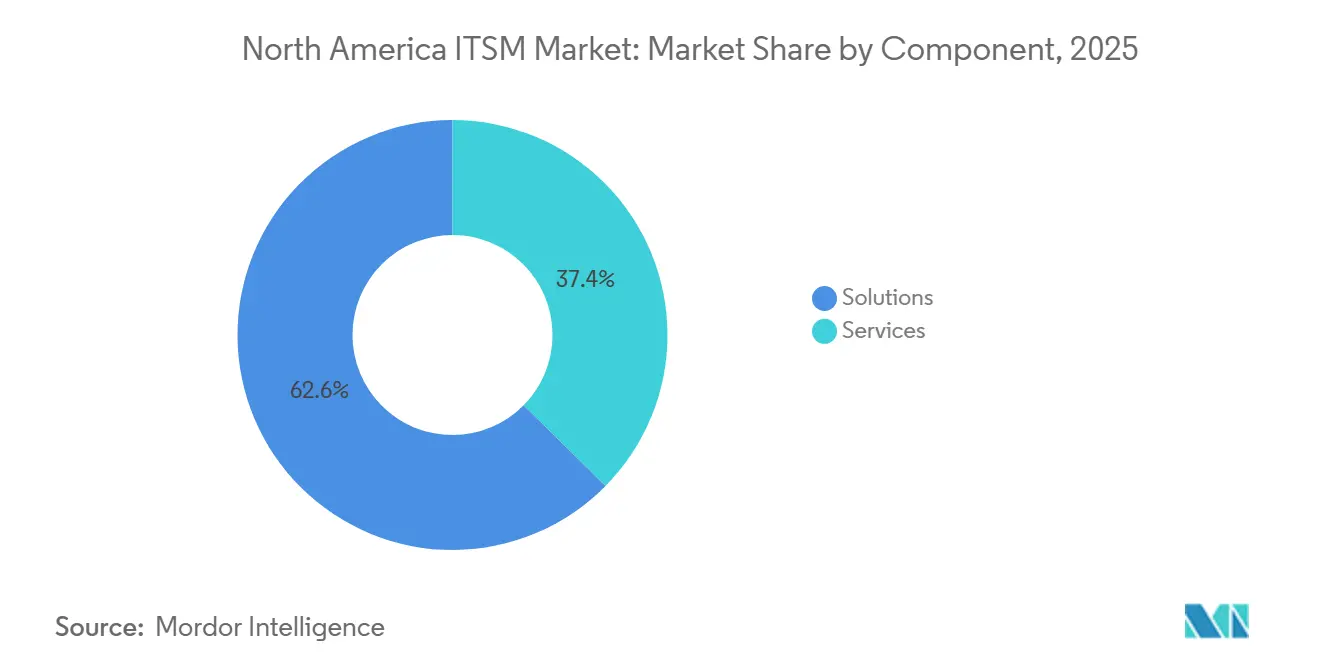
Solutions Lead Spending While Services Shift Toward Managed OutcomesSolutions held 62.61% of the North America IT service management market share in 2025, and Services are also projected to expand at a 16.12% CAGR through 2031. That lead reflects a clear buyer preference for platform-priced subscriptions over one-time implementation-heavy engagements. Enterprises increasingly want licensed capabilities that can expand over time, rather than separate software and consulting contracts that must be renegotiated whenever the scope changes. The North America IT service management market, therefore, continues to reward vendors that can package automation, self-service, analytics, and AI inside a unified software layer. This pattern also reflects the fact that ticket triage, first-response support, and basic workflow actions are being embedded in the platform rather than delivered through people-intensive service lines.
Services show the fastest-growing segment because many organizations in healthcare, government, and other complex settings need outside help to configure workflows and connect them to policy controls. Their role, however, is changing from broad implementation ownership toward targeted enablement, managed administration, and training support. ServiceNow reported that subscription revenue accounted for 97% of total fiscal 2025 revenue, while professional services and other revenue accounted for 3%, highlighting how value capture is concentrated within the software layer. That structure does not remove the need for services, but it does make them more complementary than central in many large deals. Over time, services revenue can still rise in absolute terms, yet it is likely to represent a smaller share of total spending as platform capabilities continue to absorb work that was once billed separately.
By Deployment:
Cloud Extends Its Lead While Hybrid Models Retain A Place In Regulated EnvironmentsCloud held 58.72% of the deployment segment in 2025, and it is projected to expand at a 15.89% CAGR through 2031. It was both the largest and the fastest-growing model, indicating that the migration cycle is still active rather than mature. Buyers continue to favor the cloud because it simplifies upgrades, enables new AI features to be released faster, and supports multi-site operating models with less local infrastructure. ServiceNow stated in February 2026 that its platform processes more than 80 billion workflows annually across its global customer base, which illustrates the scale benefits that favor cloud architecture. The cloud segment also benefits from the fact that many mid-sized organizations are adopting SaaS directly, rather than repeating the long on-premises investment cycle that earlier large enterprises experienced.
On-premises and hybrid models still play a role when data control, residency, or procurement rules are tighter. Federal agencies, defense-linked contractors, and some large financial and healthcare organizations continue to evaluate architecture choices through a heavier compliance lens than typical commercial buyers. Hybrid models are therefore gaining attention, as firms want cloud-grade automation and user experience while still needing tighter control over parts of the data or execution environment. BMC signed a five-year strategic collaboration agreement with AWS in February 2026 to widen SaaS availability and deepen integrations, which shows how vendors are investing to meet those mixed deployment needs across the region. The practical outcome is a deployment market where cloud keeps widening its lead, while hybrid remains relevant as a risk-managed bridge for more regulated or deeply embedded environments.
By Application:
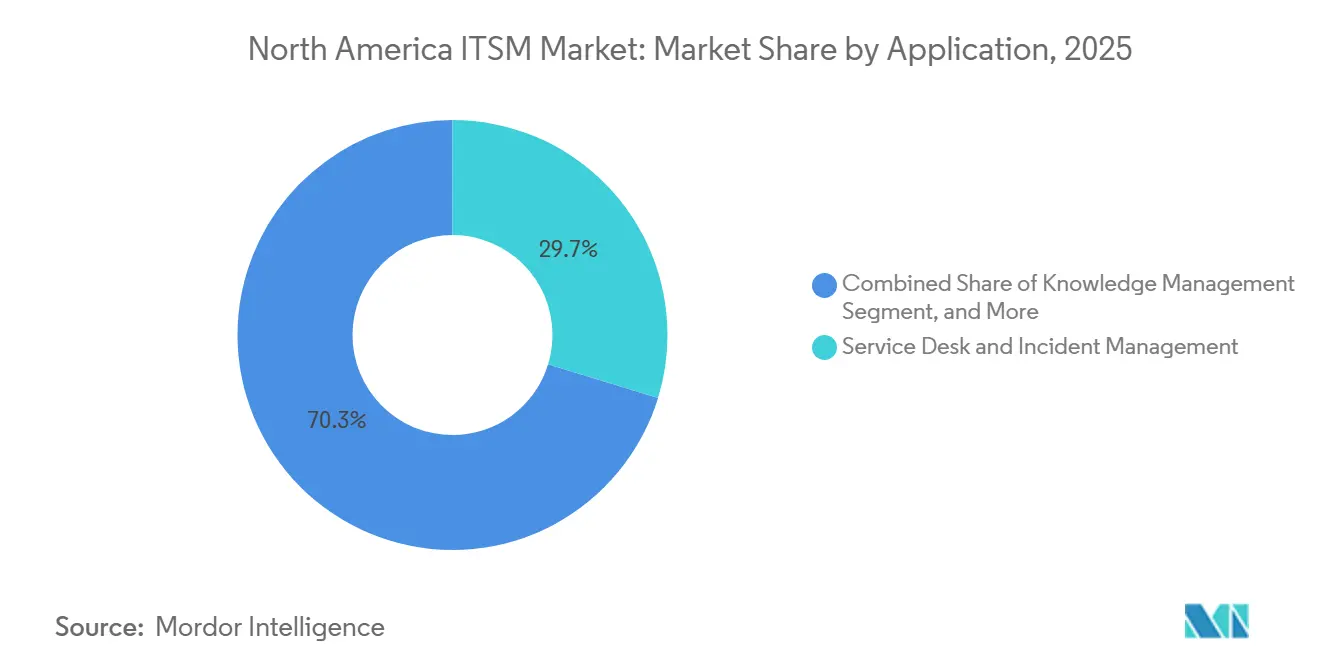
Service Desk Holds The Core While Knowledge Management Gains Speed Through AIService desk and incident management accounted for 29.73% of the North America IT service management market size in 2025, while knowledge management is projected to expand at a 15.56% CAGR through 2031. The service desk remains the core buying point because every organization needs a dependable front door for incidents, requests, and support coordination. It also acts as the operational anchor for adjacent modules such as asset visibility, change control, and workflow analytics. Because of that, many platform expansions still begin with incident handling and then spread into knowledge, request, and configuration functions. The North America IT service management market continues to reflect that structure, since buyers often measure broader platform value through improvements in issue resolution speed and user experience at the service desk.
Knowledge management is accelerating because AI results depend heavily on the quality, structure, and retrievability of internal support content. A peer-reviewed paper published in December 2025 found that hybrid large language model and retrieval architectures improved first-contact resolution in enterprise IT service desk settings, supporting the push toward stronger knowledge systems within modern platforms. That finding matters because organizations want AI to resolve issues reliably, not just draft responses that still require heavy human intervention. Asset and configuration management, change and release management, and service request management are also gaining from platform consolidation, since many enterprises are retiring standalone tools and pulling those capabilities into their core environment. The result is an application landscape where service desk volume still anchors demand, but knowledge quality is becoming a decisive factor in how much automation value customers can actually unlock.

By End-User Industry:
BFSI Leads On Compliance Intensity While Healthcare Advances On Modernization NeedsBFSI held 23.72% share in 2025, while healthcare is projected to expand at a 15.72% CAGR through 2031. BFSI remains the largest end-user group because banks, insurers, and capital markets firms treat change management, access control, and incident traceability as compliance-linked operating requirements. In these accounts, platform depth and audit readiness often matter as much as user interface or license pricing. IBM described in April 2026 how financial services environments must align with multiple U.S. regulatory frameworks at once, which helps explain why control mapping and service traceability remain central buying criteria in this segment. Manufacturing, IT and telecommunications, and retail and e-commerce also represent meaningful demand pools, but their adoption drivers are usually more connected to operational consistency and SLA performance than to strict supervisory review.
Healthcare is growing faster because providers are modernizing IT stacks after years of pressure from digital records, service continuity demands, and broader post-pandemic transformation work. Hospitals and health systems need clean incident histories, service request routing, and linked audit trails across many interdependent applications. That increases workflow volume and raises the cost of fragmented support tools. Government and public sector demand also remains distinct, because FedRAMP-linked requirements and long procurement cycles shape buying behavior differently from most commercial verticals. Travel and hospitality and other smaller end-user groups continue to adopt these platforms mainly to improve responsiveness, standardize service commitments, and handle growing digital service expectations with fewer manual steps.
By Enterprise Size:
Large Enterprises Anchor Spend While SMEs Become The Fastest-Rising CohortLarge enterprises accounted for 66.73% of spending in 2025, while SMEs are projected to expand at a 16.12% CAGR through 2031. Large organizations still dominate because they run the most complex environments, handle the highest ticket volumes, and require the deepest integrations across operations, compliance, and security layers. They also tend to support broader use cases, which lifts average contract value. Even so, the North America IT service management market is opening more quickly to smaller organizations than it did in earlier adoption cycles. Cloud delivery, modular packaging, and simpler setup tools are reducing the cost and operational burden that once kept many SMEs out of the category.
The demand gap in smaller organizations remains meaningful. EasyVista and OTRS Group reported in June 2025 that only 12% of SMBs had a fully mature and proactive ITSM framework, while 56% recognized ITSM as a strategic opportunity, indicating significant room for development within this cohort.[2] Vendors are responding by offering modular bundles that cover core incident, change, and knowledge functions without enterprise-scale deployment effort. ManageEngine, for example, released a major generative AI update for ServiceDesk Plus Cloud in September 2025, adding Ask Zia, workflow assist, and knowledge base summarization to improve productivity for lean IT teams. That shift suggests SME growth will depend less on copying enterprise sales motions and more on faster deployment, clearer value proof, and support models that fit smaller internal teams.
Geography Analysis
United States ITSM Market
The United States accounted for 82.62% of the North America IT service management market size in 2025, making it the clear center of regional demand. That dominance reflects both the heavy installed base of enterprise customers and the presence of major platform vendors with primary U.S. operations. CompTIA estimated that more than 557,000 software and IT service companies operate in the United States, helping sustain strong demand across technology, BFSI, healthcare, and government accounts. Public sector momentum is also notable, as compliance-native platforms are gaining traction as agencies seek stronger service visibility and operational resilience.
Canada ITSM Market
Canada was not separately quantified in the approved metric set, but it remains a structurally important part of the regional opportunity. The International Trade Administration stated that Canada’s ICT sector includes more than 43,200 businesses, with a strong concentration in computer services and software, which creates both vendor activity and enterprise demand.[3] That base supports a steady need for incident management, service automation, and cross-functional workflow tools across private and public institutions. Canada also tends to reward platforms with strong audit trails and privacy discipline, because procurement often places high value on data handling and operational transparency.
Mexico ITSM Market
Mexico is projected to be the fastest-growing geography in the region at a 16.98% CAGR through 2031. Growth is being supported by rising enterprise digitalization and by nearshoring-related IT investment tied to regional supply chain shifts. As U.S. manufacturers and shared service operations expand in northern Mexico, local subsidiaries need the same incident, change, and service governance standards used by parent organizations. That requirement favors cloud-based platforms that can be rolled out across distributed operations with common workflows and reporting. The result is a smaller but quickly modernizing opportunity set within the North America IT service management market.
Competitive Landscape
The North America IT service management market has a moderately concentrated structure, with ServiceNow holding the strongest position and a second tier of challengers competing hard in mid-market and function-specific deals. Competition is most active where buyers are balancing AI capability, platform breadth, implementation effort, and total cost. ServiceNow reinforced its position in February 2026 with Autonomous Workforce and EmployeeWorks, including a Level 1 Service Desk AI Specialist that it said handles over 90% of employee IT requests and operates 99% faster than human agents for assigned cases. That move raised buyer expectations around autonomous resolution, conversational support, and cross-department workflow orchestration.
Freshworks broadened its service operations position in 2026 by acquiring FireHydrant, which added AI-native incident management and reliability capabilities to Freshservice. It followed that move in May 2026 with Freddy AI Agent Studio and the MCP Gateway, giving customers a no-code way to deploy AI agents and connect them to third-party tools. BMC also strengthened its SaaS and automation position through a five-year collaboration with AWS, which expanded Control-M SaaS availability in Canada and the United States and deepened integrations with Amazon Bedrock, SageMaker, and CloudFormation. These moves show that vendors are competing on platform breadth, AI execution, and deployment flexibility rather than on ticketing alone.
ManageEngine continued to target cost-sensitive organizations with its September 2025 generative AI release for ServiceDesk Plus Cloud, including Ask Zia, workflow assist, and knowledge base summarization. That matters because many buyers want measurable productivity gains without enterprise-tier implementation effort. The planned carve-out of BMC Helix into a standalone ServiceOps and agentic AI company also signals that investors still see strategic value in focused ITSM platforms. Even with a clear leader, the North America IT service management market still has real contestability in the mid-market, in regulated niche deployments, and in AI-led workflow redesign. Competitive outcomes increasingly depend on who can combine automation, governance, and integration depth in a package that fits customer complexity and budget.
North America ITSM Industry Leaders
-
ServiceNow, Inc.
-
IBM Corporation
-
BMC Software, Inc.
-
Atlassian Corporation Plc
-
Ivanti, Inc.
- *Disclaimer: Major Players sorted in no particular order
North America ITSM Market Companies Covered in this Report
- ServiceNow, Inc.
- IBM Corporation
- BMC Software, Inc.
- Atlassian Corporation Plc
- Ivanti, Inc.
- Freshworks Inc.
- ManageEngine, a division of Zoho Corporation Pvt. Ltd.
- Broadcom Inc.
- Open Text Corporation
- Micro Focus International plc
- ASG Technologies Group, Inc.
- SysAid Technologies Ltd.
- Cherwell Software, LLC
- TOPdesk B.V.
- Hornbill Service Management Ltd.
- SymphonyAI Summit
- EasyVista S.A.
- SolarWinds Corporation
- Atlassian Corporation Plc
- Axelos Limited
Recent Industry Developments in North America ITSM Market
- June 2026: Montagu Private Equity agreed to acquire a majority stake in BMC Helix from KKR-owned BMC Software for approximately USD 875 million in a carve-out transaction. The deal separates BMC Helix into a standalone ServiceOps and agentic AI platform, ending its structural dependence on the broader BMC Software portfolio and positioning it to compete independently in the ITSM and AIOps markets.
- May 2026: ServiceNow launched ServiceNow Otto at its annual Knowledge 2026 customer event on May 5, 2026. Otto is a unified AI experience combining Now Assist, Moveworks, and AI Experience capabilities into an enterprise AI control tower that orchestrates work across departments and systems through conversational AI, enterprise search, AI voice agents, and plain-language data exploration.
- May 2026: Freshworks unveiled the Freddy AI Agent Studio and Model Context Protocol Gateway for Freshservice at its Refresh 2026 conference on May 14, 2026. The no-code studio enables enterprises to build or deploy pre-built AI agents across service workflows, while the gateway connects Freddy AI to third-party tools without custom integration code.
- February 2026: ServiceNow launched Autonomous Workforce and ServiceNow EmployeeWorks on February 26, 2026, integrating the newly acquired Moveworks platform into the ServiceNow AI Platform. The Level 1 Service Desk AI Specialist handles over 90% of employee IT requests autonomously, operating 99% faster than human agents for assigned cases.
North America ITSM Market Report Scope
The IT Service Management Market is Segmented by Component (Solutions, Services), Deployment (Cloud, On-Premise, Hybrid), Application (Service Desk and Incident Management, Asset and Configuration Management, Change and Release Management, Service Request Management, Knowledge Management, Others), End-User Industry (BFSI, Manufacturing, Government and Public Sector, IT and Telecommunications, Retail and E-Commerce, Healthcare, Others), Enterprise Size (Large Enterprises, SME), and Country (United States, Canada, and Mexico). The Market Forecasts are Provided in Terms of Value (USD).
Segmentation Overview
| Solutions |
| Services |
| Cloud |
| On-Premise |
| Hybrid |
| Service Desk and Incident Management |
| Asset and Configuration Management |
| Change and Release Management |
| Service Request Management |
| Knowledge Management |
| Other ITSM Applications |
| BFSI |
| Manufacturing |
| Government and Public Sector |
| IT and Telecommunications |
| Retail and E-Commerce |
| Healthcare |
| Travel and Hospitality |
| Other End-User Industries |
| Large Enterprises |
| Small and Mid-Size Enterprises (SME) |
| United States |
| Canada |
| Mexico |
| By Component | Solutions |
| Services | |
| By Deployment | Cloud |
| On-Premise | |
| Hybrid | |
| By Application | Service Desk and Incident Management |
| Asset and Configuration Management | |
| Change and Release Management | |
| Service Request Management | |
| Knowledge Management | |
| Other ITSM Applications | |
| By End-User Industry | BFSI |
| Manufacturing | |
| Government and Public Sector | |
| IT and Telecommunications | |
| Retail and E-Commerce | |
| Healthcare | |
| Travel and Hospitality | |
| Other End-User Industries | |
| By Enterprise Size | Large Enterprises |
| Small and Mid-Size Enterprises (SME) | |
| By Country | United States |
| Canada | |
| Mexico |
Key Questions Answered in the Report
What is the current size and outlook for the North America IT service management market?
The North America IT service management market was valued at USD 4.89 billion in 2025, reached USD 5.56 billion in 2026, and is forecast to reach USD 10.9 billion by 2031 at a 14.39% CAGR.
Which deployment model is leading adoption across North America?
Cloud leads deployment with 58.72% share in 2025 and is also the fastest-growing model, with a projected 15.89% CAGR through 2031.
Which application area creates the most revenue today?
Service desk and incident management is the largest application area, accounting for 29.73% share in 2025 because it remains the main entry point for enterprise support activity.
Which customer group is growing fastest by organization size?
SMEs are growing fastest at a 16.12% CAGR through 2031, supported by cloud subscriptions, simpler deployment models, and lower upfront implementation needs.
Which end-user vertical is expanding most quickly?
Healthcare is the fastest-growing end-user vertical with a projected 15.72% CAGR, driven by modernization work, audit trail needs, and complex multi-system IT environments.