
Asia-Pacific ITSM Market Size and Share
Market Overview
| Study Period | 2020 - 2031 |
|---|---|
| Forecast Data Period | 2026 - 2031 |
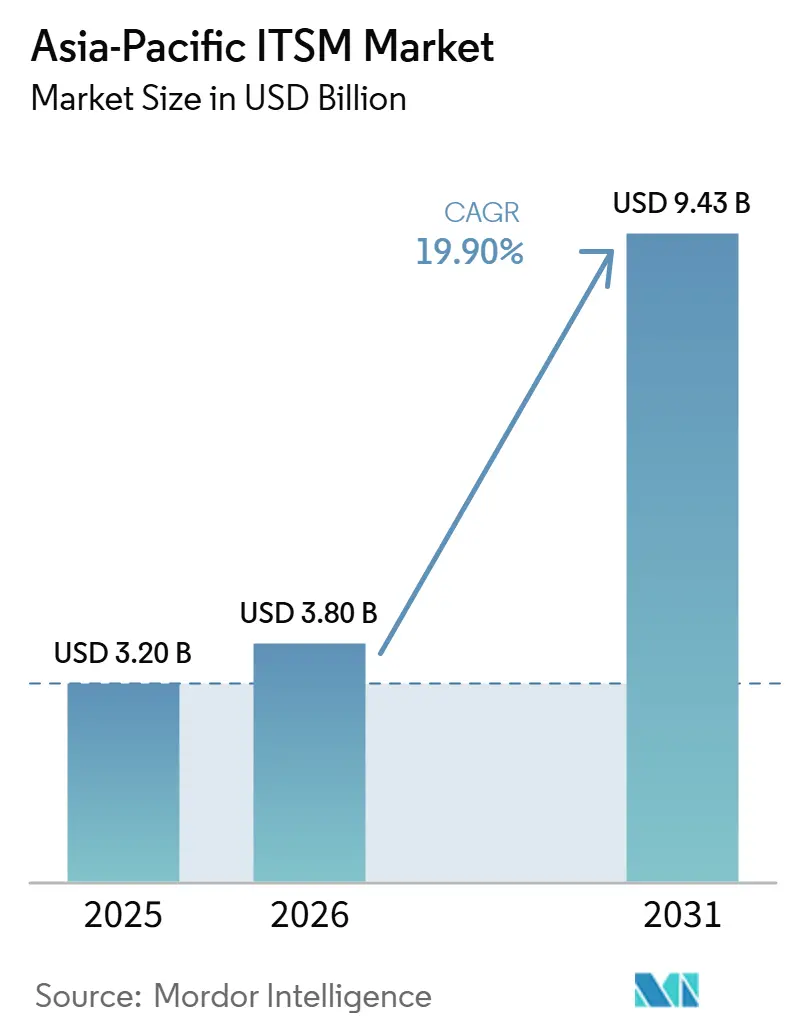
| Base Year Market Size (2025) | USD 3.20 Billion |
| Market Size (2026) | USD 3.80 Billion |
| Market Size (2031) | USD 9.43 Billion |
| Growth Rate (2026 - 2031) | 19.90 % |
| Market Concentration | Medium |
Major Players *Disclaimer: Major Players sorted in no particular order Image © Mordor Intelligence. Reuse requires attribution under CC BY 4.0. | |
Asia-Pacific ITSM Market Analysis by Mordor Intelligence
The Asia-Pacific IT service management market size was USD 3.20 billion in 2025 and is projected to reach USD 9.43 billion by 2031, at a CAGR of 19.90% over 2026-2031. The Asia-Pacific IT service management market is moving from a back-office support role to a broader operating layer for digital workflows, as enterprises and public agencies now expect service platforms to support automation, governance, and AI-led execution within the same environment. Demand is also widening beyond large enterprises, as cloud delivery and shorter deployment cycles have made structured service management more accessible for mid-market companies that previously relied on email chains, spreadsheets, and basic ticketing tools. Competitive positioning is shifting toward workflow depth, knowledge governance, and the ability to connect AI functions with service operations without sharply increasing implementation risk. At the same time, uneven digital maturity, legacy system complexity, and price sensitivity continue to shape buying behavior across countries, which means vendors that can balance enterprise-grade capabilities with flexible delivery models have a clearer path to growth. The strongest opportunity remains with organizations that want to standardize service operations now and prepare their data, workflows, and knowledge bases for more advanced automation over the forecast period.
Key Report Takeaways
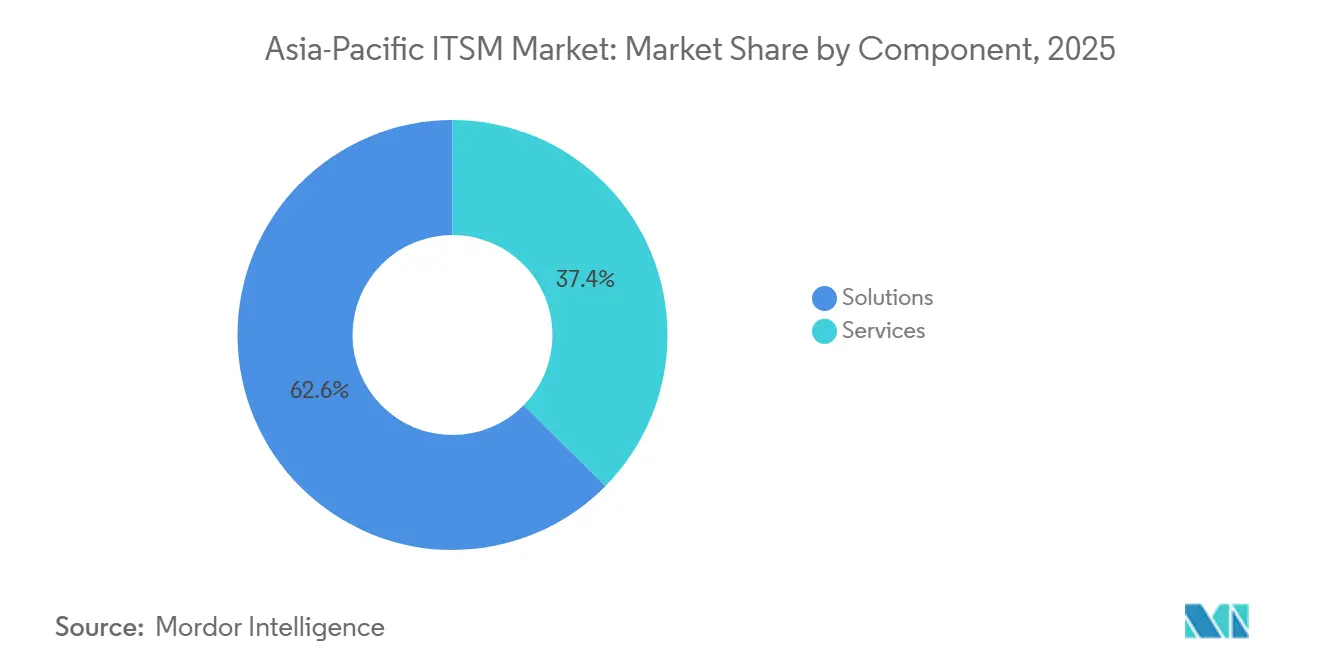
- By component, solutions held 62.61% of the Asia-Pacific IT service management market in 2025, while services are expected to gain faster momentum with a CAGR of 21.12% as platform complexity, AI governance needs, and third-party deployment support requirements increase through 2031.
- By deployment, cloud accounted for 59.62% of the Asia-Pacific IT service management market in 2025 and is expected to show the fastest CAGR of 21.32%, while hybrid and on-premises demand is expected to remain relevant in regulated and legacy-heavy environments across the forecast period.
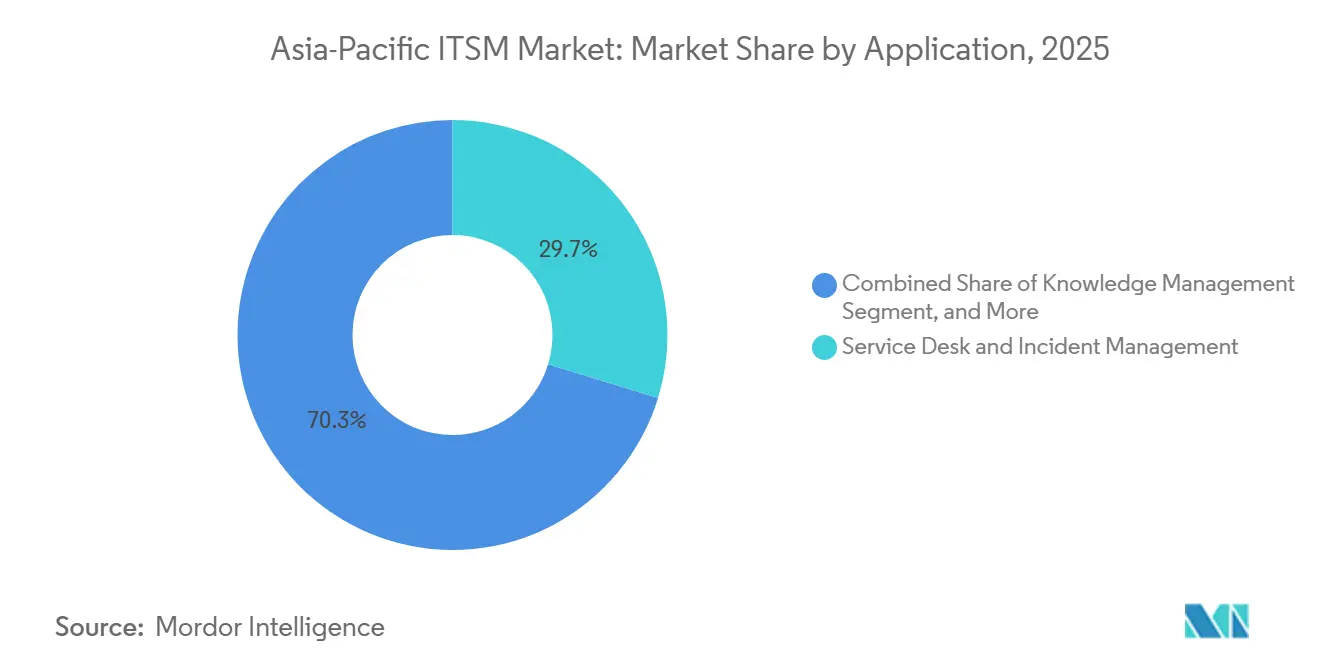
- By application, service desk and incident management led the Asia-Pacific IT service management market with a 29.73% share in 2025, while knowledge management is projected to expand at a 20.89% CAGR through 2031.
- By end-user industry, BFSI held 23.72% share in 2025 of the Asia-Pacific IT service management market, while healthcare is projected to record the highest CAGR at 20.78% through 2031.
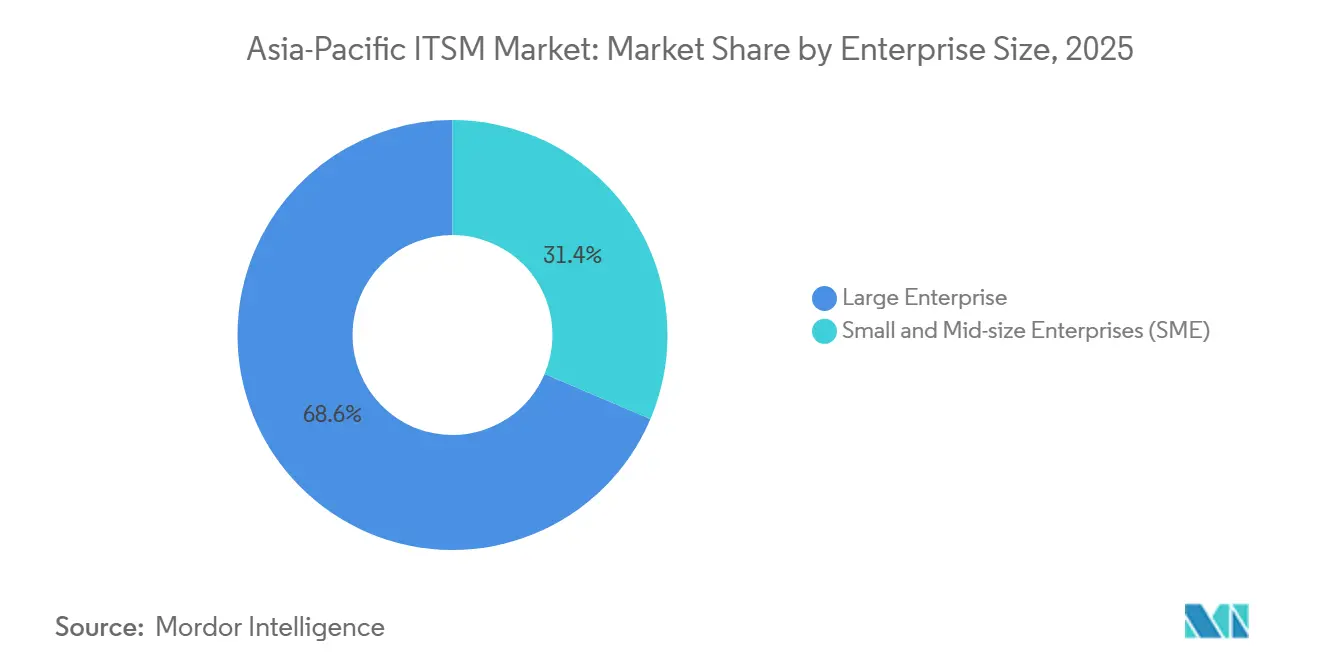
- By enterprise size, large enterprises accounted for 68.62% share in 2025 of the Asia-Pacific IT service management market, while SMEs are projected to expand at a 21.33% CAGR through 2031.
- By geography, China held 29.73% share in 2025 of the Asia-Pacific IT service management market, while India is projected to record the fastest CAGR at 21.32% through 2031.
Note: Market size and forecast figures in this report are generated using Mordor Intelligence’s proprietary estimation framework, updated with the latest available data and insights as of January 2026.
Market Trends and Insights
Drivers Impact Analysis of Asia-Pacific ITSM Market*
| Driver | (~) % Impact on CAGR Forecast | Geographic Relevance | Impact Timeline |
|---|---|---|---|
| Rapid Digitization of Public and Private Sector Service Operations | +5.2% | Global, concentrated in India, China, and Southeast Asia | Medium term (2-4 years) |
| Increasing Adoption of Cloud-Based ITSM Among Mid-Market Enterprises | +4.3% | APAC core, India, China, and Southeast Asia, with spillover to South Korea and Australia | Medium term (2-4 years) |
| Expansion of Managed Services and Outsourced IT Operations | +3.1% | Global, strongest in India, Australia, and the Philippines | Short term (≤ 2 years) |
| Strong Demand for Low-Code Workflow Design in IT Service Delivery | +2.4% | Southeast Asia and Hong Kong lead, followed by India and Australia | Short term (≤ 2 years) |
| Large-Scale Modernization of Telecom, BFSI, and Manufacturing IT Operations | +2.0% | China, India, Australia, and South Korea | Medium term (2-4 years) |
| Growth of Mobile-First and Multi-Language Service Portals | +1.2% | Southeast Asia and India, with early gains in metro centers | Long term (≥ 4 years) |
| Source: Mordor Intelligence | |||
Rapid Digitization of Public and Private Sector Service Operations
Public-sector modernization and enterprise digitization are giving the Asia-Pacific IT service management market a steadier demand base than a purely discretionary software cycle would provide. When governments move services to cloud-oriented environments, agencies also need formal workflows for requests, incidents, approvals, and audit trails, which pushes service management from an optional tool into required operational infrastructure. The same pattern appears in regulated industries and large enterprises, where digital service delivery creates a higher need for standardized change control and service continuity management. South Korea’s cloud use and security guidelines for public-sector environments demonstrate how policy frameworks can turn infrastructure changes into governance obligations that favor structured platforms over manual processes.[1] This matters because policy-backed adoption tends to be more certain than purely commercial spending, which improves vendor visibility in parts of the region where procurement cycles are otherwise uneven. As more service operations are digitized across India, China, and Southeast Asia, the Asia-Pacific IT service management market is likely to benefit from demand driven by compliance, continuity, and cross-team coordination, rather than solely by software refresh decisions.
Increasing Adoption of Cloud-Based ITSM Among Mid-Market Enterprises
Cloud delivery is reducing the costs, infrastructure burden, and deployment friction that once kept many mid-market organizations out of the Asia-Pacific IT service management market. Companies that previously ran support operations through shared inboxes or informal spreadsheets can now move to structured service workflows without first building large in-house administration teams. Freshworks reinforced this shift in May 2026 when it launched AI Agent Studio within Freshservice, aimed at helping organizations build and deploy agentic workflows in weeks rather than in long implementation cycles. That shorter path matters in price-sensitive accounts, where buyer interest is often stronger than the budget available for long consulting-heavy rollouts. The operational mindset of smaller firms is also changing, as OTRS reported that 70% of Asia-Pacific SMBs consider AI important to ITSM success, indicating demand is no longer limited to basic ticket handling.[2] As a result, the Asia-Pacific IT service management market is attracting buyers seeking better control, faster service resolution, and a clearer path to automation without the cost profile of large enterprise deployments.
Expansion of Managed Services and Outsourced IT Operations
Managed services are becoming increasingly important in the Asia-Pacific IT service management market, as many organizations seek structured service operations without bearing the full burden of internal platform design, administration, and support. In practice, the buying decision is often shaped by execution capacity rather than by interest in the platform itself, especially where internal teams are small or already stretched across security, infrastructure, and application work. Outsourced delivery also lets companies standardize incident, asset, and portfolio processes more quickly, which is useful when groups operate across several business units or countries. Cognizant’s May 2026 engagement with JG Summit Holdings in the Philippines clearly showed this direction, as the scope included ServiceNow ITSM Professional, IT Asset Management, Strategic Portfolio Management, and managed services under a mobile-first, AI-ready operating model. That kind of deal shows that service management outsourcing is not limited to pure IT vendors, because diversified enterprises also want external help to create a consistent service backbone. This supports broader growth in the Asia-Pacific IT service management market, since recurring managed support can expand platform adoption even in accounts that would otherwise delay a full in-house rollout.
Strong Demand for Low-Code Workflow Design in IT Service Delivery
Low-code and no-code design are widening access to the Asia-Pacific IT service management market by reducing the need for scarce specialist talent in workflow customization. Many buyers still want service automation, but they do not want every process change to require outside development resources or internal scripting expertise. OutSystems reported that 33% of Asia-Pacific enterprises saw low-code as a critical tool for automation and future-proofing, while Southeast Asia and Hong Kong led at 49%, followed by India at 35% and Australia at 31%. That regional pattern shows why low-code is becoming more than a convenience feature: it directly affects deployment speed, ownership costs, and the confidence of teams that need to manage workflows after go-live. Freshworks added to this direction with a no-code environment and prebuilt agent workflow options in Freshservice, aligning its product design with the same demand pattern. In effect, the Asia-Pacific IT service management market is becoming easier to enter for organizations that want structure and automation but do not have the headcount to sustain a heavily customized implementation.
Restraints Impact Analysis of Asia-Pacific ITSM Market*
| Restraint | (~) % Impact on CAGR Forecast | Geographic Relevance | Impact Timeline |
|---|---|---|---|
| Uneven Digital Maturity Across Countries and Industry Verticals | -2.8% | Southeast Asia, South Asia, and Pacific island markets, with clear rural-to-metro gaps | Medium term (2-4 years) |
| Price Sensitivity Among Small and Mid-Size Enterprises | -1.9% | APAC core, especially Indonesia, Vietnam, and the Philippines | Short term (≤ 2 years) |
| Shortage of Skilled ITSM Administrators and Process Consultants | -1.4% | National, with acute pressure in Singapore and Australia | Medium term (2-4 years) |
| Integration Complexity Across Hybrid Infrastructure and Local Systems | -1.1% | Japan, South Korea, and legacy-heavy manufacturing environments | Long term (≥ 4 years) |
| Source: Mordor Intelligence | |||
Uneven Digital Maturity Across Countries and Industry Verticals
Uneven digital maturity remains a real brake on the Asia-Pacific IT service management market because demand does not move at the same level of readiness across countries, sectors, or even cities within the same market. Some organizations are buying advanced workflow orchestration and AI-enabled knowledge functions, while others are still trying to replace manual ticket handling and fragmented internal support processes. OTRS found that 35% of Malaysian SMBs still relied on basic ticketing systems, spreadsheets, or manual workarounds, even though 62% recognized ITSM as a strategic opportunity. This split makes it harder for vendors to standardize packaging, pricing, and service models across the region without losing either advanced buyers or first-stage adopters. It also extends sales cycles because education, internal process redesign, and workflow cleanup often need to occur before the platform discussion can move forward. As long as these readiness gaps persist, the Asia-Pacific IT service management market will grow quickly, but not as evenly as headline regional demand might suggest.
Price Sensitivity Among Small and Mid-Size Enterprises
Price sensitivity limits conversion in the Asia-Pacific IT service management market even where interest in automation and structured service delivery is already strong. Many smaller firms recognize the operational value of ITSM, but they still treat subscription fees, implementation support, and ongoing administration as a single combined cost rather than separate line items. OTRS reported that only 13% of Malaysian SMBs had implemented a fully mature, proactive ITSM framework, despite broad recognition of service management's strategic role. This explains why vendors that lower go-live effort, simplify packaging, and support phased deployment tend to perform better in smaller accounts. It also helps explain why cloud-native providers have gained traction, because a shorter path to usable workflows reduces perceived risk at the buying stage. Even with strong SME growth ahead, this restraint will keep pressure on pricing models, product bundling, and channel strategy across the Asia-Pacific IT service management market.
*Our forecasts treat driver/restraint impacts as directional, not additive. The impact forecasts reflect baseline growth, mix effects, and variable interactions.
Asia-Pacific ITSM Market Segment Analysis
By Component:
Solutions Anchor a Software-Led Demand BaseSolutions accounted for 62.61% of the Asia-Pacific IT service management market share in 2025, which shows that platform spending still leads services spending at this stage of regional adoption. Buyers continue to prioritize the core system first, because ticket visibility, workflow control, approvals, service catalogs, and audit trails all depend on the platform chosen at the start of the journey. That first decision also shapes later integration choices, data structures, user experience, and the pace at which adjacent functions can be activated. In the Asia-Pacific IT service management industry, this keeps software at the center of procurement even when deployment support is important. It also explains why vendors with deep module portfolios still hold an advantage in larger deals, where clients want a platform that can stretch from incident handling to broader operational governance over time.
Services are gaining importance in the Asia-Pacific IT service management market as the fastest-growing segment, with a 21.12% CAGR, as more deployments now involve cloud migration, workflow redesign, AI enablement, knowledge base cleanup, and ongoing governance. As platforms become more central to operating models, many organizations find that configuration is only the starting point, not the end of the work. That makes implementation, consulting, and managed support structurally more relevant, especially in countries where internal ITSM administration skills are limited. The balance is also shifting because AI-enabled service operations require better data discipline, clearer ownership, and more sustained platform maintenance than earlier helpdesk rollouts. In practical terms, that means the software-led structure of the Asia-Pacific IT service management industry is likely to remain intact, but the services layer should keep expanding as deployments deepen. Over the forecast period, vendors and partners that can connect platform value with lower execution risk should benefit most from this component mix.
By Deployment:
Cloud Extends Its Lead Across New ImplementationsCloud held a 59.62% share of the Asia-Pacific IT service management market in 2025, confirming that SaaS delivery has become the preferred route for many new implementations. Buyers favor the cloud because it reduces infrastructure management burdens, speeds updates, and makes it easier to roll out service workflows across distributed teams without the large upfront architecture work. This model also fits the needs of organizations that want faster onboarding and a clearer route to automation, but do not want the long deployment cycles associated with legacy-heavy environments. Public-sector compliance frameworks have supported this shift, and South Korea’s government cloud-use and security guidelines have helped formalize the control environment for wider cloud adoption. The cloud lead also reflects the fact that many newer adopters in South and Southeast Asia can move directly into modern environments without carrying the same legacy stack burden seen in older enterprise estates.
Hybrid and on-premises demand still matters in the Asia-Pacific IT service management market because not every organization can move all service operations to the cloud at the same pace. BFSI institutions, public-sector bodies, and legacy manufacturing groups often maintain stricter data controls, complex integration needs, or country-specific infrastructure policies that favor a more gradual transition. In those accounts, ITSM adoption is not held back by lack of interest, but by the need to align workflow systems with residency, security, and operational continuity requirements. That is why hybrid models remain useful as a bridge, especially where service management must connect with both modern applications and older local systems. Over time, cloud should continue to gain weight, but the deployment mix will stay more diverse in countries where legacy estates still shape architecture decisions. This gives vendors an advantage when they can support cloud-first growth without forcing an all-at-once migration path on cautious buyers.
By Application:
Service Desk Leads While Knowledge Management Gains Strategic WeightService desk and incident management accounted for 29.73% share of the Asia-Pacific IT service management market size in 2025, which confirms that incident resolution remains the main entry point for most deployments. The reason is straightforward, because service desks solve a visible operational problem and give users a clear way to log, track, and close issues across the organization. That keeps them central to first-stage buying, especially where firms are moving from manual support practices into structured service workflows for the first time. At the same time, the application mix is changing because buyers now want ITSM platforms to reduce repetitive work and support more intelligent routing, escalation, and response. This shift is starting to pull more value toward knowledge-intensive, automation-ready functions beyond basic ticket handling.
Knowledge management is projected to expand at a 20.89% CAGR through 2031, which makes it the fastest-growing application in the Asia-Pacific IT service management market. PeopleCert mapped 66 AI use cases across 20 ITIL practices in 2025 and highlighted a strong concentration in knowledge management and incident response, which supports the stronger growth outlook for governed institutional knowledge inside modern ITSM environments. This matters because AI-based service workflows are only as effective as the quality, structure, and accessibility of the knowledge behind them. Organizations that scale incident and request management without strengthening knowledge and configuration data may find later automation gains harder to realize. Asset and configuration management, change and release management, and service request management also remain important because they support the operational discipline needed for broader workflow automation. The Asia-Pacific IT service management market is therefore moving from a service desk-led application base toward a more balanced mix in which knowledge quality becomes a platform differentiator, not a side function.
By End-User Industry:
BFSI Holds the Lead as Healthcare AcceleratesBFSI accounted for 23.72% of the Asia-Pacific IT service management market in 2025, making it the largest end-user segment in the region. Banks, insurers, and financial platforms need formal incident response, change control, audit support, and service continuity processes because their operations depend on uptime, traceability, and regulatory discipline. These institutions also operate complex environments across channels, products, partners, and customer service functions, underscoring the need for consistent workflow governance. The scale of digital payment activity and the operational sensitivity of customer-facing systems mean that service management in BFSI is tied closely to resilience, not just to IT efficiency. That is why this segment continues to anchor demand across the Asia-Pacific IT service management market, especially in countries where regulated digital finance is still expanding rapidly.
Healthcare is projected to record a 20.78% CAGR through 2031, which makes it the fastest-growing end-user segment in the Asia-Pacific IT service management market. Growth is linked to clinical digitization, multi-site care delivery, and the need to manage systems, assets, support requests, and service continuity across hospitals and public health networks. Malaysia’s June 2026 rollout of the National Digital Health Ecosystem and Connectivity Catalyst, covering 150 government hospitals and 2,488 public healthcare facilities by 2028, shows the scale at which digital health programs are now moving in the region. As healthcare groups digitize clinical, administrative, and support functions together, service workflows become more important for uptime, compliance, and coordination across locations. Other end-user groups, including manufacturing, government and public sector, IT and telecommunications, retail and e-commerce, and travel and hospitality, are also expanding adoption, but their demand patterns are more mixed by country and operating model. For this reason, BFSI still drives present volume, while healthcare is becoming one of the clearest forward growth engines for the Asia-Pacific IT service management market.
By Enterprise Size:
Large Enterprises Dominate While SMEs Expand FasterLarge enterprises accounted for 68.62% of the Asia-Pacific IT service management market in 2025, underscoring how scale, system complexity, and governance needs continue to strongly shape regional spending. Bigger organizations usually run more applications, more support layers, more user groups, and more regulated processes, making it easier to justify the value of a structured service platform. They are also more likely to buy multiple modules at once, which lifts contract value and deepens platform dependence after deployment. This has kept large enterprises at the center of the Asia-Pacific IT service management market, especially in BFSI, manufacturing, public sector, and diversified corporate groups. Their buying behavior also influences the partner ecosystem, because large projects often require integration, migration, training, and managed operations in addition to licensing.
SMEs are projected to expand at a 21.33% CAGR through 2031, making them the fastest-growing segment in the Asia-Pacific IT service management market. Growth is being supported by shorter go-live cycles, more scalable pricing, and growing interest in AI-enabled service operations among smaller firms that no longer want informal support processes. OTRS reported that 70% of Asia-Pacific SMBs saw AI as important to ITSM success, suggesting that many smaller buyers are looking beyond basic ticketing toward broader workflow improvements. The segment is still more price-sensitive than large enterprise demand, but the barrier has shifted from lack of relevance to the practical question of affordability and ease of deployment. That change is important because it moves SMEs from the edge of the Asia-Pacific IT service management industry toward a more central role in vendor growth plans. Over the forecast period, the winners in this segment are likely to be providers that keep implementation light while still offering credible automation and knowledge-led service capabilities.
Geography Analysis
East Asia ITSM Market
China held 29.73% of the Asia-Pacific IT service management market share in 2025, which made it the largest country market in the region. Its position reflects the scale of domestic enterprise technology operations, public-sector digitization, industrial modernization, and the expansion of cloud infrastructure. Large manufacturers, state-linked enterprises, and major financial institutions all create sustained demand for structured incident control, workflow governance, and service continuity management. Japan also remains important within the Asia-Pacific IT service management market because its cautious modernization cycle creates steady demand for platforms that can support legacy reduction, workflow standardization, and more disciplined service operations. South Korea adds another layer of demand through public and enterprise cloud alignment, and the government’s cloud use and security guidelines have reinforced the compliance case for structured service management environments.
India and ASEAN ITSM Market
India is projected to grow at a 21.32% CAGR through 2031, which makes it the fastest-growing geography in the Asia-Pacific IT service management market. Its momentum stems from the overlap between domestic digital adoption and its role as a major base for outsourced IT operations, shared services, and platform implementation. This combination matters because it creates both direct local demand and a wider service ecosystem that supports rollouts for multinational and regional clients. Southeast Asia is also becoming more important, because countries such as the Philippines, Vietnam, and Malaysia can adopt cloud ITSM with fewer legacy migration constraints than older enterprise markets. That gives many organizations in these countries a cleaner path into structured service workflows and stronger early platform utilization after go-live.
Oceania and Broader APAC ITSM Market
Australia and New Zealand form the most mature subregional environment within the Asia-Pacific IT service management market, even though the text does not disclose a separate share figure for them. Demand there is less about first adoption and more about platform consolidation, governance improvement, AI readiness, and reduction of technical debt across existing systems. This makes the subregion strategically important for vendors that want reference deployments tied to measurable service outcomes and deeper workflow sophistication. The rest of Asia-Pacific, including Pakistan, Sri Lanka, Bangladesh, and Pacific island markets, remains earlier in the adoption curve, where basic service management capabilities in telecom and public administration are still building the foundation for later platform expansion.
Competitive Landscape
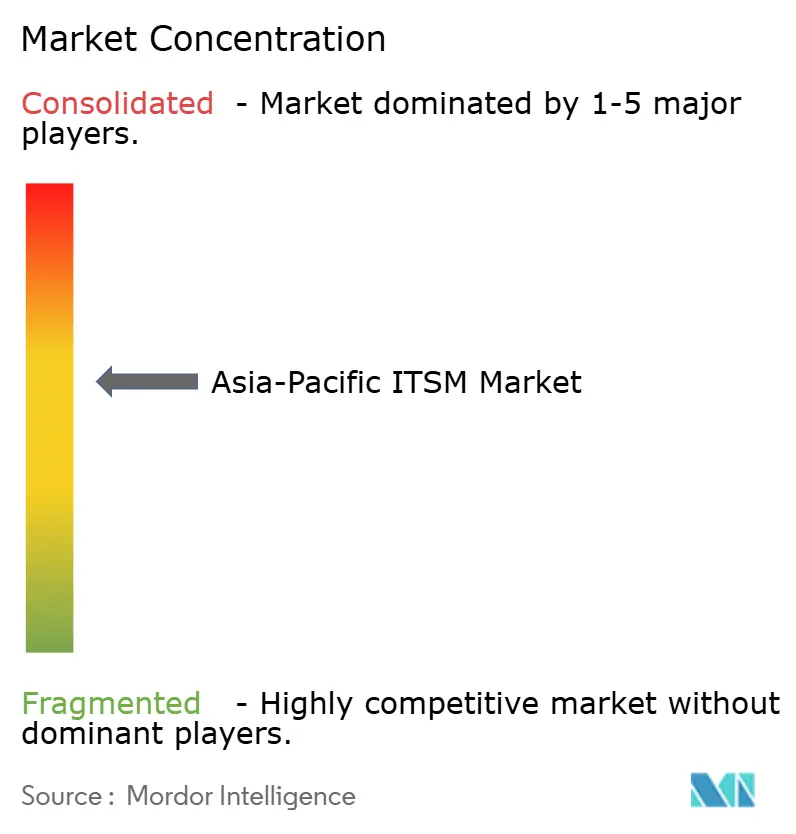
The Asia-Pacific IT service management market is moderately fragmented at the platform level, with ServiceNow holding the strongest position in large-enterprise and government accounts, while Atlassian, Freshworks, ManageEngine, and BMC Software remain relevant across mid-market and mixed-account segments. This competitive structure reflects a split market: large regulated organizations often prefer greater platform breadth and partner ecosystems, while smaller buyers focus more on speed, ease of use, and pricing. The services layer is even more crowded, since implementation, consulting, and managed support are delivered by a broad set of regional and global partners. That combination creates a market where platform leadership matters, but delivery capacity and post-deployment execution still heavily influence account wins. The Asia-Pacific IT service management market, therefore, does not operate as a winner-takes-all field, even though enterprise-tier platform strength still provides a visible advantage at the top end.
Competition is also moving beyond basic feature comparisons, as buyers increasingly evaluate how well vendors support AI-enabled workflows, govern knowledge use, and integrate across broader digital operations. Freshworks strengthened its position in May 2026 with AI Agent Studio and MCP Gateway inside Freshservice, which targeted faster workflow deployment and more open use with external AI tools. IBM and ServiceNow expanded their collaboration in June 2026 to link IBM’s AI, data, and automation capabilities with the ServiceNow platform, with a focus on AI-ready data and legacy application modernization.[3] ServiceNow and Lenovo also expanded their strategic agreement in May 2026 across Australia, New Zealand, Hong Kong, and Singapore to support AI-native IT operations management and stronger governance outcomes.
A second competitive theme in the Asia-Pacific IT service management market is the push to turn reference projects into broader regional credibility. Inspira Enterprise’s June 2026 partnership with ServiceNow, including deployment of the ServiceNow AI Control Tower as a certified production reference, is one example of how ecosystem players are using governance-led AI credentials to strengthen their delivery position. Cognizant’s work with JG Summit is another example, because it shows how service providers are using large diversified clients to demonstrate mobile-first and AI-ready service foundations in Southeast Asia. Over time, this means that platform vendors and delivery partners will compete not only on product breadth, but also on visible execution quality, ecosystem trust, and the ability to shorten the path from deployment to operational value. In that setting, the Asia-Pacific IT service management market should remain competitive, but larger incumbents and well-positioned partners still hold an edge where integration complexity and governance expectations are highest.
Asia-Pacific ITSM Industry Leaders
-
ServiceNow, Inc.
-
IBM Corporation
-
BMC Software, Inc.
-
Atlassian Corporation Plc
-
Ivanti, Inc.
- *Disclaimer: Major Players sorted in no particular order
Asia-Pacific ITSM Market Companies Covered in this Report
- ServiceNow, Inc.
- IBM Corporation
- BMC Software, Inc.
- Atlassian Corporation Plc
- Ivanti, Inc.
- Freshworks Inc.
- ManageEngine, a division of Zoho Corporation Pvt. Ltd.
- Broadcom Inc.
- Open Text Corporation
- Micro Focus International plc
- ASG Technologies Group, Inc.
- SysAid Technologies Ltd.
- Cherwell Software, LLC
- TOPdesk B.V.
- Hornbill Service Management Ltd.
- SymphonyAI Summit
- EasyVista S.A.
- SolarWinds Corporation
- Atlassian Corporation Plc
- Axelos Limited
Recent Industry Developments in Asia-Pacific ITSM Market
- June 2026: Inspira Enterprise, a cybersecurity and AI services provider with operations across India, Singapore, and Sydney, announced a strategic partnership with ServiceNow to serve as a full-spectrum platform delivery partner across Asia-Pacific. The deal includes Inspira's deployment of the ServiceNow AI Control Tower (AICT) as a certified production reference, positioning it as a model for governed AI adoption in the region.
- June 2026: IBM and ServiceNow announced an expanded collaboration to address 2 barriers blocking enterprise AI adoption at scale, the AI-ready data problem and the legacy application layer. IBM's AI, data, and automation capabilities will be combined with the ServiceNow AI Platform to enable autonomous IT operations, with joint solutions expected to be available in the second half of 2026.
- May 2026: KPMG expanded its global alliance with ServiceNow, committing USD 40 million in services over 3 years to accelerate AI-powered enterprise transformation. The agreement covers joint innovation investment, co-development of go-to-market solutions, and expanded ServiceNow license adoption within KPMG's own operations, with APAC delivery included in the global scope.
- May 2026: Freshworks unveiled AI Agent Studio within Freshservice at its annual Refresh 2026 conference, enabling organizations to build and deploy custom agentic AI workflows in weeks. The launch also introduced MCP Gateway, allowing integration with external AI tools, and fully consolidated IT asset and operations management into a single platform environment.
Asia-Pacific ITSM Market Report Scope
The Asia-Pacific IT Service Management Market is Segmented by Component (Solutions, Services), Deployment (Cloud, On-Premise, Hybrid), Application (Service Desk and Incident Management, Asset and Configuration Management, Change and Release Management, Service Request Management, Knowledge Management, Others), End-User Industry (BFSI, Manufacturing, Government, IT and Telecom, Healthcare, Retail, Travel and Hospitality, Others), Enterprise Size (Large Enterprises, SME), and Geography (China, Japan, India, South Korea, Southeast Asia, Rest of Asia-Pacific). The Market Forecasts are Provided in Terms of Value (USD).
Segmentation Overview
| Solutions |
| Services |
| Cloud |
| On-Premise |
| Hybrid |
| Service Desk and Incident Management |
| Asset and Configuration Management |
| Change and Release Management |
| Service Request Management |
| Knowledge Management |
| Other ITSM Applications |
| BFSI |
| Manufacturing |
| Government and Public Sector |
| IT and Telecommunications |
| Retail and E-Commerce |
| Healthcare |
| Travel and Hospitality |
| Other End-User Industries |
| Large Enterprises |
| Small and Mid-Size Enterprises (SME) |
| China |
| Japan |
| India |
| South Korea |
| Southeast Asia |
| Rest of Asia-Pacific |
| By Component | Solutions |
| Services | |
| By Deployment | Cloud |
| On-Premise | |
| Hybrid | |
| By Application | Service Desk and Incident Management |
| Asset and Configuration Management | |
| Change and Release Management | |
| Service Request Management | |
| Knowledge Management | |
| Other ITSM Applications | |
| By End-User Industry | BFSI |
| Manufacturing | |
| Government and Public Sector | |
| IT and Telecommunications | |
| Retail and E-Commerce | |
| Healthcare | |
| Travel and Hospitality | |
| Other End-User Industries | |
| By Enterprise Size | Large Enterprises |
| Small and Mid-Size Enterprises (SME) | |
| By Country | China |
| Japan | |
| India | |
| South Korea | |
| Southeast Asia | |
| Rest of Asia-Pacific |
Key Questions Answered in the Report
What is the Asia-Pacific IT service management market size through 2031?
The Asia-Pacific IT service management market was valued at USD 3.20 billion in 2025 and is projected to reach USD 9.43 billion by 2031, growing at a 19.90% CAGR over 2026-2031.
Which application area is growing fastest in Asia-Pacific IT service management?
Knowledge management is the fastest-growing application, with a projected 20.89% CAGR through 2031, supported by rising demand for governed knowledge in AI-enabled service workflows.
Which end-user sector leads spending in the region?
BFSI led regional demand with a 23.72% share in 2025, driven by audit, resilience, change management, and service continuity requirements.
Why is cloud deployment leading adoption across the region?
Cloud held 59.62% share in 2025 because it reduces infrastructure burden, speeds implementation, supports distributed teams, and gives many firms a cleaner path to automation.
Which country is driving the strongest growth ahead?
India is the fastest-growing geography, with a projected 21.32% CAGR through 2031, supported by domestic cloud adoption, outsourcing strength, and a broad service delivery ecosystem.