
India ITSM Market Size and Share
Market Overview
| Study Period | 2020 - 2031 |
|---|---|
| Forecast Data Period | 2026 - 2031 |
| Base Year Market Size (2025) | USD 0.52 Billion |
| Market Size (2026) | USD 0.65 Billion |
| Market Size (2031) | USD 1.91 Billion |
| Growth Rate (2026 - 2031) | 24.08 % |
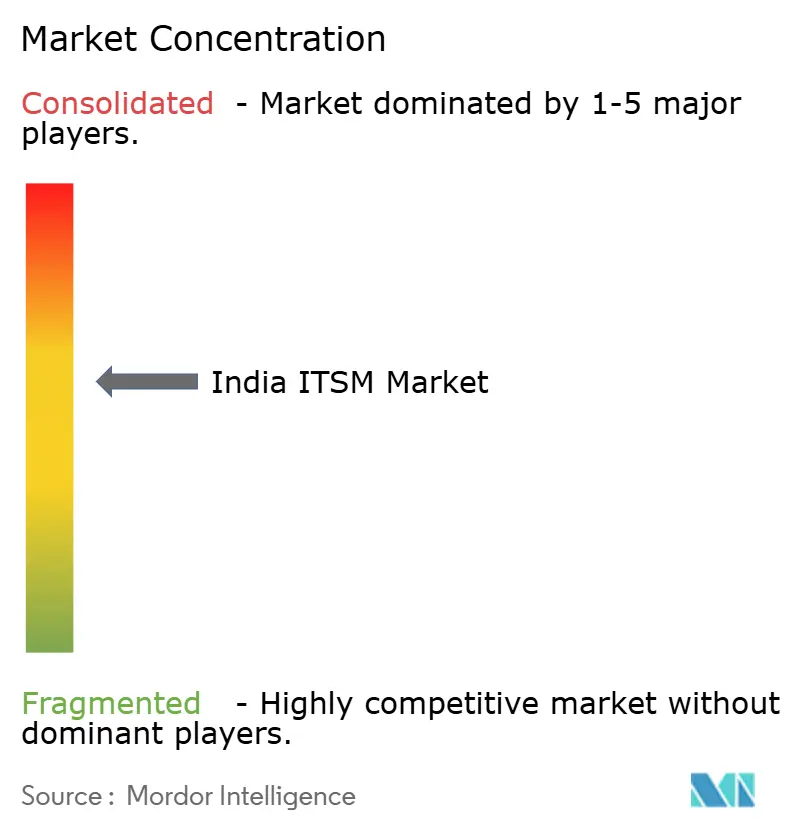
| Market Concentration | Medium |
Major Players *Disclaimer: Major Players sorted in no particular order Image © Mordor Intelligence. Reuse requires attribution under CC BY 4.0. | |
India ITSM Market Analysis by Mordor Intelligence
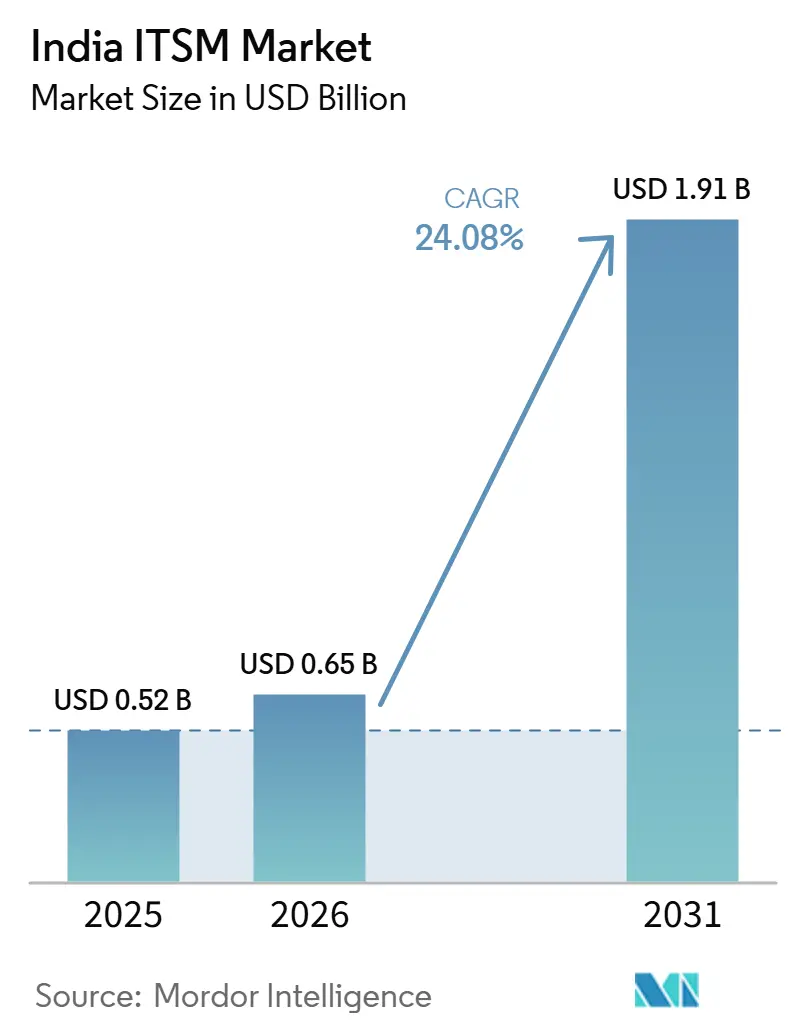
The India IT service management market size was USD 0.52 billion in 2025 and is forecast to reach USD 1.91 billion by 2031 at a CAGR of 24.08% over 2026-2031. The India IT service management market is expanding because large domestic enterprises and global capability centers are raising their digital spending and formalizing service workflows around automation, compliance, and platform consolidation. AI-led service operations are also changing buying behavior, as enterprises now expect faster resolution, stronger workflow orchestration, and lower dependence on manual ticket handling. The India IT service management market is also benefiting from cloud adoption, which is making enterprise-grade platforms more accessible across both large organizations and smaller buyers. Competitive activity remains active because software vendors, managed service providers, and India-headquartered IT companies are all trying to secure longer contracts through bundled platform, automation, and managed services offers. At the same time, data protection compliance costs and the shortage of trained ITSM professionals may slow migration for some buyers, which supports vendors that can simplify deployment and reduce implementation complexity.
Key Report Takeaways
- By component, solutions led with a 63.72% share of the India IT service management market in 2025, while services are projected to expand at a 26.31% CAGR through 2031.
- By deployment, cloud held 59.62% of the India IT service management market in 2025, while cloud is also expected to record the fastest CAGR of 26.15% through 2031.
- By application, service desk and incident management accounted for 32.73% of the India IT service management market in 2025, while knowledge management is projected to grow at a 25.34% CAGR through 2031.
- By end-user industry, BFSI held 26.73% of the India IT service management market share in 2025, while healthcare is forecast to expand at a 25.56% CAGR through 2031.
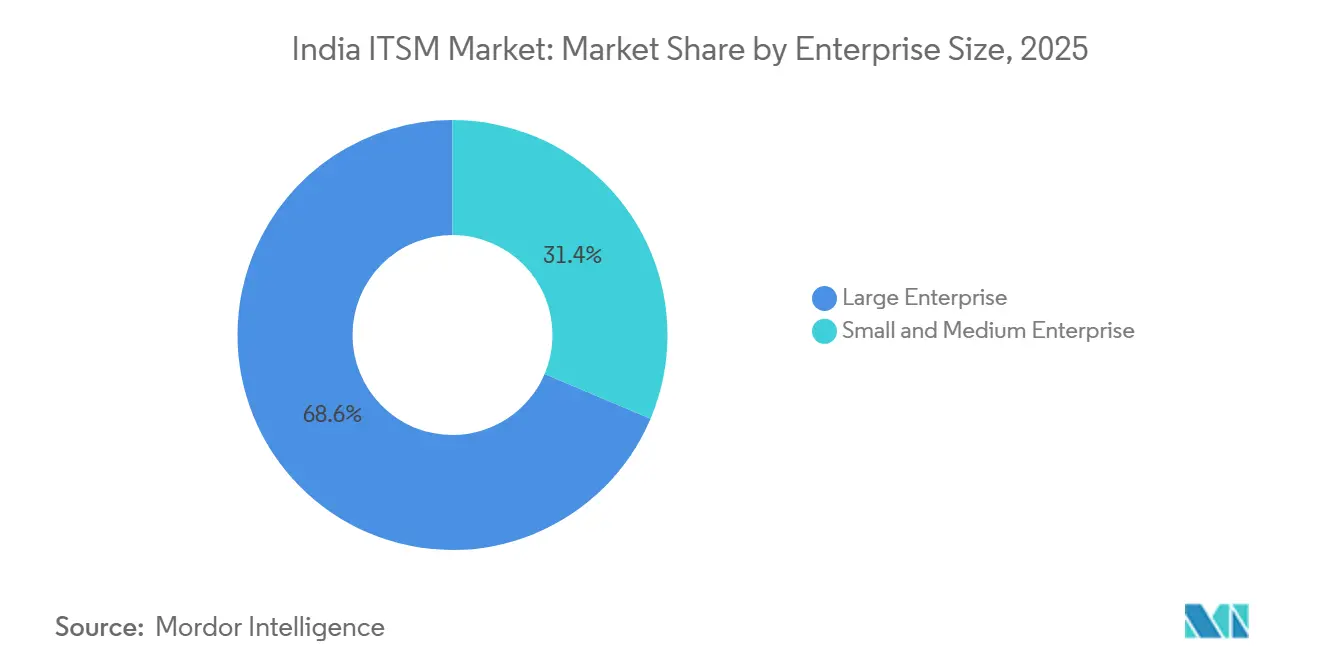
- By enterprise size, large enterprises captured 68.64% of the India IT service management market size in 2025, while SMEs are expected to advance at a 26.06% CAGR through 2031.
Note: Market size and forecast figures in this report are generated using Mordor Intelligence’s proprietary estimation framework, updated with the latest available data and insights as of January 2026.
India ITSM Market Trends and Insights
Drivers Impact Analysis*
| Driver | (~) % Impact on CAGR Forecast | Geographic Relevance | Impact Timeline |
|---|---|---|---|
| Shift To AI-Enabled Service Operations | +5.2% | Global, with India as APAC core | Short term (≤ 2 years) |
| GCC-Led Standardization Of Enterprise Services | +4.8% | India-specific | Short term (≤ 2 years) |
| Automation Pressure From High Service Desk Volume | +4.1% | India-centric, with global backdrop | Short term (≤ 2 years) |
| Expansion Of Cloud-Native ITSM Adoption | +3.7% | India and broader APAC | Medium term (2-4 years) |
| Rising Managed Services Demand In Mid-Market | +3.3% | India-specific | Medium term (2-4 years) |
| India-Specific Data Residency And Sovereignty | +2.1% | India-specific | Medium term (2-4 years) |
| Source: Mordor Intelligence | |||
Shift To AI-Enabled Service Operations Reshapes Delivery Models
The India IT service management market is moving from rule-based service handling toward AI-driven service operations that can identify, route, and resolve incidents with much less manual effort. Freshworks reported that AI-enabled ITSM teams achieved a 76.6% reduction in ticket resolution time and a 41.1% improvement in first-response time, while customer satisfaction in India rose from 97.4% to 97.83% between 2024 and 2025. This shift is changing the role of service desk teams: entry-level tickets are increasingly automated, while human staff focus more on exception handling, knowledge curation, and higher-complexity support work. Atlassian presented its Rovo Service agent as a workflow that can build an execution plan, act across connected systems, and close requests inside Jira Service Management without forcing users into other tools.. That kind of capability matters in the India IT service management market because enterprises are no longer buying platforms only for ticket recording and reporting. They are increasingly selecting platforms that can support autonomous actions inside live operational environments and shorten the path from detection to closure.
GCC Standardization Drives Enterprise-Wide ITSM Consolidation
The India IT service management market is also being supported by the scale and maturity of the country’s global capability center footprint. India had nearly 2,975 global capability centers in 2024, and the value created by this base is expected to continue rising through FY2029 as centers take on more product, AI, cybersecurity, and engineering work. These centers need standardized service processes across distributed teams, which pushes buyers toward ITIL-aligned platforms that can support governance, workflow consistency, and global service rules. The effect also extends beyond the centers themselves, as suppliers and service partners often need compatible service practices to operate within larger delivery ecosystems. The Economic Survey 2025-26 also noted that GCC expansion is moving beyond core metro corridors into Tier-2 and Tier-3 cities, which broadens the geographic base of enterprise IT service demand. This supports the India IT service management market over the long term because demand is tied not only to software refresh cycles but also to the widening operational footprint of enterprise service delivery.
Automation Pressure From Service Desk Volume Accelerates Platform Upgrades
The India IT service management market is facing sustained automation pressure because large enterprises, GCCs, and multi-site operations generate service volumes that manual teams struggle to absorb at consistent service levels. Freshworks disclosed that 47% of IT tickets were submitted outside normal business hours, and after-hours response times lagged by more than 1 hour, while SLA compliance rates could fall by as much as 5 percentage points.[1] That kind of workload pattern pushes enterprises to modernize platforms faster because delays are no longer limited to daytime service queues. LTIMindtree’s BlueVerse with OGI was launched as a platform featuring self-governing AI agents that can detect, diagnose, and remediate common incident patterns with minimal human intervention. In practical terms, the India IT service management market is now rewarding vendors that can prove measurable gains in incident handling rather than only offering broad workflow catalogs. That changes platform competition because upgrade decisions are increasingly tied to operational throughput, service quality, and off-hours resilience.
Cloud-Native ITSM Adoption Accelerates Under Hyperscaler-Led Infrastructure Expansion
The India IT service management market is also being shaped by the shift toward cloud-based enterprise infrastructure and subscription delivery models. Cloud deployment is already the largest deployment category in the market, and that lead reflects buyer interest in faster rollout, lower infrastructure management burden, and simpler multi-site standardization. Freshworks strengthened this direction in April 2026, integrating continuous infrastructure discovery and dependency mapping into Freshservice IT Asset Management following its Device42 acquisition. The move matters because cloud-native platforms are now closing gaps that once favored older on-premise environments in asset visibility and service impact mapping. IBM also confirmed its compliance-readiness positioning for India’s financial sector through its local cloud infrastructure approach, demonstrating that regulated buyers want cloud models only when sovereignty and certification expectations are addressed. As a result, the India IT service management market is not shifting to cloud only because of cost efficiency, it is also shifting because cloud platforms now align more closely with enterprise governance and operational requirements.
Restraints Impact Analysis*
| Restraint | (~) % Impact on CAGR Forecast | Geographic Relevance | Impact Timeline |
|---|---|---|---|
| Legacy Migration Complexity And Switching Costs | -3.8% | India-centric, large enterprise and government | Medium term (2-4 years) |
| Shortage Of Skilled ITSM, AIOps, And Process Experts | -3.1% | Global, acute in India mid-market | Short term (≤ 2 years) |
| Fragmented Tool Sprawl Across Enterprise IT | -2.4% | Global | Short term (≤ 2 years) |
| Budget Sensitivity Among Small And Mid-Sized Enterprises | -1.9% | India and emerging markets | Short term (≤ 2 years) |
| Source: Mordor Intelligence | |||
Legacy Migration Complexity And Switching Costs Constrain Transition Velocity
The India IT service management market still carries a large installed base of legacy environments, and that limits the pace of full platform replacement. Many large enterprises and government-linked organizations continue to run heavily customized service systems, where workflow rules, approval logic, and service catalogs have been embedded over many years. That makes migration difficult because buyers are not only moving ticket data, they are also trying to preserve business-critical operating logic without service disruption. Public sector entities and state-linked institutions often face longer approval cycles as well, which extends the time needed to validate new platforms and finalize replacement decisions. This slows the India IT service management market even when new platforms are technically stronger, because transition risk can outweigh the appeal of feature upgrades for some accounts. Vendors that provide migration tooling, staged transition methods, and lower-risk onboarding models are therefore more likely to win replacement programs in complex accounts.
ITSM Skills Shortage Limits Deployment Velocity Across Mid-Market
The India IT service management market also faces a workforce constraint because implementation quality still depends on trained practitioners who understand service design, automation logic, and platform administration. The shortage is especially visible in the mid-market, where organizations often cannot fund large consulting teams or long implementation cycles. This matters more now because modern ITSM deployments increasingly combine workflow automation, asset intelligence, AI support layers, and policy-driven governance within a single platform. Large India-headquartered IT service firms have an advantage in this setting because they can train bigger practitioner pools and spread specialized talent across multiple client programs. That leaves smaller organizations more dependent on simplified cloud products, managed services, or vendors that offer low-code onboarding. In turn, the India IT service management market tends to reward providers that reduce the need for deep specialist staffing during deployment and ongoing operations.
*Our forecasts treat driver/restraint impacts as directional, not additive. The impact forecasts reflect baseline growth, mix effects, and variable interactions.
Segment Analysis
By Component: Solutions Anchor Revenue While Services Compound Faster
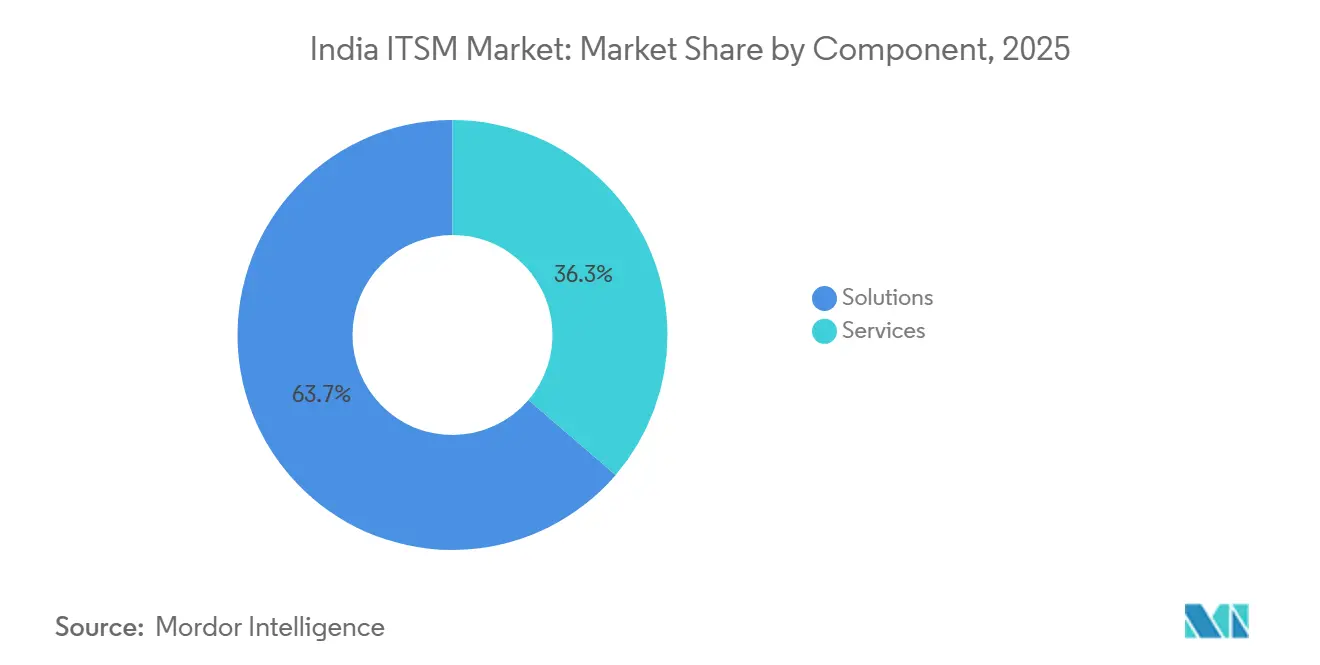
Solutions accounted for 63.72% of the India IT service management market share in 2025, which shows that buyers still allocate most spending toward core platforms that can centralize service desk, asset, change, and knowledge workflows. This pattern reflects the preference of large enterprises and GCC-led operations for integrated environments rather than scattered tools that create governance gaps. The leading platform vendors in the India IT service management market have used this preference to position multi-module suites as the default entry point for long-term client relationships. That approach also gives vendors more room to expand account value over time because once the base platform is established, adjacent functions can be added without a full replacement discussion. In the India IT service management industry, this favors companies that can support broad workflows under a single operating model and maintain policy consistency across large user bases.
Services are forecast to expand at a 26.31% CAGR through 2031, indicating that the faster-growing part of the India IT service management market lies in deployment, optimization, and managed execution rather than software alone. Buyers increasingly need outside support because AI-enabled platforms require workflow design, data preparation, process tuning, and change management before the promised benefits can be realized. This is why India-headquartered integrators and service firms are moving from basic implementation roles toward IP-led managed ITSM offerings with deeper operational scope. The shift is also changing competition because vendors that once depended mainly on license revenue now need stronger delivery ecosystems to protect adoption and renewals. Over time, this should keep software central to spending while still raising the strategic value of the services layer across the India IT service management market.
By Deployment: Cloud Platforms Capture The Largest Share And Sustain The Fastest Growth
Cloud deployment held 59.62% of the India IT service management market size in 2025, confirming that subscription-based delivery is now the dominant model for most enterprise buyers. The main appeal is not only lower infrastructure burden, but also faster standardization across distributed offices, remote teams, and outsourced service environments. This is especially relevant in the India IT service management market because large organizations often operate across multiple cities and delivery centers, which makes centralized administration more valuable. Freshworks expanded its cloud-native proposition in April 2026 by adding continuous discovery and dependency mapping to Freshservice ITAM, thereby strengthening the operational depth of a SaaS-led platform. As feature depth improves, the rationale for staying on older on-premise environments becomes weaker for buyers who do not need highly isolated infrastructure.
Cloud is also the fastest-growing deployment segment with a 26.15% CAGR through 2031, which indicates that the India IT service management market still has substantial migration room ahead. On-premise environments remain relevant in defense, select government use cases, and parts of critical infrastructure where isolation requirements remain strong. Hybrid models also continue to matter for regulated institutions that are moving gradually from legacy data centers to cloud-based service delivery. IBM’s compliance-focused positioning for India’s financial sector shows how cloud providers are trying to remove sovereignty and control concerns that once slowed adoption in regulated segments.[2] As a result, the India IT service management market is likely to see cloud growth remain broad-based, while hybrid and controlled private environments stay relevant in a smaller but still important set of verticals.
By Application: Service Desk Leads While Knowledge Management Accelerates
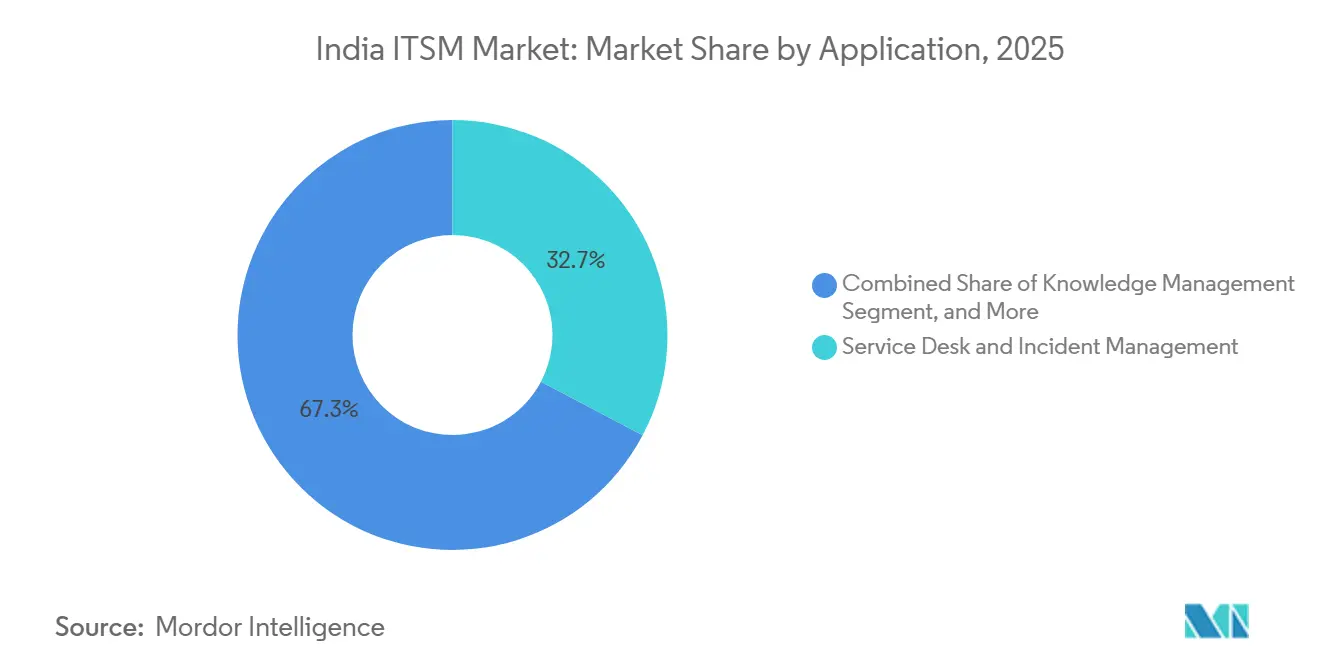
Service Desk and Incident Management commanded 32.73% of the India IT service management market in 2025, and that leadership reflects the steady flow of requests from large enterprises and GCC environments. The application remains central because device provisioning, access issues, network events, software support, and employee requests all continue to pass through ticket-based workflows. In the India IT service management market, this provides the service desk with a stable demand base even as broader transformation budgets fluctuate. The large installed base of structured service operations also supports renewal and upgrade cycles because buyers need reliable core workflows before they can automate more advanced processes. For that reason, the service desk remains the commercial anchor for platform vendors, even as the product conversation shifts toward AI and orchestration.
Knowledge Management is forecast to grow at a 25.34% CAGR through 2031, which shows how quickly the India IT service management market is moving beyond passive documentation repositories. Enterprises now expect knowledge assets to support live service resolution, guided troubleshooting, and automated response logic inside the workflow itself. Freshworks’ broader platform upgrades around service intelligence and asset visibility point in the same direction because structured operational context is becoming more useful when it can be surfaced during ticket handling, not only after the event. This is raising the value of well-managed knowledge content because faster and more accurate resolution increasingly depends on how effectively platforms can use stored service information. As that trend deepens, the India IT service management industry is likely to see more investment in knowledge architecture, content quality, and AI-ready documentation practices.
By End-User Industry: BFSI Anchors Demand While Healthcare Sets The Growth Pace
BFSI held 26.73% of the India IT service management market share in 2025, making it the largest end-user vertical in the market. The segment’s lead comes from its need for documented service workflows, vendor oversight, audit readiness, and formal incident handling across complex digital operations. In the India IT service management market, few industries face the same pressure to standardize service management as banks, insurers, capital market firms, and related financial institutions. This keeps spending resilient because workflow discipline is tied to operational continuity and control expectations, not only to discretionary modernization plans. The segment also favors vendors that can support stronger governance, role-based control, and service transparency across internal and outsourced environments.
Healthcare is projected to grow at a 25.56% CAGR through 2031, which places it at the front of future expansion within the India IT service management market. The segment is being supported by formal digitization needs in hospitals, insurers, and related health service networks that must manage uptime, service responsiveness, and compliance-driven IT processes at higher scale. Max Healthcare’s November 2025 extension of its 5-year partnership with Progressive Infotech covered service desk operations, AIOps-led monitoring, and digital workplace management across 19 hospitals, which illustrates the move toward enterprise-grade IT service operations in healthcare networks.[3] The practical effect is that healthcare buyers are increasingly treating IT service management as a core operating layer rather than an administrative back-office tool. That should keep the India IT service management market well supported by hospital chains and broader care delivery systems over the forecast period.
By Enterprise Size: Large Enterprises Lead While SMEs Drive Future Momentum
Large enterprises accounted for 68.64% of the India IT service management market size in 2025, which reflects the cost, complexity, and scale requirements of enterprise-grade deployments. These buyers include conglomerates, major GCCs, public sector undertakings, and large financial institutions that need centralized service architectures across thousands of users and multiple workflows. The India IT service management market, therefore, remains heavily influenced by organizations that can commit to multi-module rollouts, long procurement cycles, and formal governance structures. Large accounts also tend to generate richer expansion opportunities for vendors because once the base platform is accepted, adjacent modules can be layered into the contract. This keeps enterprise relationships highly valuable and helps explain why vendors continue to build strong local sales, engineering, and customer success presence in India.
SMEs are forecast to grow at a 26.06% CAGR through 2031, indicating that future expansion in the India IT service management market will not remain limited to the largest buyers. Smaller organizations are becoming more active because AI-native cloud platforms reduce infrastructure costs and the need for large support teams. Freshservice and other lighter deployment models are attractive in this segment because they package automation, workflow control, and subscription pricing into simpler adoption paths. The Freshworks case study with Asian Paints, where the company replaced a legacy ITSM system in 8 weeks and routed 80% of tickets through digital channels, highlights the appeal of faster implementation and productivity gains for buyers seeking practical operational improvement. As more SMEs formalize response processes and internal service workflows, this segment should remain an important source of momentum for the India IT service management market.
Geography Analysis
Southern India represents the strongest concentration of demand in the India IT service management market because Bengaluru, Hyderabad, and Chennai combine large enterprise density with a high concentration of GCC activity. The region benefits from a deep technology talent base, strong enterprise presence, and a large installed base of organizations that need standardized support across distributed operations. ServiceNow’s India engineering footprint has been especially significant in Hyderabad and Bengaluru, and the company’s India base now supports a major share of global product R&D. Southern India also gains from the operating demands created by a large professional workforce that depends on structured service desk, asset, and knowledge workflows every day.
Western India forms the second major demand center in the India IT service management market, led by Mumbai and Pune. Mumbai contributes strong spending from banks, insurers, capital market firms, and other regulated financial institutions that need better governance and service visibility across digital operations. Pune adds a different layer because it combines enterprise technology operations with manufacturing and engineering activity that often requires support workflows linked to broader operational systems. IBM’s 2026 communication around compliance-readiness for the Indian financial sector reflects how vendors are tailoring local infrastructure and control positioning for western India’s regulated buyers. The Freshworks case study with Asian Paints, a Maharashtra-headquartered conglomerate, also shows that western India buyers are willing to replace legacy service platforms when implementation speed and digital service adoption can be demonstrated clearly.
Northern India, centered on Delhi, Noida, and Gurugram, remains important to the India IT service management market because it combines government technology demand with a large telecom, BFSI, and enterprise services base. The region is particularly relevant for public sector and regulated contracts where structured service management is tied to continuity, oversight, and controlled modernization. The Economic Survey 2025-26 indicated that GCC expansion is also moving into Tier-2 and Tier-3 cities, which broadens the geography of future enterprise service demand beyond the largest metros. Cities such as Ahmedabad, Jaipur, Kochi, Coimbatore, and Chandigarh are therefore becoming more relevant because they are attracting technology activity that creates new service management needs. Over time, that spread should make the India IT service management market less dependent on a small number of metro clusters and more supported by a wider regional base of enterprise buyers.
Competitive Landscape
The India IT service management market has a bifurcated competitive structure, with global platform vendors competing on software and cloud subscriptions while large domestic IT service firms compete on managed execution. ServiceNow, Freshworks, BMC Helix, Atlassian, and Ivanti are key platform players, while TCS, Infosys, Wipro, HCL Technologies, LTIMindtree, and Tech Mahindra strengthen the services side of the market. This setup keeps competition active because buyers often evaluate both platform capability and delivery strength before committing to long contracts. The India IT service management market, therefore, rewards vendors that can combine product depth, local support, and credible operating outcomes at scale.
Freshworks has been using product expansion as a clear competitive lever in the India IT service management market. In May 2026, the company introduced Freddy AI Agent Studio to let enterprises build, customize, and deploy AI agents across ITSM workflows with less coding effort. In April 2026, it also integrated continuous discovery and dependency mapping into Freshservice ITAM, which strengthened its pitch around unified service, operations, and asset context. These moves matter because the India IT service management market increasingly values faster automation, better context visibility, and shorter deployment paths. Ivanti’s January 2026 expansion of Neurons with persona-based agentic AI capabilities also showed that vendors outside the largest incumbent group are trying to improve their position through autonomous service handling and natural-language interaction.
Domestic IT service firms are also strengthening their influence over the India IT service management market by tying ITSM into larger transformation and managed services contracts. LTIMindtree’s October 2025 launch of BlueVerse with OGI reflected this push toward proprietary agentic IT operations tooling rather than simple resale of third-party platforms. Infosys expanded its collaboration with GlobalFoundries in June 2026 to deliver AI-led managed services across enterprise IT operations, including service desk coverage, which shows how ITSM capabilities are being bundled into broader long-term managed operating models. Wipro’s 8-year transformation deal with Olam Group in April 2026 adds another example of how major service firms are competing through scale, AI integration, and control over wider enterprise IT environments. As a result, the India IT service management market is likely to remain competitive across both software-led and service-led routes to value.
India ITSM Industry Leaders
-
ServiceNow, Inc.
-
IBM Corporation
-
BMC Software, Inc.
-
Atlassian Corporation Plc
-
Ivanti, Inc.
- *Disclaimer: Major Players sorted in no particular order
Recent Industry Developments
- June 2026: Infosys announced an expanded multi-year collaboration with GlobalFoundries to deliver AI-led managed services across GlobalFoundries' enterprise IT landscape, covering end-to-end application, infrastructure, data, and service desk operations. The engagement transitions GlobalFoundries from externally supported IT operations to a full managed services model driven by AI, automation, and continuous optimization, reinforcing Infosys' position as a leader in mission-critical ITSM managed services.
- May 2026: Freshworks unveiled Freddy AI Agent Studio at its annual Refresh conference, introducing a no-code studio enabling enterprises to create, customize, or deploy pre-built AI agents across ITSM workflows. The platform's Model Context Protocol Gateway enables Freddy AI to pull context from third-party tools without custom integration work, while AI Insights with Experience Level Agreements connect service performance to employee sentiment at an executive level.
- April 2026: Wipro secured an 8-year managed services and IT transformation deal with Olam Group valued at over USD 1 billion, including the acquisition of Olam's IT services arm Mindsprint for USD 375 million. The engagement deploys Wipro's AI-powered and consulting-led approach across Olam's global IT operations, representing one of the company's largest single-client ITSM and managed services commitments.
- April 2026: Freshworks introduced redefined Freshservice IT Asset Management, integrating continuous infrastructure discovery and dependency mapping from its Device42 acquisition natively into Freshservice. The converged platform combines ITSM, ITOM, and ITAM into a single data layer, enabling organizations to assess service impact comprehensively and shorten resolution cycles.
India ITSM Market Report Scope
The Japan IT Service Management Market is Segmented by Component (Solutions, and Services), Deployment (Cloud, On-Premise, and Hybrid), Application (Service Desk and Incident Management, Asset and Configuration Management, Change and Release Management, Service Request Management, Knowledge Management, and Others), End-User Industry (BFSI, Manufacturing, Government and Public Sector, IT and Telecommunications, Retail and E-Commerce, Healthcare, and Others), and Enterprise Size (Large Enterprises, and Small and Medium Enterprises). The Market Forecasts are Provided in Terms of Value (USD).
| Solutions |
| Services |
| Cloud |
| On-Premise |
| Hybrid |
| Service Desk and Incident Management |
| Asset and Configuration Management |
| Change and Release Management |
| Service Request Management |
| Knowledge Management |
| Other ITSM Applications |
| BFSI |
| Manufacturing |
| Government and Public Sector |
| IT and Telecommunications |
| Retail and E-Commerce |
| Healthcare |
| Travel and Hospitality |
| Other End-User Industries |
| Large Enterprises |
| Small and Mid-Sized Enterprises (SME) |
| By Component | Solutions |
| Services | |
| By Deployment | Cloud |
| On-Premise | |
| Hybrid | |
| By Application | Service Desk and Incident Management |
| Asset and Configuration Management | |
| Change and Release Management | |
| Service Request Management | |
| Knowledge Management | |
| Other ITSM Applications | |
| By End-User Industry | BFSI |
| Manufacturing | |
| Government and Public Sector | |
| IT and Telecommunications | |
| Retail and E-Commerce | |
| Healthcare | |
| Travel and Hospitality | |
| Other End-User Industries | |
| By Enterprise Size | Large Enterprises |
| Small and Mid-Sized Enterprises (SME) |
Key Questions Answered in the Report
What is the current and future size of the India IT service management sector?
The India IT service management market size was USD 0.52 billion in 2025 and is forecast to reach USD 1.91 billion by 2031, growing at a 24.08% CAGR over 2026-2031.
Which deployment model is leading adoption in India?
Cloud led with 59.62% of spending in 2025 and is also expected to record the fastest growth at a 26.15% CAGR through 2031.
Which application area generates the most demand for IT service management platforms in India?
Service desk and incident management led with 32.73% of the market in 2025 because large enterprises and GCCs continue to generate high ticket volumes.
Which end-user vertical is driving the strongest spending?
BFSI held the largest share at 26.73% in 2025, supported by stronger governance, oversight, and documented service workflow requirements.
Which customer group is expected to grow fastest over the forecast period?
SMEs are projected to grow at a 26.06% CAGR through 2031 as cloud-native and AI-enabled platforms reduce deployment complexity and upfront overhead.