
South America UEM Market Size and Share
Market Overview
| Study Period | 2020 - 2031 |
|---|---|
| Forecast Data Period | 2026 - 2031 |
| Base Year Market Size (2025) | USD 0.36 Billion |
| Market Size (2026) | USD 0.45 Billion |
| Market Size (2031) | USD 1.48 Billion |
| Growth Rate (2026 - 2031) | 27.08 % |
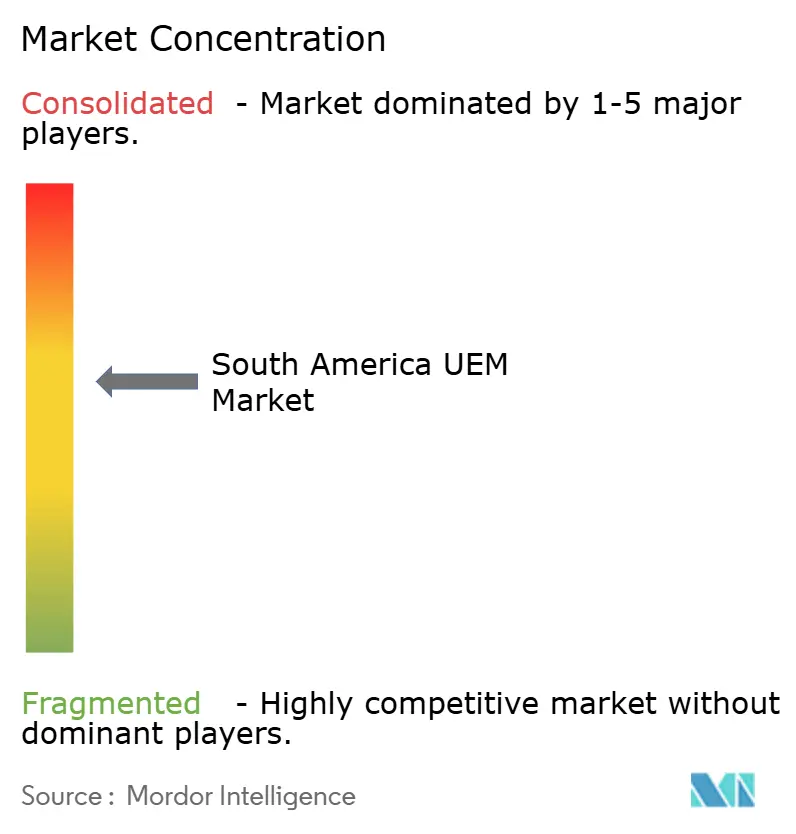
| Market Concentration | Medium |
Major Players *Disclaimer: Major Players sorted in no particular order Image © Mordor Intelligence. Reuse requires attribution under CC BY 4.0. | |
South America UEM Market Analysis by Mordor Intelligence
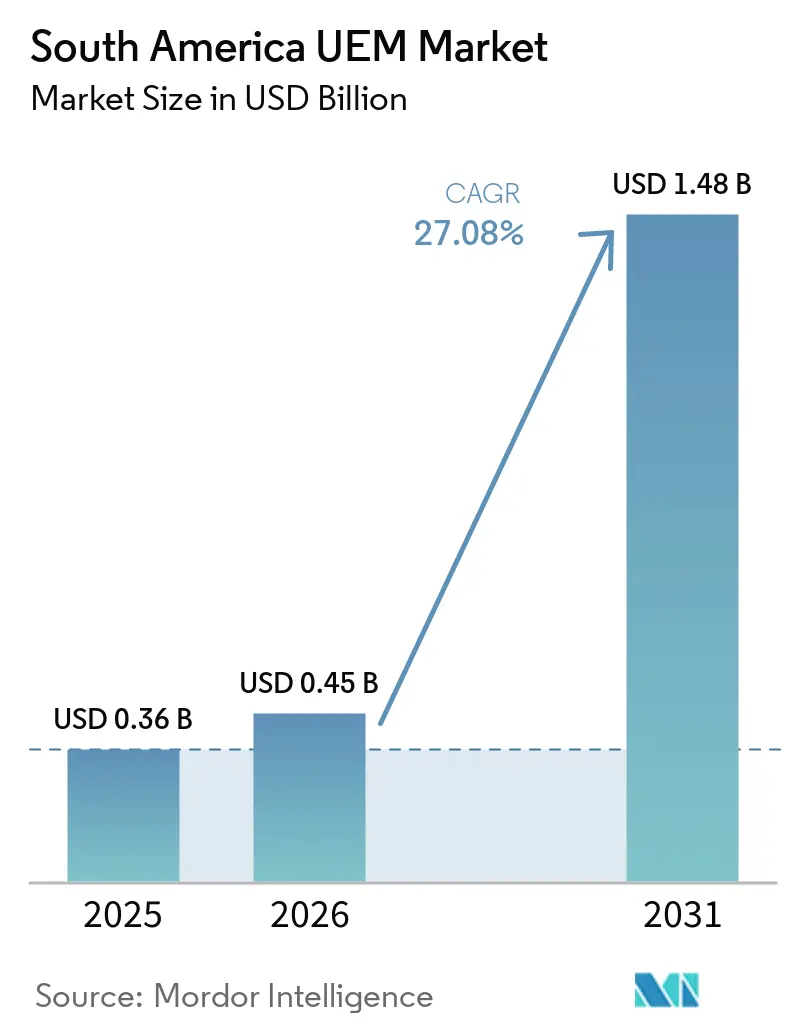
The South America UEM market size was valued at USD 0.36 billion in 2025 and is forecast to reach USD 1.48 billion by 2031 at a CAGR of 27.08% during 2026-2031. Growth is being supported by the spread of hybrid work, which has expanded the number and variety of devices that enterprise IT teams must manage under one policy framework. Cyber risk is also pushing adoption, because rising malware and ransomware activity is making fragmented endpoint tools harder to justify in large and mid-sized organizations. Data handling rules in Brazil and Chile are raising the need for continuous device compliance records, which favors platforms that can centralize policy, application, and audit controls. Brazil remains the largest source of regional demand, while Chile and Argentina are broadening the addressable base and reducing reliance on a single-country pattern. Competition is still centered on a limited group of global vendors, but market room remains open for providers that can simplify deployment, support multi-OS environments, and address budget limits in smaller accounts.
Key Report Takeaways
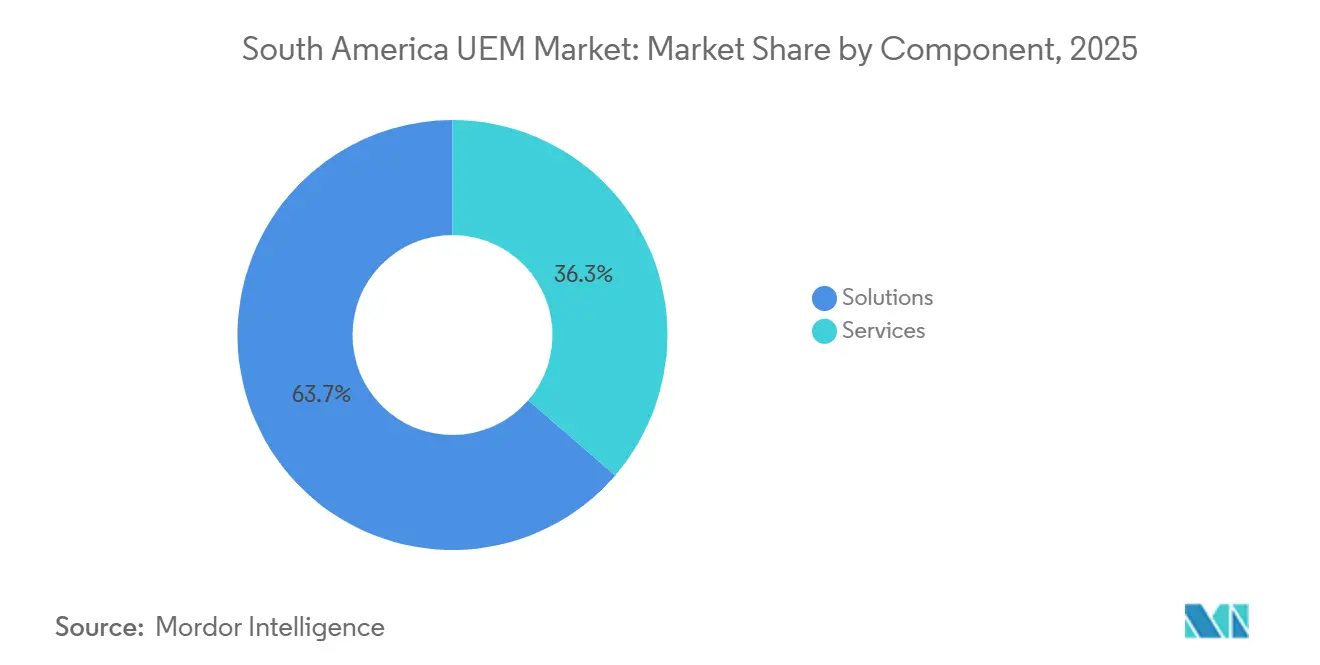
- By component, solutions held 63.66% of the South America UEM market in 2025, while the same segment is projected to expand at a 28.22% CAGR through 2031.
- By deployment mode, cloud-based delivery accounted for 56.78% of the market in 2025 and is expected to record the fastest CAGR at 28.67% through 2031.
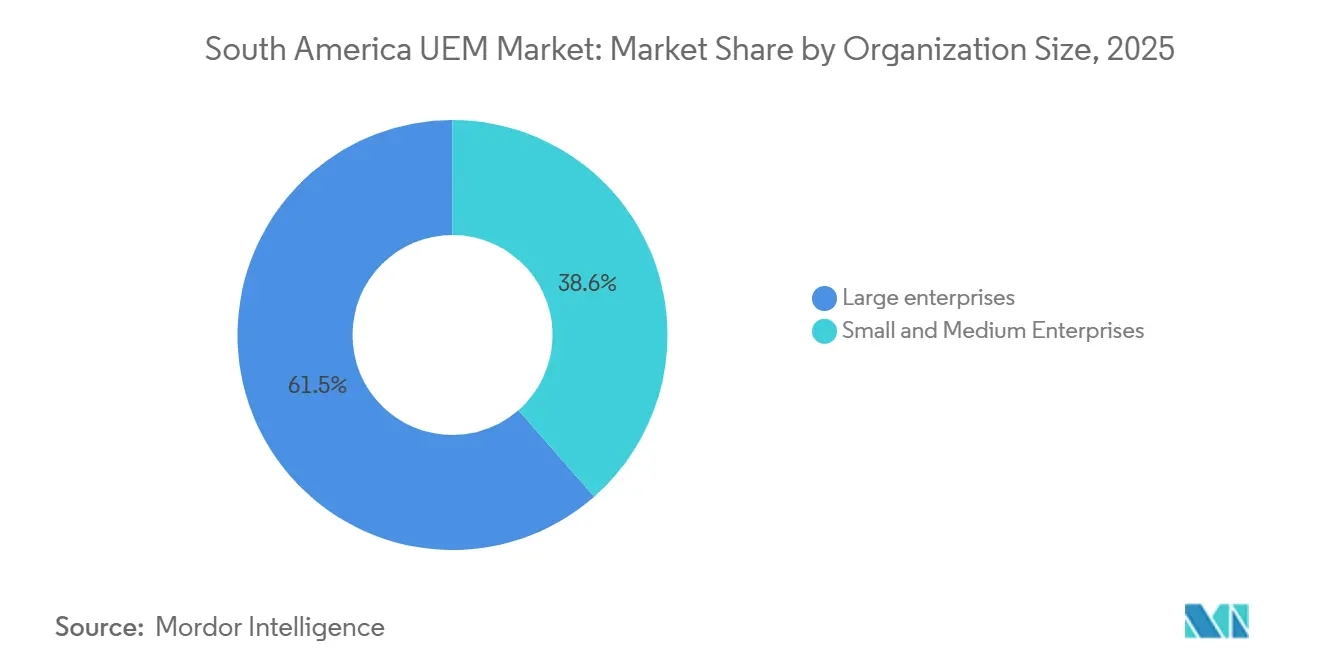
- By organization size, large enterprises represented 61.45% share in 2025, while small and medium enterprises are forecast to post the highest CAGR at 28.54% through 2031.
- By end-user industry, IT and telecommunications captured 20.22% share in 2025, while healthcare and life sciences is projected to advance at a 28.45% CAGR through 2031.
- By country, Brazil held 55.67% share of the South America unified endpoint management market in 2025, while Chile is expected to expand at the fastest CAGR of 28.32% through 2031.
Note: Market size and forecast figures in this report are generated using Mordor Intelligence’s proprietary estimation framework, updated with the latest available data and insights as of January 2026.
Market Trends and Insights
Drivers Impact Analysis of South America UEM Market*
| Driver | (~) % Impact on CAGR Forecast | Geographic Relevance | Impact Timeline |
|---|---|---|---|
| Rising BYOD and Hybrid Work Device Sprawl | +4.5% | South America-wide, with highest intensity in Brazil and Argentina | Short term (≤ 2 years) |
| Escalating Endpoint-Centric Cyberattack Frequency | +4.0% | Brazil, Chile, rest of South America | Short term (≤ 2 years) |
| Cloud Delivery Preference for Faster Rollout and Lower Upfront Cost | +3.5% | South America-wide, strongest in Brazil and Chile | Medium term (2-4 years) |
| Need for Centralized Policy Enforcement Across Multi-OS Fleets | +3.0% | South America-wide, concentrated in large enterprises in Brazil | Medium term (2-4 years) |
| Data Residency Pressure on Telemetry and Device Compliance Logs | +2.5% | Brazil, Chile, spillover to Argentina | Medium term (2-4 years) |
| Retail, Logistics, and Field Workforce Mobility Expanding Managed Endpoint Demand | +2.0% | Brazil, Argentina, Chile, spillover to rest of South America | Long term (≥ 4 years) |
| Source: Mordor Intelligence | |||
Rising BYOD and Hybrid Work Device Sprawl
The South America UEM market is gaining support from the spread of personal and remote-work devices across enterprise environments. The pressure comes less from the number of endpoints alone and more from the mix of iOS, Android, and Windows devices that now sit under one corporate identity and access structure. Hybrid work has made that challenge harder, because employees move between office networks, home connections, and public access points during the same work cycle. This has made privacy-aware policy enforcement more important, since IT teams must secure business data on personal devices without overreaching into personal use. In the South America UEM market, this shift is moving buyers away from narrow mobile device tools and toward platforms that can manage enrollment, patching, and compliance from one console. The result is steady demand for software that can reduce policy gaps across mixed fleets while keeping administration practical for regional IT teams.
Escalating Endpoint-Centric Cyberattack Frequency
The South America unified endpoint management market is also being pushed by a sharp increase in endpoint-focused cyber risk. Fortinet reported 753.8 billion attempted cyberattacks against Brazilian organizations in 2025, and October alone absorbed 198 billion attempts, with government, education, and energy among the most exposed sectors.[1] Acronis also identified Brazil as the second most malware-attacked country globally in H1 2025, while ransomware groups such as LockBit, Play, and 8Base sustained campaigns against manufacturing and IT targets. Sophos found that 54% of ransomware incidents in Brazil resulted in data encryption in 2025, above the global average of 50%, which shows how exposed endpoints have become in practical terms. In the South America UEM market, buyers increasingly treat unified telemetry as a security requirement because separate tools make lateral movement harder to detect across compromised devices. This is turning endpoint management from an administrative function into a control point that feeds broader security operations.
Cloud Delivery Preference for Faster Rollout and Lower Upfront Cost
Cloud delivery is changing the economics of the South America UEM market by replacing heavier upfront deployment models with recurring subscription spending. ABES reported that public cloud investment in Brazil reached USD 3.5 billion in 2025, up 20% from 2024, which points to a broader enterprise shift toward hosted software environments.[2] Microsoft committed BRL 14.7 billion, or USD 2.9 billion, to Brazilian cloud and AI infrastructure, and AWS expanded its São Paulo region to 6 availability zones in 2025, which helped reduce data-hosting concerns for regional buyers. These investments matter because cloud-based UEM now packages analytics, automation, and zero-trust enforcement into one subscription that many mid-sized organizations can adopt without a long buildout period. In the South America UEM market, that bundled model is improving the case for modernization among organizations managing 200 to 1,000 devices. It is also giving vendors a clearer path to reach customers that once viewed full-stack endpoint management as too costly or too complex.
Need for Centralized Policy Enforcement Across Multi-OS Fleets
The South America UEM market is benefiting from a basic operational need to enforce one policy structure across very different endpoint types. Large organizations in the region often manage Android, iOS, macOS, Windows, ChromeOS, and Linux devices at the same time, and that diversity creates gaps when each category is handled in a separate tool. Siloed management makes it harder to keep patch baselines aligned, generate one audit trail, and apply common access controls across the full fleet. Microsoft reinforced this consolidation pattern by adding advanced Intune Suite capabilities, including Endpoint Privilege Management, Advanced Analytics, Enterprise Application Management, and Cloud PKI, into Microsoft 365 E3 and E5 licenses from July 2026. That move shows how platform vendors are using multi-OS management as a central account anchor rather than a side feature. In the South America UEM market, organizations already standardized on Microsoft 365 face a clear pull toward a single management layer that covers a wider device mix with less operational overlap.
Restraints Impact Analysis of South America UEM Market*
| Restraint | (~) % Impact on CAGR Forecast | Geographic Relevance | Impact Timeline |
|---|---|---|---|
| Budget Sensitivity Among Mid-Market Buyers | -2.5% | South America-wide, most acute in Argentina, spillover to Brazil's mid-market | Short term (≤ 2 years) |
| Legacy Endpoint Tool Fragmentation and Migration Complexity | -2.0% | South America-wide, concentrated in Brazil and Argentina's large-enterprise sector | Medium term (2-4 years) |
| Limited Internal Skill Availability for Policy Orchestration and Automation | -1.5% | South America-wide, most severe in smaller urban markets and rest of South America | Medium term (2-4 years) |
| Concerns Over Cloud Control Plane Latency and Sovereignty | -1.0% | Brazil, Chile, Argentina | Long term (≥ 4 years) |
| Source: Mordor Intelligence | |||
Budget Sensitivity Among Mid-Market Buyers
Budget pressure remains a real brake on the South America UEM market, especially in mid-market organizations that must weigh per-device software costs against other immediate IT needs. This is especially visible in Argentina, where currency instability has pushed some organizations to delay broader platform consolidation or choose lighter mobility tools instead. Many of these companies also lack dedicated endpoint specialists, so total cost depends not just on licensing but also on outside implementation and support. Telco-bundled device management options offer a partial alternative, but they often fall short on policy depth and compliance reporting for regulated buyers. In the South America UEM market, this means the segment with the widest untapped potential still adopts more slowly than its device growth would suggest. Until cloud pricing becomes easier to sustain for organizations managing fewer than 500 devices, this restraint is likely to remain visible.
Legacy Endpoint Tool Fragmentation and Migration Complexity
Migration complexity is another barrier in the South America UEM market because many enterprises still operate client management environments built over several years. Those environments often contain custom scripts, policy layers, and application workflows that do not shift cleanly into a modern UEM platform. The challenge grows when business units manage their own stacks across Windows, macOS, and mobile endpoints, which forces IT teams to redesign policy before they can simplify operations. Vendors offering phased migration paths have gained attention because they let organizations move one business unit or device class at a time instead of forcing a full cutover. Even then, many buyers must carry both the old and the new platform during transition, which compresses near-term budgets and slows follow-on purchases. That overlap does not stop adoption, but it does extend decision cycles and lengthen payback in larger regional accounts.
*Our forecasts treat driver/restraint impacts as directional, not additive. The impact forecasts reflect baseline growth, mix effects, and variable interactions.
South America UEM Market Segment Analysis
By Component:
Solutions Drive the Consolidation AgendaSolutions held 63.66% of the market in 2025, and within the South America unified endpoint management market, the same segment is projected to grow at a 28.22% CAGR through 2031. This combination of scale and growth shows that buyers still prefer software-led consolidation over a services-only approach. Companies are moving toward integrated suites that combine device management, application control, compliance management, content oversight, and analytics in one environment. That preference is strongest where IT teams need broader control without adding more overlapping tools. It also reflects the need to unify administration across mobile devices, laptops, desktops, and frontline endpoints under one policy structure.
The software mix inside solutions is shifting toward security and compliance functions because that is where operational pressure is highest in the South America UEM market. Buyers increasingly want endpoint telemetry to feed security workflows, and that makes purpose-built software more central to spending decisions than basic device administration alone. Analytics and automation are also gaining weight, especially in larger accounts that want predictive patching and self-healing actions to reduce ticket volumes. ManageEngine's Endpoint Central deployment at Mater Dei in Brazil showed how one platform could help IT teams update large endpoint estates, control applications, and provide secure remote support from a unified console.[3] Services still matter, especially for mid-sized organizations that need outside help with policy design and lifecycle execution, but the buying center remains anchored in the platform itself.
By Deployment Mode:
Cloud Delivery Resets the Competitive BaselineCloud-based deployment held 56.78% share in 2025, and the South America UEM market size for this mode is projected to expand at a 28.67% CAGR through 2031. That performance reflects both practical deployment advantages and broader acceptance of hosted enterprise software in the region. Cloud delivery shortens rollout time, removes heavy infrastructure requirements, and makes pricing easier to match to device counts. It also gives customers faster access to new features, which matters in a category where security policy and endpoint behavior change quickly. In the South America unified endpoint management market, cloud architecture is becoming the default path for buyers that want lower setup friction and regular feature updates.
The infrastructure backdrop has also improved. Microsoft's BRL 14.7 billion (USD 2.9 billion), commitment to Brazilian cloud and AI infrastructure and AWS expansion in São Paulo helped reduce the data-location concern that once slowed adoption in sensitive environments. Microsoft also used its 2026 Intune roadmap to add hotpatch security updates, stronger Linux sign-on support, and AI-assisted policy configuration for cloud tenants. On-premises deployments still hold relevance in government, defense, BFSI, and manufacturing where continuity and sovereignty concerns remain stronger. Hybrid models are also gaining use because they let organizations apply cloud policy to BYOD and mobile endpoints while keeping older Windows environments on local infrastructure. This leaves vendors with a two-track opportunity, defending installed on-premises accounts while pulling those customers toward cloud subscriptions over time.
By Organization Size:
Enterprise Scale Dominates While SME Momentum BuildsLarge enterprises held 61.45% of the South America unified endpoint management market share in 2025, while small and medium enterprises are expected to post the fastest CAGR at 28.54% through 2031. The leadership of large enterprises reflects the scale and complexity of their endpoint estates, not just higher budgets. Financial services firms, hospital networks, telecom operators, and other large institutions often manage thousands of devices across several operating systems and must maintain auditable control. That makes platform-based endpoint management a governance need rather than a discretionary software purchase. In the South America UEM market, these accounts also create higher switching costs because policy design, device enrollment, patching, and access controls are deeply tied to day-to-day operations.
SME demand is now broadening the growth map of the South America UEM market. Falling per-device cloud pricing, tighter cyber insurance expectations, and wider regulatory pressure have made structured endpoint controls more relevant for smaller organizations than before. Adoption in this tier usually starts with cloud-first and services-assisted deployment, with emphasis on enrollment, policy enforcement, remote wipe, and basic compliance reporting rather than advanced automation. Managed service providers serving smaller accounts are increasingly standardizing on a narrower set of cloud UEM platforms, which strengthens vendor reach through partner channels. This matters because the South America UEM industry has long depended on large organizations for scale, but future growth depends heavily on how effectively vendors convert this underpenetrated SME base into recurring revenue.
By End-User Industry:
Healthcare Leads Expansion Across a Mixed Demand BaseIT and telecommunications accounted for 20.22% share in 2025, while healthcare and life sciences is projected to grow at a 28.45% CAGR through 2031. The IT and telecom segment remains the largest because it manages broad endpoint estates that include developer workstations, field engineer devices, customer equipment, and distributed servers. It also shapes adoption indirectly because many telecom and IT providers resell or manage UEM platforms for customers in adjacent sectors. Healthcare is moving faster because connected clinical devices, patient-facing applications, and telehealth services require closer control over endpoint access and compliance. In the South America UEM market, that combination is making healthcare one of the clearest near-term growth pockets.
Brazil's public health digitization program and the spread of electronic records are expanding the need for centralized endpoint oversight across hospital networks. Health-ISAC reported heightened threat pressure on the Brazilian healthcare sector in 2025, which raised the importance of device compliance as a clinical risk issue rather than only an IT issue. BFSI remains one of the next most important verticals because open banking, financial inclusion, and digital service delivery all depend on secure endpoint management in branch and remote settings. Government and defense continue to favor longer procurement cycles and often retain on-premises or hybrid models because of sovereign data standards. Manufacturing, retail, transportation, logistics, education, and utilities are also adding demand as tablets, rugged handhelds, shared devices, and connected field equipment become more common in daily operations. This broad mix supports the South America UEM industry by spreading demand across several operating environments rather than tying growth to a single vertical.
Geography Analysis
Brazil UEM Market
Brazil held 55.67% share in 2025, and that made it the clear anchor of regional demand. The South America UEM market size in Brazil reflects the country's scale in enterprise IT spending, the maturity of its services ecosystem, and the pressure created by data handling rules. ABES reported that Brazil reached USD 3.5 billion in public cloud investment in 2025 and remained the ninth-largest IT market globally at USD 90 billion in combined ICT spending. ANPD Resolution No. 19/2024 made Standard Contractual Clauses mandatory for international personal data transfers from August 23, 2025, which increased the need for device-level compliance records and data-flow documentation under LGPD enforcement. The South America UEM market is most mature in Brazil because buyers there are more likely to manage complex multi-OS fleets and to use channel partners that can support large deployment projects.
Chile UEM Market
Chile is the fastest-growing country segment with a 28.32% CAGR through 2031. In the South America UEM market, Chile stands out because digital transformation is being reinforced by a firmer compliance structure. Ley 21.663 became fully enforceable on March 1, 2025, and it gave the National Cybersecurity Agency binding oversight of essential service providers and operators of vital importance. InvestChile also stated that the country's cybersecurity market reached an estimated USD 658 million in 2025 and was projected to grow 12.4% in 2026, which supports a favorable spending environment for endpoint governance. Chile's data center investment pipeline is also improving the economics of cloud adoption for compliance-sensitive buyers. That combination is helping Chile move from a smaller base into a more strategically important demand center for vendors active across the region.
Broader South America UEM Market
Argentina remains relevant despite macroeconomic volatility, especially in BFSI and retail environments where cloud-based tools can offset hardware spending constraints. The rest of South America, including Colombia, Peru, Uruguay, and other Andean and southern-cone markets, still represents a smaller revenue pool but a more open competitive field. These markets are seeing early demand from financial institutions, telecom operators, fintech employers, and distributed service businesses that need structured control over remote and BYOD fleets. For the South America UEM market, this creates a practical white-space opportunity because enterprise penetration remains lower than in Brazil and Chile, and local channel relationships can still shape vendor choice at an early stage.
Competitive Landscape
The South America UEM market is moderately concentrated, with a limited group of global platform vendors controlling a large share of enterprise relationships while smaller challengers compete in selected device categories and mid-sized accounts. Microsoft remains one of the strongest forces because its broad installed base gives Intune a natural path into organizations already committed to Microsoft 365. The June 2026 decision to include advanced Intune Suite capabilities in Microsoft 365 E3 and E5 licenses strengthened that position by making functions such as Endpoint Privilege Management, Remote Help, Advanced Analytics, Enterprise Application Management, and Cloud PKI easier to access inside existing customer environments. That move raises pricing pressure on vendors whose value overlaps with bundled Microsoft functions. It also reinforces the idea that account control in the South America UEM market often starts from the wider productivity and identity stack, not from endpoint tooling alone.
Competition remains active because not every customer requirement fits a broad bundled platform. Jamf and Kandji have stronger relevance in Apple-focused environments, while SOTI is better aligned with rugged device and frontline use cases in logistics and retail. Jamf expanded that position in 2025 by launching a Platform API ecosystem, AI-assisted device management features, and automated OS update workflows aimed at deeper automation in managed Apple environments. Ivanti also pushed its product direction forward through its Q2 2026 release, which emphasized AI-everywhere capabilities, zero-trust policy enforcement, and a more unified administrative experience. These moves show that vendors are trying to differentiate through automation quality, policy depth, and endpoint-specific expertise rather than only through core device management. In the South America unified endpoint management market, that leaves room for specialists where customer environments are too mixed, too regulated, or too operationally distinct for a one-size-fits-all approach.
A second layer of competition is forming around the mid-market, where deployment simplicity and partner support often matter more than advanced feature breadth. ManageEngine has been visible in this part of the South America unified endpoint management market because its platform approach fits buyers that want broad capability without the cost structure of the largest enterprise stacks. Omnissa has also continued its platform transition, with Workspace ONE UEM 25.09 marking the final release that supported direct upgrade into its Modern SaaS Architecture for deferred-upgrade customers. As a result, the competitive pattern is unlikely to collapse into one dominant vendor, because enterprise standardization supports leaders while regional variation, device diversity, and migration complexity still create openings for focused providers.
South America UEM Industry Leaders
-
Microsoft Corporation
-
VMware, Inc. (Broadcom Inc.)
-
Ivanti, Inc.
-
BlackBerry Limited
-
Zoho Corporation Pvt. Ltd.
- *Disclaimer: Major Players sorted in no particular order
South America UEM Market Companies Covered in this Report
- Microsoft Corporation
- VMware, Inc. (Broadcom Inc.)
- Ivanti, Inc.
- BlackBerry Limited
- IBM Corporation
- Citrix Systems, Inc. (Cloud Software Group, Inc.)
- Zoho Corporation Pvt. Ltd.
- SOTI Inc.
- Sophos Limited
- HCL Technologies Limited
- ManageEngine (Zoho Corporation Pvt. Ltd.)
- Jamf Holding Corp.
- Kandji, Inc.
- CrowdStrike Holdings, Inc.
- Google LLC
- Samsung Electronics Co., Ltd.
- Motorola Solutions, Inc.
- Lenovo Group Limited
- Dell Technologies Inc.
- HP Inc.
- Baramundi Software GmbH
Recent Industry Developments in South America UEM Market
- June 2026: Microsoft announced the integration of advanced Intune Suite capabilities, including Endpoint Privilege Management, Remote Help, Advanced Analytics, Enterprise Application Management, and Cloud PKI, into Microsoft 365 E3 and E5 licenses, rolling out from mid-June 2026 and completing by August 1, 2026.
- May 2026: Ivanti released EPMM 2026.2, its Q2 2026 platform update, introducing AI-everywhere capabilities, zero-trust-aligned policy enforcement, and a unified admin experience consolidating workflows across Neurons for MDM and Neurons for ITSM, alongside UWM localization support for multi-language enterprise deployments.
- April 2026: Omnissa, formerly VMware EUC and operating under Broadcom Inc., completed one year of release for Workspace ONE UEM 25.09, the final product release supporting direct upgrade with automatic deployment to the Modern SaaS Architecture for legacy deferred-upgrade customers.
- March 2026: Microsoft Intune's March 2026 update introduced Windows Hotpatch security updates, patches that apply without requiring a device restart, as the default configuration for eligible Windows 11 devices starting May 2026, reducing endpoint disruption during patch cycles.
South America UEM Market Report Scope
The South America Unified Endpoint Management (UEM) Market represents a comprehensive ecosystem of solutions, platforms, and services designed to centrally manage, monitor, and secure a diverse range of endpoint devices, including smartphones, tablets, laptops, desktops, wearables, IoT devices, and ruggedized enterprise hardware, across organizations.
The South America Unified Endpoint Management (UEM) Market Report is Segmented by Component (Solutions [Device Management, Application Management, Content Management, Security and Compliance Management, and Analytics and Automation] and Services), Deployment Mode (Cloud-Based, On-Premise, and Hybrid), Organization Size (Large Enterprises and Small and Medium Enterprises), End-User Industry (IT and Telecommunications, BFSI, Government and Defense, Healthcare and Life Sciences, Manufacturing, Retail and E-Commerce, Education, Transportation and Logistics, Energy and Utilities, and Other End-User Industries), and Country (Brazil, Argentina, Chile and Rest of South America). The Market Forecasts are Provided in Terms of Value (USD).
Segmentation Overview
| Solutions | Device Management |
| Application Management | |
| Content Management | |
| Security and Compliance Management | |
| Analytics and Automation | |
| Services |
| Cloud-Based |
| On-Premise |
| Hybrid |
| Large Enterprises |
| Small and Medium Enterprises |
| IT and Telecommunications |
| BFSI |
| Government and Defense |
| Healthcare and Life Sciences |
| Manufacturing |
| Retail and E-Commerce |
| Education |
| Transportation and Logistics |
| Energy and Utilities |
| Other End-User Industries |
| Brazil |
| Argentina |
| Chile |
| Rest of South America |
| By Component | Solutions | Device Management |
| Application Management | ||
| Content Management | ||
| Security and Compliance Management | ||
| Analytics and Automation | ||
| Services | ||
| By Deployment Mode | Cloud-Based | |
| On-Premise | ||
| Hybrid | ||
| By Organization Size | Large Enterprises | |
| Small and Medium Enterprises | ||
| By End-User Industry | IT and Telecommunications | |
| BFSI | ||
| Government and Defense | ||
| Healthcare and Life Sciences | ||
| Manufacturing | ||
| Retail and E-Commerce | ||
| Education | ||
| Transportation and Logistics | ||
| Energy and Utilities | ||
| Other End-User Industries | ||
| By Country | Brazil | |
| Argentina | ||
| Chile | ||
| Rest of South America |
Key Questions Answered in the Report
What is the outlook for South America unified endpoint management market size through 2031?
The market was valued at USD 0.36 billion in 2025 and is forecast to reach USD 1.48 billion by 2031, advancing at a 27.08% CAGR during 2026-2031.
Which country leads demand across South America?
Brazil led the region with 55.67% share in 2025, supported by larger IT spending, stronger cloud adoption, and tighter data compliance requirements.
Which deployment model is expanding the fastest?
Cloud-based deployment is the fastest-growing model, with a projected 28.67% CAGR through 2031, while it also held 56.78% share in 2025.
Which customer group is creating the next wave of growth?
Small and medium enterprises are expected to post the fastest growth at 28.54% CAGR through 2031, helped by cloud pricing, compliance needs, and managed service support.
Which end-user sector is moving fastest?
Healthcare and life sciences is projected to grow at a 28.45% CAGR through 2031, driven by connected medical devices, telehealth use, and tighter handling of patient data.
What is the main competitive pressure on vendors?
Vendors face pressure from bundled platform offerings, especially from Microsoft, while still needing to support varied operating systems, compliance needs, and budget limits across countries and customer sizes.