
South Africa ITSM Market Size and Share
Market Overview
| Study Period | 2021 - 2031 |
|---|---|
| Forecast Data Period | 2026 - 2031 |
| Base Year Market Size (2025) | USD 97.10 Million |
| Market Size (2026) | USD 114.10 Million |
| Market Size (2031) | USD 265.5 Million |
| Growth Rate (2026 - 2031) | 18.40 % |
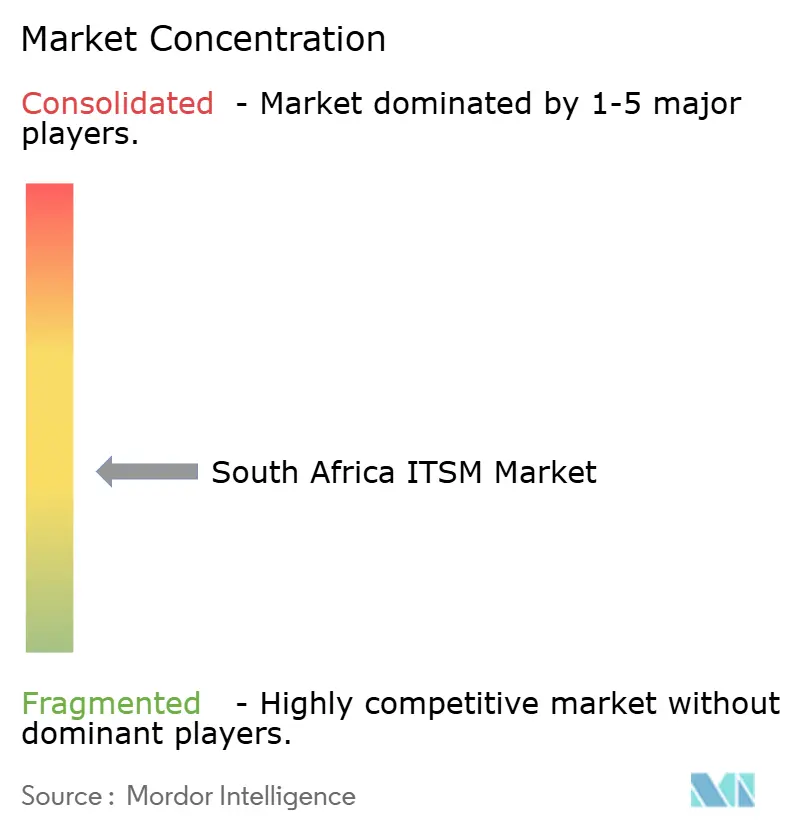
| Market Concentration | Medium |
Major Players *Disclaimer: Major Players sorted in no particular order Image © Mordor Intelligence. Reuse requires attribution under CC BY 4.0. | |
South Africa ITSM Market Analysis by Mordor Intelligence
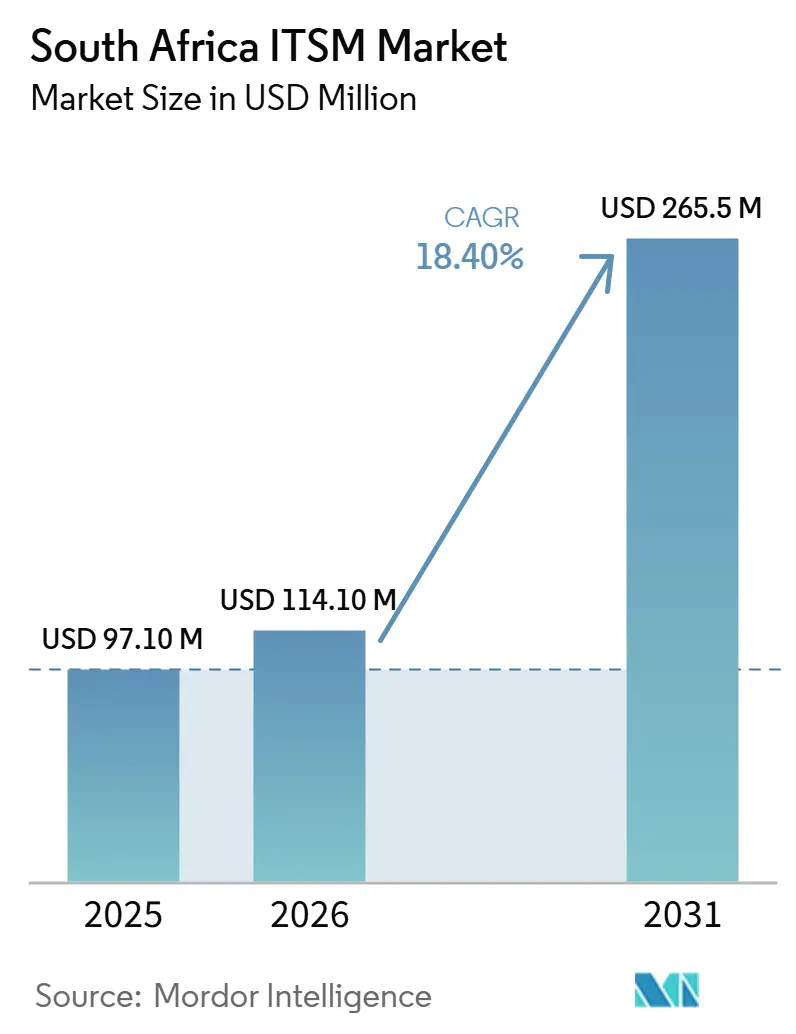
The South Africa ITSM Market size is projected to be USD 97.10 million in 2025, USD 114.10 million in 2026, and reach USD 265.5 million by 2031, growing at a CAGR of 18.40% from 2026 to 2031.
The South Africa ITSM market is expanding as enterprises replace disconnected helpdesk tools with integrated service platforms that can support cloud operations, workflow control, and audit readiness across large organizations. Demand is also rising because cloud adoption, AI-enabled service automation, and policy compliance needs are moving forward at the same time, which makes service management a core operational system rather than a supporting tool. The South Africa ITSM market is also benefiting from stronger digital spending across banking, mining, retail, healthcare, and government, where service reliability and documentation standards now carry more weight in technology buying decisions. At the same time, the South Africa ITSM market faces friction from skills shortages, budget pressure in the midmarket, and the work needed to connect new platforms with older ERP, identity, and monitoring environments. Competition is therefore sharpening between global platform vendors with broad enterprise capabilities and smaller providers that are using lower-cost delivery models and mobile-first service channels to win local demand.
Key Report Takeaways
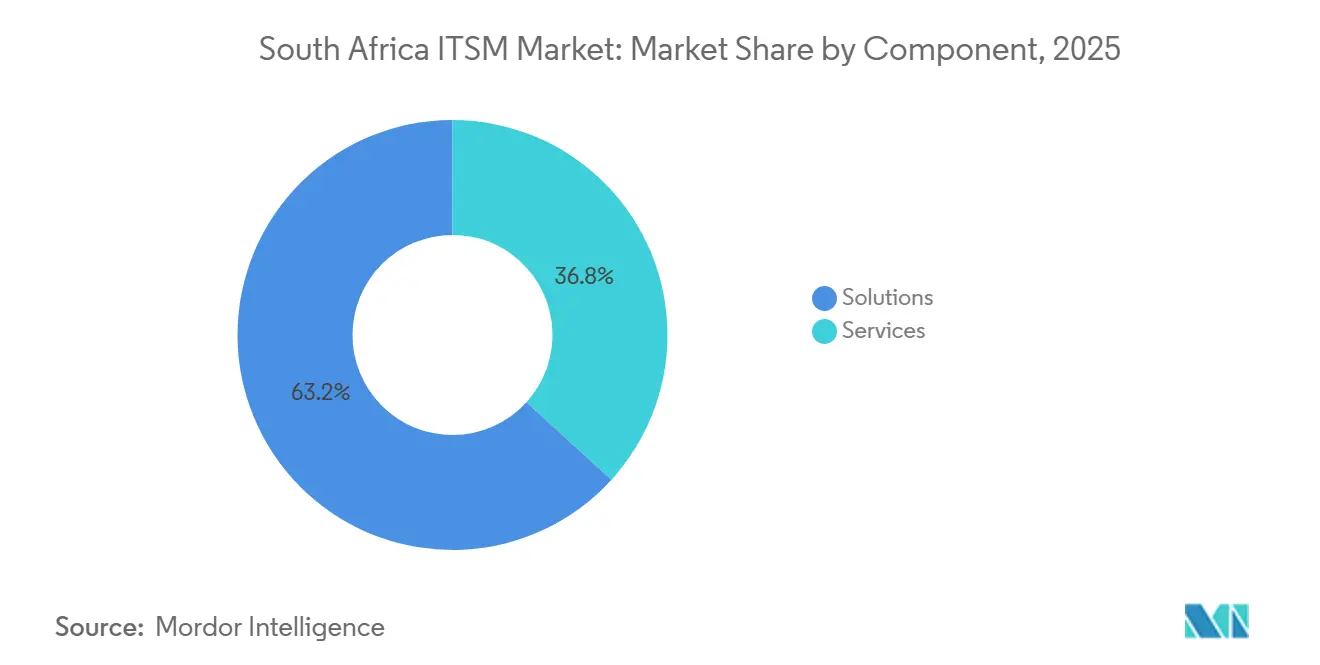
- By component, Solutions held 63.25% share in 2025, while Services is projected to expand at a 17.15% CAGR through 2031.
- By deployment, Cloud held 64.87% share in 2025 and remained the leading mode of delivery across the South Africa ITSM market.
- By application, Service Desk and Incident Management accounted for 27.90% share in 2025, while Knowledge Management is projected to expand at a 17.03% CAGR through 2031.
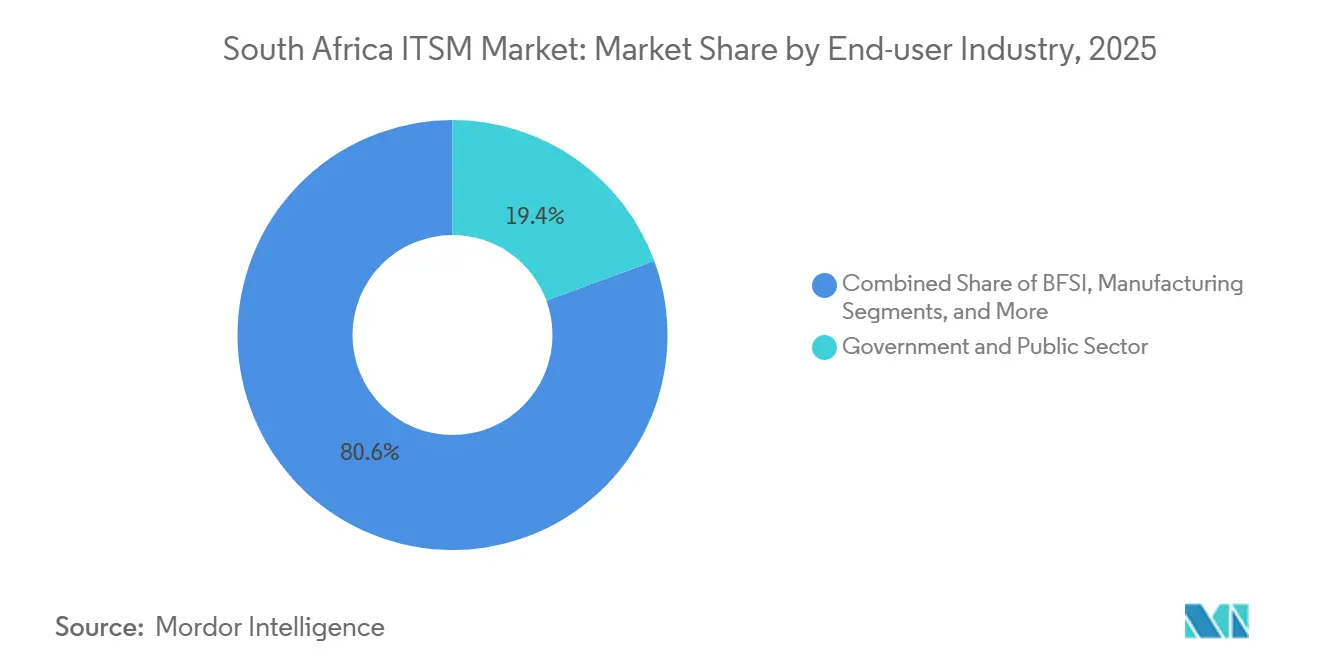
- By end-user industry, the Government and Public Sector held 19.40% share in 2025, while Healthcare is projected to expand at an 18.20% CAGR through 2031.
- By enterprise size, Large Enterprises held 67.65% share in 2025, while SMEs are projected to expand at a 17.30% CAGR through 2031.
Note: Market size and forecast figures in this report are generated using Mordor Intelligence’s proprietary estimation framework, updated with the latest available data and insights as of January 2026.
South Africa ITSM Market Trends and Insights
Drivers Impact Analysis*
| Driver | (~) % Impact on CAGR Forecast | Geographic Relevance | Impact Timeline |
|---|---|---|---|
| Accelerated Shift Toward Cloud-First ITSM Procurement | +4.5% | National, concentrated in Gauteng and Western Cape | Short term (≤ 2 years) |
| AI-Assisted Ticket Triage and Agent Productivity Gains | +3.8% | National, with early gains in Johannesburg and Cape Town | Medium term (2-4 years) |
| Hybrid Workforce Demands for Unified Service Delivery | +2.7% | National, concentrated in financial services and IT hubs | Short term (≤ 2 years) |
| Compliance Pressure Around Data Residency and Auditability | +2.3% | National, concentrated in BFSI and healthcare | Medium term (2-4 years) |
| Rising Need for FinOps-Enabled Service Management | +1.9% | National, with early gains in cloud-intensive sectors such as BFSI and retail | Medium term (2-4 years) |
| Low-Code Workflow Demand to Offset Local Skills Scarcity | +1.5% | National, with higher penetration in SMEs and government | Long term (≥ 4 years) |
| Source: Mordor Intelligence | |||
Accelerated Shift Toward Cloud-First ITSM Procurement
South Africa’s enterprise cloud spending is moving in a direction that is changing how service management platforms are evaluated and purchased. The local cloud services market is rapidly expanding, which gives the South Africa ITSM market a larger and more cloud-ready buyer base. In many enterprises, SaaS delivery is now the default starting point, which shortens the evaluation path and reduces dependence on capital expenditure approval. This shift also raises demand for configuration, integration, and managed support because cloud adoption does not remove the need to design service processes or connect systems. The South Africa ITSM market also benefits because a stronger local cloud infrastructure has reduced earlier concerns around latency and data location for regulated buyers. As more organizations standardize cloud operations, service management moves closer to the center of digital operating models across large and midsize accounts.
AI-Assisted Ticket Triage and Agent Productivity Gains
AI is changing the economics of service management in South Africa because it shifts part of the workload away from human agents and into automated triage, resolution support, and knowledge retrieval. ServiceNow stated in Q1 2026 that Now Assist AI had surpassed USD 750 million in annual contract value, which signals a clear enterprise preference for agentic workflows and supports the broader direction of the South Africa ITSM market. This matters more in South Africa because technology hiring remains difficult and many employers are struggling to fill specialist roles. The 2025 Critical Skills Survey showed that 22% of surveyed companies faced shortages of ICT specialists, up from 14% in 2024, which makes automation a response to limited labor supply rather than a simple efficiency layer. BDO South Africa’s move to SysAid Copilot showed how AI-led triage and knowledge surfacing can reduce routine ticket loads while also extending service management into HR and facilities use cases[1]. The result is that the South Africa ITSM market is moving toward platforms that can automate first-line support while still fitting local channel behavior and enterprise governance needs.
Hybrid Workforce Demands for Unified Service Delivery
Hybrid work remains a structural feature of the South African technology environment, and it is creating steady demand for consistent support across offices, homes, branches, and field locations. The 2025-2026 Remchannel Employee Benefits Guide found that 67.4% of hybrid organizations required staff to be in the office at least 3 days a week, up from 40.7% in 2023. That pattern creates a more distributed service environment where endpoint support, request fulfillment, and SLA tracking need to work across several locations at the same time. IT positions with remote options also remained common in South Africa’s tech labor market, which means service access and response visibility must be reliable outside central offices. In this setting, the South Africa ITSM market gains from platforms that unify catalog access, incident handling, and policy enforcement across a mixed work model. The need is not temporary because enterprises now treat flexible work as part of their operating structure rather than an exception to it.
Compliance Pressure Around Data Residency and Auditability
Compliance remains a direct buying factor for service management platforms because regulated workflows increasingly need evidence, access control, and documented process history. In April 2025, amended POPIA regulations broadened data subject rights and tightened documentation requirements, which pushed service operations closer to formal compliance review. Administrative fines can reach ZAR 10 million (USD 532,000) per violation, which gives auditability a clear financial consequence in procurement decisions. This benefits the South Africa ITSM market because platforms with change-level records, access tracking, and documentation controls are more attractive in BFSI, healthcare, and public sector evaluations. It also encourages organizations to replace scattered tools with fuller suites so that audit evidence does not need to be assembled from several disconnected systems. Over time, the South Africa ITSM market should continue to favor vendors that can show both workflow depth and strong support for local data handling obligations.
Restraints Impact Analysis*
| Restraint | (~) % Impact on CAGR Forecast | Geographic Relevance | Impact Timeline |
|---|---|---|---|
| Legacy Tool Sprawl and Migration Complexity | -3.5% | National, concentrated in large enterprises and government | Medium term (2-4 years) |
| Budget Sensitivity Among Midmarket Buyers | -2.9% | National, concentrated in manufacturing, retail, and hospitality | Short term (≤ 2 years) |
| Limited In-House ITSM Process Maturity | -2.1% | National, concentrated in SMEs and government entities | Long term (≥ 4 years) |
| Integration Friction With ERP, Identity, and Monitoring Stacks | -1.8% | National, concentrated in manufacturing and BFSI | Medium term (2-4 years) |
| Source: Mordor Intelligence | |||
Legacy Tool Sprawl and Migration Complexity
Many South African organizations still run service operations through a mix of older helpdesk tools, spreadsheets, monitoring consoles, and locally adapted workflows. Replacing that sprawl is difficult because migration often includes data cleanup, process redesign, user retraining, and links to other business systems. The public sector example is especially relevant because SITA is itself working through a multi-year redesign that shows how complex large-scale technology renewal can become in practice. For large enterprises, this slows the South Africa ITSM market because buyers do not only compare software functions, but also weigh service disruption risk during transition. The challenge becomes more severe in mining and manufacturing, where service management has to touch operational environments with limited standardization. As a result, vendors that can reduce migration risk and provide staged deployment support are better placed to win cautious accounts.
Budget Sensitivity Among Midmarket Buyers
Budget pressure remains a real barrier for the South Africa ITSM market, especially among midsize buyers that need modern service management but cannot absorb enterprise pricing with ease. Licensing costs become harder to justify when configuration, integration, and training services are added to the initial software bill. This creates room for lower-cost providers that can deliver ITIL-aligned functions without the same level of service dependency or minimum seat commitments. The pressure is sharper because many companies are already dealing with rising cloud bills and do not yet have strong cost governance in place. That combination forces some buyers to delay platform modernization even when their service environment is becoming more complex. The South Africa ITSM market, therefore, continues to develop as a two-speed environment, with stronger investment among large institutions and more selective adoption in the middle of the market.
*Our forecasts treat driver/restraint impacts as directional, not additive. The impact forecasts reflect baseline growth, mix effects, and variable interactions.
Segment Analysis
By Component: Solutions Dominate, but Services Revenue Compounds Faster
Solutions accounted for 63.25% of the South Africa ITSM market size in 2025, while Services is projected to expand at a 17.15% CAGR from 2026 to 2031. That pattern shows that software platforms still take the larger revenue base, but services are gaining ground as deployment and optimization work becomes more specialized. The South Africa ITSM market still relies on core modules such as service desk, asset management, and configuration databases to replace older helpdesk environments. This keeps solution demand firm because many buyers are still moving through foundational modernization rather than full operating model redesign. At the same time, the South Africa ITSM industry is showing that platform ownership alone is no longer enough for enterprises that need measurable improvements in workflow speed, audit readiness, and AI use.
Services are growing faster because implementation, integration, advisory, and managed support are now central to value realization. The shortage of ICT talent in South Africa means many buyers cannot configure advanced platforms on their own, which pushes more operational responsibility toward vendors and service partners. That tends to lengthen service contracts and deepen client dependence once a platform is live. ServiceNow’s 2026 partner program changes, including stronger reimbursement and deployment incentives, show that vendors are actively building delivery capacity where local skills are constrained. The South Africa ITSM market should therefore continue to see services expand alongside software because more buyers need outside help to operationalize complex environments at scale.
By Deployment: Cloud Consolidates Its Lead While Hybrid Addresses Sovereign Concerns
Cloud held 64.87% of the South Africa ITSM market size in 2025, which means the largest deployment model is also the one still benefiting from clear structural momentum. This is important because it shows the South Africa ITSM market is not merely experimenting with SaaS delivery, it is increasingly organizing new purchases around it. Cloud deployment appeals to buyers who want faster rollout, simpler upgrades, and predictable subscription models rather than hardware-heavy implementations. It also fits the needs of SMEs and distributed workforces that want service access without building local infrastructure. Even so, on-premise remains relevant in parts of government, defense, and critical operations where hosting pathways are more restricted.
Hybrid deployment remains important because it gives regulated enterprises a way to balance cloud efficiency with control over sensitive workloads. South Africa’s localization rules and cross-border information concerns still influence architecture choices, especially where personal information and high-risk records are involved. In practice, this means some banks and regulated entities keep selected records or control layers on-premise while using cloud environments for other services. That design raises demand for platforms that can provide a single service view across mixed environments. The South Africa ITSM market is therefore likely to see Hybrid act as a transition model for many regulated buyers while cloud continues to widen its lead as local infrastructure confidence improves.
By Application: Service Desk Leads as Knowledge Management Accelerates
Service Desk and Incident Management accounted for 27.90% of the South Africa ITSM market size in 2025, while Knowledge Management is projected to expand at a 17.03% CAGR from 2026 to 2031. The current lead for service desk reflects the basic operational importance of ticket handling, user support, and incident response across large employers. It also shows that many organizations still begin modernization with the most visible and transaction-heavy part of service management. The South Africa ITSM market keeps growing in this area because distributed users, larger digital estates, and stricter response expectations all increase frontline service demand. At the same time, the fastest growth in knowledge tools shows a move from reactive support toward self-service and agent assistance.
Knowledge Management is gaining popularity because enterprises want to reduce routine queries and free support staff for more complex issues. That use case has become more urgent in a labor market where specialist capacity remains tight, and hiring does not easily solve service backlog problems. Freshworks’ 2026 product updates, including MCP Gateway support for external AI tools, also show how knowledge capture and AI response layers are starting to converge within one workflow environment. Asset, configuration, change, release, and request modules still matter because they usually follow service desk rollouts as process maturity improves. The South Africa ITSM market is therefore moving beyond basic issue handling toward broader service enablement, with knowledge tools becoming a key bridge between automation and user experience.
By End-User Industry: Government Anchors the Market as Healthcare Accelerates
Government and Public Sector accounted for 19.40% of the South Africa ITSM market size in 2025, while Healthcare is projected to expand at an 18.20% CAGR through 2031. Government remains the largest end-user because national and agency-level digital service programs require structured workflows, audit trails, and support systems across many departments. The MyMzansi roadmap for the digital transformation of government added weight to this demand by mandating digital identity, data exchange, and citizen service infrastructure in Phase 1. Even so, public sector buying often moves slowly because contract cycles are large and formal procurement procedures take time. That helps explain why the South Africa ITSM market sees strong government share leadership without the fastest growth profile.
Healthcare is growing faster because several policies and interoperability actions are now pulling the sector in the same direction. The National Health Insurance Act, the February 2026 EMR tender across 8 provinces, and South Africa’s May 2026 adoption of SNOMED CT all increase the need for structured support, issue management, and deployment control around health systems[2]. The January 2026 national digital health interoperability projectathon also showed that cross-vendor exchange is becoming technically viable at scale, which raises the importance of service coordination across applications. BFSI remains a high-value segment because compliance and governance demands often extend beyond simple ticketing into fuller workflow control. Across the South Africa ITSM industry, healthcare now stands out as the segment where policy, standardization, and system rollout are pushing demand forward at the fastest pace.

By Enterprise Size: Large Enterprises Lead but SMEs Narrow the Gap
Large Enterprises held 67.65% of the South Africa ITSM market share in 2025, while SMEs are projected to expand at a 17.30% CAGR from 2026 to 2031. Large organizations still dominate because banks, mining groups, telecom operators, and public institutions need broad integration, deep reporting, and more formal process governance. These buyers also have the budgets and internal scale to run larger programs, even when implementation is complex. The South Africa ITSM market, therefore, remains weighted toward enterprise accounts in absolute spending terms. Even so, smaller organizations are closing part of the maturity gap because cloud-native pricing has reduced the historic entry barrier for service management tools.
SME growth is being supported by simpler onboarding, per-seat pricing, and product designs that reduce reliance on large consulting engagements. Vendors such as ManageEngine, Freshworks, and SysAid are using these features to compete for companies that want practical ITIL-aligned functions without a heavy implementation burden. South Africa’s startup ecosystem also adds to this opportunity because newer firms with scaling ambitions need structure but often reject long procurement cycles. Freshworks’ no-code AI Agent Studio is especially relevant in this context because it lowers the skills threshold for service automation. The South Africa ITSM industry is therefore becoming broader at the lower end of the buyer base, even though large enterprises still account for the bigger revenue pool.
Geography Analysis
South Africa held a strong regional lead because it accounted for 25% of all private capital transactions in Africa in 2025 and 47% of communication services deals, which supports the scale and visibility of the South Africa ITSM market within the continent. That lead reflects more than market size because the country combines stronger enterprise demand, deeper infrastructure, and a more developed compliance setting than many neighboring markets. Nigeria presents a meaningful opportunity, but enterprise cloud maturity remains more uneven, and data center constraints still limit broader service platform adoption. Egypt has a large government and industrial base, but the compliance dynamic around service auditability is less specific than the one shaping demand in South Africa. Kenya is growing from a lower base, especially around fintech and digital services, yet contract sizes and enterprise penetration still remain below the South African threshold. This makes the South Africa ITSM market the most durable regional entry point for global vendors looking at sub-Saharan Africa.
Within the country, Gauteng and the Western Cape represent the two main demand centers, but they do so for different reasons. Gauteng remains the largest enterprise technology and delivery hub because Johannesburg and Pretoria concentrate large employers, public institutions, and broad digital infrastructure. Collective X reported 18,021 ICT job opportunities in Gauteng versus 8,255 in the Western Cape, which shows how strongly enterprise technology demand is centered in the province[3]. The same province also benefits from major infrastructure investment, including Cassava Technologies’ 2026 commitment directed toward fiber, data center capacity, and AI factory development in Gauteng. In the South Africa ITSM market, Gauteng therefore leans toward large enterprise and public sector buying with stronger integrator involvement. This gives it a higher concentration of complex implementations than any other provincial market.
The Western Cape has a different buyer profile because it combines startups, scale-ups, business process outsourcing, financial services, and retail operations. The Cape Technology and Innovation Ecosystem Report 2025 confirmed the region’s growing role as a technology center with expanding enterprise digital investment needs[4]. Stronger cloud infrastructure presence in Cape Town also supports faster SaaS adoption and helps the South Africa ITSM market reach mid-market buyers with lower implementation friction. KwaZulu-Natal and the Eastern Cape remain smaller, but manufacturing, logistics, and port-linked operations are beginning to create more service management demand around connected operational environments. POPIA applies nationally, yet the compliance signal has been more visible in Gauteng and the Western Cape, which strengthens buying urgency in the country’s 2 largest technology corridors.
Competitive Landscape
The South Africa ITSM market shows a split structure where enterprise demand is led by a smaller set of global platforms, while the mid-market and SME layers remain more contested. ServiceNow appears strongest at the enterprise end because it combines product breadth, AI investment, and the resources to scale partner delivery in high-value accounts. In Q1 2026, ServiceNow reported USD 3.77 billion in revenue and said Now Assist AI had already surpassed USD 750 million in annual contract value, which supports its ability to invest heavily in sales, product development, and ecosystem growth. BMC and IBM still benefit from installed positions in older enterprise environments where replacement risk remains high. Microsoft also competes through bundled capability and infrastructure alignment in organizations that already run on Microsoft 365 and Azure. The South Africa ITSM market, therefore, remains competitive, but the balance of power is different by buyer size and deployment complexity.
Strategic product and partner moves are now playing a larger role in competition than basic functionality alone. ServiceNow used Knowledge 2026 to expand AI Control Tower and launch its Autonomous Workforce suite, including the general availability of its L1 IT Service Desk AI Specialist, which strengthens its position in automation-led enterprise selling. ServiceNow also enhanced its global partner program in June 2026 with expanded reimbursement and investment support, a move that can improve delivery depth in markets where in-house skills are scarce. Freshworks has targeted the mid-market with integrated ITAM, ITOM, no-code AI tools, and external AI connectivity, which gives it a practical land-and-expand path in accounts that care about speed and cost. ISG’s 2026 evaluation, which rated 8 vendors as exemplary, also suggests that core platform parity is increasing across the field. That means differentiation in the South Africa ITSM market is shifting toward AI usefulness, deployment speed, local delivery support, and total cost of ownership.
The clearest white space sits in the 200 to 2,000 employee segment, where no vendor appears to hold a decisive national lead. This part of the South Africa ITSM market rewards simple onboarding, lower seat thresholds, and easier automation design more than it rewards feature breadth alone. SysAid has local relevance because BDO South Africa documented its shift to SysAid Copilot and reported lower routine ticket volumes after deployment. Local or localized offerings also have an opening where messaging behavior, budget sensitivity, and rapid deployment matter more than large-platform standardization. The result is a market that is competitive across all tiers, but not dominated in the same way across all customer groups.
South Africa ITSM Industry Leaders
-
ServiceNow, Inc.
-
BMC Software, Inc.
-
IBM Corporation
-
Atlassian Pty Ltd
-
Open Text Corporation
- *Disclaimer: Major Players sorted in no particular order
Recent Industry Developments
- June 2026: ServiceNow enhanced its global Partner Program with expanded Market Development Fund reimbursements, 100% for select activities, and new Strategic Investment Fund allocations to scale AI agent delivery through system integrator partners.
- May 2026: South Africa joined SNOMED International, formally adopting SNOMED CT for clinical data standardization across its national health information system, a compliance milestone that accelerates healthcare ITSM procurement by establishing interoperability requirements that service management platforms must meet.
- February 2026: South Africa's National Department of Health issued tender NDoH-04 (2025/2026) for EMR implementation across 8 provinces within 18 months, triggering procurement activity for ITSM platforms capable of supporting provincial-scale health IT service management.
- January 2026: South Africa hosted its first National Digital Health Interoperability Projectathon at the CSIR International Convention Centre, successfully demonstrating FHIR-based cross-vendor clinical data exchange, confirming technical readiness for healthcare ITSM integration at national scale.
South Africa ITSM Market Report Scope
IT Service Management (ITSM) is the set of repeatable practices, processes, and enabling technologies used by organizations to plan, provision, operate, secure, and optimize IT‑delivered services for internal and external customers. It covers the full service lifecycle service strategy, design, transition, operation, and continual improvement, and includes core domains such as incident, problem, change, configuration, request, asset, and knowledge management, plus service-catalog and SLA governance.
The South Africa ITSM Market Report is Segmented by Component (Solutions and Services), Deployment (Cloud, On-premise, and Hybrid), Application (Service Desk and Incident Management, Asset and Configuration Management, Change and Release Management, Service Request Management, Knowledge Management, and Other Applications), End-user Industry (BFSI, Manufacturing, Government and Public Sector, IT and Telecommunications, Retail and E-commerce, Healthcare, Travel and Hospitality, and Other End-user Industries), and Enterprise Size (Large Enterprises and Small and Mid-size Enterprises [SME]). The Market Forecasts are Provided in Terms of Value (USD).
| Solutions |
| Services |
| Cloud |
| On-premise |
| Hybrid |
| Service Desk and Incident Management |
| Asset and Configuration Management |
| Change and Release Management |
| Service Request Management |
| Knowledge Management |
| Other Applications |
| BFSI |
| Manufacturing |
| Government and Public Sector |
| IT and Telecommunications |
| Retail and E-commerce |
| Healthcare |
| Travel and Hospitality |
| Other End-user Industries |
| Large Enterprises |
| Small and Mid-size Enterprises (SME) |
| By Component | Solutions |
| Services | |
| By Deployment | Cloud |
| On-premise | |
| Hybrid | |
| By Application | Service Desk and Incident Management |
| Asset and Configuration Management | |
| Change and Release Management | |
| Service Request Management | |
| Knowledge Management | |
| Other Applications | |
| By End-user Industry | BFSI |
| Manufacturing | |
| Government and Public Sector | |
| IT and Telecommunications | |
| Retail and E-commerce | |
| Healthcare | |
| Travel and Hospitality | |
| Other End-user Industries | |
| By Enterprise Size | Large Enterprises |
| Small and Mid-size Enterprises (SME) |
Key Questions Answered in the Report
How large is the South Africa ITSM market in 2026 and what is the 2031 outlook?
The South Africa ITSM market size stands at USD 114.1 million in 2026 and is projected to reach USD 265.5 million by 2031 at an 18.40% CAGR over 2026-2031.
Which deployment model leads service management spending in South Africa?
Cloud led with 64.87% share in 2025, showing that SaaS delivery has become the preferred option for many enterprises and midsize buyers.
Which end-user segment is growing fastest in South Africa ITSM?
Healthcare is the fastest-growing end-user segment, with an 18.20% CAGR through 2031, supported by EMR rollout activity, interoperability work, and SNOMED CT adoption.
Why are services growing faster than software components?
Services are projected to grow at a 17.15% CAGR because buyers increasingly need implementation, integration, advisory support, and managed operations to make platforms work well.
What is pushing AI adoption in South Africa service desks?
AI adoption is being driven by the need to automate triage, surface knowledge faster, and offset local ICT talent shortages that are making specialist hiring more difficult.
Which provinces matter most for vendor strategy in South Africa?
Gauteng and the Western Cape matter most because they concentrate enterprise demand, digital infrastructure, and technology employers, while KwaZulu-Natal and the Eastern Cape remain smaller but growing opportunities.