
Australia ITSM Market Size and Share
Market Overview
| Study Period | 2020 - 2031 |
|---|---|
| Forecast Data Period | 2026 - 2031 |
| Base Year Market Size (2025) | USD 0.28 Billion |
| Market Size (2026) | USD 0.33 Billion |
| Market Size (2031) | USD 0.78 Billion |
| Growth Rate (2026 - 2031) | 18.24 % |
| Market Concentration | Medium |
Major Players *Disclaimer: Major Players sorted in no particular order Image © Mordor Intelligence. Reuse requires attribution under CC BY 4.0. | |
Australia ITSM Market Analysis by Mordor Intelligence
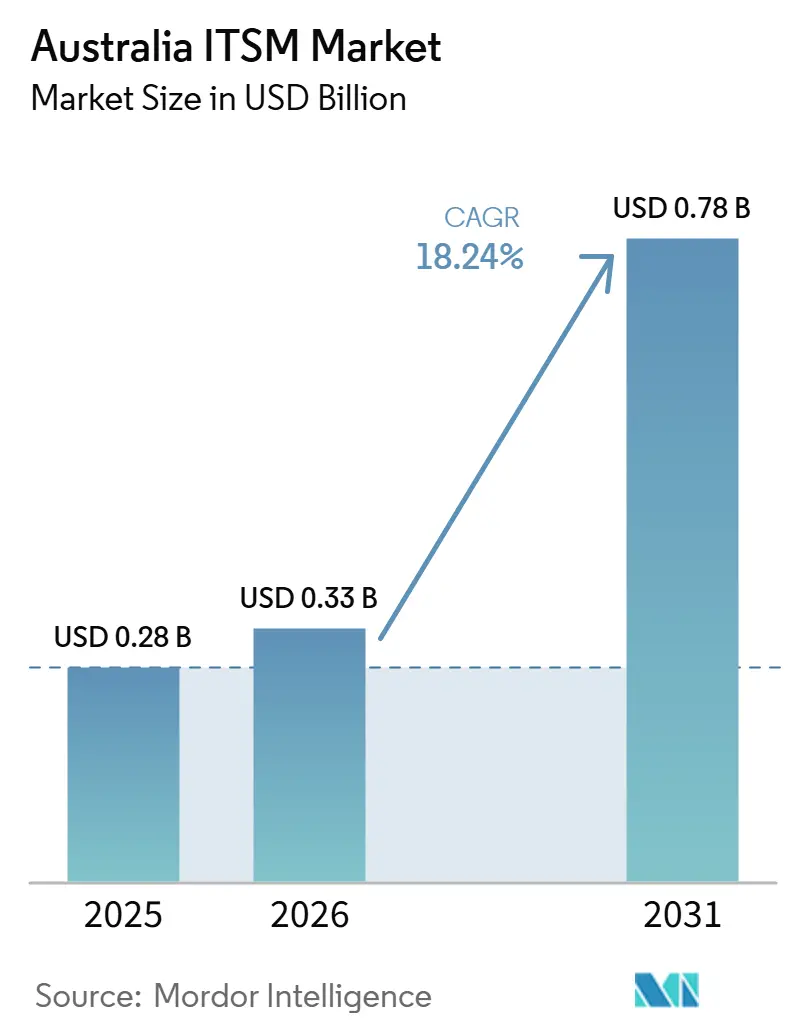
The Australia IT service management market size is expected to grow from USD 0.28 billion in 2025 to USD 0.33 billion in 2026 and is forecast to reach USD 0.78 billion by 2031 at 18.24% CAGR over 2026-2031. Growth is being shaped by a regulatory modernization cycle in financial services and government, in which service management tools are being more closely tied to resilience, auditability, and process control. The Australia IT service management market is also expanding because enterprises are using these platforms beyond IT, with workflows now extending into HR, customer support, risk, and internal operations. Cloud delivery is widening adoption by reducing deployment friction, enabling faster integration, and making it easier for smaller organizations to adopt structured service management practices. AI-assisted triage, knowledge use, and workflow automation are strengthening the case for platform upgrades, especially where enterprises want stronger self-service and better operational visibility. Competitive opportunity remains strongest in services, healthcare, SMEs, and cross-functional enterprise service management, where buyers still need implementation depth, process redesign, and ongoing managed support.
Key Report Takeaways
- By component, solutions held 62.62% share of the Australia IT service management market in 2025, while services are projected to expand at 20.62% CAGR through 2031.
- By deployment, cloud held 58.62% share of the Australia IT service management market in 2025 and is projected to advance at 20.34% CAGR through 2031.
- By application, service desk and incident management accounted for 32.72% share of the Australia IT service management market in 2025, while knowledge management is projected to grow at 19.76% CAGR through 2031.
- By end-user industry, BFSI held 26.73% share of the Australia IT service management market in 2025, while healthcare is projected to grow at 19.84% CAGR through 2031.
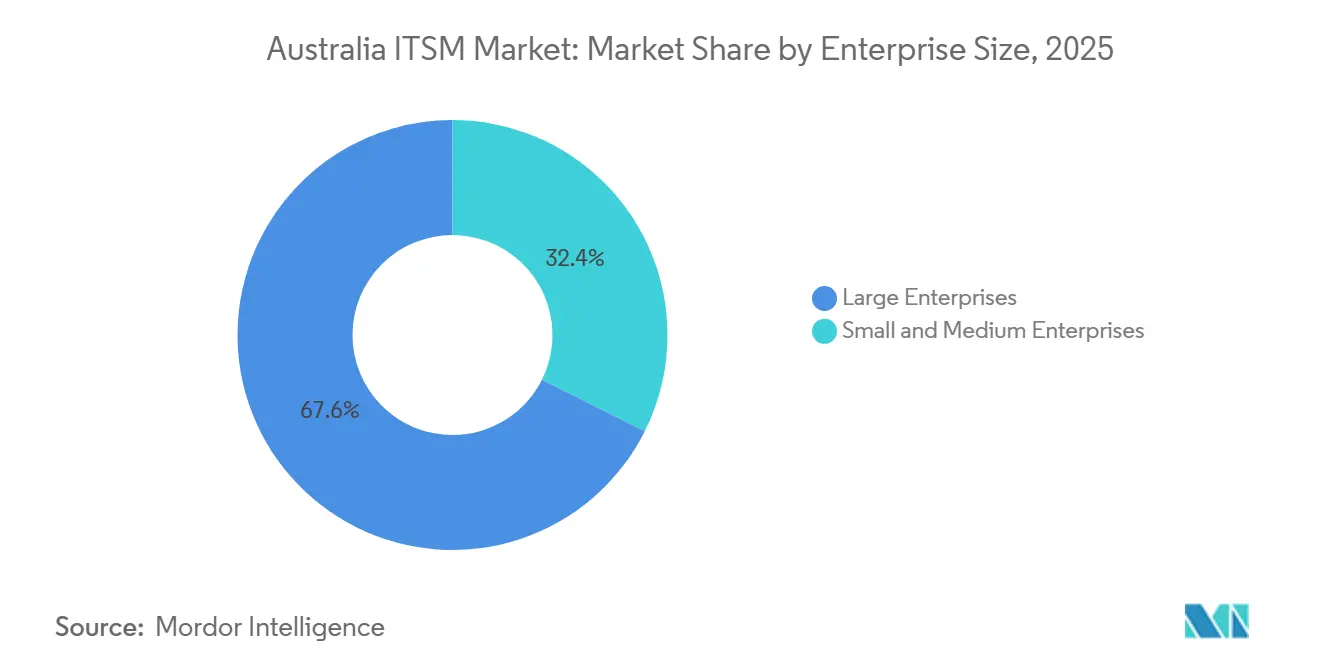
- By enterprise size, large enterprises held 67.62% share of the Australia IT service management market in 2025, while SMEs are projected to expand at 20.67% CAGR through 2031.
Note: Market size and forecast figures in this report are generated using Mordor Intelligence’s proprietary estimation framework, updated with the latest available data and insights as of January 2026.
Australia ITSM Market Trends and Insights
Drivers Impact Analysis*
| Driver | (~) % Impact on CAGR Forecast | Geographic Relevance | Impact Timeline |
|---|---|---|---|
| Cloud-First ITSM Modernization In Large Enterprises | +4.5% | National, concentrated in Sydney and Melbourne financial and technology districts | Short term (≤ 2 years) |
| AI-Assisted Ticket Triage And Workflow Automation | +3.8% | National, with early gains in BFSI and IT and telecommunications sectors | Medium term (2-4 years) |
| Demand For Unified IT, HR, And Customer Service Platforms | +3.2% | National, with spillover to government agencies and higher education institutions | Medium term (2-4 years) |
| Compliance-Driven Auditability And Service Tracking | +2.6% | APRA-regulated financial entities and ISM-aligned Commonwealth agencies | Short term (≤ 2 years) |
| Integration-Led Replacement Cycles For Legacy ITSM Tools | +1.9% | National, concentrated in large public sector and defense entities | Medium term (2-4 years) |
| Rising Managed Services Adoption In Mid-Market | +1.5% | National, with early gains in regional Queensland and Western Australia | Long term (≥ 4 years) |
| Source: Mordor Intelligence | |||
Cloud-First ITSM Modernization Resets Large Enterprise Infrastructure Timelines
Cloud modernization is changing how large organizations evaluate service management platforms across the Australia IT service management market. Buyers are placing less weight on basic ticketing features because those functions are now widely available across established tools. Attention has shifted toward integration depth with identity systems, observability platforms, enterprise applications, and security workflows.[1] This pattern raises switching costs because every added workflow and connected data source makes a replacement project harder to justify. ServiceNow reinforced that direction in May 2026, when its Australia Release reached general availability, featuring APAC-specific compliance guardrails, real-time incident intelligence, and timezone-aware change management workflows. The Australia IT service management market is therefore seeing cloud deployment behave less like a hosting choice and more like a long-term operating model decision.
AI-Assisted Ticket Triage Is Reshaping Renewal Decisions Across Enterprises
AI capability is moving to the center of renewal discussions across the Australia IT service management market. Enterprises are increasingly distinguishing between AI built directly into the platform and AI that sits behind additional pricing layers. When AI is bundled into the core service management environment, adoption tends to spread faster across teams, and renewal risk becomes lower. ServiceNow pushed this model further in 2026 by bundling AI capabilities such as Now Assist and AI Control Tower into higher-value tiers, making AI a contract upgrade path rather than a side purchase. Kyndryl added a governance angle in April 2026 with Agentic Service Management, aligning its offering with the ISO 42001 AI management standard and formalizing how enterprises can adopt agentic workflows within IT operations.[2] The Australia IT service management market is now treating AI readiness as part of platform architecture, governance, and budget planning rather than as a limited productivity feature.
Unified Service Platforms Extend Contract Value Beyond IT
Cross-functional workflow expansion is lifting contract depth across the Australia IT service management market. Organizations that started with IT support are extending those platforms to employee services, customer support, approval flows, and internal request handling. That shift matters because it increases the number of business teams that depend on the same workflow engine and the same service data. Once multiple departments use a shared platform, the economic case for replacement weakens, while the case for expansion strengthens. ServiceNow and AWS highlighted this pattern in May 2026 when they expanded their partnership to include an AI governance architecture built on ServiceNow AI Control Tower and Amazon Bedrock AgentCore, a move that supports broader enterprise workflow orchestration for organizations operating on AWS. The Australia IT service management market is therefore growing not only through new platform adoption, but also through the broadening role of installed platforms across daily business operations.
Compliance-Driven Auditability Is Turning ITSM Into Resilience Infrastructure
Compliance pressure is creating durable demand across the Australia IT service management market, especially in regulated sectors. Financial institutions are treating service management tools as part of operational resilience and control documentation, not just as help desk systems. That changes budget behavior because compliance-linked spending tends to persist even as discretionary transformation programs slow. The same pattern is visible in healthcare, where the Australian Digital Health Agency continued work on transforming national digital health infrastructure and sought application support and maintenance services for that environment in 2025.[3] In practice, enterprises are expanding service management coverage to include risk, continuity, service mapping, and traceable workflow controls to support reviews and operational discipline. The Australia IT service management market is benefiting because these compliance-led extensions increase both platform scope and the need for high-quality implementation.
Restraints Impact Analysis*
| Restraint | (~) % Impact on CAGR Forecast | Geographic Relevance | Impact Timeline |
|---|---|---|---|
| Saturation In Large Enterprise Accounts | -2.1% | National, concentrated in Sydney and Melbourne | Short term (≤ 2 years) |
| Long Replacement Cycles For Deeply Embedded Platforms | -1.8% | National, concentrated in large public sector and BFSI entities | Medium term (2-4 years) |
| Procurement Scrutiny And Vendor Risk Control | -1.2% | Government entities and APRA-regulated industries | Medium term (2-4 years) |
| Data Privacy And AI Governance Concerns | -0.9% | National, heightened in healthcare and financial services | Long term (≥ 4 years) |
| Source: Mordor Intelligence | |||
Large Enterprise Saturation Is Redirecting Growth Toward Platform Deepening
Large enterprise adoption is limiting new-logo expansion in the Australia IT service management market. Many major organizations already operate mature platforms, which means vendors now compete more through module expansion, pricing shifts, and displacement attempts. Those routes usually involve longer sales cycles because the buyer already has a functioning environment in place. ServiceNow’s 2026 licensing changes added another layer to this pattern, pushing customers seeking broader AI capabilities toward higher-value tiers rather than simple add-on purchases. This supports revenue growth for leading vendors, but it also makes the next phase of market expansion more dependent on deeper account penetration than on first-time rollouts. The Australia IT service management market, therefore, remains attractive, but the pace of movement in top-tier accounts is naturally slower than in earlier deployment cycles.
Platform Lock-In And Migration Complexity Extend Replacement Timelines
Replacement cycles remain long across the Australia IT service management market because deeply embedded platforms are difficult to unwind. Migration involves workflow redesign, data cleanup, retraining, service continuity planning, and, often, a period during which old and new systems run in parallel. That burden is heavier in regulated organizations where audit trails, access controls, and internal approvals must remain intact during the transition. Kyndryl’s April 2026 commentary on agentic service management noted that many organizations still struggle to translate AI investment into value because governance frameworks and operational processes were designed before current AI demands emerged. This means dissatisfaction with an incumbent platform does not automatically create a quick switching opportunity for challengers. The Australia IT service management market therefore continues to reward vendors that can deepen existing accounts while reducing the disruption attached to change.
*Our forecasts treat driver/restraint impacts as directional, not additive. The impact forecasts reflect baseline growth, mix effects, and variable interactions.
Segment Analysis
By Component: Services Are Closing The Gap With Solutions
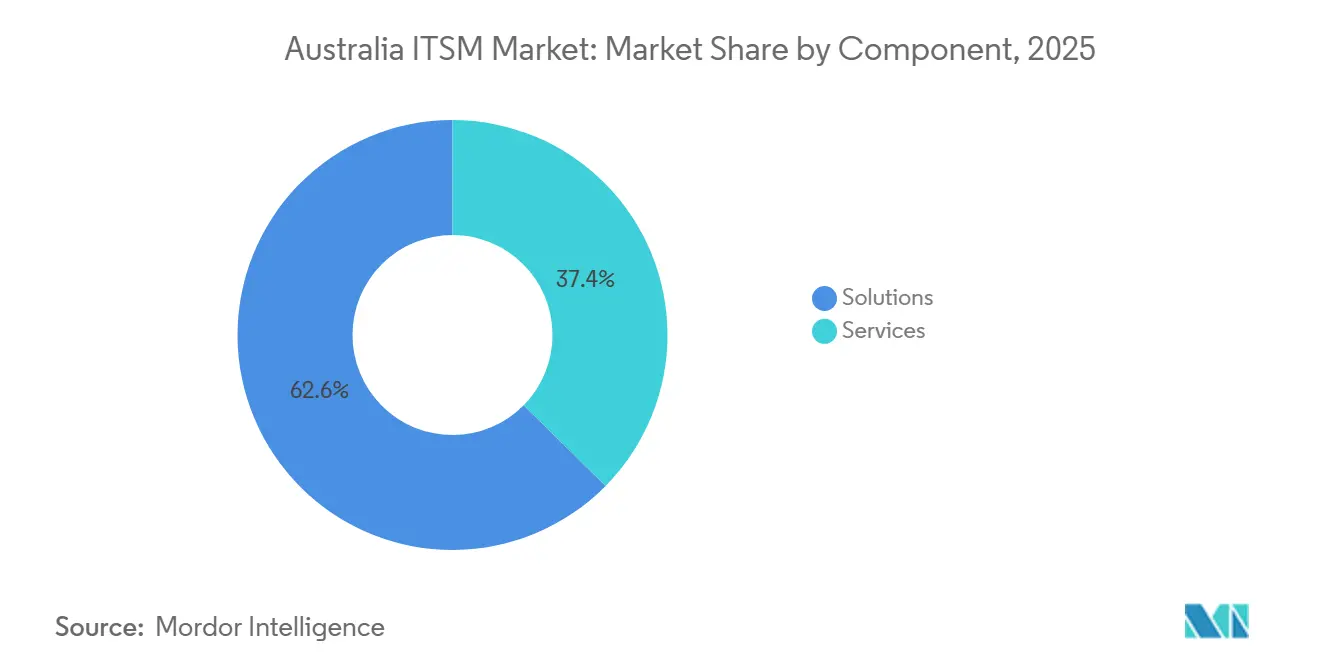
Solutions held 62.62% share of the Australia IT service management market size in 2025. That lead reflected the central role of platform licenses and SaaS subscriptions in current spending patterns. Large organizations still prioritize the workflow engine, service catalog, automation layer, and reporting tools that sit at the center of the deployment. The solutions segment also benefits from the fact that many buyers standardize on one platform before they decide how much outside support they will need. In the Australia IT service management market, this keeps core software spending firmly ahead in the early phase of rollout and expansion.
Services are projected to expand at 20.62% CAGR within the Australia IT service management market mix through 2031. That faster growth shows that buyers increasingly need help with integration, process design, managed operations, and AI-related tuning after the initial platform decision has been made. The need becomes stronger as ITSM expands into HR, risk, customer support, and shared services, as these moves require workflow redesign across multiple business units. Infosys reinforced the importance of local delivery capacity in August 2025 when it acquired a 75% stake in Versent Group to combine global AI capabilities with an established Australian engineering base. The Australia IT service management industry is therefore seeing services grow faster because realizing platform value now depends as much on execution depth as on software selection.
By Deployment: Cloud Keeps Widening Its Lead Over On-Premise
Cloud accounted for 58.62% of the Australia IT service management market size in 2025. It led because organizations wanted faster deployment, simpler upgrades, and easier integration with other enterprise software already running in hosted environments. Cloud delivery also aligns well with distributed teams because it removes some of the infrastructure overhead associated with on-premises operations. In the Australia IT service management market, this has made cloud the default choice for many new projects unless a strong security or sovereignty condition points elsewhere. The result is a deployment mix that increasingly favors platforms designed for continuous updates and broad API connectivity.
Cloud is also projected to expand at 20.34% CAGR through 2031, which keeps it as the fastest-growing deployment model in the Australia IT service management market. That dual position matters because it shows that buyers are not only adopting cloud-first, but also deepening their dependence on it over time. Every additional integration with HR tools, enterprise resource planning systems, identity providers, and observability platforms makes a return to isolated on-premise architectures less practical. ServiceNow’s Australia Release in May 2026 added local compliance guardrails and region-specific workflow capabilities, which further strengthened the case for cloud-delivered enterprise service management. The Australia IT service management market is therefore seeing cloud growth driven by product maturity, compliance support, and integration economics at the same time.
By Application: Knowledge Management Is Becoming Central To AI-Led Value
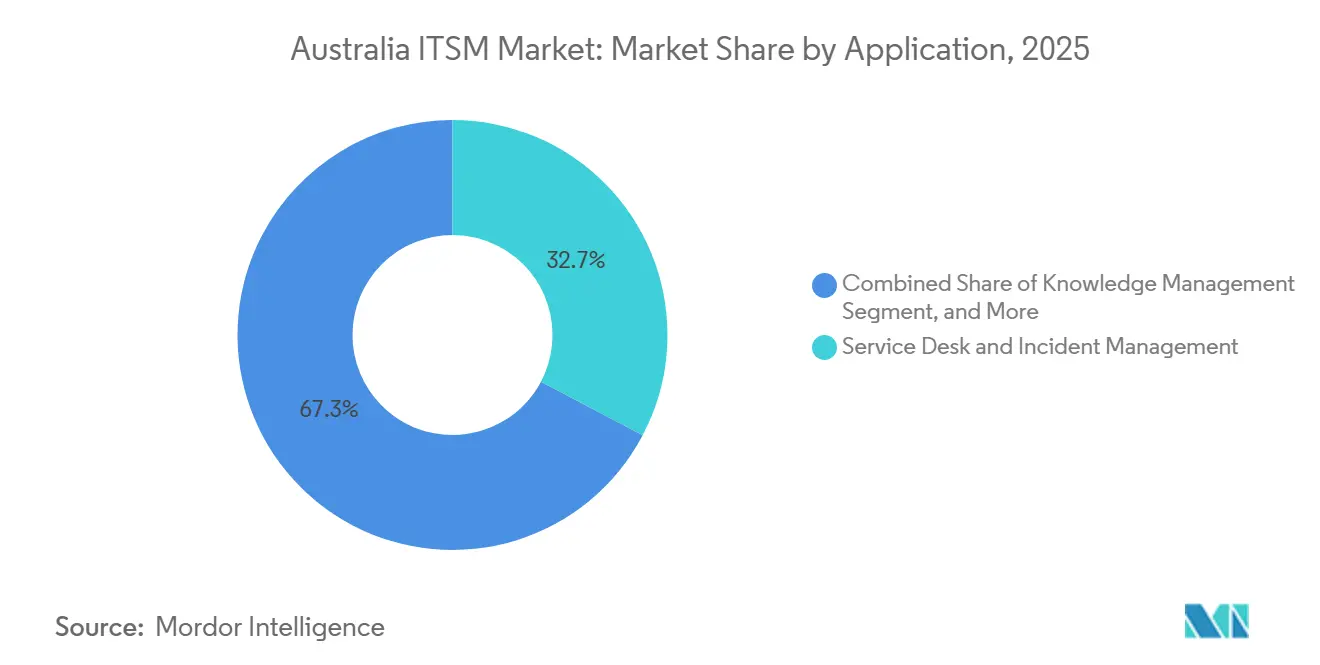
Service desk and incident management accounted for 32.72% of application demand in 2025 and remained the largest use case in the Australia IT service management market. That position is expected because most deployments begin with user support, issue routing, service requests, and response coordination. These functions deliver immediate operational value and create the structured workflow foundation that later modules can build on. They also make the platform visible to end users, which helps internal adoption and process discipline. For many organizations in the Australia IT service management market, strong service desk performance still defines the credibility of the entire deployment.
Knowledge management within the Australia IT service management market size mix is projected to grow at 19.76% CAGR through 2031. That fast growth shows that knowledge is no longer a supporting library sitting behind the service desk. It is becoming the content base that determines how well virtual agents, AI-assisted resolution paths, and self-service experiences actually perform. Vendors that improve context, search quality, and knowledge structure are strengthening the core economic value of their platforms. Forrester’s May 2026 discussion of context graphs around leading IT management platforms captured that direction by highlighting how organizational context improves AI-enabled service outcomes. The Australia IT service management market is therefore moving toward a model where knowledge quality directly affects automation quality.

By End-User Industry: BFSI Leads While Healthcare Gains Speed
BFSI held 26.73% of Australia IT service management market share in 2025. It led because financial institutions face stronger demands around control, continuity, traceability, and managed service performance than most other verticals. In that environment, service management platforms support more than ticket workflows because they help structure operating discipline and document execution across critical processes. Banks and other regulated entities are also more likely to extend ITSM into related control areas once the platform has been established. The Australia IT service management market, therefore, remains anchored by BFSI spending even as other verticals accelerate.
Healthcare is projected to grow at 19.84% CAGR within the Australia IT service management market mix through 2031. That pace reflects a widening need for integration, consistency in support, and operational coordination across digital health environments. The Australian Digital Health Agency’s work on national digital health infrastructure and application support requirements illustrates the scale of modernization and maintenance activities across the sector. Western Australia also completed major digital health system deployment work in 2025 under its electronic medical record program, strengthening the foundation for more integrated service operations. In the Australia IT service management market, healthcare is gaining speed because the complexity of clinical and administrative systems is outgrowing older service support practices.
By Enterprise Size: SMEs Are Expanding Faster Than Large Enterprises
Large enterprises held 67.62% of Australia IT service management market share in 2025. Their lead reflects broader module adoption, deeper integration budgets, and more established demand for workflow standardization across multiple business functions. Large organizations are also more likely to use service management platforms as a common layer for IT, HR, security, and internal operations. That creates bigger contract values and more room for add-on services after the initial deployment. The Australia IT service management market, therefore, still draws most of its present revenue from large enterprise environments.
SMEs are projected to expand at 20.67% CAGR through 2031, making them the fastest-growing segment in the Australia IT service management market. Cloud-native delivery has lowered the operational and financial barrier to adopting structured service management, which is why smaller organizations are entering the category more quickly. These buyers are often looking for practical support workflows, simple automation, and cleaner audit trails rather than full enterprise-wide platform depth at the start. Vendors that offer lighter implementation models and clearer pricing are therefore well positioned to grow in this tier. The Australia IT service management industry is seeing the SME segment gain momentum because it now has access to tools that were previously too costly or too complex to justify.
Geography Analysis
The Australia IT service management market is concentrated most heavily in New South Wales and Victoria because these states host the country’s deepest clusters of financial services, technology, healthcare, and professional services activity. Sydney remains the most important node because major banks, large enterprises, and national service providers are concentrated there. That concentration supports larger deployments, more complex integrations, and wider use of enterprise-grade platforms across multiple business functions. Melbourne follows with a strong mix of healthcare, higher education, manufacturing, and corporate operations that create steady demand for service management modernization. Together, these two states continue to set the pace of adoption for the broader Australia IT service management market.
The Australian Capital Territory has a smaller population, but it carries outsized relevance because Commonwealth agencies drive formal procurement, security alignment, and structured workflow requirements. Canberra-centered demand tends to favor platforms that can support secure authentication, clear reporting, and multi-team service coordination across complex institutional settings. This makes federal procurement activity an important signal for vendors even when the absolute volume is smaller than in Sydney or Melbourne. Western Australia is emerging as a stronger demand pocket because digital health modernization has improved the operating base for more integrated service support. The Government of Western Australia reported the completion of single sign-on and digital medical record deployment across WA Health in September 2025 under its electronic medical record program, which strengthens the case for more mature service operations in the state.
Queensland and South Australia are developing more gradually, with demand often tied to public sector modernization, healthcare support needs, and service standardization in regional business environments. These states still matter because cloud delivery reduces the dependence on heavy local infrastructure and broadens access to structured service management tools. Regional adoption is therefore becoming less constrained by physical deployment limits than in earlier market phases. The Australia IT service management market is also attracting targeted vendor investment because suppliers now see local feature design, managed services, and partner capacity as necessary for winning Australian accounts. ServiceNow’s Australia Release in May 2026 and Kyndryl’s April 2026 launch of Agentic Service Management both showed that vendors are designing more explicitly for the needs of Australian enterprises. This regional pattern suggests that eastern seaboard leadership will continue, while government-led and healthcare-led projects create additional demand nodes across other states.
Competitive Landscape
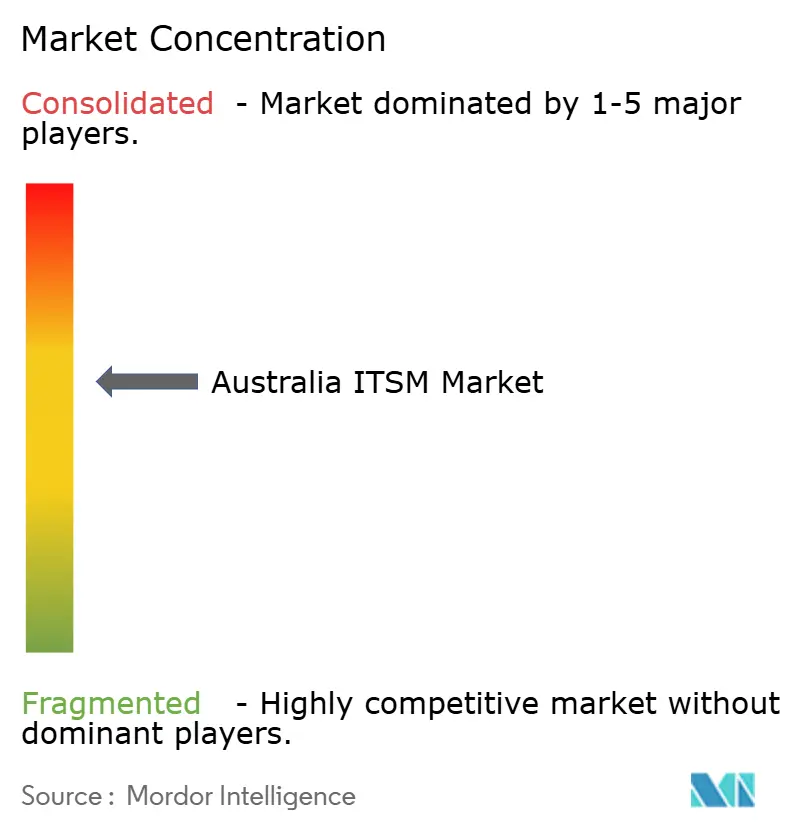
The competitive structure of the Australia IT service management market is moderately concentrated, with ServiceNow, Atlassian, and BMC Software holding the strongest positions in large enterprise and government environments. Freshworks, ManageEngine, Ivanti, SysAid, TOPdesk, and other challengers are more active among buyers who place greater weight on pricing simplicity, deployment speed, and lower operating overhead. This creates a two-level market where enterprise-grade breadth matters at the top end, while implementation ease and cost discipline matter more in the mid-market. ServiceNow remains especially visible because its Australia and New Zealand entity generated AUD 819.8 million in 2025 revenue, up 17% from AUD 703.4 million in 2024, which signals strong installed-account momentum in the region. The Australia IT service management market, therefore, shows strong leadership positions without collapsing into a closed field.
Strategic moves in 2025 and 2026 show how competitors are trying to widen their influence. ServiceNow used product localization and pricing redesign to strengthen its hold on enterprise accounts, with the Australia Release and bundled AI tiers both aimed at deeper platform dependence. Kyndryl moved further up the value chain by launching Agentic Service Management and linking it to governance frameworks, which positions the firm not only as an operator but also as an advisor on AI-enabled service operations. Infosys expanded local delivery capacity through its 75% stake in Versent Group, strengthening its ability to serve government, financial services, energy, and utilities accounts that need both cloud and ITSM execution depth. The Australia IT service management market is therefore competitive not only at the software layer, but also in the surrounding implementation and managed services ecosystem.
White-space opportunity remains strongest in SMEs and in verticals where service management maturity still lags system complexity, especially healthcare, manufacturing, and resource-linked operations. This is where lighter deployment models and channel-led routes to market can create openings for challengers that cannot match the scale of the largest enterprise platforms. Ivanti’s distribution agreement with Westcon-Comstor in December 2025 reflected this dynamic by widening reseller access to enterprise service management capabilities across Australia. At the same time, the broadening role of ITSM in risk, continuity, and operational control continues to favor platforms and partners that can connect workflow depth with governance needs. The Australia IT service management market is likely to stay moderately concentrated because leading vendors already hold strong enterprise positions, yet meaningful room remains for specialists that address cost-sensitive and underpenetrated segments.
Australia ITSM Industry Leaders
-
ServiceNow, Inc.
-
Atlassian Corporation Plc
-
BMC Software, Inc.
-
Freshworks Inc.
-
Ivanti, Inc.
- *Disclaimer: Major Players sorted in no particular order
Recent Industry Developments
- June 2026: Westpac advanced its AIOps and event-driven automation program, integrating Red Hat Ansible with ServiceNow to automatically enrich support tickets with endpoint health data within seconds of an infrastructure alert, an AI advisory output is also attached to each ticket, compressing L1/L2 response time and expanding the scope of automated IT operations across Australia's second-largest bank.
- May 2026: ServiceNow's Australia Release reached general availability, delivering APAC-specific compliance guardrails, real-time incident intelligence benchmarked against Australian operational standards, timezone-aware change management workflows, and AI agent collections for incident triage and change governance, marking ServiceNow's first regionally differentiated ITSM platform rollout for the Australian and New Zealand market.
- May 2026: ServiceNow and AWS announced that AWS Marketplace transactions through ServiceNow crossed USD 1 billion, with the partnership expanding to include AI governance architecture built on ServiceNow AI Control Tower and Amazon Bedrock AgentCore, enabling Australian enterprises operating on AWS infrastructure to build and govern agentic ITSM workflows.
- April 2026: Kyndryl launched Agentic Service Management globally, including in Australia, offering an ISO 42001-aligned maturity model and structured assessments to help enterprises adopt agentic AI within ITSM environments, internally, Kyndryl executes nearly 200 million automations monthly across 8,000 certified playbooks through its Kyndryl Bridge platform.
Australia ITSM Market Report Scope
The Australia IT Service Management Market is Segmented by Component (Solutions, and Services), Deployment (Cloud, On-Premise, and Hybrid), Application (Service Desk and Incident Management, Asset and Configuration Management, Change and Release Management, Service Request Management, Knowledge Management, and Others), End-User Industry (BFSI, Manufacturing, Government and Public Sector, IT and Telecommunications, Retail and E-Commerce, Healthcare, and Others), and Enterprise Size (Large Enterprises, and Small and Medium Enterprises). The Market Forecasts are Provided in Terms of Value (USD).
| Solutions |
| Services |
| Cloud |
| On-Premise |
| Hybrid |
| Service Desk and Incident Management |
| Asset and Configuration Management |
| Change and Release Management |
| Service Request Management |
| Knowledge Management |
| Other ITSM Applications |
| BFSI |
| Manufacturing |
| Government and Public Sector |
| IT and Telecommunications |
| Retail and E-Commerce |
| Healthcare |
| Travel and Hospitality |
| Other End-User Industries |
| Large Enterprises |
| Small and Mid-Size Enterprises (SME) |
| By Component | Solutions |
| Services | |
| By Deployment | Cloud |
| On-Premise | |
| Hybrid | |
| By Application | Service Desk and Incident Management |
| Asset and Configuration Management | |
| Change and Release Management | |
| Service Request Management | |
| Knowledge Management | |
| Other ITSM Applications | |
| By End-User Industry | BFSI |
| Manufacturing | |
| Government and Public Sector | |
| IT and Telecommunications | |
| Retail and E-Commerce | |
| Healthcare | |
| Travel and Hospitality | |
| Other End-User Industries | |
| By Enterprise Size | Large Enterprises |
| Small and Mid-Size Enterprises (SME) |
Key Questions Answered in the Report
What is the expected size of the Australia IT service management (ITSM) market by 2031?
The Australia IT service management market is forecast to reach USD 0.78 billion by 2031, rising from USD 0.33 billion in 2026 at an 18.24% CAGR over 2026-2031.
Which deployment model leads adoption in Australia?
Cloud leads deployment with 58.62% share in 2025 and is also the fastest-growing model, with a projected 20.34% CAGR through 2031.
Which application area is growing fastest in this space?
Knowledge management is the fastest-growing application segment, with a projected 19.76% CAGR through 2031 as AI-enabled service workflows rely more heavily on structured knowledge content.
Which end-user group drives the most current demand?
BFSI leads current demand with 26.73% share in 2025 because regulated institutions use these platforms for control, continuity, and traceable workflow management.
Why are SMEs becoming more important to vendors?
SMEs are projected to grow at 20.67% CAGR through 2031 because cloud delivery has lowered cost and deployment barriers, making formal service management more accessible.