
Colombia ITSM Market Size and Share
Market Overview
| Study Period | 2021 - 2031 |
|---|---|
| Forecast Data Period | 2026 - 2031 |
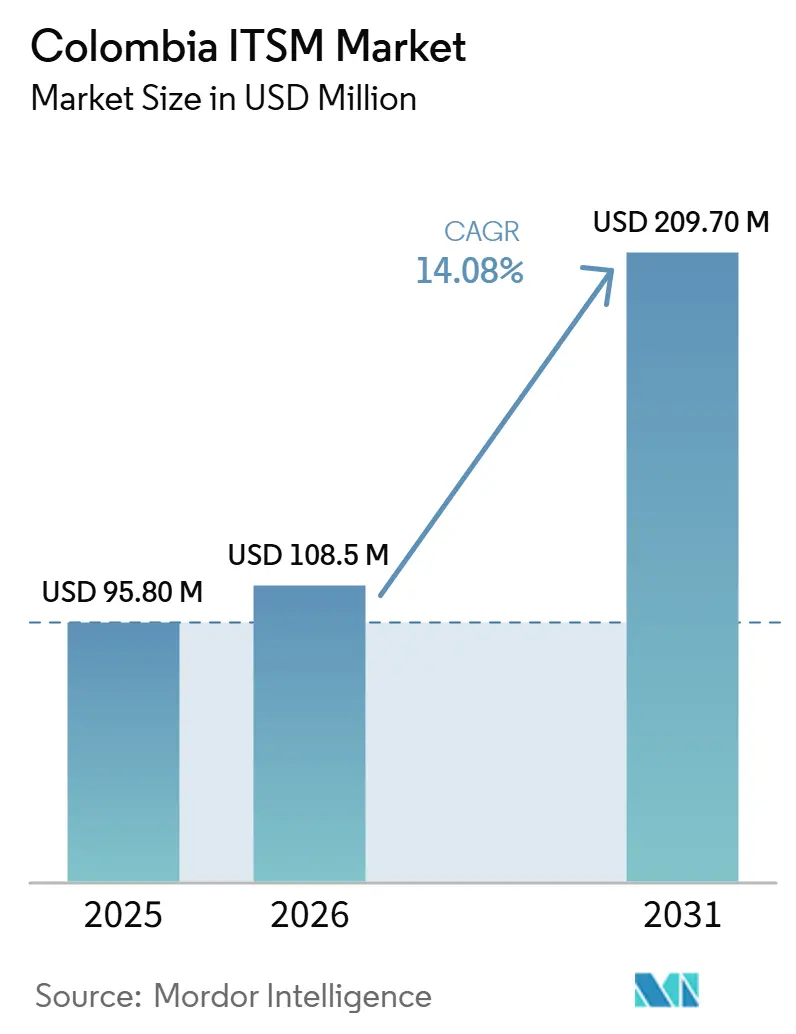
| Base Year Market Size (2025) | USD 95.80 Million |
| Market Size (2026) | USD 108.5 Million |
| Market Size (2031) | USD 209.70 Million |
| Growth Rate (2026 - 2031) | 14.08 % |
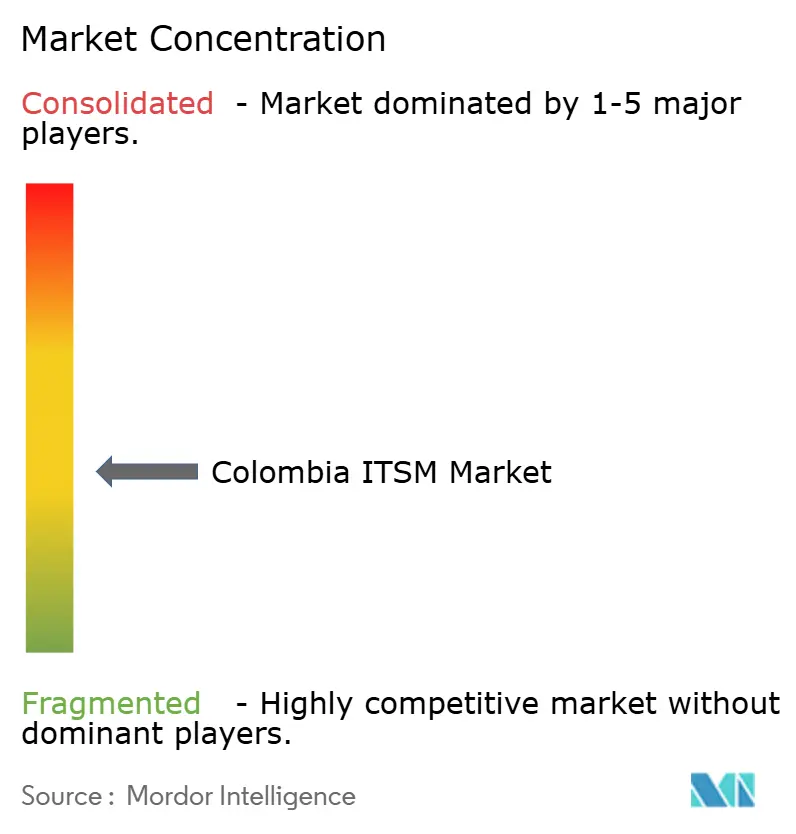
| Market Concentration | Medium |
Major Players *Disclaimer: Major Players sorted in no particular order Image © Mordor Intelligence. Reuse requires attribution under CC BY 4.0. | |
Colombia ITSM Market Analysis by Mordor Intelligence
The Colombia ITSM Market size is projected to be USD 95.80 million in 2025, USD 108.5 million in 2026, and reach USD 209.70 million by 2031, growing at a CAGR of 14.08% from 2026 to 2031.
The market is moving ahead as public cloud procurement has been restored for state entities, and the national IT governance model continues to push institutions toward structured service delivery, stronger controls, and more formal operating practices. Cloud deployment already led adoption in 2025, and large enterprises still accounted for most spending, which shows that modernization is most advanced where governance, budget, and process discipline are already established. At the same time, the Colombia ITSM market is widening beyond core enterprise accounts, as healthcare interoperability mandates and growing demand for managed services are pulling adoption into organizations that need outside support to translate software purchases into stable operating processes. Competition is intensifying between global platforms and Aranda Software, with buyers weighing certified process depth, local language support, partner reach, and embedded automation rather than software features alone. Growth conditions remain favorable, but the Colombia ITSM market still faces procurement friction around cloud compliance, a limited supply of ITSM practitioners, and the high cost of moving away from deeply customized legacy service desk environments.
Key Report Takeaways
- By component, Solutions held 61.40% share in 2025, while Services is projected to expand at a 13.82% CAGR through 2031.
- By deployment, Cloud held 63.45% share in 2025 and also recorded the highest projected CAGR at 13.45% through 2031.
- By application, Service Desk and Incident Management accounted for 27.09% share in 2025, while Knowledge Management is expected to grow at a 12.90% CAGR through 2031.
- By end-user industry, the Government and Public Sector held 18.30% of the Colombia ITSM market in 2025, while Healthcare is projected to expand at a 13.74% CAGR through 2031.
- By enterprise size, Large Enterprises held 66.70% share in 2025, while Small and Mid-size Enterprises are expected to record the highest CAGR at 13.65% through 2031.
Note: Market size and forecast figures in this report are generated using Mordor Intelligence’s proprietary estimation framework, updated with the latest available data and insights as of January 2026.
Colombia ITSM Market Trends and Insights
Drivers Impact Analysis*
| Driver | (~) % Impact on CAGR Forecast | Geographic Relevance | Impact Timeline |
|---|---|---|---|
| Accelerating Cloud Migration Across Colombian Enterprises | +2.8% | National, concentrated in Bogotá and Medellín | Medium term (2-4 years) |
| Rising Need for Faster Incident Resolution in Digital Operations | +2.3% | National, concentrated in BFSI and IT and Telecommunications | Medium term (2-4 years) |
| Stronger IT Governance Requirements in Regulated Industries | +1.9% | National, particularly BFSI, Healthcare, and Government and Public Sector | Long term (≥ 4 years) |
| Expansion of Managed Service Adoption in Mid-Market Firms | +1.6% | National, with early adoption in Bogotá, Medellín, and Cali | Medium term (2-4 years) |
| Rising Demand for Unified Service Catalog and Self-Service | +1.4% | National, across all enterprise sizes | Medium term (2-4 years) |
| Higher Automation Demand From Hybrid Work Environments | +1.2% | National, concentrated in IT and Telecommunications and BFSI | Short term (≤ 2 years) |
| Source: Mordor Intelligence | |||
Accelerating Cloud Migration Across Colombian Enterprises
Cloud migration remains the strongest growth force in the Colombia ITSM market because service workflows become harder to manage informally once applications, infrastructure, and user support move into shared and distributed cloud environments. The fifth-generation Public Cloud Framework Agreement, signed in February 2026 with seven global cloud providers, restored a standardized procurement route for Colombian state entities and removed a key near-term bottleneck that had affected purchasing continuity. The national MGGTI framework also directs public bodies to evaluate cloud services first when defining new IT capabilities, which turns cloud consideration from an optional architecture choice into a policy-backed planning step. That shift matters for the Colombia ITSM market because cloud adoption exposes weak approval paths, inconsistent asset records, and incomplete service ownership much faster than isolated on-premise environments usually do. As more Colombian organizations place business services on cloud platforms, they are also pushed toward documented change control, service catalogs, and escalation rules, which makes ITSM spending part of operational readiness rather than a secondary software decision. The Colombia ITSM market therefore gains not only from new cloud deployments, but also from the process standardization work that cloud environments force across support teams, compliance functions, and service owners.
Rising Need for Faster Incident Resolution in Digital Operations
The Colombia ITSM market is also benefiting from rising pressure to reduce downtime, restore service quickly, and manage incidents with better precision as digital channels become central to customer and employee interactions. ServiceNow’s published case study on Banco Davivienda showed that after the bank integrated ITSM and IT Operations Management, incident resolution fell from 27 hours to 1 second, and monthly alert handling increased from 300 to more than 15,000 events. Those results give the Colombia ITSM market a visible proof point for business value, especially in financial services, where service outages now affect customer trust, transaction continuity, fraud monitoring, and compliance response at the same time. The same pattern increasingly matters outside banking because digital service expectations tend to spread from the most mature sectors into supplier networks, insurers, healthcare systems, and public agencies that interact with those institutions. Once larger organizations begin setting faster response expectations in contracts and service agreements, smaller Colombian firms face stronger incentives to formalize ticketing, monitoring, and escalation practices. That creates a broader demand base for the Colombia ITSM market, since the need is no longer limited to software replacement and instead reaches response quality, workflow automation, and measurable service performance.
Stronger IT Governance Requirements In Regulated Industries
Regulatory structure is giving the Colombia ITSM market a durable compliance-led foundation, especially in sectors where service continuity, traceability, and data handling already sit close to legal and audit obligations. MinTIC Resolution 2277 of 2025 updated the digital security model for public entities and reinforced expectations around control environments, service management discipline, and risk handling in government-linked systems. In healthcare, Decree 228 of 2025 operationalized SIIFA and required staged interoperability across financial and care information systems, with the first module activated in July 2025 and full deployment required by June 2026. These requirements expand the Colombia ITSM market because organizations cannot meet interoperability, auditability, and service accountability expectations with informal help-desk practices alone. They need clearer ownership models, structured request handling, release control, knowledge workflows, and service reporting that can stand up in procurement reviews and compliance checks. The result is that governance policy is not only supporting demand at the top end of the Colombia ITSM market, but also pushing institutions with weaker process maturity toward formal adoption for reasons that are increasingly mandatory rather than discretionary.
Expansion of Managed Service Adoption in Mid-Market Firms
Managed services are becoming more important in the Colombia ITSM market because many organizations have already invested in digital tools, but still lack the internal design capacity needed to run those tools as stable service systems. CINTEL’s 2025 study on digital transformation in large Colombian companies found that technology investment does not automatically translate into operational efficiency, which reinforces the gap between tool ownership and process maturity that many ITSM buyers now face. This dynamic supports the Colombia ITSM market by lifting demand for implementation support, advisory work, training, and managed operations alongside platform licenses. It also explains why service-oriented offers are gaining traction in organizations that need external help to define catalog structures, approval logic, service levels, and governance roles before they can capture value from automation. The effect is especially relevant in mid-market accounts, where hiring experienced internal ITSM architects is harder and the cost of trial-and-error deployments is more damaging to budget discipline. As a result, the Colombia ITSM market is increasingly shaped by whether vendors and partners can convert software demand into practical service outcomes for organizations that do not yet have mature internal operating models.
Restraints Impact Analysis*
| Restraint | (~) % Impact on CAGR Forecast | Geographic Relevance | Impact Timeline |
|---|---|---|---|
| High Switching Costs From Legacy Service Desk Tooling | -0.9% | National, concentrated in large enterprises | Medium term (2-4 years) |
| Shortage of ITSM Administrators and Process Designers | -0.7% | National, across all sectors | Long term (≥ 4 years) |
| Data Residency and Compliance Concerns for Cloud ITSM | -0.6% | National, regulated industries | Medium term (2-4 years) |
| Limited Process Maturity Outside Large Enterprises | -0.5% | National, SMEs and mid-market | Long term (≥ 4 years) |
| Source: Mordor Intelligence | |||
High Switching Costs From Legacy Service Desk Tooling
High migration costs remain the clearest near-term restraint on the Colombia ITSM market because many organizations are not replacing a simple ticketing tool; they are unwinding years of custom workflows tied into HR, finance, and enterprise resource systems. Legacy environments often contain embedded approval rules, reporting logic, asset records, and user habits that were built over time and are difficult to recreate without operational disruption. Atlassian’s comparison of Jira Service Management with BMC Remedy reflects a pattern that is relevant in Colombia, where organizations may modernize only selected practices first and leave other workflows on older systems for a longer period. That partial migration approach slows revenue realization in the Colombia ITSM market because contracts are phased, coexistence periods last longer, and vendor consolidation takes more than one budget cycle. The issue is particularly visible in large enterprises and public institutions, where procurement rules, internal approvals, and integration dependencies make full replacement harder to justify in a single step. Even when the long-term direction is clear, the Colombia ITSM market still absorbs the practical drag created by cautious migration timing, retained legacy modules, and the need to retrain support teams without disrupting live services.
Shortage of ITSM Administrators and Process Designers
The Colombia ITSM market also faces a talent constraint because organizations need more than software administrators; they need people who understand service design, governance structure, service levels, catalog logic, and the discipline required to keep processes consistent after go-live. PeopleCert’s framework updates and the move toward ITIL Version 5 add another layer of certification and recertification pressure for teams that are still building depth under the existing ITIL 4 base. This matters for the Colombia ITSM market because deployment quality depends heavily on practitioners who can translate business needs into process flows, approval models, knowledge structures, and measurable service commitments. Where that expertise is scarce, buyers often delay implementation scope, rely more heavily on service partners, or choose simpler cloud-native options that reduce configuration complexity. The skills gap is therefore not only a labor issue, but also a factor shaping vendor mix, deployment speed, and how quickly organizations can move from basic service desks to broader operating maturity. Until the professional base deepens further, the Colombia ITSM market is likely to keep favoring providers that can package strong guidance, implementation support, and standardized best-practice workflows around the platform itself.
*Our forecasts treat driver/restraint impacts as directional, not additive. The impact forecasts reflect baseline growth, mix effects, and variable interactions.
Segment Analysis
By Component: Solutions Retain Leadership While Services Gain Speed
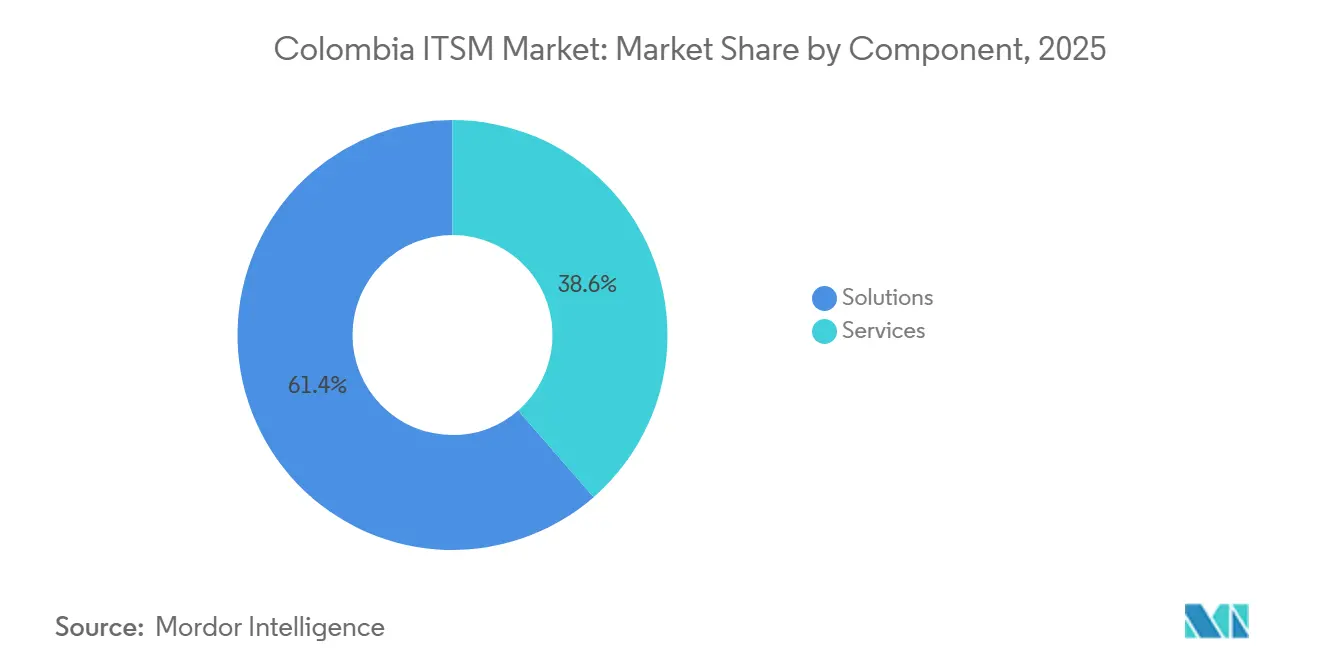
Solutions captured 61.40% of the Colombia ITSM market share in 2025, which confirms that software platforms for incident management, change control, asset management, and service workflows still account for most spending in the country. The Colombia ITSM market continues to rely on solutions revenue because many organizations are still formalizing core service processes for the first time, especially in regulated settings where documentation, approvals, and audit trails now carry greater weight. This pattern is especially visible where public institutions and healthcare organizations are building more structured operating models and need stable platform foundations before they can expand into advanced automation or analytics. In that sense, solutions leadership does not only reflect replacement demand, it also reflects a first-wave adoption cycle in which formal ITSM capability is being established as a basic operating requirement. The component mix, therefore, shows that the Colombia ITSM market remains anchored in core platform build-out even while competitive attention increasingly shifts toward surrounding services.
Services, however, are projected to record the fastest growth at 13.82% during 2026-2031, which shows that buyers increasingly need help turning software investments into reliable service practices. That growth is tied to implementation work, advisory support, training, managed operations, and ongoing optimization, all of which become more important when organizations have tools in place but lack mature process design. The Colombia ITSM industry is therefore gaining service intensity as buyers seek help with governance structure, catalog design, escalation logic, and knowledge base management rather than focusing only on license procurement. This also explains why service-led value propositions are becoming stronger in mid-market and public sector accounts, where internal ITSM architecture talent is still limited and deployment risk must be controlled more carefully. As the Colombia ITSM market grows, the balance between solutions and services is expected to stay complementary, with software holding the larger base while services capture more of the incremental maturity work needed to make those platforms effective.
By Deployment: Cloud Consolidates the Preferred Operating Model
Cloud deployment represented 63.45% of the Colombia ITSM market size in 2025 and is also projected to post the fastest CAGR at 13.45% through 2031, which points to broad agreement around cloud as the preferred direction for new ITSM environments. Public policy has strengthened that preference because the national IT governance framework directs public institutions to assess cloud first for new capabilities, while the 2026 public cloud agreement restored a standardized way for state entities to procure cloud services. The Colombia ITSM market benefits from that alignment because cloud deployments usually encourage faster rollout of service catalogs, remote support functions, workflow updates, and vendor-managed enhancements. They also tend to reduce some of the infrastructure burden that previously slowed adoption in organizations without large in-house support teams. For many buyers, cloud is becoming less of a technology preference and more of a practical operating choice that supports flexibility, multi-site support, and quicker access to automation features.
Hybrid deployment still holds an important place because some financial institutions, telecommunications operators, and regulated entities must manage sensitive data, integration depth, and existing on-premise assets more carefully before moving fully to cloud environments. Those organizations often need continuity across old and new environments, which means hybrid models can serve as a transition step while change control, data policies, and system dependencies are worked through. On-premise deployment is losing relative weight, but it remains relevant where customization is deep, internal hosting rules are still strict, or migration economics do not yet support a full move. The Colombia ITSM market therefore shows a layered deployment structure in which cloud is setting the standard, hybrid is enabling controlled transition, and on-premise systems persist where technical and compliance conditions still favor a slower shift. The Colombia ITSM industry is likely to keep consolidating around cloud-led architectures, but the pace of that shift will remain uneven across buyer groups with different regulatory exposure, legacy burdens, and implementation readiness.
By Application: Service Desk Holds the Base While Knowledge Management Gains Importance
Service Desk and Incident Management accounted for 27.09% of the Colombia ITSM market size in 2025, which reflects its role as the most common starting point for formal service management adoption. The service desk remains central because organizations usually seek visible gains in ticket routing, response time, escalation control, and service-level tracking before they move into broader process modules. Banco Davivienda’s results with ServiceNow illustrate why this application area leads spending, as the bank reported a sharp reduction in incident resolution time and a major increase in alert handling capacity after integrating ITSM and IT Operations Management. That kind of business case gives the Colombia ITSM market a strong anchor, since support leaders can link platform investments directly to service continuity, faster recovery, and better operational visibility. It also explains why service desk functionality remains the core commercial entry point even when buyers intend to broaden scope later into asset, request, and release processes.
Knowledge Management is projected to grow at a 12.90% CAGR through 2031 because organizations that have already structured basic service operations now want to reduce repeat tickets and improve first-contact resolution through searchable, governed knowledge. As workflows mature, the value of knowledge content increases because it supports consistency across teams, reduces dependence on individual staff experience, and allows automation tools to work against better-defined guidance. Asset and Configuration Management, Change and Release Management, and Service Request Management also continue to expand because they sit close to governance needs in banking, government, and manufacturing environments. The Colombia ITSM market thus evolves from basic incident control toward a broader process stack in which service desks remain the operational front door while knowledge, change, and configuration disciplines deepen service quality behind the scenes. Over time, that progression should strengthen platform stickiness because buyers that expand across multiple applications become less likely to treat ITSM as a narrow ticketing purchase and more likely to manage it as an operating framework.
By End-User Industry: Government Provides the Base While Healthcare Advances Fastest
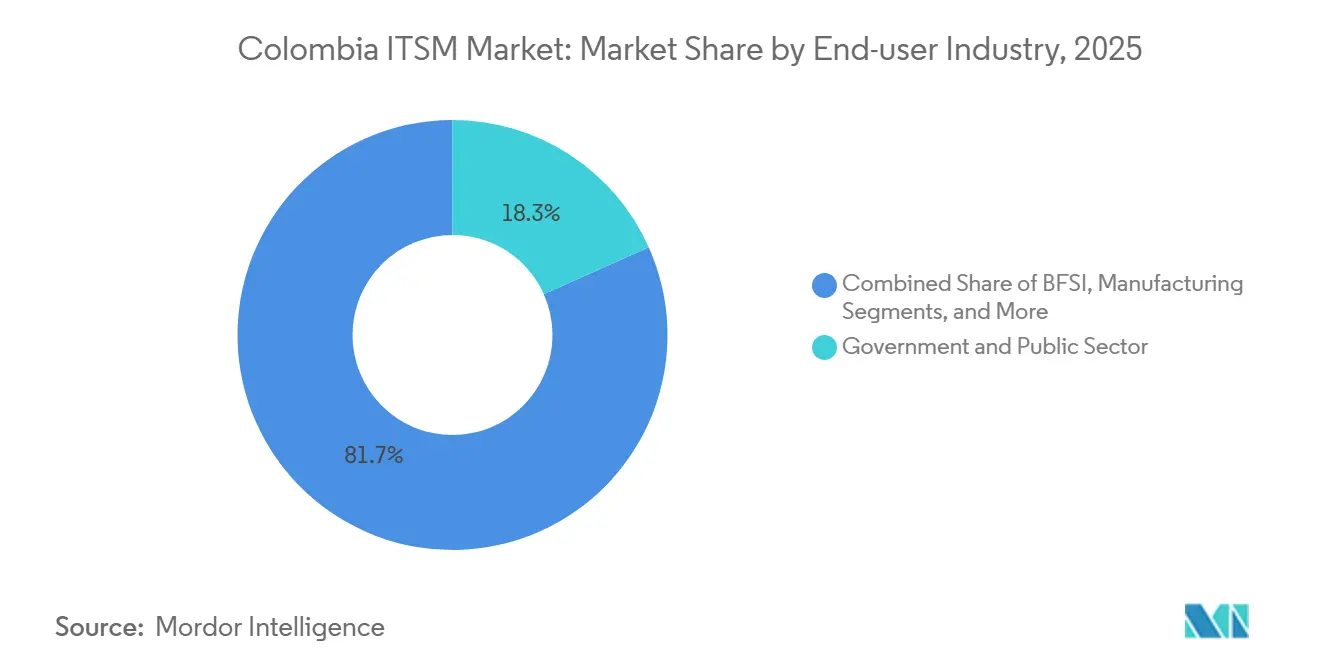
Government and Public Sector held 18.30% of the Colombia ITSM market share in 2025, which made it the largest end-user segment and reflected the direct effect of public governance requirements on service management demand. The MGGTI framework places IT governance and service management discipline near the center of state operating practice, which gives public institutions a structural reason to formalize workflows, approvals, and service accountability. That demand base matters for the Colombia ITSM market because government accounts often require broad process coverage, detailed controls, and alignment with procurement and compliance expectations that extend beyond basic ticketing. It also creates a reference environment that influences suppliers, partners, and other regulated buyers who interact with public institutions. In effect, public sector leadership shows that the Colombia ITSM market is not being driven only by private enterprise modernization, but also by formal state requirements that keep service management visible in institutional planning.
Healthcare is projected to expand at a 13.74% CAGR through 2031, supported by both regulatory pressure and active process modernization in the sector. Decree 228 of 2025 activated SIIFA implementation, and ADRES launched its Intelligent Audit System in May 2026 with AWS and Blend360 to automate medical billing audit workflows at national scale. These moves increase the need for interoperability, service monitoring, governed workflows, and cross-entity coordination, which raises the strategic value of ITSM capabilities in hospitals, insurers, and administrative bodies. BFSI, IT and Telecommunications, Manufacturing, and Retail and E-commerce still make up much of the remaining demand, but each brings a different set of operational priorities such as security response, hybrid infrastructure management, asset lifecycle control, and omnichannel support. The Colombia ITSM market therefore shows a sector mix in which public administration provides steady baseline demand while healthcare emerges as the most dynamic growth engine because regulation and operational complexity are rising at the same time.

By Enterprise Size: Large Enterprises Dominate While SMEs Build Momentum
Large Enterprises held 66.70% of spending in 2025, which confirms that the Colombia ITSM market still depends heavily on organizations with larger budgets, deeper IT teams, and more formal governance expectations. These buyers were earlier adopters of structured service frameworks, and they are better positioned to absorb implementation costs, integration work, and the organizational change that enterprise-grade platforms usually require. Large accounts also tend to broaden deployments over time, moving from basic service desk operations into change control, asset visibility, monitoring integration, and knowledge workflows. That gives the Colombia ITSM market a strong installed base in banks, telecom operators, multinational firms, and major public institutions, where platform scope can widen gradually after the initial rollout. As a result, enterprise demand remains the revenue anchor even while growth opportunities are opening in less mature customer groups.
Small and Mid-size Enterprises are projected to record the highest CAGR at 13.65% through 2031 because cloud pricing, software-as-a-service delivery, and partner-led implementation are lowering the entry barrier for formal service management. The Colombia ITSM market is becoming more accessible to SMEs that want better compliance discipline, more automation, and a clearer way to manage service requests without building large internal support functions. Freshworks’ February 2025 reseller agreement with Unisys supports this shift by expanding distribution reach for service management and infrastructure discovery tools into mid-market and enterprise accounts. The Colombia ITSM industry is therefore broadening from an enterprise-heavy base toward a wider customer profile in which channel partners and managed services play a bigger role in buyer confidence and execution quality. If that support ecosystem continues to deepen, SMEs should account for a larger share of new adoption even if large enterprises remain dominant in absolute spending.
Geography Analysis
Bogotá remains the largest demand center in the Colombia ITSM market because it brings together federal institutions, major financial organizations, and the country’s deepest concentration of enterprise technology buying activity. The city’s role is reinforced by public cloud procurement pathways and digital governance rules that affect many state entities headquartered there, which keeps Bogotá central to the implementation of formal service management models. Bogotá also benefits from the concentration of large BFSI clients whose digital operations require fast incident response, stronger alert handling, and tighter workflow governance than many smaller markets. Because these organizations often act as reference accounts for the rest of the country, their technology choices shape expectations around service levels, integration depth, and automation readiness. The Colombia ITSM market therefore, shows a clear metropolitan core, with Bogotá setting the pace for procurement scale, platform maturity, and compliance-led adoption.
Medellín stands out as the most dynamic secondary center in the Colombia ITSM market because its business base combines technology activity, manufacturing exposure, and a stronger appetite for operational modernization. Firms in and around the Aburrá Valley increasingly value ITSM tools that support uptime, service automation, and structured support across hybrid environments, especially where digital operations intersect with production requirements. That makes Medellín important not only as a regional customer hub, but also as a setting where outcome-oriented buying behavior can push vendors toward clearer value cases and more service-linked offers. Cali, Barranquilla, and other secondary cities still account for a smaller portion of present demand, yet their retail, healthcare, and logistics activity is gradually creating conditions where formal ITSM adoption becomes more practical. In these markets, channel partners and managed service providers are likely to remain the main bridge between vendor platforms and customer execution needs during the next stage of expansion. As the Colombia ITSM market broadens geographically, adoption outside the capital is expected to deepen first where digital workloads rise and service disruption begins carrying higher business costs.
At the regional level, Colombia holds a distinct position in the South America ITSM environment because it combines growing demand for global platforms with the presence of a credible local vendor that has meaningful process certification depth. Aranda Software’s certified practice base and regional client footprint give Colombia a locally rooted reference point that few other South American countries can match in this category. Colombia’s regional weight is also supported by policy development, as the OECD’s 2026 review noted stronger regulatory authority and a deeper governance framework around digital connectivity and supervision. That combination of local platform capability, national governance pressure, and expanding cloud procurement keeps the Colombia ITSM market strategically important within South America even though demand is still concentrated in a few metropolitan and institutional clusters.
Competitive Landscape
The Colombia ITSM market is contested by global enterprise platforms, regional challengers, and a strong local incumbent, which creates a competitive structure that is active but not dominated by a single vendor. ServiceNow and Atlassian remain closely associated with premium enterprise environments, while Freshworks, ManageEngine, and other providers compete more actively where buyers seek lower complexity, faster deployment, or stronger channel support. Aranda Software holds a distinctive position in the Colombia ITSM market because it combines local roots with formal process certifications that help narrow the trust gap buyers often see between domestic and global vendors. That mix matters because many Colombian customers are not only comparing features, they are also weighing language support, partner responsiveness, regulatory fit, and the credibility of implementation guidance. In practical terms, competition in the Colombia ITSM market is less about one clear leader controlling the field and more about different vendors holding stronger positions in different customer tiers and process maturity levels.
Recent strategic moves show that vendors are trying to strengthen both product differentiation and route-to-market coverage. Ivanti launched a customer preview of persona-based agentic AI for Neurons for ITSM in Q1 2026 and positioned the capability for broader availability later in the year, which reflects the growing importance of autonomous incident and request handling in vendor strategy. Freshworks expanded its reach through the February 2025 reseller agreement with Unisys, a move that supports broader distribution into mid-market and enterprise accounts that may prefer partner-assisted adoption. Aranda also reinforced its position by renewing PinkVerify certification for 11 ITSM processes in August 2025, adding AI-assisted capabilities that help maintain parity in process credibility against international competitors. These moves matter because buyers in the Colombia ITSM market increasingly expect certified process depth, automation support, and dependable implementation ecosystems together rather than as separate considerations. Competitive strength is therefore being built through a combination of AI readiness, local delivery capacity, and proof that the platform can support mature operating practices.
The most open competitive space appears in mid-market accounts, public health workflows, and buyers that need help bridging from basic ticketing to broader governance maturity. Government cloud procurement channels and compliance-linked buying criteria can favor vendors that align well with certified infrastructure ecosystems and structured service management frameworks. At the same time, the Colombia ITSM market is likely to reward providers that can simplify deployment for customers with limited internal expertise, because skills shortages and switching costs still shape buying behavior strongly. This means the winning formula in the Colombia ITSM market is unlikely to rest on product depth alone, and will instead depend on how well vendors combine platform capability, certification credibility, partner execution, and practical support for organizations moving toward more formal service operations.
Colombia ITSM Industry Leaders
-
ServiceNow, Inc.
-
Atlassian
-
BMC Software, Inc.
-
Ivanti, Inc.
-
Freshworks Inc.
- *Disclaimer: Major Players sorted in no particular order
Recent Industry Developments
- May 2026: Colombia's ADRES (Administradora de los Recursos del Sistema General de Seguridad Social en Salud) launched the Sistema Inteligente de Auditoría (SIA), an AI-based platform built with AWS and Blend360 that automates medical billing audit workflows for the national health system, reducing claim processing time from over three months to fewer than 14 days. The system, capable of scaling to 100,000 claims per day, establishes a new benchmark for AI-driven ITSM deployment within Colombia's public health infrastructure.
- February 2026: Colombia Compra Eficiente awarded the fifth-generation Public Cloud Framework Agreement (CCE-SNG-AMP-011-2026) to seven cloud service providers, Microsoft, AWS, Oracle, Google, Alibaba, Huawei, and IBM, restoring a structured, competitive procurement pathway for cloud-native ITSM platforms for over 119 Colombian state entities and expanding the addressable government ITSM market.
- August 2025: Aranda Software renewed its PinkVerify certification for 11 ITSM processes, adding new capabilities aligned with global ITIL standards, including advanced automation and AI-assisted practices, reinforcing its position as the leading certified ITSM platform for the South American enterprise market.
- February 2025: Freshworks and Unisys announced a strategic reseller agreement under which Unisys distributes Freshservice and Device42 to mid-market and enterprise clients globally, expanding Freshworks' South American distribution reach through Unisys' field services and enterprise relationships across the region.
Colombia ITSM Market Report Scope
IT Service Management (ITSM) is the set of repeatable practices, processes, and enabling technologies used by organizations to plan, provision, operate, secure, and optimize IT‑delivered services for internal and external customers. It covers the full service lifecycle service strategy, design, transition, operation, and continual improvement, and includes core domains such as incident, problem, change, configuration, request, asset, and knowledge management, plus service-catalog and SLA governance.
The Colombia ITSM Market Report is Segmented by Component (Solutions and Services), Deployment (Cloud, On-premise, and Hybrid), Application (Service Desk and Incident Management, Asset and Configuration Management, Change and Release Management, Service Request Management, Knowledge Management, and Other Applications), End-user Industry (BFSI, Manufacturing, Government and Public Sector, IT and Telecommunications, Retail and E-commerce, Healthcare, Travel and Hospitality, and Other End-user Industries), and Enterprise Size (Large Enterprises and Small and Mid-size Enterprises [SME]). The Market Forecasts are Provided in Terms of Value (USD).
| Solutions |
| Services |
| Cloud |
| On-premise |
| Hybrid |
| Service Desk and Incident Management |
| Asset and Configuration Management |
| Change and Release Management |
| Service Request Management |
| Knowledge Management |
| Other Applications |
| BFSI |
| Manufacturing |
| Government and Public Sector |
| IT and Telecommunications |
| Retail and E-commerce |
| Healthcare |
| Travel and Hospitality |
| Other End-user Industries |
| Large Enterprises |
| Small and Mid-size Enterprises (SME) |
| By Component | Solutions |
| Services | |
| By Deployment | Cloud |
| On-premise | |
| Hybrid | |
| By Application | Service Desk and Incident Management |
| Asset and Configuration Management | |
| Change and Release Management | |
| Service Request Management | |
| Knowledge Management | |
| Other Applications | |
| By End-user Industry | BFSI |
| Manufacturing | |
| Government and Public Sector | |
| IT and Telecommunications | |
| Retail and E-commerce | |
| Healthcare | |
| Travel and Hospitality | |
| Other End-user Industries | |
| By Enterprise Size | Large Enterprises |
| Small and Mid-size Enterprises (SME) |
Key Questions Answered in the Report
What is the Colombia ITSM market size in 2026 and 2031?
The Colombia ITSM market size is USD 108.5 million in 2026 and is forecast to reach USD 209.7 million by 2031, at a CAGR of 14.08% over 2026-2031.
Which deployment model leads ITSM adoption in Colombia?
Cloud leads adoption, with 63.45% share in 2025, and it is also the fastest-growing deployment model with a 13.45% CAGR through 2031.
Which end-user segment is growing fastest in Colombia?
Healthcare is the fastest-growing end-user segment, with a projected CAGR of 13.74% through 2031, supported by SIIFA rollout and wider interoperability needs.
Why are managed services gaining traction in Colombian IT service management?
Managed services are expanding because many organizations need help with process design, training, governance setup, and ongoing optimization after software deployment.
What is holding back wider ITSM adoption in Colombia?
The main constraints are high switching costs from legacy tools, limited availability of experienced ITSM practitioners, and continued compliance concerns around cloud migration.
How competitive is the vendor landscape in Colombia?
The field is active and fairly fragmented, with ServiceNow, Atlassian, Freshworks, ManageEngine, Ivanti, and Aranda Software competing across different customer tiers and deployment needs.