
South America CRM Marketing Services Market Size and Share
Market Overview
| Study Period | 2020 - 2031 |
|---|---|
| Forecast Data Period | 2026 - 2031 |
| Base Year Market Size (2025) | USD 1.28 Billion |
| Market Size (2026) | USD 1.41 Billion |
| Market Size (2031) | USD 2.44 Billion |
| Growth Rate (2026 - 2031) | 11.59 % |
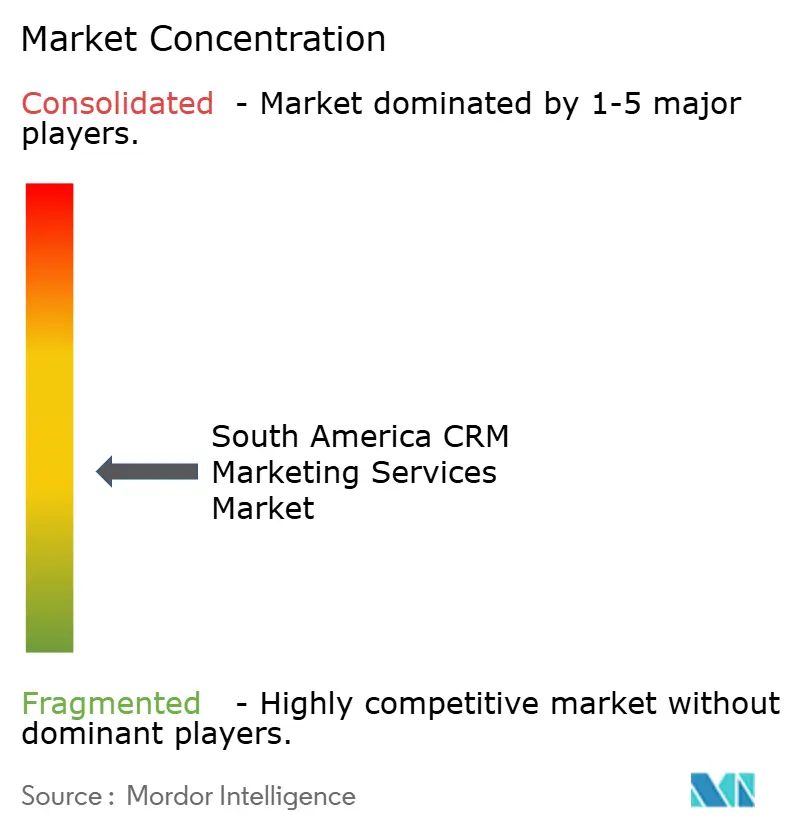
| Market Concentration | Medium |
Major Players *Disclaimer: Major Players sorted in no particular order Image © Mordor Intelligence. Reuse requires attribution under CC BY 4.0. | |
South America CRM Marketing Services Market Analysis by Mordor Intelligence
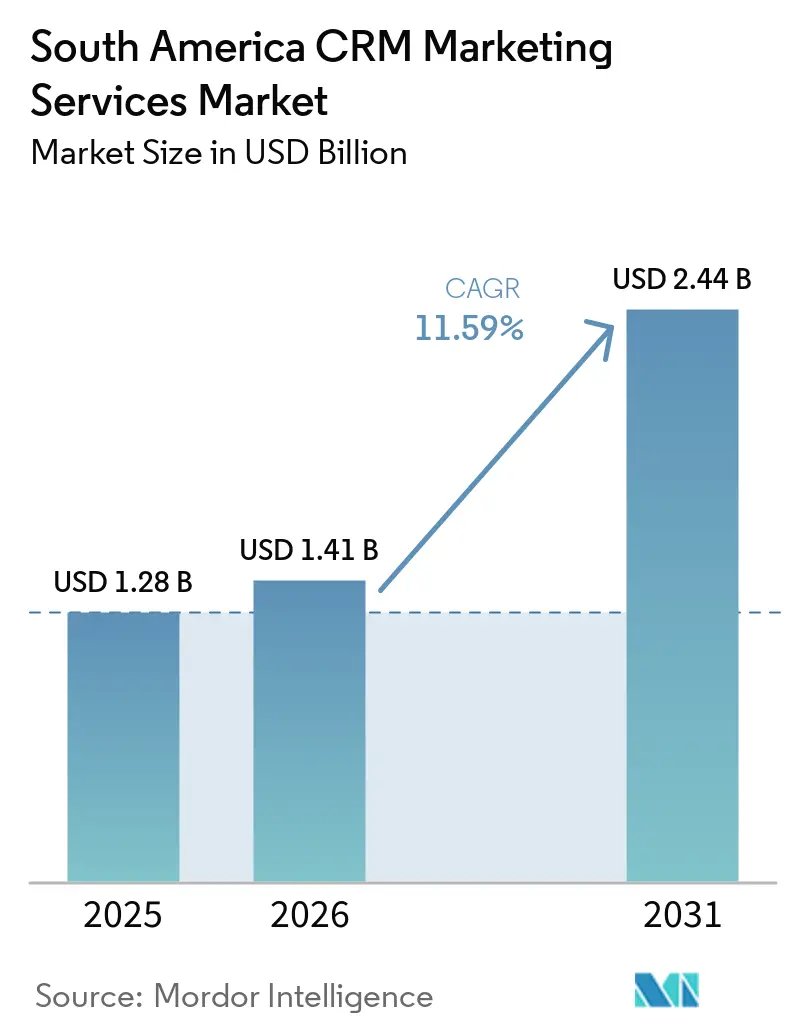
The South America CRM marketing services market size was valued at USD 1.28 billion in 2025 and is estimated to grow from USD 1.41 billion in 2026 to reach USD 2.44 billion by 2031, at a CAGR of 11.59% during the forecast period (2026-2031). The South America CRM marketing services market is moving beyond basic software rollout and is now centered on modernization, workflow redesign, and long-term service support. Demand is being pushed by cloud deployment, AI-led personalization, and the growing role of conversational commerce in daily customer engagement. Large contracts are increasingly split between integration-heavy programs for legacy environments and AI-first programs for cloud-native stacks, which is changing how service providers position consulting, migration, and managed services. Brazil remains the region’s anchor for scale and platform maturity, while Colombia is gaining speed as financial services and digital businesses expand. Competitive differentiation is also becoming more durable because providers with strong local delivery capability, regulated-sector experience, and stronger data governance can hold renewal advantage for longer periods.
Key Report Takeaways
- By service type, CRM implementation and integration held 27.1% of the South America CRM marketing services market share in 2025, while CRM migration and modernization is projected to grow at a 12.7% CAGR through 2031.
- By enterprise size, large enterprises accounted for 58.1% revenue share in 2025, while SMEs are forecast to expand at a 12.8% CAGR through 2031.
- By service application, customer acquisition accounted for 20.2% share in 2025, while omnichannel customer engagement is forecast to advance at a 13% CAGR through 2031.
- By end-user industry, BFSI held a 16.1% revenue share in 2025, while healthcare and life sciences is forecast to grow at a 13.1% CAGR through 2031.
- By geography, Brazil held 33.1% of the South America CRM marketing services market share in 2025, while Colombia is projected to expand at a 13.2% CAGR through 2031.
Note: Market size and forecast figures in this report are generated using Mordor Intelligence’s proprietary estimation framework, updated with the latest available data and insights as of January 2026.
Market Trends and Insights
Drivers Impact Analysis of South America CRM Marketing Services Market*
| Driver | (~) % Impact on CAGR Forecast | Geographic Relevance | Impact Timeline |
|---|---|---|---|
| Rapid Shift to Cloud-Delivered CRM and Marketing Automation | +2.8% | Brazil, Colombia, Argentina, Chile | Medium term (2-4 years) |
| Rising Demand for AI-Driven Personalization and Lead Scoring | +2.4% | Brazil, Colombia, Argentina | Medium term (2-4 years) |
| Expansion of E-Commerce and Digital Commerce Orchestration | +1.8% | Brazil, Colombia, Chile | Short term (≤ 2 years) |
| Multichannel Customer Engagement Across Mobile and Social Touchpoints | +1.6% | Brazil, Colombia, Peru | Short term (≤ 2 years) |
| Data Localization and Privacy Compliance Readiness as a Buying Trigger | +1.2% | Brazil (LGPD/ANPD), Colombia (SIC/Ley 1581), Argentina (PDPA) | Medium term (2-4 years) |
| SME Subscription Adoption and Modular Pricing Preference | +1.0% | Brazil, Colombia, Chile, Peru | Long ter |
| Source: Mordor Intelligence | |||
Rapid Shift to Cloud-Delivered CRM and Marketing Automation
The South America CRM marketing services market is increasingly organized around cloud delivery because most new enterprise programs now assume SaaS deployment from the start. This is increasing demand for implementation, migration, integration, and post-deployment support under a single contract rather than in separate workstreams. Brazil is also showing that cloud adoption has moved into a more mature phase, as Salesforce described the country in 2026 as one of its leading markets for moving Agentforce from pilot programs into production environments. The same pattern is visible in large program design, where CASSI rolled out Salesforce Health Cloud, Marketing Cloud, Data Cloud, Sales Cloud, Service Cloud, Einstein Bot, Loyalty Management, and Advertising Studio as part of one broader healthcare transformation effort. As cloud architecture becomes standard, providers with stronger connectors, migration capability, and local delivery depth are better placed to capture larger and longer mandates.
Rising Demand for AI-Driven Personalization and Lead Scoring
The South America CRM marketing services market is also being pushed by the shift from basic automation toward AI-supported sales and service execution. Banco do Brasil clearly showed this direction when it presented a Salesforce-based CRM and hyperpersonalization strategy aimed at improving sales by 30%, with a 2026 phase planned to have AI agents handle routine client interactions. That kind of program shifts service demand away from one-time implementation and toward data preparation, model tuning, workflow redesign, and ongoing optimization. Salesforce’s acquisition moves have reinforced this direction by deepening its data and AI stack through Informatica and by adding an autonomous customer support capability through Fin. As AI features become part of frontline execution, CRM service providers with stronger data-handling and AI operations capabilities are gaining a more defensible position.
Expansion of E-Commerce and Digital Commerce Orchestration
The South America CRM marketing services market is benefiting from retail and commerce workflows that now require customer data, messaging, recommendations, and payment actions to work together within a single flow. Magazine Luiza made this visible when it launched full AI commerce on WhatsApp in 2025, linking CRM, product recommendations, and payment steps within a single conversational channel. This shifts service demand away from basic contact management and toward orchestration across discovery, transaction, and post-purchase engagement. It also raises the value of partners that can connect commerce systems, customer records, campaign tools, and service workflows without forcing a full stack replacement. As a result, retail-facing mandates in the South America CRM marketing services market are becoming broader in scope and more operationally complex.
Multichannel Customer Engagement Across Mobile and Social Touchpoints
The South America CRM marketing services market is also being reshaped by customer engagement models built around mobile and social channels rather than email alone. WhatsApp has become a practical service and sales channel in the region, which has increased demand for workflow design, campaign coordination, and response automation that work across different customer touchpoints. Magalu’s rollout on WhatsApp and Banco do Brasil’s AI-led service plan both show that the region is moving toward customer engagement models that combine commercial action with real-time support. This also explains why service providers are increasingly being assessed on integration quality and operational execution, not only on platform certification. In the South America CRM marketing services market, the multichannel shift is expanding the need for unified customer data, conversation tracking, and service continuity across functions.
Restraints Impact Analysis of South America CRM Marketing Services Market*
| Restraint | (~) % Impact on CAGR Forecast | Geographic Relevance | Impact Timeline |
|---|---|---|---|
| Integration Complexity Across Legacy ERP, POS, and Commerce Stacks | -1.8% | Brazil, Argentina, Chile (legacy-heavy manufacturing and retail) | Medium term (2-4 years) |
| Budget Sensitivity and Longer Payback Cycles Among Mid-Market Buyers | -1.4% | Argentina, Peru, Rest of South America | Short term (≤ 2 years) |
| Data Quality Gaps That Weaken Automation and Attribution Outcomes | -0.9% | Brazil, Colombia, Chile | Medium term (2-4 years) |
| Talent Shortage in Martech Operations and CRM Administration | -0.7% | Brazil, Colombia, Argentina | Long term (≥ 4 years) |
| Source: Mordor Intelligence | |||
Integration Complexity Across Legacy ERP, POS, and Commerce Stacks
The South America CRM marketing services market still faces a major delivery constraint because many clients operate with uneven legacy environments across ERP, commerce, payments, and point-of-sale systems. This slows down projects, increases implementation effort, and often pushes consulting costs above initial budget assumptions. The issue is especially important in large enterprise environments where multiple clouds, business units, and regulated data flows must work together within a single design. Grupo Aval’s migration work with Siebel CRM Cloud Manager and Oracle Autonomous Database reflects the kind of architecture depth that makes integration a central part of the service opportunity and a central source of execution risk. In the South America CRM marketing services market, providers that reduce integration friction can protect margins better and improve client confidence during renewal cycles.[1]
Budget Sensitivity and Longer Payback Cycles Among Mid-Market Buyers
The South America CRM marketing services market also faces budget sensitivity in the mid-market, especially in Argentina, Peru, and smaller regional markets, where buyers remain careful about multi-year technology commitments. Many contracts are priced around software and service models that can become harder to sustain when buyers face currency pressure or slower internal adoption. This makes shorter deployment timelines and clearer value milestones more important during vendor selection. The issue does not remove demand, but it does change deal structure because clients often phase projects or prioritize modules that show operational benefit earlier. In the South America CRM marketing services market, service providers that can simplify rollout and tie work more closely to measurable outcomes are better positioned to win these accounts.
*Our forecasts treat driver/restraint impacts as directional, not additive. The impact forecasts reflect baseline growth, mix effects, and variable interactions.
South America CRM Marketing Services Market Segment Analysis
By Service Type:
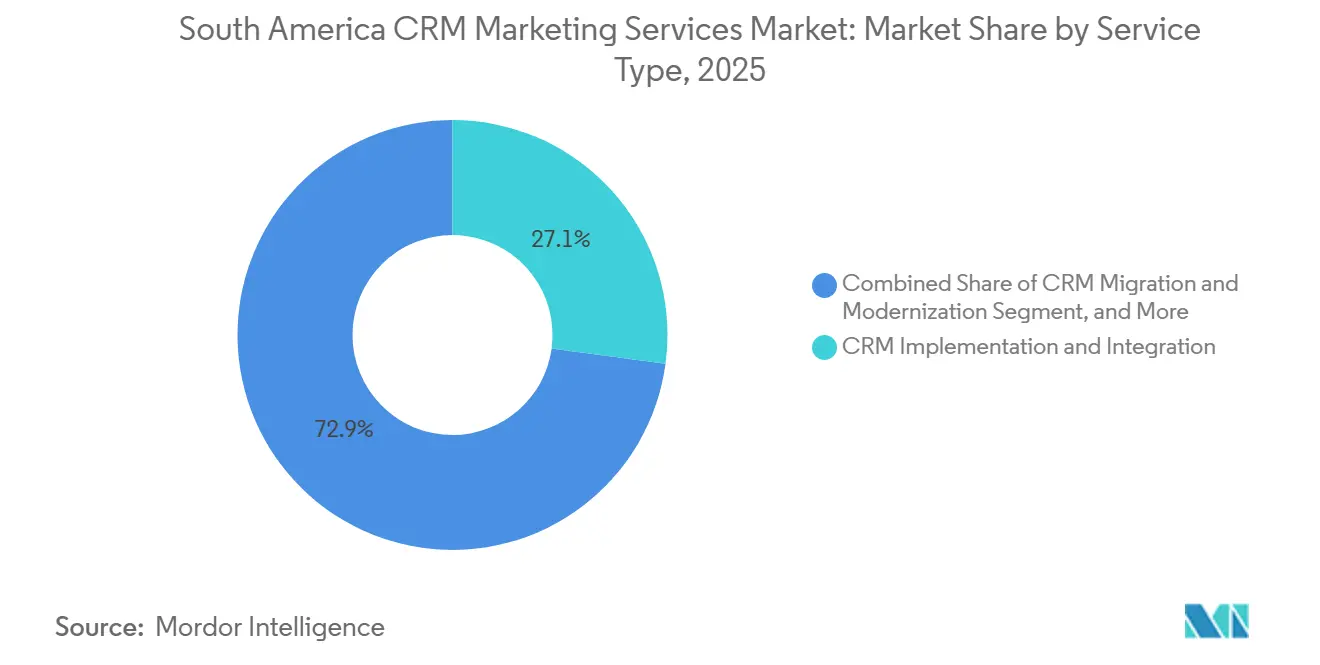
Implementation Volumes Sustain Leadership While Modernization AcceleratesCRM implementation and integration held the largest share among service types at 27.1% in 2025, keeping this part of the South America CRM marketing services market at the center of new contract flow. The segment still benefits from first-generation deployments in some enterprises and from complex replacement cycles in others. Many clients are not yet in a stable optimization phase, so implementation work continues to absorb a large part of spending across BFSI, retail, and healthcare. This also means the South America CRM marketing services industry still rewards providers that can handle architecture design, workflow mapping, data migration, and user rollout in one engagement. The segment remains important because every subsequent service layer still depends on the quality of implementation at the start.
Implementation scope is also becoming broader. CASSI’s multi-module Salesforce rollout is a strong example because one program covered Health Cloud, Marketing Cloud, Data Cloud, Sales Cloud, Service Cloud, Einstein Bot, Loyalty Management, and Advertising Studio. CRM migration and modernization are forecast to grow at a 12.7% CAGR through 2031, and the South America CRM marketing services market is benefiting from the need to replace older architectures that are less suited to AI and event-driven workflows. That growth is also helping adjacent categories such as strategy consulting, managed services, and training because modernization rarely ends with technical migration alone. As a result, implementation still leads on current revenue while modernization is setting the pace for future expansion.

By Enterprise Size:
Large Enterprises Anchor Revenue as SMEs Reshape Growth GeometryLarge enterprises accounted for 58.1% of total market revenue in 2025, making them the primary revenue driver for the South America CRM marketing services market. Their contracts are larger because they usually cover several business functions, more users, deeper integration, and longer support terms. Petrobras illustrated this scale in 2026 when it initiated procurement for Salesforce development and maintenance services with a reference budget of more than BRL 155 million, or approximately USD 30 million. Programs at this level tend to combine solution architecture, agile delivery, AI teams, and ongoing support, keeping service intensity high throughout the contract cycle. Large enterprises, therefore, continue to set the commercial benchmark for delivery capability and account depth.
SMEs are forecast to expand at a 12.8% CAGR through 2031, which is changing the growth pattern of the South America CRM marketing services market, even if not the immediate revenue base. Subscription pricing and modular deployment have reduced entry barriers, which makes CRM programs more realistic for smaller buyers than in earlier cycles. Even so, SME growth does not necessarily mean easier delivery because smaller firms often need more onboarding support and clearer operating discipline after go-live. This creates a recurring opening for lower-cost consulting, workflow setup, training, and performance support rather than only for software resale. The South America CRM marketing services market is therefore being shaped by two different buyer groups, one defined by contract size and the other by faster expansion.[2]
By Service Application:
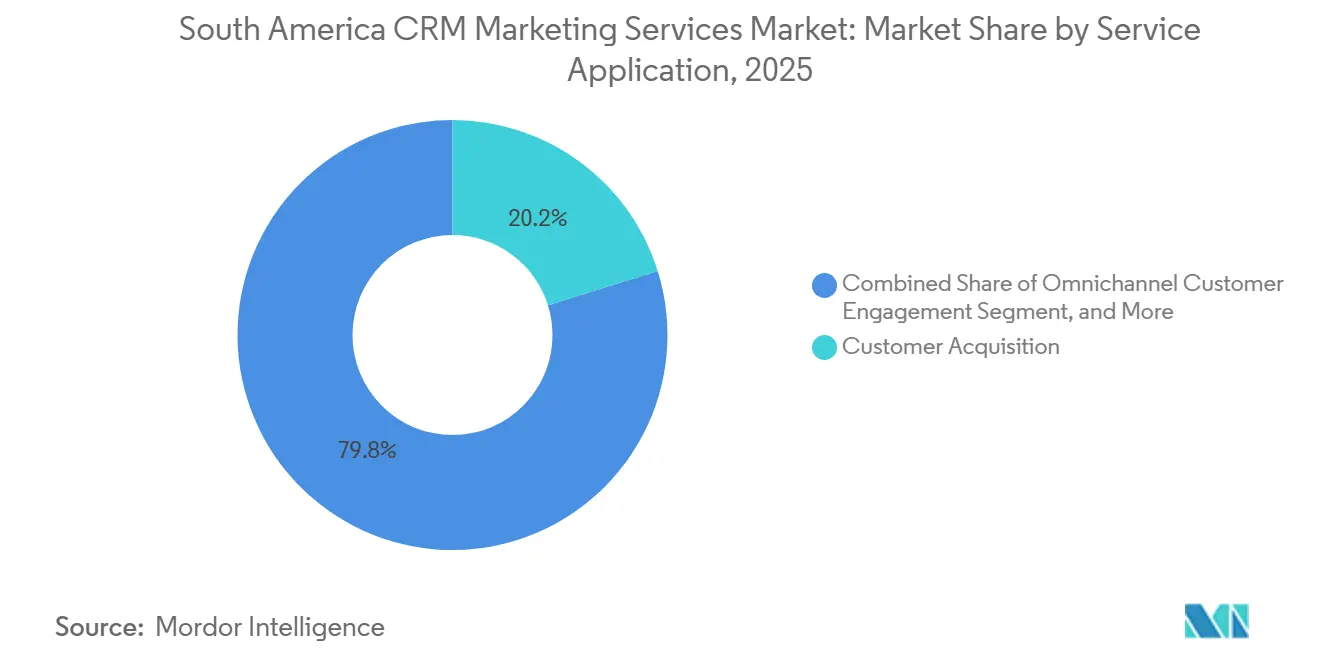
Acquisition Anchors Share While Omnichannel Outpaces the FieldCustomer acquisition retained its leading share among service applications at 20.2% in 2025, keeping top-of-funnel activity at the core of service demand in the South America CRM marketing services market. Enterprises continue to spend heavily on lead capture, qualification, campaign support, and response workflows because customer growth still depends on faster and more coordinated engagement. In this segment, conversational selling is becoming more important than static campaign execution. Magalu’s 2025 WhatsApp commerce rollout showed how CRM-linked recommendation and payment steps can be embedded directly into customer acquisition activity. That kind of use case keeps acquisition spending strong because it connects media response, sales actions, and checkout behavior into a single operating flow.
Omnichannel customer engagement is forecast to expand at a 13% CAGR through 2031, and the South America CRM marketing services market size tied to this application is rising as firms try to coordinate journeys across WhatsApp, email, Instagram, and in-store touchpoints. The shift is important because it changes service work from campaign management to journey orchestration. Providers now need to manage customer records, trigger logic, service handoffs, and analytics more uniformly. Salesforce’s completion of the Informatica acquisition in 2025 also strengthened expectations around data quality, governance, and attribution inside CRM environments. In the South America CRM marketing services market, it is pushing more value toward service providers that can combine engagement design with stronger data management discipline.
By End-User Industry:
BFSI Sustains Largest Share as Healthcare Scales FastestBFSI led all end-user industries with a 16.1% revenue share in 2025, which kept the sector at the center of the South America CRM marketing services market. Banks, insurers, and financial groups typically require more complex customer data handling, more frequent workflow redesign, and tighter service standards than many other end users. The sector also supports larger contracts because customer journeys often span multiple products and channels. Grupo Aval’s technology stack, which works on Siebel CRM and Oracle infrastructure, illustrates the depth of transformation programs in large regional financial institutions. Banco do Brasil’s hyperpersonalization plan adds the AI dimension, showing how BFSI demand now extends from platform modernization into frontline sales and service execution.[3]
Healthcare and life sciences are forecast to grow at a 13.1% CAGR through 2031, making it one of the fastest-moving pockets of the South America CRM marketing services market. Demand is being driven by health plan operators, hospital systems, and commercial healthcare teams that need more organized patient and beneficiary engagement. Vertical specialization matters more here because generic platforms often require significant customization to fit healthcare sales, service, and compliance workflows. Unimed Ponte Nova’s 2026 implementation of Smark Saúde CRM shows how specialized health plan tools are gaining relevance in Brazil’s mid-market healthcare environment. This is allowing the South America CRM marketing services market to expand not only through large global platforms but also through focused solutions built for specific vertical operating needs.[4]
Geography Analysis
Brazil CRM Marketing Services Market
Brazil accounted for 33.1% of regional revenue in 2025, making it the largest national market in the South America CRM marketing services market. The country leads because it combines enterprise scale, stronger vendor presence, and faster movement toward AI-enabled CRM operations. Petrobras’s 2026 procurement for Salesforce development and maintenance services, with a reference budget of more than BRL 155 million, or approximately USD 30 million, shows the scale of enterprise mandates already being awarded in Brazil. Salesforce’s description of Brazil as a leading market for full-production Agentforce deployments reinforces the view that platform maturity is advancing faster there than in most neighboring countries. Brazil’s compliance environment also raises the value of vendors that can handle data governance and local delivery with more confidence.
Argentina and Chile CRM Marketing Services Market
Argentina and Chile add a secondary scale to the South America CRM marketing services market, but they do so in different ways. Argentina is important as a delivery and development base, supported by Salesforce’s January 2025 plan to invest USD 500 million over 5 years in the country, including expanding MuleSoft engineering in Buenos Aires and supporting public-sector and SME digital transformation. That investment supports the view that Argentina is not only a demand center but also a regional hub of capabilities. Chile contributes through its more mature enterprise environment and its role as a location for multinational regional activity. This helps create steady consulting demand, even if Chile's volume does not match Brazil's. Together, these markets give the South America CRM marketing services market more balance beyond its Brazilian core.
South America CRM Marketing Services Market
Colombia is forecast to post the fastest country-level CAGR of 13.2% through 2031, which will give it a rising role in the South America CRM marketing services market. Financial services, fintech activity, and broader digital business expansion are supporting cloud-native CRM demand there. Credibanco’s AI-enabled CRM case management for commerce clients and Grupo Aval’s 2026 focus on AI, cloud, real-time architectures, and customer experience show that the financial sector is already using CRM programs as part of wider operating change. Peru, Ecuador, Bolivia, and the rest of South America remain earlier-stage demand centers, where budget caution, infrastructure gaps, and lower enterprise software penetration moderate adoption. Even so, these markets still widen the addressable base as locally priced and Spanish-language offerings become easier to deploy.
Competitive Landscape
The South America CRM marketing services market is moderately consolidated at the platform level and much more fragmented at the services level. Salesforce, Microsoft Dynamics 365, SAP, Oracle, and HubSpot remain the main names in large enterprise platform decisions, but implementation and support revenue is spread across many regional firms. This creates a two-layer structure where scale matters in software selection, while local execution capability matters in service delivery. The South America CRM marketing services market, therefore, does not behave like a winner-take-all field, even though platform leaders still shape a large share of contract value.
Strategic moves by major vendors are raising competitive pressure. Salesforce completed its acquisition of Informatica in November 2025, which added stronger data catalog, governance, quality, and master data management capabilities to its broader platform. In June 2026, Salesforce also signed a definitive agreement to acquire Fin for approximately USD 3.6 billion, extending its position in autonomous service workflows and AI agents. HubSpot’s plan to open a São Paulo office in Q4 2026 shows that global vendors still see local presence as important for winning faster in Brazil’s mid-market opportunity. In the South America CRM marketing services market, these moves increase switching barriers and deepen the role of ecosystem partnerships.
Regional and vertical specialists remain important because they compete on fit, speed, and customization rather than only on global brand strength. Healthcare-focused providers are gaining ground by offering workflows that better match the needs of health cooperatives and health plan operators. Unimed-related CRM wins, and the broader adoption of specialized healthcare solutions, demonstrate how niche expertise can displace generic solutions in some projects. The same pattern is present in no-code and AI-native delivery partnerships, where faster deployment and local service can matter more than scale alone. As a result, the South America CRM marketing services market still offers room for both global platform ecosystems and smaller service specialists with stronger regional alignment.
South America CRM Marketing Services Industry Leaders
-
Salesforce, Inc.
-
Adobe Inc.
-
Microsoft Corporation
-
Oracle Corporation
-
SAP SE
- *Disclaimer: Major Players sorted in no particular order
South America CRM Marketing Services Market Companies Covered in this Report
- Salesforce, Inc.
- Adobe Inc.
- Microsoft Corporation
- Oracle Corporation
- SAP SE
- HubSpot, Inc.
- Zoho Corporation Pvt. Ltd.
- Pipedrive OÜ
- Freshworks Inc.
- Zendesk, Inc.
- ActiveCampaign, LLC
- Intuit Inc.
- Braze, Inc.
- Klaviyo, Inc.
- Iterable, Inc.
- Acoustic, L.P.
- SAS Institute Inc.
- Salesforce Benelux B.V.
- SugarCRM Inc.
- Keap Inc.
Recent Industry Developments in South America CRM Marketing Services Market
- June 2026: Salesforce signed a definitive agreement to acquire Fin (formerly Intercom) for approximately USD 3.6 billion. Fin's AI agent resolves an average of 76% of customer support queries end-to-end across multiple channels, the transaction is expected to close in Q4 of Salesforce's fiscal year 2027 and will extend Agentforce's autonomous service capabilities to South American enterprise clients managing high-volume customer service operations.
- June 2026: HubSpot announced plans to open its first physical office in Brazil, located in São Paulo and expected to be operational in Q4 2026. The office, HubSpot's 16th globally and second in South America, will bring local sales leadership and go-to-market functions to a country that already ranks among the company's fastest-growing markets outside the United States.
- April 2026: Petrobras initiated procurement of Salesforce development and maintenance services, covering solution architecture, AI teams, and agile delivery practices, with a reference budget of more than BRL 155 million (approximately USD 30 million), one of the largest publicly disclosed CRM services contracts in South American energy.
- February 2026: Unimed Ponte Nova launched implementation of Smark Saúde CRM across its commercial operations to improve client management, automation, and sales intelligence, joining a growing roster of Unimed regional cooperatives adopting the specialized health plan CRM.
South America CRM Marketing Services Market Report Scope
The South America CRM Marketing Services market refers to solutions and services that help organizations design, implement, and optimize customer relationship management (CRM) strategies to enhance customer acquisition, retention, and engagement. These services include consulting, integration, modernization, managed services, and training, while enabling applications such as campaign management, marketing automation, customer analytics, omnichannel engagement, and personalization. Driven by the growing digital transformation across industries, rising demand for customer-centric strategies, and increasing adoption of cloud-based CRM platforms, sectors such as BFSI, healthcare, IT, retail, manufacturing, and government are leveraging these services to improve customer loyalty, operational efficiency, and business growth. The primary objective of this market is to empower enterprises with data-driven, scalable, and personalized CRM marketing solutions that strengthen customer relationships and drive sustainable competitive advantage across South America.
The South America CRM Marketing Services market report is segmented by Service Type (CRM Strategy and Consulting, CRM Implementation and Integration, CRM Migration and Modernization, CRM Managed Services, CRM Training and Support), Enterprise Size (Large Enterprises and Small and Medium Enterprises), Service Application (Customer Acquisition, Customer Retention and Loyalty, Campaign Management Services, Marketing Automation Services, Customer Analytics and Insights, Omnichannel Customer Engagement, Personalization Services), End-user Industry (Banking, Financial Services, and Insurance (BFSI), Healthcare and Life Sciences, Information Technology and Telecom, Retail and E-commerce, Industrial Manufacturing, Government and Public Administration, and Other End-user Industries), and Geography (Brazil, Argentina, Colombia, Chile, Peru, and Rest of South America). The Market Forecasts are Provided in Terms of Value (USD).
Segmentation Overview
| CRM Strategy and Consulting |
| CRM Implementation and Integration |
| CRM Migration and Modernization |
| CRM Managed Services |
| CRM Training and Support |
| Large Enterprises |
| Small and Medium Enterprises |
| Customer Acquisition |
| Customer Retention and Loyalty |
| Campaign Management Services |
| Marketing Automation Services |
| Customer Analytics and Insights |
| Omnichannel Customer Engagement |
| Personalization Services |
| Banking, Financial Services, and Insurance (BFSI) |
| Healthcare and Life Sciences |
| Information Technology and Telecom |
| Retail and E-commerce |
| Industrial Manufacturing |
| Government and Public Administration |
| Other End-user Industries |
| Brazil |
| Argentina |
| Colombia |
| Chile |
| Peru |
| Rest of South America |
| By Service Type | CRM Strategy and Consulting |
| CRM Implementation and Integration | |
| CRM Migration and Modernization | |
| CRM Managed Services | |
| CRM Training and Support | |
| By Enterprise Size | Large Enterprises |
| Small and Medium Enterprises | |
| By Service Application | Customer Acquisition |
| Customer Retention and Loyalty | |
| Campaign Management Services | |
| Marketing Automation Services | |
| Customer Analytics and Insights | |
| Omnichannel Customer Engagement | |
| Personalization Services | |
| By End-user Industry | Banking, Financial Services, and Insurance (BFSI) |
| Healthcare and Life Sciences | |
| Information Technology and Telecom | |
| Retail and E-commerce | |
| Industrial Manufacturing | |
| Government and Public Administration | |
| Other End-user Industries | |
| By Geography | Brazil |
| Argentina | |
| Colombia | |
| Chile | |
| Peru | |
| Rest of South America |
Key Questions Answered in the Report
What is the 2031 value outlook for South America CRM marketing services?
The sector is forecast to reach USD 2.44 billion by 2031, rising from USD 1.41 billion in 2026 at an 11.59% CAGR.
Which service type currently leads revenue in South America CRM marketing services?
CRM implementation and integration leads the field, with 27.1% revenue share in 2025, reflecting continued demand for rollout and integration work.
Which buyer group is expanding faster across South America CRM marketing services?
SMEs are projected to grow faster, at a 12.8% CAGR through 2031, even though large enterprises still contributed 58.1% of revenue in 2025.
Which application area is growing fastest in CRM-related services across the region?
Omnichannel customer engagement is the fastest-growing application, with a projected 13% CAGR through 2031, as firms coordinate journeys across messaging, email, social, and store touchpoints.
Which end-user vertical offers the strongest current scale and future growth?
BFSI led with 16.1% share in 2025, while healthcare and life sciences is expected to grow fastest at a 13.1% CAGR through 2031.
Which country is most important for regional demand and which is growing fastest?
Brazil led with 33.1% revenue share in 2025, while Colombia is projected to record the fastest growth at a 13.2% CAGR through 2031.