
Europe ITSM Market Size and Share
Market Overview
| Study Period | 2020 - 2031 |
|---|---|
| Forecast Data Period | 2026 - 2031 |
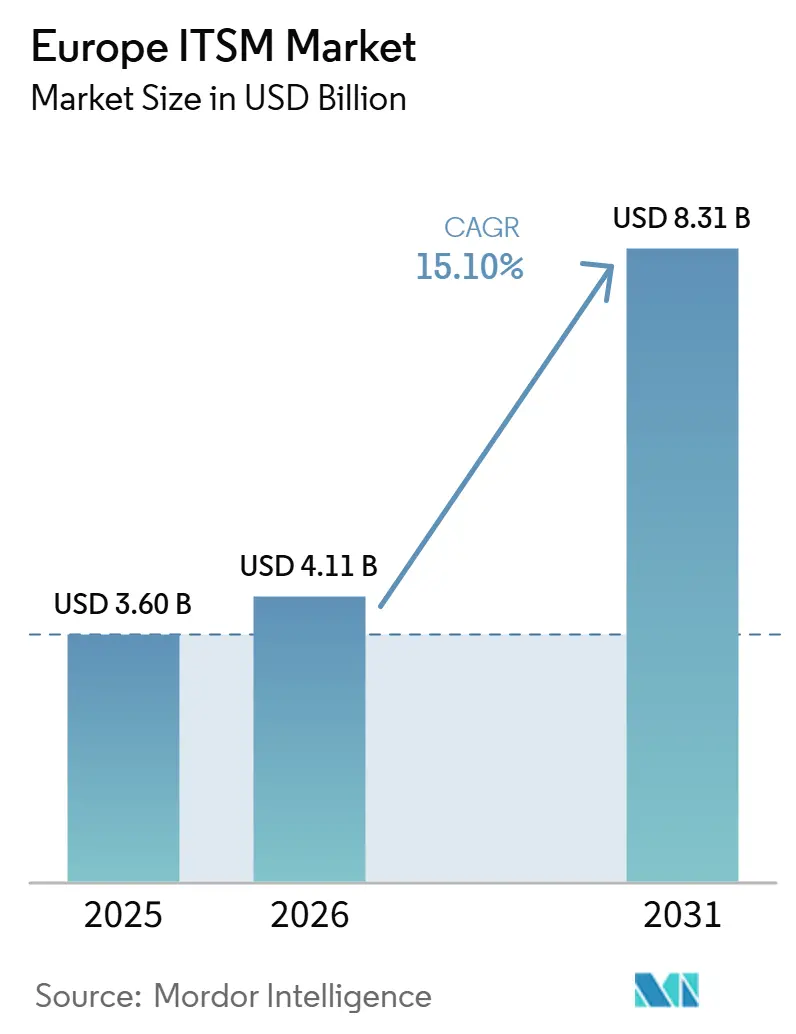
| Base Year Market Size (2025) | USD 3.60 Billion |
| Market Size (2026) | USD 4.11 Billion |
| Market Size (2031) | USD 8.31 Billion |
| Growth Rate (2026 - 2031) | 15.10 % |
| Market Concentration | Medium |
Major Players *Disclaimer: Major Players sorted in no particular order Image © Mordor Intelligence. Reuse requires attribution under CC BY 4.0. | |
Europe ITSM Market Analysis by Mordor Intelligence
The Europe IT service management market size is projected to be USD 3.60 billion in 2025, USD 4.11 billion in 2026, and reach USD 8.31 billion by 2031, growing at a CAGR of 15.10% from 2026 to 2031. The Europe IT service management market is moving into a phase where governed service workflows, auditability, and policy-based change control are becoming standard buying conditions rather than optional add-ons. Regulatory pressure is combining with sovereign cloud demand, which is pushing buyers to evaluate architecture, hosting jurisdiction, and traceability earlier in the purchase cycle. Legacy platform retirement also keeps the replacement cycle active, especially when older on-premises environments no longer meet current resilience and security expectations. Large cross-border enterprises are using the Europe IT service management market to standardize service operations across multiple countries, while AI-enabled self-service is improving the case for broader automation. A further opening is emerging around ESG-related operational reporting, where service platforms are increasingly expected to organize service, asset, and workflow data in a more usable form.
Key Report Takeaways
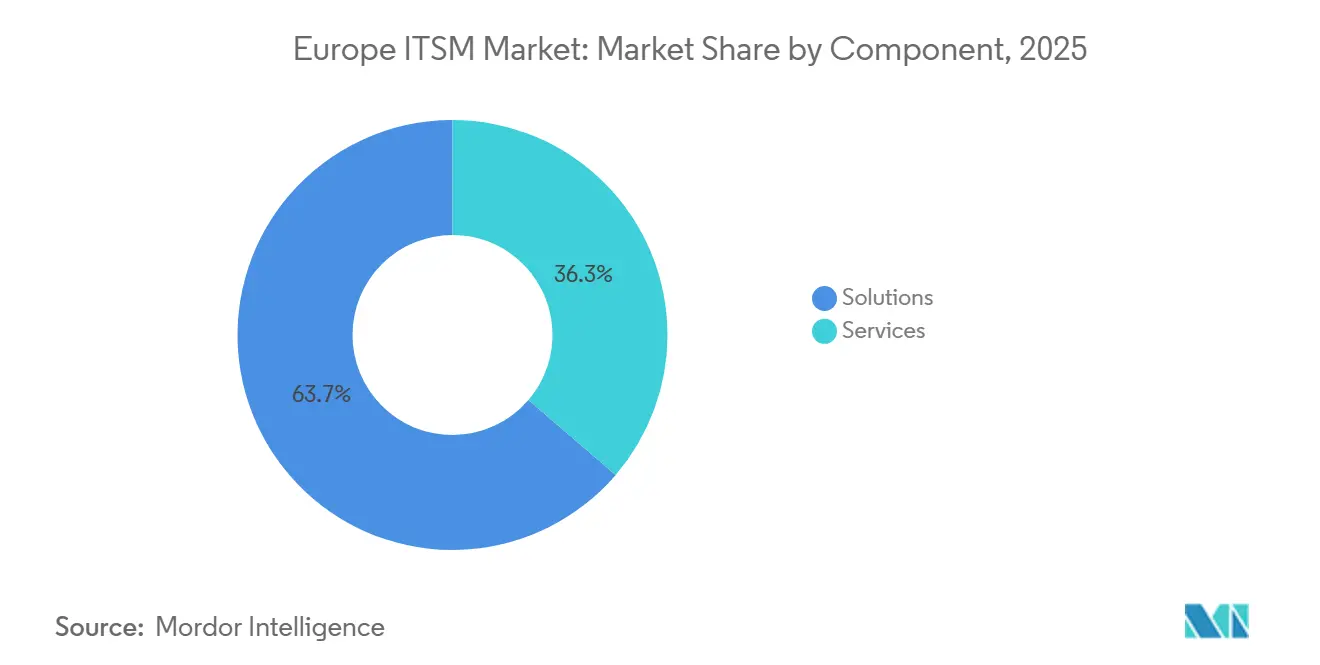
- By component, solutions held 63.72% of the Europe IT service management market in 2025, while the services segment remained the fastest-growing with 17.12% as CAGR as implementation and compliance-heavy deployments continued across the region.
- By deployment, cloud held a 58.63% share in 2025 and remained the fastest-growing with a CAGR of 16.87% of the Europe IT service management market, while on-premises and hybrid deployments continued to serve organizations managing sovereign data, conducting phased migrations, and maintaining highly customized legacy estates.
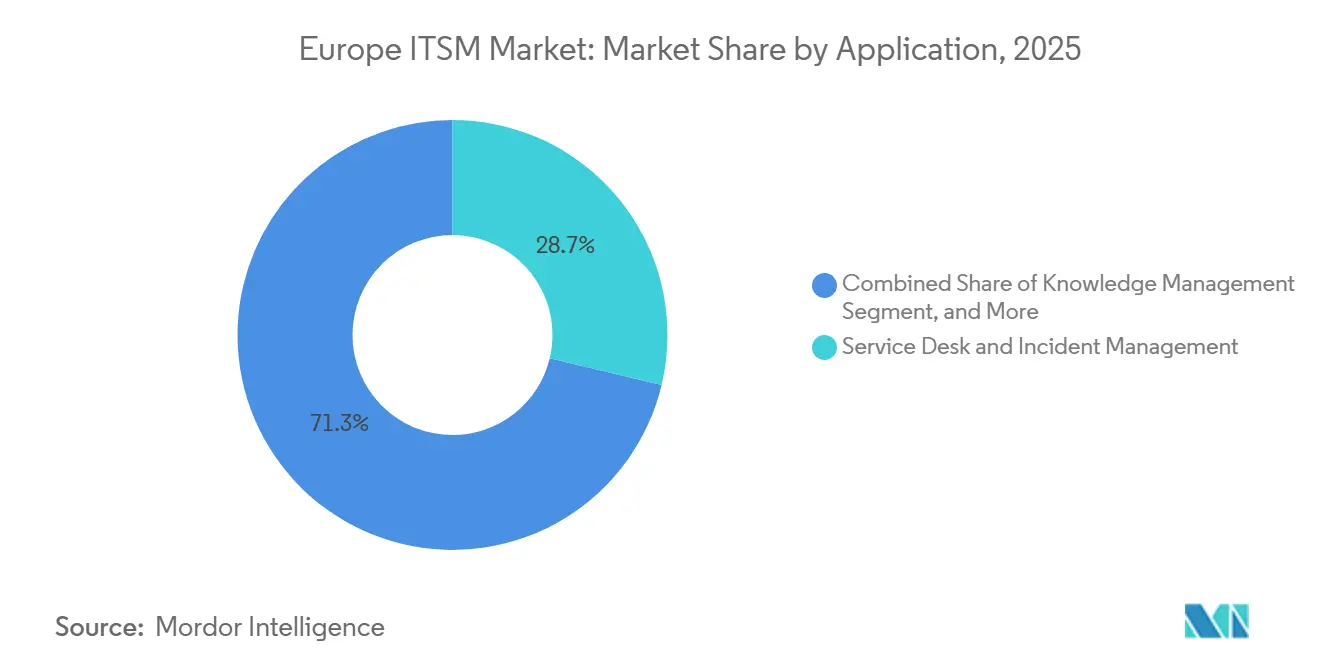
- By application, Service Desk and Incident Management remained the largest application by revenue share in 2025 with 28.73% of the Europe IT service management market, while Knowledge Management is projected to expand at a 16.34% CAGR through 2031.
- By end-user industry, BFSI remained the largest revenue contributor in 2025 with 24.62% of the Europe IT service management market, while healthcare is projected to expand at a 16.42% CAGR through 2031.
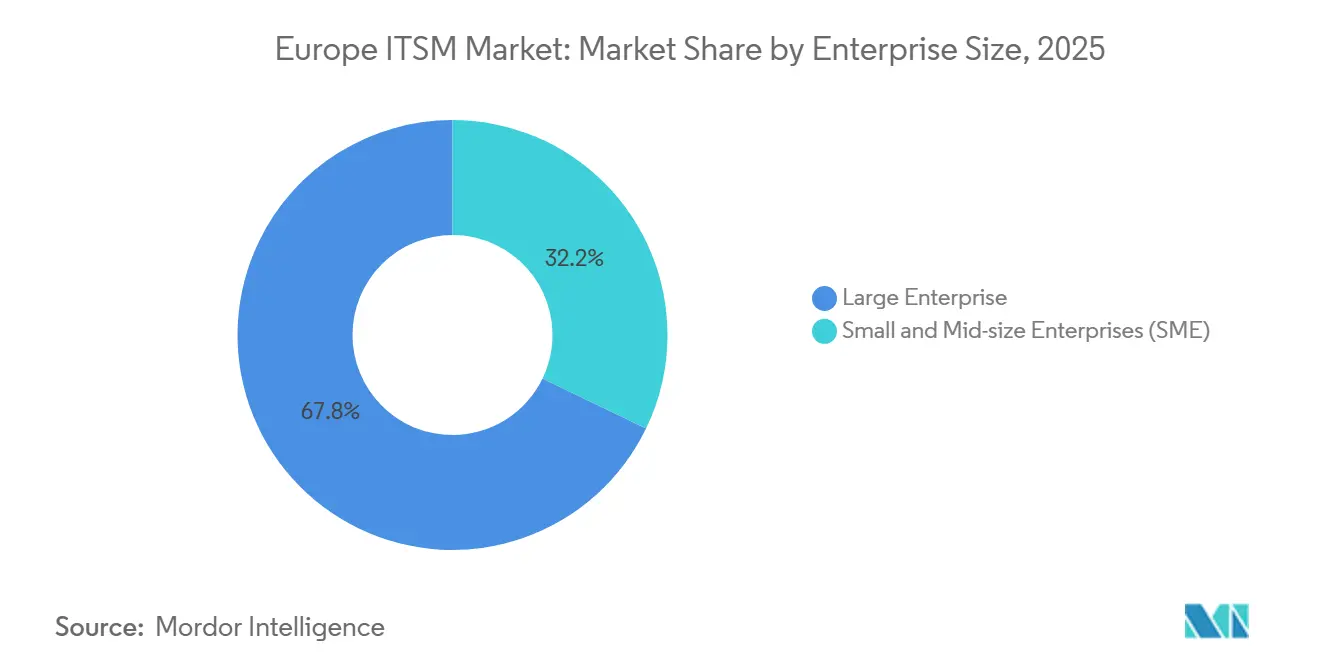
- By enterprise size, large enterprises remained the leading revenue base in 2025 with 67.83% of the Europe IT service management market, while SMEs are projected to expand at a 17.11% CAGR through 2031.
- By geography, Germany held 30.61% share in 2025 of the Europe IT service management market, while Spain remained the fastest-growing country market by 17.01% CAGR through the forecast period.
Note: Market size and forecast figures in this report are generated using Mordor Intelligence’s proprietary estimation framework, updated with the latest available data and insights as of January 2026.
Market Trends and Insights
Drivers Impact Analysis of Europe ITSM Market*
| Driver | (~) % Impact on CAGR Forecast | Geographic Relevance | Impact Timeline |
|---|---|---|---|
| Strong Compliance-Driven Adoption Of Governed IT Service Processes | +3.5% | EU-wide, with highest intensity in BFSI and critical infrastructure sectors across all 27 member states | Medium term (2-4 years) |
| Demand For Data Residency, Privacy, And Audit-Ready Service Platforms | +3.0% | EU-wide, with highest demand in Germany, France, and Nordic financial centers | Medium term (2-4 years) |
| Replacement Of Legacy On-Premise Service Desk Systems With Cloud Models | +2.5% | EU-wide, with early momentum in the UK, Germany, and Benelux | Short term (≤ 2 years) |
| Cross-Border Enterprise Standardization Across Multi-Country Operations | +1.8% | EU core markets and major industrial hubs including Germany, France, and Benelux | Medium term (2-4 years) |
| Rising Need For Self-Service And Employee Experience Platforms | +1.5% | Europe-wide, with early adoption in the UK, the Netherlands, and the Nordic countries | Short term (≤ 2 years) |
| Growing Emphasis On Green IT And Sustainable Operations Reporting | +0.8% | EU-wide, led by large companies already under early CSRD reporting requirements | Long term (≥ 4 years) |
| Source: Mordor Intelligence | |||
Compliance-Driven Adoption Reshapes ITSM As A Governance Infrastructure Layer
The Europe IT service management market is being shaped by a regulatory cycle that has moved service management closer to legal and operational governance. NIS2, DORA, GDPR, and related cyber and resilience rules are forcing organizations to treat incident workflows, evidence retention, and controlled changes as essential operating capabilities. ENISA noted that interactions among NIS2, DORA, and GDPR can create multiple breach notification regimes for the same incident, underscoring the value of a single system of record for service operations and control evidence.[1] ENISA Buyers are therefore favoring platforms that already align with ITIL process controls, and that can support audit preparation without parallel manual documentation. This matters most in BFSI and critical infrastructure, where service management decisions now carry direct compliance implications alongside operational ones. The result is that the Europe IT service management market is seeing demand that is tied less to convenience and more to regulatory readiness.
Data Residency And Privacy Mandates Drive Architectural Decisions In European ITSM Procurement
Data residency has become a design requirement in the Europe IT service management market, especially for enterprises that want to keep operational records, workflows, and service data under EU jurisdiction. Buyers are placing more weight on hosting location, key control, traceability, and portability, which is changing vendor selection before feature depth is even compared. ServiceNow on STACKIT reflects this shift because the offer is positioned around sovereign hosting under European legal and operational conditions rather than generic cloud access.[2] This means vendors with Europe-based infrastructure, strong audit support, and clearer jurisdictional positioning are entering procurement processes with an advantage that is difficult to replicate quickly. It also means global platforms face closer scrutiny when their architecture depends on broader global operating models. The Europe IT service management market is therefore rewarding regulatory architecture as much as workflow capability.
Legacy Platform Exits Create A Compressed Cloud Migration Wave Across European Enterprises
A major part of the current demand in the Europe IT service management market is coming from replacement rather than first-time adoption. Many organizations are reaching decision points at which older service desk systems can no longer justify continued support, pose security risks, or entail heavy customization overhead. This is making cloud migration more urgent, especially as enterprises seek AI capabilities, stronger automation, and faster release cycles without rebuilding their entire service architecture. The urgency is reinforced by vendor activity across the cloud segment, where platform providers are expanding AI-led workflow capabilities and making the cloud model the default path for future product development.[3] The effect on buying behavior is clear, evaluation periods are shortening, implementation priorities are becoming more focused, and buyers are giving more weight to migration speed and configuration fit. This replacement cycle is helping the Europe IT service management market sustain momentum even when broader enterprise budgets remain selective.
Cross-Border Enterprise Standardization Elevates ITSM To A Pan-European Operating Layer
Large organizations are using the Europe IT service management market to build more consistent operating models across national subsidiaries, business units, and support functions. Standardized workflows help these organizations measure service levels consistently, manage policy changes with less variation, and support internal audits without rebuilding evidence across countries. Atlassian reported a case in which a Swiss integrated healthcare network extended service management practices across IT, legal, people operations, and data governance functions, demonstrating how the platform role is expanding beyond the classic help desk.[4] This cross-functional standardization also extends to supplier ecosystems, as large buyers increasingly expect aligned service levels and governed processes from partners and contractors. That dynamic helps explain why smaller firms are entering the category even when they did not historically treat service management as a top software priority. The Europe IT service management market is therefore becoming a broader operational layer for enterprise coordination across Europe.
Restraints Impact Analysis of Europe ITSM Market*
| Restraint | (~) % Impact on CAGR Forecast | Geographic Relevance | Impact Timeline |
|---|---|---|---|
| Fragmented Regulatory And Procurement Requirements Across Countries | -2.8% | EU-wide, most acute in public sector and cross-border enterprise procurement across Southern and Eastern Europe | Medium term (2-4 years) |
| Data Sovereignty Constraints Limiting Vendor Architecture Choices | -2.2% | Germany, France, Austria, and Nordic countries where sovereignty compliance adds deployment cost and timeline friction | Long term (≥ 4 years) |
| Slower Budget Approvals In Public Sector And Traditional Enterprises | -1.5% | EU public sector, especially Southern and Eastern Europe with longer procurement cycles | Short term (≤ 2 years) |
| High Switching Costs From Mature Legacy IT Service Management Installations | -0.8% | EU-wide, most acute in large enterprises with deeply customized legacy installations | Long term (≥ 4 years) |
| Source: Mordor Intelligence | |||
Fragmented EU Regulatory And Procurement Environments Slow Vendor Expansion Cycles
The Europe IT service management market still faces a structural drag from the way regional rules are implemented and purchased at the country level. Even when a directive is shared across Europe, organizations still face national authorities, local interpretations, language requirements, and varying evidence expectations during implementation. ENISA highlighted that overlapping obligations under NIS2, DORA, and GDPR can create parallel notification and governance burdens, which add work before service workflows are fully configured and approved. This slows expansion for vendors that lack local references, country-specific support capability, and established procurement familiarity in multiple jurisdictions. Public entities add another layer of delay because formal tenders, qualification filters, and contract processes usually take longer than private purchases. As a result, the Europe IT service management market remains uneven across countries even when the underlying demand case is clear.
Data Sovereignty Compliance Adds Cost And Complexity To Cloud ITSM Architectures
Sovereignty requirements can support growth, but they also make delivery harder in the Europe IT service management market. Vendors often need region-specific infrastructure, local hosting arrangements, clearer control over encryption, and more explicit commitments regarding legal jurisdiction before they can serve large, regulated accounts. Sovereign deployment models, such as ServiceNow on STACKIT, show that market access increasingly depends on architectural choices that go beyond product functionality. These requirements raise delivery cost, lengthen solution design, and narrow the set of vendors that can credibly serve the most regulated customer groups at scale. Smaller providers can still compete, but many need partnerships to meet enterprise expectations in countries where sovereignty is a procurement threshold. This tension supports demand in the Europe IT service management market, while also slowing execution and limiting the pace of wider rollout.
*Our forecasts treat driver/restraint impacts as directional, not additive. The impact forecasts reflect baseline growth, mix effects, and variable interactions.
Europe ITSM Market Segment Analysis
By Component, Solutions Anchor Enterprise ITSM Platform Investments
Solutions accounted for 63.72% of the Europe IT service management market size in 2025, which showed that enterprises continued to prioritize platform spending over service-only engagements. This mix reflected the fact that buyers wanted durable workflow, automation, and governance capabilities built into the core environment rather than layered on afterward. The solutions position was also strengthened by the way modern platforms package AI, analytics, asset visibility, and knowledge tools into one operating model. In the Europe IT service management market, that combination makes the software layer the main driver of long-term account value. Buyers also preferred the flexibility of expanding modules over time instead of running large stand-alone consulting projects each time a process changed.
The services segment remained the fastest-growing with 17.12% as CAGR, as implementation and compliance-heavy deployments continued across the region. The services side mattered because many European deployments remain tied to regulation-heavy operating environments and cross-country process design. Enterprises still needed implementation support, change management, migration planning, and workflow tuning where local obligations or legacy complexity were high. This was especially relevant when organizations wanted to translate incident, change, and audit requirements into platform rules that internal teams could sustain after go-live. The Europe IT service management industry therefore continued to support a meaningful services ecosystem even as its revenue mix leaned toward software. The practical shift was not that services were becoming unimportant, it was that services were increasingly tied to faster deployment, migration support, and governance alignment instead of open-ended customization.
By Deployment, Cloud Cements Dominance As Legacy Infrastructure Ages Out
Cloud held 58.63% of the Europe IT service management market share in 2025, which confirmed that the deployment center of gravity had already shifted toward hosted and cloud-native models. The cloud lead came from both demand pull and supply push, because buyers wanted faster upgrades and AI features, while vendors increasingly built their newest capabilities for cloud environments first. In the Europe IT service management market, this made cloud the clearest route for organizations trying to modernize without carrying the full burden of legacy infrastructure refresh. It also fit buyers who wanted shorter deployment cycles and simpler access to connected modules over time. The cloud model has therefore moved beyond convenience and into the core of platform strategy.
On-premises deployments still played a real role, especially in government, industrial, and highly regulated environments, where control, historical customization, and political sensitivity remain important. Some enterprises still viewed local infrastructure as a safer path for critical service operations, especially when they had heavily tailored environments and long-established internal ownership models. Hybrid deployment also remained relevant during phased transitions, because many organizations were not in a position to replace every service workflow at once. The Europe IT service management market thus continued to support mixed estates, even as long-term strategic direction favored cloud. Hybrid often served as a bridge, not a final destination.
By Application, Knowledge Management Drives The Self-Service Value Inflection
Knowledge Management is projected to expand at a 16.34% CAGR through 2031, making it the fastest-growing application in the Europe IT service management market. The growth reflects a simple operational reality, every resolved issue can improve future answer quality when the knowledge layer is actively used and continuously updated. Buyers are treating this as more than a documentation function because a strong knowledge base now supports self-service, agent guidance, search quality, and faster issue containment. That changes the economics of support, especially when organizations want to reduce repetitive ticket volumes without reducing service quality. Knowledge Management is therefore becoming one of the most important scaling tools inside the Europe IT service management market.
Service Desk and Incident Management still remained the largest application by revenue share in 2025 because it sits at the center of daily service operations. Every enterprise still needs intake, prioritization, routing, and visibility around disruptions, which keeps this application category foundational even as adjacent workflows expand. The size of this base also means vendors typically win broader platform adoption by first strengthening their core incident and request environment. In the Europe IT service management market, the largest applications still anchor the commercial relationship, while faster-growing applications raise the depth of platform use. That mix supports both stability and expansion in vendor revenue.

By End-User Industry, Healthcare Outpaces All Verticals While BFSI Holds The Revenue Base
Healthcare is projected to expand at a 16.42% CAGR through 2031, making it the fastest-growing vertical in the Europe IT service management market. The demand comes from a wider digitization effort across hospitals and care systems that now extends beyond the help desk into onboarding, equipment coordination, operational service continuity, and governed support processes. Buyers in this segment are also under pressure to support more staff with fewer administrative delays, which makes structured workflows and self-service more valuable than before. Growth is therefore coming from practical operating needs as much as from broad digital modernization goals. In the Europe IT service management market, healthcare is moving from a secondary vertical into a more central demand engine.
BFSI still accounted for the largest revenue concentration in 2025 because financial institutions have high process maturity, stringent control expectations, and deeper experience with formal service governance. These organizations typically run larger IT estates, more layered change processes, and tighter evidence requirements than most other buyer groups. That combination supports higher platform depth and stronger demand for integrated workflow control. The Europe IT service management market therefore continues to depend on BFSI for a large part of its current revenue structure, even as faster expansion is now visible in other sectors. The stability of BFSI also gives vendors a strong reference base when selling governed service operations elsewhere.
By Enterprise Size, SMEs Emerge As The Fastest-Growing Buyer Segment
SMEs are projected to expand at a 17.11% CAGR through 2031, which makes them the fastest-growing enterprise size group in the Europe IT service management market. Their growth is notable because smaller organizations were historically less likely to invest early in formal service management platforms. That barrier is easing as cloud delivery lowers entry friction and as larger customers push more structured service expectations into their supplier networks. In practical terms, many SMEs are not adopting only because they want a better internal help desk, they are also adopting because they need process compatibility with bigger partners. This is helping the Europe IT service management market widen beyond its traditional large-enterprise core.
Large enterprises remained the dominant revenue base in 2025 because they support the largest user populations, the most mature process estates, and the broadest need for integrated service operations. These organizations often extend service management across HR, finance, facilities, and governance functions, thereby increasing account value even when growth rates are slower than those of smaller firms. Their installed complexity also means replacement projects can be large and multi-year. The Europe IT service management market still depends heavily on this group for total revenue, platform breadth, and large reference accounts.
Geography Analysis
Germany ITSM Market
Germany held 30.61% of the Europe IT service management market share in 2025, keeping it firmly ahead of the rest of the region by revenue. Its lead reflected the depth of its industrial base, the scale of enterprise IT operations, and the strong weight buyers place on operational control and jurisdictional clarity. Sovereign cloud positioning is especially relevant in Germany, where ServiceNow on STACKIT illustrates how cloud demand is being shaped by the need for European hosting and legal assurance rather than by generic hyperscale adoption alone. The Europe IT service management market in Germany, therefore, combines strong demand with stricter architectural expectations. That makes Germany both the largest revenue contributor and one of the most demanding environments for platform design.
United Kingdom and France ITSM Market
The United Kingdom remained close behind Germany in revenue terms, supported by financial services depth, broad enterprise digitization, and continued activity in public sector technology programs. The healthcare and public service environment also contributes to UK demand, as standardization efforts create space for larger service platform programs spanning multiple entities and user groups. National Services Scotland moved forward with an IT service management platform tender in 2025, which showed that public healthcare modernization remains an active demand source. France remained important as a regulated and service-intensive market, and vendor expansion into French-speaking Europe showed continued commercial interest in that buyer base. SysAid's partnership with EasyClic in France, Belgium, and Luxembourg reflected that opportunity in practical channel terms.
Broader European Markets
Spain remained the fastest-growing country market by CAGR in the regional forecast, which pointed to stronger momentum than its current revenue base would suggest. That momentum fits a broader pattern where modernization, shared service buildout, and multinational operating support are giving Southern Europe a larger role in future demand. The Europe IT service management market is also developing across the Nordics, Benelux, and Eastern Europe, although the pace and shape differ by local budget conditions and procurement maturity. Nordic markets stand out for early interest in automation and digital operating efficiency, while Benelux remains tied to service-intensive enterprise environments and financial activity. Eastern Europe is gaining relevance as nearshoring and shared service models expand, even if infrastructure and procurement capacity still lag the more mature Western markets. Taken together, the regional pattern shows that the Europe IT service management market is broadening geographically, while growth rates remain uneven across national markets.
Competitive Landscape
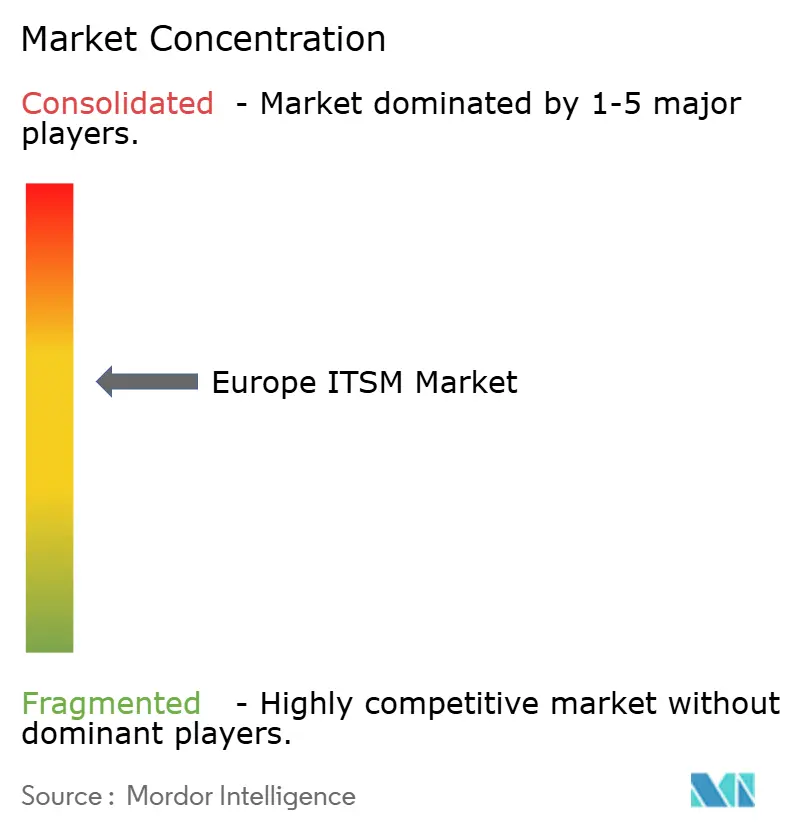
The Europe IT service management market remained moderately fragmented in 2025, with the top 5 vendors accounting for a notable share of cloud revenues and a large share of the remainder spread across regional specialists and focused challengers. ServiceNow, Atlassian, BMC Helix, Freshworks, and ManageEngine led the visible global platform set, but they did not control enough share to shut out local or category-specific competitors. That left room for European providers such as TOPdesk, EasyVista, SysAid, Matrix42, and others to remain relevant in mid-market and regulated accounts. The Europe IT service management market, therefore, rewarded scale while still leaving meaningful opportunities for vendors to address local operational and architectural requirements. The field was competitive because product breadth alone did not decide every deal.
The largest vendors continued to compete by widening the role of service management inside the enterprise. ServiceNow strengthened that position through its acquisition of Moveworks, completed in December 2025, and through its 2026 AI Control Tower positioning, both of which pushed the platform closer to an enterprise-wide orchestration role for AI and workflows. Atlassian took a different route, emphasizing a more modern, AI-native platform and reporting its largest-ever quarter of competitive displacements from a major ITSM provider in Q3 FY2026. These moves showed that the Europe IT service management market was not only a scale contest, it was also a contest over ease of adoption, pricing logic, and the future role of AI inside service operations. Buyers were therefore choosing between broader governance platforms and lighter, faster, developer-friendly alternatives.
Ownership and channel moves also shaped competition. Montagu's June 2026 agreement to acquire a majority stake in BMC Helix created an independently funded pure-play ServiceOps business, which signaled continued belief in focused platform specialization at a time when many buyers were still consolidating vendors. Freshworks expanded its European reach through Unisys and wider partner activity, while SysAid used EasyClic to deepen presence in French-speaking markets. EasyVista also continued to develop its platform with AI-led service interactions, which supported the case for regional players that can blend workflow depth with local relevance. The Europe IT service management market remained open enough for different competitive models to coexist, which is why regional, sovereign, and mid-market specialists still mattered alongside global leaders.
Europe ITSM Industry Leaders
-
ServiceNow, Inc.
-
IBM Corporation
-
BMC Software, Inc.
-
Atlassian Corporation Plc
-
Ivanti, Inc.
- *Disclaimer: Major Players sorted in no particular order
Europe ITSM Market Companies Covered in this Report
- ServiceNow, Inc.
- IBM Corporation
- BMC Software, Inc.
- Atlassian Corporation Plc
- Ivanti, Inc.
- Freshworks Inc.
- ManageEngine, a division of Zoho Corporation Pvt. Ltd.
- Broadcom Inc.
- Open Text Corporation
- Micro Focus International plc
- ASG Technologies Group, Inc.
- SysAid Technologies Ltd.
- Cherwell Software, LLC
- TOPdesk B.V.
- Hornbill Service Management Ltd.
- SymphonyAI Summit
- EasyVista S.A.
- SolarWinds Corporation
- Atlassian Corporation Plc
- Axelos Limited
Recent Industry Developments in Europe ITSM Market
- June 2026: Montagu, a mid-market private equity firm based in London, agreed to acquire a majority stake in BMC Helix in a carve-out transaction from KKR-owned BMC Software, creating an independently funded, pure-play agentic AI ServiceOps company. The transaction allows BMC to focus on its core automation business while Helix accelerates AI innovation targeting enterprise IT operations, KKR retains a minority stake in Helix.
- May 2026: ServiceNow unveiled its AI Control Tower expansion, Autonomous Workforce, and Context Engine at Knowledge 2026, positioning the platform as a unified governance layer for all AI agents across enterprise functions. The Context Engine fuses ServiceNow's CMDB, Knowledge Graph, and the Armis cyber asset graph into a single intelligence substrate, enabling AI agents to reason across operational, identity, and asset data simultaneously.
- May 2026: Atlassian reported its largest-ever quarter for competitive displacements from a major ITSM provider at its Q3 FY2026 earnings, with quarterly revenue of USD 1.8 billion, up 32% year over year, significantly outpacing competitive growth rates. CEO Mike Cannon-Brookes attributed the gains to customers choosing Atlassian's "more modern, AI-native" platform over legacy ITSM systems.
- May 2026: Freshworks unveiled AI Agent Studio in Freshservice, enabling organizations to build, customize, and deploy AI agents in weeks. The update integrates AI-native workflows into Freshservice's unified ITSM, asset management, and operations management platform, extending automated resolution capabilities across enterprise service functions.
Europe ITSM Market Report Scope
The Europe IT Service Management Market is Segmented by Component (Solutions, Services), Deployment (Cloud, On-Premise, Hybrid), Application (Service Desk and Incident Management, Asset and Configuration Management, Change and Release Management, Service Request Management, Knowledge Management, Others), End-User Industry (BFSI, Manufacturing, Government and Public Sector, IT and Telecommunications, Retail and E-Commerce, Healthcare, Others), Enterprise Size (Large Enterprises, SME), and Country (Germany, UK, France, Russia, Spain, Others). The Market Forecasts are Provided in Terms of Value (USD).
Segmentation Overview
| Solutions |
| Services |
| Cloud |
| On-Premise |
| Hybrid |
| Service Desk and Incident Management |
| Asset and Configuration Management |
| Change and Release Management |
| Service Request Management |
| Knowledge Management |
| Other ITSM Applications |
| BFSI |
| Manufacturing |
| Government and Public Sector |
| IT and Telecommunications |
| Retail and E-Commerce |
| Healthcare |
| Travel and Hospitality |
| Other End-User Industries |
| Large Enterprises |
| Small and Mid-Size Enterprises (SME) |
| Germany |
| United Kingdom |
| France |
| Russia |
| Spain |
| Rest of Europe |
| By Component | Solutions |
| Services | |
| By Deployment | Cloud |
| On-Premise | |
| Hybrid | |
| By Application | Service Desk and Incident Management |
| Asset and Configuration Management | |
| Change and Release Management | |
| Service Request Management | |
| Knowledge Management | |
| Other ITSM Applications | |
| By End-User Industry | BFSI |
| Manufacturing | |
| Government and Public Sector | |
| IT and Telecommunications | |
| Retail and E-Commerce | |
| Healthcare | |
| Travel and Hospitality | |
| Other End-User Industries | |
| By Enterprise Size | Large Enterprises |
| Small and Mid-Size Enterprises (SME) | |
| By Country | Germany |
| United Kingdom | |
| France | |
| Russia | |
| Spain | |
| Rest of Europe |
Key Questions Answered in the Report
What is the Europe IT service management (ITSM) market size in 2026?
The Europe IT service management market size stands at USD 4.11 billion in 2026 and is forecast to reach USD 8.31 billion by 2031 at a 15.10% CAGR.
Which deployment model leads across Europe?
Cloud leads with 58.63% share in 2025, supported by faster modernization cycles and stronger alignment with AI-led platform roadmaps.
Which application is growing the fastest?
Knowledge Management is the fastest-growing application, with a 16.34% CAGR through 2031, as self-service and AI-based retrieval become more important.
Which end-user group is expanding the quickest?
Healthcare is the fastest-growing end-user vertical, with a 16.42% CAGR through 2031, while BFSI remains the largest revenue base.
Why are SMEs becoming more important buyers?
SMEs are projected to grow at a 17.11% CAGR because cloud delivery lowers entry barriers and large enterprises increasingly expect structured service processes from suppliers.