
South America Electric Vehicle (EV) Fluids Market Size and Share
Market Overview
| Study Period | 2020 - 2031 |
|---|---|
| Forecast Data Period | 2026 - 2031 |
| Historical Data Period | 2020 - 2024 |
| Growth Rate | 20.74 % |
| Market Concentration | Medium |
Major Players_Fluids_Market-Major_Players.webp) *Disclaimer: Major Players sorted in no particular order Image © Mordor Intelligence. Reuse requires attribution under CC BY 4.0. | |
South America Electric Vehicle (EV) Fluids Market Analysis by Mordor Intelligence
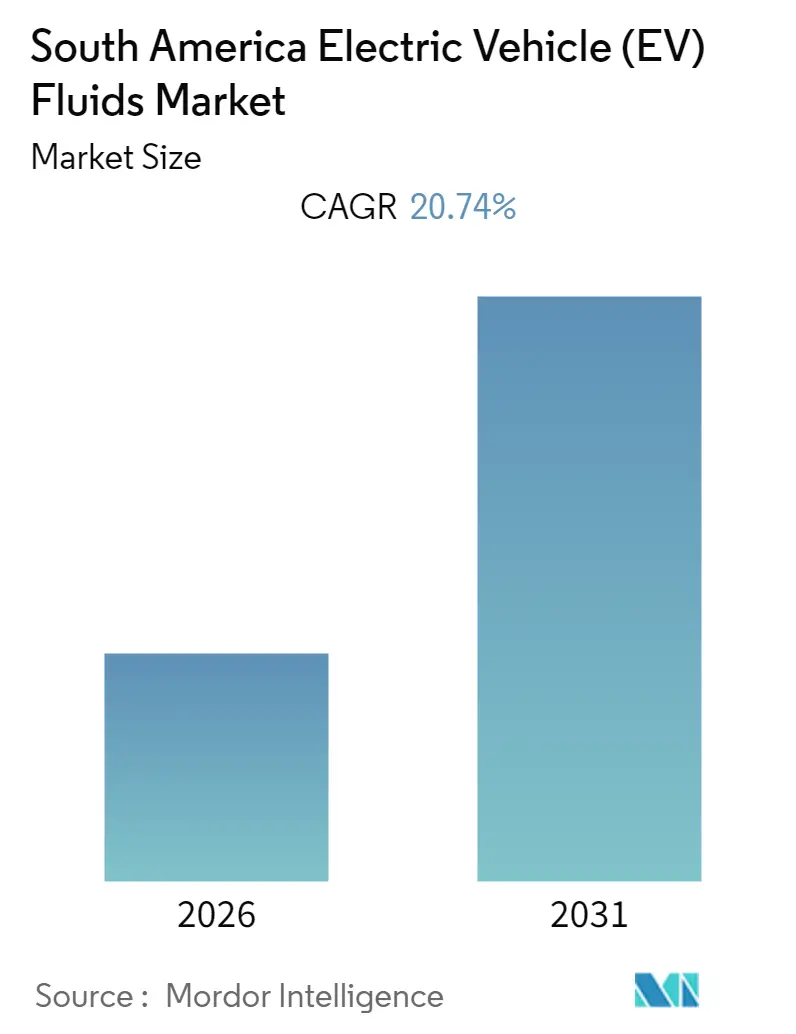
The South America Electric Vehicle (EV) Fluids Market size is expected to grow from USD 219.3 million in 2025 to USD 264.78 million in 2026 and is forecast to reach USD 679.1 million by 2031 at 20.74% CAGR over 2026-2031.
The market was hampered by the COVID-19 pandemic, as lockdowns, social distances, and trade sanctions triggered massive disruptions to global supply chain networks. The automotive industry, including sales and manufacturing of electric vehicles,witnessed a decline due to the halt in activities. However, the condition was expected to recover in 2021, which could benefit the market during the forecast period.
- Major factors driving the South America electric vehicle (EV) fluids market studied are the increasing demand for electric vehicles among consumers in Brazil.
- The high cost of purchasing an electric vehicle is expected to hinder the growth of the South America electric vehicle (EV) fluids market.
- Increasing government initiatives to promote the sale of EVs is likely to act as an opportunity in the future.
Note: Market size and forecast figures in this report are generated using Mordor Intelligence’s proprietary estimation framework, updated with the latest available data and insights as of 2026.
Proportional positioning is established by comparing regional contributions against the global total, including that of South america. The electric vehicle (ev) fluids market share in our global report expresses these relative weights.
South America Electric Vehicle (EV) Fluids Market Trends and Insights
Hybrid Electric Vehicles Propulsion Type Segment to Dominate the Market
- A hybrid electric vehicle is a type of vehicle that combines a conventional internal combustion engine system with an electric propulsion system. According to the Society of Automotive Engineers, a hybrid vehicle can be defined as a vehicle with two or more energy storage systems.
- In 2021, all major vehicle markets in the region reported an increase in the sales of Electric Vehicle (EV), which was expected to continue at a faster pace in the coming years. By 2030, the sales of hybrid electric vehicles in the region are expected to reach 488.9 thousand units, followed by 405.2 thousand units sale of plug-in hybrid electric vehicles, and 123.7 thousand units sale of battery electric vehicles.
- There is an expectation of commercialization of approximately 1 million electrified vehicles in the South America region and the total electrified vehicles in operation are expected to be 5.4 million by 2030.
- According to the local business association, Andi, and the federal merchants association, Fenalco, in 2021, EV sales in Colombia increased by 60%. Moreover, the combined sales of EVs and hybrids (HEV) also increased significantly jumping almost 200% to around 18,000 units.
- In 2021, the sales in Argentina doubled when compared to the value of the previous year. The country sold nearly 5,900 units of electric and hybrid vehicles. During the first six months of 2022, 140,049 of total vehicles were sold in Argentina, out of which 3,371 vehicle sales were HEVs.
- Therefore, all the aforementioned pointers are expected to grow the demand for coolants product type of EV fluids over the forecast period.
Brazil to Dominate the Market
- Brazil is expected to dominate the electric vehicle (EV) fluids market in the South America region due to the increasing demand for electric vehicles in the country. Due to the environmental, social, and governance (ESG) agenda of green logistics followed by Brazil, there is a significant growth in the sales of electric vehicles in the country.
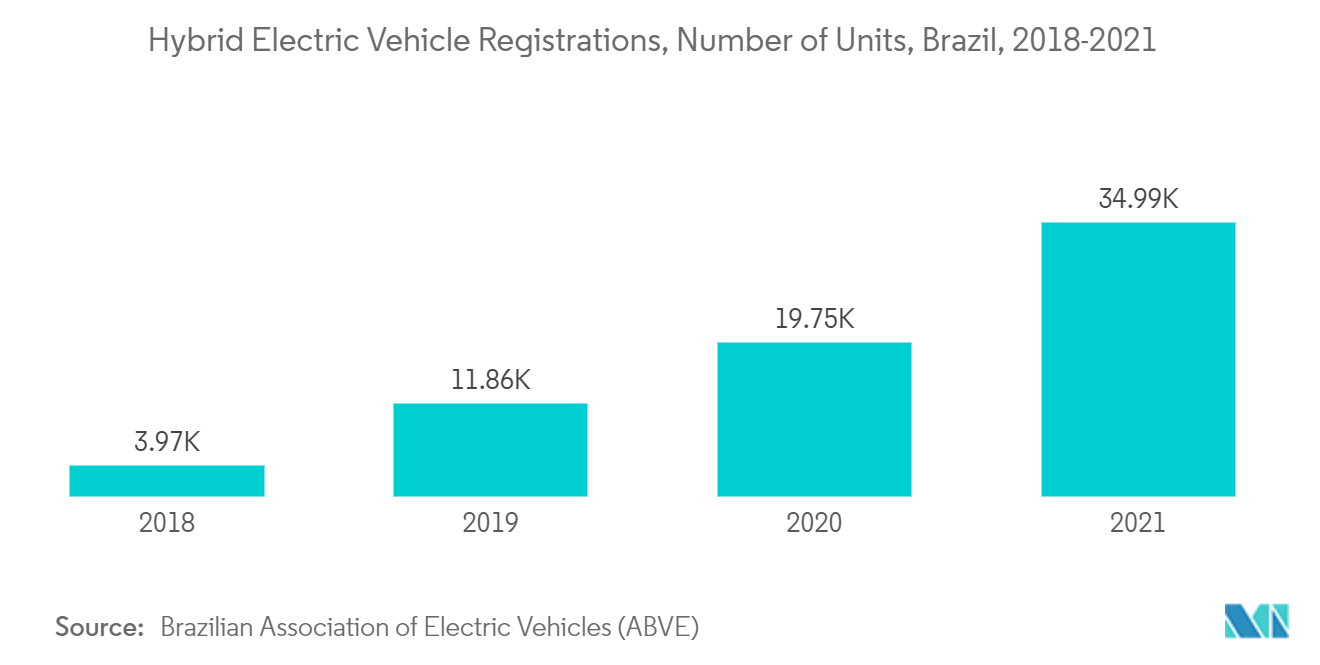
- The National Association of Motor Vehicle Manufacturers' statistics report indicates that in 2021, sales of hybrid electric vehicles in Brazil skyrocketed and reached nearly 35 thousand units, an increase of 77% over the previous year.
- According to a study commissioned by GM South America, Brazil follows the global trend of a continuous increase in the adoption of zero-emission technology, and is expected to reach 5.5 million electric vehicles by 2035.
- The biggest boost to the development of electric mobility comes from the Rota 2030 plan. Through this program, the Brazilian government promotes the development of R&D projects in the automotive sector, encourages the transition to sustainable mobility, and provides incentives to both companies and vehicle owners to promote the growth of the sector.
- Due to the policies under Rota 2030, more and more companies and individuals are turning to electric vehicles. Data obtained for 2021 shows that more than 7,000 new electric vehicles were registered in the January-April period alone, and the year represents the highest number of electric car sales ever recorded.
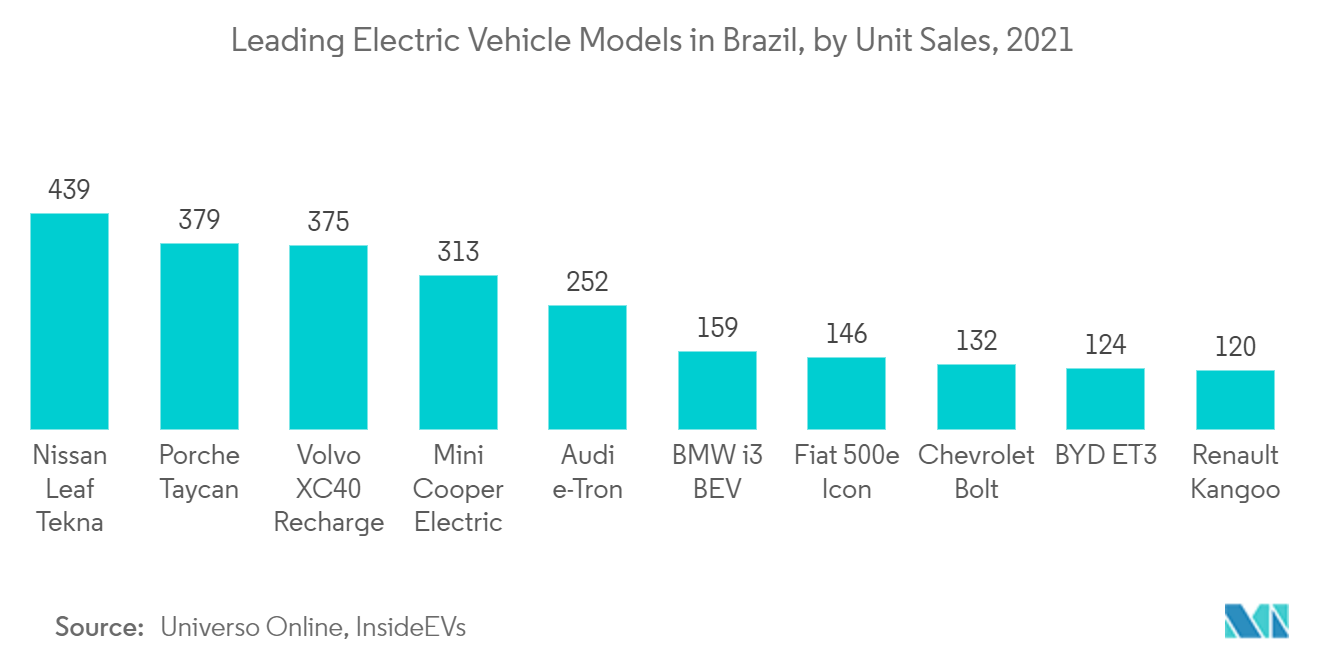
- In 2021, Nissan and Porsche dominated the electric vehicle sales in Brazil. Nissan sold 439 units of the Leaf Tekna in South American countries, whereas Porsche sold around 379 units of its Taycan model in the same period.
- In 2021, the Brazilian market witnessed a growth in the sales of electric vehicles. According to the Brazilian Association of Electric Vehicles (ABVE), 34,990 units were sold, and 79,800 cars were in circulation. In 2022, the Brazilian automotive sector reached 100 thousand electrified cars on the streets.
- All the aforementioned factors contribute to the growth of hybrid electric vehicles, which further drives the South America electric vehicle (EV) fluids market over the forecast period.
Value Chain Analysis
EV fluids in South America flow from upstream base oils and additives (including thermal-management chemistries such as low-conductivity coolants and dielectric fluids) into blending and packaging by multinational and regional lubricant players, then into OEM first-fill, dealer channels, and the independent aftermarket. Global suppliers such as Shell and Valvoline participate through dedicated EV fluids portfolios and local distribution partnerships, while product validation increasingly centers on thermal-management performance for batteries, e-motors, and power electronics rather than legacy ICE wear protection.
Downstream, demand formation is closely tied to Brazil-led electrification momentum and the build-out of charging and fleet infrastructure, which expands service points that specify coolants, transmission fluids, and greases for electrified drivetrains. New infrastructure models (for example, battery-swapping networks referenced in Brazil) reinforce the need for standardized modules and repeatable thermal-management practices, strengthening the role of technical service, OEM approvals, and training across workshops and fleet maintainers as part of the value chain.
Competitive Landscape
The South America electric vehicle (EV) fluids market is partially consolidated in nature. The major companies include Shell plc, Valvoline Global Operations, TotalEnergies, Exxon Mobil Corporation, and CASTROL LIMITED, among others.
South America Electric Vehicle (EV) Fluids Industry Leaders
-
Shell plc
-
Valvoline Global Operations
-
TotalEnergies
-
Exxon Mobil Corporation
-
CASTROL LIMITED
- *Disclaimer: Major Players sorted in no particular order
_Fluids_Market-Market_Concentration.webp)
Market Opportunities and Future Outlook
Shell is testing dielectric thermal fluids for battery immersion cooling as an alternative to water-ethylene-glycol, highlighted by the Triple 10 Challenge demonstration in June 2026, signaling active product development that can translate into OEM and fleet qualification work across Brazil and neighboring markets. The broader charging-infrastructure expansion signals growing needs for advanced thermal management near battery systems and charging sites, as evidenced by industry collaborations to accelerate fast-charging deployment in Brazil.
Valvoline Brazil, via the Usiquimica Group, is pursuing premium EV fluids with a 2026 target of 5% market share and 38 million liters in sales, indicating intensified competitive activity in Brazil for EV-specific coolants and driveline fluids across workshops and fleets. The expansion of go-to-market localization and channel scale-up by established lubricant brands reinforces the availability of EV-specific credentials, certifications, and technical support necessary for OEM fills and aftermarket service.
Recent Industry Developments
- July 2026: Tirreno Moove launched the first EV-battery coolant developed with 100% national technology in Brazil at Conecta Oficina Brasil 2026. The move introduces a direct EV fluids product in the South America market. It strengthens regional value-chain localization for battery cooling fluids.
- July 2026: GAC Energy announced strategic partnership with GreenV and 99 to build a fast-charging ecosystem in Brazil. The collaboration supports the expansion of charging infrastructure across South America. It raises potential demand for cooling and related fluids in charging equipment ecosystems in Brazil.
- June 2026: Castrol Limited launched Castrol ON EV Transmission Fluid W3 for wet e-motors. The product targets EV specific transmission lubrication with regional aftermarket and OEM relevance. The launch expands availability of EV specific lubricant solutions and may influence South America market adoption of OEM approved fluids.
Research Methodology Framework and Report Scope
Market Definition and Coverage
This market covers the demand value of specialized fluids used in electric vehicles across South America, counted at the point of sale into the local automotive fluid channel and aligned to the in-use EV parc and new EV registrations.
Scope exclusions: It does not include conventional internal combustion engine lubricants used only in non-electrified vehicles, and it also excludes workshop labor or service revenues.
Segmentation Overview
- Product Type
- Engine oil
- Coolants
- Transmission Fluids
- Greases
- Other Product Types
- Propulsion Type
- Battery Electric Vehicles (BEVs)
- Hybrid Electric Vehicles (HEVs)
- Plug-in Hybrid Electric Vehicles (PHEVs)
- Vehicle Type
- Passenger Vehicle
- Commercial Vehicles
- Other Vehicle Types
- Geography
- Brazil
- Argentina
- Rest of South America
Data Sources, Market Sizing, and Validation
Desk Research
Desk research was used to set the outer limits of the model, before assumptions were added. We relied on public EV registration and fleet signals, trade and production statistics, and technical references that explain where fluids are actually used in EV systems.
Typical inputs came from sources such as national transport and vehicle registration authorities in key South American countries, customs and trade statistics portals, energy and environment agencies tracking electrification policy, and standards bodies plus SAE technical papers describing EV thermal management needs. We also used company annual reports, investor presentations, and credible press coverage to capture product launches and channel footprint changes, then supported this with paid subscriptions that provide company financials and patent activity, plus shipment-level import and export visibility for relevant fluid categories. The desk sources listed here are illustrative only, and many other public documents and databases were reviewed to validate figures and clarify assumptions.
Primary Interviews and Surveys
We conduct interviews and surveys with fluid formulators, vehicle and component specialists, distributors, service operators, fleet representatives, and policy or technical experts across South America. Their input clarifies EV parc growth, fill volumes, replacement timing, product availability, local pricing, and factory-fill versus service demand. These checks help close public-data gaps and triangulate the final estimate.
Distribution of primary research fieldwork respondents
| Company type | Respondent position |
|---|---|
| Top tier: 30% | CXOs: 15% |
| Mid tier: 45% | Functional/Unit leaders: 35% |
| Smaller Players: 25% | Managers: 50% |
Market-Sizing & Forecasting
Sizing starts from a top-down demand pool that is rebuilt using South America EV parc by propulsion type, new sales by vehicle type, and expected fluid touchpoints across coolant loops, driveline fluids, greases, and brake fluids. Once the vehicle base is constructed, average fluid fill volumes and service intervals are applied. The resulting volumes are translated to value using country-level average selling price ranges that reflect import mix, base-oil trends, and additive intensity.
To keep totals realistic, we corroborated the model with selective bottom-up checks, such as rolling up a sample of supplier and distributor revenues, sanity-checking channel markups, and testing volume outputs against import patterns for comparable fluid categories. Where bottom-up visibility was thin for smaller markets in the Rest of South America, gaps were handled by using proxy penetration rates from similar duty cycles, then tightening them through interview feedback.
For forecasting, we used scenario analysis because growth depends on policy support, charging buildout, and model availability, which can change faster than a smooth time series. Key forecast inputs included EV sales growth by country, battery cooling system adoption rates (liquid versus simpler solutions), changes in recommended drain intervals, local currency movement against the US dollar for imported fluids, and expected shifts toward higher performance chemistries.
Data Validation & Update Cycle
Outputs are validated through several checks so obvious mismatches are caught early. We compare demand implied by the EV parc and service behavior against independent signals such as EV sales trends, trade flows for relevant fluid categories, and price movement patterns. Country-level outliers are reviewed before sign-off.
A second analyst reviews assumptions, unit conversions, and year-to-year growth steps. Respondents are re-contacted if a key variable changes materially, or if a country result looks inconsistent with the adoption story. Reports are refreshed annually, and interim updates are triggered when major policy changes, supply disruptions, or large platform launches can shift the near-term outlook. Before delivery, a final pass is completed so clients receive the most recent view.
Mordor Intelligence's South America Electric Vehicle Fluids Market Size Measured Against Other Published Estimates
Published market sizes for South America EV fluids can differ sharply because studies often count different fluid baskets, use different timing for EV parc updates, or apply unlike price assumptions for imported versus locally blended products. Even a small change in drain interval logic or the share of liquid-cooled packs can move the outcome meaningfully when the EV base is still expanding.
Some estimates bundle broader automotive lubricant and service revenue pools, which pushes the total up quickly. Mordor Intelligence counts only the fluid categories directly consumed by electric vehicles and limits the value build to fluid volumes and realistic average selling prices that are cross-checked with trade signals and interview-led service behavior.
Benchmark comparison
| Source | Market Size | Gaps in Research Methodology |
|---|---|---|
| Mordor Intelligence | USD 219.30 M (2025) | |
| Industry Portal A | USD 310.00 M (2025) | Uses a broader definition that appears to include adjacent conventional automotive lubricants and workshop-related revenue, and it does not clearly separate EV-only consumption from general vehicle fluids. |
| Trade Journal B | USD 170.00 M (2026) | Applies conservative EV penetration and shorter coverage of vehicle types, and it likely relies on a narrow set of fluids, which reduces the implied per-vehicle fluid requirement and undercounts replacement demand. |
The spread in the table is mainly explained by what gets counted and how quickly the EV parc and service cycles are refreshed in the model. By keeping the calculation tied to EV parc, fill and replacement volumes, and country price ranges that can be rechecked, the estimate stays transparent and repeatable even when adoption is changing fast.
Key Questions Answered in the Report
What is the current South America Electric Vehicle (EV) Fluids Market size?
The South America Electric Vehicle (EV) Fluids Market is projected to register a CAGR of 20.74% during the forecast period (2026-2031)
Who are the key players in South America Electric Vehicle (EV) Fluids Market?
Shell plc, Valvoline Global Operations, TotalEnergies, Exxon Mobil Corporation and CASTROL LIMITED are the major companies operating in the South America Electric Vehicle (EV) Fluids Market.
What years does this South America Electric Vehicle (EV) Fluids Market cover?
The report covers the South America Electric Vehicle (EV) Fluids Market historical market size for years: 2019, 2020, 2021, 2022, 2023, 2024 and 2025. The report also forecasts the Electric Vehicle (EV) Fluids Market size for years: 2026, 2027, 2028, 2029, 2030 and 2031.