
Market Overview
| Study Period | 2021 - 2031 |
|---|---|
| Forecast Data Period | 2026 - 2031 |
| Base Year Market Size (2025) | 261.33 Million liters |
| Market Volume (2026) | 269.69 Million liters |
| Market Volume (2031) | 315.69 Million liters |
| Growth Rate (2026 - 2031) | 3.20 % |
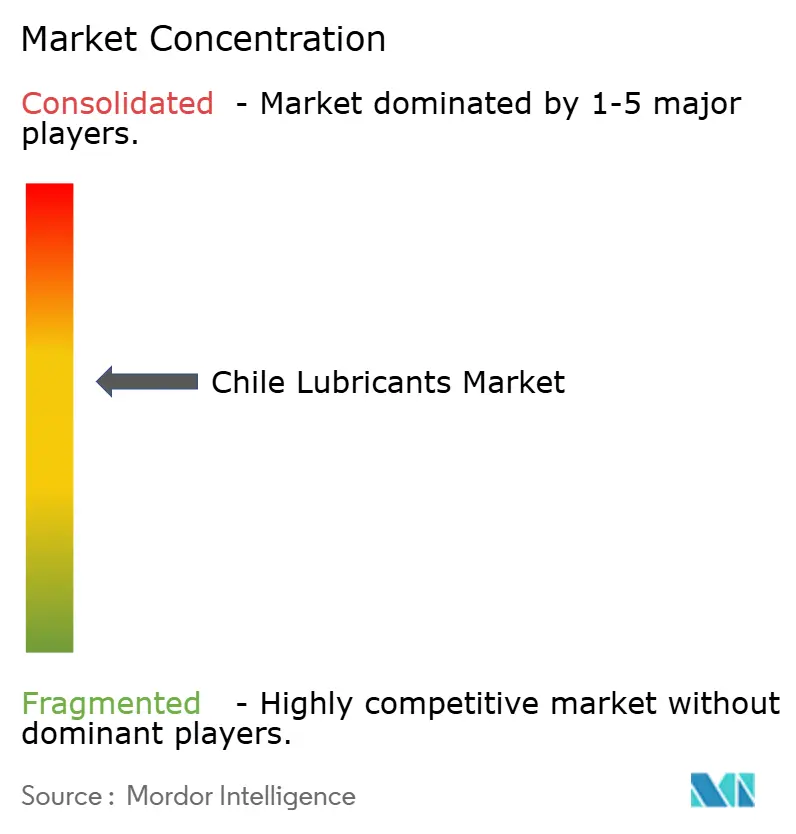
| Market Concentration | Medium |
Major Players *Disclaimer: Major Players sorted in no particular order Image © Mordor Intelligence. Reuse requires attribution under CC BY 4.0. | |
Chile Lubricants Market Analysis by Mordor Intelligence
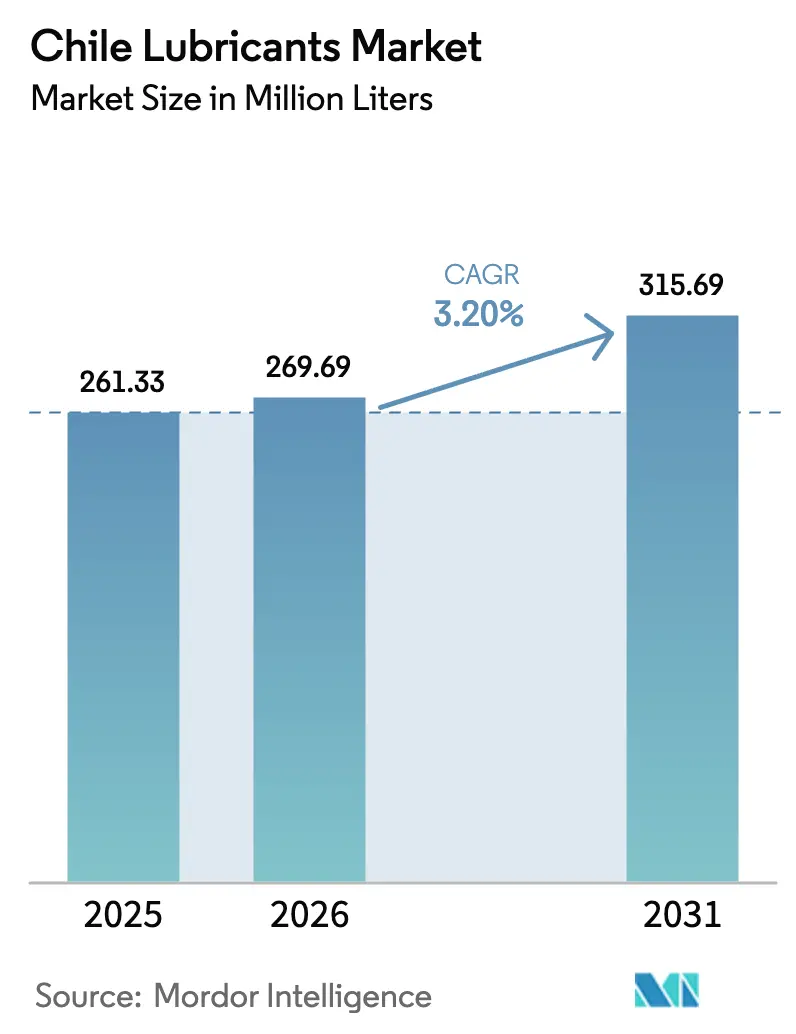
The Chile Lubricants Market size was valued at 261.33 million liters in 2025 and is estimated to grow from 269.69 million liters in 2026 to reach 315.69 million liters by 2031, at a CAGR of 3.20% during the forecast period (2026-2031). This tempered headline growth conceals a deeper transition. Electrification across copper mining and public transport, tighter sulfur caps in fuel, and Law 20.920’s extended-producer-responsibility (EPR) rules are reshaping formulations, pushing demand toward premium synthetics and bio-based blends even as longer drain intervals curb volume turnover. With imported base oils constituting nearly all of the supply, fluctuations in the peso and shifts in freight rates can significantly impact landed-cost spreads and influence stocking choices. Engine oil remains the dominant segment. However, this supremacy is being tempered by the rapid rise of niche segments, including specialty greases tailored for battery-electric haul-truck drivetrains and biodegradable hydraulic fluids designed for underground mining. The competitive landscape is fierce: Empresas Copec, harnessing Mobil-branded products and its Quintero blending plant, commands a notable market share. Meanwhile, Enex is expanding its footprint with service stations and Shell Oil Change centers, bolstering its national presence.
Key Report Takeaways
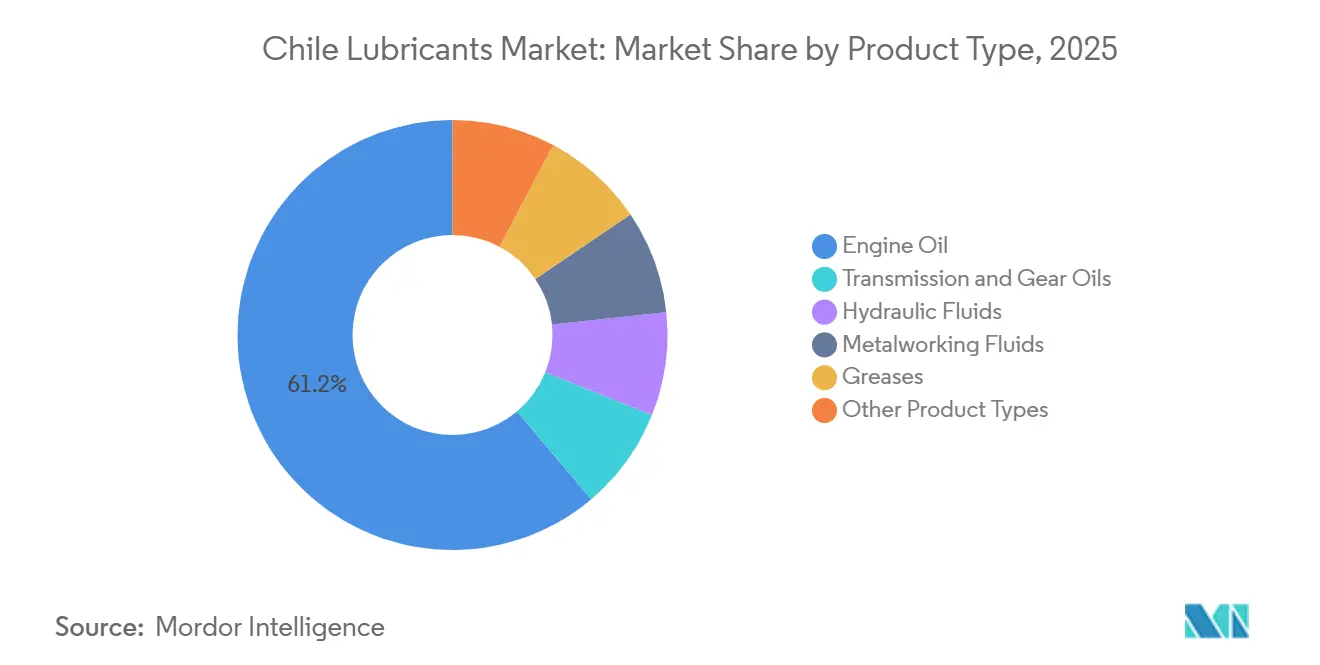
- By product type, engine oil accounted for a 61.16% share of the Chile lubricants market in 2025 and is expected to expand at a 4.80% CAGR through 2031.
- By end-user, the automotive sector held 82.08% of the Chile lubricants market share in 2025, while power generation is projected to post the fastest CAGR at 5.10% through 2031.
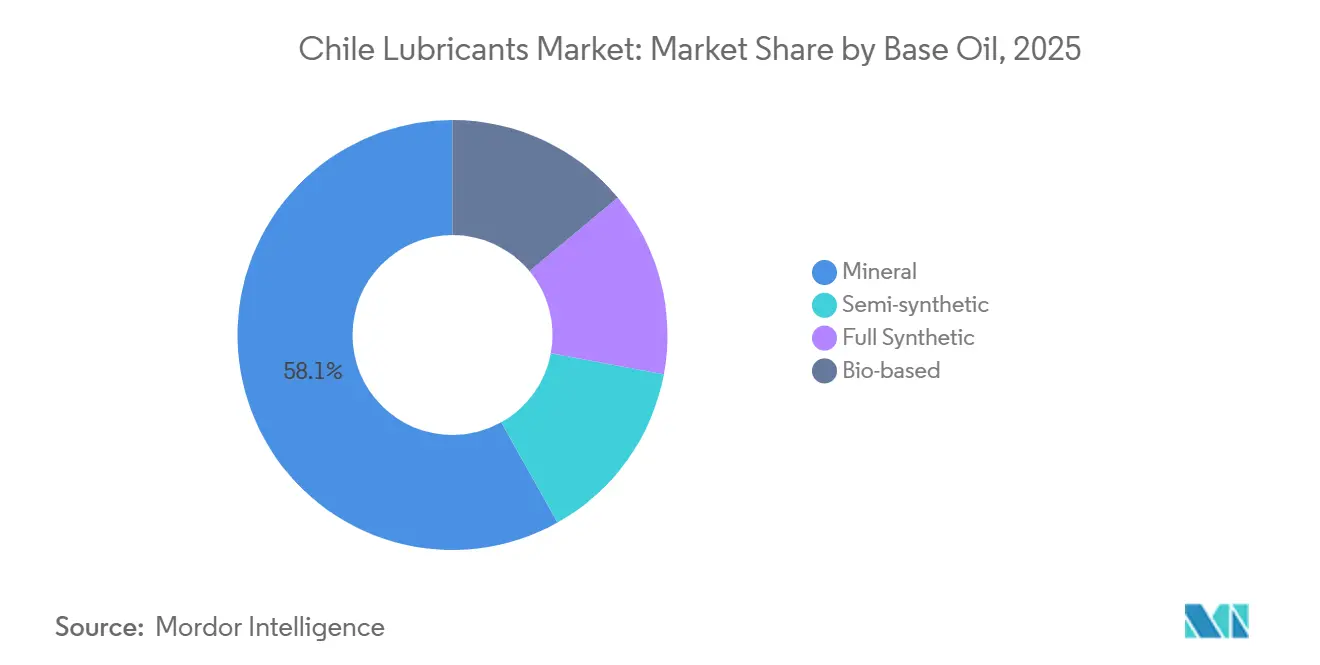
- By base oil, mineral grades captured 58.12% of the Chile lubricants market size in 2025, whereas bio-based formulations are forecast to advance at a 6.41% CAGR to 2031.
Note: Market size and forecast figures in this report are generated using Mordor Intelligence’s proprietary estimation framework, updated with the latest available data and insights as of January 2026.
Chile Lubricants Market Trends and Insights
Drivers Impact Analysis*
| Drivers | (~) % Impact on CAGR Forecast | Geographic Relevance | Impact Timeline |
|---|---|---|---|
| Surge in mining-equipment lubricant demand | +1.2% | Antofagasta, Atacama, Coquimbo | Long term (≥ 4 years) |
| Growing automotive-aftermarket volumes | +0.8% | Santiago, Valparaíso, Concepción | Medium term (2–4 years) |
| Expansion of copper-processing capacity | +0.6% | Antofagasta, O’Higgins | Long term (≥ 4 years) |
| OEM-approved low-viscosity synthetics | +0.5% | Atacama Desert mining corridors | Medium term (2–4 years) |
| Maritime fuel-efficiency mandates | +0.3% | Valparaíso, San Antonio, Antofagasta, Iquique | Short term (≤ 2 years) |
| Source: Mordor Intelligence | |||
Surge in Mining-Equipment Lubricant Demand
Cochilco’s investment pipeline through 2028 keeps demand robust for hydraulic fluids, greases, and engine oils used in haul trucks, excavators, and crushers[1]. TotalEnergies field trials report diesel savings when optimized lubricants reduce friction and heat in large mining fleets, directly supporting cost-of-ownership targets. Codelco’s November 2025 five-year multi-vendor contracts confirm a preference for supply security and performance differentiation, spreading volumes across Copec, Enex, Klüber Lubrication Chile, Mining Lube Engineering, and Esmax. Water scarcity drives up-time priorities; a significant portion of Antofagasta’s water now comes from desalination, increasing dust exposure and heightening the need for high-film-strength lubricants. The IEA projects global copper extraction must rise significantly over three decades to meet the energy-transition metals demand, locking in Chile’s position as a lubricant-intensive supplier.
Growing Automotive-Aftermarket Volumes
Chile's expanding vehicle parc fuels a robust aftermarket for engine oils, coolants, and transmission fluids. Enex, with its Shell Oil Change centers and service stations, anchors convenience, catering to both DIY motorists and commercial fleets. In December 2025, distributor Andes Motor standardized product approvals, integrating Shell Helix and Shell Rimula lubricants across its network, covering brands from Maxus to Iveco. The market sees a swift shift to ultra-low-viscosity grades, with SAE 0W-20, 0W-16, and 0W-12 oils, featuring low-SAPS chemistries, safeguarding modern after-treatment systems. Chevron's March 2025 roll-out of GF-7 underscores the industry's pivot towards OEM-certified synthetics.
Expansion of Copper-Processing Capacity
In 2024, Chile focused heavily on exploration, with a primary emphasis on copper. This move indicates a rise in demand for metalworking fluids and hydraulic oils, thanks to the introduction of new concentrators. Meanwhile, battery-electric and hydrogen-hybrid haul trucks are turning to high-performance greases for their wheel bearings and gear sets, which are designed to endure higher torque cycles. This demand for greases is helping to counterbalance a dip in engine oil consumption. Highlighting the industry's shift, TotalEnergies introduced HYDRANSAFE HFC-E, a fire-resistant and biodegradable hydraulic fluid, showcasing a commitment to underground safety and eco-toxicity standards.
OEM-Approved Low-Viscosity Synthetics for Chile’s Cold-Desert Nights
In the Atacama Desert, where day-night temperature swings are extreme, lubricants must have pour points below –40 °C and high viscosity indices. Detroit Diesel’s DT12 Latin America bulletin endorses MB 235.16 75W-85 fluids, permitting extended drain intervals. This not only compresses lubricant turnover but also elevates the per-liter value. The API introduced its SQ specification in 2025, targeting hybrid vehicles. This new standard tightens volatility and oxidation thresholds, steering formulators towards Group III+ and PAO base stocks. ExxonMobil’s Mobil Delvac 1 Transmission Fluid V30, boasting certifications from Volvo 97307/97318, showcases a low pour point and a high viscosity index, highlighting the industry's shift towards premium synthetics.
Restraints Impact Analysis*
| Restraints | (~) % Impact on CAGR Forecast | Geographic Relevance | Impact Timeline |
|---|---|---|---|
| Accelerating EV adoption in Santiago’s taxi fleet | –0.6% | Santiago Metropolitan Region | Medium term (2–4 years) |
| Stricter used-oil disposal norms (DS148 revision) | –0.3% | Urban centers nationwide | Short term (≤ 2 years) |
| Base-oil import cost volatility | –0.2% | National | Short term (≤ 2 years) |
| Source: Mordor Intelligence | |||
Accelerating EV Adoption in Santiago’s Taxi Fleet
In 2024, Santiago's all-electric bus fleet expanded significantly, accounting for a notable portion of the city's total buses. Projections indicate further growth by the close of 2025, signaling a shift away from heavy-duty engine oil demand. Passenger battery electric vehicle (BEV) sales have also boosted market penetration. With policy roadmaps in place, there's a strong indication that national BEV uptake could surpass a significant threshold in the next decade. This shift threatens to diminish engine oil volumes, a staple in the automotive industry. In response, suppliers are increasingly diversifying, focusing on high-performance greases tailored for electric drivetrains and exploring non-automotive sectors like power generation and mining.
Stricter Used-Oil Disposal Norms (DS148 Revision)
Law 20.920 lists used lubricating oil as priority waste under EPR rules, assigning collection and recycling obligations to producers and importers[2]. Decree DS148 classifies used oil as hazardous, mandating certified storage, transport, and treatment—raising compliance costs especially for small workshops. Enex joined the ReSimple and ProREP collective systems and became the first lubricant brand with a HuellaChile product-footprint verification, signaling a move toward lifecycle transparency that may favor incumbents with logistics scale.
*Our forecasts treat driver/restraint impacts as directional, not additive. The impact forecasts reflect baseline growth, mix effects, and variable interactions.
Segment Analysis
By Product Type: Engine Oils Anchor Volume, Greases Gain in Mining
Engine oil held a 61.16% slice of the Chile lubricants market in 2025 and is expected to expand at a 4.80% CAGR through 2031 on the back of a large legacy internal-combustion fleet. Even with extended drain intervals, the shift towards API SP and SQ synthetic grades continues to drive revenue growth, outpacing volume increases. While transmission and gear oils constitute a smaller yet vital segment, Detroit's DT12 gearboxes now recommend MB 235.16 75W-85 oils. These oils, with drain intervals extending significantly, elevate their value based on specifications, even as overall turnover sees a decline.
Hydraulic fluids play a crucial role in mining operations. Biodegradable, fire-resistant HFC-E products are now meeting the heightened safety standards mandated for underground operations. Mining investments are fueling concentrator expansions, which in turn require lubricants for cutting, grinding, and forming. Specialty greases are witnessing the fastest growth in this landscape, driven by electrified haul-truck drivetrains that demand higher torque loads and operate on continuous duty cycles. Lithium-complex chemistry is at the forefront, bolstered by domestic lithium extraction, ensuring a steady supply of raw materials.

By End-User Industry: Automotive Dominates, Power Generation Accelerates
Automotive retained 82.08% of Chile's lubricants market share in 2025 but faces a structural slide as EV penetration climbs, especially in urban fleets. While engine-oil volumes taper, ultra-low-viscosity synthetics and service bundles cushion revenue decline. Power generation, although smaller, posts the fastest CAGR at 5.10% through 2031 as wind, solar, and battery storage projects demand turbine oils, transformer oils, and hydraulic fluids for pitch systems. Codelco’s multi-vendor contracts underscore steady diesel-engine demand for mine fleets, while new LNG-powered maritime assets pull in dual-fuel marine-engine lubricants.
By Base Oil: Mineral Leads, Bio-Based Surges on Regulatory Tailwinds
Mineral grades held a 58.12% share in 2025 courtesy of cost advantage, yet bio-based formulations exhibit the highest growth trajectory at 6.41% CAGR to 2031, underpinned by EPR incentives and eco-labeling requirements. Semi-synthetic blends bridge cost-performance gaps, while Group III and PAO full synthetics gain share as OEM drain specifications tighten. Shell’s Panolin range and TotalEnergies’ HYDRANSAFE offerings illustrate how suppliers leverage biodegradable credentials to win contracts in environmentally sensitive operations.
Geography Analysis
The regions of Antofagasta, Atacama, and Coquimbo, rich in copper, accounted for a significant portion of Chile's national copper output in 2024. In Antofagasta, where a significant percentage of water extractions now depend on desalination, water scarcity exacerbates dust and heat challenges. As a result, miners are increasingly turning to high-film-strength synthetics and biodegradable hydraulic fluids, tailored for the region's harsh desert conditions.
Passenger cars and light commercial vehicles dominate the central-valley regions of Santiago, Valparaíso, and O’Higgins. However, with Santiago rapidly electrifying its public transport and ride-hailing fleets, traditional engine oil consumption is poised to decline. This shift heightens competition for premium synthetics and services at quick-service centers.
Marine-lubricant demand is anchored in coastal hubs like Valparaíso, San Antonio, Antofagasta, and Iquique. These hubs cater especially to fishing and coastal cargo vessels, which are now adopting LNG or biofuel blends to comply with IMO carbon-intensity regulations. Meanwhile, the southern macro-zones, stretching from Biobío to Magallanes, may have a smaller lubricant demand, but it's growing. This uptick is fueled by the needs of forestry machinery, aquaculture facilities, and onshore wind turbines, all of which require specialized greases and turbine oils.
Value Chain Analysis
Chile lubricant supply is anchored in imported base oils and additives, with domestic value added focused on blending, packaging, and distribution. ENAP remains the core national refining asset in the hydrocarbons chain, while private fuel and lubricant marketers such as Empresas Copec (Mobil-branded lubricants, Quintero blending plant), Enex (Shell lubricants through its network), and Esmax (300+ service stations and a lubricants plant) connect import flows to finished lubricants sold into automotive quick-service channels and industrial accounts.
Downstream, the route to end users splits between (i) branded retail and lubricentros serving passenger and commercial vehicles, and (ii) industrial distributors and site-service specialists supplying mining and heavy equipment in the north. Alongside majors, importers and specialists such as Lubricantes Crescent, SKC Insumos (Grupo Sigdo Koppers), and LubChile (importer of Mannol and Fanfaro) expand product availability and technical support for fleets and workshops. Under Law 20.920 (EPR) and DS148 hazardous-waste controls for used oil, the post-consumption leg (collection, certified transport, treatment, and recycling/valorization) becomes a defined part of the lubricants value chain, increasing the role of compliant reverse-logistics partners and collective systems.
Competitive Landscape
The Chile lubricants market is moderately consolidated. Niche specialists such as Klüber Lubrication Chile win share in high-performance greases through technical differentiation, while Mining Lube Engineering leverages site-based service contracts to entrench product lines in remote mining districts. White-space opportunities cluster around bio-lubricants, turbine oils for renewable projects, and digital oil-analysis platforms that shift engagements from product supply to condition-based maintenance.
Chile Lubricants Industry Leaders
-
Shell Plc
-
Chevron Corporation
-
BP PLC
-
TotalEnergies
-
YPF SA
- *Disclaimer: Major Players sorted in no particular order
Market Opportunities and Future Outlook
Mining electrification and higher-duty cycles are widening whitespace in specialty greases and hydraulic fluids that address heat, torque, and safety constraints in large equipment, including fire-resistant and biodegradable formulations for underground use. This product-mix shift is reinforced by procurement structures in mining, where multi-vendor supply models and on-site service expectations favor suppliers that bundle technical support, oil-condition monitoring, and lubricant optimization rather than competing only on unit price.
Extended Producer Responsibility under Law 20.920, together with related used-oil obligations, creates an additional investment lane in used-lubricant collection, recycling, and valorization infrastructure, particularly for small workshops with higher compliance burdens under hazardous-waste handling rules. Service-led distribution is also supporting opportunities in digital oil-analysis platforms and condition-based maintenance programs aimed at reducing downtime for mine fleets and industrial assets. In the automotive channel, partnerships that integrate lubricants into OEM or distributor aftersales programs, including standardized approvals across dealer networks, improve pull-through for premium, OEM-certified low-viscosity synthetics even as drain intervals lengthen.
Recent Industry Developments
- May 2026: Landking and Enex-Shell signed an agreement for Enex to become the official supplier of Shell lubricants for Landking vehicles in Chile. The arrangement broadens Shells aftermarket footprint in the country and solidifies access to Landking’s vehicle fleet. It expands distribution through the Landking network and increases Shell lube penetration in automotive and industrial fleets.
- May 2026: Enex S.A. and Andes Maq (SANY representative) finalized a strategic alliance to integrate Shell lubrication solutions into Andes Maq machinery post-sale support. This moves Shell lubrication into heavy machinery service and maintenance ecosystems. The partnership strengthens after-sales service and revenue opportunities in mining and construction sectors.
- May 2026: Shell Lubricants and Enex - Shell Lubricants and AndesMaq (Kaufmann Group) established a strategic partnership to supply lubricants for the construction, mining, and forestry sectors. The collaboration expands Shell Lubricants reach across capital projects and industrial maintenance. The alliance enhances market coverage in construction, mining, and forestry applications.
Research Methodology Framework and Report Scope
Market Definition and Coverage
For this study, the Chile lubricants market covers finished lubricants sold for use in vehicles, industrial machinery, and other equipment, measured in volume and counted at the point of domestic consumption across Chile.
Scope exclusions: This scope excludes additives sold as standalone chemicals, greases where tracked separately, and non-lubricant process chemicals that do not primarily reduce friction or wear.
Segmentation Overview
- By Product Type
- Engine Oil
- Transmission and Gear Oils
- Hydraulic Fluids
- Metalworking Fluids
- Greases
- Other Product Types (Industrial Heat Transfer Fluid, etc.)
- By End-user Industry
- Automotive
- Power Generation
- Heavy Equipment
- Metallurgy and Metalworking
- Other End-user Industries (Marine and Rail, etc.)
- By Base Oil
- Mineral
- Semi-synthetic
- Full Synthetic
- Bio-based
Data Sources, Market Sizing, and Validation
Desk Research
Desk research is used to set the factual base and make sure the model is tied to Chile-specific activity levels. We start with public time series that signal lubricant demand, such as national vehicle fleet and new registrations, industrial production, and mining and construction activity.
Common references include sources such as the Instituto Nacional de Estadisticas (INE) for industrial indicators, Servicio Nacional de Aduanas for import and export statistics, Comision Nacional de Energia (CNE) for fuel and energy consumption context, and Ministerio de Transportes y Telecomunicaciones for transport sector signals. We also review technical notes and safety data trends from standards bodies and peer-reviewed engineering papers. To confirm product positioning and channel shifts, we then cross-check company filings, investor presentations, and credible local press.
In addition, a paid subscription for lubricants specific market information is used selectively to cross-check base oil movements and packaging mix assumptions. These desk sources are not exhaustive, and additional documents were referenced for data collection, validation, and clarification.
Primary Interviews and Surveys
Primary work is used to confirm how volumes flow through Chile and how end users shift between product grades as operating conditions change. We speak with stakeholders across the value chain, such as blenders and distributors, service workshops, fleet operators, mining and industrial maintenance teams, and procurement or technical roles that influence drain intervals and lubricant selection. Since Chile is the only geography in scope, the focus is on local channel splits, operating hours, and product substitution patterns. Assumptions are rechecked until the demand story is internally consistent.
Distribution of primary research fieldwork respondents
| Company type | Respondent position |
|---|---|
| Top tier: 26% | CXOs: 16% |
| Mid tier: 56% | Functional/Unit leaders: 33% |
| Smaller Players: 18% | Managers: 51% |
Market-Sizing & Forecasting
Sizing is built using a top-down demand reconstruction, where Chile activity indicators are converted into lubricant consumption pools and then adjusted by use intensity. For automotive uses, vehicle parc by type, average annual mileage, typical sump sizes, and drain interval shifts are translated into annual liters. For industrial uses, mining equipment operating hours, industrial output trends, hydraulic system volumes, and maintenance cycle norms help shape consumption, especially where lubricants are consumed through planned shutdowns.
The model is then corroborated with selective bottom-up approximations, such as sampled pack and bulk price checks, channel markups, and distributor throughput conversations that help stress-test the totals. When direct splits are not observable, gaps are handled by using proxy ratios from similar operating environments and then narrowing them through interviews, before final volumes are locked. For forecasting, we mainly use scenario analysis supported by short time series smoothing on key drivers. This approach reflects how demand moves with macro cycles and mining investment timing, and then the final trajectory is validated with expert views on drain interval adoption and product upgrading.
Data Validation & Update Cycle
Outputs are checked through triangulation across independent signals, and the model is not signed off until major variances are explained. We run reasonableness checks such as liters per vehicle ranges, industrial share consistency with mining intensity, and year to year movements versus import signals and lubricant price trends.
If an outlier shows up, the input is re-audited, and relevant interviewees are re-contacted to confirm whether the change is real or a data artifact. Each report is refreshed annually, and interim updates are triggered when material events occur, such as major changes in mining activity, trade flows, or regulatory shifts that impact lubricant specifications. Before delivery, an analyst performs a fresh pass so clients receive the latest updated view.
Mordor Intelligence's Chile Lubricants Market Estimate Compared With Other Published Estimates
Published market numbers for Chile lubricants can look far apart because the underlying study choices are not the same, even when the titles appear similar. The biggest differences usually come from whether the estimate is in volume or value, which lubricant families are counted, and whether the scope is all end uses or only a single application like automotive.
By tracking volume demand drivers and conversion checks (vehicle parc, drain intervals, mining operating hours, and trade signals), Mordor Intelligence keeps the estimate tied to finished lubricant consumption in liters, instead of mixing it with partial revenue views or adjacent fluid categories.
Benchmark comparison
| Source | Market Size | Gaps in Research Methodology |
|---|---|---|
| Mordor Intelligence | USD 269.69 M (2026) | |
| Industry Publisher A | USD 363.12 M (2024) | This estimate is for automotive lubricants only and is reported in revenue, so it can look larger even though it excludes industrial demand and may assume different pricing and channel margins. |
| Industry Publisher B | USD 57.23 M (2024) | This number tracks metalworking fluids, which is a narrow industrial subset and not a full lubricants total, thereby understating the broader market when compared at the country level. |
The comparison shows that the spread is mostly explained by scope boundaries and units. When the market is kept as finished lubricants consumed in Chile and checked against a repeatable set of demand signals, the result stays consistent year to year and is easier for teams to reconcile with operational planning.
Key Questions Answered in the Report
What is the current size and forecast growth of the Chile lubricants market?
The Chile lubricants market size is 269.69 million liters in 2026 and is projected to reach 315.69 million liters by 2031, reflecting a 3.20% CAGR.
Which product category leads consumption?
Engine oil remains dominant with a 61.16% share in 2025, supported by a large internal-combustion fleet and premium migration to synthetics.
How will electric-vehicle adoption affect lubricant demand?
Electric buses and passenger BEVs reduce engine oil volumes, especially in Santiago, but create opportunities for specialty greases and thermal-management fluids for electric drivetrains.
Which regions account for the highest lubricant consumption?
Antofagasta, Atacama, and Coquimbo regions lead industrial volumes due to copper mining, while Santiago and Valparaíso dominate automotive demand.