
Market Overview
| Study Period | 2020 - 2031 |
|---|---|
| Forecast Data Period | 2026 - 2031 |
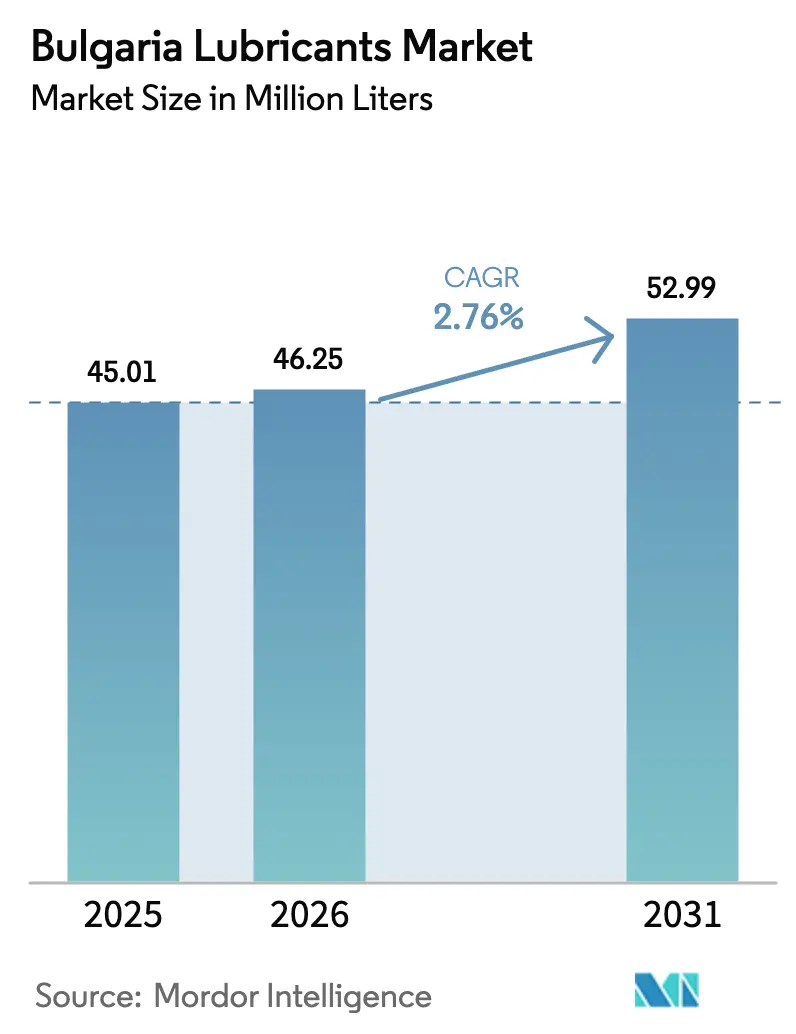
| Base Year Market Size (2025) | 45.01 Million liters |
| Market Volume (2026) | 46.25 Million liters |
| Market Volume (2031) | 52.99 Million liters |
| Growth Rate (2026 - 2031) | 2.76 % |
| Market Concentration | Medium |
Major Players *Disclaimer: Major Players sorted in no particular order Image © Mordor Intelligence. Reuse requires attribution under CC BY 4.0. | |
Bulgaria Lubricants Market Analysis by Mordor Intelligence
The Bulgarian Lubricants Market size in 2026 is estimated at 46.25 million liters, growing from 2025 value of 45.01 million liters with 2031 projections showing 52.99 million liters, growing at 2.76% CAGR over 2026-2031. Aging vehicles, selective industrial resilience, and EU-driven sustainability mandates together shape near-term volumes and long-term formulation shifts. Conventional engine oil demand remains strong, as the majority of Bulgaria’s registered vehicles have exceeded 15 years of service life. Industrial usage is supported by metallurgical and mining output, offsetting the slump in domestic vehicle manufacturing. EU Recovery and Resilience funds, totaling EUR 5.7 billion (USD 6.1 billion) through 2026, are set to boost construction and heavy-equipment activity, providing additional demand for hydraulic, gear, and grease products. On the supply side, reliance on a single refinery under Lukoil ownership amplifies feedstock risk, although local blending leader Prista Oil and new distribution alliances by international majors continue to widen product access.
Key Report Takeaways
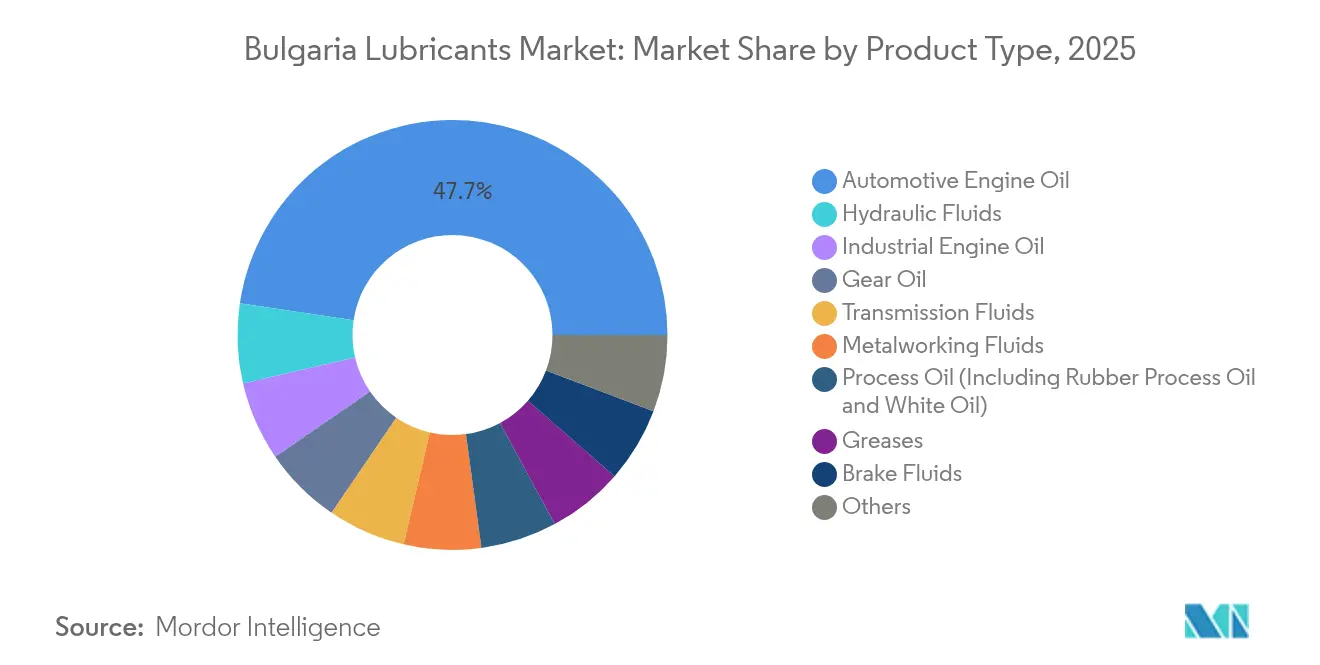
- By product type, Automotive Engine Oil held 47.65% of the Bulgarian lubricants market share in 2025. Industrial Engine Oil is projected to post the fastest 3.33% CAGR through 2031.
- By end-user industry, Automotive captured 59.60% of the Bulgarian lubricants market size in 2025. Industrial applications are advancing at a 2.93% CAGR to 2031.
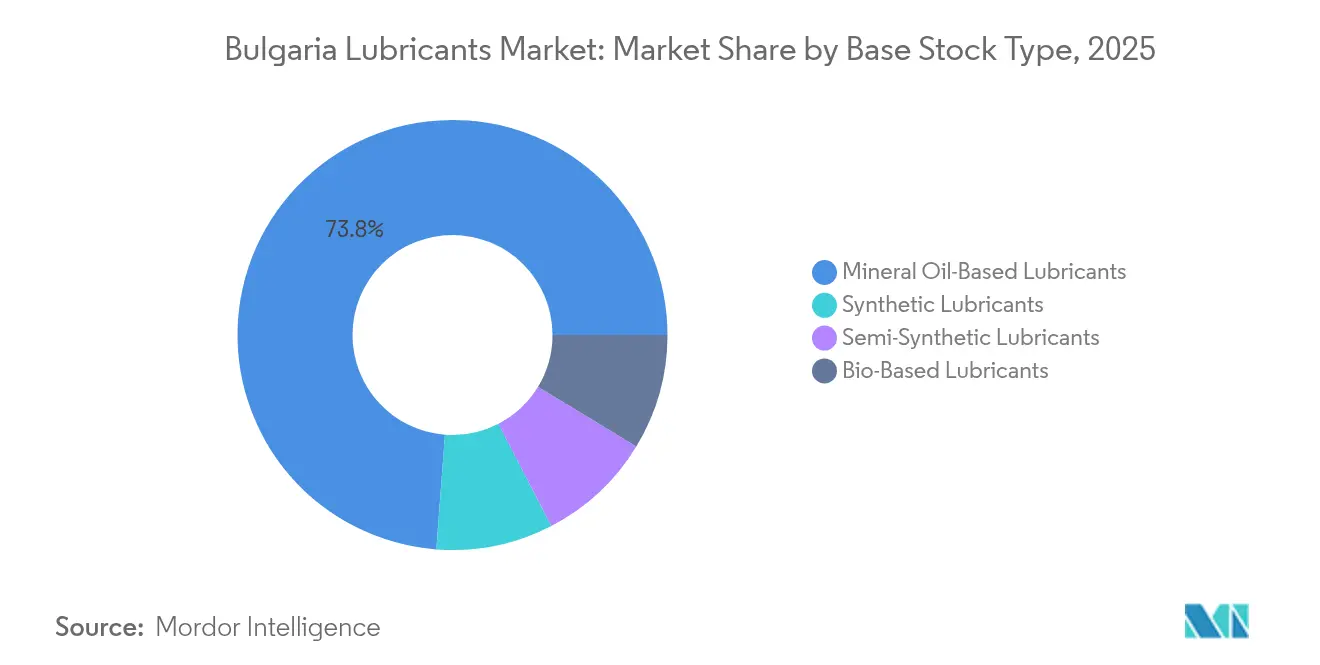
- By base stock, mineral oil formulations accounted for 73.80% of the 2025 volume; bio-based products led growth at a 3.17% CAGR through 2031.
Note: Market size and forecast figures in this report are generated using Mordor Intelligence’s proprietary estimation framework, updated with the latest available data and insights as of 2026.
Bulgaria Lubricants Market Trends and Insights
Drivers Impact Analysis*
| Drivers | (~) % Impact on CAGR Forecast | Geographic Relevance | Impact Timeline |
|---|---|---|---|
| ICE-dominant vehicle parc | +0.8% | National, urban centers | Medium term (2-4 years) |
| Industrial rebound in metallurgy and heavy equipment | +0.6% | Mining regions | Medium term (2-4 years) |
| Euro 7 and ACEA C7 push low-viscosity synthetics | +0.4% | EU-wide | Long term (≥ 4 years) |
| Distributor consolidation | +0.3% | Rural penetration | Short term (≤ 2 years) |
| Base-oil rerefining investments | +0.2% | Bulgaria and Central Asia | Long term (≥ 4 years) |
| Predictive-maintenance telematics | +0.2% | Industrial clusters | Long term (≥ 4 years) |
| Source: Mordor Intelligence | |||
ICE-dominant vehicle parc sustains engine-oil demand
More than 70% of Bulgaria’s light-duty fleet exceeds 15 years, and 82.6% of new registrations in early 2025 were gasoline models[1]. The age profile translates into higher-viscosity oil consumption, frequent top-ups, and robust aftermarket sales through multi-brand service chains that serve over 80% of out-of-warranty vehicles. Limited EV incentives and in-use battery vehicles are expected to preserve the Bulgarian lubricants market’s dependence on internal-combustion formulations over the medium term.
Industrial output rebound in metallurgy and heavy equipment
Despite an overall decline in manufacturing in March 2025, fabricated metal products rose, and mining output increased, underpinning demand for hydraulic fluids, gear oils, and extreme-pressure greases. Bulgaria extracts minerals, with lignite and copper ore leading volumes, generating continuous lubricant requirements for draglines, mills, and haul trucks. Upcoming EU-funded modernization programs will add remote monitoring and longer-life synthetics to the consumption mix.
Euro 7 and ACEA C7 push low-viscosity synthetics
Regulation (EU) 2024/1257 introduces crankcase emission limits and onboard diagnostics, effective November 2026, which compel automakers to specify 0W-20 and thinner oils with low-SAPS chemistry[2]. ACEA C7 further tightens volatility, ash, and oxidation criteria. Suppliers must therefore dual-track their portfolios for Bulgaria’s legacy fleet and its gradual influx of compliant vehicles, reshaping the Bulgarian lubricants market toward synthetics after 2027.
Distributor consolidation expands nationwide lubricant reach
TotalEnergies’ tie-up with Inter Cars unlocks a 250-branch aftermarket network, improving rural availability of branded fluids. Coupled with Lukoil’s 220-station retail grid, consolidated channels lower unit logistics cost and widen SKU offerings. Wholesalers dedicate a portion of revenue to inventory digitalization, enabling predictive stock and JIT delivery that benefits small garages.
Restraints Impact Analysis*
| Restraints | (~) % Impact on CAGR Forecast | Geographic Relevance | Impact Timeline |
|---|---|---|---|
| Growing EV penetration and extended drain intervals | -0.5% | EU-wide | Long term (≥ 4 years) |
| Single-refinery base-oil dependence | -0.3% | National | Short term (≤ 2 years) |
| Tight waste-oil compliance costs | -0.2% | Industrial regions | Medium term (2-4 years) |
| Import-price volatility from Black-Sea freight disruptions | -0.2% | Regional | Short term (≤ 2 years) |
| Source: Mordor Intelligence | |||
Growing EV penetration and extended drain intervals
While EV adoption is modest, EU-wide targets imply an acceleration in uptake post-2026. Synthetics enabling 15,000-20,000 km of drains halve the annual oil volume per ICE vehicle, compounding the volumetric challenge even before electrification is fully established.
Single-refinery base-oil dependence risks feedstock shocks
Neftohim Burgas accounts for the domestic Group I supply; sanctions against parent Lukoil and crude-switch trials from Kazakhstan, Iraq, and Tunisia raise concerns about output stability. The Competition Protection Commission’s levy penalty for restricting rival imports underscores the fragility of Bulgaria's lubricants market logistics.
*Our forecasts treat driver/restraint impacts as directional, not additive. The impact forecasts reflect baseline growth, mix effects, and variable interactions.
Segment Analysis
By Product Type: Automotive dominance drives conventional demand
Automotive Engine Oil accounted for 47.65% the Bulgarian lubricants market in 2025 and occupied the primary volume anchor for the Bulgarian lubricants market. Industrial Engine Oil is forecast to grow at a 3.33% CAGR, driven by rebounds in mining and fabricated metal industries that require high-load gear and compressor oils. Transmission fluids and gear oils experience incremental gains because older drivetrains require more frequent changes, while hydraulic fluid volumes benefit from infrastructure projects funded under EU recovery funds. Greases serve ports at Varna and Burgas, where water-resistant calcium-sulfonate grades are specified for ship-loader bearings.
Process oils supply Bulgaria’s plastics and tire producers; metalworking fluids expand in tandem with growth in the fabricated metals sector. Turbine and transformer oils protect power assets under grid modernization schemes, and low-SAPS synthetics are beginning to permeate the brake-fluid and ATF segments as Euro 7 rolls out.

By End-user Industry: Automotive leads while industrial accelerates
The Automotive segment generated 59.60% of the Bulgarian lubricants market size in 2025, thanks to a sizable million registered passenger cars and commercial-vehicle transit fleet that services the EU-Turkey trade corridor. Heavy-duty diesel trucks crossing Danube and Black-Sea ports add long-drain CK-4 and FA-4 demand, while two-wheelers contribute niche volumes of mono-grade or API SN oils.
Industrial usage, advancing at a 2.93% CAGR, spans power generation, metallurgy, and oil and gas exploration, including OMV Petrom’s Han Asparuh offshore block. Marine consumption is expected to increase through growth at Port Burgas, introducing ISO-FME-approved cylinder oils into the Bulgarian lubricants market. Agriculture and construction machinery, backed by EU-funded mechanization, lift demand for multifunctional tractor fluids and biodegradable hydraulic oils to meet eco-zone rules near river basins.
By Base Stock Type: Mineral oils dominate amid synthetic growth
Mineral formulations retained 73.80% volume in 2025, reflecting cost sensitivity across the Bulgarian lubricants industry workshops. Yet, bio-based lubricants, growing at a rate of 3.17% annually, are gaining traction in forestry, agriculture, and municipal fleets, aligning with EU Green Public Procurement criteria. Semi-synthetics bridge performance and price, particularly in light-duty gasoline vehicles seeking 10,000 km drains.
Full synthetics lead premium migration in industrial gearboxes and Euro 7 passenger cars, where 0W-20 and 0W-16 grades slash pumping losses. Prista’s rerefining initiatives and Motor Oil’s Greek Group II output ensure a stable feedstock alternative should Neftohim supply falter, supporting the Bulgarian lubricants market against external shocks.
Geography Analysis
Bulgaria’s lubricant demand is concentrated in Sofia, Plovdiv, Varna, and Burgas. Urban concentration shapes service-station placement and quick-lube footprints, favoring integrated distributors that can replenish high-turnover SKUs daily. Southeastern Burgas houses the single refinery and the nation’s largest petroleum port, enabling direct ship-borne base-oil inflow; Varna supports northern industrial clusters and naval facilities.
Mining regions in central-western provinces drive specialty industrial demand, particularly for open-gear lubricants and rock-drill oils used in the extraction of lignite and copper. Agricultural belts in the Danube Plain employ universal tractor transmission oils and biodegradable hydraulic fluids that are compatible with EU eco-zone regulations. Cross-border corridors to Greece and Turkey support heavy-haul diesel volumes, while Romanian transit generates top-up sales at the Danube River crossings.
Geopolitical shifts away from Russian feedstock have triggered diversification of crude supply through Azerbaijani, Iraqi, and North African grades, altering supply logistics along the Black Sea coast. The EUR 5.7 billion recovery program earmarks regional infrastructure upgrades, which will propel the use of road-building machinery lubricants. Consequently, the Bulgarian lubricants market is expected to see Burgas and Sofia combined consume almost 37.50% of national volume by 2031, even as rural penetration improves through distributor consolidation.
Regulatory Landscape
Lubricants and related petroleum-product activities in Bulgaria are governed by the Law on Administrative Regulation of Economic Activities Related to Crude Oil and Petroleum Products. The law includes registration requirements for entities engaged in these activities with the Ministry of Economy, Investments and Industry, and it was amended by the 51st National Assembly in November 2025, tightening compliance expectations across import, storage, distribution, and downstream trade.
For product stewardship and quality oversight, the Ministry of Environment and Water sets quality control requirements for liquid fuels and petroleum products through an ordinance covering product specifications and inspection procedures. For lubricant marketers and distributors, the rules affect documentation, traceability, and conformity processes, and they also raise the compliance bar for smaller wholesalers operating outside major branded networks.
Value Chain Analysis
Bulgaria's lubricants value chain starts with base-oil availability, anchored by the Neftohim Burgas refining complex and supplemented by imports of base oils and additive packages from international suppliers. Domestic blending is a key value-add step, led by producers such as Prista Oil in Ruse, which combines base stocks and additives into finished lubricants and packages them for multiple end-use segments.
After blending and packaging, products move through bulk storage and transport nodes into wholesale, retail, and service channels. Distribution relies on multi-channel networks that include fuel-station operators, notably Lukoil's retail presence, and aftermarket wholesalers, supported by terminals and transshipment infrastructure on the Danube, including Ruse for bulk handling and regional redistribution. End users cover automotive workshops and fleets as well as industrial customers in mining, metallurgy, power, ports, and construction, where procurement is often tied to service contracts, drain-interval management, and equipment-OEM specifications.
Competitive Landscape
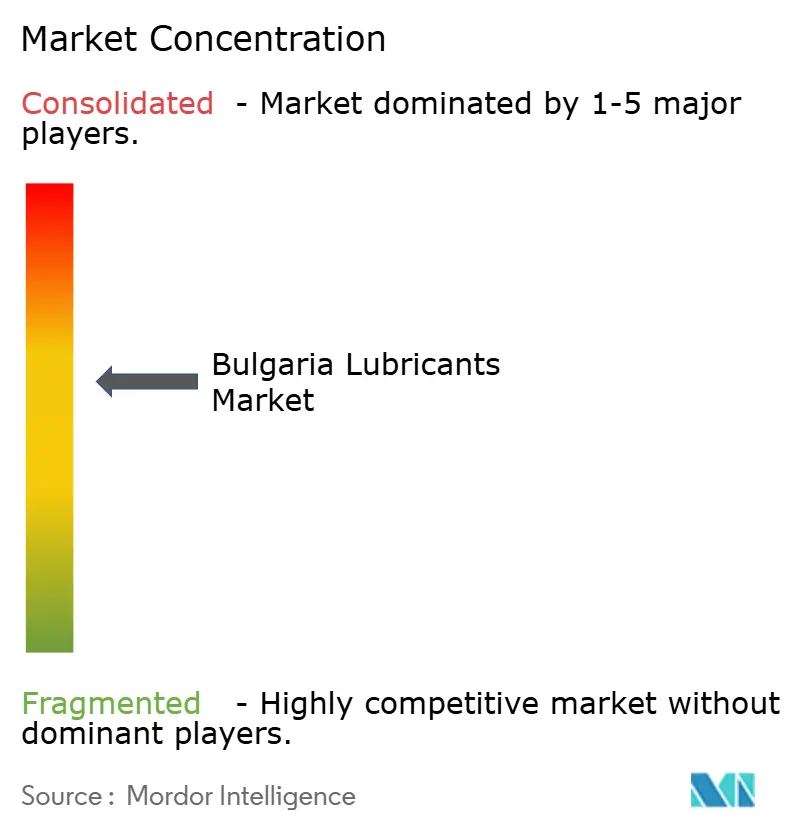
The Bulgarian lubricants market is moderately concentrated. Small importers focus on private-label mineral oils, particularly in rural retail settings. Digital tools such as IoT-enabled fluid monitoring and e-commerce portals differentiate premium players, whereas smaller firms compete on price and localized service. White-space opportunities lie in EV-specific fluids—such as dielectric coolants and e-axle greases—and circular-economy services, including waste-oil collection, rerefining, and carbon-footprint reporting. Market entry barriers remain moderate: EU regulations demand technical conformity but do not impose local content rules, while aggressive pricing and warranty partnerships can offset brand loyalty in the automotive aftermarket.
Bulgaria Lubricants Industry Leaders
-
Prista Oil
-
Lukoil
-
Shell Plc
-
BP Plc (Castrol)
-
TotalEnergies SE
- *Disclaimer: Major Players sorted in no particular order
Market Opportunities and Future Outlook
Portfolio upgrading around Euro 7 and ACEA C7 creates a specific whitespace for suppliers that can address two parallel needs: cost-sensitive demand from Bulgaria's legacy vehicle parc, and the gradual inflow of newer low-viscosity, low-SAPS specifications linked to Regulation (EU) 2024/1257, effective from November 2026. On the demand side, that shift increases requirements for 0W-20 and thinner passenger car engine oils, while industrial users also raise expectations for higher-performance lubricants as they adopt condition monitoring and longer-life synthetics in mining and metalworking.
Circular-economy services and domestic capability buildout are another actionable opportunity area, supported by named local assets and programs. Prista Oil operates production in Ruse and has modernization activity supported by European funding mechanisms, including Operational Program Innovations and Competitiveness 2014-2020, while its integrated river port operations in Ruse support inbound and outbound logistics along the Danube. At the same time, tighter waste-oil compliance and traceability requirements are pushing demand for bundled service offerings that include collection, documentation, and reporting, particularly for SMEs in industrial regions facing rising disposal and audit burdens.
Recent Industry Developments
- June 2026: PJSC LUKOIL (Neftochim Burgas refinery operations) Special administrator announced lifting restrictions on crude oil purchases from Swiss-registered counterparties, enabling normalized refinery operations. The move improves feedstock supply continuity and downstream pricing stability in Bulgaria, reducing volatility in lubricant production. The action enhances resilience of Bulgaria's lubricants supply chain and may shift local supply dynamics as governance actions around the refinery unfold.
- January 2026: PJSC LUKOIL / LUKOIL International GmbH Sale agreement with Carlyle for LUKOIL International GmbH (including refinery and retail network assets in Bulgaria). The deal affects ownership and operational control of Bulgarian asset base, with potential changes in procurement and distribution strategy. This could influence product availability and pricing dynamics for Bulgarian lubricants.
- June 2025: BP Plc (Castrol unit) Divestment process announced for Castrol unit, affecting product availability across Eastern Europe including Bulgaria. The announcement signals a structural market rebalancing risk for suppliers and downstream players, creating uncertainty in lubricant supply chains and pricing in Bulgaria.
Research Methodology Framework and Report Scope
Market Definition and Coverage
For this report, the Bulgaria lubricants market covers lubricating oils and greases consumed within Bulgaria across automotive, industrial, and other operating equipment uses. We measure demand at the point of domestic consumption and express it in volume terms (liters). Product movement is validated using trade data and local supply signals.
Scope exclusions: This sizing does not count fuels, base oil feedstocks sold as commodities, or lubricant additives sold as standalone chemical products.
Segmentation Overview
- By Product Type
- Automotive Engine Oil
- Industrial Engine Oil
- Transmission Fluids
- Gear Oil
- Brake Fluids
- Hydraulic Fluids
- Greases
- Process Oil (Including Rubber Process Oil and White Oil)
- Metalworking Fluids
- Turbine Oil
- Transformer Oil
- Other Product Types
- By End-user Industry
- Automotive
- Passenger Vehicles
- Commercial Vehicles
- Two-Wheelers
- Marine
- Aerospace
- Heavy Equipment
- Construction
- Mining
- Agriculture
- Industrial
- Power Generation
- Metallurgy and Metalworking
- Textiles
- Oil and Gas
- Other End-Use Industries
- Automotive
- By Base Stock Type
- Mineral Oil-Based Lubricants
- Synthetic Lubricants
- Semi-Synthetic Lubricants
- Bio-Based Lubricants
Data Sources, Market Sizing, and Validation
Desk Research
Desk research is used to set the country context and build the first draft of the demand pool for lubricants by use case. We relied on public statistics and reference series such as national accounts and industry output from the National Statistical Institute of Bulgaria, cross-border trade codes from Eurostat and UN Comtrade, and energy and transport indicators from sources such as the International Energy Agency and the European Environment Agency.
To turn these signals into a practical market model, we also reviewed filings and presentations for active suppliers and distributors, along with association releases and reputable press coverage on topics like automotive parc, freight activity, and industrial production. Where needed, paid subscriptions were used for company financials and intelligence, and for shipment-level import and export checks that help explain abrupt year-to-year shifts. The desk sources listed are illustrative, and we also used other public references to collect, validate, and clarify the final dataset.
Primary Interviews and Surveys
We speak with lubricant producers, distributors, service outlets, industrial users, and fleet managers in Bulgaria. Their feedback helps test vehicle replacement cycles, product mix, realized pricing, export leakage, and industrial demand. Open gaps are rechecked against the Bulgaria market model before finalization.
Distribution of primary research fieldwork respondents
| Company type | Respondent position |
|---|---|
| Top tier: 29% | CXOs: 18% |
| Mid tier: 49% | Functional/Unit leaders: 31% |
| Smaller Players: 22% | Managers: 51% |
Market-Sizing & Forecasting
Our sizing starts with a top-down build that reconstructs lubricant consumption using Bulgaria-specific activity indicators, which are then translated into lubricant volumes through application-based usage rates. We followed this with selective bottom-up approximations, including supplier and channel sense checks, sample price-per-liter ranges, and sanity checks against observable imports and local blending signals, so totals remain realistic even when a single data series is noisy.
Key inputs used in the model include vehicle parc age and usage patterns, freight and road transport intensity, industrial output trends in heavy consuming activities, equipment and construction activity proxies, and the shift in product mix between mineral, semi synthetic, synthetic, and bio-based options. For forecasting, we used scenario analysis to reflect how quickly synthetic penetration and drain intervals could change, then anchored scenarios using expert views on maintenance behavior and industrial utilization. Where direct data is missing for a small end-use pocket, assumptions are filled using comparable application norms and then rechecked through follow-up calls before the numbers are finalized.
Data Validation & Update Cycle
Validation is done through several cross-checks so the output is not dependent on one source. We compare modeled volumes against independent signals such as trade flows, industrial activity direction, and known channel feedback, and we investigate outliers such as sudden jumps that do not match underlying demand conditions.
Before sign-off, the work is reviewed in steps, with assumptions and conversions checked by another analyst and adjusted if the supporting evidence is weak. Reports are refreshed annually, and interim updates are triggered when material events occur that can shift supply, pricing, or consumption patterns. Right before delivery, a fresh pass is completed so clients receive the latest updated view aligned with the most recent information available.
Mordor Intelligence's Bulgaria Lubricants Market Size Compared Against Other Published Estimates
Published market sizes for Bulgaria lubricants can differ even when they appear to describe the same space, because each publisher uses its own unit basis, scope boundaries, and conversion logic between value and volume. Differences also show up when assumptions on drain intervals, product mix, or the share sold through workshops versus direct industrial supply are not aligned.
Some estimates present a value number built from broad petroleum product groupings or older snapshots that are not revalidated against current channel conditions. In the Mordor Intelligence approach, the market is kept as in-country lubricant consumption in liters with a defined base year (45.01 million liters in 2025) and forecast path (46.25 million liters in 2026). Adjacent items like fuels, base oils as commodities, and standalone additives are left out so totals do not get inflated by upstream trade value.
Benchmark comparison
| Source | Market Size | Gaps in Research Methodology |
|---|---|---|
| Mordor Intelligence | USD 0.18 B (2025) | |
| Industry Publisher A | USD 0.22 B (2025) | Often converts from trade value and broad oil categories, which can pull in base oils and other petroleum items that are not end use lubricants, and may apply generic price per liter assumptions. |
| Regional Consultancy B | USD 0.15 B (2025) | Commonly assumes faster synthetic shift and longer drain intervals without confirming service practices locally, which can compress estimated volumes and then understate the market when priced at conservative averages. |
The spread in published figures mostly comes from what gets counted and how volume to value conversions are handled. By tying the model to clear consumption drivers and then checking it with channel feedback, us and our readers get a number that can be repeated and stress tested with the same inputs year after year.
Key Questions Answered in the Report
What is the current size and growth outlook for lubricants demand in Bulgaria?
Consumption reached 46.25 million liters in 2026 and is projected to rise to 52.99 million liters by 2031, reflecting a 2.76% CAGR.
Which product category generates the highest sales volume?
Automotive engine oil, with a 47.65% share of the 2025 volume, is expected to remain dominant through 2031.
How will Euro 7 regulations change lubricant specifications in the country?
The rule takes effect for new vehicle types in November 2026 and will accelerate the shift to ultra-low-viscosity, low-SAPS synthetics that meet ACEA C7 criteria.
What effect could electric-vehicle adoption have on lubricant volumes?
Rising electrification, combined with longer drain intervals, is forecast to trim approximately 0.5% from long-term volume growth.