
Security Training And Awareness Services Market Size and Share
Market Overview
| Study Period | 2019 - 2030 |
|---|---|
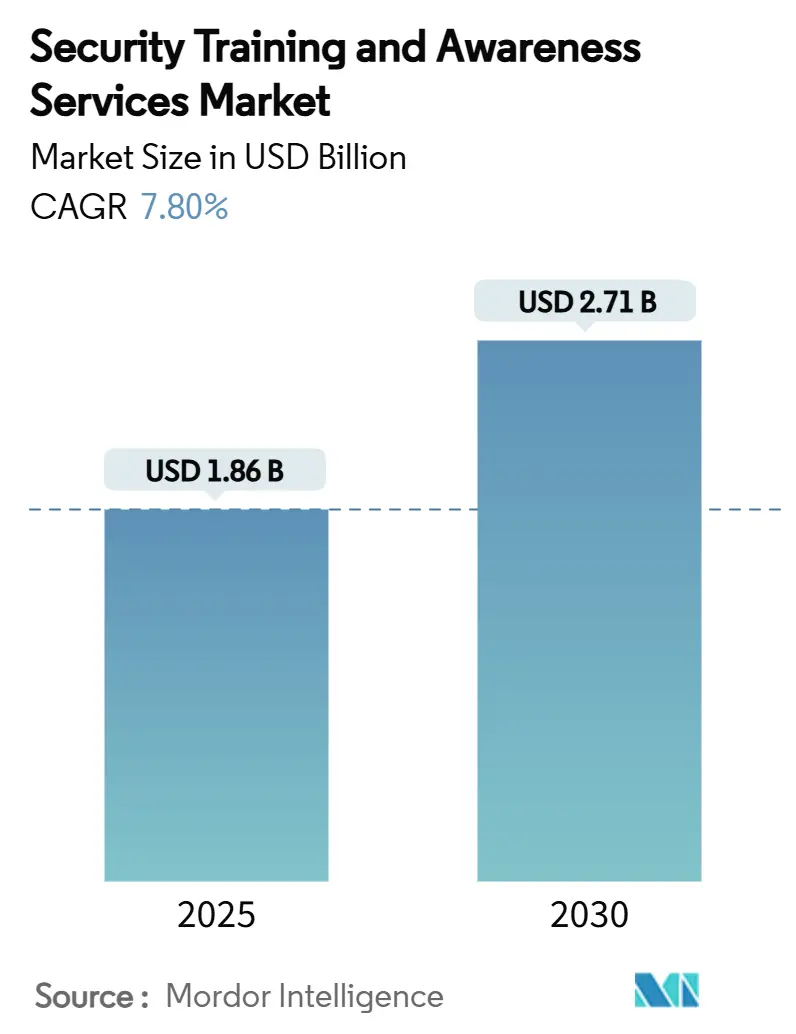
| Market Size (2025) | USD 1.86 Billion |
| Market Size (2030) | USD 2.71 Billion |
| Growth Rate (2025 - 2030) | 7.80 % |
| Fastest Growing Market | Asia Pacific |
| Largest Market | North America |
| Market Concentration | Medium |
Major Players *Disclaimer: Major Players sorted in no particular order Image © Mordor Intelligence. Reuse requires attribution under CC BY 4.0. | |
Security Training And Awareness Services Market Analysis by Mordor Intelligence
The security training and awareness services market size reached USD 1.86 billion in 2025 and is forecast to attain USD 2.71 billion by 2030, advancing at a 7.8% CAGR. Tighter global regulations, rising executive liability for breaches, and escalating ransomware payouts underpin this growth. North America leads revenue, yet Asia-Pacific records the fastest expansion as digital transformation exposes millions of new endpoints. Organizations pivot from compliance-only programs to behavior-modification curricula that cut incident response costs and unlock insurer discounts. Vendors able to prove measurable risk reduction and deliver mobile, bite-sized content capture outsized demand, while M&A accelerates platform convergence toward end-to-end human-risk management solutions.
Key Report Takeaways
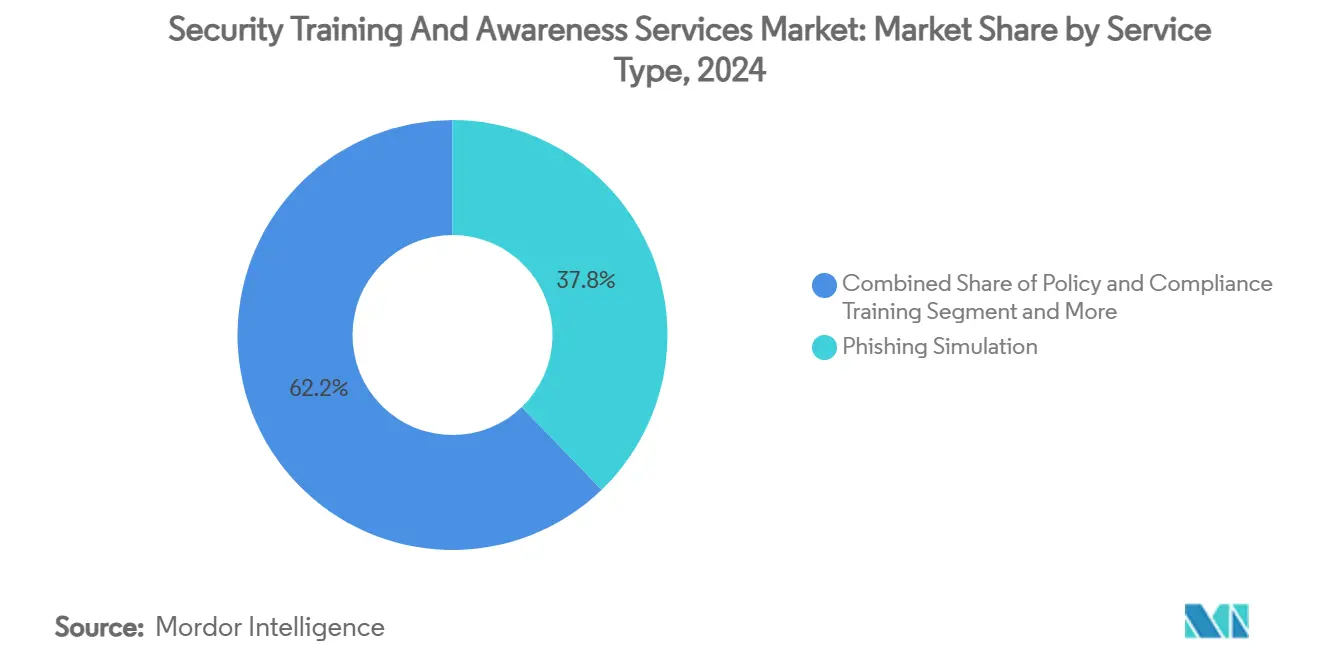
- By service type, phishing simulation held 37.8% of the security training and awareness services market share in 2024, while gamified security awareness is projected to grow at an 8.8% CAGR to 2030.
- By delivery mode, web-based self-paced learning accounted for 53.3% share of the security training and awareness services market size in 2024; mobile-based micro-learning is expanding at a 9.2% CAGR through 2030.
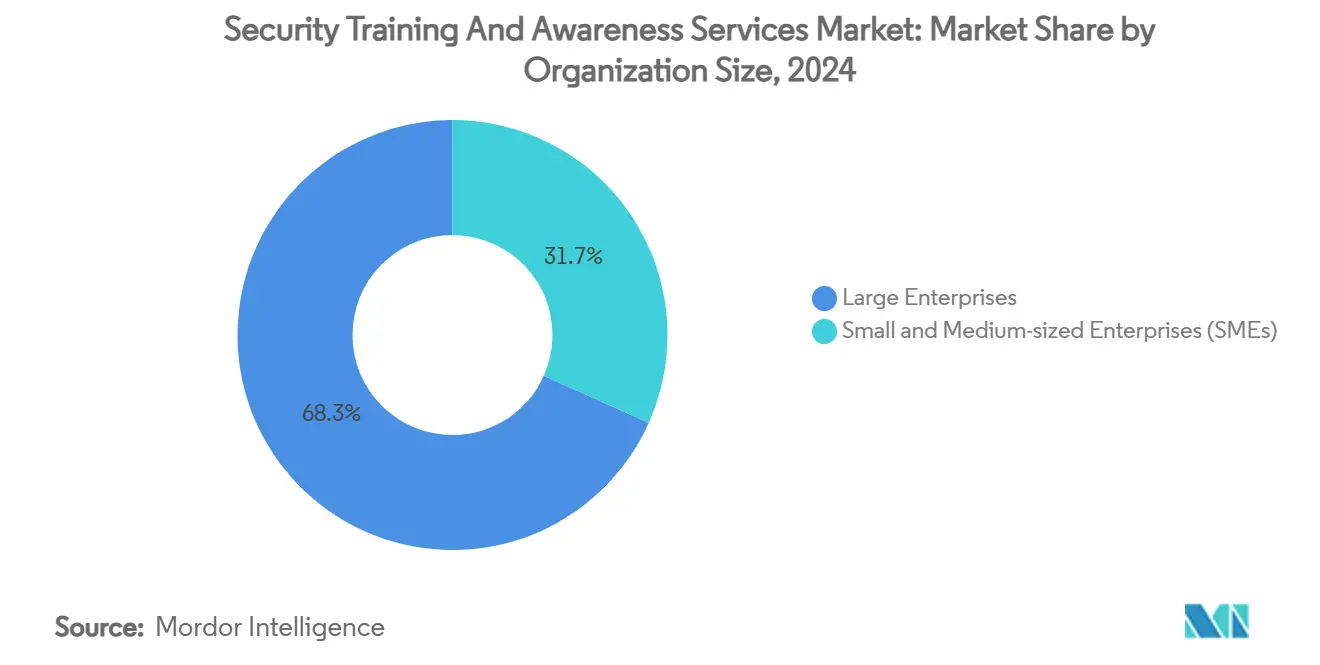
- By organization size, large enterprises captured 68.3% of the security training and awareness services market share in 2024, whereas small and medium enterprises are set to advance at a 9.6% CAGR to 2030.
- By industry vertical, BFSI led with 29.7% share of the security training and awareness services market size in 2024 and healthcare is moving at an 8.6% CAGR through 2030.
- By geography, North America commanded 38.3% revenue share of the security training and awareness services market in 2024; Asia-Pacific is forecast to climb at a 9.0% CAGR over 2025-2030.
Global Security Training And Awareness Services Market Trends and Insights
Drivers Impact Analysis*
| Driver | (~) % Impact on CAGR Forecast | Geographic Relevance | Impact Timeline |
|---|---|---|---|
| Regulatory mandates for workforce cyber-hygiene | +1.8% | Global; EU and North America lead | Medium term (2-4 years) |
| Ransomware and phishing surge against remote staff | +1.5% | Global; highest in APAC | Short term (≤ 2 years) |
| Rising C-suite accountability for human-layer breaches | +1.2% | North America and EU | Medium term (2-4 years) |
| Insurer discounts for certified awareness programmes | +0.9% | North America and EU | Long term (≥ 4 years) |
| AI-driven adaptive learning adoption | +1.1% | Global tech-forward regions | Short term (≤ 2 years) |
| M&A-driven bundling within X-as-a-Service stacks | +0.7% | Mature markets | Medium term (2-4 years) |
| Source: Mordor Intelligence | |||
Increasing regulatory mandates for workforce cyber-hygiene
The EU NIS2 Directive obliges entities in 18 critical sectors to deploy role-based training, prompting immediate procurement of specialised programmes. [1]European Union Agency for Cybersecurity, “NIS2 Technical Implementation Guidance,” enisa.europa.eu Financial institutions in Europe face parallel pressure from DORA, effective 2025, that prescribes security training for all staff. In the United States, new SEC rules compel listed firms to disclose material incidents within four business days, spurring demand for incident-response education. Organizations now commit 9% of IT budgets to information security, and half of the senior leadership attend dedicated sessions to evidence compliance. These mandates transform training from a discretionary spend into a line-item necessity that auditors monitor for effectiveness.
Surge in ransomware and phishing attacks targeting remote staff
Average ransomware payments hit USD 2.73 million in 2024 as attackers exploited home-office weaknesses. AI-generated phishing raised success rates by 55% between 2023 and 2025, outranking human red teams in crafting believable lures. APAC now absorbs 31% of global cyber strikes, with some enterprises logging 10,000 daily alerts. Healthcare exemplifies the financial stakes: the Lehigh Valley Health Network breach ended in a USD 65 million settlement, underscoring the value of proactive staff education. Programmes delivering at least four targeted phishing drills per year boost suspicious email reporting rates to 50%, far above single-session approaches.
Growing C-suite accountability for human-layer breaches
Boards are now personally liable under NIS2, driving executives to demand evidence-backed training outcomes. Studies link active leadership participation to 15-25% lower breach costs, proving culture starts at the top. New York’s Department of Financial Services mandates CISO oversight of employee education, further institutionalising the practice. As 68% of breaches stem from human error, executive interest in measurable behaviour change fuels premium demand for analytics-rich platforms.
Adoption of AI-driven adaptive learning platforms
Vendors deploy machine-learning engines that personalise modules in real time. KnowBe4’s HRM+ applies behavioural telemetry to tailor content and deliver on-screen coaching. Adaptive Security fuses open-source intelligence with user scores to plot risk-based training paths. Continuous content refresh aligns lessons with emerging threats, a necessity as AI accelerates attack innovation. Early adopters report higher quiz completion and faster phishing-report rates, confirming effectiveness over static slideware.
Restraints Impact Analysis*
| Restraint | (~) % Impact on CAGR Forecast | Geographic Relevance | Impact Timeline |
|---|---|---|---|
| End-user fatigue and declining completion rates for repetitive modules | -1.4% | Global, particularly in mature markets | Short term (≤ 2 years) |
| Budget re-prioritisation toward zero-trust tech over training | -1.1% | North America and EU primarily | Medium term (2-4 years) |
| Fragmented global certification standards | -0.8% | Global, with varying regional standards | Long term (≥ 4 years) |
| Data-sovereignty hurdles for cloud-hosted training content | -0.6% | EU, APAC with strict data laws, emerging in other regions | Medium term (2-4 years) |
| Source: Mordor Intelligence | |||
End-user fatigue and declining completion rates for repetitive modules
Seventy-one percent of employees still take risky actions despite knowing the consequences, a pattern linked to cognitive overload from redundant slide shows. [2]Proofpoint, “2024 State of the Phish Report,” proofpoint.com A 19,500-person study from US universities found no significant correlation between completed courses and phishing-simulation success, spotlighting instructional design flaws. Large-scale analysis across 12,511 staff at a fintech firm echoed these findings, recording effect sizes below 0.01 for traditional training. Such results propel demand for gamified micro-learning that breaks monotony, retains attention, and supplies instant feedback.
Budget re-prioritisation toward zero-trust technology over training
Enterprises poured USD 212 billion into cybersecurity in 2025, with many favouring automated controls that promise quicker wins. Sixty percent of large banks plan full zero-trust rollouts by 2026, threatening to siphon funds from human-centric initiatives. Economic models caution firms not to exceed 37% of expected loss on any single security investment, intensifying scrutiny on training ROI. Nonetheless, 89% of companies subject to NIS2 still need additional staff to fulfil the directive, confirming that education remains indispensable. Vendors that integrate technical controls with analytics-rich training stand best placed to defend budgets.
*Our forecasts treat driver/restraint impacts as directional, not additive. The impact forecasts reflect baseline growth, mix effects, and variable interactions.
Segment Analysis
By Service Type: Simulation-based training dominates
Phishing simulation accounted for 37.8% of the security training and awareness services market share in 2024, underlining corporate focus on the most exploited attack vector. Gamified security awareness is forecast to accelerate at an 8.8% CAGR, driven by demand for engaging experiences that cut through alert fatigue. The security training and awareness services market size for gamified programmes is predicted to grow from USD 430 million in 2025 to USD 675 million by 2030, alongside these dynamics. Policy and compliance training retains a steady user base owing to DORA and sector-specific mandates. Executive coaching modules gain ground as liability shifts to the boardroom.
Early success stories reinforce the trend. SANS Institute’s “Snack Attack!” raised knowledge retention scores by two-thirds after a four-week programme. [3]SANS Institute, “Snack Attack! Gamified Ransomware Defense Training,” sans.org Keepnet Labs recorded a 99% phishing-recognition rate among 1,800 employees after a three-month gamified roll-out. Specialty modules around AI-threat awareness and supply-chain security emerge as new revenue streams, mirroring the wider threat landscape.



By Delivery Mode: Mobile learning transforms access
Web-based self-paced courses controlled 53.3% of revenue in 2024, but their share is eroding as smartphone-friendly formats bloom. Security training and awareness services market size for mobile-based micro-learning is projected to grow at a 9.2% CAGR to hit USD 910 million by 2030. KnowBe4’s Mobile Learner App packs more than 100 short modules that staff can complete in three-minute bursts. Instructor-led sessions still matter for deep-dive topics such as incident-response drills, especially in healthcare and finance. Blended programmes that interweave live webinars, simulations, and short quizzes achieve some of the highest completion rates.
Hybrid-work realities and just-in-time support needs drive the migration to mobile. Phished Academy reports near-universal course completions when lessons arrive immediately after a user’s risky action, confirming the value of contextual delivery. Employers also appreciate lower production costs: micro-learning clips typically cost 40% less to refresh than 30-minute slide decks.
By Organization Size: SME adoption accelerates
Large enterprises retained 68.3% of 2024 revenue, yet SMEs provide the fastest incremental opportunity as affordable cloud platforms democratise access. Security training and awareness services market size for SMEs is set to grow at a 9.6% CAGR, reflecting heightened attacker attention; 43% of breaches already hit firms with fewer than 250 staff. Typical breach recovery costs between USD 120,000 and USD 1.24 million dwarf the USD 5,000-50,000 annual outlay for structured training, tilting ROI equations in favour of education.
Customised content tuned to SME workflows cuts incident volumes by up to 65% and lowers deployment costs by 40% versus one-size-fits-all suites. Meanwhile, multinationals pursue expansive rollouts such as KnowBe4 HRM+, which blends coaching, email filtering, and analytics, underscoring market bifurcation between turnkey cloud offerings and enterprise-scale platforms.
By Industry Vertical: Healthcare growth accelerates
BFSI led with 29.7% of 2024 revenue, upheld by strict audit regimes and high-value targets. Healthcare follows as the fastest riser at 8.6% CAGR through 2030, stimulated by 725 reported breaches in 2023 alone. The security training and awareness services market size in healthcare is forecast to reach USD 515 million by 2030. Mandatory annual training from the US Department of Health and Human Services illustrates regulatory pull. IT and telecom firms adopt advanced AI-driven simulations early, while government and defence demand tailored exercises addressing nation-state threats.
Energy, retail, and manufacturing now embed supply-chain risk modules as interconnected operations expand attack surfaces. Verticals with compliance heavyweights or immediate patient-safety implications allocate larger per-employee budgets, directing vendor roadmaps toward sector-specific content libraries.
Geography Analysis
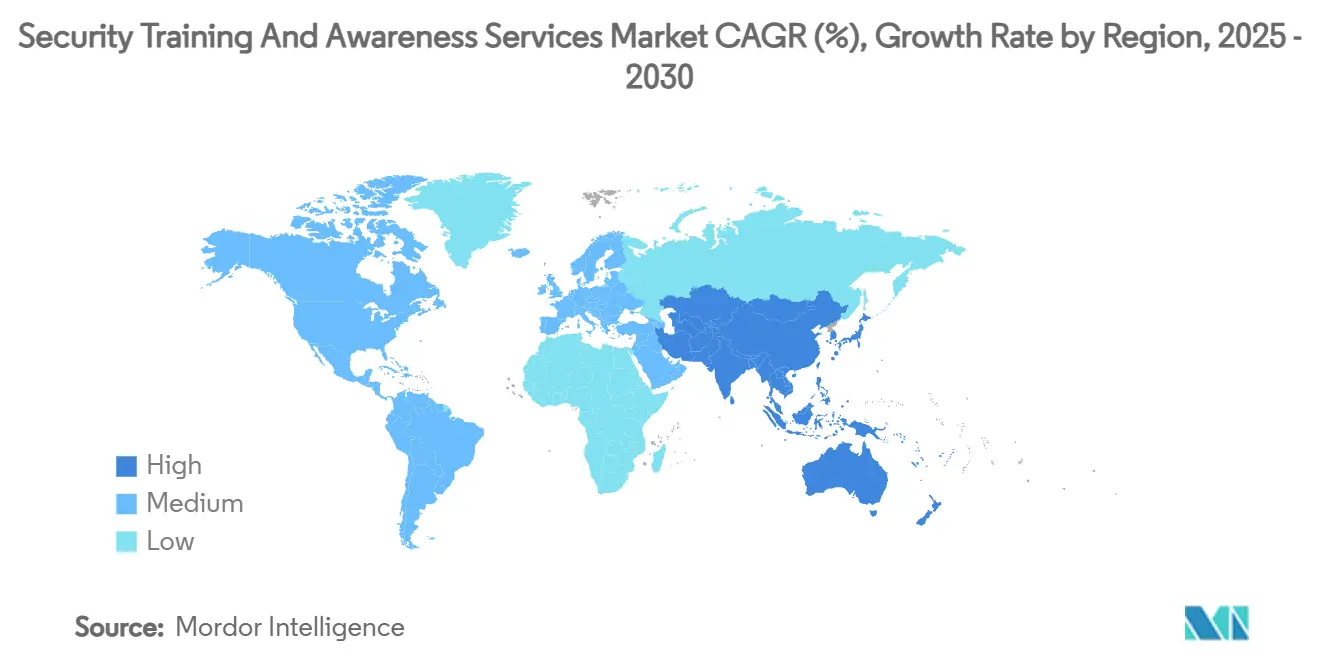
North America generated 38.3% of global revenue in 2024 on the back of SEC disclosure rules and NYDFS training mandates, with companies reporting 50x ROI from targeted anti-phishing programmes. The United States alone represented more than 40% of worldwide cybersecurity spending in 2025, signalling the premium placed on human-layer controls. Canada and Mexico add momentum through expanding cloud adoption and cross-border privacy statutes that standardise curriculum requirements.
Europe’s outlook is regulation-led. Germany raised cybersecurity outlays 13.8% to EUR 11.2 billion (USD 12.6 billion) in 2024, funneling sizeable portions into awareness services. [4]Bitkom e.V., “Germany Cybersecurity Spending Tops EUR 10 Billion,” bitkom.org DORA forces all finance employees to complete role-specific courses, while NIS2 extends obligations across 18 critical sectors. Businesses assign 9% of IT budgets to security, and over half of executives now attend workshops, reflecting a cultural shift. Skills shortages—estimated at 300,000 positions—boost outsourced training demand.
Asia-Pacific is the fastest-growing market at a 9.0% CAGR, helped by 12.8% forecast growth in regional cybersecurity spend to USD 52 billion by 2027. Japan earmarks workforce upskilling funds as its cyber market heads toward USD 13.25 billion by 2029. Australia’s Cybersecurity Bill 2024 and India’s Digital Personal Data Protection Act elevate baseline expectations for employee proficiency. Enterprises in China, India, and Singapore face rising insurance premiums unless they document training effectiveness, further fuelling uptake.

Competitive Landscape
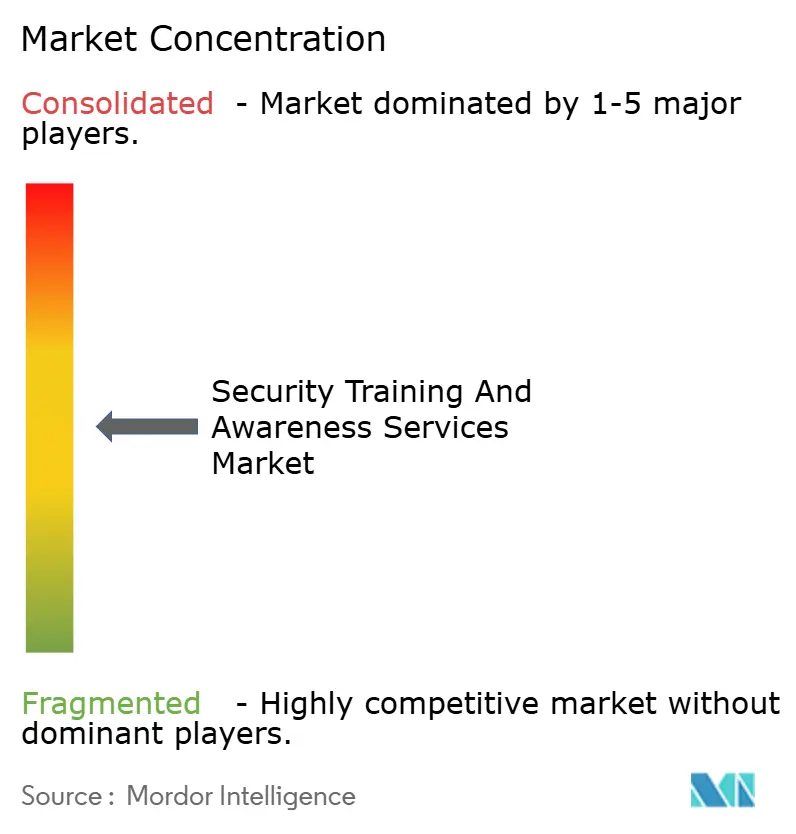
The security training and awareness services market remains moderately fragmented yet tilts toward consolidation as buyers demand unified human-risk platforms. KnowBe4, Proofpoint, and Cofense leverage integrated stacks that couple email security with adaptive coaching. Vista Equity Partners took KnowBe4 private for USD 4.6 billion, accelerating roadmap alignment with behavioural analytics. Proofpoint’s planned USD 1 billion Hornetsecurity buy adds Microsoft 365 protection layers aimed at mid-market customers.
Differentiation hinges on AI-powered personalisation. KnowBe4 HRM+ surfaces real-time coaching cues driven by individual behaviour, while Adaptive Security ranks users via OSINT-derived scores. Mid-tier challengers carve niches in supply-chain training and VR-based simulations. Patent filings around machine-learning threat detection grow, exemplified by IBM’s strategy to lock in AI-enabled safeguards.
Future M&A is expected as endpoint, email, and identity-security vendors seek to fold training into bundled subscriptions. Platforms able to present clear ROI dashboards—linking behavioural metrics to incident reductions—are positioned to win longer-term enterprise contracts.
Security Training And Awareness Services Industry Leaders
KnowBe4, Inc.
Proofpoint, Inc.
Cofense Inc.
Escal Institute of Advanced Technologies (SANS Institute)
Infosec Institute, Inc.
- *Disclaimer: Major Players sorted in no particular order

Recent Industry Developments
- May 2025: Proofpoint agreed to acquire Hornetsecurity for >USD 1 billion to deepen Microsoft 365 protection.
- April 2025: Proofpoint surpassed USD 2 billion in annual recurring revenue after onboarding 420 new enterprises.
- March 2025: SEALSQ boosted 2025 R&D budgets 44% to develop post-quantum training toolkits.
- January 2025: The EU Digital Operational Resilience Act (DORA) took effect, mandating continuous staff education in finance.
- November 2024: KnowBe4 launched HRM+, integrating training, email security, and real-time coaching.


Global Security Training And Awareness Services Market Report Scope
| Phishing Simulation |
| Policy and Compliance Training |
| Gamified Security Awareness |
| Role-based and Executive Training |
| Other Specialised Modules |
| Web-based Self-paced |
| Instructor-led (On-site/Virtual) |
| Mobile-based Micro-learning |
| Blended Learning |
| Small and Medium-sized Enterprises (SMEs) |
| Large Enterprises |
| BFSI |
| Healthcare and Life Sciences |
| IT and Telecom |
| Government and Defense |
| Retail and eCommerce |
| Energy and Utilities |
| Manufacturing |
| Other Industry Verticals |
| North America | United States | |
| Canada | ||
| Mexico | ||
| South America | Brazil | |
| Argentina | ||
| Chile | ||
| Rest of South America | ||
| Europe | Germany | |
| United Kingdom | ||
| France | ||
| Italy | ||
| Spain | ||
| Rest of Europe | ||
| Asia-Pacific | China | |
| Japan | ||
| India | ||
| South Korea | ||
| Australia | ||
| Singapore | ||
| Malaysia | ||
| Rest of Asia-Pacific | ||
| Middle East and Africa | Middle East | Saudi Arabia |
| United Arab Emirates | ||
| Turkey | ||
| Rest of Middle East | ||
| Africa | South Africa | |
| Nigeria | ||
| Rest of Africa | ||
| By Service Type | Phishing Simulation | ||
| Policy and Compliance Training | |||
| Gamified Security Awareness | |||
| Role-based and Executive Training | |||
| Other Specialised Modules | |||
| By Delivery Mode | Web-based Self-paced | ||
| Instructor-led (On-site/Virtual) | |||
| Mobile-based Micro-learning | |||
| Blended Learning | |||
| By Organization Size | Small and Medium-sized Enterprises (SMEs) | ||
| Large Enterprises | |||
| By Industry Vertical | BFSI | ||
| Healthcare and Life Sciences | |||
| IT and Telecom | |||
| Government and Defense | |||
| Retail and eCommerce | |||
| Energy and Utilities | |||
| Manufacturing | |||
| Other Industry Verticals | |||
| By Geography | North America | United States | |
| Canada | |||
| Mexico | |||
| South America | Brazil | ||
| Argentina | |||
| Chile | |||
| Rest of South America | |||
| Europe | Germany | ||
| United Kingdom | |||
| France | |||
| Italy | |||
| Spain | |||
| Rest of Europe | |||
| Asia-Pacific | China | ||
| Japan | |||
| India | |||
| South Korea | |||
| Australia | |||
| Singapore | |||
| Malaysia | |||
| Rest of Asia-Pacific | |||
| Middle East and Africa | Middle East | Saudi Arabia | |
| United Arab Emirates | |||
| Turkey | |||
| Rest of Middle East | |||
| Africa | South Africa | ||
| Nigeria | |||
| Rest of Africa | |||


Key Questions Answered in the Report
What is the current size of the global security training and awareness services market?
The market was valued at USD 1.86 billion in 2025.
What CAGR is forecast for the security training and awareness services market to 2030?
The market is projected to grow at 7.8% CAGR through 2030.
Which segment holds the largest share in the security training and awareness services market?
Phishing simulation leads with 37.8% market share in 2024.
Which region is expected to grow fastest in the security training and awareness services market?
Asia-Pacific is predicted to register a 9.0% CAGR between 2025 and 2030.
Why is healthcare a high-growth vertical for security training and awareness services?
Ransomware incidents and regulatory mandates push healthcare spending, driving an 8.6% CAGR to 2030.
How does executive involvement affect training outcomes?
Firms with active C-suite participation report 15-25% lower breach costs due to stronger security culture.
Page last updated on:


 Your data is secure and never sold or shared.


