
Security Printing Machines Market Size and Share
Market Overview
| Study Period | 2019 - 2030 |
|---|---|
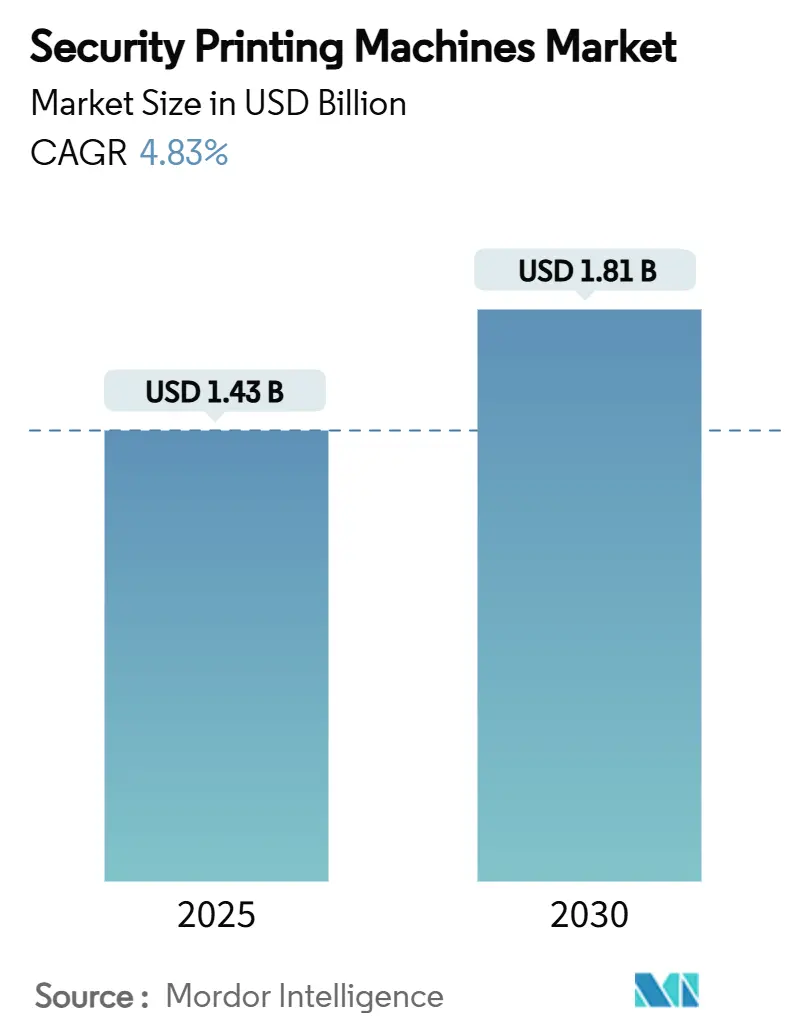
| Market Size (2025) | USD 1.43 Billion |
| Market Size (2030) | USD 1.81 Billion |
| Growth Rate (2025 - 2030) | 4.83 % |
| Fastest Growing Market | Asia Pacific |
| Largest Market | Europe |
| Market Concentration | Medium |
Major Players *Disclaimer: Major Players sorted in no particular order Image © Mordor Intelligence. Reuse requires attribution under CC BY 4.0. | |
Security Printing Machines Market Analysis by Mordor Intelligence
The security printing machines market stands at USD 1.43 billion in 2025 and is forecast to expand to USD 1.81 billion by 2030, reflecting a 4.83% CAGR. Stable growth stems from governments’ continued commitment to anti-counterfeiting investments, even as digital payments advance. Polymer substrates, rising at a 6.06% CAGR, and expanding biometric passport programs underpin equipment-replacement cycles. Europe remains the largest regional buyer thanks to stringent European Central Bank (ECB) standards, while Asia-Pacific leads growth on the back of rapid e-passport adoption. Technology evolution toward digital-inkjet and flexo-hybrid presses, coupled with AI-based inline inspection, is reshaping competitive dynamics and accelerating modernization timelines.
Key Report Takeaways
- By printing process, Intaglio presses led with 41.67% revenue share of the security printing machines market in 2024.
- By end-use document, banknotes accounted for 48.42% of the security printing machines market size in 2024.
- By substrate material, cotton-based paper captured 53.79% of the security printing machines market size in 2024.
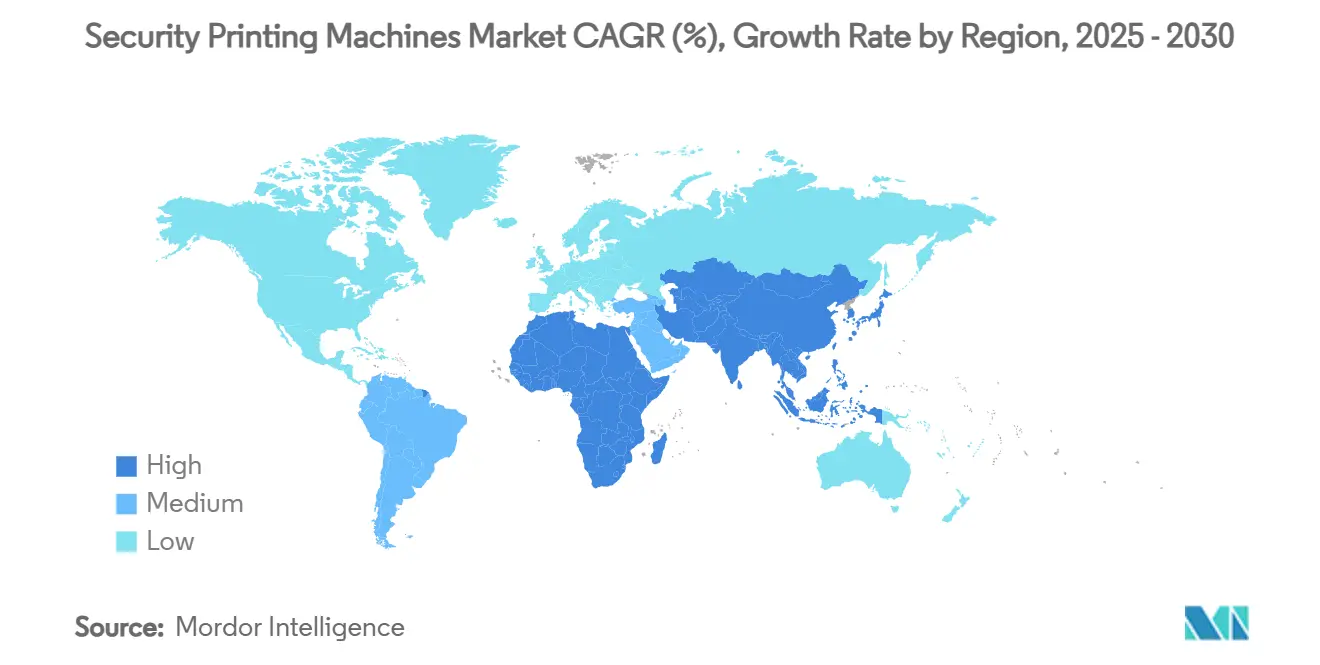
- By geography, Asia-Pacific is projected to rise at a 5.72% CAGR between 2025-2030.
Note: Market size and forecast figures in this report are generated using Mordor Intelligence’s proprietary estimation framework, updated with the latest available data and insights as of January 2026.
Market Trends and Insights
Drivers Impact Analysis of Security Printing Machines Market*
| Driver | (~) % Impact on CAGR Forecast | Geographic Relevance | Impact Timeline |
|---|---|---|---|
| Rising shift to polymer banknotes | +1.2% | Global (Canada, Australia, UK early adopters) | Medium term (2–4 years) |
| Modernisation to meet advanced security-feature demand | +0.9% | Europe and North America; spill-over to APAC | Long term (≥ 4 years) |
| Surge in e-passport and secure-ID programmes | +1.1% | APAC core, expanding to MEA and Latin America | Medium term (2–4 years) |
| AI-driven inline inspection boosting replacement cycle | +0.7% | North America and EU advanced markets | Short term (≤ 2 years) |
| CBDC-linked hybrid physical-digital security needs | +0.5% | Global pilots (China, EU, Caribbean) | Long term (≥ 4 years) |
| Source: Mordor Intelligence | |||
Rising Shift to Polymer Banknotes
Central banks are accelerating polymer adoption to curb counterfeiting and lengthen note lifespans. Japan’s July 2024 series uses high-definition watermarks and enhanced holograms, demanding precision intaglio and hybrid presses.[1]European Central Bank, “New Euro Banknote Themes Selected,” ecb.europa.euPolymer notes require presses capable of managing unique substrate tension and ink-adhesion profiles. The ECB’s forthcoming euro redesign, due in 2026, confirms sustained spending on polymer-ready machinery. Polymer durability also reduces replacement frequency, allowing issuers to justify higher initial press CAPEX through lifecycle savings, thereby fuelling an orderly yet persistent equipment upgrade wave.
Modernisation to Meet Advanced Security-Feature Demand
Counterfeit deterrence now depends on multilayer features, microtext, optically variable inks, tactile relief, and embedded threads that only ultra-precise presses can deliver. The ECB reported just 18 counterfeits per million genuine notes in 2024, a historic low attributed to advanced design and print methods. ICAO’s evolving Doc 9303 requirements for machine-readable travel documents elevate technical thresholds for passport producers.[2]International Civil Aviation Organization, “Doc 9303 Machine-Readable Travel Documents,” icao.int As reproduction tech improves, print lines need nanometer-level registration. This demand for accuracy drives recurring modernisation budgets across mature markets while setting new entry barriers in emerging economies.
Surge in E-passport and Secure-ID Programmes
Governments are rolling out biometric passports that blend RFID and printed security layers. ICAO’s TRIP framework standardises these documents, prompting procurement of presses that can personalise variable data without compromising embedded electronics. Emerging Asian states are especially active, spurred by tourism rebounds and border-security mandates. Each project triggers bundled orders for intaglio, inkjet-personalisation, and lamination lines. Vendors able to supply turnkey systems win long-term service contracts, supporting predictable annuity revenues even as banknote volumes plateau in cash-light economies.
Cashless-payment Migration Lowering Banknote Volumes
Contactless and mobile wallets now dominate retail payments in Scandinavia, the Netherlands, and urban North America. The ECB’s digital euro project underlines the policy pivot, even while insisting on parallel cash resilience.[3]European Central Bank, “Digital Euro Project Update,” ecb.europa.eu Falling circulation volumes lead many issuers to prioritise quality over capacity, dampening new-press orders. To compensate, vendors pivot to identity-document and tax-stamp niches, but overall utilisation in older banknote-centric lines declines.
Restraints Impact Analysis of Security Printing Machines Market*
| Restraint | % Impact on CAGR Forecast | Geographic Relevance | Impact Timeline |
|---|---|---|---|
| Cashless-payment migration lowering banknote volumes | -1.3% | Europe & North America advanced economies | Medium term (2-4 years) |
| High CAPEX & long tender cycles | -0.8% | Global, particularly affecting emerging markets | Long term (≥ 4 years) |
| Export-licence / dual-use restrictions on press sales | -0.4% | Global trade, concentrated impact on China, Russia, Iran | Short term (≤ 2 years) |
| Source: Mordor Intelligence | |||
High CAPEX and Long Tender Cycles
A complete state-of-the-art banknote line can exceed USD 10 million, with RFP to handover stretching 18-36 months. Budget cycles, security vetting, and multi-stage factory acceptance tests slow adoption, especially in lower-income countries. Financing hurdles often involve multilateral development banks or vendor-managed deferred-payment schemes, raising perceived credit risk for equipment makers and tempering headline revenue growth.
Export-Licence / Dual-Use Restrictions on Press Sales
Security presses are controlled as dual-use goods. Licences affecting spare parts or software updates have tightened, particularly for deliveries into Russia and Iran since 2024. Compliance costs lengthen lead times and in some cases force vendors to withdraw bids, trimming potential volume by 0.4% of CAGR during the forecast horizon.
*Our forecasts treat driver/restraint impacts as directional, not additive. The impact forecasts reflect baseline growth, mix effects, and variable interactions.
Security Printing Machines Market Segment Analysis
By Printing Process:
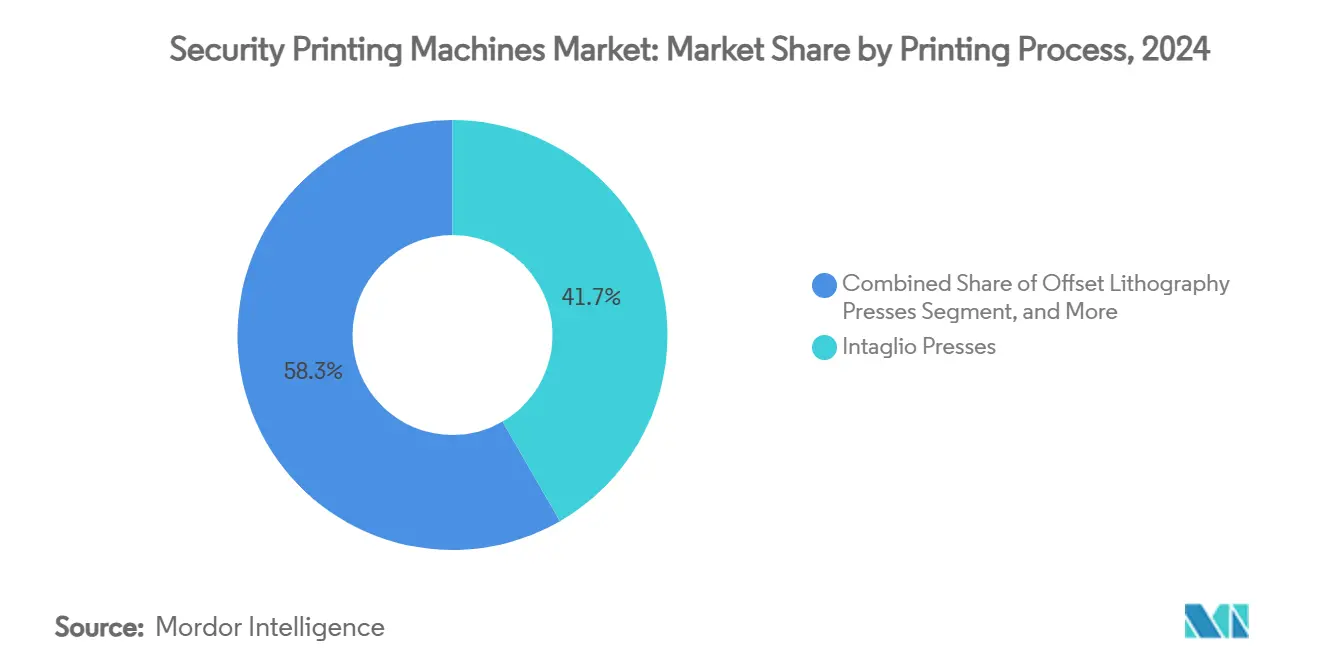
Intaglio Dominance Faces Digital DisruptionIntaglio presses accounted for 41.67% of the security printing machines market in 2024, underscoring their critical role in producing tactile, high-relief features impossible to emulate digitally. Deep-etched plates create raised ink lines that help the visually impaired verify authenticity and deter counterfeiters. Demand remains steady as central banks refresh designs to embed more sophisticated intaglio microtextures. The security printing machines market size tied to intaglio technology is projected to expand at a 3.9% CAGR, supported by ongoing currency-modernisation cycles.



By Substrate Material:
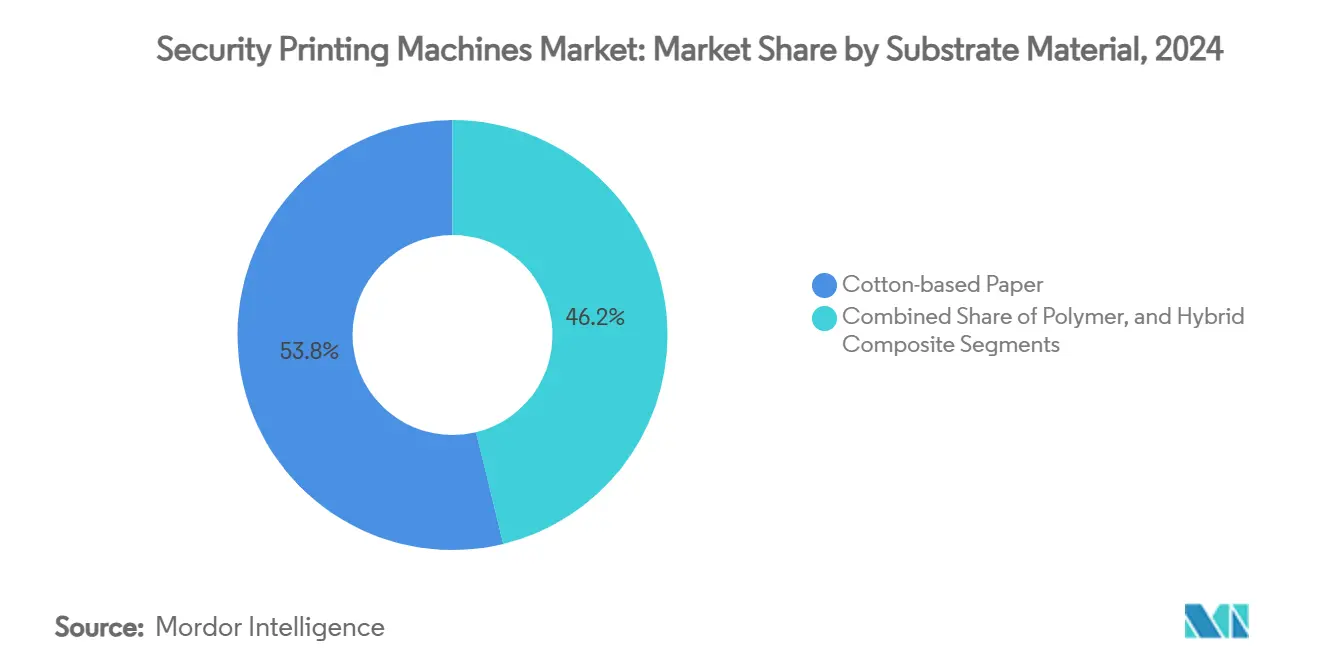
Polymer Innovation Drives GrowthCotton fibre paper maintained 53.79% of the security printing machines market share in 2024, valued for its tactile familiarity and proven press compatibility. Yet polymer substrates are forecast to post the strongest 6.06% CAGR through 2030 as issuers seek longer note lifecycles and advanced window-based features. Polymer notes last two-to-three times longer in circulation, offering lifecycle savings despite higher initial sheet costs. Upgrading from cotton to polymer entails retrofits such as modified dryer units, anti-static controls, and precise sheet-handling modules, generating incremental orders for specialist OEMs.
Composite substrates blending paper cores with polymer overlays are emerging, promising the best of both worlds, enhanced durability with a cotton-like tactile feel. Though still niche, this class spurs Research and Development investment among equipment suppliers eager to future-proof their offerings. As substrate diversity widens, presses capable of rapid switchover between materials gain an advantage in multi-document state printing houses.
By End-use Document Type:
Banknotes Lead Despite Digital HeadwindsBanknotes contributed 48.42% to the security printing machines market size in 2024, a share that persists thanks to continued cash usage across emerging Asia, Africa, and parts of Latin America. Even in mature economies, pandemic-driven cash withdrawals in 2024 highlighted the role of physical currency as a contingency store of value. Extensive anti-counterfeiting upgrades keep banknote presses fully booked, though unit volumes inch downward in cash-light regions.
Passports and ID cards form the fastest-expanding segment at 5.86% CAGR, driven by global migration, travel recovery, and national ID programmes. Each e-passport requires a secure chip-inlay embedding plus high-resolution holder photo printing. This technical complexity sustains premium pricing for hybrid inkjet-intaglio lines. Tax stamps, excise labels, and secure certificates hold mid-single-digit growth as governments clamp down on illicit trade. Meanwhile, cheque volumes retreat but continue to need niche security print runs, particularly for certified instruments and treasury warrants.
Geography Analysis
Europe Security Printing Machines Market
Europe commanded 36.23% of the security printing machines market in 2024, anchored by the ECB’s robust anti-counterfeiting regime and uniform currency cycles. The ECB’s 2025 design competition and 2026 rollout committee guarantee fresh capital outlays for intaglio lines and holographic foil applicators. Regional vendors, such as Heidelberger Druckmaschinen, target more than EUR 300 million in security and packaging revenue by 2029, leveraging established service networks.[4]Heidelberger Druckmaschinen AG, “Growth Strategy 2028/29,” heidelberg.com Strong regulatory oversight means European print shops prioritise precision and defect-free output, sustaining higher ASPs than other regions.
APAC Security Printing Machines Market
Asia-Pacific, posting a 5.72% CAGR, is the engine for incremental volume. Japan’s 2024 banknote series exemplifies regional appetite for cutting-edge features, Bank of Japan. China’s digital-yuan pilots create demand for hybrid redemption vouchers, while India’s Aadhaar-linked ID ecosystem requires scalable personalisation capacity. Southeast Asian nations, including Indonesia and Vietnam, plan full e-passport compliance by 2027, driving multi-press tenders and consumables contracts.
North America, LATAM and Africa Security Printing Machines Market
North America shows steady but slower growth as the U.S. Bureau of Engraving and Printing implements phased upgrades. State-level REAL-ID rollouts sustain passport-card volumes, although cheque and money-order demand erodes. Latin America and Africa offer long-term upside once macro-economic stability allows large-scale platform procurements. Multilateral financing increasingly underwrites these deals, helping vendors penetrate new markets without overexposing to sovereign-credit risk.

Competitive Landscape
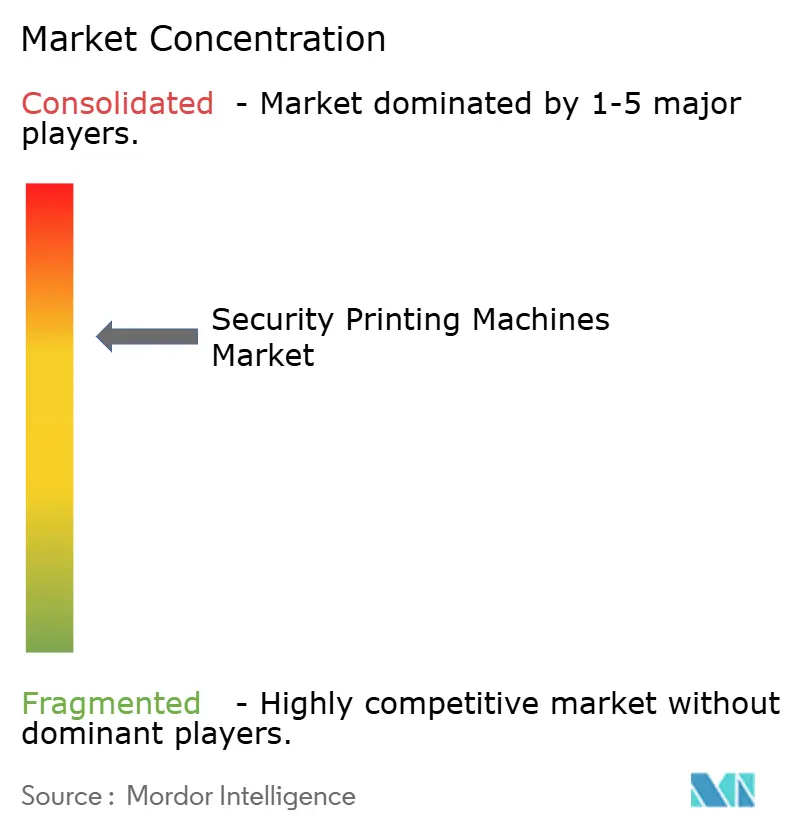
The security printing machines industry remains moderately concentrated. The top five OEMs account for an estimated 62% of revenue, led by Giesecke+Devrient, which posted record EUR 3 billion sales in 2023 and secured EUR 3.2 billion in orders for 2024. De La Rue, though exposed to banknote volume swings, maintained a GBP 239.2 million order book through 2024, signalling continued demand for its polymer-ready “Safeguard” presses. Komori–NTL and KBA-NotaSys focus on high-speed intaglio lines, while Heidelberg leverages sheet-fed offset heritage to supply background-printing modules and finishing systems.
Strategic moves centre on AI-enabled quality control and lifecycle services. In 2024, leading vendors released subscription-based predictive-maintenance platforms that bundle remote diagnostics with consumables contracts, locking in clients for up to 15 years. Joint ventures with local integrators in India and Indonesia aim to satisfy localisation rules and shorten service-response windows. Export-control compliance has become a competitive differentiator; firms with robust internal vetting face fewer shipment delays, win bids in sensitive jurisdictions.
Merger and Acquisition activity remains selective, targeting software analytics or specialty-substrate suppliers rather than full-press manufacturers. Vertical integration into holographic-foil or micro-lens film production secures critical inputs against supply chain shocks. Competitive pressure is expected to remain balanced high entry barriers offset volume volatility, supporting stable pricing power for incumbents even as cashless trends weigh on unit orders.
Security Printing Machines Industry Leaders
Koenig & Bauer Banknote Solutions
Komori Corporation
BW Papersystems
Mühlbauer Group
Gietz AG
- *Disclaimer: Major Players sorted in no particular order
Security Printing Machines Market Companies Covered in this Report
- Koenig and Bauer Banknote Solutions
- Komori Corporation
- BW Papersystems
- Hunkeler Systeme
- Gietz AG
- Mühlbauer Group
- Taiyo Kikai Ltd.
- Gallus (Heidelberg Group)
- SPGPrints
- Edale Ltd.
- Windmöller and Hölscher
- Nilpeter A/S
- Tangshan YIYANG
- MGI Digital Technology

Recent Industry Developments in Security Printing Machines Market
- January 2025: European Central Bank selected two artistic themes, “European Culture: Common Cultural Sites” and “Rivers and Birds: Strong through Diversity,” for the next euro banknote series, initiating design and security-feature prototyping that will underpin fresh equipment demand.
- September 2024: ECB confirmed continued digital-euro development while reaffirming commitment to high-security physical notes, signalling balanced investment in hybrid monetary infrastructure.
- July 2024: The Bank of Japan placed redesigned banknotes into circulation with high-definition watermarks, holography, and tactile intaglio, prompting nationwide press retrofits of the Bank of Japan.
- April 2024: Giesecke+Devrient reported record EUR 3 billion revenue for 2023, up 18%, supported by strong demand in Currency Technology and Digital Security segments.
- January 2024: ECB announced that only 16 counterfeit notes per million genuine notes were withdrawn in 2023, highlighting the effectiveness of current secure-printing technologies.


Global Security Printing Machines Market Report Scope
| Intaglio Presses |
| Offset Lithography Presses |
| Screen / Letterpress Machines |
| Digital Inkjet and Flexo-Hybrid Security Printers |
| Banknotes |
| Passports and ID Cards |
| Tax Stamps and Excise Labels |
| Cheques and Certificates |
| Others (Tickets, Brand-Protection Labels) |
| Cotton-based Paper |
| Polymer |
| Hybrid Composite |
| North America | United States |
| Canada | |
| Mexico | |
| South America | Brazil |
| Argentina | |
| Rest of South America | |
| Europe | Germany |
| United Kingdom | |
| France | |
| Italy | |
| Rest of Europe | |
| Asia Pacific | China |
| Japan | |
| South Korea | |
| India | |
| Rest of Asia-Pacific | |
| Middle East and Africa | Saudi Arabia |
| United Arab Emirates | |
| Turkey | |
| South Africa | |
| Rest of Middle East and Africa |
| By Printing Process | Intaglio Presses | |
| Offset Lithography Presses | ||
| Screen / Letterpress Machines | ||
| Digital Inkjet and Flexo-Hybrid Security Printers | ||
| By End-use Document Type | Banknotes | |
| Passports and ID Cards | ||
| Tax Stamps and Excise Labels | ||
| Cheques and Certificates | ||
| Others (Tickets, Brand-Protection Labels) | ||
| By Substrate Material | Cotton-based Paper | |
| Polymer | ||
| Hybrid Composite | ||
| By Geography | North America | United States |
| Canada | ||
| Mexico | ||
| South America | Brazil | |
| Argentina | ||
| Rest of South America | ||
| Europe | Germany | |
| United Kingdom | ||
| France | ||
| Italy | ||
| Rest of Europe | ||
| Asia Pacific | China | |
| Japan | ||
| South Korea | ||
| India | ||
| Rest of Asia-Pacific | ||
| Middle East and Africa | Saudi Arabia | |
| United Arab Emirates | ||
| Turkey | ||
| South Africa | ||
| Rest of Middle East and Africa | ||


Key Questions Answered in the Report
What is the current size of the security printing machines market?
The market is valued at USD 1.43 billion in 2025 and is projected to reach USD 1.81 billion by 2030.
Which region leads the security printing machines market?
Europe held a 36.23% share in 2024, driven by stringent ECB anti-counterfeiting standards and ongoing banknote redesigns.
What segment is growing fastest within the market?
Digital inkjet and flexo-hybrid presses are forecast to grow at 5.93% CAGR, reflecting rising demand for variable data and personalised security documents.
How are polymer banknotes affecting equipment demand?
Polymer substrates, expanding at a 6.06% CAGR, require specialised presses, driving replacement cycles even where banknote volumes are flat.
Page last updated on:





