
Qatar Transportation Infrastructure Construction Market Size and Share
Market Overview
| Study Period | 2020 - 2031 |
|---|---|
| Forecast Data Period | 2026 - 2031 |
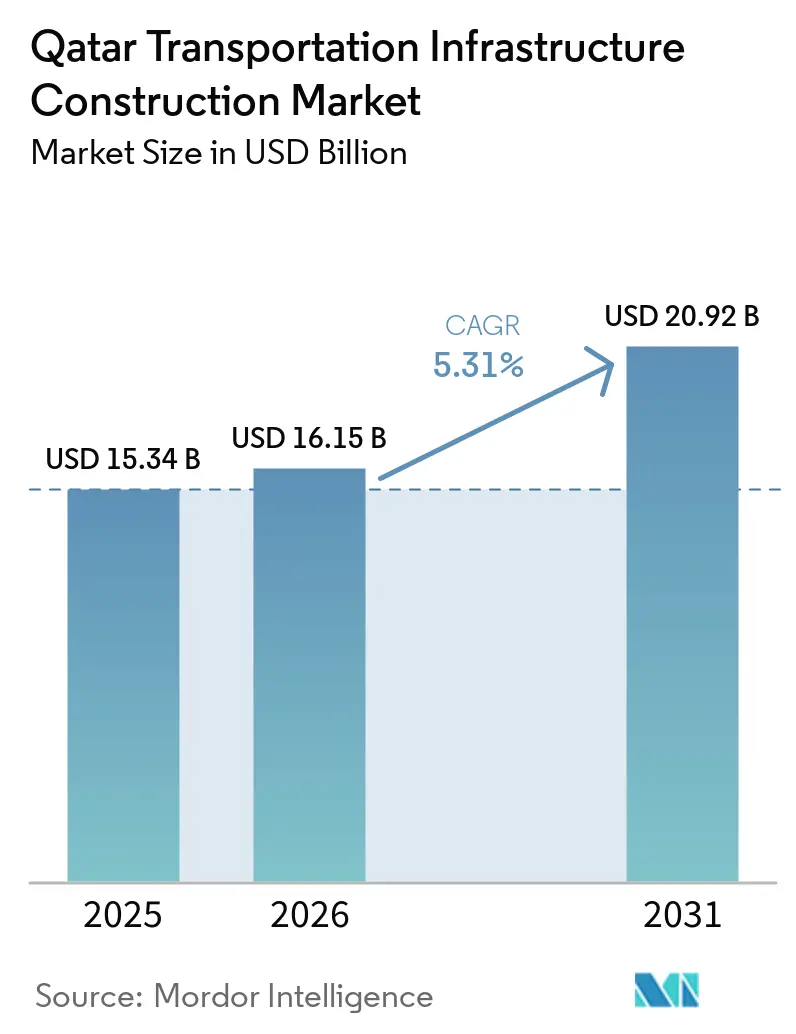
| Base Year Market Size (2025) | USD 15.34 Billion |
| Market Size (2026) | USD 16.15 Billion |
| Market Size (2031) | USD 20.92 Billion |
| Growth Rate (2026 - 2031) | 5.31 % |
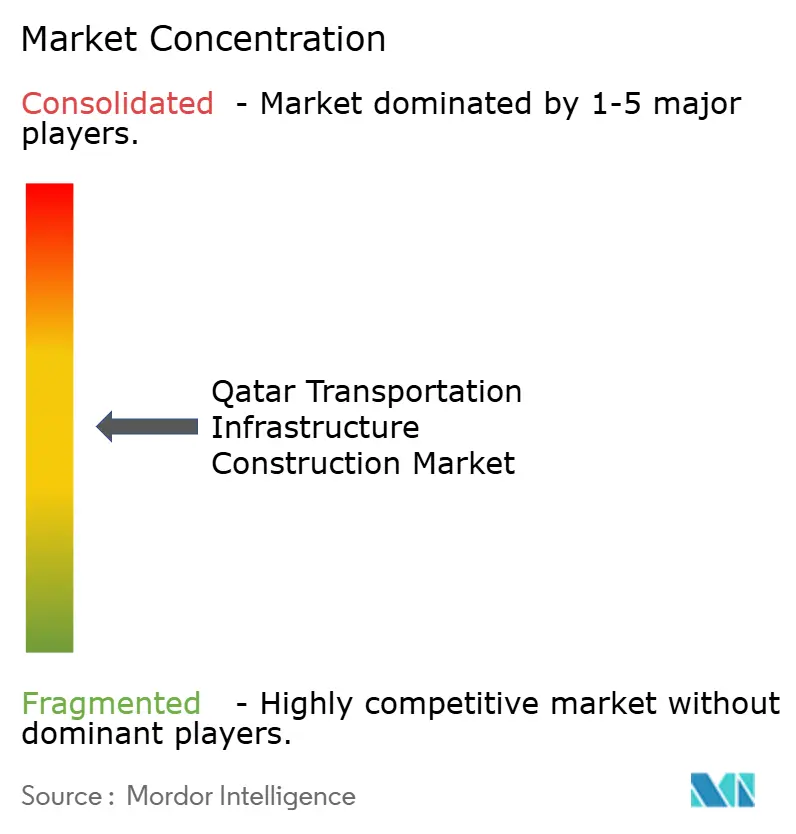
| Market Concentration | Medium |
Major Players *Disclaimer: Major Players sorted in no particular order Image © Mordor Intelligence. Reuse requires attribution under CC BY 4.0. | |
Qatar Transportation Infrastructure Construction Market Analysis by Mordor Intelligence
The Qatar Transportation Infrastructure Construction Market size is expected to grow from USD 15.34 billion in 2025 to USD 16.15 billion in 2026 and is forecast to reach USD 20.92 billion by 2031 at 5.31% CAGR over 2026-2031.
The Qatar transportation infrastructure construction market is now being shaped by long-cycle national connectivity priorities rather than event-led construction, with Qatar National Vision 2030 and the Third National Development Strategy directing capital toward durable multi-modal assets. The Ministry of Transport's strategy for 2025 to 2030 sets out 125 projects across 42 initiatives, with investment exceeding USD 330 million and a target of 40% private-sector participation, signaling a broader push to deepen delivery capacity beyond state-funded execution. The Qatar transportation infrastructure construction market is also benefiting from stronger links between urban mobility, logistics corridors, ports, and future cross-border rail, which is widening the pipeline beyond central Doha and supporting more distributed project demand. Competition remains moderately concentrated, yet the rise in local supplier participation to 77% of contract value is changing how international and domestic firms position themselves for bids and execution. Regional tensions continue to create cost and timing pressures for imported materials and equipment. Still, sovereign backing and a deep public pipeline continue to support the Qatar transportation infrastructure construction market over the forecast period.
Key Report Takeaways
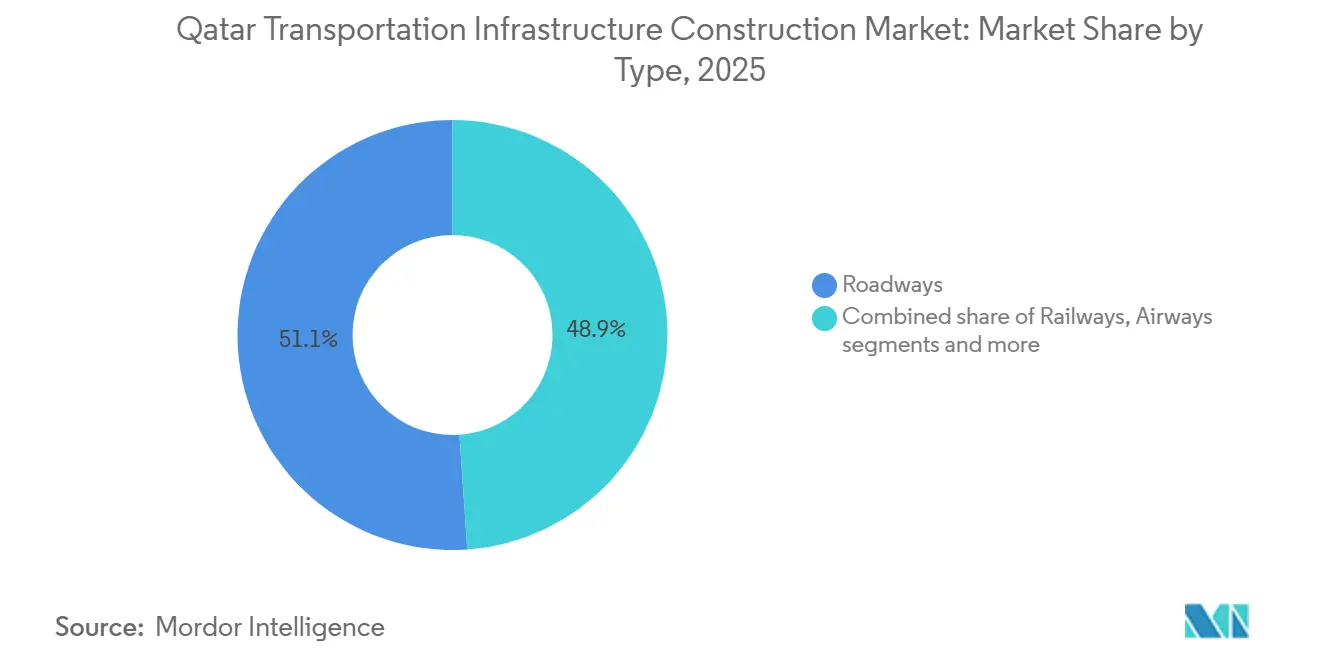
- By type, roadways led with a 51.1% of the Qatar transportation infrastructure construction market share in 2025, while railways are projected to expand at 6.21% CAGR through 2031.
- By construction type, new construction accounted for 78.9% of the Qatar transportation infrastructure construction market size in 2025, while renovation is set to grow at 5.98% CAGR through 2031.
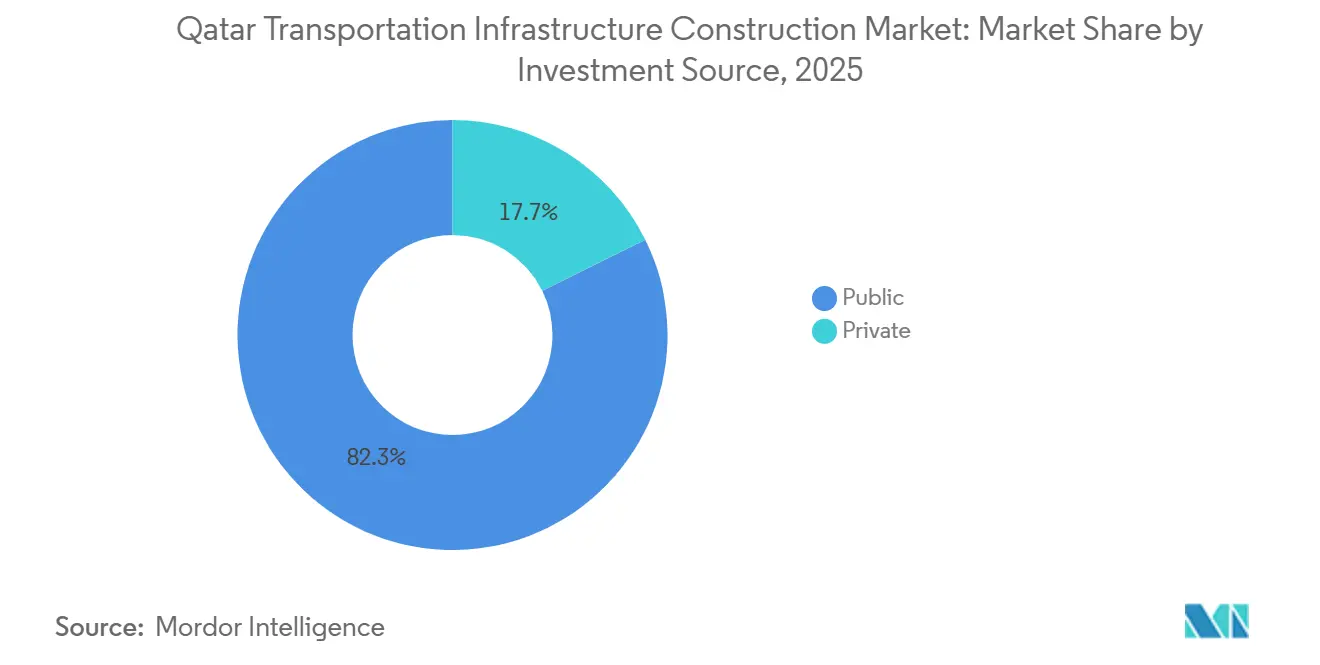
- By investment source, public investment accounted for 82.3% in 2025, while private investment is forecast to record the highest CAGR of 6.11% through 2031.
- By key cities, Doha held a 42.7% share in 2025, while Lusail is projected to grow at 6.43% CAGR through 2031.
Note: Market size and forecast figures in this report are generated using Mordor Intelligence’s proprietary estimation framework, updated with the latest available data and insights as of January 2026.
Qatar Transportation Infrastructure Construction Market Trends and Insights
Drivers Impact Analysis*
| Drivers | (~) % Impact on CAGR Forecast | Geographic Relevance | Impact Timeline |
|---|---|---|---|
| Continued Investment in Road, Rail, Metro, and Port Infrastructure Under the National Vision 2030 Development Agenda | +1.2% | National, with concentration in Doha, Lusail, and key inter-city corridors | Long term (≥ 4 years) |
| Expansion of Logistics and Trade Infrastructure Supporting Qatar's Position as a Regional Transportation Hub | +0.8% | Hamad Port, Ras Bufontas Free Zone, Umm Alhoul, and Al Wukair logistics zones | Medium term (2-4 years) |
| Ongoing Urban Development and New City Projects Driving Demand for Transportation Connectivity Infrastructure | +0.7% | Lusail, Al Daayen, Al Rayyan, Semaisma, and secondary residential corridors | Medium term (2-4 years) |
| Growing Investments in Intelligent Transportation Systems (ITS) and Smart Mobility Solutions Across the Transport Network | +0.6% | National, with high concentration in Doha and Lusail | Medium term (2-4 years) |
| Increasing Industrial and Economic Zone Developments Creating Demand for Road and Freight Transportation Infrastructure | +0.5% | Manateq logistics zones, Birkat Al Awamer, and Ras Laffan Industrial City | Medium term (2-4 years) |
| Source: Mordor Intelligence | |||
Continued Investment in Road, Rail, Metro, and Port Infrastructure Under the National Vision 2030 Development Agenda
The Qatar transportation infrastructure construction market is being supported by a planning framework that now reaches well beyond short-term asset delivery. The Ministry of Transport's strategy for 2025 to 2030 includes 125 projects under 42 initiatives, with investment above USD 330 million and a target to raise private-sector participation to 40%, while also aiming to double the transport sector's contribution to gross domestic product[1]Ministry of Transport Qatar, “MOT Strategy 2025–2030, Reaching Beyond Horizons,” Ministry of Transport, mot.gov.qa. Ashghal’s five-year plan for 2025 to 2029 reached USD 22.2 billion, which keeps roads, drainage, public buildings, and tunnel works active across both core and secondary districts. Planning and Statistics Authority data showed construction value-added growth of 9.1% year on year in the third quarter of 2025, after 8.7% in the second quarter and 4.4% in the first quarter, confirming strong execution momentum across the wider construction base that supports the Qatar transportation infrastructure construction market[2]Planning and Statistics Authority Qatar, “Qatar Construction Industry Value-Add Growth Figures,” Planning and Statistics Authority, psa.gov.qa . The 2026 budget also kept tender activity active, indicating this demand cycle is tied to multi-year national priorities rather than one-off event preparation. This gives the market a steadier base for project continuity through the forecast period.
Expansion of Logistics and Trade Infrastructure Supporting Qatar's Position as a Regional Transportation Hub
The Qatar transportation infrastructure construction market is also gaining support from logistics and trade activities that sit alongside the urban mobility pipeline. Qatar’s ports handled 1.46 million twenty-foot equivalent units in 2025, and building materials moving through the three ports rose 106% year on year, which directly supports continued demand for port access roads, freight interfaces, and related transport links. The Ministry of Communications and Information Technology and the Ministry of Transport launched the Transport and Logistics Digital Transformation Roadmap in November 2025 with 39 strategic initiatives, and the program is expected to add USD 76.4 million to non-hydrocarbon information and communications technology output[3]Ministry of Communications and Information Technology Qatar and Ministry of Transport Qatar, “Transport and Logistics Digital Transformation Roadmap Launch at MWC25 Doha,” Ministry of Communications and Information Technology, mcit.gov.qa. This matters because better freight visibility shifts capacity needs and increases the value of intermodal links across roads, rail, and ports. As logistics parks and free zones expand, the Qatar transportation infrastructure construction market is likely to see steadier demand driven by freight movement requirements rather than passenger mobility projects. It also gives transport construction a stronger economic role beyond urban commuting needs.
Ongoing Urban Development and New City Projects Driving Demand for Transportation Connectivity Infrastructure
The Qatar transportation infrastructure construction market is now drawing stronger support from urban development outside the traditional Doha core. Lusail remains the clearest example because it was planned as a transit-oriented city, and its tram network has carried more than 10 million cumulative passengers since launch. At the same time, the turquoise extension became operational in 2025. Ashghal also reported 67 projects in the first quarter of 2026 across roads, intersections, and drainage, indicating that transport connectivity work is now extending across both major corridors and secondary residential areas. This wider urban build-out reduces the earlier concentration of opportunities in central Doha and gives the Qatar transportation infrastructure construction market a broader geographic base. It also creates a larger role for domestic contractors and specialist suppliers, as more projects now sit at the district and neighborhood levels rather than only at the mega-project scale. That makes demand less concentrated and more evenly spread across the country’s developing urban zones.
Growing Investments in Intelligent Transportation Systems (ITS) and Smart Mobility Solutions Across the Transport Network
The Qatar transportation infrastructure construction market is entering a phase in which digital systems are becoming part of the core construction scope. Ashghal awarded contracts worth USD 3.3 billion in September 2025 across roads, drainage, public buildings, and intelligent transportation systems, and the package included artificial intelligence-based digital management, self-driving survey vehicles, laser road defect detection, and smart monitoring systems. Mowasalat, which operates as Karwa, started robotaxi trials in January 2026 under the Autonomous Vehicle Strategy for 2025 to 2030, which is adding pressure for roads and related infrastructure to support sensor-heavy mobility systems. The digital roadmap launched by the Ministry of Communications and Information Technology and the Ministry of Transport shows that future asset value will increasingly depend on data, control systems, and network integration. This is raising the technical threshold for delivery in the Qatar transportation infrastructure construction market and is changing how contractors compete for higher-value work. It is also starting to lift specification intensity in smart transport corridors such as Doha and Lusail.
Restraints Impact Analysis*
| Restraints | (~) % IMPACT ON CAGR FORECAST | Geographic Relevance | Impact Timeline |
|---|---|---|---|
| Rising Geopolitical Tensions in the Middle East Impacting Investor Confidence and Project Execution Timelines | -0.7% | National, with greater exposure around Hamad Port, Ras Laffan, and major Doha nodes | Short term (≤ 2 years) |
| Dependence on Government Spending and Hydrocarbon Revenues Influencing Infrastructure Investment Cycles | -0.5% | National, with direct exposure across the public project pipeline | Long term (≥ 4 years) |
| Rising Construction Material and Labor Costs Increasing Transportation Infrastructure Project Expenses | -0.4% | National, with a stronger impact in Doha, Lusail, and major corridors | Medium term (2-4 years) |
| Source: Mordor Intelligence | |||
Rising Geopolitical Tensions in the Middle East Impacting Investor Confidence and Project Execution Timelines
The Qatar transportation infrastructure construction market faces its clearest near-term constraint from regional instability. Transport projects still depend on imported steel, cement, heavy equipment, and specialist systems, so any logistics disruption can quickly affect procurement timing and on-site sequencing. This also tends to increase insurance costs and bidder caution, narrowing competition on technically complex packages. Large public projects remain more protected than purely private developments, yet the shared logistics chain means the effect still spreads across the full delivery base. As a result, the Qatar transportation infrastructure construction market remains active, but contractors are likely to place greater weight on sourcing resilience and schedule flexibility in 2026. These pressures are likely to remain most visible in projects with high levels of imported material content.
Dependence on Government Spending and Hydrocarbon Revenues Influencing Infrastructure Investment Cycles
The Qatar transportation infrastructure construction market still relies heavily on sovereign funding, with public investment accounting for 82.3% of spending in 2025. That structure supports scale and continuity, but it also means project timing can remain sensitive to public budget priorities and the broader hydrocarbon revenue cycle. The policy response is already evident, as the Ministry of Transport's strategy targets 40% private-sector participation, and the 2026 state budget authorized the Ministry of Finance to assess suitable infrastructure projects for transfer to private execution vehicles. The contractor base has also widened, which helps, but private financing depth is still developing compared with the scale of the public pipeline. This means the Qatar transportation infrastructure construction market is likely to stay structurally led by the state even as private participation expands. Over time, the pace of diversification in funding will influence the balance of the project pipeline.
*Our forecasts treat driver/restraint impacts as directional, not additive. The impact forecasts reflect baseline growth, mix effects, and variable interactions.
Segment Analysis
By Type: Railways Redefine the National Connectivity Agenda
Roadways accounted for 51.1% of the Qatar transportation infrastructure construction market share in 2025, making them the largest segment across expressways, connector roads, and inter-city links. The scale of active roadwork remains substantial, as Ashghal reported 67 projects in the first quarter of 2026 across roads, intersections, and drainage in both primary and secondary districts. This keeps roadways central to Qatar's transportation infrastructure construction market, even as capital starts to spread toward more multi-modal assets. Railways are the fastest-growing type segment, with a 6.21% CAGR from 2026 to 2031, reflecting a stronger push to connect metro, tram, and airport systems, as well as the future cross-border corridor. The Doha Metro Blue Line is scheduled for final delivery in 2026, with 17.5 km of track and 14 stations linking Hamad International Airport Terminal 2 to West Bay. This project reinforces rail’s role in the next stage of national connectivity.
The rail case is becoming stronger because several projects are now feeding into one another rather than progressing as isolated assets. Lusail Tram upgrades kept rail work active in 2025 and 2026, while the Qatar-Saudi high-speed rail agreement, signed in December 2025, created a new long-distance corridor of 785 km, with trains expected to exceed 300 km/h and capacity targeted at 10 million passengers per year. Airways, ports, and inland waterways remain smaller within the type split, but they still add significant project volume through airport access, quayside infrastructure, and port-side logistics links. Port activity provides that segment with a direct construction signal, as building materials handled at Qatar’s ports rose 106% in 2025, supporting greater access and freight infrastructure around the maritime gateway. This keeps the type mix broad, even while roads remain dominant and rail accelerates fastest. The result is a more connected and less single-mode project structure for the years ahead.



By Construction Type: Renovation Signals Infrastructure Maturation
New construction accounted for 78.9% of the Qatar transportation infrastructure construction market in 2025, indicating that greenfield delivery still dominates the current pipeline. Large outer-district programs, network extensions, and new connectivity links continue to keep fresh build activity at the center of the Qatar transportation infrastructure construction market. Renovation is the fastest-growing construction type, with a 5.98% CAGR from 2026 to 2031, marking the start of a more organized renewal cycle for assets delivered between 2015 and 2022. This is an important shift because it broadens contract demand beyond expansion and begins to normalize recurring upgrades, rehabilitation, and lifecycle work. The June 2026 suspension of the Lusail Tram at-grade section for network-wide upgrades gave a clear example of this transition from build-out to asset improvement. It shows that transport assets are now entering a more mature operational phase.
Renovation is also becoming more formal within procurement practice. Ashghal’s September 2025 package, worth USD 3.3 billion, covered roads, drainage, public buildings, and intelligent transportation systems, and it helped establish operations and maintenance work as a recurring contract stream rather than an occasional add-on. This helps smaller domestic firms because rehabilitation, pavement renewal, intersection upgrades, and smart retrofits are more accessible than metro tunneling or major elevated structures. At the same time, qualification standards are rising as asset management capability and structured maintenance planning become increasingly important in tender design. That combination should keep the Qatar transportation infrastructure construction market balanced between large-scale expansion and a steadily growing renewal segment through 2031. It also means future competition will depend on both build capability and lifecycle service capacity.
By Investment Source: Private Financing Gaining Structural Traction
Public investment accounted for 82.3% in 2025, confirming that the Qatar transportation infrastructure construction market remains overwhelmingly state-led in terms of funding. That dominance reflects long-established sovereign control over transport, utilities, and the delivery of city-scale infrastructure. Private investment is projected to grow at 6.11% CAGR from 2026 to 2031, and this shift is being driven by policy design rather than spontaneous market change. The Ministry of Transport strategy targeted 40% private-sector participation across its 125 projects, and the 2026 state budget authorized review and transfer of suitable projects into private-sector execution vehicles. This means the Qatar transportation infrastructure construction market is beginning to build a financing base broader than just direct annual public appropriations. The change is gradual but increasingly visible in planning and project structuring.
Execution capacity is also supporting that transition. Ashghal’s public-private partnership approach has already been used for infrastructure development across more than 5,500 residential plots, and the number of registered firms in Ashghal’s contractor database rose from 201 in the first quarter of 2022 to 733 by the third quarter of 2024. Free-zone incentives in Ras Bufontas and Umm Alhoul are also attracting logistics and light manufacturing activity that requires road and freight connectivity, creating infrastructure demand that does not always appear as a line item in traditional public budgets. The result is a Qatar transportation infrastructure construction market where public money remains dominant. Still, private capital is gaining a more visible structural role in delivery and in shaping the future pipeline. This broadens the long-term funding mix without altering the market’s near-term state-led character. It also creates a larger opportunity set for firms with financing and concession experience.
Geography Analysis
Doha held 42.7% of the Qatar transportation infrastructure construction market share in 2025, making it the largest geography by value. The city has the most mature transport asset base in the country, with the Doha Metro network, active expressway and intersection works, and port-linked infrastructure in the south all concentrated within or around the capital. The regulatory framework also remains stable, as the Ministry of Transport and Ashghal continue to operate under Qatar National Vision 2030 and the Qatar Construction Specifications 2014 framework. In 2026, the Doha Metro Blue Line adds 17.5 km of new track and 14 stations between Hamad International Airport Terminal 2 and West Bay, which will support another phase of access-road, interchange, and station-adjacent construction. This keeps Doha at the center of Qatar's transportation infrastructure construction market, even as the geographic spread widens.
Lusail is the fastest-growing geography, with a 6.43% CAGR from 2026 to 2031, and the Qatar transportation infrastructure construction market in this city is being boosted by the overlap between transit expansion and smart-city infrastructure. The turquoise Lusail Tram extension became operational in 2025, the city runs one of the world’s largest electric bus depots, and real-time monitoring systems keep digital infrastructure closely tied to physical transport upgrades. Al Rayyan and Al Daayen remain in active road and infrastructure development phases, which support a stronger westward and northward expansion path for the Qatar transportation infrastructure construction market. The completion of the Al Kharaitiyat and Izghawa Package 2 in May 2026, with 46 km of roads, 3 signal-controlled intersections, and 51 km of drainage networks, demonstrates that connectivity investment is now moving into secondary districts at scale. This confirms that transport construction is no longer concentrated only in the most established urban core.
The Rest of Qatar segment is receiving more structured investment than in previous cycles, especially across coastal, industrial, and logistics corridors. Birkat Al Awamer, Semaisma, and Al Wukair all point to demand now linked to logistics access, industrial land development, and outer-district settlement growth rather than solely to capital-city congestion relief. This matters because it makes the Qatar transportation infrastructure construction market more spatially diverse and less dependent on one metropolitan core. The Qatar-Saudi high-speed rail agreement, signed in December 2025 and ratified in February 2026, also creates a new national corridor linking Doha to the Salwa border as part of the wider 785 km Doha-Riyadh route. This corridor is likely to reshape the distribution of future transport construction demand across Qatar over the medium term. It also introduces a new strategic geography that has historically received less dedicated transport investment.
Competitive Landscape
The Qatar transportation infrastructure construction market is moderately concentrated, with high-value contracts still clustering around a relatively small group of government-linked owners, large domestic contractors, and established international engineering firms. Ashghal remains the dominant project owner and procurer, and the 2026 budget kept its tender pipeline active with USD 13.5 billion in planned tenders, while Qatar Rail continues to anchor the rail segment as owner, developer, and operator of the national rail network. International firms such as Webuild, Vinci Construction (through Qatari Diar Vinci Construction), Hyundai Engineering and Construction, China Railway Construction Corporation, and Consolidated Contractors Company often work with local partners to meet in-country value requirements and comply with Ashghal tender conditions. Local contractors such as HBK Contracting Company, Midmac Contracting Company, and Al Jaber Engineering keep an edge in mobilization, local sourcing, and familiarity with public-sector delivery practices. This mix keeps the Qatar transportation infrastructure construction market open to foreign expertise, but still anchored by strong domestic execution networks.
Competitive positioning is shifting toward digital delivery and multi-modal integration. Ashghal’s September 2025 award package, worth USD 3.3 billion, included intelligent transportation systems, artificial intelligence-based management platforms, self-driving survey vehicles, and smart condition monitoring, which shows that the technical scope is expanding beyond traditional civil works. Webuild and Hyundai Engineering and Construction signed a memorandum of understanding in March 2026 to pursue port, airport, defense infrastructure, and green energy projects through public-private partnership, engineering, procurement, and construction, and design-build structures, which gives both firms a stronger route into the kind of multi-asset programs now emerging in the Qatar transportation infrastructure construction market. Egis also strengthened its visible position through the 10-year highway operations and maintenance framework awarded in September 2025 with local partners, which reinforces the growing value of lifecycle capability in this market. These moves show that contractor differentiation is increasingly tied to digital, operational, and multimodal strengths rather than solely to construction scale.
A second layer of competition is forming around specialist capability rather than simple scale. Parsons, Mott MacDonald, and Bechtel are well placed to provide transport programs with planning, program management, and asset lifecycle support, rather than only physical construction. Tekfen Construction and PORR compete where underground civil work and tunnel expertise matter more than a broad contractor footprint. Acciona and Samsung C&T remain relevant where integrated design-build execution and higher technical coordination are required across transport interfaces. This keeps the Qatar transportation infrastructure construction market balanced: mega-project awards are concentrated, but renovation, district roads, and smart mobility upgrades create space for a wider set of firms to compete. The result is a market where concentration is visible at the top, yet the competitive field remains active beneath the largest contract tier.
Qatar Transportation Infrastructure Construction Industry Leaders
Qatar Rail
Ashghal
HBK Contracting Company W.L.L.
Qatari Diar
Midmac Contracting Company W.L.L.
- *Disclaimer: Major Players sorted in no particular order

Recent Industry Developments
- June 2026: Qatar's Ministry of Transport launched the first stakeholder workshop for the Qatar Public Transport Master Plan, a long-range initiative to expand and integrate public transport across the country as part of the Ministry of Transport Strategy 2025 to 2030 and Qatar National Vision 2030. The plan, developed in partnership with Egis, is intended to produce practical investment prioritization tools for future transport infrastructure and is directly linked to the broader multi-modal connectivity mandate.
- March 2026: Webuild and Hyundai Engineering and Construction signed a memorandum of understanding to strengthen their global infrastructure partnership, with a focus on port, airport, and defense infrastructure, as well as the green energy sector. The Memorandum of understanding provides for the creation of project-specific joint ventures under public-private partnership, engineering, procurement, and construction, and design-build frameworks, enhancing both firms' competitiveness in high-value infrastructure niches globally.
- February 2026: The Saudi Council of Ministers ratified the Qatar-Saudi high-speed electric railway agreement, advancing the 785 km Doha-Riyadh corridor at speeds exceeding 300 km per hour with stops at Al-Hofuf and Dammam, and inter-airport connections at King Salman International Airport and Hamad International Airport. The project targets 10 million passengers annually and is projected to be completed in 6 years, creating direct transportation infrastructure construction demand across Qatar's northern corridor.
- February 2026: Ashghal announced the awarding and tendering of 20 new projects, valued at USD 3.16 billion, including road and infrastructure development projects in Izghawa and Al Thumid, as well as the Hamad General Hospital redevelopment. The package also covers residential land infrastructure for citizens' plots across northern and southern Qatar.


Qatar Transportation Infrastructure Construction Market Report Scope
The Qatar Transportation Infrastructure Construction Market Report is Segmented by Type (Roadways, Railways, Airways, Ports, and Inland Waterways), Construction Type (New Construction and Renovation), Investment Source (Public and Private), and Key Cities (Doha, Al Rayyan, Al Daayen, Lusail, and Rest of Qatar). The Market Forecasts are Provided in Terms of Value (USD).
| Roadways |
| Railways |
| Airways |
| Ports and Inland Waterways |
| New Construction |
| Renovation |
| Public |
| Private |
| Doha |
| Al Rayyan |
| Al Daayen |
| Lusail |
| Rest of Qatar |
| By Type | Roadways |
| Railways | |
| Airways | |
| Ports and Inland Waterways | |
| By Construction Type | New Construction |
| Renovation | |
| By Investment Source | Public |
| Private | |
| By Key Cities | Doha |
| Al Rayyan | |
| Al Daayen | |
| Lusail | |
| Rest of Qatar |


Key Questions Answered in the Report
What is the outlook for Qatar's transportation infrastructure construction through 2031?
The sector is projected to rise from USD 16.15 billion in 2026 to USD 20.92 billion by 2031 at a 5.31% CAGR, supported by national connectivity plans, road programs, and rail expansion.
Which transport mode accounts for the most spending in Qatar right now?
Roadways led with a 51.1% share in 2025 because expressways, municipal road works, and inter-city links still account for the largest active construction base.
Which segment of Qatar's transportation infrastructure construction is growing fastest?
Railways are the fastest-growing segment, with a 6.21% CAGR through 2031, supported by the Doha Metro Blue Line, Lusail Tram upgrades, and the Qatar-Saudi rail corridor.
Why is private investment becoming more important in this space?
Public funding still dominated with 82.3% share in 2025, but policy now targets 40% private-sector participation, and suitable projects are being prepared for private execution vehicles.
Which city is likely to see the strongest growth in transport construction?
Lusail is projected to grow at the fastest pace, with a 6.43% CAGR, as its tram network, smart-city systems, and transit-oriented layout continue to drive higher-specification infrastructure.
What are the main risks affecting project delivery in Qatar?
The main near-term risks are regional tensions, dependence on imported materials and equipment, and cost pressure, which can affect procurement timing, pricing, and bidder participation.
Page last updated on:





