
Market Overview
| Study Period | 2020 - 2031 |
|---|---|
| Forecast Data Period | 2026 - 2031 |
| Base Year Market Size (2025) | USD 11.5 Billion |
| Market Size (2026) | USD 12.16 Billion |
| Market Size (2031) | USD 16.03 Billion |
| Growth Rate (2026 - 2031) | 5.70 % |
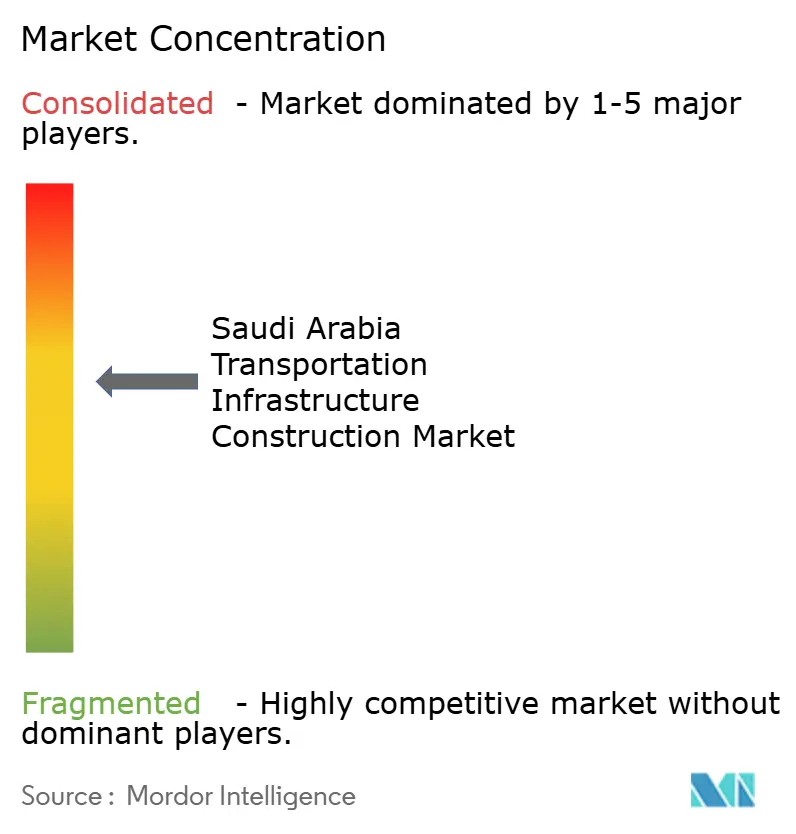
| Market Concentration | Medium |
Major Players *Disclaimer: Major Players sorted in no particular order Image © Mordor Intelligence. Reuse requires attribution under CC BY 4.0. | |
Saudi Arabia Transportation Infrastructure Construction Market Analysis by Mordor Intelligence
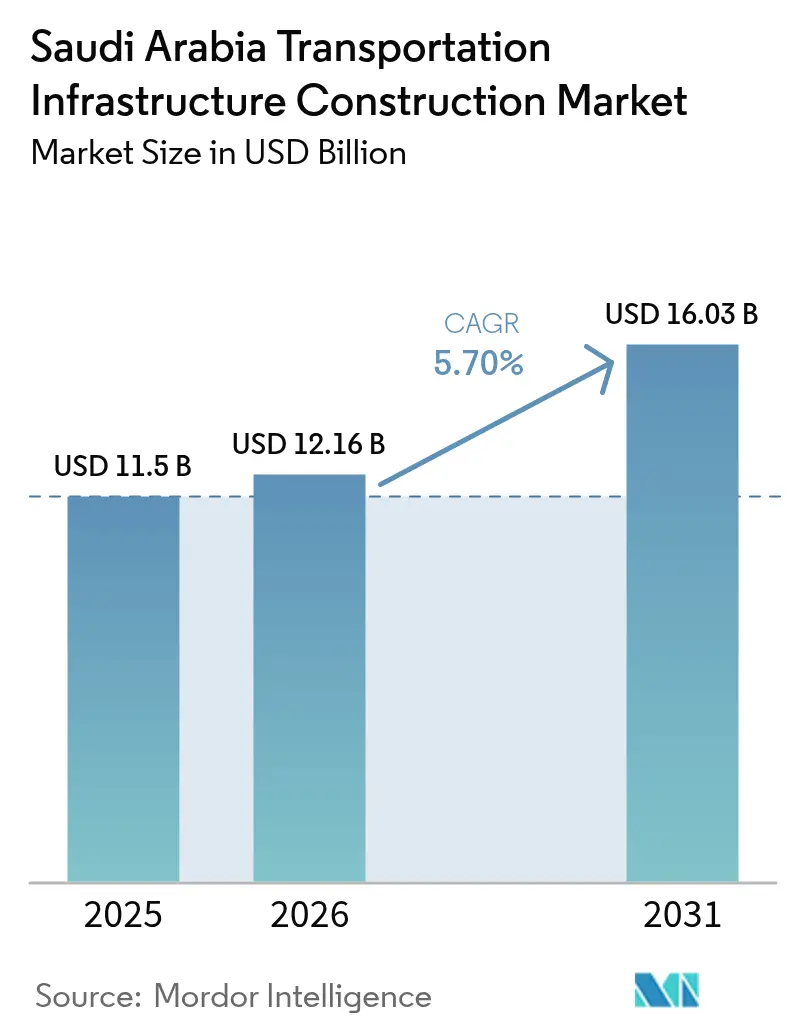
Saudi Arabia transportation infrastructure construction market size in 2026 is estimated at USD 12.16 billion, growing from 2025 value of USD 11.5 billion with 2031 projections showing USD 16.03 billion, growing at 5.7% CAGR over 2026-2031. Capital deployed through the Public Investment Fund, Vision 2030-linked giga-projects, and a maturing public-private partnership framework stand out as the principal expansion catalysts. Road upgrades, metro build-outs, and port modernizations keep commissioning activity high, while the King Salman International Airport project underpins aviation infrastructure growth. Private capital is increasingly visible, aided by clearer risk-allocation rules and bankable project pipelines. The market also benefits from an ecosystem that rewards digital engineering, modular building, and green mobility solutions, helping contractors maintain cost discipline despite escalations in steel, cement, and imported equipment.
Key Report Takeaways
- By type, roadways held a 44.10% revenue share of the Saudi Arabia transportation infrastructure construction market in 2025. The Saudi Arabia transportation infrastructure construction market for railways is poised for the fastest 6.28% CAGR between 2026-2031.
- By construction type, new construction accounted for 78.25% of the Saudi Arabia transportation infrastructure construction market share in 2025. The Saudi Arabia transportation infrastructure construction market for renovation is projected to expand at a 6.05% CAGR between 2026-2031.
- By investment source, the public segment controlled 80.65% of the Saudi Arabia transportation infrastructure construction market in 2025. The Saudi Arabia transportation infrastructure construction market for private funding records the highest 6.52% CAGR between 2026-2031.
- By geography, Riyadh contributed 29.55% of the Saudi Arabia transportation infrastructure construction market total activity in 2025. The Saudi Arabia transportation infrastructure construction market for the Dammam Metropolitan Area is forecast to grow at 6.68% CAGR between 2026-2031.
Note: Market size and forecast figures in this report are generated using Mordor Intelligence’s proprietary estimation framework, updated with the latest available data and insights as of 2026.
Saudi Arabia Transportation Infrastructure Construction Market Trends and Insights
Drivers Impact Analysis*
| Driver | % Impact on CAGR Forecast | Geographic Relevance | Impact Timeline |
|---|---|---|---|
| Vision 2030-linked mega projects continue to drive large-scale transport infrastructure needs | +1.8% | National, with concentration in NEOM, Riyadh, Red Sea regions | Long term (≥ 4 years) |
| Ongoing metro and high-speed rail construction is enhancing urban and intercity connectivity | +1.2% | Riyadh, Jeddah, Makkah corridor, future extensions to other cities | Medium term (2-4 years) |
| Expansion of port infrastructure is supporting national logistics and trade ambitions | +0.9% | Red Sea coast, Arabian Gulf ports, particularly Jeddah and Dammam | Medium term (2-4 years) |
| Development of integrated mobility hubs is strengthening airport, rail, and road linkages | +0.7% | Major urban centers: Riyadh, Jeddah, DMA | Medium term (2-4 years) |
| Strong PPP engagement and foreign investment are enabling faster project execution | +0.6% | National, with emphasis on high-value infrastructure projects | Long term (≥ 4 years) |
| Strategic focus on green and smart mobility is encouraging sustainable transport initiatives | +0.5% | Urban centers and new city developments like NEOM | Long term (≥ 4 years) |
| Source: Mordor Intelligence | |||
Vision 2030 Mega Projects Anchor Demand
Vision 2030’s giga-projects lock in sustained order books for the Saudi Arabia transportation infrastructure construction market. NEOM’s USD 500 billion master plan entails a 170-kilometer high-speed spine, a 100% renewable port, and an on-demand urban transit grid. The Red Sea Project adds bespoke air, road, and maritime links for luxury tourism and logistics. Partnerships such as NEOM’s USD 347 million robotics joint venture with Samsung C&T show the premium placed on automated, productivity-enhancing methods. The multistage build program keeps procurement visibility strong well past 2030.
Metro and High-Speed Rail Expansion Strengthens Urban Mobility
The six-line Riyadh Metro entered service in 2024 after USD 25 billion of works, transporting up to 3.6 million daily passengers. A seventh line has been tendered, while the Makkah Metro’s USD 8 billion restart moves rail capability beyond the capital. The Haramain High-Speed Rail already links Makkah, Jeddah, and Madinah at 320 km/h. Future corridors to NEOM illustrate how railways will knit together new economic clusters, delivering the highest growth inside the Saudi Arabia transportation infrastructure construction market.
Port Infrastructure Expansion Fuels Logistics Ambitions
Jeddah Islamic Port’s USD 1.7 billion redevelopment and King Abdulaziz Port’s USD 1.86 billion expansion lift total box capacity to 15 million TEUs. The Port of NEOM, designed for full automation and renewable power, positions the Kingdom as a digital trade hub. Safer Red Sea anchorage and better hinterland highways amplify investment returns, solidifying a multimodal logistics platform[1].
Integrated Mobility Hubs Link Transport Modes
King Salman International Airport’s USD 7.2 billion scheme embeds high-speed rail platforms and advanced ground-access roads, preparing for 185 million annual passengers by 2050[2]. ACI reports King Abdulaziz International Airport processed 49.1 million passengers in 2024, underscoring demand for seamless terminal-to-city transfers[3]. Such hubs elevate passenger experience while freeing capacity for cargo and e-commerce flows.
Restraints Impact Analysis*
| Restraint | % Impact on CAGR Forecast | Geographic Relevance | Impact Timeline |
|---|---|---|---|
| Contractor mobilization delays and labor sourcing issues are impacting project schedules | -0.8% | National, with particular challenges in remote mega-project locations | Short term (≤ 2 years) |
| Volatile oil-linked public spending is creating capital planning uncertainties | -0.6% | National, affecting all government-funded infrastructure projects | Medium term (2-4 years) |
| Lengthy regulatory approvals and land acquisition delays are affecting project starts | -0.5% | National, with complex procedures for large-scale developments | Short term (≤ 2 years) |
| Escalating input costs and logistics disruptions are pressuring budgets and delivery timelines | -0.4% | National, with particular impact from Red Sea shipping disruptions | Short term (≤ 2 years) |
| Source: Mordor Intelligence | |||
Contractor Mobilization Challenges Trim Schedules
Long visa cycles, extreme-climate site conditions, and tight accommodation capacity slow workforce deployment. Firms juggling multiple billion-dollar jobs report overlapping peak-manpower curves that strain craft-labor availability. NEOM’s remoteness further enlarges logistics costs, nudging bids upward and stretching delivery calendars.
Oil-Price Volatility Clouds Fiscal Planning
Lower crude receipts periodically tighten budget ceilings, prompting scope deferrals such as the scaling of THE LINE’s first phase to 2.4 kilometers. Efforts to diversify revenues via taxes and PPP concessions temper this risk but do not eliminate funding cyclicality.
*Our forecasts treat driver/restraint impacts as directional, not additive. The impact forecasts reflect baseline growth, mix effects, and variable interactions.
Segment Analysis
By Type: Railways Advance Despite Roadway Scale
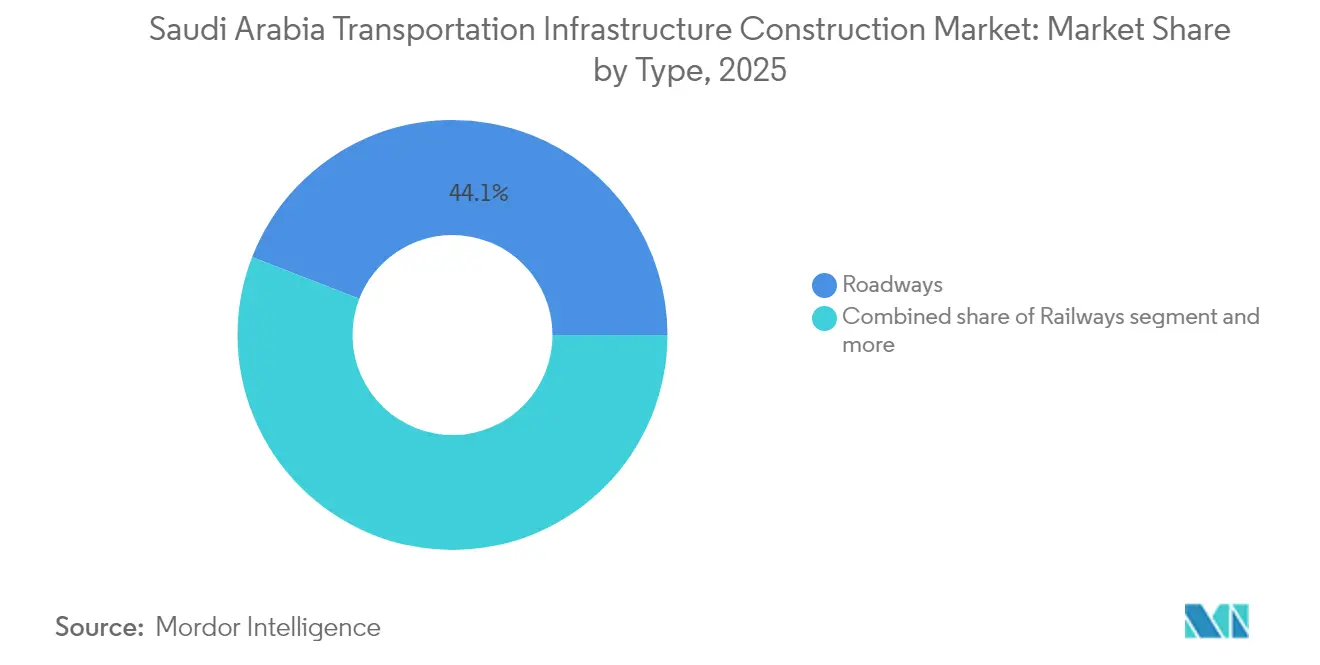
Roadways continued to own the largest 44.10% share, owing to 73,000 kilometers of existing highways and fresh upgrades for freight corridors. Continuous resurfacing contracts, Hajj pilgrim routes, and smart-highway pilots keep baseline spending predictable. Railways will capture the steepest 6.28% CAGR through 2031 as urban metros, high-speed lines, and freight spurs move from design to notice-to-proceed. Elevated stations, cut-and-cover tunneling, and CBTC signaling enrich supplier opportunities. The rail build-out broadens the Saudi Arabia transportation infrastructure construction market by adding turnkey electromechanical packages and long-term O&M concessions.
Passenger experience standards adopted from the Haramain line influence rolling-stock specifications and depot design. Interoperability with ports and airports improves rolling asset utilization, lifting lifecycle returns, and sustaining contractors’ five-year backlogs. As public ridership targets rise, rolling capital allocations shield the Saudi Arabia transportation infrastructure construction market from cyclical pauses in highway procurement.

By Construction Type: Greenfield Dominates, Retrofit Gains Traction
In 2025, greenfield projects accounted for a significant share, making up 78.25% of Saudi Arabia's transportation infrastructure construction market. As part of the Vision 2030 initiative, city clusters like Qiddiya, Diriyah Gate, and the Red Sea resort zones are being developed from the ground up, necessitating new road grids, marinas, and intermodal stations. By employing design-build contracts with integrated value engineering, project timelines are shortened, and costs are kept within acceptable limits.
With legacy assets reaching capacity thresholds, renovation works are witnessing a growth rate of 6.05% CAGR. Contractors specializing in asset management are expanding their service offerings, undertaking airport terminal enlargements, bridge widenings, and ITS retrofits. Predictive maintenance, guided by digital twins of Riyadh Metro tunnels, is not only reducing life-cycle costs but also unlocking additional demand. As the post-2030 asset refresh cycles commence, the market for retrofit programs in Saudi Arabia's transportation infrastructure construction is poised for further growth.
By Investment Source: Public Wallet Still Largest, Private Money Accelerates
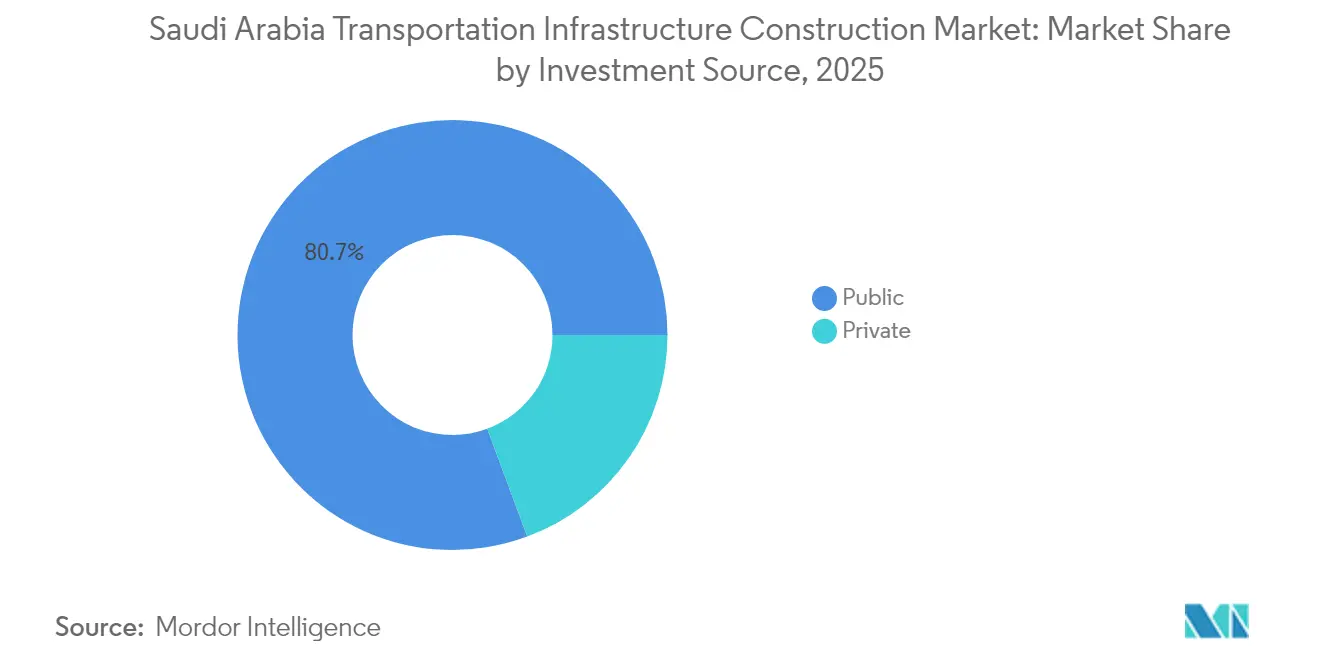
Public entities poured significant funding into projects, capturing 80.65% of Saudi Arabia's transportation infrastructure construction market. This sovereign backing not only reduces early-stage risks but also attracts master planners and global contractors.
Private investments are projected to grow at a 6.52% CAGR through 2031. This growth is bolstered by clarified PPP legislation, escrow arrangements, and step-in rights, all of which enhance lender confidence. Revenue streams are diversified through toll-based highway concessions, build-operate port terminals, and retail leases at stations. Additionally, road PPP pilots aiming for 5% network coverage by 2030 could further elevate the private sector's share. With strategic investors securing annuity-style cash flows, the outlook for Saudi Arabia's transportation infrastructure construction industry remains robust.
Geography Analysis
Riyadh’s 29.55% contribution underscores its role as Vision 2030’s command center. The completed six-line metro, 85 stations, and park-and-ride hubs form the region’s multimodal backbone. King Salman International Airport’s phased build catalyzes arterial highway and rail spurs, making the capital a transcontinental node. Intersection upgrades, pedestrian boulevards, and BRT corridors further sustain civil works tenders.
Jeddah remains the commercial hinge between Red Sea trade and religious tourism. King Abdulaziz International Airport’s 49.1 million passengers in 2024 highlight resilient visitor flows, while Jeddah Islamic Port’s redevelopment expands berth depth and yard automation. Dedicated Hajj access roads and service tunnels mitigate seasonal surges, keeping the Saudi Arabia transportation infrastructure construction market in the city robust.
The Dammam Metropolitan Area posts the quickest 6.68% CAGR, propelled by King Abdulaziz Port’s box-terminal enlargement and the King Salman Maritime Complex’s six-kilometer quay walls. Proximity to hydrocarbon plants feeds specialized heavy-haul road and rail demand. Integration of port, rail, and airport logistics platforms shortens delivery cycles for petrochemical exports, enhancing regional competitiveness. New interchange upgrades and ring-road extensions also reduce congestion in the growing conurbation.
Other provinces benefit from NEOM’s transformative spending. The Port of NEOM employs AI-driven crane timing, pushing the frontier of smart ports, while urban spine tunnels for THE LINE refine TBM deployment at scale. These works broaden supplier bases and funnel skills into previously underserved hinterlands, lifting nationwide standards and the overall Saudi Arabia transportation infrastructure construction market.
Regulatory Landscape
Transport infrastructure delivery is governed by a mix of national construction compliance and sector-specific transport policy. The Saudi Building Code (SBC) 2024 edition became mandatory on 30 June 2025, and the Saudi Building Code Center was moved under the Ministry of Municipalities and Housing (MOMAH) following a March 2025 Council of Ministers decision. This shift tightens alignment between permitting and building safety requirements. MOMAH also updated the Executive Regulation for SBC application via Decision 4700028 (April 2026), reinforcing code-based plan checks and site compliance for large transport-adjacent structures such as stations, terminals, depots, and logistics facilities.
Permitting and compliance are increasingly digital and enforcement-led. The Balady platform is the main pathway for construction permits and engineering-plan audits against the SBC, and it supports coordination requests for major developments where utilities and road access interfaces are critical. Additional compliance levers, including the occupancy certificate requirement for electrical current activation (Council of Ministers Decision 286, October 2024) and the Building Compliance Certificate initiative, increase the need for documentation, inspections, and handover readiness for contractors working on airports, metros, and port-linked corridors.
Value Chain Analysis
The value chain starts with public owners and program managers (notably Vision 2030 entities, the Ministry of Transport and Logistic Services, and the Royal Commission for Riyadh City), which define pipelines under the National Transport and Logistics Strategy (NTLS). Projects then move into feasibility, design, and procurement, where PPP packaging and design-build contracts are common for large corridors. Engineering and design houses, global PMCs, and specialist rail and aviation consultants provide reference designs and systems integration, followed by EPC and civil contractors executing earthworks, structures, and MEP packages, with specialist suppliers delivering ITS, signaling, electrification, and airport systems.
Downstream, commissioning, testing, and operations interfaces carry material weight, particularly when transport assets connect to logistics zones and ports. Execution depends on access to aggregates, cement, steel, and imported equipment, and Red Sea security disruptions and logistics bottlenecks affect lead times and costs. Localization requirements also drive contractors to qualify domestic producers and secure local subcontractor capacity. The chain is further shaped by freight network development, including SAR container rail operations exceeding 2,500 TEUs per day, which increases demand for inland terminals, last-mile road tie-ins, and dedicated freight corridors that separate port traffic from city road networks.
Competitive Landscape
Moderate fragmentation prevails, with top local and global contractors vying for multi-billion-dollar packages. Saudi Binladin Group and Almabani leverage deep government ties and local labor pools, while Bechtel, Parsons, and China Railway Construction Corporation bring mega-project governance and advanced design tools. Consortium bidding balances risk, ensures resource depth, and satisfies local content thresholds.
Digitalization, modular precast systems, and robotics become decisive factors. NEOM’s USD 347 million Samsung C&T robotics agreement aims for 80% manual-labor reduction, signaling future procurement preferences. Contractors adopting BIM level-3 standards and drone-aided progress tracking report faster payment certification cycles, promoting cash-flow stability.
Strategic moves in 2025 include Bechtel-Parsons’ airport win and DP World’s logistics park commitment, both cementing first-mover advantages in aviation and maritime verticals. Market entrants with smart-asset O&M capabilities find white space in post-handover service contracts, underlining a shift from build-only to build-operate mindsets across the Saudi Arabia transportation infrastructure construction market.
Saudi Arabia Transportation Infrastructure Construction Industry Leaders
-
Saudi Binladin Group
-
AL-AYUNI Company
-
Almabani
-
Nesma & Partners
-
Binyah
- *Disclaimer: Major Players sorted in no particular order
Market Opportunities and Future Outlook
Active procurement under the National Transport and Logistics Strategy is creating investable workstreams that combine civil construction with systems scope, especially in rail freight, logistics nodes, and highway PPPs. In rail, Saudi Arabia Railways awarded the lead design role for the 1,500 km Saudi Landbridge to a consortium led by Sener (April 2026). It also contracted a joint venture of OHL Arabia and Hassan Allam Construction Saudi for the Eastern Province freight network expansion (June 2026), pointing to continued packaging of rail works into bankable, phased deliverables. These programs broaden opportunities across tunneling and heavy civils, track and electrification, signaling, and intermodal interfaces linking ports, industrial cities, and airports.
A second opportunity area is long-tenor DBFOM road concessions and supporting structures (bridges, tunnels, interchanges), where private funding and lifecycle delivery capability can shape bid outcomes. The Roads General Authority set a bid deadline of May 31, 2026 for the Asir-Jizan highway under a 30-year PPP model, highlighting demand for contractors and investors that can manage financing, construction risk, and O&M performance. Alongside corridor build-out, the Crown Prince-launched General Plan for Logistics Centers targets 59 logistics centers (over 100 million square meters), with 21 under construction, which expands demand for access roads, utilities, yards, and multimodal interfaces around ports and inland hubs. It also raises the premium on digital engineering and compliance-ready delivery through platforms such as Balady.
Recent Industry Developments
- July 2026: AtkinsRealis won engineering, supervision, and project management contracts from the Royal Commission for Riyadh City for the Riyadh Metro network and strategic road projects. The awards reinforce the push toward tighter governance and delivery controls on multi-package urban mobility programs. This supports a deeper pipeline of design assurance, interface management, and construction supervision services tied to metro expansions and arterial road upgrades.
- May 2026: The Roads General Authority set May 31, 2026 as the bid submission deadline for the Asir-Jizan highway, a 136 km corridor with 57 bridges and 11 tunnels structured as a 30-year DBFOM PPP. The packaging signals continued use of long-tenor concessions for complex roadway assets and creates scope for contractors with financing and lifecycle O&M capability. It also lifts demand for major structures work alongside roadway civil construction.
- December 2024: NEOM and Samsung C&T formed a SAR 1.3 billion construction-robotics joint venture targeting an 80% reduction in manual rebar work. The move formalized automation as a procurement differentiator for mega-project delivery in remote locations with labor mobilization constraints. Contractors and suppliers aligned to robotics-enabled workflows gained a clearer pathway to meet productivity and schedule requirements on large transport-adjacent packages.
Research Methodology Framework and Report Scope
Market Definition and Coverage
This market covers the value of construction activity tied to Saudi Arabia's transportation infrastructure, across road, rail, airport, and water transport assets, measured in USD. We treat the market as spending captured through project execution, including new builds and renovation work, within the country.
Scope exclusions: Excludes non-transport infrastructure works such as power, water, oil and gas, and general building construction that is not directly linked to transport networks.
Segmentation Overview
- By Type
- Roadways
- Railways
- Airways
- Ports and Inland Waterways
- By Construction Type
- New Construction
- Renovation
- By Investment Source
- Public
- Private
- By City
- Riyadh
- Jeddah
- DMA (Dammam metropolitan area)
- Rest of Saudi Arabia
Data Sources, Market Sizing, and Validation
Desk Research
Desk research starts with public demand and pipeline signals that can be checked repeatedly and that also map well to transport spending. We rely on sources such as the Saudi Ministry of Transport and Logistic Services, the General Authority of Civil Aviation, the Saudi Ports Authority, and the General Authority for Statistics for macro context and sector activity cues.
To translate pipeline into spend timing, we also use official budget releases and project announcements, tender portals, and credible press coverage, then cross-check against company annual reports and investor presentations for exposure and backlog direction. Where available, paid databases are used only for company financials and intelligence, contract and tender tracking, and shipment-level import and export checks for construction inputs that move with large projects. The sources mentioned here are illustrative and not exhaustive, and many other references were also used to collect data, validate assumptions, and clarify gaps.
Primary Interviews and Surveys
Primary work is used to stress-test the desk view of project phasing, what gets executed versus announced, and how pricing moves through the build cycle. We speak with contractors, engineering and project management professionals, material suppliers, and project owners so that assumptions like utilization, award-to-execution lags, and renovation shares can be adjusted with real market feedback across Saudi Arabia.
Distribution of primary research fieldwork respondents
| Company type | Respondent position |
|---|---|
| Top tier: 33% | CXOs: 20% |
| Mid tier: 45% | Functional/Unit leaders: 28% |
| Smaller Players: 22% | Managers: 52% |
Market-Sizing & Forecasting
Sizing is built using a top-down model where national infrastructure plans, awarded work signals, and mode-level investment direction are translated into annual construction spend for roads, rail, airports, and waterways. Results are then checked using selective bottom-up approximations like sampled project cost ranges, contractor revenue exposure to transport works, and spot checks of typical cost per kilometer or per facility build component where those benchmarks are available.
A few inputs tend to move the model the most, so they are tracked closely and updated when new evidence appears. These include the split of spend between new construction and renovation, the public versus private funding mix, city-level phasing patterns (Riyadh, Jeddah, Dammam metro, and the rest of the country), and the timing gap between award and on-site execution. For pricing, we use a simple mix of construction cost inflation indicators and interview-based updates on labor and material pass-through, which helps keep value estimates consistent with what is being contracted.
Forecasting uses scenario analysis supported by trend smoothing, because project execution can accelerate or slow based on approvals, funding cadence, and delivery capacity. When gaps appear in bottom-up cross-checks, they are handled through conservative ranges and then narrowed using interview validation on what share of the pipeline is realistically deliverable within the year.
Data Validation & Update Cycle
We validate the final totals through triangulation across at least three angles, usually meaning pipeline and award signals, macro construction activity indicators, and supplier and contractor feedback on execution conditions. Outliers are reviewed for common causes like one-time mega project bookings, re-scoping between modes, or price spikes that do not translate into realized spend.
Before sign-off, the model is reviewed in steps so that assumptions and math checks are not done by the same person who built the first draft. Any large variances trigger re-checks with sources and, when needed, follow-up calls. Reports are refreshed annually, with interim updates when there are material shifts such as major awards, funding announcements, or program re-phasing. Right before delivery, a final pass is completed so the client receives the most current view available at that time.
Mordor Intelligence's Saudi Arabia Transportation Infrastructure Construction Market Size Compared Against Other Published Estimates
Published market values for this space often differ because not everyone counts the same set of works, and the timing of when spending is recognized is handled differently. Differences also show up when some sources lean heavily on announced giga-project values rather than what is likely to be executed within a given year.
Port equipment procurement and logistics facilities that sit inside industrial development are treated as outside Mordor Intelligence's scope unless they are part of a defined water transport infrastructure construction program, which is one reason the spread can look wide versus broader transport narratives. Other gaps commonly come from whether rehabilitation is counted alongside new builds, how public versus private funding is treated in the base case, and whether USD conversion uses a single-year average rate or a point-in-time rate.
Benchmark comparison
| Source | Market Size | Gaps in Research Methodology |
|---|---|---|
| Mordor Intelligence | USD 12.16 B (2026) | |
| Industry Publisher A | USD 9.90 B (2024) | Uses an earlier base year and often reflects a narrower realized-spend view, and it may apply conservative phasing that reduces near-term value compared with an award and execution blended model. |
| Regional Consultancy B | USD 98.00 B (2023) | Appears to mix very broad transport-related construction and program totals, and it may include adjacent urban development and non-construction components, which can inflate the number versus mode-linked infrastructure construction spend. |
The table shows that most variation comes from what gets counted as transport infrastructure construction and from how execution timing is assumed for large programs. By tying the estimate to mode-level construction activity, realistic award-to-build lags, and checked pricing progression, we keep the market size traceable to repeatable inputs rather than announcement-level totals.
Key Questions Answered in the Report
What is the current size of the Saudi Arabia transportation infrastructure construction market?
The market is worth USD 12.16 billion in 2026.
How fast is the Saudi Arabia transportation infrastructure construction market expected to grow?
A 5.70% CAGR is projected between 2026 and 2031, taking the value to USD 16.03 billion.
Which segment is expanding quickest within the market?
Railways post the fastest 6.28% CAGR through 2031, driven by metro extensions and high-speed corridors.
How significant is private sector participation?
Private capital funded 19.35% of 2025 spending and is growing at 6.52% CAGR as PPP pipelines mature.
Why is the Dammam Metropolitan Area a growth hotspot?
Port expansions, maritime-industrial complexes, and rising air traffic propel a 6.68% CAGR in the region.