
Peer-to-Peer Lending Market Size and Share
Market Overview
| Study Period | 2020 - 2031 |
|---|---|
| Market Size (2026) | USD 28.03 Billion |
| Market Size (2031) | USD 44.03 Billion |
| Growth Rate (2026 - 2031) | 9.45 % |
| Fastest Growing Market | Asia-Pacific |
| Largest Market | North America |
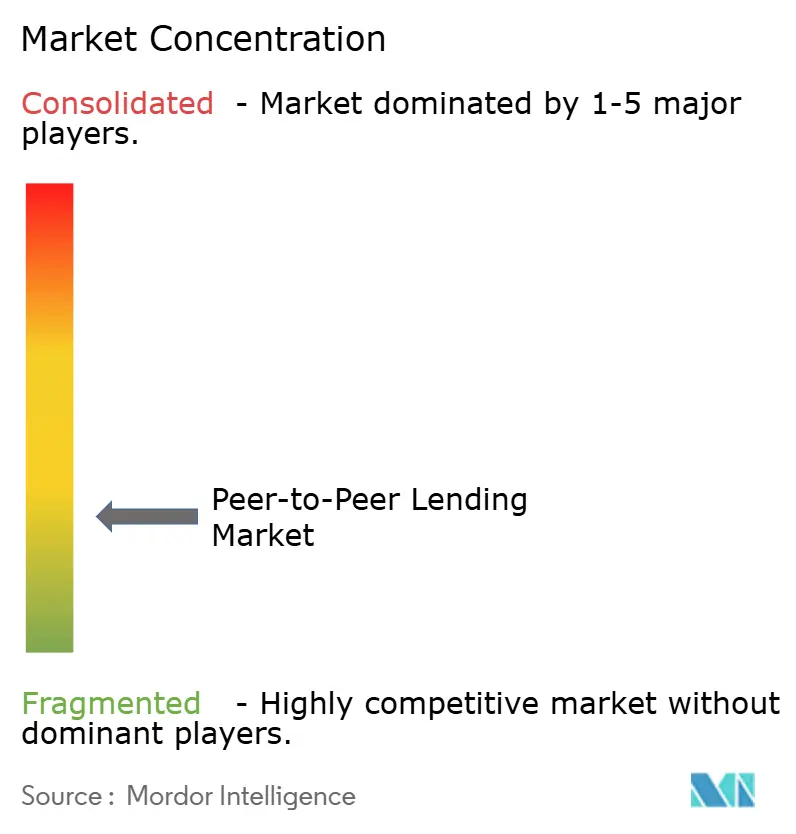
| Market Concentration | Low |
Major Players *Disclaimer: Major Players sorted in no particular order Image © Mordor Intelligence. Reuse requires attribution under CC BY 4.0. | |
Peer-to-Peer Lending Market Analysis by Mordor Intelligence
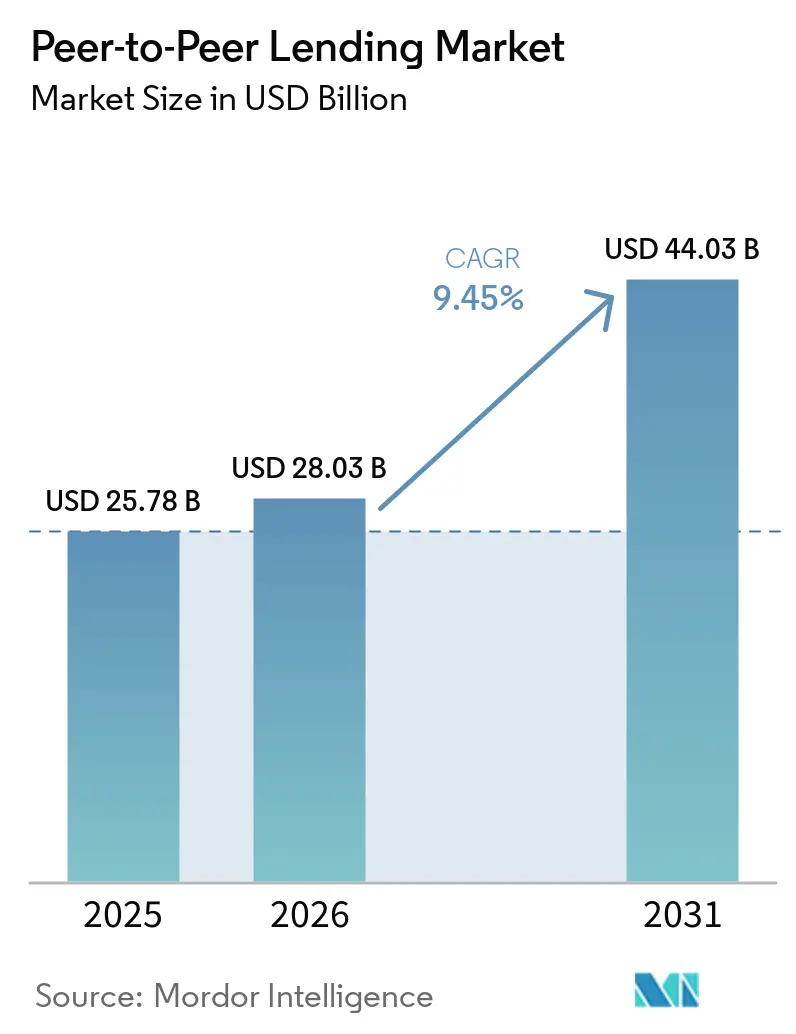
The Peer-to-Peer Lending Market size is expected to increase from USD 25.78 billion in 2025 to USD 28.03 billion in 2026 and reach USD 44.03 billion by 2031, growing at a CAGR of 9.45% over 2026-2031.
The peer-to-peer lending market has moved away from the first retail-led model, which came under pressure from regulation and credit losses in many countries between 2019 and 2022. Platforms that remained active rebuilt around digital origination, stronger compliance, and institutional funding, which lowered single-platform risk but increased exposure to wholesale funding conditions. The peer-to-peer lending market is also being reshaped by faster underwriting, wider use of AI-based credit workflows, and alternative data tools that improve decisions for borrowers with limited bureau history. Competitive behavior in the peer-to-peer lending market is shifting toward bank-charter strategies, embedded distribution, and multi-year forward-flow funding deals, which favor larger compliant platforms with deeper capital access. This setup points to a peer-to-peer lending market that should keep expanding in origination value. At the same time, a smaller group of technology-forward participants captures a larger share of new volume.
Key Report Takeaways
- By borrower type, consumer borrowers led with 68% of the peer-to-peer lending market share in 2025, while business borrowers are forecast to expand at 11.2% CAGR through 2031.
- By repayment term, medium-term loans held 74% of the peer-to-peer lending market share in 2025, while short-term loans are forecast to expand at 10.1% CAGR through 2031.
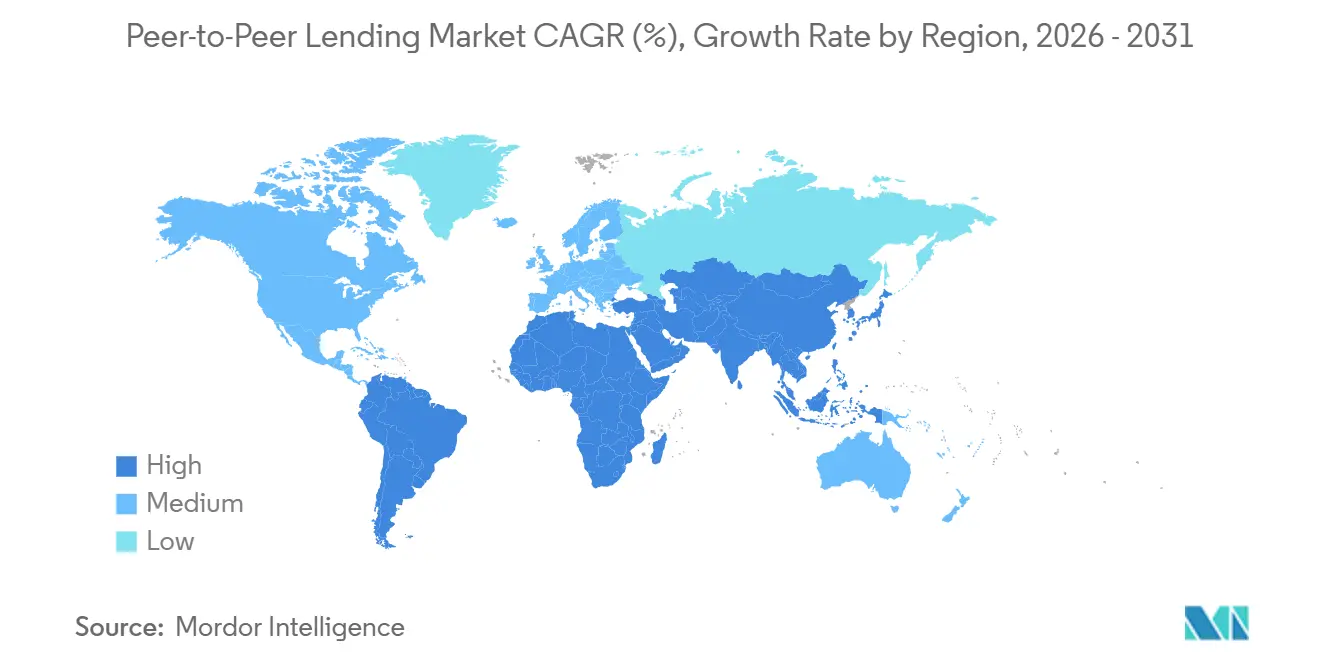
- By geography, North America held 58% of the peer-to-peer lending market share in 2025, while Asia-Pacific is forecast to expand at 12.8% CAGR through 2031.
Note: Market size and forecast figures in this report are generated using Mordor Intelligence’s proprietary estimation framework, updated with the latest available data and insights as of January 2026.
Market Trends and Insights
Drivers Impact Analysis of Peer-to-Peer Lending Market*
| Driver | (~) % Impact on CAGR Forecast | Geographic Relevance | Impact Timeline |
|---|---|---|---|
| Rising Demand for Non-Bank Credit Access | +2.5% | Global, most acute in Asia-Pacific and MEA | Medium term (2–4 years) |
| Faster Digital Onboarding and Loan Approval Cycles | +1.8% | Global, with Asia-Pacific and North America leading deployment | Short term (≤ 2 years) |
| Investor Demand for Yield in Rate-Sensitive Markets | +1.6% | North America and the EU, spill-over to the Asia-Pacific core | Medium term (2–4 years) |
| Use of Alternative Data to Expand Credit Scoring Coverage | +1.4% | Global, most impactful in EM and thin-file consumer segments | Medium term (2–4 years) |
| Embedded Finance Partnerships With SME Software and Payments Platforms | +1.2% | Global, with the EU and North America leading adoption | Long term (≥ 4 years) |
| Increasing Institutional Participation in Marketplace Lending Platforms | +1.0% | North America, Europe, and select Asia-Pacific markets | Long term (≥ 4 years) |
| Source: Mordor Intelligence | |||
Rising Demand for Non-Bank Credit Access
The peer-to-peer lending market continues to benefit from credit demand that banks have not fully served across consumer and SME categories. Gaps in branch density, stricter bank underwriting, and uneven small-business lending coverage have made non-bank intermediation a lasting part of the credit system rather than a mere convenience channel. Enova International reported USD 7.8 billion in credit extended during 2025, which shows the scale of borrowers operating outside conventional banking filters[1]. In markets such as Indonesia, the formalization of platform rules also shows that regulators now treat digital non-bank lending as a structural credit layer that must be supervised rather than removed from the system. The peer-to-peer lending market, therefore, has a strong demand floor, but platforms still need tighter borrower segmentation if rising volumes are not to recreate the loss cycles seen earlier in the decade.
Faster Digital Onboarding and Loan Approval Cycles
The peer-to-peer lending market is being pushed forward by underwriting systems that reduce approval times from days to seconds. Automated onboarding, digital identity verification, and real-time credit assessment are reducing friction across the borrower journey, allowing platforms to process smaller loans and time-sensitive financing requests more efficiently. This speed advantage is widening the addressable base of the peer-to-peer lending market because small-ticket working capital, invoice advances, and other time-sensitive use cases become practical only when unit processing costs fall sharply. Platforms that scale these workflows effectively can move into secondary cities and serve smaller borrower cohorts without carrying the same manual cost burden that limited earlier expansion.
Investor Demand for Yield in Rate-Sensitive Markets
The peer-to-peer lending market is also supported by investors seeking higher-yielding credit exposure as policy rates remain elevated relative to the prior decade. As more institutional capital replaces fragmented retail funding, the peer-to-peer lending market is developing a two-tiered cost structure in which platforms still bear retail-grade disclosure obligations even as the investor mix shifts upward. That dynamic is pressuring mid-sized platforms because their compliance costs remain high, while their funding-cost advantage narrows against larger peers.
Use of Alternative Data to Expand Credit Scoring Coverage
Alternative data is expanding the reach of the peer-to-peer lending market into thin-file and underbanked borrower groups that traditional bureau models do not score well. Experian launched Cashflow Score in March 2025, a decisioning tool built on bank account transaction data for consumers with limited or no conventional credit history. As of 2025, adding regional macroeconomic indicators to peer-to-peer models improved AUC performance by more than 1.1%, and near-prime borrowers in the 620-680 FICO band were 2 to 3 times more sensitive to unemployment variables than prime segments. These findings matter because the peer-to-peer lending market relies on finer risk segmentation when serving borrowers with sparse formal credit histories. The trade-off is that data-protection rules, especially in Europe and India, raise compliance demands that smaller platforms may struggle to meet, even as credit models improve.
Restraints Impact Analysis of Peer-to-Peer Lending Market*
| Restraint | (~) % Impact on CAGR Forecast | Geographic Relevance | Impact Timeline |
|---|---|---|---|
| Regulatory Fragmentation Across Jurisdictions | -2.2% | Global, most disruptive for platforms with cross-border origination models | Medium term (2-4 years) |
| Credit Loss Volatility and Investor Risk Perception | -1.8% | Global, most pronounced in APAC emerging markets | Short term (≤ 2 years) |
| Platform Funding Dependence on Wholesale Capital Cycles | -1.4% | North America and the EU, secondary exposure in APAC | Medium term (2-4 years) |
| Weak Borrower Literacy on Fees, Risk, and Repayment Terms | -0.8% | APAC, MEA, South America | Long term (≥ 4 years) |
| Source: Mordor Intelligence | |||
Regulatory Fragmentation Across Jurisdictions
The peer-to-peer lending market still lacks a single governing model, and that keeps cross-border expansion expensive and slow. National rules differ on capital requirements, borrower exposure limits, escrow treatment, disclosure standards, and product classification, so platforms often need market-by-market operating designs rather than one scalable template. Korea tightened household debt measures in April 2026 and extended loan-to-value regulation to P2P mortgage products, while Vietnam moved to a formal sandbox structure that still allows platforms to operate within a time-bound testing window before permanent licensing[2]. Europe offers a clearer route through the ECSPR framework, but it still requires capital, disclosure, and wind-down planning that smaller operators may not always be able to fund. The result is a peer-to-peer lending market where compliance strength is becoming a barrier to entry, narrowing the field of platforms able to scale across multiple jurisdictions.
Credit Loss Volatility and Investor Risk Perception
Credit performance remains the most immediate operational restraint for the peer-to-peer lending market, as investors react quickly when defaults rise. This is especially important in emerging markets, where borrower buffers are thinner and local macro shocks can quickly alter repayment behavior. Smaller platforms lack the same data depth, compliance infrastructure, or funding resilience, so they are more exposed when investor risk tolerance weakens. That gap is widening capital allocation differences inside the peer-to-peer lending market, with institutional investors leaning toward large, transparent originators and away from weaker underwriting models.
*Our forecasts treat driver/restraint impacts as directional, not additive. The impact forecasts reflect baseline growth, mix effects, and variable interactions.
Peer-to-Peer Lending Market Segment Analysis
By Borrower Type:
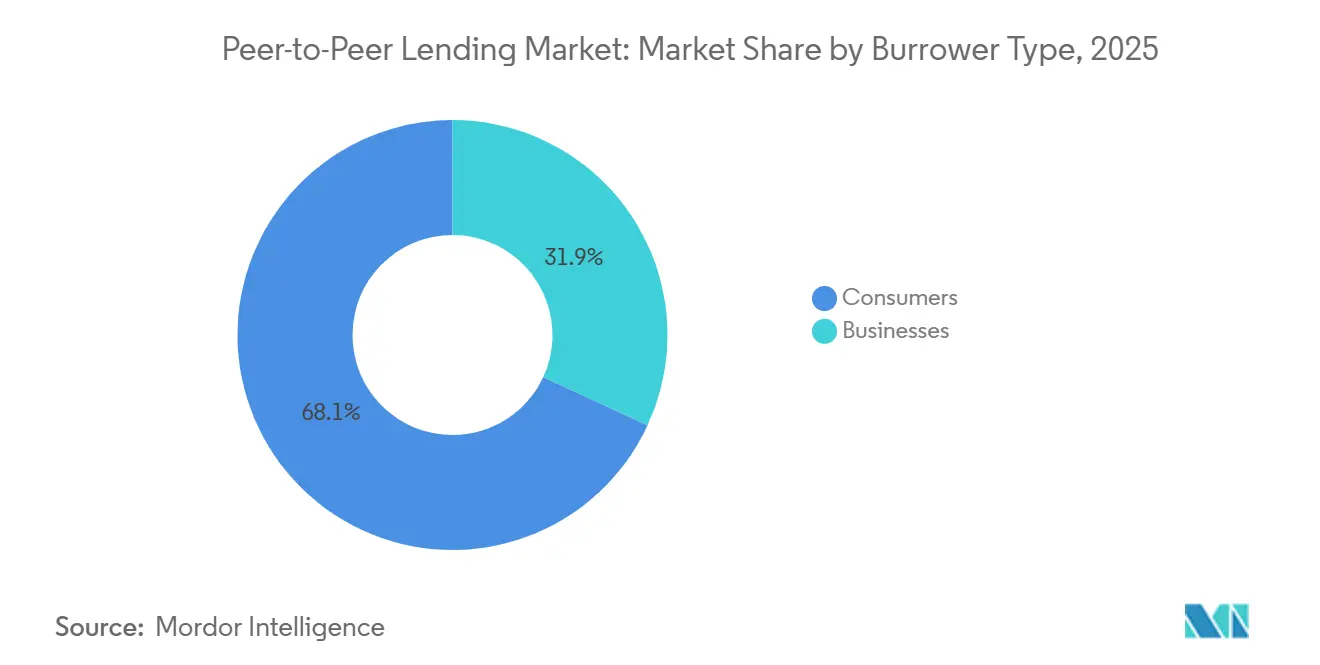
SME Credit Gaps Accelerate Business Segment GrowthConsumer borrowers held 68.1% of the peer-to-peer lending market share in 2025 and are forecast to grow at 8.9% CAGR, supported by high-volume products such as debt consolidation, home improvement financing, and medical expense loans in North America and the United Kingdom. The consumer side of the peer-to-peer lending market still benefits from recurring demand pools in which borrowers value faster decisions and more flexible access than traditional banks typically offer. Upstart stated that 70% of funding for home and auto loans originated in Q4 2025 came from 11 institutional partners, showing that consumer lending categories are becoming more vertically diversified and less dependent on a single funding source[3].
Business borrowers held a 31.9% of the peer-to-peer lending market share in 2025, and this segment is forecast to grow at a 11.2% CAGR through 2026-2031. This part of the peer-to-peer lending industry is gaining momentum because SMEs still face unresolved working capital gaps, especially when ticket sizes are too small or operating histories are too thin for traditional bank underwriting. Embedded distribution is changing how the business side of the peer-to-peer lending industry sources borrowers, with lending offers increasingly appearing inside software, payments, and merchant workflow environments rather than on standalone credit portals. Invoice and receivables finance remain especially attractive because open banking data lets platforms price risk more precisely and shorten the time to funding for smaller enterprises.
By Repayment Term:
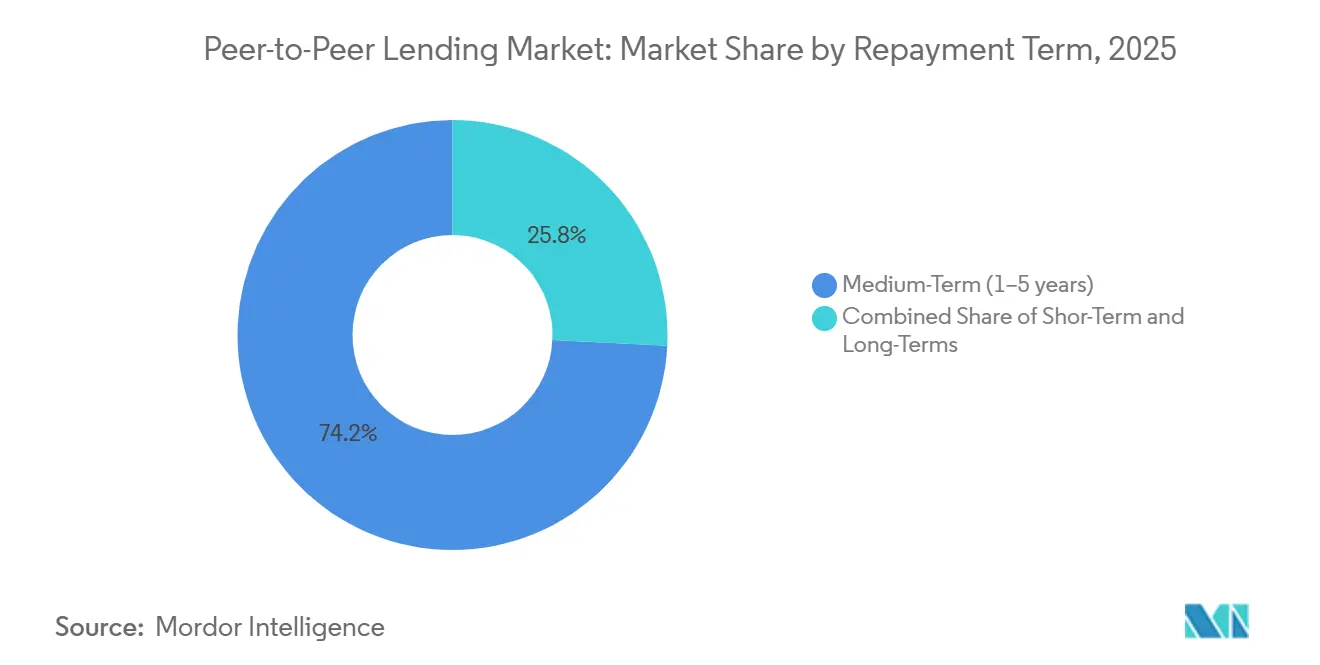
Short-Tenor Products Reshape the Risk-Return ProfileMedium-term loans with maturities of 1 to 5 years held 74% of the peer-to-peer lending market share in 2025, and are forecast to grow at 9.3% CAGR, making them the core tenure structure across the peer-to-peer lending market. These products fit common use cases such as debt consolidation, student loan refinancing, equipment purchases, and growth financing because they balance manageable monthly payments with enough duration to support larger ticket sizes. The loan category remains central to the peer-to-peer lending market because it serves both mass consumer needs and a large share of standard SME borrowing patterns.
Short-term loans of 12 months or less are the fastest-growing tenor category, and the peer-to-peer lending market for this segment is set to expand at a 10.1% CAGR through 2031. Growth is being driven mainly by invoice finance and working capital products, where borrowers value immediate decisions over long repayment terms. Long-term loans of 5 years or more held an 11% share in 2025 and remain concentrated in real estate-linked use cases, particularly property development and secured lending, in the United Kingdom and selected European markets.
Geography Analysis
North America Peer-to-Peer Lending Market
North America held 58% of the peer-to-peer lending market share in 2025, and the region is forecast to grow at 8.7% CAGR through 2031. The region remains the anchor of the global peer-to-peer lending market because the United States hosts the largest scaled platforms and the deepest institutional funding pools. The model has changed materially, with leading originators moving away from retail matching and toward bank-charter or bank-like operating structures that improve funding flexibility and compliance capacity. Upstart illustrates this shift, having emphasized AI-led underwriting, diversified capital channels, and closer alignment with the mainstream financial system. Canada remains smaller and more fragmented because lending rules vary by province, while Mexico is still in an earlier stage of development and is seeing more limited embedded SME lending activity.
Europe Peer-to-Peer Lending Market
Europe held a 23% share in 2025 and remains the second-largest geography in the peer-to-peer lending market. The United Kingdom continues to be a key market in Europe, supported by mature brands, although the market is operating under tighter product regulations than during its earlier peak years. The ECSPR framework is helping some platforms scale across borders, but its capital, disclosure, and wind-down requirements are also forcing smaller firms to merge or exit.
APAC Peer-to-Peer Lending Market
Asia-Pacific held a 11% share in 2025, and the peer-to-peer lending market in the region is forecast to grow at a 12.8% CAGR through 2031. This makes Asia-Pacific the fastest-growing region in the peer-to-peer lending market, as regulatory normalization and digital lending infrastructure are improving simultaneously. India has become a key accelerator after its revised NBFC-P2P Directions tightened exposure limits, leverage treatment, and escrow clearing standards, providing the market with clearer operating rules. Indonesia and Vietnam are also moving toward more formal supervisory structures that support long-term scale, even if short-term compliance costs rise.
Competitive Landscape
The peer-to-peer lending market is fragmented, but consolidating around larger and increasingly institutionalized platforms, with a mix of established global platforms and numerous regional and niche operators serving different borrower segments and geographies. Companies such as Prosper, Kiva, and Upstart maintain strong positions in key markets with no single platform exercising dominant control over the industry. Competitive differentiation is increasingly driven by access to institutional capital, advanced underwriting capabilities, regulatory compliance, and diversified product offerings rather than by scale alone. In addition, many leading platforms are shifting toward bank-like funding structures, embedded finance partnerships, and institutional forward-flow agreements to enhance funding stability and profitability.
Upstart has reinforced its position in the peer-to-peer lending market through repeated institutional funding wins, including a USD 1.25 billion forward-flow agreement with Fortress Investment Group in April 2026. The company’s model also stands out because it now supports auto and home lending, backed by 11 funding partners, which reduces concentration risk at the capital provider level. These moves show that the peer-to-peer lending market is rewarding platforms that combine distribution, underwriting depth, and durable funding rather than those that rely on a single product or investor type.
Peer-to-Peer Lending Industry Leaders
-
Prosper Marketplace, Inc.
-
Upstart Holdings, Inc.
-
Kiva
-
Bondora AS
-
PeerBerry
- *Disclaimer: Major Players sorted in no particular order
Peer-to-Peer Lending Market Companies Covered in this Report
- LendingClub Corporation
- Prosper Marketplace, Inc.
- Upstart Holdings, Inc.
- Zopa Group Limited
- SoFi Technologies, Inc.
- Kiva
- Mintos Holdings AS
- Bondora AS
- PeerBerry
- EstateGuru OU
- CrowdProperty Limited
- RateSetter
- Avant, LLC
- CommonBond, Inc.
- OnDeck Capital, Inc.
- LendingTree, Inc.
- Faircent
- LenDenClub
- i2ifunding
Recent Industry Developments in Peer-to-Peer Lending Market
- June 2026: Kiva advanced Refugee RADAR, a technology initiative designed to help lending partners identify and better serve refugees and internally displaced people, expanding Kiva's technology-enabled financial-inclusion capabilities.
- May 2026: PeerBerry added three new short-term loan originators, RealCredito in Spain, Lendi in Argentina, and Prestamo365 in Peru, growing its outstanding portfolio by a 5% month-on-month increase, and projecting up to 20% expansion in loan supply through mid-2026.
- February 2026: EstateGuru OU strengthened its loan-recovery and portfolio-management capabilities across European markets, while continuing to develop its property-backed lending platform and investor ecosystem.
- December 2025: LenDenClub announced plans to pursue an IPO within 18–36 months after restructuring operations in response to tighter RBI regulations governing P2P lending.
Global Peer-to-Peer Lending Market Report Scope
The global peer-to-peer (P2P) lending market comprises digital platforms that directly connect borrowers with individual or institutional lenders to facilitate personal and business loans, offering an alternative to traditional bank-based lending through online credit assessment, loan origination, and servicing.
The Peer-to-Peer Lending Market Report is Segmented by Borrower Type (Consumers, Businesses), Repayment Term (Short-Term, Medium-Term, Long-Term), and Geography (North America, South America, Europe, Asia-Pacific, Middle East, and Africa). The Market Forecasts are Provided in Terms of Value (USD).
Segmentation Overview
| Consumers | Debt Consolidation Loans |
| Home Improvement / Property Loans | |
| Medical Expense Loans | |
| Vehicle / Auto Loans | |
| Education / Student Loans | |
| Other Personal Loans | |
| Businesses | Working Capital Loans |
| Equipment Financing | |
| Invoice / Receivables Financing | |
| Real Estate / Property Development Loans | |
| Start-Up / Growth / Expansion Loans | |
| Other Business Loans |
| Short-Term (< 12 months) |
| Medium-Term (1-5 years) |
| Long-Term (> 5 years) |
| North America | United States |
| Canada | |
| Mexico | |
| Rest of North America | |
| South America | Brazil |
| Argentina | |
| Rest of South America | |
| Europe | Germany |
| United Kingdom | |
| France | |
| Italy | |
| Spain | |
| Rest of Europe | |
| Asia-Pacific | China |
| India | |
| Japan | |
| South Korea | |
| Australia | |
| Indonesia | |
| Rest of Asia-Pacific | |
| Middle East and Africa | Turkey |
| Israel | |
| Saudi Arabia | |
| United Arab Emirates | |
| South Africa | |
| Egypt | |
| Rest of Middle East and Africa |
| By Borrower Type | Consumers | Debt Consolidation Loans |
| Home Improvement / Property Loans | ||
| Medical Expense Loans | ||
| Vehicle / Auto Loans | ||
| Education / Student Loans | ||
| Other Personal Loans | ||
| Businesses | Working Capital Loans | |
| Equipment Financing | ||
| Invoice / Receivables Financing | ||
| Real Estate / Property Development Loans | ||
| Start-Up / Growth / Expansion Loans | ||
| Other Business Loans | ||
| By Repayment Term | Short-Term (< 12 months) | |
| Medium-Term (1-5 years) | ||
| Long-Term (> 5 years) | ||
| By Geography | North America | United States |
| Canada | ||
| Mexico | ||
| Rest of North America | ||
| South America | Brazil | |
| Argentina | ||
| Rest of South America | ||
| Europe | Germany | |
| United Kingdom | ||
| France | ||
| Italy | ||
| Spain | ||
| Rest of Europe | ||
| Asia-Pacific | China | |
| India | ||
| Japan | ||
| South Korea | ||
| Australia | ||
| Indonesia | ||
| Rest of Asia-Pacific | ||
| Middle East and Africa | Turkey | |
| Israel | ||
| Saudi Arabia | ||
| United Arab Emirates | ||
| South Africa | ||
| Egypt | ||
| Rest of Middle East and Africa | ||
Key Questions Answered in the Report
What is the current size of the peer-to-peer lending space?
The peer-to-peer lending market reached USD 25.78 billion in 2025 and stood at USD 28.03 billion in 2026, with growth expected to reach USD 44.03 billion by 2031.
How fast is peer-to-peer lending expected to grow through 2031?
The peer-to-peer lending market is projected to grow at a 9.45% CAGR from 2026 to 2031, supported by institutional funding, embedded distribution, and AI-led underwriting.
Which borrower group leads global P2P lending activity?
Consumer borrowers led with 68% share in 2025, while business borrowers are growing faster and are forecast to expand at 11.2% CAGR through 2031.
Which repayment term is growing the fastest?
Short-term loans are the fastest-growing category with a 10.1% CAGR through 2031, mainly due to invoice financing and working capital demand.
Which region has the largest share, and which region is growing the fastest?
North America held the largest share at 58% in 2025, while Asia-Pacific is the fastest-growing region with a 12.8% CAGR through 2031.
What are the main competitive shifts shaping platform strategies?
Leading platforms are moving toward bank-like funding models, embedded partnerships, and institutional forward-flow agreements, with examples including Upstart’s USD 1.25 billion Fortress deal and SoFi’s USD 3.6 billion partnership set.