
Market Overview
| Study Period | 2020 - 2031 |
|---|---|
| Forecast Data Period | 2026 - 2031 |
| Base Year Market Size (2025) | USD 179.21 Billion |
| Market Size (2026) | USD 186.59 Billion |
| Market Size (2031) | USD 228.25 Billion |
| Growth Rate (2026 - 2031) | 4.12 % |
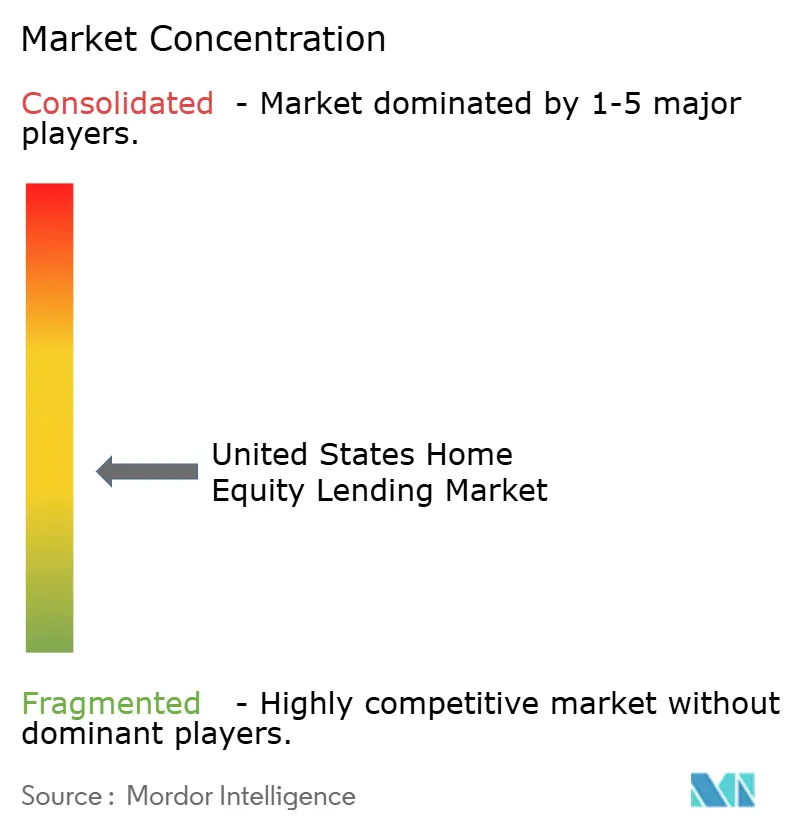
| Market Concentration | Medium |
Major Players *Disclaimer: Major Players sorted in no particular order Image © Mordor Intelligence. Reuse requires attribution under CC BY 4.0. | |
United States Home Equity Lending Market Analysis by Mordor Intelligence
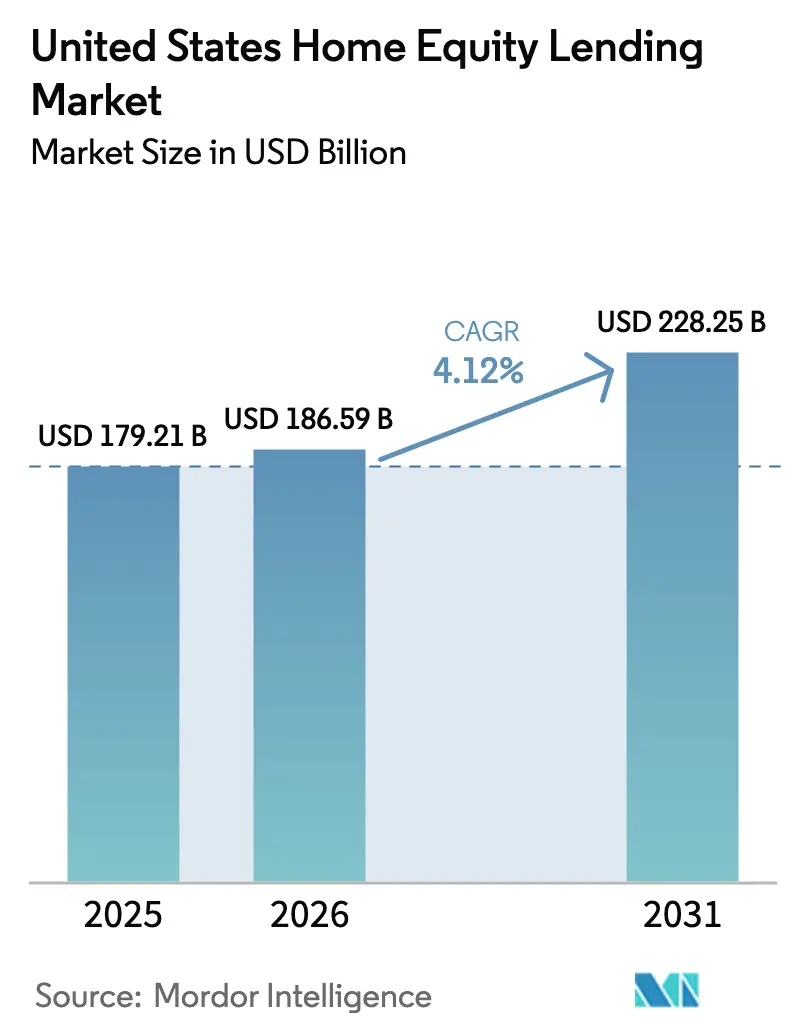
The United States home equity lending market size was valued at USD 179.21 billion in 2025 and estimated to grow from USD 186.59 billion in 2026 to reach USD 228.25 billion by 2031, at a CAGR of 4.12% during the forecast period (2026-2031). This growth trajectory aligns with a record pool of tappable home equity in 2024 and a sharp decline in first-lien refinancing, prompting households to favor second-lien solutions that keep their original low-rate mortgages intact. Substantial renovation outlays provide a continuing demand engine for equity-backed borrowing. Digital-first underwriting and e-closing platforms, capable of delivering approvals in minutes and funding in days, are lowering origination costs and widening consumer reach, while an expanding secondary market for closed-end seconds bolsters lender liquidity. Regulatory scrutiny from the Consumer Financial Protection Bureau (CFPB) over fee structures, coupled with the Federal Register’s new HOEPA thresholds in force from 2025, is raising compliance requirements, yet also clarifying the operating environment. Overall, the United States home equity lending market is positioned for disciplined but sustained advance as banks, credit unions, and fintechs refine second-lien offerings, enhance risk controls, and tap investor appetite for home-equity-backed securities.
Key Report Takeaways
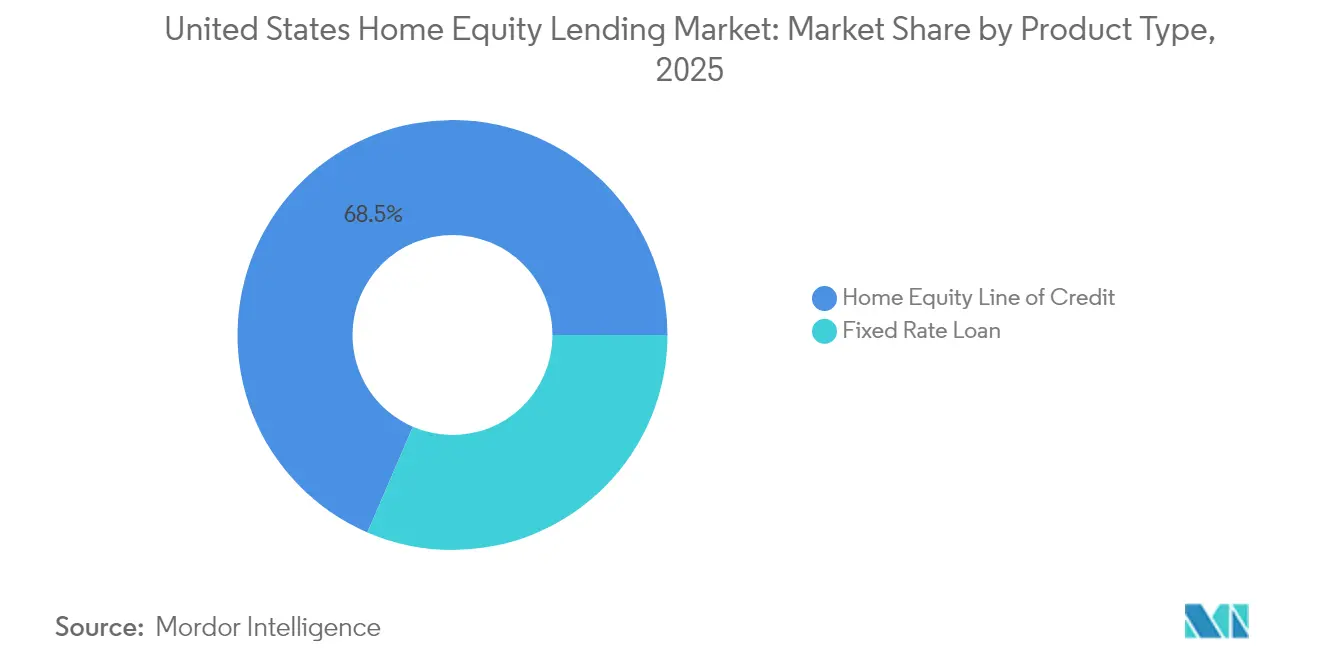
- By product type, Home Equity Lines of Credit (HELOCs) commanded 68.52% of the United States home equity lending market share in 2025 and are projected to register the highest expansion at a 5.34% CAGR through 2031.
- By provider, banks held 70.62% share of the United States home equity lending market size in 2025, whereas the Others segment (fintechs, brokers, and specialty lenders) is forecasted to post an 8.35% CAGR to 2031.
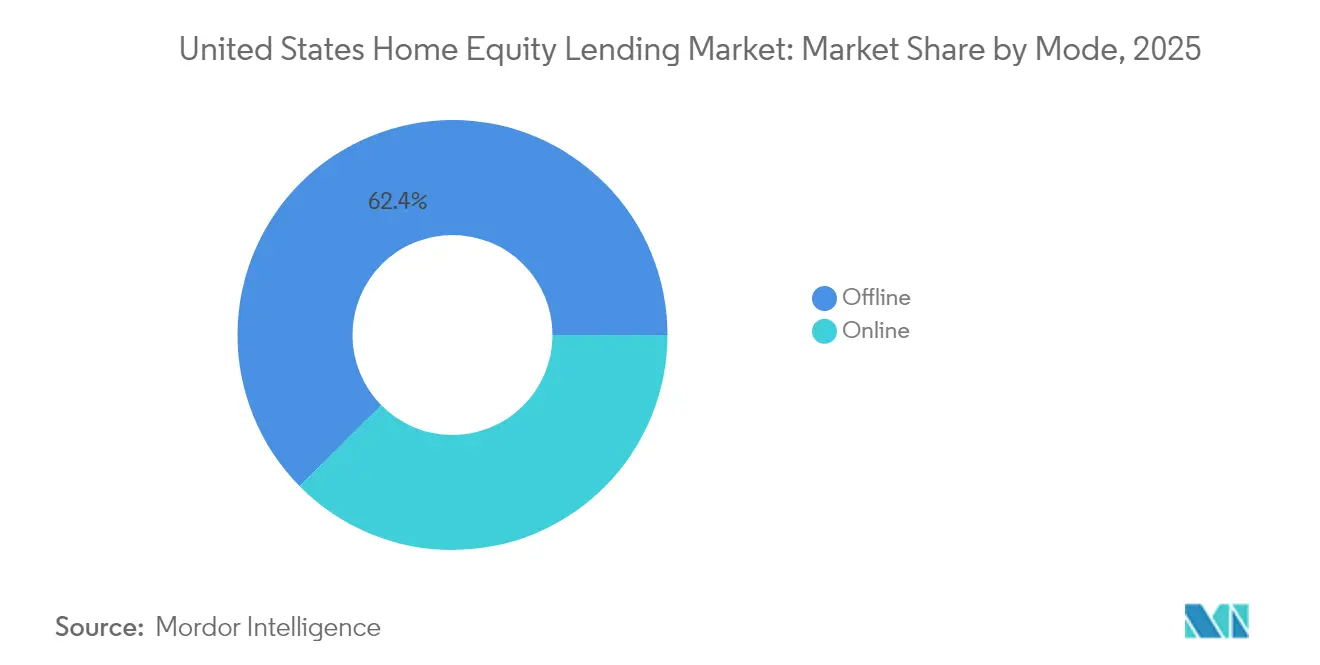
- By mode, offline channels retained 62.41% share of the United States home equity lending market in 2025, yet online platforms are expected to expand at a 8.74% CAGR over the forecast horizon.
- The United States home equity lending market is moderately fragmented. Major players in the market include Bank of America, JP Morgan Chase, Wells Fargo, and U.S Bank.
Note: Market size and forecast figures in this report are generated using Mordor Intelligence’s proprietary estimation framework, updated with the latest available data and insights as of 2026.
Market Trends and Insights
Drivers Impact Analysis of United States Home Equity Lending Market*
| Driver | ( ~ ) % Impact on CAGR Forecast | Geographic Relevance | Impact Timeline |
|---|---|---|---|
| Record-high tappable home-equity pools | +1.8% | Nationwide, concentrated in high-value metros | Long term (≥ 4 years) |
| Post-pandemic home-improvement boom | +1.2% | Nationwide, led by suburban neighborhoods | Medium term (2-4 years) |
| Falling HELOC introductory rates since 2024 | +0.9% | Nationwide | Short term (≤ 2 years) |
| Digital-first origination & e-closing platforms | +0.7% | Nationwide, early adoption in tech-forward states | Medium term (2-4 years) |
| Secondary-market demand for closed-end seconds | +0.5% | National, with institutional investor concentration | Long term (≥ 4 years) |
| Credit-union push into home-equity to replace refi income | +0.4% | Regional, concentrated in credit union strongholds | Medium term (2-4 years) |
| Source: Mordor Intelligence | |||
Record-high Tappable Home-Equity Pools
An unprecedented USD 11.5 trillion in tappable equity is sitting on household balance sheets, yet only 0.41% was accessed in Q1 2025[1]. Roughly 60% of mortgage holders hold at least USD 100,000 of equity, and most enjoy first-mortgage rates below 4%, generating an attractive credit profile for lenders. Banks and credit unions are mining internal servicing portfolios to identify second-lien prospects, aided by data models that blend property-value analytics with borrower risk parameters. Because only 23% of borrowers return for cash-out refinances, equity lines, and closed-end seconds provide the main liquidity avenue. With households averaging USD 212,000 in tappable equity, this reservoir remains the core fuel for the United States home equity lending market.
Post-pandemic Home-Improvement Boom
Annual remodeling outlays stabilized near USD 600 billion, still 50% above pre-pandemic norms. Elevated spending reflects the median 44-year age of the U.S. housing stock, climate-driven disaster repair needs exceeding USD 49 billion, and homeowners’ preference to upgrade rather than relocate in a low-inventory environment. Roughly 45% of home-equity borrowers cite renovation funding as the primary purpose, and energy-efficiency retrofits add further momentum as federal tax incentives raise return-on-investment calculations. Demographic factors—particularly the growing share of older owners and more racially diverse borrowers—broaden the addressable base. Together, these dynamics secure a medium-term uplift for the United States' home equity lending market.
Falling HELOC Introductory Rates Since 2024
The prime-rate cycle has pushed variable HELOC rates below 7.5%, and market consensus anticipates a mid-6% range as the Federal Reserve eases in 2025[2]. Lower coupon levels have trimmed the typical payment on a USD 50,000 balance, widening affordability for middle-income households and making debt-consolidation use cases more compelling relative to rotating credit-card balances. Lenders sharpen competitive edges by waiving origination fees and offering promotional margins over prime to accelerate share capture. Rate sensitivity amplifies loan demand in the short term, giving borrowers an incentive to act before the next cycle shift, thereby reinforcing near-term growth in the United States home equity lending market.
Digital-first Origination & E-closing Platforms
Automated underwriting, real-time income verification, and blockchain-based lien indexing enable some fintechs to grant approvals in under five minutes and fund in as few as five days. Figure Technologies, for example, leverages proprietary algorithms and tokenized collateral records to scale originations and cut per-loan processing costs by hundreds of dollars. ICE Mortgage Technology’s Encompass eClose suite integrates document ordering, borrower collaboration, and settlement workflows, shrinking cycle times and boosting pull-through. While 54% of homeowners still express cybersecurity concerns, adoption is rising rapidly among digital-native cohorts, positioning technology capability as a decisive differentiator across the United States home equity lending market.
Restraints Impact Analysis of United States Home Equity Lending Market*
| Restraint | ( ~ ) % Impact on CAGR Forecast | Geographic Relevance | Impact Timeline |
|---|---|---|---|
| CFPB & state-level fee-cap scrutiny | −0.8% | Nationwide with state variances | Medium term (2-4 years) |
| Rising property-tax & insurance pressures | −0.5% | High-tax and coastal states | Long term (≥ 4 years) |
| Rate-volatility dampening borrower appetite | -0.6% | National | Short term (≤ 2 years) |
| Cyber-fraud risks on digital HELOC portals | -0.3% | National, with higher impact in digital-first markets | Medium term (2-4 years) |
| Source: Mordor Intelligence | |||
CFPB & State-level Fee-Cap Scrutiny
The CFPB’s 2025 amendments to Regulation Z elevate HOEPA coverage thresholds to USD 26,968 in total loan size and USD 1,348 in points and fees, subjecting more products to additional compliance layers. Texas, meanwhile, retains stringent caps under Article XVI, Section 50 of its state constitution, limiting fee structures and permissible terms. Lenders must bolster governance, audit, and disclosure processes, which add fixed costs that scale less easily for smaller originators[3]. Although the rules aim to protect consumers, the resulting margin compression could restrain the growth tempo of the United States home equity lending market. This could also accelerate market consolidation as smaller lenders struggle to absorb rising compliance costs and operational overhead.
Rising Property-tax & Insurance Pressures
Escalating property-tax levies and insurance premiums, especially in disaster-prone coastal markets, erode available equity by increasing mandatory carrying costs. When escrow obligations climb, back-end debt-to-income ratios tighten, limiting loan size eligibility and suppressing draw volumes. Florida, Louisiana, and California exhibit the sharpest insurance-rate jumps, while Northeastern states show steep tax-bill growth. Over time, these cost pressures curtail the equity borrowers can prudently access, subtracting incremental basis points from the long-term expansion of the United States home equity lending market. Lenders may also face increased risk-layering concerns, as rising non-loan obligations dilute borrower repayment capacity even when credit scores remain stable. This dynamic forces tighter underwriting.
*Our forecasts treat driver/restraint impacts as directional, not additive. The impact forecasts reflect baseline growth, mix effects, and variable interactions.
United States Home Equity Lending Market Segment Analysis
By Product Type:
HELOCs Drive Market EvolutionHome Equity Lines of Credit (HELOCs) held 68.52% of the United States home equity lending market share in 2025 and will pace sector growth with a 5.34% CAGR to 2031. This flexible, revolving structure allows borrowers to draw and repay on demand while benefitting from variable-rate resets that historically track prime moves downward, thereby widening utilization amid easing cycles. Fixed-rate home-equity loans remain a strategic option for customers prioritizing payment predictability on lump-sum needs such as tuition outlays or major renovations, preserving a sizable minority slice of the United States home equity lending market size.
Securitization momentum adds fresh liquidity: In 2025, Angel Oak brought the first landmark HELOC securitization to market, validating investor appetite and signaling a maturing secondary outlet for non-bank issuers. Average utilization rates now exceed 90%, with many households drawing substantially at origination rather than treating lines as standby resources. This behavioral pivot underscores rising borrower confidence in variable-rate debt servicing and cements the HELOC format as the fulcrum within the United States home equity lending market.

By Provider:
Fintech Disruption AcceleratesBanks captured 70.62% of the 2025 value, leveraging deposit funding and branch networks to set rate and fee benchmarks across the United States home equity lending market. Yet technology-centric entrants are expanding at an 8.35% CAGR to 2031, propelled by data-driven underwriting, remote identity verification, and direct-to-consumer branding. Figure Technologies surpassed USD 10.4 billion in cumulative originations while pursuing a multi-billion-dollar IPO, underscoring investors’ bullish view on fintech scalability. Traditional lenders are responding by integrating APIs and AI-driven credit scoring models into legacy infrastructure. However, their slower innovation cycles and regulatory inertia often constrain full-scale adoption, keeping them behind the curve in consumer experience.
Credit unions, historically reliant on first-mortgage refinances, are reallocating capital to second-lien portfolios to offset the refinancing downturn. Institutions such as Valley Strong Credit Union have originated more than USD 2 billion in home-equity loans via white-label fintech partnerships, illustrating how cooperative lenders combine relationship banking with modern workflow engines. The competitive gap is therefore narrowing, and a hybrid lender-fintech ecosystem is becoming the standard operating model within the United States home equity lending industry. Smaller credit unions are also forming consortia to share technology costs and enhance underwriting capabilities through pooled data platforms. As a result, regional players are gaining agility and scale without sacrificing their local engagement advantage.
By Mode:
Digital Transformation Reshapes AccessOffline channels still accounted for 62.41% of 2025 originations, reflecting borrower comfort with in-person consultations for complex financial transactions. Even so, online platforms are forecast to grow at a 8.74% CAGR as automated document ingestion, embedded e-signature, and AI-driven stipulation clearing shorten cycle times. Rocket Mortgage’s AI-based Rocket Logic suite processes nearly 1.5 million documents per month and trims closing windows by 25%, proving the scale efficiencies attainable through systemization. Moreover, digital originations often yield higher per-loan profitability due to reduced staffing and processing overhead. This margin advantage is prompting even traditional lenders to reengineer customer journeys around hybrid-digital workflows.
Community banks and credit unions safeguard their niche by offering blended models that couple self-service portals with loan-officer guidance. Solutions like Coviance’s Home Equity Express, adopted by more than 425 local institutions, exemplify how smaller lenders can deliver rapid approvals without surrendering personal touch. As digital fluency rises across demographics, a phygital strategy, where borrowers toggle seamlessly between online interfaces and human advice, will define the optimal service blueprint for the United States home equity lending market. These institutions are also investing in digital CRM systems and omni-channel support to deepen engagement and cross-sell opportunities. The ability to blend empathy-driven relationship management with tech-enabled efficiency is becoming a core differentiator.
Geography Analysis
California and Northeast corridor states amassed the largest absolute equity gains in 2024, with Connecticut, New Jersey, and Delaware leading median home-equity growth following sustained property-value appreciation and limited housing inventory. Although these coastal markets boast sizable balances, elevated property taxes and insurance costs temper borrowing capacity. Texas, governed by Article XVI, Section 50 fee caps and strict loan-to-value ceilings, compels lenders to tailor products within narrower compliance guardrails, thus moderating penetration relative to underlying demand.
Florida and Arizona demonstrate robust momentum owing to inbound migration, favorable homestead protections, and volume growth from retirees unlocking equity for lifestyle and medical expenditures. The Mountain West—Colorado, Utah, and Nevada—benefits from amenable regulation and continued job inflows that sustain home-price resilience, enticing firms like Splitero to extend equity-sharing platforms into these territories. Nonetheless, softening price trends in select Floridian metros and rising insurance premiums present nascent headwinds.
Midwestern and Southeastern states offer a mixed picture: median home values are lower, but strong credit-union density drives relationship-based lending that supports home-equity usage for deferred maintenance of an aging housing stock. Rural counties lag in digital-access infrastructure, inhibiting online application volume, whereas urban hubs leverage fintech penetration to deliver competitive pricing. Collectively, these regional dynamics ensure diversified growth vectors that underpin the nationwide expansion of the United States home equity lending market.
Regulatory Landscape
United States home equity lending is primarily governed by the Truth in Lending Act (TILA) and Regulation Z (12 CFR Part 1026), including specific requirements for open-end home equity plans under Section 1026.40. The CFPB also requires creditors to provide the CFPB-approved consumer brochure, What you should know about home equity lines of credit, as part of HELOC disclosures, which standardizes borrower education in origination workflows.
Supervisory attention has shifted beyond disclosures toward valuation governance and high-cost coverage. In June 2024, the CFPB and federal banking regulators finalized the Interagency Automated Valuation Models (AVM) rule, adding quality control standards for AVMs used in home equity credit decisions. In July 2024, regulators issued interagency guidance on Reconsiderations of Value (ROV) to address appraisal bias and valuation weaknesses. Separately, the CFPB published the annual 2026 threshold adjustments in December 2025, setting HOEPA high-cost triggers at USD 27,592 (loan amount) and USD 1,380 (points and fees), which can pull more second-lien products into enhanced compliance and pricing guardrails.
Value Chain Analysis
The value chain starts with customer acquisition (bank branches, call centers, brokers, and digital direct-to-consumer funnels) and application intake, then moves through identity and income verification, property valuation, underwriting, and offer generation across HELOCs and closed-end second liens. Compliance and disclosure production is embedded throughout: Regulation Z requirements for home-equity plans and mortgage disclosures shape document sets, timing, and permitted plan features, while HOEPA thresholds influence product design and fee structures.
Downstream, lenders fund and book loans on balance sheet or distribute through secondary channels, with servicing platforms managing draws, repayment, and line management for HELOCs. Core enabling vendors and infrastructure include credit bureaus, automated verification providers, settlement and closing agents, valuation partners (including AVM providers subject to the 2024 interagency AVM rule), and e-closing or origination platforms such as ICE Mortgage Technology solutions referenced in market operations. A recurring bottleneck is operational scalability, where manual handoffs, disconnected steps, and inconsistent exception handling slow cycle times. This is pushing lenders toward workflow orchestration, automated document handling, and tighter integration between valuation, underwriting, and closing to protect margins while meeting regulatory control requirements.
Competitive Landscape
The United States home equity lending market features moderate concentration. Large depository institutions—JPMorgan Chase, Wells Fargo, and Bank of America—capitalize on cross-sell capabilities, branch visibility, and low-cost deposits to sustain origination leadership. JPMorgan Chase, for instance, logged more than USD 1 billion in home-lending revenue in Q2 2024 while introducing new equity-access products aligned with mobile-banking channels.
Fintech innovators intensify rivalry by coupling frictionless onboarding with alternative securitization pipelines. Figure Technologies applies blockchain to automate lien perfection and investor settlement, achieving five-minute approval metrics that recalibrate customer expectations. Angel Oak’s 2025 issuance of a stand-alone HELOC structured note diversified secondary-market take-out options and validated appetite among fixed-income managers for non-agency paper, thereby lowering capital costs for tech-enabled originators.
Strategic M&A accelerates scale economics: Rocket Companies’ USD 9.4 billion all-stock acquisition of Mr. Cooper united a combined servicing portfolio exceeding USD 2.1 trillion, granting the entity roughly one in six U.S. mortgages. Consolidation pressures smaller lenders to seek white-label partnerships or exit the segment, while vertical integrations that pair real-estate search, brokerage, and lending suggest a future landscape dominated by diversified, technology-centric platforms that continually reshape the contours of the United States home equity lending market.
United States Home Equity Lending Industry Leaders
-
Bank of America
-
JPMorgan Chase
-
Wells Fargo
-
U.S. Bank
-
PNC Financial Services
- *Disclaimer: Major Players sorted in no particular order
United States Home Equity Lending Market Companies Covered in this Report
- Bank of America
- JPMorgan Chase
- Wells Fargo
- U.S. Bank
- PNC Financial Services
- Truist Financial
- Navy Federal Credit Union
- PenFed Credit Union
- Flagstar Bank
- Citizens Bank
- NBKC Bank
- Discover Home Loans
- Rocket Mortgage
- Figure Technologies
- Spring EQ
- Fifth Third Bank
- TD Bank
- Point
- Better Mortgage
- SoFi
Read Analysis of United States Home Equity Lending Companies
Market Opportunities and Future Outlook
New product structures are creating an opportunity to monetize home equity beyond traditional HELOCs and fixed-rate second liens, particularly home equity investment (HEI) and shared appreciation-style contracts. The CFPB has flagged home equity contracts for monitoring due to complex terms and non-standardized disclosures, and multiple states have started applying mortgage-style frameworks. This creates whitespace for providers that can operationalize compliant, state-specific underwriting, disclosures, and consumer support at scale. Maine enacted LD 1901 (April 13, 2026) to regulate shared appreciation agreements under its Consumer Credit Code, and Illinois implemented a comprehensive HEI framework effective June 1, 2026 under amendments to the Residential Mortgage License Act.
Technology and process modernization also remain a practical competitive lever. Faster digital intake, automated underwriting, and controlled valuation workflows can help address throughput constraints in home-equity operations while aligning with heightened valuation governance driven by the 2024 AVM rule and 2024 ROV guidance. At the same time, distribution and capital-market innovation are opening. In 2025, Angel Oak completed a stand-alone HELOC securitization, and lenders with strong origination and servicing data can use securitization outlets to expand liquidity for second-lien products. Large lenders are also widening adjacency financing tied to housing outcomes, including Wells Fargo pairing mortgage lending with developer financing for 3D-printed home construction through ICON. That connection links purchase and construction activity to later equity-access needs, such as renovations and debt-consolidation funding.
Recent Industry Developments in United States Home Equity Lending Market
- July 2026: Bank of America reported USD 2.899 billion of quarterly home-equity originations for Q2 2026, up 18% from the prior quarter. The step-up highlights how large depositories are leaning further into second-lien lending as a core balance-sheet product, competing on speed and customer retention across existing deposit and servicing relationships.
- May 2026: Wells Fargo announced an agreement to serve as the preferred mortgage lender for 3D-printed homes built by ICON, including a 50 basis point lender credit for qualified buyers and business financing for developers purchasing ICON Titan 3D printers. This expands Wells Fargo's housing-finance ecosystem reach and connects construction and purchase activity with future home-equity lending opportunities such as renovations and upgrades.
- May 2025: Angel Oak completed the first stand-alone HELOC securitization, expanding a dedicated take-out channel for revolving home-equity collateral. The transaction strengthened secondary-market liquidity options for lenders and supports product growth by improving funding flexibility beyond on-balance-sheet retention.
United States Home Equity Lending Market Report Scope and Research Methodology
Market Definition and Coverage
This market covers the value of home equity lending issued in the United States, where a homeowner borrows against accumulated home equity through a closed-end home equity loan or a revolving line of credit, and the value is tracked in USD.
Scope exclusions: Reverse mortgages, first-lien purchase mortgages, and cash-out refinancing are excluded from this home equity lending total.
Segments Covered in This Report
- By Product Type
- Fixed Rate Loans
- Home Equity Line of Credit
- By Provider
- Banks
- Credit Unions
- Non-Banking Financial Institutions
- Others (Fintech, Brokers, etc.)
- By Mode
- Online
- Offline
Data Sources, Market Sizing, and Validation
Desk Research
Desk research starts with public data series that help us anchor lending conditions and borrowing appetite. We referenced sources such as the Federal Reserve (Financial Accounts and FRED series), the Consumer Financial Protection Bureau for rule updates and fee related guidance, the Federal Housing Finance Agency for house price and mortgage market indicators, and the US Census Bureau for housing and renovation related releases that often tie back to borrowing intent. We also reviewed housing market reads from sources such as the National Association of Realtors and the US Department of Housing and Urban Development to keep underwriting and affordability context grounded.
On the supply side, we reviewed lender disclosures like 10-Ks, quarterly updates, call transcripts, and investor presentations to understand product mix, underwriting tightening or loosening, and channel shifts toward digital origination. News and financials subscriptions were used selectively to track rate-driven behavior changes and notable policy or funding events, and a paid patent database was checked to spot persistent themes in underwriting automation and servicing workflows. These sources are not exhaustive, and many other public documents and datasets were also referred to for data collection, validation, and research clarification.
Primary Interviews and Surveys
Primary work was used to pressure test what we saw in public datasets, especially around how lenders are pricing, where approvals are tightening, and how borrowers are choosing between home equity loans and HELOCs. We spoke with a mix of lenders, intermediaries, and servicing focused participants, and then used follow-up checks to confirm assumptions on fee structures, typical draw behavior, and online versus offline origination patterns across the US.
Distribution of primary research fieldwork respondents
| Company type | Respondent position |
|---|---|
| Top tier: 31% | CXOs: 13% |
| Mid tier: 49% | Functional/Unit leaders: 27% |
| Smaller Players: 20% | Managers: 60% |
Market-Sizing & Forecasting
Sizing is built using a top-down and bottom-up approach, where a national demand pool is reconstructed and then cross-checked with lender level reality checks. The top-down side starts from home equity lending activity signals and turns them into value using market-consistent conversions, and then the totals are allocated across products and channels using observed mix patterns. To keep the number practical, we also corroborate it with selective bottom-up approximations like sampled lender origination disclosures, channel checks on typical deal sizes, and product mix splits, which are then used to adjust outliers.
A few inputs matter more than others in this market, so we focused on variables that can be tracked regularly. These include the interest rate spread between first mortgages and second liens, homeowner equity availability and loan-to-value comfort levels, HELOC versus closed-end second preference, refinancing lock-in intensity, and renovation related borrowing intent. When the story looks unclear in one dataset, the gap is handled through primary feedback and conservative smoothing, so the final model does not overreact to a single quarter.
For forecasting, scenario analysis is used because home equity demand is highly rate sensitive and can swing when housing turnover changes. We built a base case and then flexed the path based on expected rate movements, credit tightening signals, and channel adoption, and then we checked the direction with interview feedback to make sure the resulting growth curve stays realistic.
Data Validation & Update Cycle
Outputs are checked against independent signals so the final size is not driven by one assumption. We compare the modeled totals with observed product mix shifts, rate environment changes, and public lender commentary, and then we run variance checks to find jumps that do not match the underlying demand conditions. Where anomalies show up, the assumptions are reviewed and, if needed, experts are re-contacted to confirm whether a structural change has occurred or if it is a short-term distortion.
Before publication, the model and narrative go through multi-step analyst review, followed by a final consistency pass so definitions, units, and year labels match across exhibits. Reports are refreshed annually, and interim updates are triggered when there are material events such as major regulatory changes, sharp rate moves, or a visible shift in borrower behavior.
Mordor Intelligence's US Home Equity Lending Market Size Versus Other Published Estimates
Published market sizes for US home equity lending often look different because the underlying math is not always counting the same thing. Differences usually come from whether the estimate tracks originations versus outstanding balances, whether it mixes in cash-out refinancing, and how it treats HELOC limits compared with amounts actually drawn.
The table shows a noticeable spread, and in Mordor Intelligence's model the value is tied to US home equity loan and HELOC origination value in USD for the stated year, instead of using total available credit limits or outstanding balance stock measures that move for reasons beyond new lending.
Benchmark comparison
| Source | Market Size | Gaps in Research Methodology |
|---|---|---|
| Mordor Intelligence | USD 179.21 B (2025) | |
| Industry Data Provider A | USD 311.00 B (2025) | Uses a broader reported activity total that can reflect combined home equity formats and reporting conventions, which may not align with an origination-value definition and can be pulled upward by HELOC limit reporting. |
| Research Publisher B | USD 35.20 B (2025) | Applies a narrower product and channel coverage that can undercount national issuance when key lender cohorts are not fully represented or when HELOC activity is partially excluded. |
Reading across the three values, the biggest driver is definition choice, not arithmetic errors. When issuance value is separated from credit limits and from outstanding stock measures, the market total becomes easier to reconcile with rate conditions, product mix, and lender commentary, and it can be repeated year after year with the same inputs.
Key Questions Answered in the Report
What is the current value of the United States home equity lending market?
The market stood at USD 186.59 billion in 2026 and is projected to reach USD 228.25 billion by 2031.
How fast is the United States home equity lending market expected to grow?
The forecast compound annual growth rate (CAGR) is 4.12% between 2026 and 2031.
Which product leads the United States home equity lending market?
HELOCs held 68.52% market share in 2025 and are expected to record the fastest growth through 2031.
Why are homeowners choosing HELOCs over refinancing?
Many borrowers prefer to retain sub-4% first-lien mortgage rates while tapping equity through second-lien lines that offer flexible draw structures.